
Turn Podcast Appearances into a Referral Flywheel | Dustin Riechmann | 729
The Leveraging Thought Leadership podcast is created by Peter Winick and Bill Sherman and produced by Thought Leadership Leverage.
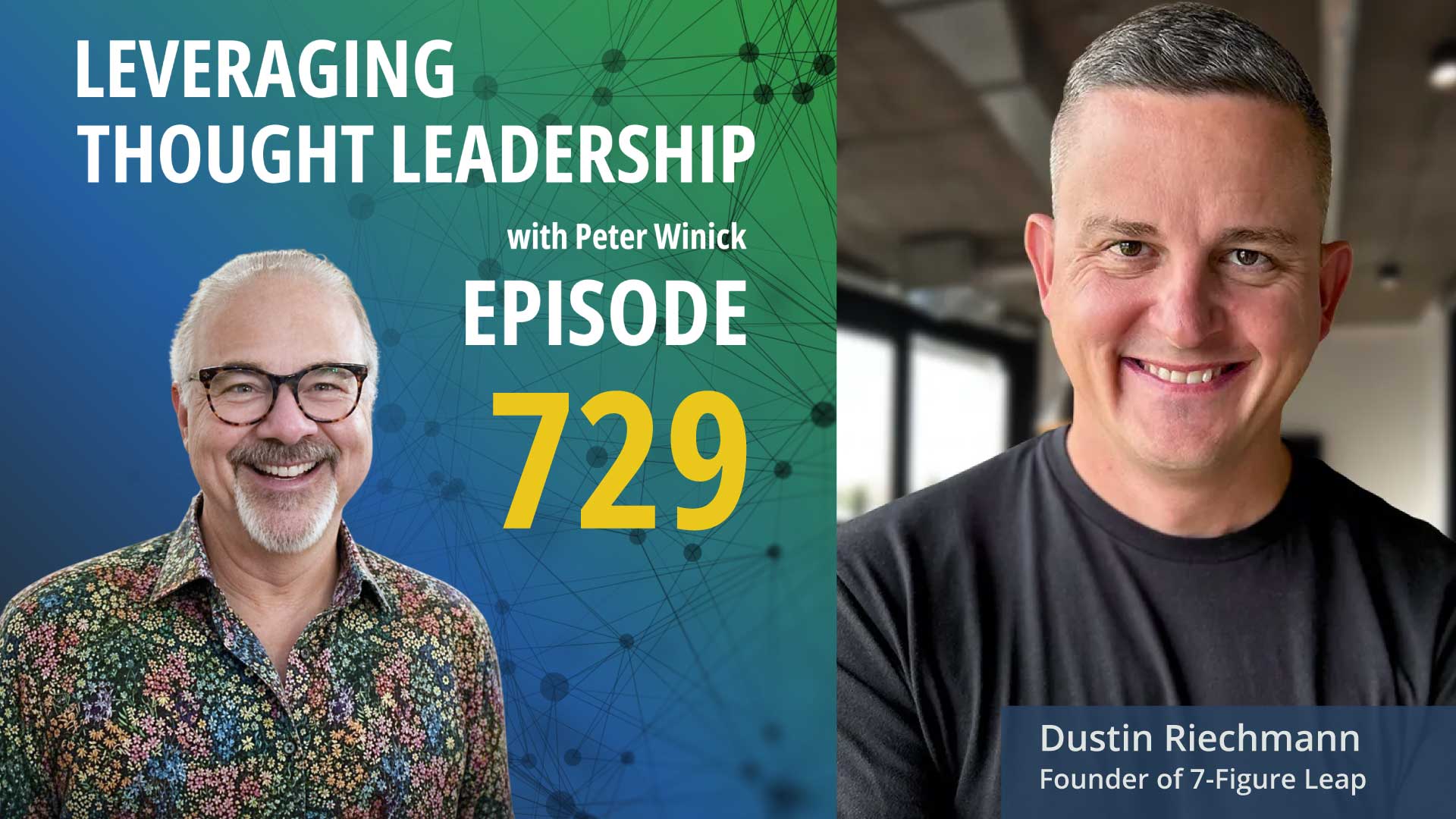



How coach and entrepreneur Dustin Riechmann helps experts build seven-figure brands through guesting
Most experts treat podcast guesting as a marketing checkbox — book the show, share nothing, move on. This episode makes the case that the
real payoff is relational, not transactional: borrowed trust, host referrals, and a flywheel effect that compounds only when guests engage with intention and follow-through.
Book the podcast. Do the interview. Move on to the next one. That’s the default playbook for most podcast guests — and according to this week’s guest, it’s leaving most of the value on the table. Dustin Riechmann, founder and CEO of 7 Figure Leap, and host the 7 Figure Leap Podcast, has spent the last four years helping coaches, consultants, and agency owners turn podcast guesting into a genuine growth engine — not just a lead-gen tactic. His argument: in a “trust recession” flooded with AI content and social media noise, the real currency isn’t reach, it’s trust. And trust, done right, scales. Peter and Dustin dig into what that actually looks like in practice. It starts with borrowing trust — the audience a host has spent years building extends some of that credibility to any guest who shows up and delivers. But the bigger opportunity, Dustin argues, is what happens after the mic turns off: the relationship with the host, the access to a guest list full of potential referral partners, and the content that can be repurposed for months.
That’s where the conversation turns pointed. Peter shares a stat that should make every podcast guest wince: only about 60% of guests actually share their episode after it airs, despite the host doing the legwork to book, produce, and promote it. Dustin calls it a strategic blunder as much as a hygiene issue — because the guests who do the simple things (leave a review, share the episode once, say thank you) become the ones hosts refer business to.
The two also unpack the difference between hiring a podcast booking agency to check a box and building a deliberate, relationship-first guesting strategy — and why one podcast a week, done with intention, can outperform a hundred done without it.
If you’ve ever wondered why some guests turn a single appearance into years of referrals while others get nothing out of dozens of interviews, this episode lays out exactly what separates the two.
Three Key Takeaways:
- Trust is the new currency, and it scales through borrowing. In a noisy, AI-saturated market, audiences no longer take credibility at face value — appearing on a trusted host’s platform lets guests borrow that trust instantly, then build their own with the audience over time.
- Sharing your episode isn’t optional, it’s strategic. Roughly 40% of guests never promote the interviews they’re given, and that gap is exactly what separates a forgettable guest from the one a host refers to future opportunities.
- The real ROI is relational, not transactional. A single interview compounds into referral partnerships, guest-list networks, and repurposable content — but only for guests who treat the host relationship as a two-way investment rather than a 20-minute box to check.
Every guest on this show has wrestled with the same question: how do you turn deep expertise into lasting influence, not just a moment of visibility? That question is exactly what The Thought Leadership Handbook answers. Bill Sherman, Peter Winick, and Naren Aryal distilled patterns from more than 700 conversations on this very podcast into practical frameworks for building a body of work that scales — covering everything from your core ideas to the platform that carries them. If you’re ready to move from insight to real impact, this is the field guide. Learn more and order your copy at thoughtleadershiphandbook.com.
Order now:
Amazon
Barnes & Noble
Bookshop.org
Amplify Publishing
Apple Books
Learn more at thoughtleadershiphandbook.com
Transcript
Peter Winick Welcome, this is Peter Winick, I’m the founder and CEO at Thought Leadership Leverage and you’re joining me on the podcast which is Leveraging Thought Leadership. Today my guest is Dustin Reichmann, he is the founder& CEO of Seven Figure Leap. He is a coach, he’s a serial entrepreneur and an online marketing expert and instead of talking about him, I prefer to talk with him because he’s right here with me. So welcome, Dustin, how are you?
Dustin Reichmann I’m doing awesome. Thanks Peter for having me and ready to dive into some good thought leadership juice here for the audience.
Peter Winick Yeah, so give me a bit because you and I have talked a couple of times now and I was intrigued by what it is that you do relative to sort of the whole thought leadership universe if you will. So describe that for me if you like, who comes to you and what are they hoping to achieve?
Dustin Reichmann Yeah, so we work primarily with coaches, consultants, and some agency owners, so entrepreneurs, and we’re helping them use podcast guesting specifically as a way to basically add profits to their business. So our tagline is helping mission driven experts build seven figure brands by telling their story. And sort of the more specific way we do that is helping these experts teach coach and a love on people the way that they’re gifted at doing. In front of other people’s audiences as a way to attract clients for their own business.
Peter Winick Okay, so they’re looking for this, not as a if I think when you think about some of this stuff, it’s like, well, is this about building the branders net net, you know, net new client acquisition, this is the latter, right? This is okay, how do I get these folks there? And the thinking behind this is, okay, so here’s a coach or an advisor, whatever that does act if I put them in front of these audiences or these podcasts, there’s a lot of people that look like X, that’ll hear that be smart, insightful, intelligent, etc, etc. And then it doesn’t take much to put together a plus B equals C, they can reach out and talk to them. So can you give me like an example of how well that works for clients, you know, they do a bunch of podcasts and something about the rainbows and unicorns, if you .
Dustin Reichmann Yeah. Yeah. Well, yeah. And I think what you said there is absolutely true. And that I would consider that sort of the foundational level of this where, Hey, you’re an expert at whatever topic, let’s call it career coaching, just as an example, and so you go share your unique framework, the thing you wrote your book about, the things that people pay you a lot of money to do, and you share that teaching in front of an audience. In that audience, yes, will be some people who would love to get a promotion and are looking for this kind of advice, and that foundational layer of lead generation is why most people do this first and foremost. But it goes deeper than that. The way I view it and doing this pretty much exclusively for four years now and helping people through this process, the real magic here is actually in how you can build high quality relationships through borrowing trust at scale and we can kind of unpack what I mean by that. But you know, if I’m this career coach, yes, some people come into my email list and they hire me as to be their coach, they buy some books, like that’s really good and that’s a good sort of linear return on your time. But where the exponential impact comes in is now I have a relationship with this host and this host with a lot of people who would be great referral partners, right? And now I’m part of a guest list. I’m a part of this sort of fraternity that’s created or sorority of other people interviewed on the same podcast. And there’s so many relationships to garner from that and I have more under the surface than it appears.
Peter Winick Yeah, so I think a lot of people miss that, right? They think, okay, I want to get on so-and-so’s podcast because it’ll be interesting to talk to them and blah, blah, and second to that, they have an audience, maybe it’s cachet because they’ve had notable people. But people forget that like you know for you and I now we’ve been talking on and off for I think a month or so we’ve had a few conversations we made some mutual introductions clearly a relationship has developed right where it goes knows but it’s not just like we’re going to chat for 20 minutes and then we both go our separate ways. Absolutely understand what I do I get to understand what you do you know and that’s pretty cool and then I’m going to put this podcast together and you know I like the way that you talk about borrowing trust because as a podcaster. I honor the trust that the listeners give us right because we have to put out we try our best to put out a good show right and I don’t want people on here shilling if you will like you know I think people do sell a lot of things on here but it’s never shilling like if you’re smart and you’re in a divide and you do what you do and just listen to you and I have a conversation about that that should be more than enough right and and I just hate these oh and if you You know, you click here today, you know, I call it like you’re the yellow highlight of marketing. The only today where you audience, I’m going to give a special, you know, 10% off and it’s like. The best way to you know to me this is the free sample right you walk into the bakery and and they chop up the muffin in a million pieces you nibble on it while you’re on the line you’re like oh that’s a good blueberry muffin i think i’ll buy a few of those it’s kind of the free-sample amaz
Dustin Reichmann Absolutely. Yeah. And I want to talk about that. So now more than ever, you know, I feel like we’re in a trust recession there’s with AI and you know the noisiness of social media and all the things on the internet. We have this really interesting tension where you need trust, which is what we’re talking about here. Yeah, and if you only had to like solve for trust to sell more coaching, consulting, advising work, you would just do everything one on one in person like that’s how you build trust and intimacy, right? But that’s not a way to scale because this other tension is scale. Well, I have all of the opportunity in the world to reach all the people. And the temptation then becomes to chase the algorithm, to chase to automation and to use AI. And there’s nothing inherently wrong with that on the surface. But I think what we have to solve for now is trust at scale. So like, what are ways to. Distribute our message have a scalable impact in the world, but in a way that’s trustworthy and it’s one of the reasons I like podcasting and podcast guesting specifically because You and I are having a conversation because in some way you trust me and you think hey He’s got some value to add to my audience and the audience now trust me, at least to start, I can screw that up, right? But there’s an inherent trust, and it scales in the sense that lots of people can listen to this. It’ll live on for a very long time, right, and I think it’s indisputable.
Peter Winick There’s a lot of those folks, a lot of the thought leaders, the advisors, the consultants, et cetera, they’re so focused on putting out consistent high quality content that when I’m working with them, I’m saying, okay, well, that’s really cool. So you’ve got the following. You’ve got your newsletter, your list, your YouTube channel, your whatever. You’ve your stuff and you’ve a population, small, medium, large, whatever, that tunes into that, right? They open your news, they listen to your thing, whatever. But if all you’re doing is talking to your people, I would argue that the yield that you’re getting is fixed, right? Like the number of people. So how do you grow your list? Well, there’s different things that you can do to grow your list, one of them being, you know what, if I were to go on instead of writing, you know, whatever, 10 articles a month, cut that time in half and say, I’m going to get on five blog posts a month and write five articles. And those blog posts, I have to be really smart, because I don’t want to be on a blog. I don’t wanna be on a podcast for people that are, you know, passionate about needle point, nothing. The overlap of those people to people that I work with is probably zero so don’t waste your time but it’s somebody else’s done the hard work of putting together an audience and the audience doesn’t need to be huge it’s not it’s a quantity number not a it’s quality number not quantity number and people sometimes forget that like you know Tim Ferriss doesn’t stay up late at night worrying about Mick like right but I I’ve curated a fairly loyal but small audience of people that are looking for one thing right they’re looking for high quality content from thought leadership from a wide variety of guests right so that’s that’s what that’s about so i i love that i want to go in a little bit of a different direction and get your thoughts on this so i’ve been podcast i’ve been hosting the podcast for over eight years and i’ve been guesting for longer than that and one of the things that i i just my head about all the time is. More people than ever are retaining podcast, guesting agency services, whatever, and pitching themselves. But I see the defaults, which being I would think 80, 90 percent of people are hiring someone to do that for them, which made up a lot of sense. And you know they they’ll go through the screening process and they go on and they it’s a great conversation and then we as the host will send to someone so I’m going to say to you when we’re done with this call hey Dustin you know what this is going to go live in I don’t know what Mike six weeks or something like that and we’re going to promote it because that’s what we do and I’m gonna send you a couple of assets that you could put on LinkedIn or Twitter Twitter or whatever, and I hope that you would share it to your audience as well. Yep. I would think that the last numbers I got from our team were getting maybe a 60 percent compliance rate to that and I scratch my head and go why would you go through all the work of getting going on of talking to me yeah of course I’m going to share it that’s what I do right but why wouldn’t you be proud of the conversation to share with your population right to share your followers as well like I don’t to me it’s it’s somewhere between etiquette and hygiene How do you feel?
Dustin Reichmann Yeah, etiquette hygiene and sort of strategic blunder, I would say too. So I think there’s kind of two questions in this question. So one is this whole like podcast booking agency and like what’s it good for, what’s it not good for. And then the other would be how can guests maximize the relationship building that they’re doing with the host. And one of the ways is obviously what you just described or not doing what you just described. So real quick on the guest thing on the host or the guest booking thing Like, that’s not what we are. Most people assume by default, like, oh, you must be a booking agency because you help people with podcasting. So they kind of let people know what that means if they’re not familiar. A podcast booking agency means I pay this company money, they book me on four shows a month, I show up to do interviews, and they’ve met their scope of work. And you know, we have that relationship. So they’re basically an agent for podcasting, right? That’s quite an easy way for people to think about it. So with that a couple dynamics quickly emerge One is I, as the thought leader in this case, am not myself building a relationship with that host, right? Like I have an agent kind of doing that for me, and it becomes a very transactional
Peter Winick Well, but let me push back a little there. I would say yes and, so the way I think about it is the people that do that well hire the podcast guesting agency to curate the right list, do the pitches, do a lot of the grunt work, but they will still develop the rapport, the relationship, etc. With the host where need be, right? So it’s not that they’re outsourcing that, but you’re also to some degree hijacking to an extent the relationship that the podcast guesting agency may have. I know we get pitched all the time and there are people that pitch us that are absolute dodo birds that I don’t even open their email because they’re pitching me. People don’t speak English or people are so unrelated to what we do and then there are people like you know what, they’re smart. I will always open that email, don’t always accept the guest because they know who I’m looking for and have put a good attempt in to put in front of me someone that looks like a previous guest that I’ve had or would add to the conversation, I would at least consider.
Dustin Reichmann So I guess to clarify, there are great podcast booking agencies. I’m not against podcast booking agencies, but I guess where I’m going with this is the dynamic from the start is one of I want to check a box and be on that. I want be on four shows a month. You’re going to choose an agency, which ones we may have a discussion about the types of markets I want to focus on, but I, as the expert, am not invested in. That process right and that that can be good it depends on your goals so as an example of a what where i would totally recommend using an agency if i’m publishing a book and the publishers like you got to be on 20 podcasts in q2 and and i as the expert i’m like i don’t care to build a relationship i don’t need clients from these podcasts i just need
Peter Winick I don’t even know how to do that. I don t even know where to get the list from or anything.
Dustin Reichmann Pay money to have that done. The people we’re working with, it’s much more about how do I very intentionally select a smaller number of podcasts and do it with a lot of purpose. Do it to build a relationship with the host, with the other guests from that show, with the audience.
Peter Winick Mm-hmm, yeah
Dustin Reichmann do it with an end in mind of profit, like of getting leads from this opportunity, right? So it’s just a different model. They’re both podcast guesting, but it’s a different models. So anyway, I think that’s part of the dynamic that happens there is I, as the guest, like you’re just a 20 minute block on the calendar. And then tomorrow I got another one. I don’t really feel a lot of reciprocity, like I need to promote you. I think it’s a dumb strategic blunder because promoting you is good for me and you, but I think that’s part of the dynamic that gets created here is there’s not actually a relationship that’s been created because the agency is sort of the intermediary who kind of owns the relationship and I’m just showing up as quote unquote the talent And I’m moving on to the next thing
Peter Winick If you ever wondered how strong ideas become visible, trusted, and scalable, that’s the work behind the Thought Leadership Handbook. Bill Sherman, Naren Aryal, and I wrote it for experts who are ready to move from insight to real impact. Learn more at ThoughtLeadershipHandbook.com and order it today at Amazon, B&N, Bookshop, or Amplify.
Dustin Reichmann Anyway, to close my thought on that, if you’re a guest and you’re listening to this and you want to really stand out and you want to get referrals from hosts and make more money and have more clients, it’s really simple to stand out because Peter just described the reality. If you leave the host a rating or review on your favorite podcast player like Apple or Spotify, tell them you did that. Thank them like there’s an idea and then one time share a post anywhere like LinkedIn newsletter, Facebook, whatever your foot your boat and tag them or let them know that you did that because you appreciate them. You can answer this Peter as a host. You’re gonna be like the top 1% of guests just because you gave a damn enough to like do something with the interview. And then whenever someone comes to Peter and says, Do you know any good guests in marketing? He’s like, this Dustin guy is really a stand up guy. He left me a rating and like, you know, I’m gonna become top of mind president.
Peter Winick The bar’s pretty low. The bar is really.
Dustin Reichmann The bar is really low. That’s the point I’m trying to get at with that long guy.
Peter Winick I’ve talked to a bunch of the agencies about their onboarding process because I think there’s a hole in the bucket. And I think to some degree, some of them are like, you know, hey, the client’s paying me. My job is to pitch them and get them on like you said, 10, 10 a month, whatever the thing is. And I’m like, well, I think your job should be more to educate them a little bit because they’re all good people. Like nobody comes on a podcast to be a jerk. Nobody says I’m going to come on to this podcast to annoy Dustin and be a juror or like maybe they do. I hope it’s like… But if you don’t know what the etiquette is, right? Like if you do, you know that if you’re traveling to different countries, you want to learn the etiquete of, you know, how do I take a business card from someone in Japan? Or like, that’s just common sense. Right. And I think there is some norms and all that stuff. The other, I think, is just selfishly, when you take that asset that you’ve created. So we’re creating an asset now. Right. Absolutely. It’s going to be something that lives in perpetuity or not. Like we’re trading something, right. And we’re going to put this on the podcast, whatever. But you have an opportunity to slice and dice this and put this on your newsletter and say, hey, Peter’s podcast is one of the greatest ones in his face or whatever you might want to say about it or whatever. And I’m happy to have been on it and I want to share that conversation with you. It’s an excuse to get your ideas in front of your customers and just use me as the like, oh yeah, it happened to be Peter I was talking to and he’s had some guests like ABC and D that you might find interesting as well. Absolutely. There’s a way to make this. Selfish and selfless. Yes without being manipulative and I think that’s really the secret sauce of how can I make this a win for you? Dustin, how could you make it a win from it? And I think
Dustin Reichmann name of the game. It’s a win for Peter as the host, it’s a wind for Dustin, in this case, as the guest, and most importantly, it is a win for your audience. So when they listen to this, they’re like, I like Peter more. I like Dustin more. And I’ve benefited with inspiration, education, whatever that is. And it truly is like a pie that just gets bigger. It’s like no one loses, right? Like I’m not taking anything from you by being a guest. You’re not taking him from me by having me as a and the audience is winning too, and I think that is the mentality when I think of marketing, partnerships, collaborations, like how can we create a win-win-win and podcast guesting to me is a pretty simple way. Pretty simple application of that if you know what you’re doing and you don’t ruin it along the way, so
Peter Winick And I would say, you know, we didn’t talk today about the score of a baseball game yesterday. So in essence, the gist of this conversation is somewhat evergreen, whether somebody listens to it the day it drops on the podcast, or a month or six months or maybe even a year or two later. Bye! To that person at that moment in time, a light bulb should go up and go, wow, that was really good, right? Like I don’t, you know, I don t open up a business book and go when was that published? Like, oh, good to great. That was published 20 years ago. Oh, no, that’s not valid anymore. You know, we’re in search of excellence. No, no. That’s all, you know, old like there are books that are trying to be, you know, like, like now there’s a ton of AI books that are absolutely stoked, like probably should have been magazine articles because they, you know, they age pretty quick. I was going to say something else, oh, I want to get your reaction to this. I know that when I started the podcast, I experimented by being a guest and I’m like, okay, I dig this. Like I’m not a great writer. I don’t really enjoy it. But this is like for me, for some reason, this I like I’m a talker. Whatever I have to say is a different story. But like this is like kind of easy and comfortable to me. But I committed to doing a certain amount to a to develop the chops and then to sort of measure. And I’ve talked to people that have been podcast guests in this. Oh, well, you know, I did three of them last quarter and nothing came of that. I’m like, you’re missing the point here, right? Like you have to commit to. A period of time and a number, I don’t believe maybe there’s a secret sauce but like six months and a couple dozen or whatever it is to A, to get your chops built out there and then you have to give it time because it’s not just when that podcast dropped but somebody listens to it and says, “Hey, I listen to Peter’s podcast and there’s this guy Gustav and I never heard of him before but you should listen to it because of that thing we talked about over lunch yesterday.” They do have a flywheel effect.
Dustin Reichmann Absolutely.
Peter Winick The longer they’re out there, the more they, I’m always shocked, like I get an email from someone that says, oh, hey, I, you know, I listened to your podcast. When I talk to them, I’ll say, well, when did you first do that? Or when I was like, oh it was an episode from like four years ago, I dug up because that person that you had, I really liked that. I’m like, that’s so cool that that resonated with you now, you know, and it gave me the idea to reach out and have a conversation. I think people forget that versus so much media and marketing. You an email campaign. It’s done. Like if you don’t get that.
Dustin Reichmann Are you a social media post that’s literally done in 15 minutes, maybe, maybe two hours if you’re if you really lucky. This is very much ever. Ever. Yeah. This is a very much Evergreen content. I would say this is more analogous to like YouTube, where it really lives on a long time. It’s searchable. There’s a lot of benefits. This, you know, SEO and like now AEO, like AI, you no search. Yeah, that the long tail effect is very real. And then the other thing I would say… To the flywheel effect. I mean that like basically that’s what our service is is we work with these experts and we help them build a flywheel And the thing turning the fly wheel is podcast guessing that’s sort of the energy into the flywheel and what you said is covering about a fourth of the fly-wheel, which is people will listen to this at many different points, you know, immediately, middle, long-term. So that evergreen email list growth and sales is an important part of the flywheel. But if you kind of keep going around this, this imaginary circle, the relationship side is where this really gets exciting. And I know it’s kind of open with this too. Yeah. But as I get to know, another host that’s really valuable. And then I open up this whole guest list of these other peers and potential partners, and I’ve got content to repurpose. What happens with even one time is you get more authority. Yeah, Peter, where this gets really exciting and I’ll give it a frequency just to kind of give people an assignment here, like art with our clients, at least for 90 days, we’re working with them and our goal is to get them for a period of time to one podcast, guesting opportunity a week. Not forever, but for, you know, to get in this like rhythm of doing it and getting clarity and figuring out exactly how to do it. So if you think about it, if I did one cat podcast interview a week for a year, just to like give this some numbers, it’s Now, 50 interviews, which 50 interviews is great, but they’re 50 of the right interviews with the right story, with the rights data, right? Fifty opportunities evergreen to grow my email list, make sales. Fifty new hosts that I now have relationships with because I’ve actually treated them with respect and wrote them a review and they know me. Fifty guest lists that are now opportunities for me to build relationships. 50 sources to repurpose content like So the whole idea of a flywheel is every time you do it, it gets easier and more powerful, like it builds momentum. As you can see, after you do this, it doesn’t take 50, usually after like three to five, people really start to build momentum with it where, you know, it’s not just, Hey, it published this week. How many sales did he get this week? It’s it becomes cumulative which becomes exponential, right? Like that’s where the exponential growth comes in is through doing this repeatedly in a measurable way and like I have an engineering background like I’m all about like is this actually getting us results and I don’t I’m not in the school of although I hear it all the time like you said of either I did three and I Don’t know if it really did much for my business or I was on a hundred last year. I hear this all the time too. I’m like a hundred podcasts. That’s exhausting. Like it’s like tell me about that And they’re like. I really enjoyed it, but I don’t know what it did for my business. I don’t have any way to measure it. I’m like, that’s horrible. I’m not trying to be that. I’m quality over quantity and very intentional in how we do this.
Peter Winick Yet I think the last thing I would say is the quality over quantity that as the guest, you still have the veto power and if you don’t understand why someone’s pitching you to a certain podcast and they can’t explain it, that’s a red flag because you want alignment if it’s just a numbers game of, oh, I’m paid to get you on 10 a month, so they might not say this out loud. I don’t really care which 10.
Dustin Reichmann I’m going to send you the same ten as everyone else, or I get a kickback. These things happen too. Again, I don’t want to overstate that, but if you’re a podcast booking agency, think of what you’re incentivized to do. Make my clients fulfill my scope of work by getting my clients on podcast with as little effort as possible. If I have willing hosts who like to accept my clients, I’m gonna put them on them for sure. Even if it’s not strategically like the best place for that client to go. So yeah, I get where you’re going with that.
Peter Winick Yeah, I know this way. If you know, if if someone said, Well, why should I be on the seven figure leap? And they said, Well, Dustin works with people similar to you, you work with people similar him, the audiences would benefit you would benefit, he would benefit like, okay, that makes sense. If they can’t sort of connect the dots. Something’s wrong. Like, wait, why is this, you know, association I never heard of good. Anyway, this has been a lot of fun. I appreciate your time. And the last thing I would say is, you know. Dustin is the real deal in that he eats his own dog food and walks the talk, right? So, which is
Dustin Reichmann I’m doing the thing I teach, even as you’re listening to this, right? So, yeah, exactly.
Peter Winick Appreciate your time, Dustin, and thanks for sharing your ideas with us today.
Dustin Reichmann Yeah, it was an honor. Thanks, Peter. Appreciate you and look forward to having more conversations to come.
Peter Winick To learn more about Thought Leadership Leverage, please visit our website at thoughtleadershipleverage.com. To reach me directly, feel free to email me at peter at thoughtleadershipleverage.com, and please subscribe to Leveraging Thought Leadership on iTunes or your favorite podcast app to get your weekly episode automatically.
