What elite sellers do differently and how thought leadership turns performance into impact. Today we…
Best of 2025: The Ideas That Scaled
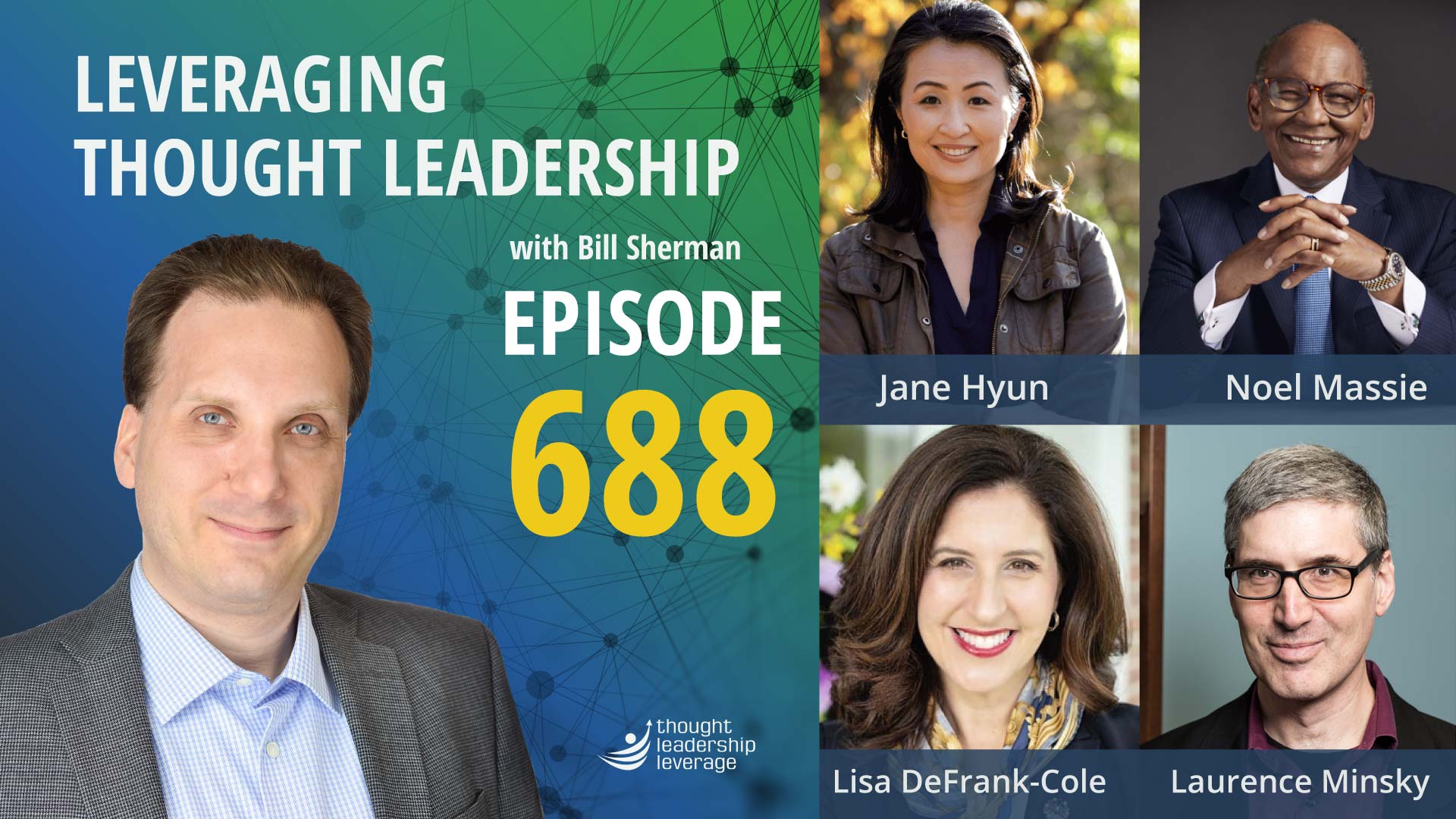



A Best of 2025 compilation on clarity, culture, and credibility.
This Best of 2025 episode revisited standout clips on what it really took to turn expertise into influence—building cultural fluency, investing in mentorship, and translating research into clear, usable ideas. It emphasized the long game: credibility was earned through disciplined writing, iteration, and consistent platform-building rather than quick wins. The throughline was practical and direct: leaders scaled their impact when they treated thought leadership like a craft and a product, not a personality trait.
What did the best thought leaders do differently in 2025—and what can you learn for your own work in 2026?
This “Best of 2025” episode looked back at standout moments from prior conversations and pulled one clear thread through them: ideas don’t scale by accident. They scaled when leaders treated communication, authorship, and development as skills to build—not traits you either “had” or didn’t.
We first revisited cultural fluency with global leadership strategist Jane Hyun. She defined it simply: working effectively with people who were different from you across many kinds of human difference—not just one label. And she made the bar real: it took intentional effort, because it was a developmental skill that most people were never formally taught.
Next, we look at a candid conversation on mentorship, legacy, and the discipline of writing with Noel Massie. He argued that “legacy” showed up in what you gave—especially the investments you made in other people. Then he told the unglamorous truth behind a meaningful book: it took coaching, rewrites, and years of sustained effort—because “fast” wasn’t the same as “better.”
Then we look at a different kind of bridge-building with Dr. Lisa DeFrank-Cole—moving research out of academia and into the rooms where decisions got made. She shared the tension many experts faced: it was one thing to teach and publish for a specialized audience, and another to translate research into plain language for podcasts, media, and organizations. She emphasized patience—compounding work over time until it reached critical mass.
Finally, we returned to the power of curiosity and publishing with Laurence Minsky. He described how asking the right questions led to books—and how books created credibility that opened unexpected doors, including a path into academia.
If you want more great advice for 2026 we encourage you to explore the back catalog or reach out to the Thought Leadership Leverage team if you want help taking big insights to scale this year!
Transcript
Bill Sherman We meet Jane Hyun, global leadership strategist and author who has focused a career on helping people lead across differences. You’ve talked about cultural fluency a couple of times and you just mentioned it. Let’s give the listeners just a quick definition of what that is and then I want to talk a little bit about how do you create it. So, first off, let’s define cultural fluency.
Jane Hyun Yeah. So cultural fluency very simply is working very effectively with people who are different from you across a variety of human differences that they bring to the table. Yeah. So it’s not any one thing could be culture. It could be ethnicity, could be gender, could be age. It could give variety of different experiences that make us different. So everybody has something different, right? That they can bring them up from. Some differences matter more than others and some differences are more apparent than others. But I’m helping people to understand and learn how to engage around those differences.
Bill Sherman You’ve said this before, it takes intentional effort to actually improve in navigating difference. But it is a skill. It’s not something that you’re either born with or not born with, right?
Jane Hyun It is definitely a developmental. So, you know, most of us are born into societies or communities and we can’t choose that, right? But throughout our lives, whether it’s school or because we move or because of our careers, you know we’re thrust into these environments that are different from the way that we’re socialized from an early age and so it becomes a necessity later on, right. And I guess sometimes we get people who are like, well, we’ve, you know, we’re in a very you know, homogenous kind of a setting, we don’t see a lot of difference here in that kind of thing. But I bet if I talk to them more, and I try to understand their experience more, they might start to see that maybe their experiences actually are a little bit more expansive than that. But in essence, it’s something that we’re not taught and we need to work on it in order to know how to engage around that.
Bill Sherman And you’ve talked about getting people talking, whether that’s through a keynote or through a fireside chat or a workshop or even executive coaching, like you said, which was one of the things where you realized, hey, I’m influencing how leaders think and act and that influences the organization. So talk about… Those modalities and some of the impact that you’ve seen. So working with people at scale in a keynote or a fireside chat is obviously different than someone who picks up a copy of a book and that. But I know you’ve also done book launches, for example, on your books.
Jane Hyun Yeah, I think, um, there are different ways that people have been exposed to the concepts and, uh, the fireside chats and the keynotes, the larger events, you know, that I’ve been invited to speak at that, that, actually reaches lots of people, right? Hundreds and thousands of people that are present and or tune in if it’s a virtual and a hybrid thing. Uh, so I think that’s one way of doing it, but I’ve also worked with organizations where We’ve done leadership offsites, that we’ve done retreats. We’ve, I’ve spoken at internal sales conferences. There are different places where they want someone to infuse a very particular audience with that. Or maybe even smaller team, like here’s my leadership team of 25 people that’s really looking to drive change across the global enterprise. And we want you to come in and we want to you to diagnose how we’re doing. And then we want them to equip them one-on-one, but also. Um, as we work together, uh, more effectively, because they’re grappling with it, right? They really are. And they need some of these intercultural skills and tools to know how to do it better. And then of course, one-on-one, right. The one-one-one right that that’s where I wanted to go. Yeah. That’s something that my team and I also lean into because yes, you could talk about it conceptually, right, and you can see how the group is doing. You can certainly learn the concepts and tools, but you really have to change and demonstrate this on an individual level. So anything.
Bill Sherman Make it real and relevant to the person and their experience, right? Right. That’s right. That is right. And create a safe space for them to ask questions. That’s Right.
Bill Sherman Noel Massie is executive sponsor of mentorship and leadership development. This is a large chunk of your time and we’ll go into the writing of the book and how you rewrote it several times, but this wasn’t, oh, I’ll dash this off in a couple of weeks and call it done. This has been a passion project for you.
Noel Massie For me, it really came down to, what are you leaving of yourself behind? What legacy are you living on this planet? And that matters significantly to me in my life. Number one, is I feel a deep responsibility to serve others. It’s what I do. I mean, when you look at my life, predicting the last, I’m fed up of it. It’s been fundamentally focused on how can I help others become better at whatever it is they want to become better in the leadership category that is. Not just that. I sit on four nonprofit boards.
Bill Sherman And I want to ask you about the N and-
Noel Massie in a minute, but yes. Yeah, but that’s really the bottom line is I think on a daily basis, in a way that, and I’m fortunate and I was taught by great mentors that that’s really ultimately the greatest gift you’re gonna give and life is support to other people and their pursuits, goals, et cetera. And I had the benefit of having that given to me, right, so I wouldn’t be the person I am today The mentors I had, which the list is too long. The minute you mentioned one, you’re going to leave some of them out. Right. Uh, but I had some really fantastic individuals in my life as a young person at 19 and 20, and that continued all the way until I retired. Uh, and it’s just a natural outgrowth of the way that I’ve been built.
Bill Sherman In terms of legacy, you want to give more than you’ve received, but it also sounds like in your mind, you’ve received a lot. So that’s a pretty big challenge to keep giving.
Noel Massie But it’s a requirement. I am really a believer, strong believer, that your life is going to reflect what you give. That’s what it’s gonna reflect. People can acknowledge that or not, but at the end of the day, that’s gonna be a truth. Is that when you make investments in others, investments in your community, from that perspective, which is ironic to me, people understand financial investment really well. If I don’t invest, I’m not gonna get, right? Right, right. And I say, it’s no different with life and humans. If you don’t give, you’re not gonna get, okay? That’s just how this thing’s gonna go. And I raised my sons here and they heard that more often than they cared to. When they were teenagers complaining about something, I’d go, well, what’d you give it? You know, did you give, it you’re full? Did you, why should you get that? I mean, in your mind’s eye, why should get that and it works. So.
Bill Sherman How long did you spend writing this book? And I include the rewriting time because we talked about that. So tell the story of how this book came to be, please.
Noel Massie So when I retired, I had thoughts around the book, but no draft. So I leaned on people in the academic community who I had close relationships with, having been on a number of numerous boards and advisory committees at universities, USC, Claremont University, and the Drucker School of Management specifically in Claremount, California. I had a lot of connections in those universities. Anyway, so I got a book coach. I was asking professors who they were using and that led me to the book coach I ended up with. I had one and then I changed. And so I wrote the book completely with my first book coach, with my second book coach Mary Curran Hackett, who lives in Cincinnati. She’s been in the business for 30 years. I sent her the first draft and it was 13 chapters. And she sent it back to me and said, I can tell that you have a lot to say around leadership. But if you wanna write a book that’s going to be true to an author’s expectations, we need to do this over. And so I rewrote the book a second time with Mary, which really ended up being like writing the book four more times because if you look at the page count, I think I wrote like a thousand pages to come up with the 250 that we ended up with. The fact is, is that Mary Curran Hackett was my coach. Everyone needs a coach. Even Michael Jordan had a coach, not that I’m saying I’m that. But I believe very firmly that everyone needs a coat. Everyone, I don’t care who you are, what you do. And so I was blessed enough with the skill set to understand that. So I immediately looked for a coach and I found Mary and she was exceptional. And so, I spent four years on this book, writing this book. Fast is not better. Hurried is not necessarily good and that was my approach to it and candidly I’m glad it took That long because I came up with thoughts in the second year writing this book. I didn’t have in the first year.
Bill Sherman Dr. Lisa DeFrank Cole, Professor and Director of Leadership Studies at West Virginia University, and co-author of the award-winning textbook, Women in Leadership, Journey Towards Equity. And I want to dive into another type of leadership, okay? And I wanna explore the intersection of two types of leadership. One being women in leadership, and the other is the practice of thought leadership. That is bringing ideas into the world and making them accessible to the people who need to hear them as well as knowing the next step. Where would you see connections between your work in women in leadership and women practicing thought leadership? From your research, is there anything that you could advise or suggest? For a woman who wants her ideas to be heard more clearly, to make an impact at scale, to change the conversation.
Dr. Lisa DeFrank Cole It’s interesting you asked that question, Bill, because that’s something that I’m trying to do right now in my own life. I am quite content being a professor of leadership whose research area or whose area of interest is women and leadership. And what I’m realizing is there’s not enough discussion in the mainstream media and literature from people like me, from people who actually study women in leadership and have been students of this area for 20 years or more. And what I’m finding is how I’m trying to do it is like today, getting out and being on podcasts and trying to share this information with a larger audience outside of academe. I go and I teach and I have 25 wonderful students show up in a college classroom. I really haven’t had to recruit them or twist their arm or publicize to get these students to come and show up. But what I’m recognizing is it’s a different skill set that you mentioned skill sets earlier. It’s a difference skill set to try to take this message into the mainstream media. And literature, writing journals, newspapers, what have you, TV, podcasts, radio. And I want to do that. And I’m recognizing that one piece can lead to something else and I’m hoping to speak to more corporations or corporate retreats or other forums where folks may want some research-based understanding of women in leadership, but given to them in a very easily digestible manner. I can talk the talk if I needed to about the statistics of women and leadership, but I also want to break things down for people. So it’s not hard to understand. I never enjoyed when people would use Jarden from a field that they’re familiar with, but I didn’t understand. And I think we need more of that leveling of the bridge between academe and the everyday populations. We need more discussions where we listen to each other and hear each other. And so that’s what I’m trying to do. So I don’t have the exact answer of what is the best way to do it. I’m try to figure that out because I absolutely. Want to do more of it and share some of those benefits that women bring as leaders.
Bill Sherman So a few things that I would add, I think you touched on earlier a point that bears repeating that you said, Hey, growing up, I didn’t have examples of women as leaders or, you know, think that women were able to contribute much. I think, and you probably can cite the or better than I could. There’s a- There’s a connection between that mindset growing up and then behaviors of an adult when an opportunity comes by, whether that’s to lead within your organization or to be the one who speaks or the one and who writes it’s that process of being willing to raise your hand and create the opportunity much like you talked about where you said after a long day of video recording. So we’ve got this idea. What do you think the ability to put the idea in front of the people who can open doors or make possibilities happen? That’s part of that proactive practice of thought leadership that becomes essential, whether it’s raising your hand for being a guest on a podcast or saying, yeah, I can speak to this general business audience.
Dr. Lisa DeFrank Cole It’s, I think, having patience and delayed gratification. If we keep doing the things that we enjoy doing, and I really enjoy writing about, talking about, doing some research about women in leadership, I feel like over time, that will add up to a critical mass. And hopefully… I’ll be able to share that body of knowledge with other people. So it takes patience. It doesn’t happen overnight.
Bill Sherman I’m speaking with Laurence Minsky, who turned his early questions about advertising portfolios into a book deal. That book launched both his advertising career and an unexpected path into academia. If we trace that line through the topics and I think the 10 books you said you’ve published, there’s a consistent theme of I’m really interested in this topic. I want to learn more and gee, there’s a gap. In the publication space, let me go find someone and create a great book.
Laurence Minsky Exactly. And my most recent book, The Voice Marketing, went on conversational AI. I had lunch with one of my former students and he’s been out of the industry, he’s graduated about 10 years ago. And he was asking me, how was I able to predict that AI was going be such a big topic. It came out shortly after CHAT GPT came out.
Bill Sherman Oh, that’s perfect.
Laurence Minsky Perfect timing. And my response was, I didn’t. It was just a topic that interested me. I actually put the proposal together with my editor from two of my books at Kogan Page. And then she left the company. And Kogan, I’m sorry about calling them out, but they looked at the proposal and they rejected it because who’s going to read a book about AI? It’s not going to be a big enough topic. And I had to go find another publisher to publish it. And I went back to the one from the activation pair of Roman and Littlefield. And they were all on it. And we were going to have a little bit longer of a runway for the book. But they cut a couple months off because of Chachi PT to get it out on the market. But it was something that interested me that I didn’t know anything about and knew that it was a thing. And, lo and behold, I wrote a book on AI. The year AI became on everyone’s.
Bill Sherman That’s fantastic. So Lawrence, you mentioned former students and I want to talk more about how this work as an author and the practice of thought leadership and advancing conversations led you to a career in academia because last we were talking about your career, we were, you know, you wanting to go into advertising. How did you hop into academia and how did that door open? Because you didn’t follow the traditional path.
Laurence Minsky I did not, and again, it goes back to how to succeed in advertising. So, um, I wrote the book, I put my portfolio together based on the knowledge of what I learned. Alternatively, the people, what the way most people did it is after you got your bachelor’s degree is you went to a portfolio school and all that, and spend time on your portfolio. But I did it on my own, just using what I learnt from the book. And it was good enough to get me a job at a small agency, which then got me a I’ll be right back. At what was at the time the biggest and considered to be among the best agencies in the world at the times. And I don’t remember when the book, I think the book didn’t come out until I was already at that agency. So, or right before it. So it was, you know, I was able to merchandise what I learned and apply it myself. So I knew what I had was good. But while I was at the agency, the agency was a unique kind back then. It was doing brand marketing. And, um, so it didn’t do the traditional media advertising of the day. And we doubled in size the year after I was there. And then we doubled and size again, and they marketed themselves as having the biggest creative staff of its kind in the industry were doing brand marketing and we did everything, you know, a client needed. From in-store merchandising and signage to, um, writing websites and digital and you name it, thinking through, um future states of our clients. So somebody at the agency came up with an idea of let’s do this program to train people how to become creatives for our industry, for our niche. And, um I helped with it. And organize it, and then the agency was bought out. President came in a bean counter and said, why do you have so many creatives here? Let’s just use freelance He didn’t understand that we were you know as a specialty agency. It wasn’t how you can do just do TV and radio and print and so My job got cut and I went to a headhunter. Oh when I was getting cut my boss said “You did a good job on the teaching. You ought to teach.” Because I was working on the program at Frankel And then I went to a headhunter, and the headhunter said the same thing, you ought to teach. And yeah, right, I only have a bachelor’s degree. I can’t do that. And the headhunter sent me over to Columbia College. She told me to go see this guy, and I made an appointment with him. I walked in, had my portfolio, because I did not have an interview for academia. And the first thing I pulled out was my book. And he said, “You wrote that?” I said, “Yeah.” He said, “When do you want to start?” And he hired me as an adjunct, which is a part-time faculty member where I had one class, and taught as an Adjunct for a very brief period of time because I was at the right place at the wrong time, and they were looking to bring in a practitioner onto full-time staff because that’s where the curriculum gets made. And so. Applied. I went through the search committee interview process and all that. And lo and behold, I was on tenure track with a bachelor’s degree. And got tenure and now I’m, you know, there’s a rank system. So before tenure, you’re assistant and then you’re associate once you have tenure. And then once you’re on a national level, you are a full professor. And so I applied for that and now, I’m a full Professor. So it’s all from the walking in with that one book.
Bill Sherman Okay, you’ve made it to the end of the episode. And that means you’re probably someone deeply interested in thought leadership. Want to learn even more? Here are three recommendations. First, check out the back catalog of our podcast episodes. There are a lot of great conversations with people at the top of their game in thought-leadership, as well as just starting out. Second, subscribe to our newsletter that talks about the business of thought leadership, and finally, feel free to reach out to me. My day job is helping people with big insights take them to scale through the practice of thought leadership. Maybe you’re looking for strategy, or maybe you want to polish up your ideas or even create new products and offerings. I’d love to chat with you. Thanks for listening.

Related Posts