The Big Decision That Changes Everything | Apollo Emeka
The Leveraging Thought Leadership podcast is created by Peter Winick and Bill Sherman and produced by Thought Leadership Leverage.



How leaders simplify strategy, speed up choices, and stop second-guessing.
A practical look at making bold, high-fulfillment decisions that simplify everything else—by replacing “should” goals, spotting common mental blockers, and committing with clarity.
What if the biggest lever you have today isn’t another action plan—but one decision?
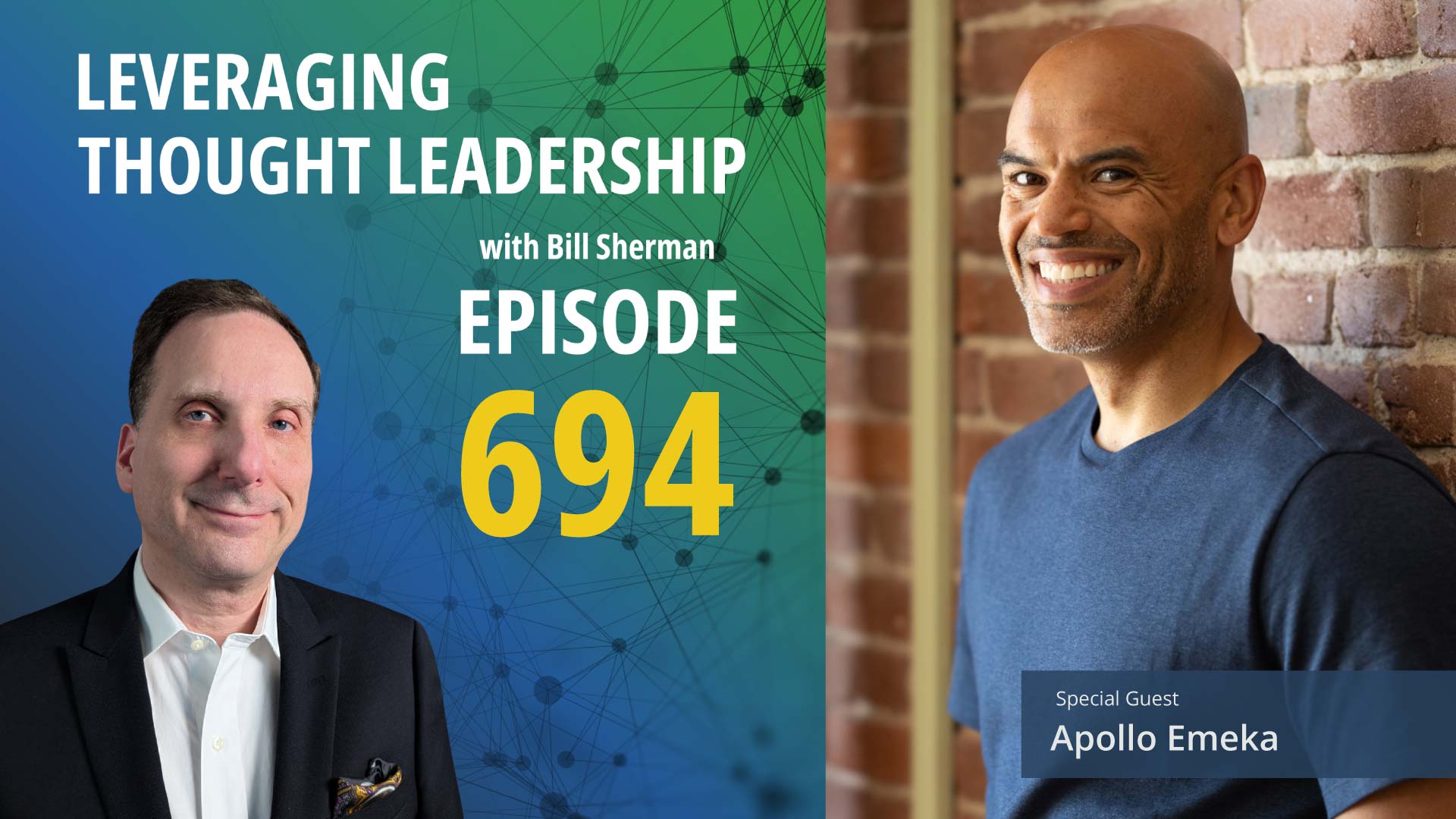
In this episode, Bill Sherman talks with Apollo Emeka, who calls himself “the big decisions guy,” and traces how that identity started early—when Apollo was effectively handed the power to choose school or not as a kid and felt the real-world consequences of deciding either way.
Apollo’s path is anything but linear: military service, Iraq deployment, an FBI internship, and a mindset shaped by high-stakes environments where “what could go wrong?” isn’t drama—it’s a discipline. He shares a vivid example: after his family was impacted by the Eaton fire in Altadena and evacuated, they stress-tested a radical idea (moving to Panama) by asking that question seriously, researching risks, and acting fast once no deal-breakers showed up.
A turning point came when Apollo commissioned a third party to interview his clients and surface where his real impact was. The message was consistent: decision-making. That clarity gave him permission to drop the “other consulting stuff” and go all-in on helping leaders make better decisions faster—then validating the shift publicly and operationally (including flipping his website).
You’ll hear practical tools, not theory. Apollo describes how most leaders’ stated goals score shockingly low on a fulfillment scale—often a 6 or 7—because they’re inherited, socially pressured, or “sensible,” not energizing. That insight becomes the doorway to choosing goals you actually want, not goals you can defend.
He also lays out what he calls a “big decision” framework: it must be a 10/10 on fulfillment, read like a toddler’s run-on sentence (because it forces your competing life priorities onto the same page), make other decisions easier, and be bold enough that people might call you crazy. Apollo reads his own big decision statement—including the ambition to build scale through a best-selling book, a top podcast, and bigger stages, while protecting what matters at home.
Finally, Apollo names the hidden saboteurs that keep smart people stuck: the “decision monsters.” He trains clients to stop living in “can / should / could,” and to recognize three common blockers—feasibility, worthiness, and social judgment—so leaders can choose with intention instead of permission.
Three Key Takeaways:
- Make one “big decision” that simplifies everything else. A real big decision is designed to be high-fulfillment (a 10/10), bold enough to feel uncomfortable, and specific enough that future choices get easier because they can be measured against it.
- Stop chasing goals you can defend and start choosing goals you actually want. Apollo argues many leaders rate their current goals at only a 6–7 on fulfillment because they’re inherited, socially expected, or “sensible.” The fix is to re-select goals based on energy and meaning—not optics.
- Name the “decision monsters” before they run the meeting in your head. He calls out the common traps—living in “can/should/could,” fear about feasibility, doubts about worthiness, and worry about social judgment. Once you label the blocker, you can choose directly instead of negotiating with it.
If this week’s episode got you thinking about making one clear decision that cuts through noise, you’ll get even more value from Lee Caraher’s conversation—because it lives in the same territory: clarity under pressure and the choices leaders make when the old playbook stops working. Lee digs into how to lead across generations without the drama, how to shift your approach when talent and expectations change, and what to do when a business model needs a reset. Listen to sharpen your decision filters, reduce second-guessing, and walk away
with practical moves you can use immediately.
Transcript
Bill Sherman How does a skill, something that you’re good at, grow into your thought leadership calling? Dr. Apollo Emeka didn’t set out to be, quote, the big decisions guy. But after a lifetime of unconventional choices and a career spanning the military, intelligence, and entrepreneurship, others began to see what Apollo hadn’t fully named yet himself. His thought leadership emerged, not from theory. But from his lived experience, testing decisions, living with consequences, and refining a process that helps leaders move forward without regret. This episode explores how Apollo Emeka found his focus and why clarity beats certainty every time. I’m Bill Sherman, and you’re listening to Leveraging Thought Leadership. Let’s begin. Welcome to the show, Apollo.
Dr. Apollo Emeka Hey, thank you so much, Bill. It’s awesome to be here.
Bill Sherman So you identify yourself as the decision-making guy. I’m pretty sure that that wasn’t your reputation in grade school or kindergarten. How did that come to be that you became focused on decision- making?
Dr. Apollo Emeka Oh my goodness, I’m so glad that you pointed to grade school because that is really when it started for me. And it’s not just decision-making, it’s big decisions, Bill. It’s big decision. Excellent. So I believe that every single day, everyone has the opportunity to make a decision that is going to alter the course of their life. And I believe that. Decisions are more powerful than actions because there are not a lot of actions that you can take in one day that are going to set you on a course that redefines your life, but you can, right now, as you are, as we’re sitting here having this conversation, you could make a decision that alters the course of your life forever. And I gained this awareness of the power of decisions, probably when I was in about fourth grade and I came home from school. And walked in the door, put my book bag down. I was one of those kids who like took every book to school for some reason. Like, I don’t know if you were one, but like all my art supplies, all my books. So my backpack always weighed a thousand pounds. Just in case he needed it. Yeah, just in case, just case. Better to have and not need than to need not have. I’ve always said, but sorry, there you are with your book bag. I throw it down and I’m, man, I hate school. And my mom is reading a book and she says, Oh, well, we were thinking about homeschooling you. And I said, Oh my gosh. So for fifth grade, I could just not go back to school. And she said, you don’t have to go back tomorrow. And I thought that was irresponsible. I was like, I got to at least finish the week here. And so, Hey, I finished the week and Monday I didn’t go back. And I used to think about that as, Oh that was the time that my parents pulled me out of school, but really What they were doing is they were handing me the power to decide when I would be enrolled. So every single day from the time that I was nine years old, I woke up like, do I still want to do this? Do I want to be in school or do I not? And so I spent a little bit of time in school almost every year until finally dropping out of high school because I just like, oh, I need to go back. I’m not learning anything. I’m I wanna go be social. So, but that was probably the first time that I became aware of the power of decisions because I felt the consequences of making them. I felt consequences of deciding to go to school and the consequences enough.
Bill Sherman Okay, so we’ve got a sense of you making your first sort of a gen tech decision, if you will, in grade school, which is pretty cool, right? That’s still far away from, well, how did this become an area of thought leadership for you connect those two dots? Where did you get into thought leadership and how did you realize you were practicing thought leadership? For others.
Dr. Apollo Emeka Yeah, so… Background that I described was incredibly unconventional. And I, by the time I was 17, I had watched a lot of TV. I loved the X-Files. I loved Saturday Night Live. And so when I was 13, I was dead set on being on Saturday Night live or being in the FBI like Mulder and Scully. But I have no or both.
Bill Sherman Why Jews? He said to the decisions guy, right?
Dr. Apollo Emeka Well, and that’s the funny thing you joke, but I ended up, you know, officially dropping out of high school and going straight into the military, pursuing the kind of FBI track and deployed to Iraq really quickly. This was like right after nine 11, uh, and came off of active duty. And I had a brother who was in Los Angeles and he was like, why don’t you just move to LA and try to go to USC and you can pursue the FBI and Saturday night live from Los Angeles. So that’s what I ended up doing. I minored in theater and I majored in sociology and got an internship at the FBI and ended up checking that box there. But it was in my time in the military and the FBI helped me again, understand the power and consequences of making decisions. I wasn’t acutely aware of this decision dynamic until years later, but I looked up actually this year. I realized that the work that I’ve done with my clients, the work I’ve in my own life, the most powerful work that I’ve been all around decision making. And I interviewed clients this year about, I actually hired a guy to interview my clients about the most impactful work, and a lot of things came up around decision-making. The skills of decision-making, but also the actual decisions that came out of that. And so, and so I just realized, oh, this is my life’s calling. I need to shed all of the other consulting activities that I’m doing around process and optimization and execution, and just strictly focus on helping people make better decisions faster. And doing that for free by going on podcasts and, uh, and doing lives and things like that, but then also reducing my work to just. How do you make big decisions?
Bill Sherman Let’s stay there for a moment. You get feedback which is a great way of you know have a third party ask what is Apollo good at right and what really transformed you that’s a great method to compile because if you ask directly you’ll get different answers you get this feedback that it centers around decisions. Was it easy to let the other pieces go? The processes, the other consulting work that you did, and focus on decision, did you wrestle with it, or was it like a moment of epiphany? Let’s drill down on that moment when you’re sitting with the feedback, quietly
Dr. Apollo Emeka Yeah, well, first I got to plug Jonathan Newman, who has a boutique agency called Good Theory, who did this process for me. He’s incredible. He’s so easy to talk to, and he was able to get all this great information out of my clients. So without that, I think it would have been a lot harder to do just talking to people myself. So, and I love feedback, but I don’t. Love it directly. So this was an amazing, I want the information, but I don’t want somebody to say it to my face. Right, right, right. Filtered is good. It filtered is great, yeah. So that was really valuable process that if you are struggling with, hey, what is my thing? I would highly recommend getting somebody to talk to folks for you. But I would say. I have a three-step process for, for making decisions. And the first step is deciding with heart and, you know, identifying what is going to be a 10 out of 10 in terms of fulfillment on the outcome. So when you ask me the question of, did I struggle with it? It was like a light bulb moment. It was an epiphany and I did not struggle some habitually. I kind of struggled, I guess, to break free from offering these other services that I have, but like, I was like, I don’t even like that stuff. This is the thing that lights me up, but I just didn’t really think that it was a thing. I didn’t think that decision-making was a thing that I could build my whole business on. And so I think I had been settling for years, kind of, yeah, I gotta do the other optimization stuff and the execution stuff, and so I had been settling, so once I was freed of it, I was like, oh, it’s go time.
Bill Sherman So this was a case where you went, oh, I don’t have to eat my Brussels sprouts to have the thing I enjoy. Yeah, exactly. Okay. So how did you make the pivot? Did you reach out to people and say, Hey, I’m going to be focusing on this. How’d you let your network know? How do you make. From doing a number of different things to focusing on one thing.
Dr. Apollo Emeka Well, I think, you know, if the way I had been showing up in my business before was, I was very, I’ll be graceful to myself. I’ll say I was. Very dynamic. And so I, I dropped out of school in fourth grade and I have a doctorate. I was a green beret. I was in military intelligence analyst. I was an FBI intelligence analyst, I wasn’t entrepreneur with an exit. And I’m fearing a lot of underachieving. I, so, so I say this to say that I’m just like, I geek out on stuff. I love learning. I love running new things and, and, yeah, I love kind of accomplishing and growing. And so for me, the way that I built my business was essentially like people would come to me with problems and then I would just summon all of these skills and ideas and experiences and build these kinds of custom solutions and meet the moment with whatever I thought it needed to be met with. And so when you talk about pivoting, for me it was fairly easy because my clients were kind of used to me showing up with very novel unstructured approaches to solving problems. And so what I started doing is I just started inserting the decision stuff. I will say that also what I did when I realized this was a thing, I went on LinkedIn and I said, Hey, I’m refining how I help. Leaders and, and teams set big goals. I’m offering free sessions for people, you know, the benefit for you is you get to set some goals and I get to refine my process and get feedback from you. So I put out that call and I, and I did these sessions with probably about 15 people, and that helped me understand what are the basic tenants that I need to bring into my existing work. And then once I, so I learned these things. I brought them into my existing work and people like, oh, this is bad ass. This is great. And so then I was able, it was validating. And so I was then able to just now say, okay, like today, literally today, we just flipped the website from business consulting that works, which is that dynamic green beret doctor guy who’s going to show up and just fix your stuff, I help you make better decisions faster. So that was today.
Bill Sherman I was looking at the website this morning. Yeah. Oh, that’s so hot. It is a new look. Congratulations. Thank you. So one of the things I hear there is you didn’t just flip the switch and go, right, I’m going to, I got this recommendations that I’m gonna be the decision guy. Let me throw everything else out. And as of tomorrow, this is a transformation process. And a sudden pivot
Dr. Apollo Emeka Absolutely. Absolutely. And even, you know, being on this podcast is a part of that journey. I want to be in conversations with people who are going to ask me questions about how my stuff works, about how ideas work, because it gives me an idea. Bill, you’ve done almost 700 interviews. You have asked questions of 700 people. Like I want that level of engagement and scrutiny. On these ideas. So yeah, it is a complete transformation that’s woven into how I do business and how I live, honestly, thinking about this kind of transition.
Bill Sherman Stay there on the moment of clarity, right? What I’ve heard from others, in addition to yourself is sometimes you come through to your area of expertise because it’s an area that you personally struggle with, right, and you’re trying to figure out how do I do this? How do I build relationships? How do i negotiate? Right. I need to get better at that. Or how do i overcome imposter syndrome? Those are all things that can prompt someone with curiosity and a desire to do a deep dive, as well as sort of academic sort of either training or instinct to go deep and say, what does the world know and what can I find that adds to the conversation for you? It’s more the world telling you, Hey, you’re really good at this. You’ve been doing it instinctively in some cases. We want the refined version of what Apollo does. And so you went out and tested processes, right. And it said, Hey, let me see if this works. Does it? Okay. I got a pattern. Now let me start building and refining from it. Absolutely.
Dr. Apollo Emeka One of the most astonishing things that I found in this process of validating the method is I asked people to come into these sessions with a list of their goals. And then I put them in a table and I said, okay, we’re gonna give them a rating, a fulfillment rating. So when you imagine accomplishing this thing on a scale of one to 10, one being regret and resent, and and 10 being Excitement and fulfillment. Where do these, where do these rank and much to the light of elementary and middle schoolers everywhere, most people would say six or seven. Uh, is, is there six, seven. Yeah. Yeah. Yeah. Most people come in and so it could be like run a marathon, spend more time with my kids, earn $300,000 next year. And going down the list. The goals that people were coming in with were one or two points above neutral. Because remember, one is not sort of fulfilled. One is I’m experiencing regret and resentment as a result of accomplishing. This journey was pain and I wish I didn’t go on it. Right, exactly. The journey was paint and the destination is unfulfilling. Yeah, yeah. And it sucks. It sucks. Like that was a big thing for me and a really wild thing. I’m sure people listening to this right now are like, oh yeah, but not me. I want to make a bet. I bet you if we write down all your goals and we say, hey, imagine that this is done. I have never seen somebody come in and say, oh yeah 10, 10, 10, 10. It’s always a six or a seven. And sometimes there’s some threes on there. Sometimes it’s like, I actually don’t even want this thing, but my parents want me to, or my spouse wants me to or. I feel like I need to because of the age I’m at. So that right there is one of the things that I learned by doing these sessions that I probably would not have learned had I just started to integrate it into my work immediately.
Bill Sherman So a couple of questions springboard from this, you’ve mentioned, you did a PhD, green beret, FBI military, right? So those are different lenses and perspectives. I’m going to stay on a couple of those for a moment. When you did your PhD, did you build a model or do validation on a framework or test or something like that? And is that some of the work that you carried forward? Into as you start going, well, what’s my decision making tool set and does it really work? Right. Oh my gosh.
Dr. Apollo Emeka That’s so funny. We didn’t talk about this, did we? Did we talk about it? Oh, well, you pretty much nailed it. But the thing that’s so interesting about that journey, I grew up pretty broke and again, super unconventional. And so I realized like, hey, I don’t wanna be broke again. And I hit this stride in my mid-twenties where kind of like all the things that I set my mind to, I was accomplishing. And so I was, you know, I got into undergrad at USC where I wanted to go. I got in to the FBI right after that. I was in the national guard, which is like the reserve, you know, the reserves. And so. I, in parallel, tried out for special forces to advance my military career. And I got that. So I was FBI, I was green beret and then I was like, Oh my gosh, I’ve got this international experience in the military on the Intel side. And on the operator side as a green beret. I’ve got the intel side of the FBI. I’m gonna go special agent in the FBI and go doctorate. And then I’ll like, no one will be able to touch my national security and intelligence background with that. I’ll be the national security advisor by the time I’m 35. What I realized is that I was like, you know what? This is actually a depressing world. Wondering what is going to explode or who’s going to take advantage of old people or financial systems or young people or what all the time. It’s intellectually really stimulating, but it’s…
Bill Sherman Depressing and an anxiety sort of rollercoaster, right? Cause you’re constantly going, what could go wrong?
Dr. Apollo Emeka Well, that’s the kind of, that the cool thing I think about the skillset that I developed across those worlds is that question for me does not produce anxiety. Okay. That question for actually soothes anxiety because I don’t treat it like a rhetorical question. I have frameworks, you have it in like, yeah, and methodologies on the backend. I actually, I don, that what I ask on. So, my family picked up… In January, we were impacted by the Eaton fire in Altadena, just outside of Los Angeles. My mother-in-law lost her house, my wife’s child at home. And we were evacuated for about a month because of ash and smoke damage to our house. And we just got, we got the idea to make a big change. And I was talking to a friend and she said, have you ever thought about Panama? Have you ever been to Panama? I said, no. And she was like, I was just there and it’s incredible. And, uh, so I got off the phone with her and I started asking that question. What could go wrong if we move to Panama? So I’m Googling Panama hurricanes, Panama safety, Panama visas, Panama kidnapping. Like I’m just Googling all the, all the things. So like, for me, I look at what could go, wrong. I treat that as a serious question and I couldn’t find any deal breakers. And I walked into the Airbnb that we were evacuated to. And I said to my wife, are we supposed to move to Panama? We had never talked about this before. And she goes, baby. And 30 days later, we were in Panama. So that was from late January, we got the idea. Late February, we moved here with our two young kids. So for me, that question of what could go wrong, I love that question. That question does not produce anxiety for me in the least. I think it’s a necessary question, especially when you wanna make big moves. So let me ask you this question.
Bill Sherman Have you applied that 10 point scale for yourself in terms of the practice of thought leadership and did that rank as a 10? Did you go, okay, this is in that middle. How did you, you make the conscious choice to go into thought leadership or how are you making the conscious.
Dr. Apollo Emeka Right? So early on, when I work with folks one-on-one, which is the thing that I’m, I’m still working with organizations, but I’m really focused on helping individuals do this because it is absolute life-changing work. So when I, when work with the individuals one-one-one early on in the process, what we do is we establish their big decision. And a big decision has four characteristics. It’s a 10 out of 10 on fulfillment. It sounds like a toddlers run on sentence and I’ll tell you why in just a second. People will probably call you crazy and your big decision makes a lot of little other decisions easy or eliminates them. So I’ll read you my big decision real quick. And it is, by the end of 2027, I will establish myself globally as the big decisions guy by releasing a best-selling awesome book, a top podcast and hitting high profile stages to earn top fees as a speaker, coach and facilitator. While helping millions of diverse execs and entrepreneurs for free or cheap with life-changing content and working four days per week, traveling less than 10 days per month so I can maintain my health to be the best husband, an amazing father, and a valued family member and friend.
Bill Sherman And we’re recording this in December of 2025. When did you write that? Because you set a time bound on 2027 by you’ll have this done. Was this recently? Was this a couple of years ago? Give me the time frame on this.
Dr. Apollo Emeka Yeah, I wrote this in June of 25, so about six months ago.
Bill Sherman And was that the output of research? He’s talked about it being sounding like the toddlers sort of run on sentence. And I’m hearing some awareness of, Hey, I want to travel less than 10 days a month, which is you can build a successful thought leadership career, but you can also be a road warrior where you’re like, okay, I know the hotel better than my own bed. Yeah, yeah, exactly. Exactly. And so you put some consideration into this in terms of what life do you want?
Dr. Apollo Emeka For sure. And that’s the thing I think that ultimately when people have these disparate goals, they’re often competing with each other. And so like, for instance, somebody came in with a thing that was like, I want to run an iron man. And also I want spend more time. I want take my kid to every major league baseball stadium and I want to earn $500,000 and I, and, and and, and I’m so like in a workout. Yeah. Yeah. So it’s like, okay, you want to train for an Ironman, that’s a part-time job right there. So how is that gonna?
Bill Sherman Impact your stuff. So 4am wake up, call and be showered and ready to work by seven. Yeah, exactly.
Dr. Apollo Emeka Exactly. So for me, the reason why it’s important that it feels like a toddler’s run on sentence is that we need to put what could be, we need put your life goals that could be contradicting each other right up next to each other. So that way we can find the one way that satisfies both at the same time. So got a good example. I started. I’ve been playing tennis for about two years, but my wife just started like four months ago. And we have a court at our building and we just had our second lesson together yesterday. And I’ve playing longer than she has. And she plays with another woman who’s kind of, who’s at the same level. And so I’m there and I’m not playing really hard. And the instructor is like, Hey, do you wanna do a lesson? That’s just you and me. So you can really like smack the ball. And yeah, for me, it was so easy. Remember one of the criteria for a big decision is that it makes other decisions easier. It was easy for me to be like, no. This is checking the box of me maintaining my health, right, by playing tennis and being a great husband and a partner, right, and a valued family member and friend because the person that we’re playing with is the head of the parents association for a school that my kids might wanna go to someday. So it’s like, we’re in the community. So for me to then say like, oh yeah, let me go do my own lessons. Now that is time that just fills one bucket. It’s just the health bucket. I’m just like, no, no that’s an automatic no for me. I wanna spend this time with my wife. I wanna spending this time with the community and I wanna be healthy. So I get all three of those things in one.
Bill Sherman And you’re leading to something that I like asking people who are practicing doll leadership, where is the joy for you in the work? And how do you find more of it?
Dr. Apollo Emeka There are three words that I train my clients to eliminate from their vocabulary. Can, should, and could. Can, Should, and Could. Well, I can do this, or I could do this or I should do that. All of those words are limited by these, what I call the three decision monsters. The three decision monster’s first one is the feasibility monster who’s like, hey, it’s impossible, it is too hard. It’s not gonna work. And this monster has like measuring tapes and graphs and charts and data and is like, don’t want that thing. There’s no point in wanting it because you can’t do it. The second monster is the worthiness monster. And the worthness monster just looks like a big mirror. And it’s like yeah, it possible. Not for you, not for someone like you. Yes, somebody else might be able to want this thing and accomplish it, but not you. And then the social monster looks like a big blob of emojis and it’s like, what are people gonna think if you want this things? What are people going to think if you try and you fail? What are you people gonna try and actually succeed and now you become this person or in this place? And so we’re all walking around with these little monsters whispering on our shoulders all the freaking time. Yep. And so… For me, the fulfillment is when I see the moment that it clicks for a leader or for a team, when they’re like, oh snap, we can actually just listen to our heart. We can actually do the thing that’s gonna be fulfilling and meaningful and make us wanna jump out of bed every single day. As long as we do the other work, we’ve been talking a lot about step one, which is decide with heart. The other steps are how you actually make it real. The other G steps. But like that thing of seeing somebody like, oh my gosh, the should, the social monster. I don’t need to care what people think in this way. I don’t need to set my life goals based on these imaginary people who I think are judging me or based on what my parents think or based what my spouse thinks or based. So watching that moment of like, oh my God, I’m free. I am free to pursue something that is truly fulfilling. Like- I’m on cloud nine, every time I have one of those moments, it like juices me up for like a solid 48 hours.
Bill Sherman So let me flip this question a little bit for you. Now, you’ve talked about, although you do work with teams and with organizations, your joy is working one-on-one with individuals on big decisions, right? Yeah. If I look at the question of scale, when I go back to that statement that you read, and you said, okay, I’m gonna have a best-selling book, this is gonna help a lot of people, and a lot that scale is gonna happen without you in the room or in the Zoom. How are you gonna feed that intrinsic sort of reward and feeling on that? When people might buy, buy a book or use your ideas and you never know, you don’t get the, the endorphin hit of that moment where you see them brush off the little monsters from their shoulder, basically, right. How do you balance that?
Dr. Apollo Emeka Have you thought? Well, I think two things. One, it’s all the other stuff in my big decision. Is the way that I’m, am I doing work that is enabling me to fill these other buckets of being an awesome dad, of being an awesome friend, of be, so there’s that. But there’s also this thing, I’ve been a lot more mindful of later today, I’m doing a lot, I’m going live on LinkedIn, on YouTube, and Instagram. And I’ve been reaching out to people who register and I’m like, hey, what do you want to hear about? Hey, why are you here? And they’re telling me these deeply personal stories. I am at this crossroads and I don’t know what to do. I feel like I already know what I do, but I can’t commit to the decision. There are other people who are like, hey, this post that was my lowest engagement post of the week, this posts changed how I look at my life. And so I think that one of the things that I have learned is that it is important to remain connected and engaged and to see how like it’s so easy. When you’re, when we talk about thought leadership, it’s easy to talk about the products and the channels books.
Bill Sherman That’s absolutely and how are you getting the ideas out there rather than how are you changing lives and making it how that is it built?
Dr. Apollo Emeka That’s the thing. And so asking that question, I don’t, that quite, I’ll always be able to ask that question and I think that if I’m not asking that question, it’s a problem. I’m, not, I’m it’s going to impact my ability to change people’s lives. And it’s also going to, impact my, ability to know how, how my, my work is, is helping people or not. So I think it’s. I’ve just been much more thoughtful about engaging with people and that’s a muscle that I’m building and I need to just make a habit.
Bill Sherman That’s a fantastic place to land the conversation is whether you wind up keeping a folder in your email box or on your drive somewhere, keep those responses when people not only share vulnerability, but then also talk about the impact and how your work impacted them. Because without that, it’s easy to live in your own head. And start just counting likes, reach, and engagement metrics and forget there are humans on the other side. Absolutely. Absolutely. I love it, Dale. So Apollo, thank you for joining us today. Good luck on the upcoming book. And we look forward to hearing from you soon and seeing more of you.
Dr. Apollo Emeka Thank you so much, Bill. Likewise.
Bill Sherman Okay, you’ve made it to the end of the episode. And that means you’re probably someone deeply interested in thought leadership. Want to learn even more? Here are three recommendations. First, check out the back catalog of our podcast episodes. There are a lot of great conversations with people at the top of their game in thought-leadership, as well as just starting out. Second, subscribe to our newsletter that talks about the business of thought leadership, and finally, feel free to reach out to me. My day job is helping people with big insights take them to scale through the practice of thought leadership. Maybe you’re looking for strategy, or maybe you want to polish up your ideas or even create new products and offerings. I’d love to chat with you. Thanks for listening.
