
How Emotional Intelligence Drives Culture, Performance, and Belonging This episode looks at how emotional intelligence…
The Tech Humanist Playbook for Responsible AI | Kate O’Neill



Why speed without trust creates risk—and how executives fix it
This episode focuses on how leaders can navigate AI and digital transformation with clearer decision-making, stronger governance, and real accountability for human impact. It explores how trust and risk shape adoption, why speed without clarity creates downstream problems, and what it takes to build future-ready strategy that scales responsibly.
What happens when your AI strategy moves faster than your team’s ability to trust it, govern it, or explain it?
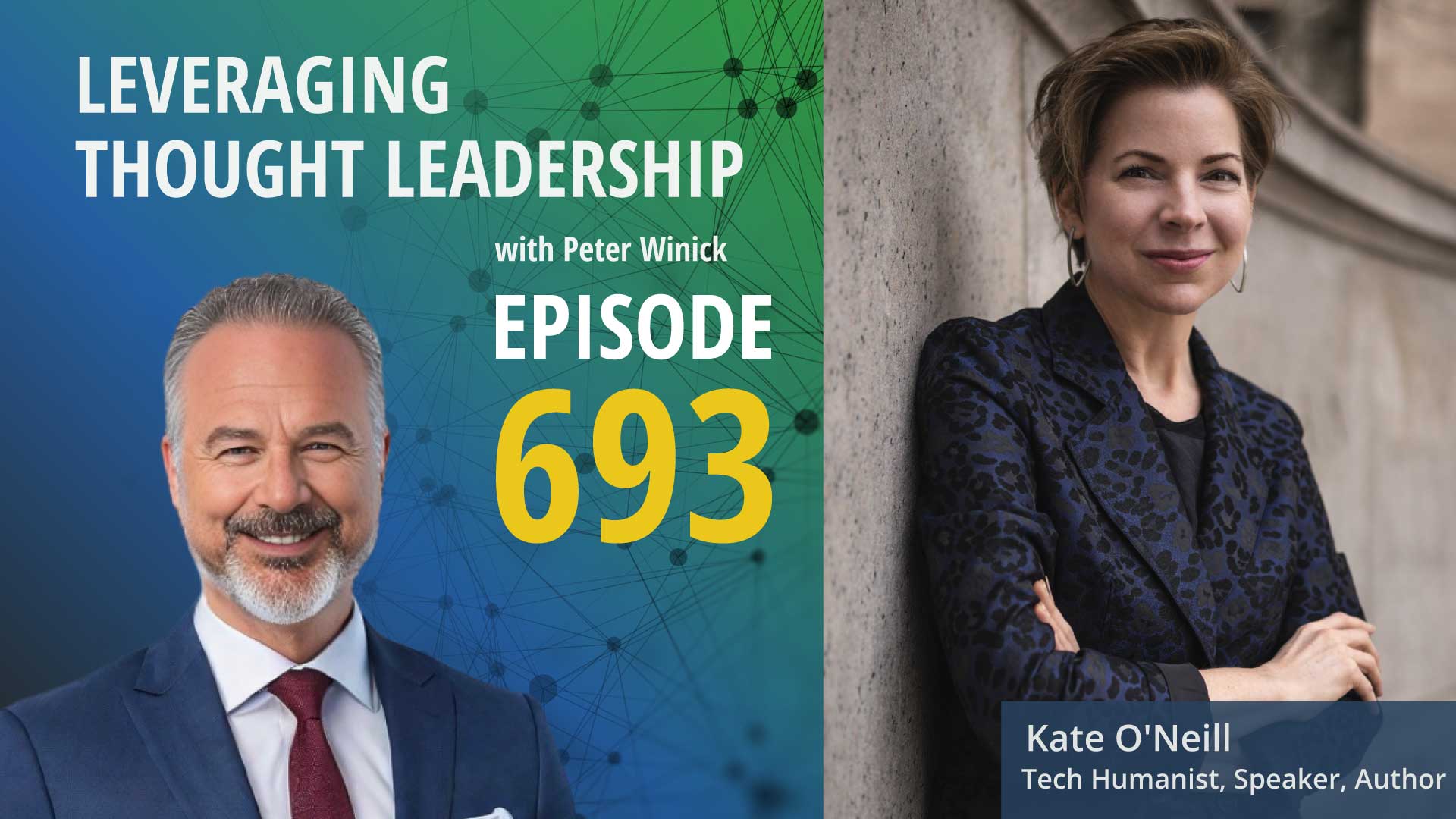
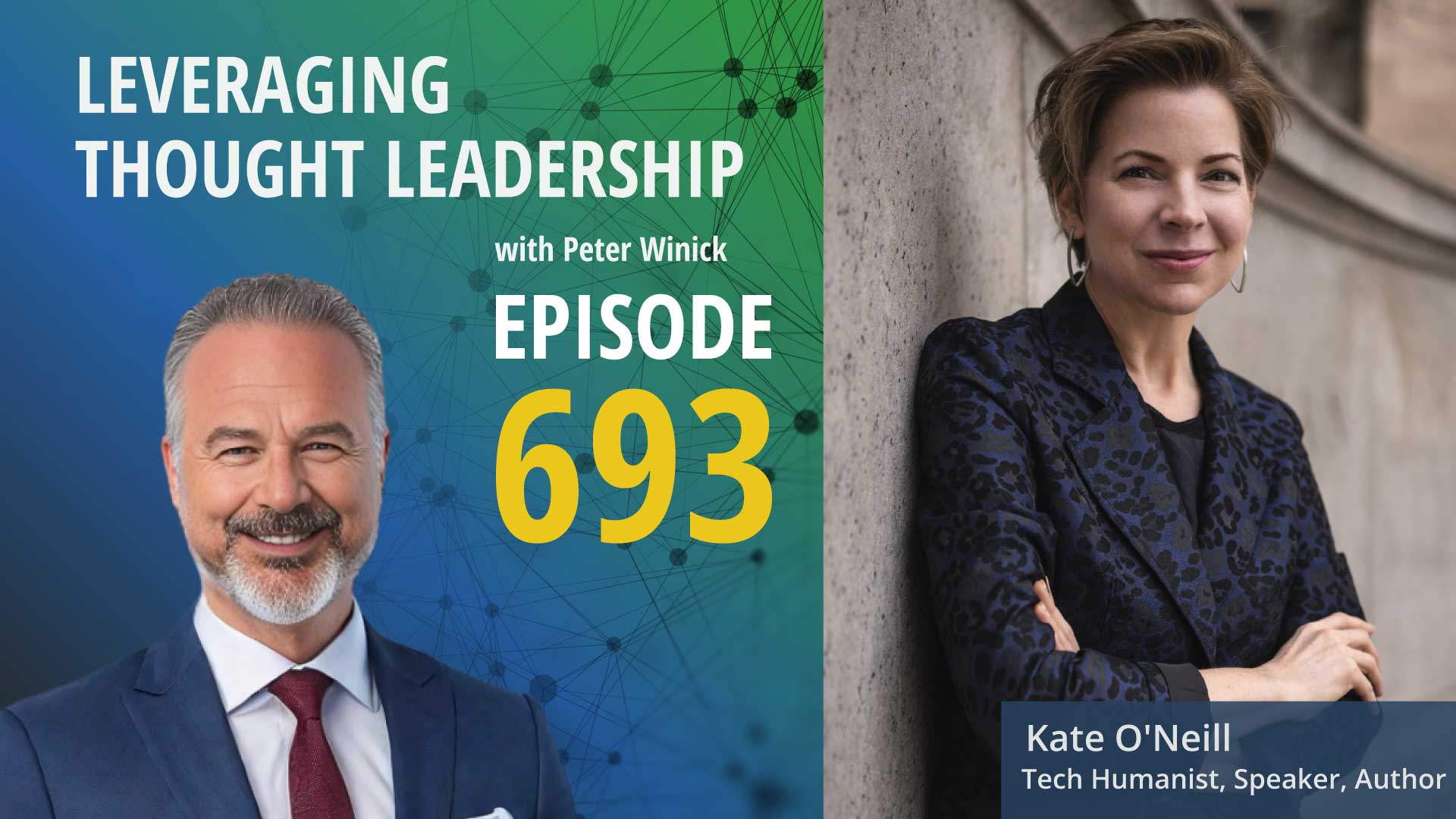
In this episode of Leveraging Thought Leadership, Peter Winick sits down with Kate O’Neill—Founder & CEO of KO Insights, author of What Matters Next, and globally recognized as a “tech humanist”—to unpack what leaders are getting dangerously wrong about digital transformation right now.
Kate challenges the default mindset that tech exists to serve the business first and humans second. She reframes the entire conversation as a three-way relationship between business, humans, and technology. That shift matters, because “human impact” isn’t a nice-to-have. It’s the core variable that determines whether innovation scales sustainably or collapses under backlash, risk, and regret.
You’ll hear why so many companies are racing into AI with confidence on the surface and fear underneath. Boards want speed. Markets reward bold moves. But many executives privately admit they don’t fully understand the complexity or consequences of the decisions they’re
being pressured to make. Kate gives language for that tension and practical frameworks for “future-ready” leadership that doesn’t sacrifice long-term resilience for short-term acceleration.
The conversation gets real about what trust and risk actually mean in an AI-driven world. Kate argues that leaders need a better taxonomy of both—because without it, AI becomes a multiplier of bad decisions, not a generator of better ones. Faster isn’t automatically smarter. And
speed without wisdom is just expensive chaos.
Finally, Kate shares the larger mission behind her work: influencing the decisions that impact millions of people downstream. Her “10,000 Boardrooms for 1 Billion People” initiative is built around one big idea—if we want human-friendly tech at scale, we need better thinking at the top. Not performative ethics. Not buzzwords. Better decisions, made earlier, by the people with the power to set direction.
If you lead strategy, product, innovation, or culture—and you’re feeling the pressure to “move faster” with AI—this episode gives you the language, frameworks, and leadership posture to move responsibly without losing momentum.
Three Key Takeaways:
- Human impact isn’t a soft metric—it’s a strategy decision. Kate reframes transformation as a three-way relationship between business, humans, and technology. If you don’t design for the human outcome, the business outcome eventually breaks.
- AI speed without trust creates risk. Leaders feel pressure to move fast, but trust, governance, and clarity lag behind. Without a shared understanding of risk and responsibility, AI becomes a multiplier of bad decisions.
- Better decisions upstream create better outcomes at scale. Kate’s “10,000 Boardrooms for 1 Billion People” idea drives home that the biggest lever isn’t the tool—it’s leadership judgment. The earlier the thinking improves at the top, the safer and more scalable
innovation becomes.
If Kate’s “tech humanist” lens made you rethink how you’re leading AI and transformation, your next listen should be our episode 149 with Brian Solis. Brian goes deep on what most leaders miss—the human side of digital change, the behavioral ripple effects of technology, and why transformation only works when it’s designed for people, not just performance.
Queue it up now and pair the two episodes back-to-back for a powerful executive playbook: Kate helps you decide what matters next—Brian helps you understand what your customers and employees will do next.
Transcript
Peter Winick And welcome, welcome, Welcome. This is Peter Winick. I’m the founder and CEO at Thought Leadership Leverage. And you’re joining us on the podcast, which is Leveraging Thought Leadership. Today, my guest is Kate O’Neill. She’s known globally as a tech humanist. We’ll figure out what the heck that means in a moment. She’s been helping leaders navigate AI ethics, responsible tech, and human-centric digital transformation. She’s on the 2025 Thinkers 50 ranking of the world’s influential management thinkers. Shortlisted for the Thinker’s 50 Distinguished Achievement Award in Digital Thinking, author of sixth book, inducted into the CX Hall of Fame, on and on and up. But anyway, welcome aboard, Kate.
Kate O’Neill Thank you. I like an introduction that’s like, blah, blah blah. It’s too long. We’re cutting it off.
Peter Winick Yeah, it’s like two pages and you’re sitting here smiling. I’d rather talk to you than tell you how brave you are or tell anybody else how great you are. You can Google that. But anyway, you’re great. All about it. Thank you. It’s great to be here. Thank you, Peter. All right. So what is a tech humanist? This is what we’re thinking.
Kate O’Neill Well, you know, I’ve worked in tech for over 25 years. And one of the things that’s always been true in my work is that I’ve always been interested in the human component to it. Like, what are we doing about user experience? What are we about customer experience, patient experience, guest experience, student experience, whatever the case may be. And what I find is that that becomes increasingly urgent the more powerful tech gets. So that was just something that a realization that I made over the last, I don’t know, decade or so. Is this framing around the three-way relationship between business, humans, and technology, and that business is what gets the technology to the humans, but the humans are obviously not just the consumers of the technology, the beneficiaries of the technology, but affected in many, many ways by that technology. And so it’s a recognition of that ecosystem and trying to make sure that I’m making the right decisions.
Peter Winick What I think that’s cool because, you know, a lot of times we’re thinking about what can technology do to help business grow faster, be more effective, do the things that businesses need to do, process, et cetera, et cetera. And the human thing is sort of like, Oh, and then we’ll impose this on the humans and they’ll write, like, like it’s, it’s an afterthought.
Kate O’Neill It is, it’s so often an afterthought and it needs to be the forethought. It’s one of those things that I think, you know, businesses understand that they can’t exist without people, you know, being consumers of their services or their products or, uh, and also the employees of the, of the company. And now I think with, with, uh increasingly with AI and, and intelligent automation, there’s this sense that we can sort of bypass some of that right like we’re well is gonna do a lot of the work and is going to you know make sure that things get in the hands of people that we want and it in the hand of and. It’s just so much more important than it ever has been for us to foreground that conversation as opposed to pushing there for a minute.
Peter Winick Because, you know, we’re living in an age where every company’s a tech company, right? And then further to that, every company is an AI company, whatever that will mean. And the reality is, you now, previous generations, if you grew up in the manufacturing world, you know now we’re manufacturing, but we’re just doing it a little better, faster, quicker, cheaper, whatever, whatever. But if everything is tech, particularly things that were not tech-driven before, you have leaders leading things that they didn’t come up that, other than sort of the you know, the Silicon Valley universe or whatever. Go on. Clients leaning into you for that.
Kate O’Neill It’s a really good observation, Peter, because I think one of the things that we can draw upon is an understanding that throughout most of business history, it was not tech leaders that ascended into the CEO role, right? Generally speaking, right, you generally saw people who came up through operations or finance or, you know, HR even or marketing, but not typically through the technology path. And you don’t even see it that often. In Silicon Valley, you might see tech founders become CEOs, but only until there’s a certain amount of growth, right? And then the venture capitalists and the, you know, the public want a more seasoned business leader to take over that CEO role. So we’re only in, I think, maybe about the first generation business-wise of businesses that are actually being led by tech founders or tech leaders who have ascended into the CEO role, That doesn’t help the situation any because people have not necessarily learned the lesson throughout technology history that humans need to be forefront in these considerations. So, you know, I think business leaders struggle in terms of thinking about humans in the technology equation just because technology doesn’t come natural to that part of the thinking. And then tech leaders who ascend into business leadership. Don’t necessarily blend that thinking either because they’re thinking technology first. So both of these are flaws of thinking and really the opportunity is for all of the leadership, all of business leadership to take a blended approach, a really integrative approach to thinking about business strategy in a way that’s really meant to be successful for the business. Obviously, we don’t want business to struggle. But we want to make sure that business is succeeding by achieving human outcomes in a way that is aligned with what the business is trying to do. Not that serves the business first and only secondarily thinks about, well, what’s this gonna do?
Peter Winick And how do you get leaders to be sort of a little vulnerable and say, Hey, I’m really strong tech really could use some help on the human side, or I come up through traditional leadership set, whatever the place I came up, how do I get a tech buddy to sort of help me figure this whole thing out?
Kate O’Neill Yeah, that’s an interesting idea, the tech buddy. I think there’s another way we go about it, which is to recognize that these shortcomings or these flaws of vision often correspond with the way people think in terms of future readiness. So some of the decision-making is a little foregrounded or it’s a little more impulsive and sort of short-sighted. And sacrifices future readiness and other kinds of decision-making. And this is often, the tech leaders are often much more driven to thinking far into the future and not necessarily thinking about immediate consequences that they may be sacrificing. So that’s the way we usually kind of set up that discussion and think about, what does it actually look like to resolve that tension where instead of trying to do one or the other, You’re actually trying to make. A set of decisions that bring you safely into the future and help you become more resilient, more future ready, where you’re more agile and you can respond to opportunities as they come, but you’re also thinking generations ahead, a la Reed Hastings at Netflix in the early 2000s, which I got a chance to witness up close and it was one of the formative experiences of my business life.
Peter Winick Love it. I love the idea of tension because people avoid Ted tensions. A good thing when applied properly and when used properly, I want to go pivot a little bit to where I usually sort of start a lot of these conversations, which is ultimately the, how the heck did you get here? Like, you know, I doubt a young Kate in third grade was thinking I want it to be a tech humanist.
Kate O’Neill You know what’s funny though, I tell this story a lot because I think it’s so funny. It sounds apocryphal. It sounds totally like I’m making this up, but it is 100% true. In first grade, as a matter of fact, I won two statewide competitions. One was a young authors competition and one was a younger programmers competition. Wait, wait, that was not, that was like paragraph 11 on your bio. I was going to get to that, but. Isn’t that funny though? I mean, so from this early age, I’m a programmer and a writer. And, you know, I have that as an identity, because I’ve already been validated for this, you know-
Peter Winick I was let me push our essence to then when did you decide like I’m going to make a living as an off speaker advisor thought leader thing like wasn’t somebody didn’t show up on career day for that.
Kate O’Neill No, no, they didn’t. And I didn’t actually make that decision straight out of childhood. I went into languages, as I think you may have read or, you know, folks may know. I’m a linguist by education. My undergrad degree is in German with a minor in Russian and linguistics, concentration in international studies. So, you now, exactly the educational background you would expect for a technology expert. Yeah.
Peter Winick That’s what we’re looking for, yeah.
Kate O’Neill Right, right. But you know, so there’s a lot of there’s decades of work in the trenches in technology, you know Just actually learning and being an opportunist at look looking at like that. There’s a problem to be solved I’m curious Let me go apply my curiosity and the skills that I have To seeing if I can help figure out that problem and then once it’s figured out kind of looking for the next problem And just keeping that curiosity Alive throughout all those years And then also this strong sense of synthesis, you know, trying to blend the insights from these different problems and opportunities and then apply them. Take that.
Peter Winick To a more, I don’t know, land the plane a little bit more and say, because that’s great and I love that. But I think what a lot of thought leaders struggle with is the business side of this, right? How do I validate that what I have, there’s a market for. How do take my stuff to market? How do get paid and paid well and paid often for the ideas that I have? Because the concept of the starving artist is like the lovely concept. I don’t think it’s a necessary one for thought leaders to make a vow of poverty.
Kate O’Neill No, no. And I, like I say, I was spent decades actually working as a technologist. And then at some point in 2009, I decided to start an agency. I’d actually left one role and been hired on to be the managing director of an agency that was doing sort of marketing, digital marketing work. And I really wasn’t that excited about digital marketing services. I started an agency thereafter called Metamarketer. And it was an analytics firm. It was meant to be strategy as service. And so what we did was help companies implement analytics in a way that would give them better insights about their customers, help them make more data-driven decisions. So five years I had that company and in the process of growing that company, I did a lot of speaking, a lot a writing, a lot thought leadership to make sure we were out front and center. And the way we capitalized on that obviously was selling services on the back end of that.
Peter Winick I’ll stay there for a minute because that’s, I think that’s you know, I see this a lot where I didn’t deliberately wake up one day and say today I will be a thought leader. It’s okay, I’m an entrepreneur, I’m trying to grow the business, I don’t have the resources of my own editors that are 10 times my size, but I have this skill. I can speak, I have my ears, I research, whatever. So I’m gonna use that to get out into the marketplace, whether I get paid for that or not isn’t the point. The point is elevating the brand, the point is standing out from the competition, cost effectively acquiring clients and all that. So you become sort of national, the voice of the brand per se, but you’re spreading these ideas and then people are going, wow, tell me more. Can you help me? So I love that. And I preach that all the time. Yeah. And then you probably realized.
Kate O’Neill Like, hey, I did. I really liked it. I did, you know, in the early years of doing that, I was, you now, doing side sessions, breakout sessions, references, talking about case studies and success stories we’d had. You know, where we increased the white space around a conversion opportunity by 10 pixels and increased it by 12%. You know? Like, really kind of… Fascinating stuff, yeah. Yeah, detail and stuff. But, you know, in a way that I was learning how to tell these kinds of things in a way that was engaging and fun and that was interesting, people could get takeaways from them. And so I got invited to bigger and bigger stages and to the main stage and eventually got started getting paid for doing keynotes. And at that point, I think it was clear to me that was the direction I wanted to go. And, so, I exited MetaMarketer and started Video Insights in 2014. And that was, the intent was to be a full-time professional speaker, author, you know, just generally like a thought leader doing these different kinds of distribution channels and, and making money at it. So that’s been the chase ever since. And it’s really been, it’s been that for the, all those years until over the last few years, I really decided that KO Insights is really, I’m not building it the way that I, or I had not been building it the way that it had the opportunity to build. Which is this, I think, a more future ready version of a mini Gartner or McKinsey or something like that, where it takes on more of an analyst consultancy sort of brand. And there’s a lot of credibility that comes along with the brand as opposed to just from me personally.
Peter Winick So, stay there, I’m one of the few people that are fascinated by this part of the journey that’s like welcome to my world, right? So, I think that, you know, I always joke with folks that there are two types of folks that come to work with us, right. Those that say make me a rock star, right, and that’s fine, whatever, and then the others that say please make me irrelevant. You’re at this phase where it’s not the Kate show, not that you’re not an important part of it. It’s an organization that you are obviously one of the assets, but it’s really about the IP. It’s about the ideas, it’s about all those things. And yeah, if you wanna pay Kate the big bucks to come and go to your conference, you should do that, cause she’s really good. But I like the idea of sort of the mini gardener, the more agile, the sort of next gen whatever, because then ultimately at some point they’re gonna go Kate who? And that’s a beautiful thing. Might be a little damaging to the ego, right? But it’s actually a great thing I think.
Kate O’Neill No, it’s about the impact for me. Like it’s, about, you know, and one of the initiatives we have, uh, we’re just launching now, I’m calling 10,000 boardrooms for 1 billion people. And it’s really about getting into, you know, either metaphorically or physically into 10, thousand boardrooms, helping make the decisions that get made at that level or even a level or two down in the VP office or whatever that are affecting many, many people downstream of those decisions. So we’re tracking that. We’re setting up metrics and dashboards that are giving us a lot of visibility into how is it that me speaking to an audience of, you know, four hoarded CEOs then translates into the kinds of decisions that they make, you know further from those events and trying to get buy-in from those organizations that they’re committing to being part of that process, to making these more intentional decisions. So I am- You know, I have ego as much as anybody, but to me, it’s not so much whether it’s the Kate show or isn’t the Kate Show. It’s like, which of these is the brand or the lever that’s going to get us access? Like, is it gonna be the KO Insights weigh in or the Kate O’Neill weigh in or the Tech Humanist show weigh in? Or, you know, which one of these is going to be the way that’s gonna open the door and help us have the kind of amazing we wanna have.
Peter Winick I like that focus on the board because it’s a definable target market, right? And I think the, one of the things going around in boardrooms today around the world is there’s a lack of, let’s say a lack of honesty, but a lack of saying, hey, let really look around this table and who here is really best qualified to answer the issues that we’re dealing with now. Right, right. Like there’s, I’m not dinging board members, they’re accomplished, they’re smart, each come from a different discipline or you know, they all bring something to the table. They tend to be a little older and they tend to have gotten there based on their track record of success, right? But no one’s lived through what we’ve all lived through in the last 10 years or will live through in the next 10. So I think this concept of bringing someone in to sort of plant the seeds of ideas into the board, once they get it, they’re smart, they’ll figure out the things that they need to do. But I love the idea of sort of being the Johnny Appleseed of tech humanism.
Kate O’Neill That is it. It’s Johnny Appleseed, indeed. It’s the Katie Appleseed, although I mean Katie, so we’re not doing that. No, no, no. Kato Appleseed will do that. And I get to keep my apostrophe in my name, which causes all sorts of e-commerce trouble, but I like it.
Peter Winick Yeah, why did e-commerce never figure out someone has an apostle?
Kate O’Neill Or hyphens for that matter, like how many people have hyphenated last name? Like an itis, iris, itis. Exactly.
Peter Winick So what are the other things as, as we’re looking like things that you’re interested in treat excited about going into the next six months, 12 months, 18 months, like what are, what are things that your noodling on now that will inevitably we’ll hear in the next keynote or book or whatever.
Kate O’Neill Well, I think one of the things I’m paying a lot of attention to right now we sort of alluded to slightly, which is that in order for these tensions to be resolved between tech business and human. I think over the coming years, what we’re going to be seeing a lot more of is a greater understanding of the taxonomy of trust and of risk, like those two concepts really need to be better understood. In order for people to make better decisions. And so we see AI, I think the AI acceleration of decision-making and of what it means to business like really.
Peter Winick But acceleration isn’t necessarily good, right? So when we talk about, you know, decision making, you go to Kahneman, fast and slow brain and all this other stuff, like AI enables or allows us to do things at a wicked speed, right. But that’s not always good. Sometimes that need to be contemplative to have some thinking time when you’re taking a walk or in the shower or whatever. AI never says, okay, and here’s the answer, by the way, think about that over the next two days. Right, exactly. Before you do anything with it.
Kate O’Neill 100% why in the subtitle of my book, What Matters Next, the long subtitle is a leader’s guide to making human-friendly tech decisions in a world that’s moving too fast. And that moving too-fast piece really is speaking to that sense of acceleration because I heard that from leaders again and again and over the last few years. I would step off stage, you know, maybe there was a formal Q&A, maybe there wasn’t during a keynote, and maybe somebody asked a question that spoke to this. But usually… It’s more the one-on-one question afterward where, you know, a CEO comes up to me and says, you know confidentially, thank you so much. This is great learning, great vocabulary and frameworks. I’ve needed this because my board just does not listen to what I have to say. And they want us to be moving faster and they want us to being accelerating, like leaning hard into this AI space. And we just don’t know what we’re doing there. And we don’t just know what the consequences of those decisions are going to be. I mean, like, I can tell you how many dozens of those kinds of questions and feedback I’ve gotten from executives.
Peter Winick Uh, those aren’t things that they can say out loud to their teams and their board of, Hey, are you scared, right? They need to dude confidence, whether it’s real or not. They can say, holy crap. I don’t know what I’m doing. And I’m scared to death at the speed at which I’m doing it, right. Like, yeah.
Kate O’Neill Yeah, about this moment is that there is this sense that no one can speak honestly about the conditions of the moment Right. Yeah that that we’re pushing for these incredibly powerful decisions to be made with incredibly far-reaching Consequences at greater scale and capacity than we’ve ever known before and we’re asking those decisions to made by people who have Genuinely no understanding of the complexity of which they’re dealing with. So it’s a, it’s a real problem. I’ll set you on a channel note. Yeah. I mean, so that’s what this book was meant to address was to try to quit some decision-making tools in the hands of leaders who needed them and in a non-judgmental way, in a way that was like, hey, look, I get it. Like, I can hear from you that this is very stressful. I have empathy for what you’re going through. And here are some ways to… Better frame the future and make it less scary and less uncertain. And here are some ways to stockpile some insights so that the next time you’re making a decision you’re doing it with more wisdom and you can do what I call ethical acceleration. You can move into rapid decision-making but with a sense of insights and foresight that you’ve already accumulated because you’ve done the work ahead of time to make sure that you’re making those decisions wisely. So there’s, I think there’s an awful lot of this that still needs doing. Uh, and, you know, I have years ahead of me, I hope, uh, helping, helping leaders do it. Uh, but I also hope that it just becomes part of the social discourse that, you know, this becomes something that we understand a bit more culturally as a need and that business schools catch up.
Peter Winick And, you know, yeah, well, that’s going to take a lot. That’s a whole nother topic. Well, this has been amazing. I appreciate your sharing your story with us and a drop in wisdom. So thank you, Peter. Great stuff. I appreciate you, Kate. Thank you.
Peter Winick To learn more about Thought Leadership Leverage, please visit our website at thoughtleadershipleverage.com. To reach me directly, feel free to email me at peter at thoughtledershipleverage.com, and please subscribe to Leveraging Thought Leadership on iTunes or your favorite podcast app to get your weekly episode automatically.

Related Posts
Comments (0)