
The Business Case for Giving Your Best Ideas Away | Dr. Ivan Misner | 731
The Leveraging Thought Leadership podcast is created by Peter Winick and Bill Sherman and produced by Thought Leadership Leverage.
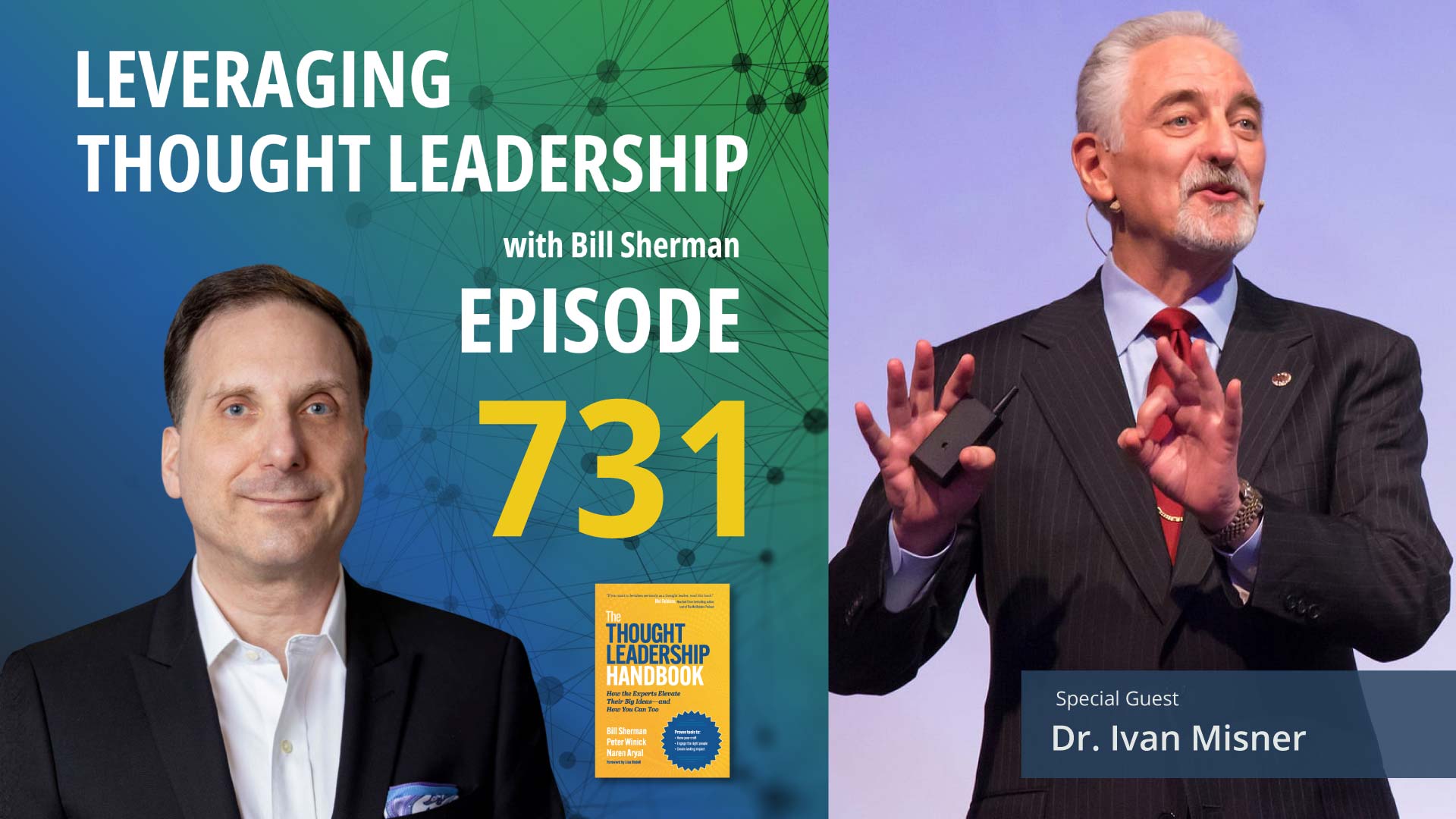



BNI founder Dr. Ivan Misner on generosity, credibility, and building a global referral network
A networking pioneer built a 41-year, $27-billion referral engine by giving his best ideas away for free. This conversation explores why generosity fuels credibility, how introverts can master relationship-building, and why leaders must keep reinventing themselves to stay in their flame.
“We hated your books.” That’s what a European competitor once admitted to Ivan Misner — years after trying to build a rival networking organization and watching his own members ask, “How come we don’t have books like BNI’s?” It’s a story that gets at the heart of this conversation: sometimes the most competitive thing you can do is give your best thinking away.
Bill Sherman sits down with Dr. Ivan Misner, founder and Chief Visionary Officer of BNI (Business Network International), to explore how a mindset of generosity — not scarcity — fueled BNI’s growth into 11,000+ chapters, 355,000+ members, and 41 consecutive years of growth. Misner walks through the origin of his 32 books, why he calls his approach “law of abundance,” and why he’d rather teach the world how to network than protect BNI’s playbook.
The conversation goes deeper than tactics. Misner unpacks his VCP process (visibility, credibility, profitability) as a model for how trust — and thought leadership — actually gets built over time. He talks candidly about being a lifelong introvert who built an empire on relationships, the mindset shift from “hunting” to “farming” in networking, and why he now describes himself as having gone from King Arthur to Colonel Sanders as he handed off day-to-day leadership.
There’s also real vulnerability here: a childhood report card that said he talked too much in class, an honest reckoning with imposter syndrome, and a tribute to the late Mark Goulston, whose “if you always try, you could eventually win” philosophy still guides how Misner thinks about leadership.
Whether you’re building a personal brand, leading a team, or wondering whether your story has already been told by someone else, this episode offers a grounded, generous perspective on what it actually takes to build something that outlasts you — and how to stay in your flame while doing it.
Three Key Takeaways:
- Generosity builds competitive advantage, not just goodwill. Misner’s “law of abundance” mindset — publishing 32 books that teach networking skills for free — created more credibility and media access than protecting BNI’s methods ever could have. Competitors who withheld their own playbooks couldn’t keep pace.
- The VCP process explains why most networking fails. Visibility, credibility, and profitability build in sequence — but most people skip straight to asking for business before they’ve earned trust. Misner calls jumping all three stages “invisibility,” and it’s the single biggest mistake he sees at networking events.
- You can reinvent your role without abandoning your purpose. After 12 years as CEO, Misner shifted to Chief Visionary Officer — going, in his words, “from King Arthur to Colonel Sanders.” Staying in your flame over decades sometimes means changing the job, not the mission.
This episode is a live case study of the book. The story that opened today’s conversation — a rival founder admitting “we hated your books” because Ivan’s own members had already read them — comes straight from The Thought Leadership Handbook, which draws on 700+ conversations from this podcast to map how thinkers build lasting influence.
If today’s episode resonated, The Thought Leadership Handbook by Bill Sherman, Peter Winick, and Naren Aryal gives you the frameworks behind what you just heard — including the five thought leadership avatars that help you figure out which one describes you.
Free chapter & quiz: thoughtleadershiphandbook.com
Get Your Copy:
Amazon
Barnes & Noble
Bookshop.org
Amplify Publishing
Apple Books
Transcript
Bill Sherman We hated your books. That’s what competitors told Dr. Ivan Misner. He’s the founder of BNI, Business Networking International, and he’s a New York Times bestselling author. In today’s conversation, I talk with Ivan about building a business based on insights and thought leadership, and how giving away his ideas in books and other resources didn’t just create a competitive advantage. It fueled the growth of B&I. Ivan and I also explore the deep connections between thought leadership and relationship building. And we reflect on purpose and living a life tied to the caring and sharing of ideas. This conversation is part of the companion to our book, The Thought Leadership Handbook. I’m Bill Sherman and you’re listening to Leveraging Thought Leadership. Let’s begin. Welcome to the show. Ivan.
Dr. Ivan Misner Good to be on. Thanks for inviting me.
Bill Sherman When we were writing the book, The Thought Leadership Handbook, one of the stories that leapt out to me was you were talking about how there were a couple people in Europe who were trying to form a competing organization and they ran into a problem with their members because the members had read your work.
Dr. Ivan Misner Could you share that story? Yes. And the irony is I met one of the founders years after. He had a parting of the ways with his partner. And so he reached out to me when I was in the UK and asked if we could get together. And I was a little hesitant because it wasn’t always a friendly competition. And so I met with him. And One of the first things we warmed up a little bit, had a drink, warmed up a little, but spoke about our backgrounds. And then when we, when I think when he felt comfortable with me, he said, we hated your effing books. And he didn’t say, he didn’t Right, right. Right. Right. It was like, we hated you’re bad word, bad word books. I said, why? And he said because we would go to the meetings and they’d have your books on how to network effectively. And they would say to us, how come you don’t have books on networking? You know, we should have books on networking, our comp, our competitor has books on networking and, you know, you could look at that in a couple of ways. Many B and I members said, you know, that it was a scarcity law of scarcity. Hey, we don’t want to publish these books because we don’t want competition to get better. I was on law of abundance. We want to get this out there. We want teach people how to network. And I remember saying some day, somewhere, someone’s going to read one of my books and go, I’m in a group, I don’t like it, this B&I thing sounds good. And by the way, most of my book are not big B& I commercials. We just, you know, we mentioned B&, I here and there, right, right. And so that to me was classic, because that’s exactly what happened.
Bill Sherman Well, and you call out something in there of leading with generosity and sharing what you know, because in your work, those books share a lot of what B&I is about, what it does in sessions. You keep a little bit behind the curtain, but…
Dr. Ivan Misner Behind the curtain. There’s manuals on how to run meetings that are not in my books.
Bill Sherman Right, but you give a lot away, an incredible amount away, right? 32 books worth. Right. Right. And so, saying more on the mindset of generosity going, oh, I should write books. Let’s go back to book number one. And how did you go and say, yeah, I guess I should be an author?
Dr. Ivan Misner Well, there are a couple of things and we don’t teach this in colleges and universities anywhere in the world Business networking and emotional intelligence social capital. It’s just not taught.
Bill Sherman So I thought leadership’s in the same curriculum at colleges and universities. Right. Well, I think leadership is, I think leadership has taught me. Well, I’m saying thought leadership, how do you lead through ideas, right?
Dr. Ivan Misner Yeah. Fair enough. And when it is, it’s probably a graduate level master’s degree, not undergrad. And so that was the first thing is we don’t teach this in school. So I, I wanted to provide content starting with my members, but then, you know, obviously make it public. And, but there was a second reason. And the second reason was I would talk to the media and I would ask them, you would you like to, you be an eyes really making a big difference in world we’re helping a lot of. Business professionals and you know, I think I’d make a good interview and they’re like take an ad out. We’re not going to promote your business. And so maybe they’d interview me if I had a book. What I learned was the media will interview any idiot with a book and I have 32. So I get lots and lots and lot of interviews on networking. And guess what? Almost every interview, B&I is at least mentioned. You know, sometimes we do a deep dive on it, but usually it’s just mentioned and so people go, I need to look into this B&I thing. What is it?
Bill Sherman So let’s talk about networking and the skills of networking versus the system. Because one of the things is you could have been an author writing about networking and the skill that aren’t taught in business school or undergraduate or wherever, right? But you said I’m going to create a system and communities. You put the idea into practice. Which preceded and what drove you to do that? Because seeing a gap is different than saying, well, I’m going to go fill it.
Dr. Ivan Misner Well, the systems and filling the gap came first before I started writing. I did my first book in 1989, which I think sold 20 copies. It didn’t do very well, but my second book did well. It sold hundreds of thousands of copies and has been translated into many languages. And so it was the second book, which came out in 94. Though B&I had been around for nine years before I had my first major book. So it was all about creating systems and processes. And what I wrote about in the book was not how to run an effective networking meeting, but how to network when you meet at networking meetings. And so.
Bill Sherman Not to do it badly like many of us do without any skills or training.
Dr. Ivan Misner Yeah. Where you go right into, you know, most people use New Arkansas face to face cold calling opportunity. Hi, Bill, my name’s Ivan. Let’s do business. And you know that’s, that’s absolutely a mistake. And so, you, you said that I wrote about the techniques, but I’ll tell you what I wrote about. It was more important than the techniques to start with. I, in most of my, certainly in my first book, I started with mindset and then went to skill set. You have to have the right mindset. And the right mindset includes a number of things, one of which is, I call the VCP process, visibility, credibility, profitability. If you don’t get VCP down, you’re not gonna understand anything. You have to be visible in the community. People have to know who you are and what you do. Then over time, you establish credibility where people know who are, they know what you’re doing, they know you’re good at it, and they’re willing to refer business to you. Or they trust you. Profitability is where they know, they trust, and they are willing to offer business to. This is not a sales process, it’s a referral process. So you might be at credibility with your clients, but if they’re not referring you, you’re not at profitability. And so what happens is the people come to networking events and they jump over visibility, they’re actually at a fourth stage, they’re at what I call invisibility. They jump over visibility, they jump over credibility and they wanna get right to, hey, my favorite is, hey, here’s three copies of my business card. You know, maybe you can give two to somebody else. And I always say, I’m sorry, what was your name again? I don’t know. I don’t t say this part, but I don t know you. I’m not going to refer you. And so they’re jumping over all three levels. So when I say networking, you know is this face-to-face cold calling, then why go to networking meetings? You go to work your way through the VCP process. You have a conversation with people that you’re not at visibility with, that you want to create visibility differently. Then it’s a different conversation than the one you have with people that you’re at credibility with. There, it’s whole different conversation. Hey, how’s that referral that you got from so-and-so? How’s that job going? How are the kids going? I mean, you have a relationship, right? It’s a completely different conversation with people you’re a profitability with. Hey, that referral you gave me turned into great business, thank you so much. I think I have a referral for you. I’ll give it to you next week as soon as it confirms. I mean there are different conversations. So when you go to a networking meeting, you have to recognize, where am I in my relationship with this person? And more importantly, where are they? I may think they may be a credibility with me, but am I at credibility with them? That’s what really counts. So you kind of assess that you have a different kind of conversation. Then it’s the techniques, then it’s skill set that kicks in after the right mindset, which is don’t sell to people you don’t know. And If
Bill Sherman And if I extrapolate that into thought leadership, which is influencing through ideas, leading people with an insight, right. And saying there’s a better way, which has certainly what you’ve done. You have to find your audience, be present with that audience and consistently share. You can’t just do one LinkedIn post, say, Hey, I drop in my manifesto, congratulations. It’s about showing up and engaging in a deeper level and having those conversations.
Dr. Ivan Misner Yeah, a hundred percent. Networking is more about farming than it is about hunting. It’s about cultivating relationships with people. And when people understand that, when they understand that it’s about, you know, getting to know, like, and trust each other, then they’re going to apply the VCP process. And then at that point, when you’re at credibility, there’s nothing wrong with asking for referrals, going deeper in the connection and the relationship. But you’ve got to get there first. You know, people say to me, it never hurts to ask. And they’re wrong. They’re dead wrong. It definitely hurts to asked. If you ask somebody, especially if you’re networking up, you’re not working with somebody who’s more successful than you, at least you believe they’re more successful than you. And the first thing you do is you say, well, I’m never gonna have this chance again. So I’m gonna ask them for business or I’m going to ask them for a referral. Then you’re doing what everybody and their mother is doing to that person. The more successfully are the more people are doing that. And they’re not going to give you what you want because they don’t know you. It’s like the person who gives me three cards and asks me to ask two of them out. I’m like, I’m sorry, I don’t, what’s your name? So.
Bill Sherman Well, and in terms of thought leadership, people need to see an idea, hear an idea evaluated multiple times before they’re going to lean in and say, I’m going to embrace that. I’m gonna put that to use today and I’m going to share it with my friends. So when I think about networking and I position it to the concept of impact within of leadership. I’m looking for ideas that create velocity when I’m not in the room, right? That other people are so excited about them, they’ll share them, hopefully accurately, in a way that others lean in and say, tell me more, right. And you’ve created not only the networking system, but then with BNI, a way that people get excited about it and say Let’s have this meaning in our community Let’s build it.
Dr. Ivan Misner Not just conceptually but implement it. And that’s a huge bridge. Yeah. Yeah. And it’s, I kind of flipped it. I, I started with let’s create systems and structures. But then the thing is I wrote everything down cause nobody taught me how to do it. And I basically was method acting my way through the first several years. I was young. I was 28 years old. I figured this out as I went, but I wrote down everything down. I wrote what worked. I wrote on what didn’t work. And so my books talk about what to do, what not to do. Right. And that means in terms of thought leadership, let me give you two points. One is contextual intelligence. You really have to understand the context of the environment that you’re in. Give you an example. When I use this in my book, Truth or Delusion, we ask questions and we say, is this truth or is this delusion? And one of the questions we ask is you can network anywhere, anytime, any place, even at a funeral. And the answer is truth. However, and it’s a massive, however, you must always honor the event. Right. Okay. So don’t go around passing your business cards out at a funeral. On the other hand, if you run into somebody that has a need, there’s nothing wrong with saying, I know somebody that could help you with that. And I’ll give you a true story that relates to that. It wasn’t a funeral, but it was a church function that I was at. And it was a potluck mixer thing. And you don’t go around passing out your business cards to something like that, right? So somebody said to me, I asked him, what do you do, how’s business? And he said, business is fantastic. My biggest challenge is charitable giving. Some years I have a lot of money and some years I don’t have a lotta money and I give it what I can. Other years I made a lotta of money, but I don’t wanna give it all away. So I wanna have some vehicle. To do that, but I’m not making enough money to create my own nonprofit foundation. I said, well, have you ever heard of a community foundation? You said, no, what’s that? I saw a community foundation creates funds, FUNDS funds right underneath the major foundation. And so you could create your own foundation. I did. It’s called the Meisner Family Foundation. It started with very little money. It’s now much more. And so you create this fund and you put in whatever you can that year. Usually you got to start off with a minimum back then it was I think $10,000, but I was in business. I did it. I could do it. So I told him all about this and he’s like, Oh my goodness, that’s exactly what I’ve been looking for. Do you have a card? Would you put me in touch with somebody from the foundation?
Bill Sherman We did that for you and you’ve now established credibility and insight in a way that’s not what do you do and.
Dr. Ivan Misner Right. You know, and, and at a church function, right? So, so I’m not, it’s not like I was going on and passing out my cards, but here was somebody where I heard a need. I said, I got somebody that can help you with that. And they asked me for my card. I gave it to him. And by the way, I put them in touch and he ended up opening a fund under what was back then my foundation was under the California community foundation. So you can network, but you have to honor the event, do it in a way that’s appropriate to the event.
Bill Sherman Meet your audience where they are, rather than where you want them to be, right? So I wanna jump back to something that you mentioned. You said, hey, I was in my 20s and I was figuring this out and taking a lot of notes, okay? First off, when you started this, were you good at networking yourself or had you been studying it? How did this become your thing and your area of expertise? Because I’ve put many different origin stories.
Dr. Ivan Misner Yeah, to answer your first question, was I good at this? The answer would be no, I was not. I was in fact method acting my way through the process and I was learning what worked and what didn’t work. And by writing it all down and then doing the things that work, I ended up becoming pretty successful at this. B&I now has 11,796 chapters in more than 75 countries around the world, there’s over 355,000 paid members Worldwide. And so it worked out pretty well, but what would surprise people to hear is that I was an introvert and am an introverted. I had, I had a disagreement with my late wife once where I said something about, oh, you know, me, honey, I’m an extrovert. And she’s like, no, you’re not. Like, we have, of course I am. I run the world’s largest network, you know organization. I’m a keynote speaker. How could I not be? Yeah. She’s like oh, whatever you say. Like, no, no. What do you mean, whatever you say? And she said, well, I’m reading this book called The Introvert and Extroverted Love. And she was a total extrovert. And now I’m annoyed with her because she says I’m not an extroverted. So I go into my home office, which is similar to this. We’re talking in my home house. And I took a test and it said, congratulations, Ivan Meisner, you are a situational. Extrovert which means that when you are talking about a subject you feel good about you come across as an extrovert when you’re with friends You’d come across an extorvert, but otherwise you’re a total introvert go apologize to your wife. Okay, didn’t see the last So I realized I mean think about the kind of organization I created I could have created a network where there were hundreds of people getting together and mixing and mingling and everybody networking No, I wanted to create an organization that it was a little more intimate, had dozens of people. Our largest chapter has, you know, over a hundred, but the average is around 30, 40, 50 members. So you can get to know people, build a relationship. That’s relationships. That an introvert sort of home space. And so I tell people, you can be an introverted and be great at networking. You can be a extrovert and be a great at network. And the thing is that extroverts, they have no problem meeting people, but they can’t shut up. And what’s their favorite topic? What do you think your favorite topic is? Themselves. So extroverts have to learn how to listen, and introverts have to learn to meet. Both can be good at networking, and I learned how to do it as an inmate.
Bill Sherman Thought leadership doesn’t happen by accident. It takes clarity, consistency, and a path for your ideas to move through the world and create impact. I, Bill Sherman, and my co-authors, Peter Winnick and Naren Ariol, wrote the Thought Leadership Handbook to help you understand that path and choose the right business model and the right frameworks and tools for your thought leadership work. Learn more about this book at thoughtleadershiphandbook.com and order today an Amazon, B&N, Bookshop, or Amplify. And I want to build on something that you mentioned, that situational extrovert and introvert pattern. As we’ve worked over 20 years with people who practice thought leadership, one of the patterns that I’ve consistently seen is many people find their area of expertise because it’s not something they’re naturally good at. Yeah. They want to know how it works. Yeah. And I think a lot of them for the curiosity, the study It appeals to an introvert. The question is introverts can learn and then, you know, fill a gap on their own and live a good life, right. And be a good role model. But the difference is there’s a step you have to jump across and say, I know this and I’m ready to share this with others and that can be a chasm. But if you feel you have something of value to share… It can also become a passion.
Dr. Ivan Misner It can, I think oftentimes people think the story’s already been told. Somebody else has told it. And so what do I have to share? Well, what you have to, if you’re listening to this, what you to share is your version of the story. And it’s funny how my version may not resonate with somebody, but somebody else can say something very similar, but there’s a click. There’s a connection that they make with an individual. So your story is so impressive. Important to share. You have to have the second thought leadership thing that I was going to say was adaptive capacity. You have the capacity to adapt to the things that you are striving for.
Bill Sherman As I, I think about that, one of the things I see consistently is there’s hurdles on imposter syndrome and what I would describe as content insecurity. And the first one’s commonly talked about content insecurity is are my ideas good enough? Are they ready? Are they polished enough? And I’ve heard that from top tier academics sharing the things in their intellectual attic to the first two people who are thinking about writing their first article. Or doing their first talk. And it’s, if you don’t speak for these ideas, who will to your audience? In my mind, silence isn’t an option on that. If you have something that’s worthy to share, the challenge is you have to earn your audience.
Dr. Ivan Misner You do. And you do that by getting out there and putting yourself out and making mistakes. You know, I’ve always felt that people ask me, you know, what would you do things differently? And my answer always surprises people. It’s like, no, I wouldn’t. Not that I haven’t made a lot of mistakes. I’ve made boatloads of mistakes, but my mistakes are my tuition for success. So if you can learn from your failures, then you can push past imposter syndrome, and that sounds odd, but it’s the truth. If you can push past those, you’re gonna do well. I’m looking for, a good friend of mine had a quote, and while we’re talking, I’ll see if I can find it. Dr. Mark Goulston.
Bill Sherman Oh, Mark. Yeah. Go, Mark!
Dr. Ivan Misner You know, he passed away just a few years ago.
Bill Sherman I do. And even how he passed away the what I’m dying to tell you series that he did after his cancer diagnosis. Absolutely amazing. A thought leader’s thought leader.
Dr. Ivan Misner Yeah, amazing person, amazing human being. I really consider him a good friend. Here’s what he said, and I published this in one of my blogs. We have much less control. This applies to the imposter syndrome thing. We have less control over winning or losing at something than we do over trying or quitting at something. If you always try, you could eventually win. If you ALWAYS quit, you can never win. And so for the people who say, well, you know, I don’t know that I’m good enough, then that’s, you got to try. You got to, you got a drive and push forward and, and don’t worry about making mistakes. You will, you will. And, and, you know, sometimes what’s in the way becomes the way that the problem that you’re facing can in fact, you know, become the way that you can live your life. I mean, I learned that I’ve getting sidetracked a little bit. I learned that when I was in elementary school, and I would constantly get these report cards that would say, we really like Ivan, he’s a good student, but he talks too much in class. He talks too in class, now my mom could have really squashed that. She was a great influence in my life. She could have squashed out, but she was like, honey, I love you. Just tone it down, okay? Just tone down, don’t talk so much, especially when the teacher’s talking, don’t so much okay? Just tone it down a little bit. It’s okay. Be yourself, but just 20 times, just a little. So now what I, I got that over and over and over again. And what makes it funny to me is I now make a living speaking being a right, right? It’s what I do for a living. So what’s in the way can become the way. And if you feel like you have something to share and you don’t want to take a step that’s in your way, but it can become your way if you do what Mark says. And that is If you always try, you could eventually win.
Bill Sherman So, I’m guessing in the year 20s, you didn’t see yourself as becoming a global networking expert.
Dr. Ivan Misner Right, I didn’t as my wife when my when my first major book came out 94. I started doing interviews It was late 94. Started doing media interviews in 95 and my publicist She was really good. She’s like, okay, so I’m gonna be I’m going to pitch you as the world’s leading expert on networking No, this is 95. Okay, so 30 years ago and I like no no, no, you can’t you can see that and she said Why not? I swore I’d
Bill Sherman There has to be someone out there who’s better.
Dr. Ivan Misner Yeah. And at that point I’m like 33 years old, I think I’m like, no, no. I can’t. I’m world’s leading expert. And she said, okay, okay. Name three other leading experts in the field. And it’s like, well, actually, I know in the 90s, I don’t know any. Right. You are Ivan, the world’s leading experts. In the field. I like, okay? So that’s she ended up pitching me at. I feel a little better with that moniker now. Not the only one. There are some great experts on networking out there and many of them are good friends of mine, not competitors, good friends of mine. Absolutely. Susan Rowan, How to Work a Room, Bob Berg, Endless Referrals, good friends of mine and great material on networking.
Bill Sherman And if I share that from my experience, right? I look at the world of people who have written serious work on thought leadership, right, as to how does it work? You could fit us in maybe not a minivan, but certainly a small bus, right. That community, I want to, and I do engage with those people because they challenge my thinking. They show me a different perspective. They have a different focus and that interplay sort of keeps my wheel spinning as I’m out there advocating and talking about the first steps on the journey. I’m looking for that enrichment from the people who have also spent large amounts of time thinking about the same question I have.
Dr. Ivan Misner Those people have come up with the same question, yeah.
Bill Sherman Yeah. So you didn’t see yourself practicing thought leadership and becoming the global networking expert. What has sustained you? Because you could have said, yeah, networking was my thing for a while and moved on to something else. But I hear a joy in your voice, see a spark in your eye that when you talk about networking, when you talked about your colleagues who are passionate about networking and the impact that it creates, there’s an energy there that doesn’t signal to me I’m done with this and how did I get stuck with this moniker of the world’s leading expert on networking.
Dr. Ivan Misner Well, I have written about a few other things, but networking is definitely, I embrace that. I think, you know, I’ve been doing this for 40, almost 42 years, coming up on its 42nd year. I think an entrepreneur is either working in their flame or working in the wax. And when they’re working in there flame, they’re on fire, they’re excited, they’re passionate about what they’re doing. You can hear it in their voice, you can see it in the way they behave. When they’re in their wax, it just takes all their energy away. And you can hear that in their voice and you can see that in the way they behave. This is my flame, doing interviews, pouring into people. I just came back from Ireland, UK, Portugal. I did lots of presentations, pouring in to people. That’s my flame. I love what I do. And if you love what you do, you know, you can do it for a long time, but let me give two caveats to that though. Please. Sometimes you got to do what you got to do to get to do it you want to do. That’s really important. So I spent many years doing stuff that I didn’t particularly like, but I had a plan. I had vision. I knew where I wanted to go. And that was, to me, extremely important. The second thing is you can, over time, as you move to the direction you want to go, you can reinvent yourself. So I went from would be an I being King Arthur. Leading the charge, scaling the company, creating franchises, building the business to becoming Colonel Sanders. You know, I’m sort of the spokesperson for the right now. And so that helps that helps me stay in my flame. And so my advice to other leaders is figure out your flame is strive towards it. You may not get there overnight, and it’s okay to reinvent yourself over time. To stay in your flame. And those are the things that I’ve done, at least in part, that I think are important.
Bill Sherman So you mentioned earlier, Mark Olston, and I knew Mark, I first met him, I think, in 2005, and he and I had the opportunity to work together. And he would always ask these provocative questions and he’d get away with things that I think anybody else, if they asked the question that way, would be shocked and go, who are you and why are you asking me that. Yeah, he asked it with a passion, sincerity, and sincerity got you to lean in and you to answer the question because he genuinely wanted to know which was amazing and he cared. He genuinely yes.
Dr. Ivan Misner Which brings me to one of my leadership points, which is a phrase that’s been around forever. People don’t care how much you know until they know how much they care. That is so important for a leader. People want to know you care. And Mark certainly did.
Bill Sherman And this goes to your comment of changing roles. I think about Mark. He launched so many projects over his career and traveled and spoke and did so many things. But when he got that diagnosis, his question was how do these ideas continue if I’m not gonna advocate them? And with that, how do I empower others carry that flame if it calls them. And I think that’s a lesson we can learn from. And each season of life is different. Like you said, there are some times where you got to do what you got do to get to where you want to be. And there are other times where it’s like, let me hand the torch on, let me take a new role in a new challenge that connects and still inspires.
Dr. Ivan Misner Yeah, which is really what I’ve done in the last 10 years. I’ve gone from being CEO to, you’re always the founder, but from CEO to Chief Visionary Officer. And you know, there aren’t too many companies, first of all, we have 41 years of consecutive growth. Year on year on years, or 41 years, very few companies have done that. And very few company have the founder still around after 12 years of stepping down from the role.
Bill Sherman Right. Normally they’re like, you still got the office there. You keep showing up. Could you please go golf or something? Yeah. Right.
Dr. Ivan Misner They’re fired oftentimes because they can’t stay out of the way. Um, but yeah, so I, I, I I’d love what I do. You talk up, you mentioned inspire with, um, with Mark, uh, which is a, I have a phrase that I think that’s your thought leadership concept really well. This is one of my quotes and it’s one of my Ivan isms. Leadership is not about managing and complying. Leadership is about mobilizing and inspiring. Yes. And listen, Mobile, I mean, managing and compliance important. That’s management. Management is important. Don’t get me wrong. But that’s different to leadership. Leadership is about mobilizing people and inspiring people. And if you can do that, you can become a great leader.
Bill Sherman Well, and I get people who say, how do I create more impact for my thought leadership? And my question is, and this goes back to your point, what are you doing to make the idea simple? What are you doing to make them relevant to your audience? And how are you empowering them to be successful with those ideas? When you’re not there, that’s how you increase your, your audience share who’s not only tuned in and listening to your radio station, but also acting on it. And that’s what I’ve seen with BNI. You started with a certain amount of velocity that you put in. You were advocating for the idea, but you built velocity and through others that became a self-sustaining system.
Dr. Ivan Misner Replicable. I mean, that was really, my goal was to make it replicable. And that’s not easy. It’s not even when there are 10,000 people who work full or part-time for the company, 10,00. It’s, um, it’s not to scale a business with that number of full and part- time people.
Bill Sherman Especially when it’s built around an idea and a skill and a behavior. People can meet each other however they want, but creating the right space for those encounters, setting up a framework and rules that people feel comfortable in is an entirely different surface solution. It is, and a lot of that can be copied.
Dr. Ivan Misner Yeah, but I’ll tell you what can’t be copied. Ultra. Culture eats strategy for breakfast. Culture is the secret sauce of a successful organization. And a great leader is the brand champion and the culture champion of the company. And all great leaders, not just the founder, but at all levels of the organization, if you have a leader of a department, if they are a great culture champion, they’re the core values. Of the organization, they’re going to be a great leader.
Bill Sherman So, Ivan, as we wrap up, I want to ask you one last question in terms of you’ve done this for 40 years. What do you see next? What is the challenge that you’re trying to solve with this work or what inspires you that you’re working on right now.
Dr. Ivan Misner Well, continued expansion of what we’re doing in BNI and making an impact on communities, that’s what just lights my fire. Last year, the organization passed over 17 million referrals and generated just under 27 billion. That’s a billion with a B, 27 billion US dollars worth of business for our members. Now, if you take a look at the United Nations estimates of GDP, gross domestic product. There are actually 100 countries in the world, a hundred countries in the world with a lower GDP than what BNI generated in what we call, thank you for close business, referral business for our members. And that’s a number they report, not we report. That’s the number they put in to our online platform. And so what I want is to make a bigger impact on local communities around the world because your network. Your network is a beacon of hope and a sea of fear. We live in a crazy world, but your network, they’re the people that you can lean on during difficult times, personal difficult times social difficult times political difficult times. They’re the people that you could lean on to help you be successful.
Bill Sherman Thank you, Ivan, for joining us today.
Dr. Ivan Misner Truly my pleasure. Thank you. I appreciate being on.
Bill Sherman Wait, before you go, take a minute to think about your own thought leadership. Are you building thought leadership for reach, revenue, legacy, impact? Whatever you answer, thought leadership skills are the way that you reach those goals. And the Thought Leadership Handbook can help you find your path. Visit thoughtleadershiphandbook.com for a free chapter, the thought leadership profile quiz worksheets. And even more resources to help you move your ideas through the world. Again, go to thoughtleadershiphandbook.com and also order your copy of the book today at Amazon, BNN, Bookshop, and Amplify Publishing. Thanks for listening.
