
The Business Model Behind a Financial Movement | Carrie Joy Grimes | 730
The Leveraging Thought Leadership podcast is created by Peter Winick and Bill Sherman and produced by Thought Leadership Leverage.
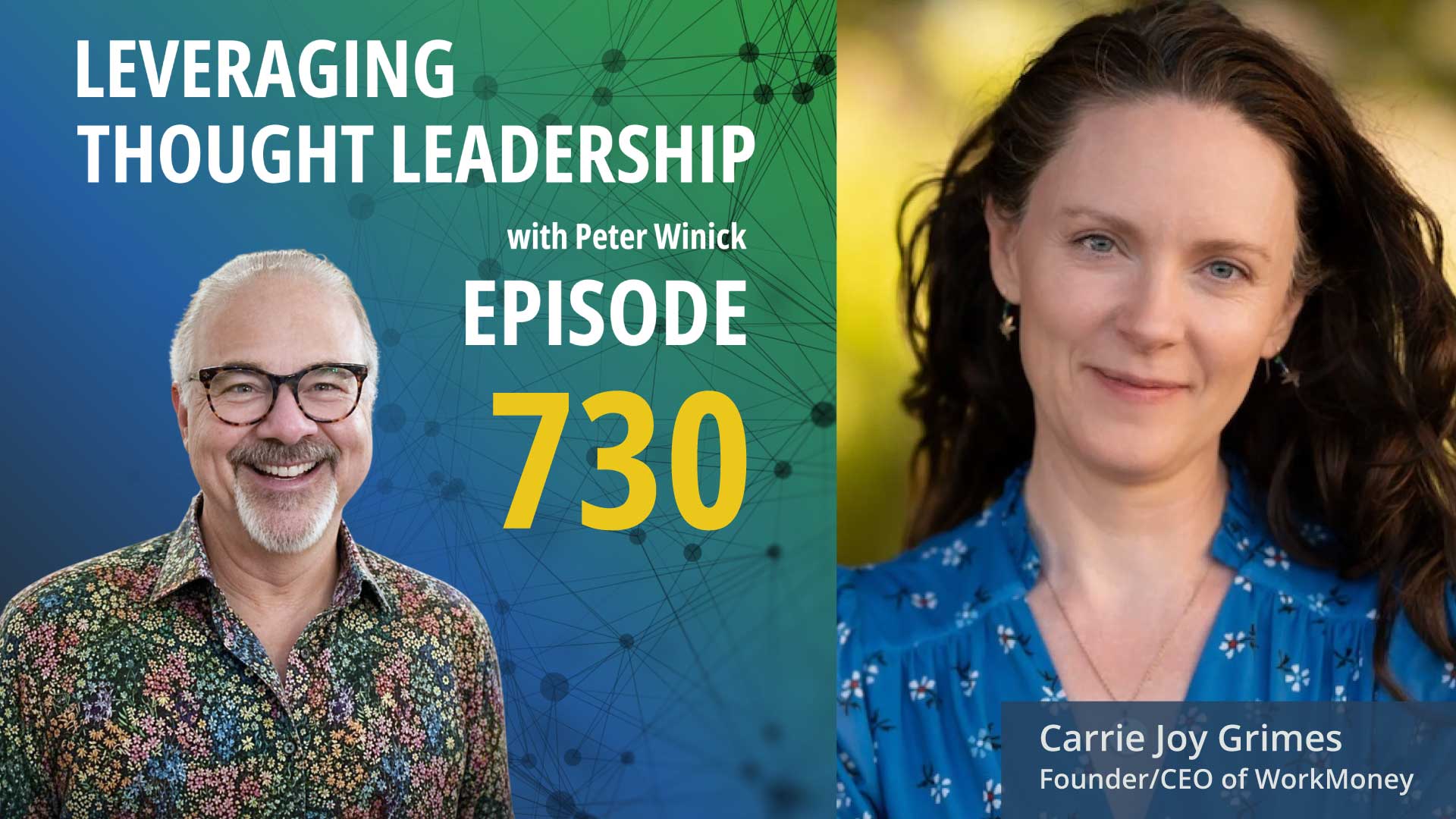



A nonprofit CEO on rebuilding money advice around dignity, not shame
A nonprofit founder explains why she treats personal finance like poker: play the hand you’re dealt, then change the odds. The conversation covers building a movement-driven business model, five revenue streams for a mission-first organization, and why most people’s money advice fails to address the loneliness underneath it.
Here’s an uncomfortable truth: most people will tell a total stranger about their weird rash before they’ll tell their best friend how much debt they’re carrying. That contradiction sits at the center of this episode.
The guest is Carrie Joy Grimes, founder and CEO of WorkMoney — a nonprofit she describes as “the AARP for everyday people’s money.” She built it in 2020 after years as a union organizer, watching thousands of people wrestle with the same financial confusion she’d faced growing up in a household where money was never discussed.
The conversation opens with a poker metaphor that ends up doing a lot of work: you play the hand you’re dealt, but you can also change the rules of the game. That’s WorkMoney’s whole thesis — help individuals make the best move with what they have, while using collective bargaining power to get everyone better cards.
From there, the discussion turns commercial. A nonprofit still has to think like a business, and Grimes walks through WorkMoney’s five distinct revenue models — sales of her book “The Joy of Money”, ethical sponsorships, a bill-negotiation product called Money Finder, and a for-profit enterprise arm designed to fund financial products that don’t quietly profit off member debt. The host presses on the hardest part: how do you measure success when your mission is “financial security” and revenue isn’t the real scoreboard? Grimes lays out three separate metrics her team tracks, including one that’s surprisingly emotional.
There’s also a sharp aside on index investing — including a detail about Warren Buffett’s will that reframes the whole “beat the market” industry — and a candid discussion of why WorkMoney deliberately avoids a pure B2C growth strategy.
If you’ve ever wondered how a mission-driven business justifies its business model without losing its mission, this one’s worth the full listen.
Three Key Takeaways:
- A nonprofit still needs a real business model. Grimes runs five distinct revenue lines at WorkMoney — including book sales, ethical sponsorships, and a fee-based bill-negotiation service — because donations alone can’t fund a movement at scale.
- B2B2C beats B2C for mission-driven growth. Rather than acquiring millions of individual customers one at a time, WorkMoney partners with organizations that have already aggregated the audience it wants to serve — dramatically lowering acquisition cost and risk.
- Success metrics get complicated when revenue isn’t the goal. WorkMoney measures impact through self-reported financial confidence, actual debt/wealth changes, and retirement trajectory — because, as Grimes puts it, if members don’t feel more secure, the work isn’t landing.
If today’s conversation had you thinking about what it actually takes to turn a big idea into a sustainable business, you’ll want to check out The Thought Leadership Handbook, co-authored by Bill Sherman, Peter Winick, and Naren Aryal. It’s the playbook for shaping, packaging, and scaling expertise in a crowded market — exactly the kind of business-model thinking Carrie Joy Grimes brought to this episode. Learn more at thoughtleadershiphandbook.com.
Order now:
Amazon
Barnes & Noble
Bookshop.org
Amplify Publishing
Apple Books
Learn more at thoughtleadershiphandbook.com
Transcript
Peter Winick And welcome, welcome, welcome. This is Peter Winick. I’m the founder and CEO at Thought Leadership Leverage, and you’re joining us on the podcast, which is Leveraging Thought Leadership. Today, my guest is Carrie Joy Grimes, and I’ll tell you a little bit about her. She started Work Money in 2020 because she believes money should be straightforward. And if you work hard, it shouldn’t break the bank to pay the mortgage, get dinner, or take your kiddo on a trip to Disney. She wrote a book called The Joy of Money. And we’re going to talk about both of those things today, as well as some other things. So welcome aboard, Carrie Joy, how are you? I’m pretty great. Thanks for having me. I love this podcast. Thank you. Me too. I don’t have to listen to it because I create it. So it saves me the time of listening to it.
Carrie Joy Grimes I’m having listen, isn’t that, you know, that’s funny. That’s why I wrote the book because I was really, but it’s funny that I wrote the book I wish I’d had and now I can’t imagine reading the book that I spent all those, you wrote a book recently too, is it the same thing for you?
Peter Winick Yeah, to some degree. I think we wrote the book we thought the world needed, but a lot of people we hear, you know, I wrote the books, I wish I had 20, you now, it’s like me search and therapy and all that. But yeah, how did this, tell me about your journey. How the heck did you get here?
Carrie Joy Grimes Oh my gosh. Well, before I say that, I will just say, I had to do this thing where I had to listen to the audio recording of the book, which I did. And if you, have you recorded your book yet?
Peter Winick We’re debating because there’s a lot of frameworks and models and all that, so depicting, we’re wrestling with that if we’re going to do that.
Carrie Joy Grimes I wrestled with the same thing because there’s a lot of like worksheets and forms and eventually I said, okay, so we recorded a version of it and a lot my friends bought the audio book and I have to tell you that the number of phone calls I’m getting from my friends who are like, wow, your audio book voice is very specific and deliberate because you can’t talk at a normal pace when you are recording an audio book. And so as somebody who’s a fast talker from the East Coast, I will be very curious if you have to record yours, if you go through the same emotional experience I did recording mine. Which was very difficult.
Peter Winick Well, the other thing that people experience with audiobooks is that the spoken word and the written word are very different. So what might read is a great chapter. When you read it out loud, you’re like, that’s clunky. I would never say that out loud.
Carrie Joy Grimes Loud and you can’t change it that much I mean the publishers like sorry you have to record the book that you wrote and it was such a thing oh my gosh I love that you have not I highly recommend it if for nothing else it’s like really fun to do hard things when it when you’re like to learn for me anyway that’s my that’s part of my journey so my journey I ended up here because I grew up a pretty Like on my own, I was out of my house very young, 16 to 17, and I kind of made my way through the world in the way that people do. And I felt like I had to figure out all of this money stuff all the time by myself. Like I was just trying to figure out what a dollar meant.
Peter Winick Probably because you did, if you’re on your own.
Carrie Joy Grimes Yes, and it was, you know, my parents were, were, were fine, you know, they, my home was on a safe place to grow up, but nobody ever talked about money. So I didn’t have any training in money. And then I got out on my own and I was working my way through the world. I waited tables and tended bar and that way that you did. And then, I ended up becoming a union organizer for a long time. And I had this like real gift of an experience where I got to do two things at the same time. I got to figure out my own money stuff while I was talking to thousands of people. About their money stuff. And I started to see a lot of patterns. And so that led me to starting Work Money in 2020, which is a nonprofit like the AARP where everybody, I think everybody in America, if you work hard, you should be able to afford to live a good life.
Peter Winick That would be nice
Carrie Joy Grimes I mean, it’s the, it is in theory, the purpose of what we do out here in this great country. And so the idea is get a bunch of people together into one organization, and then help us all do our best at our individual money. You know, you got to play the hand of cards you dealt. Even if it’s a crappy hand, that’s the hand you don’t play. And then also though, how do we use our collective strength, you know, to like bargain for cheaper stuff, to support businesses and entrepreneurs who are making things that for us.
Peter Winick So stay there for a minute a minute because you know when I look at the work that you’re doing you know on the one end if you have to put in a category it’s probably financial literacy something something something and the problem with that is if you’re reading a book on financial literacy it’s just such a bad brand you’re basically saying well therefore I am illiterate well nobody wants to say that like it’s right like the dummy’s book sort made fun of that. So you did the dummies book for Microsoft Excel because that was new when it came out 30 like whatever but right so you so you’re really talking about sort of two things one is the knowledge, but then the other is the choices and the power of Organizing people that might not be organized to get benefits and such that they couldn’t is that is that a fair?
Carrie Joy Grimes Yeah, that’s really, I think about it like, so my husband is a former semi-pro poker player. And we play a lot of poker in our house and he plays a methodical razor sharp game. And he plays the odds. He’s played hundreds of thousands of hands of poker, which is.
Peter Winick He’s a stats guy. He’s playing like an algorithm.
Carrie Joy Grimes He’s a quant, he’s a super quant guy. And I barely look at my cards, I just watch the humans at the table. And I’m like, okay, what are you gonna do? Oh, you’re lying, you know? And it drives him crazy when I win. And it should, it should drive him crazy.
Peter Winick Now who wins more?
Carrie Joy Grimes I’m a married person, you’re not gonna actually ask me to answer that question, except it’s me. But I would never say that out loud on a podcast because it would really upset my husband.
Peter Winick So we won’t say that it’s not him.
Carrie Joy Grimes We will not say it’s not him. Of course we would, I would never. But it’s funny because I realize a couple of things in playing poker that I think of money a lot. Like poker, what I mean by that is you play the hand of cards, you’re dealt. And you get the hand, you gotta improve it sometimes. Like sometimes you just get an off suit, bunch of garbage, and you gotta figure out what to do. And the rules of the game are also up for grabs. And so I built work money to do two different things. You just really nailed it, which most people don’t quite clock that it’s two things at once. One is like let’s look at your hand of cards, let’s help you make the best possible statistical move with that hand of card. Like what do you do next? And then also what if there was more in the pot? What if we got better cards for our end of the table? What if it was like, and we can, we can pool our power to buy stuff, we can pull our power to make sure that businesses get the right. Like if one business is better for people than the other, we should send customer to the places that are better for us. We can invent our own stuff. We can choose the kind of podcasts we listen to. Instead of falling victim to the algorithmic, you know, there’s a lot of like, if it bleeds, it leads out there.
Peter Winick Yeah, yeah, of course.
Carrie Joy Grimes Right. And then also, of course, we can use our power to make sure that I mean, I’ll be honest, I don’t really care for either political party, but I’d love to see people in charge who are making choices that make businesses better and make consumers lives cheaper. And so I think I make choices that way.
Peter Winick So I want you to unpack this right so I love the market I’ve been investing for a long time blah blah blah but at the end of the day I’ve and it took me probably tellers into it was on my 30s to realize I’m not smarter than anybody um you know like maybe some maybe there’s some much smarter than I. One or two. I’m not sustainably smarter than the market over any period of time, period, full stop. So like, although there’s like little bits of stuff, I’ll take risk and do LLPs on stuff, but like kind of an index guy. And so I look at that and go, and by the way, that’s worked incredibly well for me. And then I look at the whole financial services market, and I don’t want to be a cynic. But I’m like, you know what, most of its BS most of it’s like, why does somebody have their hand in your pocket for, you know, assets under management of a point and a half or what, like, what the you like them there. Working ten times harder for you when you’ve got a million bucks and when you get a hundred grand? I don’t think so.
Carrie Joy Grimes So you’re so smart about this. I mean, this is.
Peter Winick This is that is in your world
Carrie Joy Grimes I mean my entire book like especially when you get to the there’s a money level 9 which is about investing the whole book is kind of a love letter to index funds because I say you know like look I don’t think I’m better than Warren Buffett there’s one one one fund that regular people have access to that has beat the market and that’s Berkshire Hathaway’s that’s Warren Buffett and it didn’t do that it did not do that in the last 10 years last 10
Peter Winick Unless you see what happens when he’s gone and all that, right?
Carrie Joy Grimes Well, and now that he’s retired and his number two is in charge, the thing that’s so fascinating is that, and I couldn’t, once I read this, I was like, oh, this is ridiculous. So in his will, his money goes to his wife and 90% of it per his will’s instructions are that it gets put into an S&P 500 index fund. I mean, it’s just, I don’t think I’m better than Warren Buffett. And I do, my husband, he loves, you know, he’s a real risk guy. He’s like a quanti guy, so he loves to. He’s into crypto, he understands it, he spends a lot of time on it. And so when I look at how much time it takes to do that kind of stock picking or crypto, it’s like, A, I don’t have the expertise. I don’t have the unfair advantage because I come from that world.
Peter Winick And you probably don’t enjoy it. Like if, like, I like to watch CNBC when I’m having lunch because I’m curious, you know, it’s just, I’m not as much of a sports guy. So I like that, right? But it doesn’t, I’m impulsively changing things based on this one talking head said by Microsoft today and the other said by Nvidia. Like you can’t because you’re never gonna catch up. So tell me a bit about then your, so I get the focus of the thought leadership. What’s the business model? And this is a little meta, how does the money, the work money lady make money?
Carrie Joy Grimes Right now. Yeah, that’s right. It’s a great question. So right now, we take donations, because we’re a non-profit. From everybody, everybody and their mama. We have a lot of money from a lot donations. However, I think that’s a good question. And this is, so at WorkMoney, what we’re trying to figure out, we have five different revenue models. One is stuff like writing and selling books, you know? And so we just hit the USA Today bestseller list last week. Nice. It’s like, could not be more on brand for us. I mean, are you kidding me? It’s perfect.
Peter Winick A great idea is only the beginning. In the Thought Leadership Handbook, Bill Sherman, Naren Aryal and I share what it takes to shape, package, and scale your expertise in a crowded market. It’s available now. Learn more at thoughtleadershiphandbook.com and order it today at Amazon, BNN, Bookshop, or Amplify.
Carrie Joy Grimes So one way is making content and sponsor getting sponsorships, you know the way that content works. Yeah, there’s I think the
Peter Winick But that but stay there a minute. That’s no different. I mean, at the end of the day, nonprofits just a tax exemption, right? So you right. So you’ve got now, people don’t donate money to companies to stay in business, like nobody, nobody’s saying I’m going to leave in my will, you know, all my money to Coca Cola, so they can still put sugar water together, right. But you still have to think like a CEO and a business person.
Carrie Joy Grimes One hundred percent.
Peter Winick You just have different things that are available to you.
Carrie Joy Grimes That’s exactly right. And the thing that makes it really particularly complex is that the reason to start work money is to build the America where people can afford to live a good life. And the single most important thing, our metric of success is, do our members have more financial security at the end of the day? Which means.
Peter Winick By what standard though? How do you measure that?
Carrie Joy Grimes We measure it in three ways. One is do they self-report that they feel more financially secure? Because if you don’t feel it, it’s not happening for you. I mean, we’ve all been in that weird relationship with somebody who’s like just determined.
Peter Winick So that’s what’s interesting about that. It’s a bit counterintuitive that it’s qualitative, but I could have the same money or debt or whatever. But because I read your stuff, I feel better. Maybe I feel more confident or I have control or whatever, yeah.
Carrie Joy Grimes That’s right, that’s right. It’s one of them. And then the other is the metrics are different based on where you are at stage of life. Like, do you have more? So do you and then do you have mathematically more financial security? Are you less in debt? Are you, do have more wealth? Like one of those two things. And then third is, are you on track for like a better retirement? Like are there actually more dollars in your? Yeah, exactly, exactly. And so what I think is really interesting is that right now, if you look at the AARP as a comparison for business models, they make most of their money. Through the health insurance, the wraparound insurance, which is great for them. I mean, it’s well, it like somewhere between one and a half and two billion dollars a year that they generate revenue. Then they have their magazine, which is still a widely, most widely read magazine in their membership, but the membership fees really only pay to mail that magazine around and produce it. It doesn’t actually produce most of the revenue that they generated.
Peter Winick And you get a tote bag or something.
Carrie Joy Grimes You need a tote bag. Sometimes you have to like, you get, oh, right, I have this discount when I rent a car or something.
Peter Winick If I remember, yeah.
Carrie Joy Grimes I remember to use it you know and so like I’m an AARP member by the way anybody can join at any age I do recommend and I think a lot about this and so we have Ethical sponsorship so people who are aligned with our values like we can’t make content to sell things We have to yeah left to like our content and want to associate with it It’s just a little different than like hey, I really love that Coca-Cola money. That’s some good. It’s like no wait
Peter Winick No, no, no. Wink, wink.
Carrie Joy Grimes Yeah, you’ve got to like really believe what we believe and then we’ll walk a path with you And then we also are gonna we have memberships, which we haven’t rolled out yet But i’m okay, we’re gonna do a version of that in the in the future The thing that I think is really the bet that I want us to make which is a you know It’s a higher risk bet with higher reward is I really want us to make Products and services and to acquire businesses and to support businesses That are making things that I thinking people should have for example We have a new, it’s still in beta, but I’m going to tell everybody so you can go try that if you want. It’s called money finder, moneyfinder.com, the bill negotiation service that we’re building out and we’re starting with internet cable and cell phone bills. And right now the rule is we will take half of what we save you up to $75 and we’re not going to charge you more in the first month than you would have paid with your original bill. So the theory is.
Peter Winick You’ll spread out that savings over a little better
Carrie Joy Grimes Yeah, and so you don’t pay more so you’re never gonna
Peter Winick Why would you not take that bet like who would not and by the way who loves paying their cable company and you know, whatever
Carrie Joy Grimes and who loves calling them to deal with them? I mean, are you kidding me?
Peter Winick And there are for-profit businesses that do that. So all things being considered, it would be best to work with a non-profit if I was aligned or if I’m aligned with your way of thinking and whatever. Like, wait, you’re gonna save me money, it’s not gonna cost me any money. It’s do good, do well.
Carrie Joy Grimes Right. And so there’s like, I’m looking actively. So anybody who’s listening, like call me up, like get, find us on the web. Like I’m really looking for partners and businesses that we can help, you know, that we fund. You know, we’re, we are pretty decent seed investors. We have a pretty large budget. We’re really well supported by our members and by other folks. And so I, I am really interested in building. I mean, so we have work money, the C3 and C4 non-profits. And then we have, we wholly own a media company and then for the sponsorships. And then, we also wholly own a thing called Work Money Enterprises. And the idea there, that’s where Money Finder lives, is that we will have a fleet of products and services and financial, we’re considering financial products just because people should have access to things and aren’t you serious? It’s complicated. For example, with credit cards, which I think people should be able to get a credit card that is not gonna mess with them. And also, if you have really, if you need to rehab your credit, you gotta get a credit card to figure out how to do it. There’s a bunch of things to do, but one of that is using.
Peter Winick Right, right.
Carrie Joy Grimes The problem with credit cards the way that they’re currently constructed if you’re a non-profit is that you only make money if the people who are using the card are in debt. So you get basis points on the debt that they hold.
Peter Winick Which is the antithesis of what you’re trying to do, right? There’s no benefit of getting somebody to pay off their debt when, yeah.
Carrie Joy Grimes Yeah, not if our metrics of success that people feel more financially secure and then they have more money and they have a plan So one of the things we’re really thinking through so there’s the bill negotiation service That’s just like a mechanical can we figure out a process that scales and you know, we’re in that we’re going through that process And then the other stuff it’s like there’s going to be two different market And I love your take or any of your listeners who I I know who your audience is So part of why I’m over explaining is I’m like hey people write into peter and give me some free advice But one of things I am thinking about is at what point is it? The right decision to find better financial products, even though the financial system and then the financial services industry is really built to extract from people most of the time. It’s not really built.
Peter Winick So many products out there now that are so cheap when you actually know what you’re buying in terms of the fees, right? You know, that’s tough as well. So I wanna make a comment in terms of you’re not trying to take over the world, right, you’re trying to make a zillion bucks. What you’re really doing is creating a movement, right. And there are a subset of thought leaders that we’ve worked with over the years in varied education and a couple other places where it’s really about a movement. Right. And, and the financial piece of it, you know, in terms of the, where the money flows and all is really the mechanics, because you really try to change behaviors and change mindsets and get people to better outcomes. Right. So that’s, that’s pretty noble. That’s pretty cool.
Carrie Joy Grimes Well, you’re kind. And like, so having had a bunch of these conversations with people like me over the years, are there patterns that stick out to you? Are there places you see people get stuck? Are there things that you’re like, Oh, in this case, here are things that translate from like, you know, more rough and tumble on.
Peter Winick Yeah, I think there’s a lot of that. I think high level thought leaders, given their druthers, like to spend time creating more stuff. That’s what the classic thought leader does. So during COVID, we had sort of the COVID renaissance because what happened, a bunch of smart people that were living on planes and delivering speeches and all that other stuff, now they’re stuck at home and they learned how to make sourdough or whatever the hell they did for the, you know.
Carrie Joy Grimes Oh my god, you know, that’s how work money started because I was, it was COVID. That’s how I started work money, like same thing. I was stuck in my house.
Peter Winick I got time. What’s the thing? And you know, whatever. But I think that that going back to your point that, you know from a pattern standpoint, if you’re not putting equal to or greater than effort into the sales, marketing, business development, just that part of the house, you’re not going to win. You might you might be okay. But it sounds to me that you are spending a lot of time there, right? So you’re just creating and you know the you know that the worst thing I hear and here’s the 11 the series of 11 books I’m going to write and this and that like, okay, that’s fine. And I’m sure you do have more to say as a thought leader. But it’s really The unsexy part of thought leadership is finding the strategic partners is finding the distribution for partners is cracking the code on business models, formats, methodology. So I would say you’re, you know, what sounds like at first blush, you’re doing a lot of things well.
Carrie Joy Grimes Oh, that’s really kind. And I think that you really nailed it there. It’s funny. I didn’t, I don’t mean to represent it like I was so smart. And I thought all about distribution for the beginning. It just turns out that when you realize that the only way you have to do the thing you want to do is to get a lot of people into a distribution channel.
Peter Winick Cause so that’s why we don’t play in the B2C space, right? So we’re B2B, right. And you know, your content we could argue is B2c or B2b. Well, the net beneficiary of an end user is probably B2 C, but your business model is more B2 B2, B2-C, right to B2 to C because you’re not out there going, I need to find a hundred thousand people that’ll spend $5 or whatever you’re like, I needed to find 20 partners that have already done the hard work of aggregating 50, a hundred, a million, whatever that number of like minded people would benefit from my work. That’s the ultimate hack, if you will. Right. And I think a lot of people don’t get that because you’re and just the math, you know, when you’re going straight B to C unknown customer acquisition costs don’t like that risk profile. And maybe your plant husband wouldn’t either. Right. And then the other variables unknown lifetime value. Holy crap. Those are two variables that if you don’t know the answer to unless you got like an infinite pot of money. You don’t have the right or should not be playing there, you’re going to get crushed.
Carrie Joy Grimes Yeah, that’s right. That makes a ton of sense to me. I really appreciate that. You know, and what’s really funny too is I didn’t, this is, I don’t mean to throw a curve ball in, but let thing, you know, I think we think a lot about, you now, how, what is the value that we provide to our members? Like, how do we, how do I know that they, like, what is, the, what, what are they getting out of it? Because we don’t have revenue as a way to judge right now. And we will, right? Like we’ve got the book and where we’ve launched this.
Peter Winick You know net debt reduced of our member i mean you could come up with sort of i don’t think so metrics sort of
Carrie Joy Grimes Metametric kind of things. That’s right, that’s right. But one of the things that has come that has, so I was like at the individual member level, we have so much, it’s such a wonderful experience to have, you know, we’ve got 9.4 million people who’ve signed up for our information and services. And we’ve put about $2 billion back in folks’ pockets through private and public sector stuff and we help people navigate it. And that’s not counting. You know, any of the like, we worked really hard with the Department of Labor to raise the overtime threshold. It hasn’t been up since 70. So we’re not counting any of that stuff. This is just like straight like from our information, you got it, you gotta you gotta money in your pocket. And I, I, so I was, and we, we do count, we’re very quantity in that way. And my husband’s very happy about that. One of the things that was shocking to me was how much people have a relationship with me through the texting, emailing, and calling me to. Then I don’t think I understood. I mean, I got it intellectually kind of, we become more atomized as a society, you know, the isolation, but I did not realize, this is part of why I talk a lot about money is math and feelings. I didn’t understand how lonely, and it’s not just about lonely like being my friend. It’s more like people feel really isolated in their anxiety about their money.
Peter Winick No, and the things people will share, including total strangers with you about their personal lives or whatever, that rash they have, but people won’t talk with their closest friends about their financial issues and stuff is a little crazy. One of the things I would say when you talk about the metrics is that I could almost envision some sort of a financial mood ring. Like when I start working with work money. The mood ring is black, not that I’m dating myself but I’m dating myself right now. I mood ring as we have an age. Yeah. Yeah.
Carrie Joy Grimes And then it slowly gets to green, yellow, and then it gets to that blue color with the purple at the end, right? Yeah, totally.
Peter Winick I didn’t go pet rock. You notice I didn’t do pet rock.
Carrie Joy Grimes Well, or Chia, that would have been, at least we’re in the 90s here. Thank you very much for that.
Peter Winick Maybe, yeah. Well, this has been great. I appreciate your time and sharing your journey and great stuff. Thank you. Thank you for spending time with us today.
Carrie Joy Grimes I really appreciate the chance to talk about it and get some free advice. Thanks, Peter.
Peter Winick To learn more about Thought Leadership Leverage, please visit our website at thoughtleadershipleverage.com. To reach me directly, feel free to email me at peter at thoughtleadershipleverage.com, and please subscribe to Leveraging Thought Leadership on iTunes or your favorite podcast app to get your weekly episode automatically.
