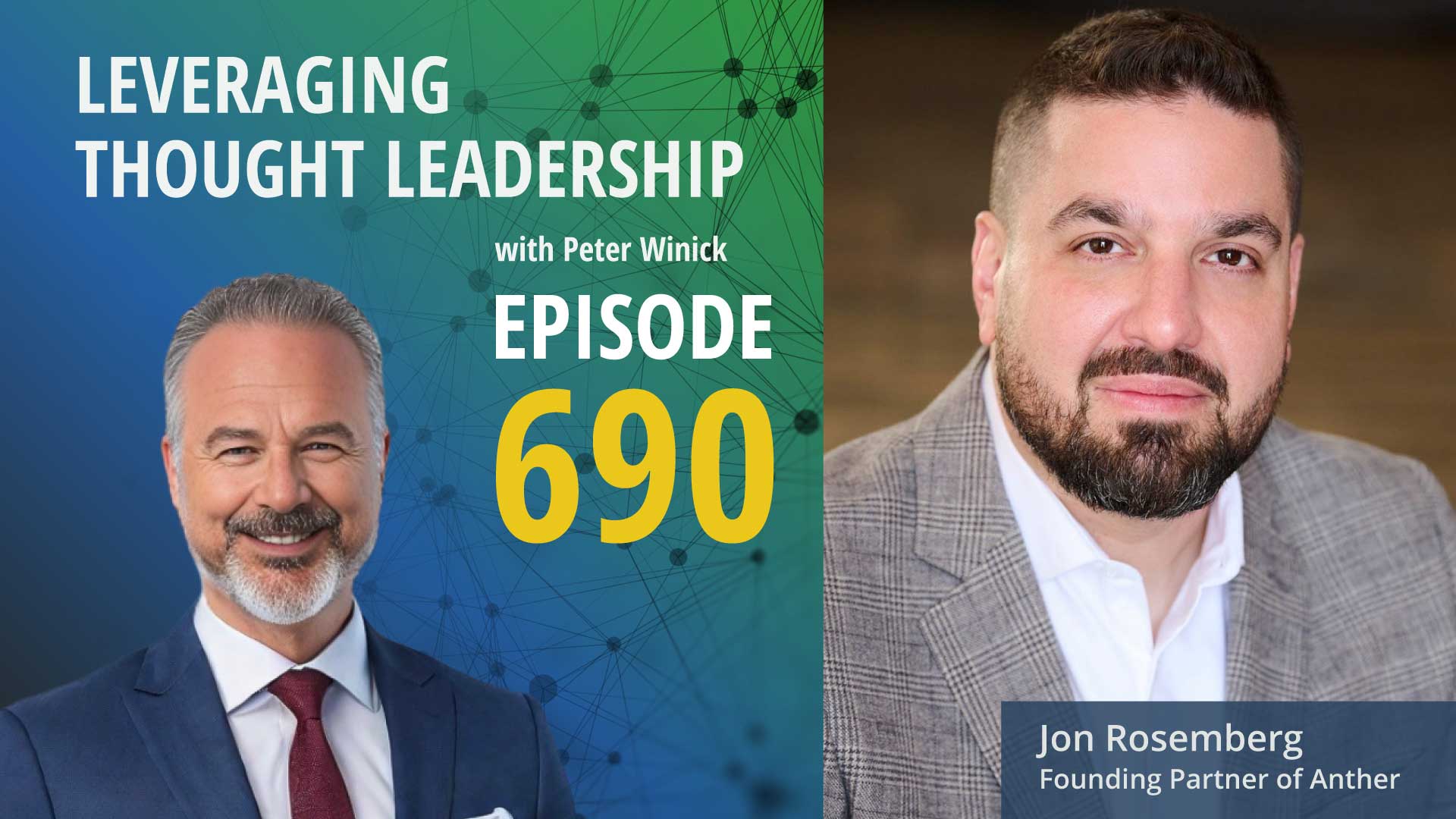
Frameworks for connection, accountability, and performance This episode examines how psychological safety drives performance, how…
Agency, Strategy, and the Science of Thriving | Jon Rosemberg



A practical framework for leaders who want clarity and performance
This episode defines thriving at work and how it differs from success and flow. It explores agency and strategic choice as levers for better leadership and stronger team performance.
What if “thriving” isn’t a soft concept—but a measurable performance advantage?
In this episode, Peter Winick sits down with Jon Rosemberg, Founding Partner of Anther and author of “A Guide to Thriving: The Science Behind Breaking Old Patterns, Reclaiming Your Agency, and Finding Meaning”, to break down what thriving really is, what it is not, and why leaders should care right now.
Jon draws a sharp line between thriving and “success.” Success can be the big house, the title, the milestones. Thriving is different. It’s a state where you’re calm, connected to others, and able to create. It’s when you can access the best of your thinking and show up as yourself—not as a reactive version of yourself.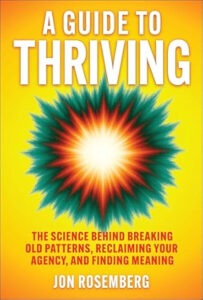
They explore the practical business implications. Jon frames thriving as the condition that makes proactive leadership possible. Less reactivity. More intentionality. Better decisions. He also positions “flow” as a subset of thriving—useful, but not the whole story.
Then the conversation gets strategic. Jon introduces agency as the lever that moves people from survival mode to thriving: the capacity to make intentional choices. And he connects it directly to strategy. Real strategy is not doing everything. It’s making clear choices—and just as importantly, choosing what you will not do.
For leaders building teams, Jon highlights the shift from productive value to relational value. Your job stops being “do the work.” Your job becomes “enable others to do their best work.” When teams are thriving, performance rises. When organizations treat well-being as a KPI, it becomes a competitive advantage—not a perk.
Finally, Jon reframes thriving as a spiral, not a finish line. Markets change. Crises hit. AI reshapes work. The goal isn’t to “arrive” at thriving. The goal is to build the capacity to return to it faster—and lead through uncertainty with more clarity, nuance, and adaptability.
Three Key Takeaways:
- Thriving has a precise definition. It’s not “success” or status; it’s being calm, connected, and creative—able to access better thinking and show up authentically.
- Agency is the lever. Moving from survival mode to thriving starts with the capacity to make intentional choices—and that maps directly to strategy in business.
- Thriving changes performance at the team level. Leaders shift from their own productivity to relational value—enabling others to do their best work—which increases team performance.
If Jon’s episode got you focused on thriving through agency, go next to Episode 156 with Linda Henman for the “now what?” Linda is all about making tough, high-stakes decisions—fast and well—so you can
turn intentional choice into real strategy. Together, they pair thriving as the mindset with decision-making as the skill that makes it real.
Transcript
Peter Winick And welcome, welcome, Welcome. This is Peter Winnick. I’m the founder and CEO at Thought Leadership Leverage. And you’re joining us on the podcast today, which is Leveraging Thought Leadership. Today my guest is John Rosemberg. John is an author. He’s an entrepreneur. And he will tell you some of the other interesting things that he does, but his latest book or his new book is called A Guide to Thriving. So welcome aboard, John.
Jon Rosemberg Thank you, Peter. It’s such a pleasure to be here and I’m looking forward to the conversation and to diving in.
Peter Winick So let me ask you one of my favorite questions that I ask pretty often, which is sort of, how did this happen, right? You didn’t wake up one day at five years old and said, this is what I wanna do. Or maybe you did.
Jon Rosemberg I did not, I was in the corporate world for over two decades and I climbed a corporate ladder and, you know, I had achieved everything that I thought I wanted to achieve when I ended up working for a startup, we raised a series B round of $150 million. We were growing double digits every month and I was like, I got it. I made it and I burnt out and I had never felt so empty in my entire career. So one day I had just gotten back from a trip from LA. I had. Just purchased new facilities for the organization. And I was in a call with a, with a technical team and the call escalated very, very quickly. And I ended up just shutting off my laptop, uh, shutting off my phone and I was like, I can’t do this anymore. So I went downstairs to the basement and my kids were playing with Legos and I just sat there with them and it started playing with the Legos, and I realized that I hadn’t been present for them for a very long time and that hit me hard. And I. I cannot do this any more.
Peter Winick So two weeks later, what’s worse being in corporate America or stepping on Legos barefoot?
Jon Rosemberg Uh, that’s a great question. I I’ll take the Legos. Uh, I’ll take the legos any day. Anyway. So in that moment, I realized I was physically present for them. Like you could see me around the house, but I wasn’t really there. I wasn’t really connecting with them. So this is when I decided to walk away. I went back to school and got my master’s in applied positive psychology, and that sent me down the rabbit hole of trying to learn more about thriving. And as I started learning about everything that has come up over the last two and a half decades, I was just fascinated by the amount of research and information and exploration that there is around this idea of going from survival mode to thriving.
Peter Winick So let me ask you that, so if there’s more research, more data available around thriving, are more people thriving today than not?
Jon Rosemberg Well, a recent study by foresters and, uh, and Gallup too, they have two different studies suggest that only about one third of employees are thriving. So we have about seven out of 10 employees who are not thriving. Now, does that mean that they’re necessarily in survival mode? We don’t know, but we know that there’s, there’s a big gap there in terms of how many people are actually feel like they’re thriving.
Peter Winick Got it. So from a wonk standpoint, how are you defining thriving? Because sometimes what happens when you’re having conversations with thought leaders is, you know, someone thinks they’re talking about X, but they really mean Y. So what is your definition of thriving? What, what does that look like? What does that feel like?
Jon Rosemberg So first, let’s define what thriving is not. And I would argue that for me, thriving is non-success. It doesn’t mean that you have a big house and a nice car and, you know, five, you fly on a private jet, that’s not thriving. That’s success. And that’s a fair definition of success for me. Thriving is this, this state in which we’re calm, connected to others, and we get to be creative. It’s a state in, which we get to engage our prefrontal cortex, a state which we get to. The show up in the world as our authentic selves. That’s thriving.
Peter Winick So it sounds to me like maybe it’s a first cousin or connected to Flo. You can’t be in details in the thriving or it sounds me like there’s a relationship there.
Jon Rosemberg I would say, and I argue this in the book, that flow is a subset of thriving. It’s a form of thriving, right? When we are in flow states, it’s likely that we’re thriving.
Peter Winick Got it. Right, because you couldn’t, I would imagine by definition, you couldn’t be in flow state and survival at the same time, biologically.
Jon Rosemberg I haven’t seen any research on it, so, uh, we can speculate about it, but I would suggest that probably not, but hey, who knows, there might be people who are able to do it.
Peter Winick All right, I want to segue into the business side of this. So this started as a passion project for you and it’s clearly evolved and you’ve invested a lot of time and energy, went back to school, wrote the book, et cetera. What is the current business model for you as a fall leader?
Jon Rosemberg 10 years ago, I wish I would have had a book like this, right? I was for you to read in the throws. Yes. For me to read, because I was in the throes of being in this perpetual state of survival mode where, unless I got a race or I got a promotion or I God, a bigger team, or I built a bigger kingdom for the companies that I was working for. I felt like I wasn’t enough, right. I felt I just needed to reach that other milestone in order to prove to myself that it was enough. I’m not sure how this is gonna turn into a business yet, Peter, to be honest. For now, what I know is that me and my partner, Lara American, and she’s the founder of Lara Bars, we’ve started Anther, which is a firm that it’s meant to help organizations find more thriving in their day-to-day. And what we’ve been doing is engaging with companies for profit and not for profit, that are looking to bring wellbeing as one of their key performance indicators. Companies that consider that their employee wellbeing is a strategic advantage. And by the way, there was research from Oxford just last year that showed that companies who prioritize wellbeing and companies in which employees are experiencing more wellbeing outperform other companies in the market by about 37%. So the data is really compelling around prioritizing thriving.
Peter Winick So I want, I want to comment on a couple of things you said. So one is, and I’ve heard this so many times, you wrote the book you needed to read. Right. Like, so now why did you do this? Now, some people are writing a book very, um, deliberately, very strategically from a business standpoint. They know where they sit in the market. They know what the market needs. They know sort of where they’re at. They’re sort of what I would call mature thought leaders, if you will, in terms of the business side of it, others are like. I don’t know what’s going on here, but I, this has to be done. Period. Full stop. Like one of the reasons I’m on the planet is to document this and the, and the act of writing the book will help me. And if nobody ever opened it, or if I never hit send to the publisher or whatever, that might be okay too. And then they sort of figure it out. And I think that’s interesting, somewhat scary. And they both work out typically. Right. But at some point you have to apply a strategy against the serendipity or the intrinsic need to do this.
Jon Rosemberg I agree. And I would argue that I’m closer to the latter than the former in terms of how I went at this, I I’m still kind of in a way pinching myself at Wiley picked it up and that now it’s going to be published in just like six weeks and it’s a big deal and at the same time it’s helped me hone into my ability to have faith. And let me define faith because I think people, when we hear the voice or the word faith, we usually think about God. I think faith is the capacity to live with uncertainty in the world. And there’s been a lot of uncertainty in terms of the process for this book. And in my conversations, as the process has evolved, I’ve realized that doors are starting to open, right? But I wasn’t really hoping that one of those doors would open or I guess I was hoping, but I wasn’t really aiming at any of those doors to open right? So it’s kind of an interesting place to be in, especially as a business leader.
Peter Winick Yeah, I’m sort of a more of a stubborn strategist, given what I do. And I would say hope is not a strategy, but I like the way that you’re framing it as faith, because that’s different than hope because hope is a bit of, uh, it’s a bit more vague than faith, like somewhere in your brain, your mind, your heart, your soul, you knew you knew something’s going to come of this, right? So that’s faith. Hope is a little bit more, I don’t know, wishy to me.
Jon Rosemberg Broader, yes. And, and by the way, there’s lots of research on how important hope is for, for having, for thriving and for having wellbeing in our lives. But as you correctly point out, Peter, it’s not a strategy in business. Hope can be really helpful in terms for us to kind of jump into the deep end, but ultimately we do need to chart a path. And one of the things that I suggest in the book is that I talk a lot about agency as the key to moving from survival mode to thriving. And I define agency as the capacity to make intentional choices. Yeah. And in order for a choice to be intentional, you have to have other choices available to you. And if you translate that to the business world, that is strategy. What is strategy? Strategy is deciding, looking at all of your options and deciding which ones you’re not going to do, right? And that’s a, it’s an interesting lens with which to look at life.
Peter Winick I love that. So one of the framings that I like to work with when it comes to someone’s thought leadership is, okay, let’s play a little game. If there was game show music, now we’d cue it up, but we don’t have that. The low bug show. What is the benefit of thriving? Because you mentioned a couple things. You mentioned at the organizational level, 37% or whatever, but break it down for me, the benefit of understanding and moving down a path of thriving at the individual level, at the team level, and the organizational levels.
Jon Rosemberg So at the individual level is very clear. We get to engage with the part of us that thinks and process, and we go from, from being reactive to being proactive, we get to be intentional. And this is incredibly important, especially because a lot of us repeats the same patterns over and over again. And when we lean into our agency, we got to break those patterns. So that can be really powerful. It could mean, right, making a huge career change, starting your own company. It could mean… Marrying somebody else, I don’t know, whatever that may look like for the person, for our listeners. At the team.
Peter Winick I just want to add to, I want to just unpack another component of the individual piece that I wanted to ask. I would imagine for some, there might also be a health benefit. If you’re in survival mode, the adrenaline’s going, the blood pressure’s on, you’re probably not exercising, eating, right? There’s probably a whole bucket of just physical stuff that you’re putting on yourself that isn’t good.
Jon Rosemberg Yeah. So I would say there’s kind of three areas in which we, you could see improve improvements in wellbeing, having a big impact, your thoughts. So for people who experience a lot of overthinking and a lot of anxiety when we’re thriving, that decreases your emotional life. So for a lot us, you know, when we were kids, especially for us men, when we are kids, we were taught, you’re either angry or happy and everything else in between, we don’t do that. So you can have a richer emotional life and emotions are really good messengers and they tell us what actually matters in the world. So they can, it can be really helpful in terms of knowing how to make better decisions in life. And the point that you’re making it’s the body, the sensations in our body and the health of our body. And there’s lots of research that suggests that, you know, from your heart health to your, like you said, the cortisol decreases in we just get to navigate the world in a much less stressful way. So that’s at the individual level. Okay, now, so back to the team level. Back to the theme level. I think for teams, what’s really important is that, you know, I learned in my career after being an individual contributor and starting leading teams and then big teams, I learned that I had to trade productive value, I helped productive, I was myself for relational value. Bye! How much I could get other folks to do their jobs in the best way that they could. When we empower teams to do their jobs in the way that can, and when they’re thriving, we can see how performance actually increases. And by the way, there’s, again, there’s lots of research on this. Let’s not get into the details of it, but high performers are usually thriving. There’s a strong correlation there. At the organizational level, What it creates is a lot of adaptability, especially today with AI and hybrid, hybrid work and all of these new trends that we’re experiencing. When we get to engage with all of this changes and all of this complexity and we’re thriving, we can actually see a lot of new ones and a lot that we can deconstruct this complexity in a way that allows us to make decisions that are beneficial in the long-term for the business.
Peter Winick And then finally at the, at the org level, what is that? I mean, and the org is typically when I think about it, more aspirational of imagine an organization that was thriving, right? Like you never totally get there, but it’s an aspiration to continually to get closer to that.
Jon Rosemberg And I would argue that thriving is not like a one state that you reach. And then I did it, um, ring the bell, the way they describe it, the way they described it is more as a spiral, right? Sometimes we go up on the spiral and we were thriving and sometimes things happen. You know, we were talking before starting the recording about the 2000, the show that you recorded with Dan Ariely and how the 2008 crisis. I mean, when something like what happened in 2008 happens, It changes the complete landscape for your business. So your adaptability depends on your ability to thrive through those changes. It depends on capacity to reframe and understand what is happening in the world in the way that best fits your business, and this is where thriving comes in, it has a lot of power for organizations, I believe.
Peter Winick If I were to say to you, let’s schedule a time a year from now, and at that point, the book was, you’re going to deem it successful by whatever criteria. What are we going to be talking about?
Jon Rosemberg That is a wonderful question, Peter. And my short answer is I don’t know. You know, when, when this first started, I said numbers of copies sold and I said, Oh, then impact how many people have reached and I’m really not sure. It’s like I said, this is the first decision in my life that I have made professionally speaking, where I didn’t actually have. A clear outcome in mind, which is, which is very unique for somebody who came from, you know, this is, this was my job. I was in operations for God’s sake. I, dashboards were like my, my, every morning I had a, like a, a flurry of dashboards filling up my inbox and I would review all the numbers, you know? So, so to do something like this, it’s really a leap into the unknown for me.
Peter Winick Yeah, so that’s interesting because you would think, once looking at the book, okay, tell me about the type of person that you think wrote this, right? And it wouldn’t be those attributes, right, someone that’s an ops person, that’s a spreadsheet guy, you know, whatever, that’s metrics-driven, KPI-driven. You know, all those sort of things. You’d probably think more of a, what we would call a right brain, or, you now, more fluid, more creative, whatever. So maybe that creativity and fluidity was always there.
Jon Rosemberg I started my career in procurement. So exactly. And that’s a reaction that I often get. I, my, one of my, uh, claims to fame in my corporate career was negotiation. I knew how to extract the best value in whatever situation I was in. So this has been a tremendous pivot for me.
Peter Winick Franklin news flash. Like there’s hope for all you procurement people that I’ve dealt with over the years that are just. Aimful to interact with it every step of the way and create sludge and annoyance and add no value to my life. But, um, you, you’ve, you you’ve reframed my thinking that there’s hope for procurement people. We’ll get to that Peter. Okay. We’re done here.
Jon Rosemberg That’s all we need. You know, the fact that we, yeah, procurement folks get a, get a bat rep. And, and, and I think I, oh, they don’t, they earn that rap, but earn it, you know, being, being in survival mode is very useful if you are in stressful zero-sum situations, it’s really useful, right? To put yourself in that, in that moment where the adrenaline is rushing and the cortisol and all of this, and you’re hyper focused on getting the outcome that you need to get, right. But when that becomes a chronic way of living, when that begins your lifestyle, it can be really problematic. And that was my lifestyle for 40 years.
Peter Winick Right. Well, the other thing I’ll say on in defense, which I never thought I said this Sentence out loud in defense of procurement people based on what you said earlier. They lack agency, right? Yeah, you can’t have a procurement person says hey boss I decided to do this deal and you know pay them net two days Even though our corporate policy is net night like they’ve got they’re very it’s a rigid They probably have some leeway, obviously, but in terms of agency, I would think of a role that have has very, very, little agency would be procurement.
Jon Rosemberg It’s very clear what you’re supposed to accomplish, lower price, longer payment terms, you know, the best possible legal and business terms that you can get. Right. So, so it is a very zero sum way of looking. Now I’ll share this with you. The best deals I closed throughout my career were deals where we sat at the table with our vendors, whoever they were and listen, I worked for Sears Canada, which no longer exists. And we did about $550 million worth of deals with IBM. These were highly complex business process outsourcing deals. And we sat at the table with them for months, designing the solution and trying to figure out how we were gonna connect whatever we were doing to the success of the business in the long run. Sure. And that changed the conversation because it wasn’t just about price. Right. So I think it’s a, it’s an, it an important, uh, nuance that sometimes gets, gets lost cause we’re just reacting to everything that’s coming at us throughout the day.
Peter Winick Well, and price is often, you know, an easy, almost lazy metric, right? Cause it’s almost one that representative of the entirety of a deal, but you can negotiate a great price and bad terms or bad return, whatever. There’s so many other variables. Anyway, this has been amazing. I appreciate your time and your transparency. And I wish you the best on your journey there, John.
Jon Rosemberg Thank you so much, Peter. It was a pleasure talking with you.
Peter Winick To learn more about Thought Leadership Leverage, please visit our website at thoughtleadershipleverage.com. To reach me directly, feel free to email me at peter at thoughtledershipleverage.com, and please subscribe to Leveraging Thought Leadership on iTunes or your favorite podcast app to get your weekly episode automatically.

Related Posts