Building Books That Strengthen Brand and Influence A sharp conversation on publishing strategy, book positioning,…
Deinstitutionalizing Your Expertise | David Lancefield
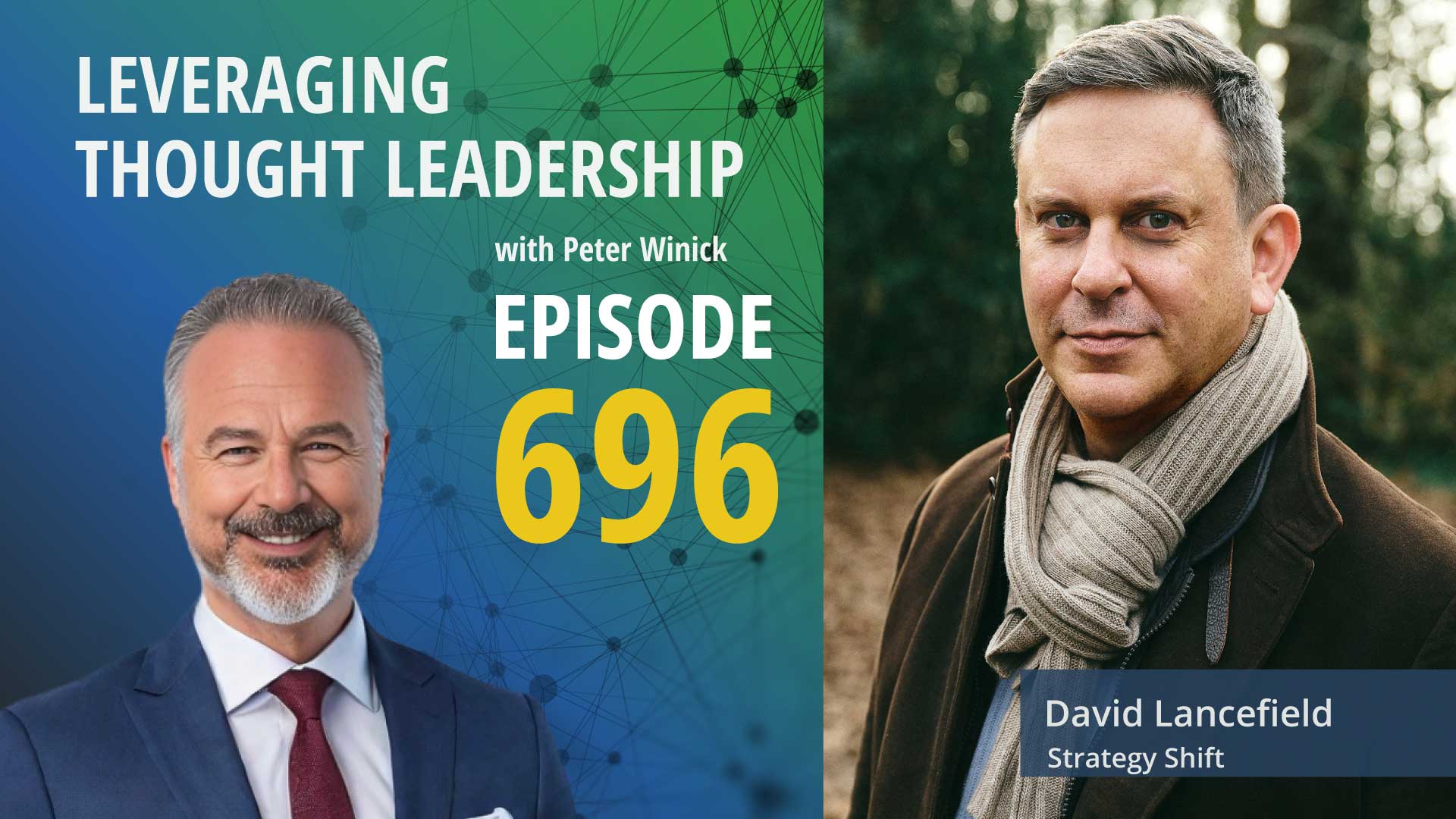



The mindset shift from institutional brand to personal platform—and why it matters
Strategy, leadership, and culture—plus how real thought leadership differentiates you (not brochure content), builds credibility beyond the big-logo brand, and scales impact through smart collaboration.
What happens when you walk away from the big logo—and discover that your thought leadership gets sharper, not smaller?
In this episode, Peter Winick sits down with David Lancefield, host of Lancefield on the Line podcast, a strategy coach to CEOs, C-suite leaders, and founders who has advised more than 50 CEOs and hundreds of executives over three decades. David writes on strategy, leadership, and culture for outlets like Harvard Business Review and MIT Sloan, and he’s deeply focused on what strategy looks like in practice, not just on slides.
David breaks down what thought leadership actually does when it’s done well: it differentiates you, attracts the right conversations, and creates a platform for real debate. But he’s equally blunt about what it becomes when it’s done poorly—a “glorified brochure” sitting on top of a product. If you’ve ever wondered why some “insights” feel alive and others feel like marketing copy, this is the distinction.
You’ll hear how David approaches thought leadership now that it’s tied to his name, not a firm’s brand. He’s intent on building a credible voice in a cluttered marketplace by staying rooted in the work he cares most about: strategy as an operating system for day-to-day decisions, leadership behaviors that actually move outcomes, and culture as a lever—not a poster. His writing isn’t just content. It’s credentialing. It’s a signal. And yes, it drives leads—though he’s candid about the reality: quality varies, and discernment matters.
The conversation also goes deep on collaboration as a serious thought leadership growth strategy. David argues that one voice is rarely enough anymore—and that co-creating with the right partner can make 1+1=3, if you do it intentionally. He lays out what “good collaboration” looks like: shared premise, distinct lenses, complementary audiences, and—most importantly—operating standards. Deadlines. Quality. Mutual ownership. No babysitting. No chaos. Just professional chemistry that produces better ideas faster.
Finally, David unpacks a subtle but important shift many leaders miss when they move from institution to independence: the definition of “enough.” Inside big organizations, “enough” rarely exists—there’s always another growth target, another push, another rung. Outside, you can reverse-engineer your needs, design your capacity, and choose work that fits your life without losing intensity or impact. It’s not about working less. It’s about working with agency.
Three Key Takeaways:
- Thought leadership is either a differentiator—or a brochure. At its best, it creates a platform for debate, positions you as an originator, and connects directly to real services and outcomes. At its worst, it’s “a glorified brochure on top of a product.”
- Independence forces clarity on your voice, not your résumé. When you leave the big brand, people care less about who you were and more about who you are now—and what you stand for. Your writing becomes proof of credibility, not just content.
- Collaboration can be a growth strategy—if your operating standards match. The upside is 1+1=3: shared premise, complementary lenses, expanded audiences. The risk is misalignment on deadlines, quality, and effort—so you have to set expectations early like pros.
If you liked David Lancefield’s take on credibility and differentiation, listen to Episode 9 with Charles H. Green (“The Trusted Advisor”).
Charles shows how trust is the real engine that turns thought leadership into better conversations, faster decisions, and stronger client relationships. It’s the perfect companion to David’s message: don’t just sound smart—become the advisor buyers believe and choose.
Transcript
Peter Winick And welcome, welcome, Welcome. This is Peter Winick. I’m the founder and CEO at Thought Leadership Leverage. And you’re joining me on our podcast, which is Leveraging Thought Leadership. Today, my guest is David Lancefield. He is a strategy coach for CEOs, C-suite executives, and founders at some of the world’s top organizations. He’s worked with more than 50 CEOs and hundreds of execs over the last 30 years. He writes about strategy, leadership, and culture in places like Harvard Business Review, MIT Sloan, and he does a lot of other. Interesting things so welcome aboard David. Nice to see you today.
David Lancefield Thank you, likewise Peter.
Peter Winick Great. So how did this happen? So you and I were chatting and you took what I would consider a non-traditional path, right? You got the brass ring, the partner at the big firm, and then you said, you know, I kind of don’t like the taste of brass, right, or tell me the story, if you would.
David Lancefield Yeah, or perhaps I wanted to taste something different. Yeah, so I’ve been a partner for 14 years. When I said I was going to moving on at age 46, people thought I was courageous or most of them thought I was mad giving up quite a lot. I just fancied to doing some new things. I’d sort of started as a postgraduate, um, being working in the same organization, working with more than 30 countries, lots of variety, lots of stimulus, but there was a niche working more closely with the CEOs, trying some new thing out, uh, new environments and also with a bit more flexibility to help look after my son. So actually it was a positive mood. I wasn’t frustrated, but I also didn’t want to become plateaued or stale, which I saw some people doing later in life.
Peter Winick For many, that would be the time where people say, great, I did it, right? I put in those 80 hour weeks, I’m making the big box. I’m working on the big client engagements. Not that it’s cushy at that age, cause you’re still working really, really hard, but there’s a lot of risks to go from the known to the unknown at that point. Particularly like you said, you know, 46 children, the whole, the whole gamut, so I think there’s.
David Lancefield Yeah, no, absolutely. So yes, I mean, you lose, you lose a big brand, you lose the, you know, the, the introduction where you say, my name’s David Lancefield. I’m a partner at type of sort of stuff at the same time. When you have a big jolt in your life, which I did years before that, my son having brain damage, that was one of the major triggers to say life can be really short and I don’t want to have you like keep, I could carry on doing the same sort of things, hopefully progressing, making more money, working really hard and it would be fine. Hopefully. But I don’t want to end up 10, 20, 30 years later, because I want to live a long time thinking, why wasn’t I not braver? And I had a cushion behind me financially. So I thought, why not? And I could go back to that organization or other ones if I chose to. So I did, and it took a long Peter. I mean, it took probably a year of thinking and talking with people. This is not a snap decision. And then I had to notice period of a year as well. Remember, so this is not.
Peter Winick Cause this is sort of a two year, right. This was not impulsive obviously. So talk about, cause I, I work with lots of C-level senior execs, et cetera, that leave the big, the big logo, if you will, to go out on their own. Most love it. I don’t know anyone that’s ever gone back and said, Oh man, I miss, I miss the meeting about the meeting, about the meeting.
David Lancefield I know what you’re talking about.
Peter Winick Yeah. And I, and I miss budget season and I’m, you know, here’s a long list of things that I miss, but a lot of them will say, you know, and this is sort of thematically, wow, it was harder than I thought, or I didn’t realize that dot dot dot like account receivable is a thing. How, what were the biggest surprises for you, both positive and negative now that you’re sort of, you know, the emperor has no clothes, if you will.
David Lancefield The background and the history and the impact that I had helped a bit for some people, but actually a lot of people like, well, who are you, who you right now and who do you want to become? Which meant that I have to bring that in carefully rather than being a former partner here, I had to start learning and doing a lot myself. I mean, when you’re in a senior level, it’s all about leverage, leveraging teams, individuals, and so on. And yes, I brought some people along, I had a designer account and all those sort of people. But I also didn’t want to load myself up with a massive machine because I didn’t want the pressure of having to feed people right from the beginning. So I had to roll my sleeves up. That was the biggest surprise and learning.
Peter Winick To say, right, okay, if I’m. That’s almost a backwards piece going back to say because as a partner, you’re not really, and this won’t, I don’t mean this to sound the way it might, but you’re really doing the work, right? You’re not hands up pulling all-nighters on deliverables. You have teams to do that. You’ve, again, the leverage piece, right. You’re servicing clients, setting the vision, et cetera, but now you’re going back probably five, 10 years in your career going, geez, I’m responsible for the deliverables, right!
David Lancefield Yeah. I mean, I won’t react to that tease, but it’s not quite true. But then let’s move on. But the, uh, I was doing a hell of a lot of work, but I actually enjoyed it. Once I got over myself and got out of my own way, I actually thought, right. So now I’m going to have to pitch for work. Uh, go out and look at my network carefully. Obviously given non-competes, I’m gonna have to write and pitch ideas to publications, uh do keynotes and so on. Uh, and actually I had a good team of people around me who’d gone through some of this transition before they really helped. I had some role models to look, look out for and learn from. And then you just have to say, right. I’m an apprentice again, and not think you deserve much. I think too many people have a strong sense of entitlement because I’m this person, look at my CV, I deserve your attention, interest, et cetera. And frankly, it’s a competitive space out there and there’s a lot. Tell me how many coaches, advisors, consultants, speakers, authors are there out there? I mean, hundreds, thousands. Yeah. So you have to find a way to stand out. I think the other thing, Peter will be, you have to find away to do things that you truly enjoy doing because it’s all about your personal brand. Now, if you don’t, and if you’re just running through the motions, actually it becomes a very, very obvious in what you say, how you say it.
Peter Winick Yeah, one of the things you and I were talking to prepare for this the other day or last week, one thing you said to me that got me thinking about today is when you’re in the big firm, whether that’s professional services or any other industry, nobody ever comes out of a meeting and said, okay, um, you know, this year it’s going to be about enough, right? Like we have enough, nobody comes out over corporate meetings, you know, and if we don’t grow this year, that’s okay. In fact, if we cut back 20% jolly, you Like That never works because that’s an African, that’s not going to fly by the board, by the shareholders, by whatever. But one of the things that I took away from our call was content, right? You don’t, you don’t. You’re not in a place right now where you want to do a hundred hours a week, or you want take on more clients and you can service, you have autonomy. So speak to that a little, because I think that’s a bit of a mindset shift in terms of the first 25 years of your career versus the last several.
David Lancefield I mean, it took a long time to de-institutionalize myself, to use my sister’s term. My sister’s a psychiatrist and she said, you’ve been in the same institution for a long time. And yes, if your pipeline of work is not rich and overflowing, it’s like, what are you doing? And so it took me a while to sort of get over that. And part of what helped was to say, this is me right now. This is what I can give. Uh, in terms of energy interest, this is what I actually need. I did the numbers. I’ve done the numbers in terms of what I need. And it’s like, well, so actually I don’t need to earn as much. I still got pills bills to pay. I’m not independently wealthy, but okay, work back from that envelope and then say, what do you actually need to do? And then you also have to be very careful about not, um, looking too, too far across to others who may be doing full on 80 hour 100 hour weeks without traveling around the world. Good for them. Fantastic. You know, hats off to them. But you have to say what do I actually need myself as opposed to trying to copy somebody else who may be doing and it’s very, very easy Peter to spot the people you want. Ah, these people have got their own individual brands. They’ve got it for the last 20 years. Like I’m okay. I’m on date day two now. So give myself a break.
Peter Winick It’s also that, that in order, I would argue that in order for you to, and you’re, you’re a fairly humble and grounded guy for you, to make partner, you were probably high-performing type a, you know, able to do lots and lots of things better than most, right? Because there’s lots of smart people in consultancies. Those that make partner not that they’re the smartest, but they put, it’s a combination of smarts, grit, putting the points on the board, emotional, you know, there’s a lot of variables there. And then you When you go out on your own, you get to control those leverage. Cause you’re not there to impress anybody. You know, you can say, if I make X, X is fine. A little bit more is fine, but I don’t need to make two X because that’s going to require spending more time on the road or taking on a bigger work or doing the things that I’ve chosen not to do. How did you adjust to that? That’s a big change of mindset and patterns and work style. I would imagine.
David Lancefield Yeah, I may partner at 32, which is quite young, a bit of luck, good mentorship helped as well. I was good at my job. I think there was a disconnect for me around effort and results and I think many people think that by working a lot, doing a lot being seen everywhere, actually you get the biggest results and actually I researched the topic, I advise many organizations on becoming more outcomes driven organizations. So now I’m still type A in a different way and actually, I guess it’s having that jolt in my personal life, seeing quite a few colleagues and clients who are 10 to 20 years older who were. Rich financially, but burnt out and stale, didn’t want that. And then I just said to myself, okay, what do I have agency over? And this is from work I did with a coach as well. I’ve been doing the last year around, okay. I have some real daily choices I can make. So it was sort of looking back at my, in my personal life, looking at others. And then actually saying my presence, my effort and so on is not the same. So if I spend 20 hours or 30 hours a week now working. I give it absolutely full tilt and I hope my clients would say that but I also have other aspects of my life as well which are not public they’re not all on inking as well.
Peter Winick So speak a little bit about the role that thought leadership has played when you’re at the big firm and does play now as more of a solo practitioner.
David Lancefield So in the big firms, I’ll stop more broadly rather than just my own. Yeah, it can be a defining platform to attract clients, differentiate yourself in the market and to link to services at its best, and it can create you as genuine originators of ideas and platforms for debate and so on. It’s often, however, just a glorified brochure on top of a product. And that’s the distinction between the two I’d say in the big firms in a nutshell. Now it’s around trying to create a voice in a cluttered world, a voice on topics I care about. I care deeply about strategy and how strategy works day to day, not just in the big picture. It’s an opportunity to give myself credentials and credentialize myself in front of clients. And so when I write articles, I do get leads from them. Yes. Mixed quality, I’d say. It is also an opportunity to find spaces and environments to collaborate with other. Thinkers, practitioners.
Peter Winick Two things, two things I want to play on there. One is, I’m guessing, but I want to hear from you, it’s probably harder to get those articles placed as David from David co, then David from big brand co. Is that true or not true?
David Lancefield Not for me. No, actually, that’s easier. That may be because in my previous room, and I know this, I know, this will be the case in other firms. It’s not just a PwC strategy endpoint. It’s not close to being core for many people. It’s all about the sales. So there’s a making the time. And secondly, you have to go through understandably a lot of hurdles of approval. Whereas I approve what I write now.
Peter Winick And I guess you don’t have compliance.
Lancefield Yeah, but I’m well aware for somebody relative who hasn’t written and published a lot, it may be a different space to me. Having the brand name of the organization behind you is certainly a big, big strength. If you were, for example, a coach or an advisor with two years experience who’d done no thought leadership and then wanted to pitch to one of the high-profile publications, I mean, good luck.
Peter Winick Yeah, well, exactly right. So, so there was a transference of brand equity, if you will, from David previous to David current, because it’s still David’s brain and thinking and such that the publications admire and respect the other thing that you said that I think is interesting and I agree with is this collaboration piece for too many, my perspective, my observation, fault leaders, they choose to keep it as a solo game and it could be a team sport, right? Like so. You’ve got what to say on strategy, but somebody might have a take on that. Well, what does strategy mean in digital transformation or agile or in a specific industry and whatever. And I think the two voices combining in, in a piece of thought leadership, whether it’s an article, a book, or whatever might be is a great example of one-on-one makes three and you lending your brand to someone else. And vice versa speak, speak to how you choose partners to collaborate with and what some of those outcomes and benefits have been.
David Lancefield Yeah. It’s a tricky, it’s a great, great opportunity and it’s tricky and hard to get right. So when it works well, you have, as you say, complementary perspectives on a shared interest. Could be around the intersection between strategy and innovation or strategy and culture. But you, so you have a shared premise of an idea, but you look through different lenses and that lens could be from different, and this is important to drill down to be from your method, your experience, your style, your way of thinking could be lots of different angles. But you’re still share an interest in the topic. And then there’s something around, okay, actually us together. Would it be good for our respective platforms? Do we have audiences that actually would like to see us together? That’s harder to judge, but that’s important. There’s the really personal spark style, right? There’s also word style. I was going to come, I was gonna come and you beat me to it. I need to get on, need to speed up. That’s the tricky thing, but actually the hardest where in your conversations, um, are they the people you can work with? So for me. I come from a business where I meet deadlines. I work effectively and efficiently. And so people who say, Oh, we’re going to turn it around in two days and it’s two weeks. I don’t like, um, if it is, if they explain it, that’s a different matter. Similarly, I’m not their editor. So if we were working together, we can all edit each other’s, but actually we take responsibility for the quality of what we put over and then put to put over the, if you like the fence to each other, and then there’s also something around. Um, do we really want to do high quality work or is this just pushing out an idea as quickly as possible for sort of volume and metrics? That’s the bit that is hard to judge until you have some early interactions, but it’s like a chemistry called in coaching or advisory. I had, you know, talk about it. How do you actually work? How do like, do you have space for it? Do you have, do have capacity for this?
Peter Winick I like the idea of having those sort of expectations set in calls of, Hey, I’m someone that makes deadlines. Cause I fall into that and it drives me bananas when someone does it. And I don’t want to manage someone that I’m partnering with or collaborating with, right? Like if I said, I’m going to get it done and I always tell people that, you know, and if it’s not done, call the morgue or the hospital, if I haven’t called you, cause something happened where other folks, it’s like three days after a deadline, they’re sending you, Oh yeah, I did that thing on Monday and that, you know that’s not a style that works well. Not, not the style I work well with is how I should say my work well for them. So I think that’s it. So last sort of bucket would, would be, what are you enjoying most about being more independent and having more agency and what might you be missing a bit of in terms of your, your previous life, if you would
David Lancefield I love the ability to make more decisions without having to consult lots of people even as a senior partner. I love being able to experiment and innovate and try new things out without the big massive expectation that I would have had before. So I can let me try that let me let me look at that new product patch launching a new product or writing a book and so on I can experiment more. And I love the fact that and I think this is more of a mindset thing on my part rather than being in a big organization. Reaching out to people, finding ways to speak, learn, interact. And the world you’re raised to, it sounds glib, but I mean, it’s beautiful. I love it. I, what I miss, I miss having teams of people around me. I worked with some incredibly high performing teams. Uh, and there were, there are moments still where the brand, the platform gives you access to people where, frankly, I speak to some of my former colleagues and other consultants thinking, use it, use it, stop being so timid. Those are the sorts of things I miss.
Peter Winick Well, this has been great. I appreciate you sharing your journey and your story. And, uh, I think there’s a lot here that others that are either thinking or on the similar path could learn from. So I appreciate that, David. Thank you.
Peter Winick To learn more about Thought Leadership Leverage, please visit our website at thoughtleadershipleverage.com. To reach me directly, feel free to email me at peter at thoughtledershipleverage.com, and please subscribe to Leveraging Thought Leadership on iTunes or your favorite podcast app to get your weekly episode automatically.

Related Posts