Are You Solving the Right Problem? | Thomas Wedell-Wedellsborg
The Leveraging Thought Leadership podcast is created by Peter Winick and Bill Sherman and produced by Thought Leadership Leverage.




How Great Thought Leadership Begins with the Right Question
What does it take to build thought leadership that actually works in the market? This episode explores problem framing, innovation inside real organizations, and why the best ideas start with solving a clear, meaningful problem. It also looks at how thought leadership grows beyond the book, turning strong concepts into practical tools, market relevance, and long-term business value.
What makes thought leadership actually travel? Not a bigger platform. Not louder marketing. A sharper idea that solves a real problem.
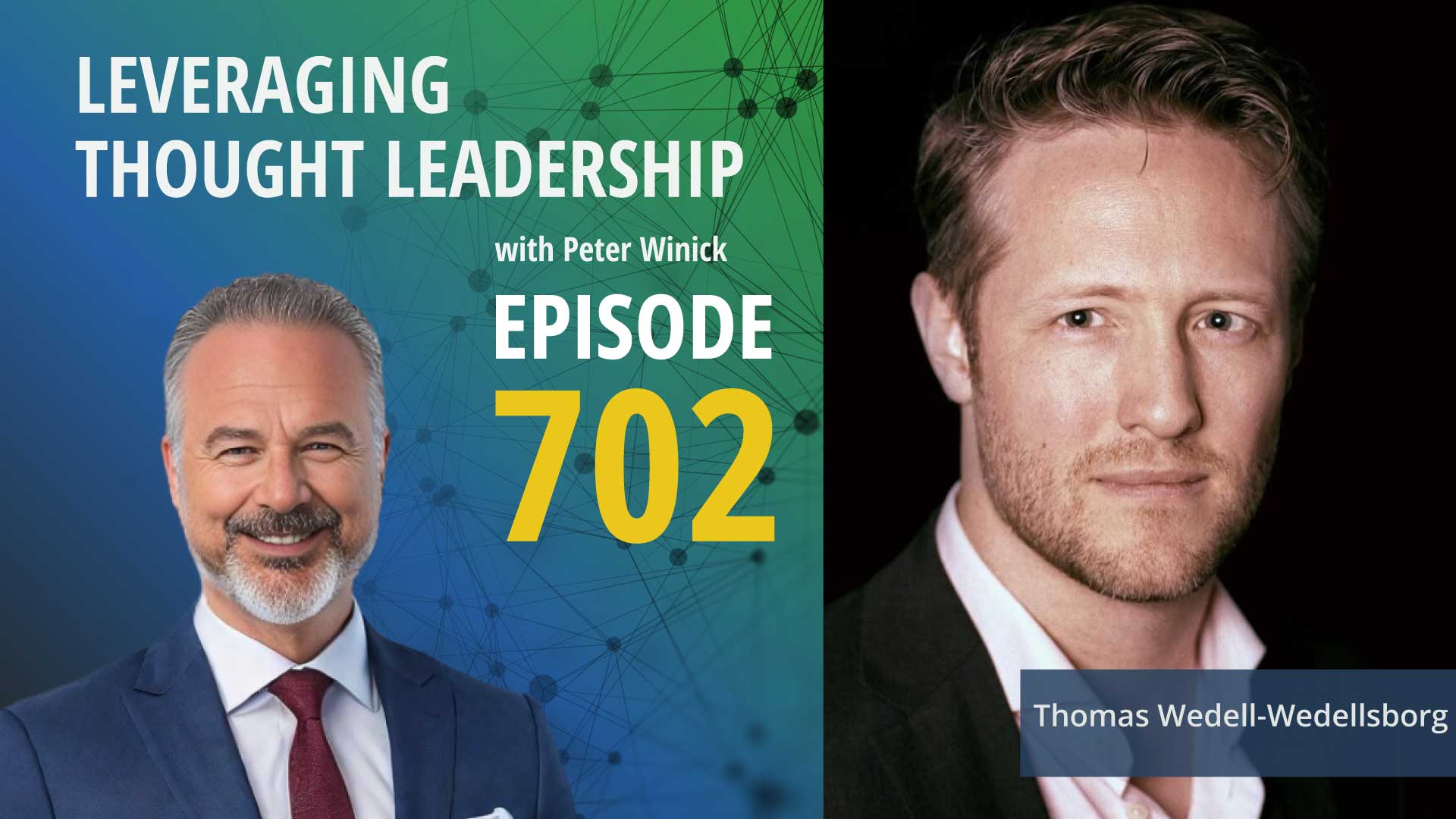
In this episode, Peter talks with Thomas Wedell-Wedellsborg, coauthor of Innovation as Usual: How to Help Your People Bring Great Ideas to Life and author of What’s Your Problem?: To Solve Your Toughest Problems, Change the Problems You Solve. Thomas’s work sits at the intersection of innovation, problem framing, and practical execution inside real organizations.
The conversation focuses on a core truth behind strong thought leadership: the best ideas win because they are useful. Thomas explains that both of his books grew from underserved problems in the market. Innovation as Usual challenged the idea that innovation belongs only to CEOs or startups. It made the case that innovation has to work for managers operating inside the constraints of large organizations.
Peter and Thomas also unpack why What’s Your Problem? has such broad appeal. Its core idea is simple and powerful: most leaders are not bad at solving problems. They are bad at identifying the right problem to solve. That framing gives Thomas thought leadership that works across industries, roles, and even age groups because the problem is
universal and the method is practical.
This episode is also a masterclass in how thought leadership grows after a book is published. Thomas is candid about the anticlimax of launch day and the longer work that follows. A book is not the end goal. It is the platform. The real job is pushing the idea into the world, finding the people it helps, and building traction over time.
Another standout theme is precision. Thomas argues that you do not start by chasing the audience. You start by naming the problem clearly. That is what helps the right audience find you. It is also why his ideas resonate with leaders, product managers, conference audiences, and executive education clients alike. Clear problem definition becomes clear market positioning.
Peter also explores the discipline behind work that lasts. Thomas shares how testing ideas, getting blunt feedback, and refining the material made the second book stronger. For leaders building their own platforms, that is the takeaway: thought leadership becomes more powerful when it is pressure-tested, practical, and easy for others to pass along.
This is a rich conversation about building thought leadership that does more than sound smart. It solves meaningful problems. It earns relevance in the market. And it creates lasting value long after the book hits the shelf.
Three Key Takeaways:
- Great thought leadership starts with a real problem, not a broad audience. Thomas makes the case that the breakthrough came from finding a novel angle on a useful issue. Instead of chasing visibility, he focused on problems that were important but underserved—first innovation inside large organizations, then problem
framing itself. - A book is not the end product. It is the platform. One of the clearest lessons in the episode is that publishing is often anticlimactic. The real work begins after launch, when the author has to push the idea into the world, find the people it helps, and build traction over time.
- The strongest ideas spread because they are practical and shareable. Thomas talks about testing his work with others and watching for the moment when readers said, “Can I share this with a buddy?” That is the signal that the idea is useful enough to travel. His work on solving the right problems has range because it is clear, practical, and easy for people to apply in very different settings.
Enjoyed this episode? Queue up our conversation with Thomas Koulopoulos next. Thomas Wedell-Wedellsborg focuses on solving the right problem. Thomas Koulopoulos explores how thought leaders tackle problems that never stand still. Put them together and you get a smart, practical masterclass on innovation, relevance, and how great
thought leadership becomes real market value.
Transcript
Peter Winick And welcome, welcome, welcome. This is Peter Winick. I’m the founder and CEO at Thought Leadership Leverage and you’re joining us on the podcast, which is leveraging thought leadership. So today my guest is Thomas Wedell Wedelsborg. I’m hoping I pronounced that right. Is that what my biggest challenge of the morning? He’s a harvest business press author. He’s the keynote speaker, a globally recognized expert on reframing innovation and problem solving. And his most recent book is what’s your problem? Was recommended by Google’s Eric Schmidt with the words, if you want the superpower of solving better problems, read this book. So there’s more on his bio, but I’d rather just talk to him. So welcome aboard today, Thomas. And I hope I didn’t mingle your name, although I might not be the first.
Thomas Wedell-Wedellsborg I mean, you could try for the Danish version, but that is utterly unpronounceable by non-Danes. So I just… Let’s go. Let’s.
Peter Winick All right, I don’t know what version I mildly mangled, but I don’t know it was Danish. So, interesting stuff going on. Let’s start with the, how did this happen? How did one get here, right? If you were thinking back five, 10, 20 years ago, what were the things that happened to make it all happen, if you will?
Thomas Wedell-Wedellsborg Uh, it is 20 years ago and I, uh, it was really me starting working with an old professor of mine, uh Patty Miller. We’re, uh that got me the opportunity to go into a lot of different companies and do in-depth research on the topic of what ended up as my first book, namely how innovation happens in practice when you’re kind of in a big company. And, uh eventually after four years of doing that, we approached Harvard together and said, we think there’s a book on this and they agreed. So that that like The short version is it was kind of knowing a lot of the theory, but then getting the chance to see how that actually played out in real people’s lives inside companies and kind of sorting out, Oh, there’s things we actually need to think differently about. There’s really good advice we can give here. And that’s kind of what made public say yes to publishing it as well.
Peter Winick So stay there a minute because a lot of people that I speak to and work with. Hope, you know, one is lightning in a bottle. They’re doing all the right things. They’re working hard. They’re not even thinking about sort of scaling, leveraging, whatever. And then something happens. It might be a Ted talk. It might, be Harvard business review. It could be strategy, whatever there’s one of the dozens and dozens of things that can happen. What would you advise folks around looking for? Something like that like Harvard people spend a lot of time trying to get into Harvard Business Review and there are no easy tricks and even if you follow the protocol whatever anything you would Think about or recommend to folks in terms of how to sort of accelerate the lighting in a bottle
Thomas Wedell-Wedellsborg I mean, this is not a tactical answer in the sense like, oh, you need to connect to this person and whatever. What made the difference for us was to find a novel take on a really useful topic. So at the time, innovation was mostly written about in the context of assuming that you’re either the CEO or you’re a startup at Silicon Valley or whatever. Sure. And the people we ran into was, basically they were, you know… Middle to senior managers in a big company. They were heavily constrained. They were kind of maybe does bureaucracy and so on. Right. And there is very little advice for those people.
Peter Winick Kind of like that’s interesting because I think this concept of. The democratization of this thought leadership, right? Cause everybody, you know, there’s so many things written for the CEO. And the reason for that is the CEO can decide to do more or less whatever they want within the constraints of a board, right. But if you’re a middle manager and just do the math, most of us are more in the middle, don’t have full agency, whatever. What is there that I can do right like that’s an interesting question and I think that would apply to other things outside of innovation, whether it’s creativity or whatever.
Thomas Wedell-Wedellsborg Absolutely. And I think that’s true for both my books. So I kind of like running into something that was really important to people, but that wasn’t very well covered in the existing kind of literature or whatever. Or maybe it was covered somewhat academically, but not in a version that regular people could pick up and use in their day-to-day lives. That to me, I think people often assume, how do you, how to get into Hobbit? Well, you have to network your way and then connect to an editor and so on. Yeah. And all of that’s going to go absolutely nowhere. If you then show up with an idea that’s kind of like meh. So, so I advise people to focus a lot on, on kind of, how do you find this, that idea?
Peter Winick So let’s take that journey, so you get, let’s call it somewhat a combination of skill, meaning you’ve got these sharp ideas, and then luck, where Harvard says yes. Okay, so what actually happens? It gets published, and then you’re virtual famous?
Thomas Wedell-Wedellsborg Well, it gets published and then you experience anti-climax because you’re just standing with a book in your hand and that’s nice, but then kind of like, okay. And what happened, at least in my case, was then gradually started to get fun. As the book started to out there and kind of people reacted to it and so on, it built up over time. But you know, the main thing I say to new authors is like, you know. Uh, hey, it was really anticlimactic for me to publish the book House has Been For You. And most people go like, yes, that’s a-
Peter Winick I love that framing because I think what happens is, and probably more so with first time authors, they think the hard work is writing the book, getting the publishing deal, blah, blah. And then there’s a release date and then they’re waiting and waiting and what they don’t realize sometimes is as great as Harvard is or any of the other publishers are, the burden is on you to be the evangelist of the book and there’s A lot of work that needs to be done. To get that message out there, right? And it’s not a six week or two month or three month.
Thomas Wedell-Wedellsborg You’re not trying to publish a book. You’re trying to kind of make a difference in the world. The book is part of that, but it’s only a stepping stone. And so there is a big question of kind of, after the book, what then? And I, you know, that’s a lot of the stuff you are an expert in.
Peter Winick Yes, so let’s talk about the post book thing. So how long has your book been out now?
Thomas Wedell-Wedellsborg The first one has been since 2013, so that’s 12 years, and the most recent one watcher problem was in 2020, 5 years.
Peter Winick And we had this little COVID thing in the middle there. Oh, what was that you said? Yeah, yeah, yeah. Exactly. That might have been a corrupted thing. So what are the lessons that you’ve learned around being the shepherd of the idea?
Thomas Wedell-Wedellsborg I would say, I mean, first and foremost, exactly as you point out, it is kind of a longer journey where you’re figuring out how to, uh, how to kind of push your idea into the world to find the people for whom it’ll make a difference. I would, I’m assuming, I think there are people who are really good at marketing their ideas. I’m not necessarily that person. What my strength is, is that, uh has been like insane perfectionism around the book itself. And I think there’s a trade-off between, let’s say… Your book’s at 85%, meaning it’s good enough to publish. You can publish it, it’s going to be a good book. Yes. Do you keep working until it’s at 95%? It depends. If you’re writing about AI, probably just get it out because speed really matters. But the approach I at least have taken is to kind of push it till it cannot get any better. And I think, you know, for somebody who’s not necessarily in love with doing marketing, even though it’s necessary. I think that’s the trade off that you, the more time you invest in making the book really, really good, the less you have to actively market it yourself. The more people will help you market it.
Peter Winick I’ll push on that a little, because for some folks, it’s never good enough, right? And it’s actually, that’s an excuse for, I’m afraid to unleash it, I don’t want, I’m a afraid for the feedback, et cetera, because I’m not advocating put out mediocre, because I think the reality today, the scarcest resource we’re asking of people is not the 20, 30 bucks they spend for the book, but you basically say to them, please invest three, four hours in my thinking. That’s a big ask, and I would expect that for you to ask that of the public of me or whoever. And I’m asking that of you because I think it’s worth it. And I think the return you’re going to get on that. That being said, there is a point and publishers will tell you this all the time, where it’s more than good enough. Your, your definition of 90% might be the publisher definition of 120% right? Cause that’s a subjective thing.
Thomas Wedell-Wedellsborg I mean, I think you’re spot on because what you need in that ecosystem is other people. It kind of, you’d have either to tell you it’s not good enough yet or to tell you you’re there, go for it.
Peter Winick Well, no, and I think that’s a critical point because we’re the worst judges of the quality of our stuff, right? And sometimes we’re embarrassed or we want to polish it or digest more research or whatever the case may be. I think other people is interesting is have some sort of a cohort or advisory group, whatever, and say, hey, tell me. You can tell me the kids are ugly and cross-eyed. You could tell me, the truth. I give you permission. And in fact, I really want you to do that. And tell me when it’s good enough, right? Like that’s pretty cool. Have you done that with the latest book?
Thomas Wedell-Wedellsborg Uh, I did more so with the second book and I think I’ve got better for it. And, uh, I think the market was really when people started saying, Hey, can I share this with a buddy because that’s a sign that they’re suddenly not just kind of saying, hey, this is good, but kind of, Oh, I found this useful enough to actually want to share it with Michael over there who has this problem now, you know, that, that’s pretty strong indication. So the second, you’ll see the acknowledgement page is kind of four pages long. It’s all of the people who are like, I’m a great believer in kind of really as many people as you can get involved in, you know, one way or another.
Peter Winick Which is a bit counterintuitive because when you think about it, writing is the ultimate sort of individual sport, but it’s really a team sport.
Thomas Wedell-Wedellsborg Yeah, I mean, you have two types of teammates. You have, if you’re lucky, you have friends who are authors and they give you really good feedback. Yeah. And you probably, regardless, regardless you have just general friends, they can’t necessarily tell you what to fix, but they can tell you if it’s working or not, like, you know, what I literally did was to give people, you know advanced copies of the book with a red and a green highlighter, orange and green. And said like green, if you liked it, orange, if you thought it was terrible or didn’t understand it or got bored or whatever. And that they can do even though they’re not necessarily book people themselves.
Peter Winick And you have to take that feedback from where it comes, right? If you have a friend that’s a poet, maybe they can’t help you as much as a friend that’s on a board of directors, right.
Thomas Wedell-Wedellsborg Exactly. There are not enough stanzas in this book.
Peter Winick Yeah, yeah, all the sentences don’t rhyme nothing rhyme. This is a terrible book. Nothing rhyme. Yeah, you need more limericks So now where has the book? Allowed you to go that you don’t think you might have gone without it in terms of clients that you work on or platforms that you’re on or what is what’s that experience say the first book
Thomas Wedell-Wedellsborg me into a lot of spaces and conference speaking and so on. The second book was more interesting because it was a method book. It’s about solving the right problems and specifically, it was called like problem framing. And that has allowed me to go anywhere because everybody has problems. I can go in, you know, I was down at Fort Bragg and see this to two and three staff generals in the US army. And then I can in the next day, literally in Kindergarten, I have. And kind of teach kindergarten kids how to start solving their problems.
Peter Winick Stay there a minute because I think defining that audience, you know, or audiences plural isn’t easy. How do you communicate to the marketplace that although there are universal principles here, I can bring it to life for you know on Tuesday to a group of engineers and Thursday to a group of middle school teachers.
Thomas Wedell-Wedellsborg I think you’ve focused not on the audience, but on the problem you’re solving. And the more, the more crisply you put the problem, the easier it’ll be for people to opt in and say like, yes, that’s the thing, uh, you know, are you solving the right problems? That is a very good tagline. And like, if you want to make it even better, you say, are your people solving the problems? Because if you’re speaking to leaders, of course, they might think, oh, I’m doing fine on that, but my team, well, they really need to get better. Yeah, yeah, yeah. So There’s an understanding there as well of like, who’s the person who books you in and separately who’s your audience for the actual talk or the session or what are you doing? But I’d say it’s, it’s primarily for me. The audience I’ve almost kind of discovered in part subsequently. Of course, for instance, I knew, yes, it is a business book. So that’s somewhat defined. It’s defined partially by it’s Harvard. So we know what their audience is. But beyond that, it has been a matter in part of saying Oh, here’s the problem I’m solving. And then seeing who comes up, like one thing that propped out is like product managers, they love the book because they are in a role where defining the problem clearly is really, really important. So you kind of partially discover your audience as you go through it. And ideally you do a lot of this work before the book comes out, at least.
Peter Winick So stay there for a minute. So now you’ve one of the things that you’ve learned is, and which might not have been on your radar, it doesn’t sound like it was when you’re writing the book, like this, this resonates with product project managers. Yeah. So how has that influenced your product is Asia moving forward to saying, ah, if project managers can benefit from the book. I could create a certification series for them or a workshop for them. Like how, how has influence your framing positioning in the marketplace?
Thomas Wedell-Wedellsborg I mean, I could probably learn something from you here and from any of your other authors, because I wouldn’t say I’m necessarily a role model in terms of having developed a full product portfolio. For lifestyle reasons, what I prefer to do is to live off giving talks and they can read like 45-minute keynotes or they can look like half a kind of executive education type things. That’s chiefly what I do. And to be honest, this is an area I could get better.
Peter Winick Got it. Got it, so you’ve been, you’ve found your lane on the speaking workshop side, but there’s probably opportunity in terms of productizing it. Because you know, one of the things I think about with my work with clients is okay, forget about you, not about you’ve got this intellectual property, this body of work that has tremendous value when you go into a room and the maximum value you’re going to get in an hour from it is Thomas goes in a room and speaks and this and that. Right. So it’s, it’s relatively low volume of a relatively high ticket. You could flip that thinking and say, what would a relatively low value, high volume iteration of this look like? Maybe it’s an assessment tool, video based training, whatever. But what that does is not an either, or you could have both in your business, but now you’re generating revenue without getting on a flight to Seattle or Miami or whatever the case can be.
Thomas Wedell-Wedellsborg I think that’s very true. It is a, I think the main constraint I’m working with is kind of, I’m not optimizing for making money. I’m optimizing for what I want to spend my time on.
Peter Winick Which is fair, listen, that’s the choice we make. This, yeah, no, this has been great. I appreciate your time and I appreciate sharing the journey because I think it’s really helpful for folks to hear. Good stuff. Thank you so much, Thomas. Well, thank you, Peter.
Peter Winick To learn more about Thought Leadership Leverage, please visit our website at thoughtleadershipleverage.com. To reach me directly, feel free to email me at peter at thoughtledershipleverage.com, and please subscribe to Leveraging Thought Leadership on iTunes or your favorite podcast app to get your weekly episode automatically.
