
How Leaders Build Character Under Pressure | John Lentini | 707
The Leveraging Thought Leadership podcast is created by Peter Winick and Bill Sherman and produced by Thought Leadership Leverage.
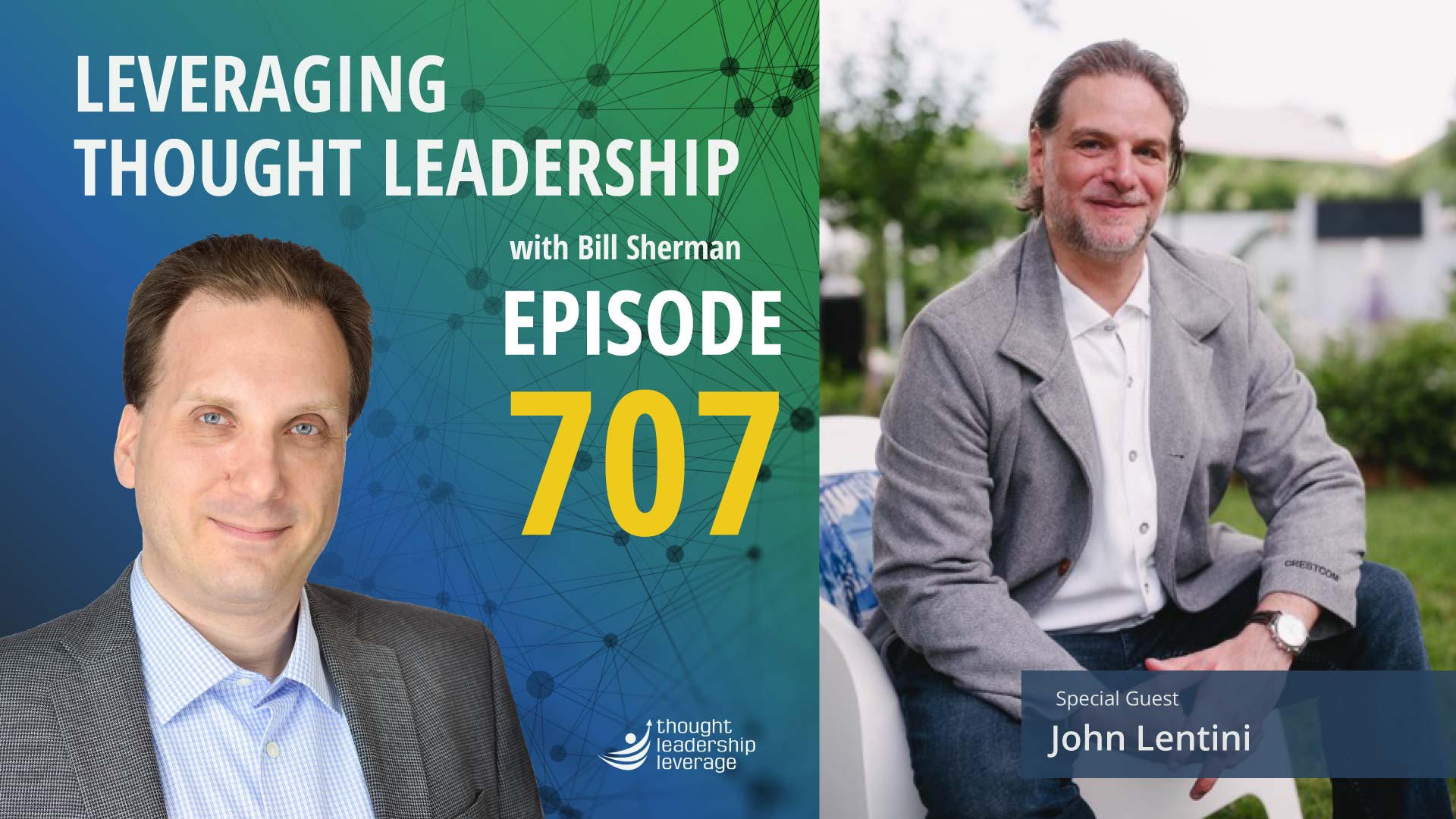



Turning crisis, resilience, and hard decisions into a practical leadership framework
A conversation on character-driven leadership, resilience under pressure, authenticity, trust, and how defining life experiences can be turned into a practical framework for leading yourself and others.
What does it take to turn crisis into a leadership framework others can actually use?
In this episode, Bill Sherman talks with John Lentini, Founder and President of BOLD Training Corp and a partner of Crestcom International, about how defining moments can become disciplined thinking, practical models, and a mission that is bigger than one person’s story.
John’s path to thought leadership did not begin in theory. It began in high-stakes moments. He reflects on surviving 9/11, leading through the Fukushima crisis, and learning firsthand that character is not an abstract idea. It is revealed under pressure. More importantly, he argues it can be built with intention.
At the center of the conversation is John’s six-dial framework for what he calls engineering character, which can be found in his upcoming book Engineering Character: Six Dials to Build Better Leaders releasing March 2027. He explains how discipline, mindset, and resilience help leaders lead themselves first. Then integrity, empathy, and influence help them lead others in ways that build trust. The result is a model designed to make character practical, teachable, and repeatable.
This episode also goes deeper than framework talk. Bill and John explore the personal cost of leadership, the difference between good leadership and bad leadership, and the tension leaders feel when corporate expectations collide with personal values. John is candid about where he got it right, where he got it wrong, and why those lessons now shape his work as a speaker, facilitator, and leadership thinker.
There is also a powerful thread on authenticity. John shares why he ultimately chose to step outside corporate life and use thought leadership to express ideas more fully and more honestly. For him, this work is not about visibility for its own sake. It is about impact. It is about getting a message into the world that helps people lead with more courage, more empathy, and more character.
Listeners will also hear John talk about the writing journey behind his forthcoming book on engineering character, the emotional work of putting real life on the page, and why he chose a hybrid publishing path. No previously published book by John is named in the transcript, but this episode clearly positions his upcoming book as the foundation of his thought leadership platform and future speaking work.
If you care about leadership under pressure, values in action, and the challenge of turning lived experience into a message that scales, this conversation delivers. It is honest. It is practical. And it shows how thought leadership is often built not from abstract ideas, but from moments that test who we are.
Three Key Takeaways:
- Character can be built on purpose. The episode centers on the idea that leadership character is not just innate. It can be developed through intentional habits like discipline, mindset, resilience, integrity, empathy, and influence.
- Crisis reveals what leadership really looks like. High-pressure moments expose whether leaders act with preparation, courage, empathy, and trust. The conversation shows how extreme events can shape a lasting leadership philosophy.
- Authenticity matters more as leadership grows. A major theme is the tension between corporate expectations and personal values, and how thought leadership can become a way to express ideas more honestly and create broader impact.
If John Lentini’s episode made you think about how character is tested in moments of crisis, then “Thought Leadership for Crisis Management | Helio Fred Gracia” is the perfect next listen. Where John explores leadership through resilience, integrity, empathy, and trust under pressure, Helio extends that conversation by showing how leaders can prepare for crises before they happen, protect trust when things go wrong, and respond with clarity instead of emotion. Together, the two episodes create a powerful one-two combination on crisis, character, and the disciplined leadership choices that matter most when the stakes are high.
Transcript
Bill Sherman How do you turn life’s most defining moments into a framework that others can use? For John Lentini, the journey to thought leadership didn’t begin with a model. It began with lived experience. From surviving 9-11 to leading through global crises, John spent decades navigating moments where character wasn’t theoretical. It was tested. Over time, his experiences evolved into a system, a language, and now a book focused on one idea that character can be built intentionally one decision at a time. I’m Bill Sherman, and you’re listening to Leveraging Thought Leadership. Let’s begin. Welcome to the show, John. Thank you, Bill, it’s a pleasure to be here. So I wanna begin with a question and attention. Your book, which is coming out later this year, is about engineering character and really character as revealed in difficult moments, right? How do you put those choices into a framework, let alone a book? How do make characters something that you can teach, communicate? Rather than because I’m sure some people would say, well, that’s what you’re born with, right?
John Lentini Yeah, absolutely. I compartmentalize into two different segments. You need to learn to lead yourself before you can really take on the privilege of leading others. So I’ve conceptualized that into what I call a three-dial system of discipline, mindset, and resilience to essentially lead yourself and achieve determination, to achieve your own outcomes, to lead your self, not necessarily to other people. But then once you’ve achieved those outcomes, a different onus of responsibility comes into play, and you need to learn to lead others. And that’s where my second set of dials to build out the full six-style framework comes in. And those are integrity, empathy, and influence, which yield trust. And together, the six-dials build character, which I feel is a dwindling resource in our society, so I felt there’s an opportunity to give people a system to build it. So talk to me about the six…
Bill Sherman Styles. When did they come about? And when did you sort of start seeing them, using them? Because some people scratch out frameworks and say, Hey, I’ve been using this for years. And others, as they write the book, the framework becomes clear for the first time.
John Lentini What was the experience for you? Yeah, there’s a kind of few factors that organically developed this whole concept for me. Firstly, I certainly believe in thought leadership, but I feel many of us are really thought in the space of thought-buildership, right? Because there aren’t too many brand new ideas. We often build on ideas. So the initial concept, the Discipline, Mindset, and Resilience was introduced by a mentor of mine within the Crestcom network. As the three things you need to navigate your business. And it immediately resonated with me and I was working with that. And that drove success through a very dark period. I founded my business just before COVID, which was very challenging to be starting something. I’d just really gotten off the ground in February of 2020 and everything came to a crashing halt. So those three elements of discipline, mindset and resilience in concert with each other. Were really what enabled me in real life practice to see my way to the end of that dark tunnel to the light. That ultimately led to a TEDx talk. So I delivered a TEDX talk in June of 2025 that essentially focused on that first component of three dials to lead yourself. That’s where the framework started to crystallize. And I, of course, have a corporate history in leading large organizations. So I’ve seen.
Bill Sherman And I want to get into that in a moment, right?
John Lentini Yeah, so that it out of the back story.
Bill Sherman Okay, so it’s been in an evolution process and it sounds like you had forcing mechanisms such as the Ted talk where it’s like, okay, these are things in my head. How do I communicate them in a way that’s clear and the framework becomes a tool, right? Now, you talk about leading an organization, so you’ve led through and been in some… Very difficult times. That’s right, yeah. Are you comfortable sharing some of that context and how that impacts…
John Lentini Why you do the work you do? Oh, absolutely. I mean, there’s a few elements that led to the space I’m in now and more of an entrepreneurial thought leadership space. And certainly a lot of it was for it to do crisis, real world crisis. And I was involved in some historic crisis. The biggest, please. Yeah, the biggest, most prominent of course is I’m a 9-11 survivor. So a plane went through my desk on the 80th floor of 2L Trade Center. Literally, my seat was three feet from the window that the plane entered on Tower 2. So it was a very challenging period for me, to say the least. I lost about 40 people that I knew, some of them very close to me. It was a dark tunnel back then for two years, I’d say. It was bit of a blur, but I didn’t really talk openly about it for about a decade. It’s only recently that I’ve come to grips with it’s shaped who I am in so many ways, I need to stop hiding from it. So that’s the first component, 9-11, clearly a big story, which is part of my TEDx talk, certainly part of my forthcoming book. Um, another- you know, historic event, which I was involved with managing teams in Asia was the Fukushima nuclear event. And I had a team on the ground in Tokyo, and I was at odds with my senior leadership and how to navigate some of the individuals who were adversely impacted, having learned from 9-11 in a way that others had not. And that certainly informed a lot of my model. And I want to stay there.
Bill Sherman For a moment and sort of sit in the moment here right. You talk about character and you’re talking about serious moments that are often short both shorthanded by dates in their respective cultures 9-11 and 3-11 Right. So those moments. Did you think about character in those moments or is it the processing afterwards? How do the pieces come together? Because I genuinely believe that when it comes to thought leadership, our lives, our identity, our defining moments really push us as to what we’re passionate and talking about. So I want to give you the space to say, how did those shape you? Bolt in, leading, and then choosing to speak about ideas.
John Lentini Yeah, I think the term character came later as I put together my six style model. I saw the result as a leader of character. That just organically came to me as a natural outcome of what would happen if you navigated these six attributes properly. Really the precursor was having seen what bad leadership looks like in corporate life. I’ve certainly had the good fortune to work for many good leaders, fortunately Many of them early in my career, which had a very positive developmental you know, impact on me. But I’m also extraordinarily grateful for many of the very bad leaders that I work for, quite frankly. And a lot of the poor leadership attributes, behaviors, decisions, and frankly, not blaming individuals, the culture that rewards the wrong behaviors in corporate life, certainly in the investment banking industry I came from, inform me as to what I think is needed to build a better brand of corporate leadership, which is really what I’m trying to drive with the mission of my model. Let’s circle here for.
Bill Sherman If you talk about bad leadership and good leadership, going to 9-11, what leadership did you experience in that crisis?
John Lentini So that’s an interesting story. And it’s the open of my book. You know, I had leadership, I should say there’s a strong Japanese theme throughout my work. And that came to me as I started to really draft my book, I didn’t realize how many of the dots were connected through Japan. The bank that I worked for in 9-11 was a Japanese bank. The five senior executives who were all lost, evacuating our floor, were all Japanese nationals. As Americans in an American subsidiary, we often felt a very real frustration of how the Japanese approached banking business. You know, very much zero tolerance for imperfection. It seemed to be teetotaling at times, lacked practical application. So there was constant friction about their approach. You know what we saw as, you know, penny rich for pound poor sort of thing. So that was constant. But on 9-11, I learned the real value of their culture of preparation. You know, we had. Taken on a very severe and, and, you know, a clear approach around response to disasters because we’d been a tap in 93 in the trade center prior to my time joining the firm, but we had that legacy history. So everyone in our organization had an emergency grab and go bag in our desks as a constant reminder of what was at stake. Our fire drills were always conducted with military precision. They were never treated as an unwelcome distraction. And people understood the need. You’re on the 80th floor of a tower that had been attacked not too long ago. So our senior leadership took this very seriously and ingrained in us in that Japanese way, zero tolerance. When it comes to life and human capital, which as it turns out, believe it or not, even in banking is our most precious asset, not the financial capital we’re chasing all day every day.
Bill Sherman It’s not the deal itself, it’s the people behind the deal, right?
John Lentini There’s no deal without the people, right? There’s not firm exactly. So on 9-11, many people were lost. Many of them I know because it was announced in the building, false information, a small Piper jet had hit the other tower. It’s safe to return to work. My senior leaders, I was on the street. I hadn’t gotten up. I was running a bit late from the gym. My senior leader’s evacuated everybody without pause. While many others were lost because they were listening to this false information. But they took their approach, which on a daily basis may have caused frustration. When it really mattered, I learned what Simon Sinek meant by leaders eat last. And tragically, they were all lost that day, but they died as heroes in my view.
Bill Sherman And that’s a powerful story. And one, I genuinely appreciate you sharing on vulnerability. Um, I want to take a step forward then 3 11, instead of someone being led, you’re now in the role of leader. How does that influence your actions? Consciously, unconsciously.
John Lentini Yeah, this is where I think the evolution of corporate politics impacted me adversely. I ended up kowtowing or I’d say acquiescing to senior leadership views. I had a brand new hire on the ground in Japan from New York. It just landed months before that. Now, I don’t know if you have any experience in Japan but experiencing your first earthquake there can be pretty unnerving to say the least, right? So those are veterans who were born there her ex-bats have lived there for years are used to it. There’s some, you know, bedding down of the anxiety. But if you’re brand new and you never experienced an earthquake, and then all of a sudden you have the worst earthquake in recorded history, you can imagine the response of terror that you’ll be feeling. So I had an individual who was new who wanted out of Japan. He was terrified and there were real risks. This wasn’t just overreaction. We had a nuclear reactor that was now, you now, sending radioactive materials into the environment. So we didn’t know where this might end.
Bill Sherman My sister was in Tokyo doing a studying program there on language fluency on 311.
John Lentini Oh wow. How do you like that? Incredible. Very, very traumatic for a very long time because he didn’t know what the long term.
Bill Sherman And you’re watching the news as an outsider, not knowing what’s going to happen, right?
John Lentini Yeah, and the reality was this one individual wanted to get out of there. And my view was I should cater to that. Now, I understand corporate protocol, you can’t allow mass evacuation, there’d have to be protocols with disaster recovery. Certainly understand that element. I understand the business reasons to want everyone to behave in the same way. But there was a level of empathy for a situation and a real level of liability because there were potentialities that were out of our control at that point. Now, coming from the place I did, where I’d seen 24 people from my previous firm and close to 40 people perish on 9-11 due to decisions that were or were not made by my leadership and others, I had some experience that you can’t play games. And if somebody felt that their life was at risk, and there was certainly real reason to believe it could have been, you needed to cater to that. But I played the hard line. He ended up flying out of Tokyo against orders, essentially, at his own dime. Uh, met up with me in Hong Kong where I was on a business trip. I should say I was actually, I was living in Singapore at the time I was in Hong Kong on a bussiness trip. I was due to leave for Tokyo that morning, the next morning. I was, I’m away from Hong Kong to Tokyo. And then when this earthquake happened, of course, my travel plans were canceled. So that was, I was essentially settled down in Hong Kong. I didn’t cancel my trip to Tokyo because of this, managing my team remotely, because I had teams around the region. But, when I look back… I wish that I had stayed true to my personal values and integrity and toed the line of what was right. And this is where experience matters. There aren’t too many people, and it’s not a pride thing, it’s a braggadocia thing, but aren’t so many people who’ve lived through loss of life on the job in that industry. I was probably the only one, at least the only that I’m aware of. In hindsight and even at the time, I think I would have appreciated some more know, deference to someone who’s been there and done that rather than this is the BPM, you know, listen to your chain of command. And that is a lot of what informs my model of integrity, empathy, and influence. I saw a bit of a lack what I consider pure integrity, lack of empathy, certainly for this individual, and from my standpoint, a weakness in influence, to influence what I thought was the right approach. And, that’s largely where the second set of dials was grounded.
Bill Sherman So John, we’ve started a journey that’s leading towards thought leadership in a book, right? You’ve experienced exceptional leadership on nine 11, right. You faced your own test on three 11 and had to navigate corporate and individual sort of, you know, character tension, right, You could have continued to lead in investment banking. You could even been a leadership coach or facilitator, right? Something caused you to want to speak up about character and to give that idea voice in this space. Why? Didn’t have to.
John Lentini Yeah, it’s a fair point. I did continue to lead within banking for years thereafter. I moved to Poland, back in New York, the industry changed. That was a big component of it. The banking industry, you know, really continued to consolidate and became far less inspiring and the post Lehman fallout, which continues to this day in many respects. I ultimately felt that I could be more effective developing leadership from outside of corporate life and I felt I was able to from inside. The more senior you get in those organizations, which is part of my motivation for this model, the more it becomes about leading up and less about leading the people within your charge. It’s more about appeasing the people who are at charge. And I just felt I could be a better coach, mentor, and leadership developer from outside of corporate walls and inside. But…
Bill Sherman What makes you write a book? When did you realize, hey, I’m being pulled into the world that many would call thought leadership, right? That’s a choice to speak on a different level. And my question is why? What lights you up and what motivates you to do so?
John Lentini Yeah, and I think this stuff is innate for those of us who like to do these sorts of things. And for me, it probably dates back, the earliest place that I could probably pinpoint would be my eighth grade American history class, where I had a teacher who was probably one of the most impactful of all the teachers I had throughout college and MBA. I had him again for AP American history in senior year of high school. So I had them twice and he forced me to look through the lens of American politics and history. Very much through a political science lens of John Locke’s and Thomas Hobbes. And I carry that conceptual lens with me today through everything in current events and life. So I always found myself to be very conceptual, which I think is a big piece of all of this. So that conceptual piece was always there. I’d say I probably wanted to be a history teacher originally, and my book does incorporate a lot of historic biographical supporting narratives, which scratches that itch. Moving into the space of leadership development training, which I do, training and facilitating. Scratches that itch to some extent. So I’d say inorganically, I landed back where I probably would have gone. You know, I ended up in banking because I landed a internship in the World Trade Center through serendipity through my network the summer after my freshman year of college. I switched from a history major to, you know, a number of times to ultimately switch from liberal arts to business school. Graduated as a finance major, worked in banking for over 20 years. That’s a huge switch. It was, and you know, I’m not a left brain thinker. I am not your typical finance guy. In many ways, it’s how I thrived because I was the right brain think or had creative ideas and could coach and mentor and inspire large organizations. And that’s where I found my passion ultimately was leading large organizations, I managed groups of hundreds of people across Europe, Asia, and the U.S. And the people leadership became the… The passion point for me, the derivatives, which I mostly worked in and the financial and operational elements became far less interesting, the more senior I got, the politics became very uninteresting, which is really one reason I decided to, you know, go out of my own and try to impact the world with my own worldview rather than trying to plug into someone else’s, if that makes sense.
Bill Sherman So John, you’re in the process of publication. You’ve turned in manuscript, right? And you have a pub date coming ahead either later this year or early in 2027. What does that look like for you? What do you want to happen with this book?
John Lentini Oh, the book kind of unveils my soul of what I think good leadership should look like. The real premises that I feel character is a diminishing resource that we haven’t acknowledged is dwindling. And I’m hoping my book gives everyone a mechanism to rebuild character. I believe that character was organically developed in previous generations through what I call fountains of formation. Through military and community and religious institutions, a lot of that has been degraded over the generations. And with it, we’ve lost a lot character. You know what Tom Brokaw may have framed as the greatest generation in his book, right? And to get back there, I think we have to do with intention. It’s not going to happen on its own. And it’s my hope that my sixth style model inspire people to develop themselves and to lead others with greater character. So the more people obviously the book gets into, it’s a mission-driven concept. Then the greater character will be driven in our society.
Bill Sherman You use two words that I want to return to. It reveals my soul. Right. I think personally, I look at books and grew up with books. My dad was a librarian and I read plenty of books. Those words really wouldn’t have landed with me in the same way until I went through the writing process and realized how much of yourself you have to put into the book. And it requires sort of Facing at least for me my own demons and trying to find meaning That’s not just me But what do I know and how can I share it with others? Talk to me more about that writing and revealing your soul process. I’d love to sit there for a minute.
John Lentini Well, it’s interesting, because people will often ask me, how long did it take you to write this book? And the true answer is my entire life, because this book is cumulative in so many ways. And I don’t want to reveal all of it. It’s actually a twist ending. It’s a leadership book with an M. Night Shyamalan twist ending of sorts. So it’s very personal. So many of the figures that I profile, I’ve sort of been digging into as a private scholar of sorts my entire lives. So that’s why I picked some of the characters that I did to profile in part three of my book. But in earnest, it took me probably about two years to write this. You know, it’s a myriad of things and, you know, we’ll see how it plays out because you know if everything’s a priority, nothing’s a priority, where is the focus? But you know the, the first three dials are essentially a self-help book. The second three dial is essentially a leadership book. The book is part personal memoir. There’s a lot of personal stories and pretty vulnerable stories. And there is a, were those used to write?
Bill Sherman Or…
John Lentini Were they horror? Easier than I thought, I would say. You know, I threw an act. Because you don’t know until you start. And I had the ideas of which stories, and other stories came to mind as I went through it that I would pepper throughout the narrative. But, you know, those core stories of 9-11, you know certainly drafting the script for my TEDx talk gave me a big jumpstart on that. I didn’t know how the Fukushima story would play out because there’s some sensitive, you now, kind of… Political and corporate questions. Right, right, right. Right or wrong, and I hope that it came across that I am not pointing fingers. I tried to take ownership of where I failed in all cases because I did fail in all places. There’s two sides to everything that goes wrong. So I don’t want this to ever come across to me pointing fingers at look at the bad leaders I could have done better because that is not my view at all. A lot of this is what I’ve learned and what I could’ve done better. And I took pains to hopefully achieve that in the way that I delivered the messaging. But, you know, when you’ve got something that is so, you know personal and emotional, I think the words sort of flood out of your fingertips in some respects. And it flowed a little more naturally than I might’ve expected. And it required some revisions of course, but we’ll see how it’s received. So far, you now that the actual people have read it, the feedback has been quite positive. The editor’s feedback’s been very positive, so we shall see. So you’ve talked about teaching. Thank you very much.
Bill Sherman Leadership, you’ve written a book, you’re done a Ted talk, right? Where do you go from here? And what’s the next hill you want to climb?
John Lentini Yeah, I have a second TEDx talk planned. It was originally going to be later this year. It still may be, but it may make sense to push that to next year for a host of reasons. I have second concept for a book, of course. So, you know, that’s what happens when you start one, I actually have concept for two or three more books, but I know what the next two will be. So I’ll always be writing. Um, I want to do more speaking. You know, I’ve done a lot of speaking throughout my career, both when I was in corporate and since, and I obviously still facilitate with Crestom International in the leadership development space. But I am a member of the National Speakers Association and looking to build out more of a keynote with my own intellectual property. This book will be the primary foundation for that and there’ll be a lot to build on. So I’m working on a number of assets to support this six-dollar framework and this concept of engineering character and my own kind of profile as a leadership engineer. And a lot of that, I should say, comes from my father who passed last year. I found out he passed the morning of my TEDx talk. If you watch my TEDX talk, you’ll see that. I had to live my framework in real time on the stage. I was informed that day as I entered the stage and my father was an engineer by trade. He left engineering early in his career, which turned out to be a massive mistake, but he had the DNA of an engineer. To be perfectly frank, I did not in that way. I didn’t inherit that from my father, but much of the engineering concept is a bit of an homage to my father whose passing was a pivotal moment in my transition with the TEDx talk and a lot of the inspiration for the book. And the concepts.
Bill Sherman I have a question I want to ask. The question I wanna ask John. So you chose to do a hybrid approach for publishing. What were you looking for in terms of working with a publisher and what was important to you in making that choice?
John Lentini Yeah, it’s an interesting journey because I knew nothing about it going into it. Many may have more insights than I had. Um, but I. Almost every author is at least once a first time off it, right? I imagine that must be true. So I looked at all three components, all three elements of self publishing, hybrid and traditional publishing. I was very, you know, it was very easy commute to zero and then hybrid publishing offered me the sweet spot. You know, gives you the support you need. It certainly gives me the distribution because I’m working, arguably the top hybrid publisher with four front books out of Nashville who has, you know, real gravitas and distribution channels through Simon and Schuster, but I also maintain all ownership of my intellectual property, full control of it. Um, obviously you invest to publish rather than getting paid and getting paid is always nice up front, but, I can retain the earnings. So I’m more motivated to continue to make sure this book sells because I retain more of the royalties on it. Not that I expect the money from the book to be the prime, you know, a real financial driver. No, but it’s…
Bill Sherman It’s a door opener, it’s a conversation starter, it is an opportunity creator and it’s a capital asset that you’ll use for five to seven years rather than being part of either spring or a fall catalog, right?
John Lentini That’s exactly right. And the other factor, which is, is critical, uh, with hybrid versus traditional is I have control as to when the book is released. If traditional is a very, very long lead time, which is out of your control. A lot of what you’re writing about could even become obsolete by the time it comes to market. So that was critical ownership of the IP, you know, greater retention of long-term royalty to a lesser extent, frankly, but the, um, certainly the opportunity to control when and how the book is released was, was a critical factor in my decision-making.
Bill Sherman So last two questions, what has most excited you about practicing thought leadership? What charges you up and makes you wanna do this, right?
John Lentini Well, this word has been getting a lot of grief for being overused, but I’ll use it anyway. And if there’s one word that just…
Bill Sherman It’s the name the field has, I would wish I had a magic wand to change.
John Lentini No, I don’t mean for leadership. I mean, the word I’m about to say, which sprang to mind when you said that. The word that came to mind immediately is authenticity. I felt within corporate life, as much as there’s a lot of pride in being a senior leader in a revered organization and, you know, the business card, the LinkedIn profile, and, there’s, a lot a pride of connecting yourself to an outside organization. What I felt was missing was my ability to be fully authentic. And in some ways, as a Gen Xer, I think that sets me apart because I think where Gen Z is. I think, that’s part of the challenge we’re navigating. The younger generation refuses to align with corporate values that don’t match their own personal values. My generation, the boomer generation, we were used to that. You knew that you had to leave a part of yourself at the door when you went to work each day.
Bill Sherman You put on the team colors.
John Lentini Exactly, and I was comfortable doing that for decades, but you reach a certain point, the more senior you get, the more political it gets, and you feel that some of this stuff starts to feel a bit meaningless, and you can’t really impact the world the way you’d really want to if you were to exert your true authentic self. And if I were to narrow it down to anything, I think that’s what drives me. And then I’m gonna ask the counter of that question.
Bill Sherman What is it that you wish you had the magic wand to either understand about how all this works a little bit better or that you could change? Because if authenticity is the driver, what’s the thing that’s sort of the challenge?
John Lentini Well, I’m working with a brand builders group, if you’re familiar with them, an excellent organization. This is an unpaid plug. But Rory Vane is their founder. He’s a great thought leader and public speaker himself. He talks of something called She-Han’s Wall that he named after a previous influencer for him. And this is essentially about a tipping point. You know, how do you break through She-han’s Wall? Because the whole point here is not to become rich and famous, but to get your message out to the world because you have a true belief in your mission. It’s impact. This is what it’s about. So the question is, how do you penetrate Xi Hen’s wall to the other side of where your message actually starts to break through to the public domain? That’s the big challenge, that’s the secret sauce I think all of us are looking for, but the journey is fun. I always focus on the journey, map the destination, but I do look forward to penetrating in whatever degree I can Xi Hen wall and getting my message out to as many people as it can positively impact.
Bill Sherman So John, thank you for joining us today for the conversation. Good luck on the book launch, and we look forward to hearing more from you, not only on character, but authenticity and the leadership journey. Much appreciated, it’s been a pleasure.
John Lentini Thank you, Bill.
Bill Sherman Okay, you’ve made it to the end of the episode, and that means you’re probably someone deeply interested in thought leadership. Want to learn even more? Here are three recommendations. First, check out the back catalog of our podcast episodes. There are a lot of great conversations with people at the top of their game in thought leadership, as well as just starting out. Second, subscribe to our newsletter that talks about the business of thought leadership. And finally, feel free to reach out to me. My day job is helping people with big insights take them to scale through the practice of thought-leadership. Maybe you’re looking for strategy, or maybe you wanna polish up your ideas. Or even create new products and offerings. I’d love to chat with you. Thanks for listening.
