
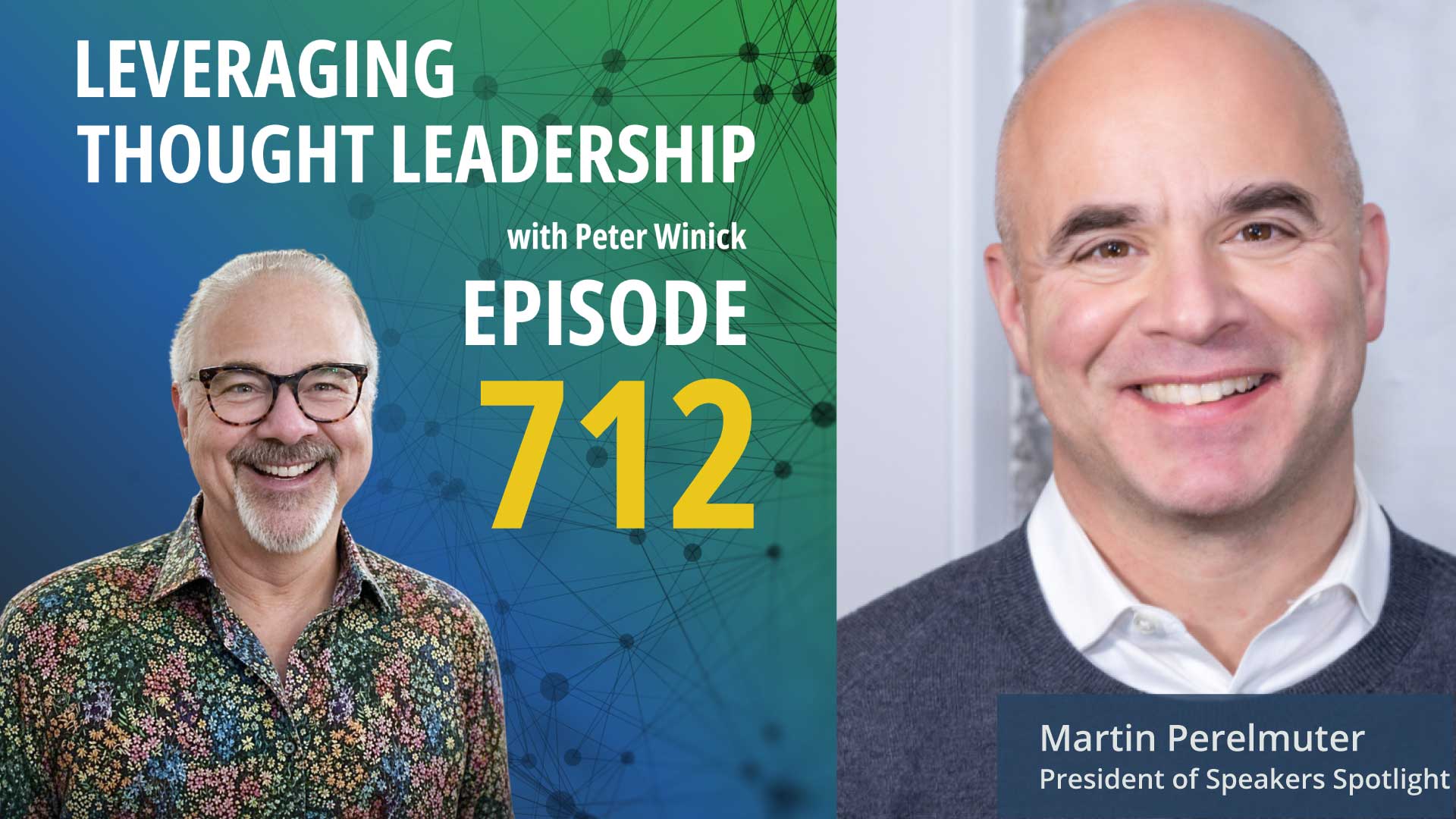
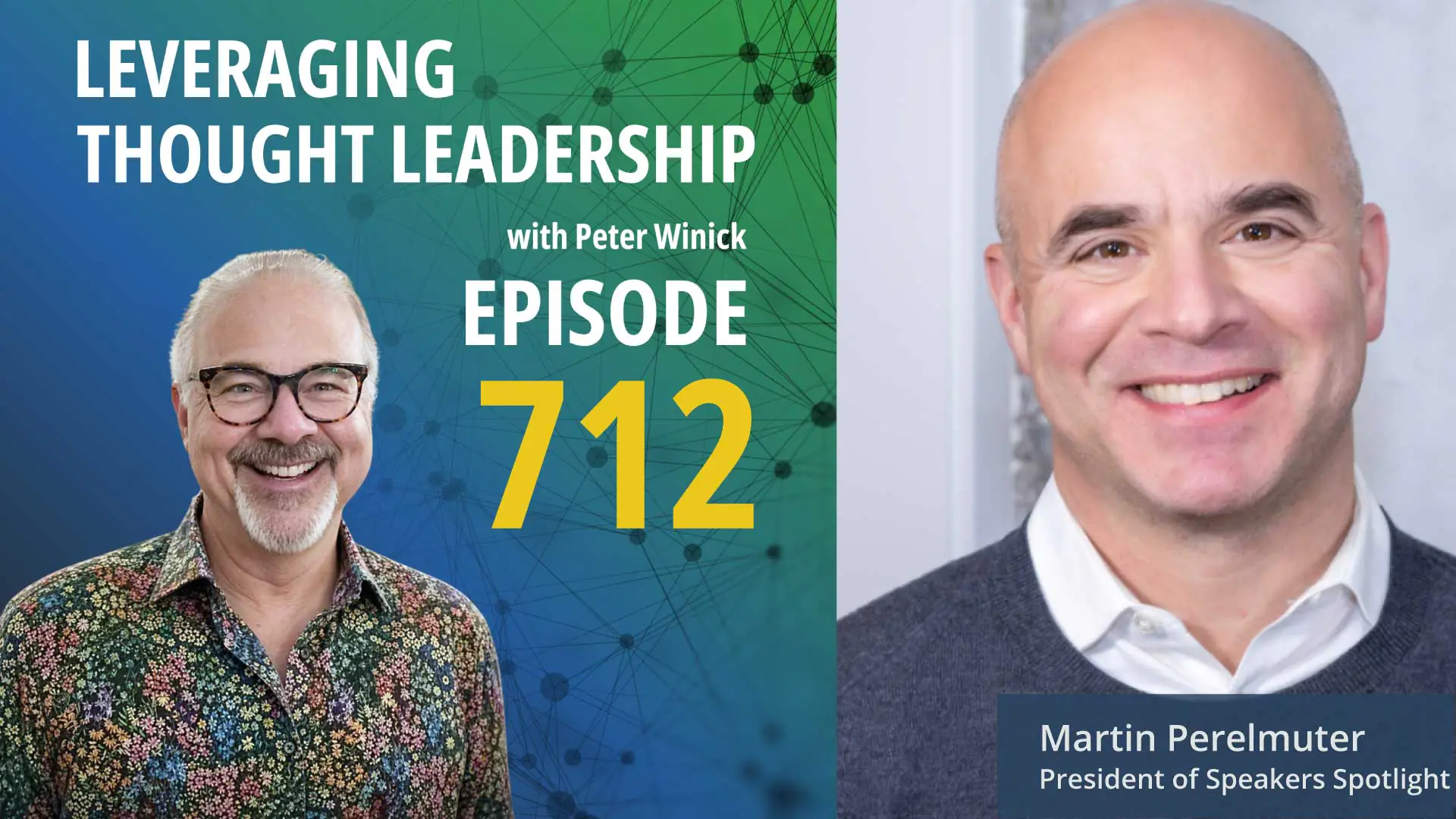
Why Great Speakers Need More Than a Great Talk | Martin Perelmuter | 712
The Leveraging Thought Leadership podcast is created by Peter Winick and Bill Sherman and produced by Thought Leadership Leverage.



How thought leaders can use preparation, positioning, and client experience to grow their business
This episode explores how organizations can turn scattered expertise into a structured thought leadership platform that builds trust, sharpens market positioning, and supports business growth.
What separates a great speaker from a true thought leadership business?
In this episode, Peter Winick sits down with Martin Perelmuter, co-founder of Speakers Spotlight and a longtime leader in the professional speaking industry, to unpack what it really takes to build a sustainable speaking platform. Not just a great talk. Not just a strong stage presence. A real business.
Martin makes the case that excellence on stage is only the beginning. It is table stakes. The real leverage comes from positioning, preparation, market demand, and the ability to turn every engagement into a high-trust client experience.
They explore why video is now one of the most important assets for any speaker or thought leader. A strong speaker reel is no longer optional. It is proof. It helps buyers sell you internally. It shows range. It shows confidence. And it shows whether you can deliver in front of 2,000 people or 20 executives in a boardroom.
Peter and Martin also dig into the moments most speakers overlook. The pre-event call. The language of the client’s industry. The follow-up. The difference between serving the event and trying to sell too soon. Martin’s view is clear: nail the keynote first. Create so much value that the client asks, “What else do you do?”
The conversation also challenges common assumptions about fees, books, and fame. A bestseller can help. A platform can help. But the market ultimately decides. Demand, value, and outcomes matter more than credentials alone.
For thought leaders, the biggest takeaway is this: speaking is not just performance. It is a business discipline. The best speakers keep refining their content, updating their relevance, and connecting their evergreen ideas to what leaders are facing right now.
Three Key Takeaways:
- Great speaking is table stakes. A strong business requires more. Martin emphasizes that stage presence matters, but it is only the starting point. Thought leaders also need clear positioning, strong marketing, credible video, and a professional client experience.
- The keynote begins before the speaker steps on stage. Every touchpoint shapes the client’s confidence. The pre-event call, industry language, audience context, and preparation all determine whether the talk feels generic or deeply relevant.
- Relevance is what keeps a thought leader in demand. Evergreen ideas still matter, but speakers must continually refresh their content. They need to connect their core expertise to today’s issues, including AI, remote work, economic uncertainty, and rapid change.
If Martin Perelmuter’s episode got you thinking about speaking as more than a performance, Jeff Kavanaugh’s episode takes that idea inside the enterprise.
Both conversations focus on what it takes to turn expertise into a real thought leadership platform. Martin looks at the professional speaking business. Jeff explores how organizations build institutional thought leadership that earns trust, creates influence, and supports growth.
Listen to Jeff Kavanaugh’s episode to hear how companies can move beyond one-off content and create a disciplined thought leadership function with strategy, structure, and commercial impact.
Transcript
Peter Winick And welcome, welcome, welcome. This is Peter Winick. I’m the founder and CEO at Thought Leadership Leverage, and you’re joining us on the podcast, which is Leveraging Thought Leadership. Today, my guest is Martin Perelmuter, and he is an unapologetic idealist. He’s passionate about people and ideas. He’s been in the speaking business for about 30 plus years. He was a co-founder at Speaker Spotlight. Before that, he was a corporate lawyer, but we’ll let him get away with that. He’s got interesting views on the speaking industry and is a past president and served on the board of governors of the International Association of Speakers Bureau. So here’s somebody that sits sort of at the center of what’s going on in the speaking world. So glad to have you board today, Martin.
Martin Perelmuter Peter, thanks so much for the invite.
Peter Winick So I’ve got so many questions, and I’m gonna just fire away if I could. So as you know, you probably know better than I, there’s so many people out there that say, hey, I wanna be a speaker, right? And sometimes it’s because their Uncle Melvin told them they’re so funny and they do great wedding toast or whatever. What does it really mean to be professional, to practice the art, the craft, to make a living at speaking? Obviously, there’s the stage piece, but what are the… Give me sort of the totality of what that world actually looks like.
Martin Perelmuter Yeah, I mean, there’s so many parts to it and there’s different types of speakers. You know, there are those who maybe accomplish something great, they won an Olympic gold medal or, you know, climbed the Mount Everest or whatever it is. So they have something that they’ve done that… An Olympic…
Peter Winick An Olympic gold medal like the kid like the American hockey players just
Martin Perelmuter No, we’re not going to go there. I’ll just say, you’re only supposed to have six skaters on the ice, right? Five skaters on the goalie. So when you put seven or eight on it, it doesn’t get called. It’s a little upset. We won’t go there, OK? So there’s people who have some people playing the fame, a platform that gives them the opportunity to speak. But for most mere mortals, it may be thought leadership. It may be experience that people have in their professional careers that. Give them that platform. And people get invited to speak at conferences all the time, as you know, you know often within their job, and those might not be paid events. So yeah, they’re there acting on behalf of a company that they work for. But to go out and speak and charge fees and do that, you know is a different animal. And so, you know obviously you need to be a great speaker and great on stage. You need to have deep subject matter expertise. But there’s other factors as well, you now like any business, you need be able to market what you do. And There’s different pieces to that that, you know, if you want, we can unpack some of that. But yeah, so let’s talk about them.
Peter Winick Because I think everybody and I’m not downplaying the importance of the stage presence but frankly that’s table stakes right if you’re not good if you don’t have a story to tell if there’s not a lesson to be learned yes let’s move on right but the marketing piece is I think we’re a lot of people struggle because a you’re selling you right you become sort of the product and yeah how you position yourself whom in the marketplace your position to yourself Pricing is so weird, right? Because if you and I were to go shopping today and I was to say to you, oh, well, what’s your budget? Right, that’s gonna dictate where we go. But with speaking like, you could have an amazing speaker that’s 10K and someone that’s not as great of a stage president as a multiple of that. So talk about the marketing pieces. If I was starting out today, what would you be advising I think about?
Martin Perelmuter Yeah, I mean, so just take a quick set. I so like you said, the thing you really need is you need to be great on stage. So, so it is table stakes, but it can’t be overstated. How important that is, because I think some of those people think I’m just going to create some great marketing and I’ll figure out the speaking side of it later, you need, you to be. Great. And a lot of speakers, I know have gone out and done dozens, if not hundreds of free engagements just to get their, their reps and right to really hone the craft, but once you’ve got that, once you feel like you’ve got something that’s really excellent. Yeah, if people don’t know about it, it doesn’t really matter. So the most important thing is video these days. That is the most important marketing piece. So, you know, give an example, you know, of clients that I’ve worked with in some cases for years, even decades. And, you know, they trust us. And if we say, hey, you know, this person is great, they’re going to do a great job. They’ll be like, look, I trust you and I know you wouldn’t steer me wrong, but I have a board of directors or I have a committee that I have to convince. And I can’t just say that this guy that I know, you know who we’ve worked with says he’s great, I need to show them something. So having a really strong video presence is super important. And to me, that means, you know, you have a speaker reel. So that might be like three, you know, three minutes long, maybe, you know, 3-4 minutes with just some highlights. It basically tells a little bit of story kind of. It’s sort of like your business card and audition tape rolled into one. Sure. Right. So, and then, you know, having other clips from different talks is helpful too. But without having video footage of you actually on stage delivering a talk, doing what you do, it’s really challenging unless you, you know…
Peter Winick So let me ask you a couple of things about that because over the years there have been various, let’s call them templates that people have followed for the speaker reel, right? Open with you opening, show you how it goes, audience reactions, somebody smiling. There was sort of the piece now. How are you thinking that’s changed as of all post-COVID given that when we talk about speaking. 30, 40% of that might actually be done remotely today. How does a speaker convey, I could do this remotely and do it well, not just the stage stuff?
Martin Perelmuter Yeah, I think, you know, I see a lot of reels these days where, you know, you’ve got some clips of the person on stage, there’s also some of the virtual yet Hawks. Well, and you know that’s important if you, you know, like I’m looking at your background right now, like you have a, a set there, like people have a studio, home studios. And so, you know, being able to show people again, this is my, my remote set up, but we’re, you know, we’re finding about 80, 85% of events are in person now. So, so in person on a stage is definitely the most important thing. And, and, um. You know, having really good quality footage of talks that someone’s done is great and having different talks. So one might be in front of 2000 people and one might be in a smaller board room in front of 20 executives. Like if someone has that versatility, it’s good to, it’s not just about having huge.
Peter Winick Stay there a minute, because I think a lot of speakers get enamored with big, how big the audience is, and clearly, it’s a skill, right? To be able to garner the attention of people and, you know, 1,500 people, not everybody can do that. Right. But, you, know, to what you said was really interesting, showing them flex in a small audience because it might be an executive offsite, it might a VIP event or something, And it’s a different skill to be able to. Because sometimes when it’s like 1,500 people, the audience are almost objects, right? But if you’re in room with. Yeah. Yeah, I think that’s right. So I want to go now. So OK, so we’ve done the marketing. We’ve done. The wraps. We’ve got it all down. Where I see a lot of thought leaders and the speakers sort of miss some opportunity is not having the playbook that says, OK, here’s the here’s the gig. It’s going to happen in such and such a city in such a such a time. What am I doing? 30, 60, 90 days before. What am i doing on site? And what am I. Doing post. Not just to be a great speaker, because again, you have an obligation to do that for your client, but to thread in there ways to grow your business, which may include things that are not just speaking, advisory, consulting, learning, et cetera. So how do you advise a speaker to sort of map out those various touch points?
Martin Perelmuter Yeah, I mean, you know, I come at it from a unique or a specific perspective, which is, you know, we’re really focused on like we’re providing a client with a speaker for, let’s say, a keynote for an hour at a conference. So our whole focus is everything we can do to make sure that that hour is as good as it can possibly be for the audience, for the client. So in terms of the prep, I mean, we obviously that you do pre event calls and so forth. And, you know, there’s a speaker, we work with Peter Katz and he has a saying that before the first pre-event called the client, he says the gig starts now, like that, right? It’s not like when you show up on site, it’s like you have that first event with that client, you don’t do it, you know, running through an airport like on a cell phone or whatever. It’s like, they’re starting to form impressions of you at that moment where you have the first interaction. So, you now, I think it’s really key that every touch point with the client is really high, is high quality as possible. So that by the time you show up on-site they’ve gotten to know you a little bit. Thanks.
Peter Winick Stay there a minute, there’s so much good stuff in that. I think thought leader, you know, listen, they’re on the run, they’re in airplanes, they’re running through there, whatever. It shows a level of, I don’t know, maybe it’s lack of respect on not being professional, whatever, where you’re doing a pre-call, you’re like, hold on, I’m going through TSA, give me a minute. It’s like, wait a minute we’re paying you a lot of money, can we have your undivided, like it’s, if it was a job interview, it’s not a job interviewee, but you’re not making them feel like the most important thing in the world to them, right? And you’re not? Conveying, I’m here to make you, Mr. Or Ms. Client, as successful as you can be, tell me what I need to know because showing up and sort of throwing up, like just doing the same old show, it’s not about the speaker.
Martin Perelmuter Yeah. And that’s the thing. I mean, I think that the, you know, taking the time in those pre-event calls to take the care, to listen, to understand what their needs are, their objectives, and making sure that you’re aligning your message is key. So, you, know, everybody’s busy and has things to do. But if you’re just kind of doing it like on the fly, it sort of sends the message like, yeah, yeah. This is just sort of a necessary evil. I have to do this pre-events call with you. And, that’s not what it is. It’s really that’s where the valuable information comes out so that by the time the speaker shows up on site, they’re really well prepared. So, you know, I think that that’s a really important part of it. You know, if you have, if your thought leader and you have other services, you provide consulting, training, coaching, whatever it is, you know, my, my this is just my perspective is if you deliver an amazing keynote, those opportunities will present themselves afterwards, right? You want people like after an hour going, wow, that was amazing. What else do you do? Because an hour wasn’t even enough for us. We want more of what you do. Let me push on that though, because I get it.
Peter Winick Coming at it from the Bureau’s standpoint, that makes total sense, right? But I think there’s this phenomenon that happens where up to the point of the event, the client always makes the time to talk to you, to speak with you, why? Because the event’s coming up. And then the day after the event and it’s not a reflection on you or your performance, your personality, your ego, whatever, they’re onto the next thing, right, they’re planning the next things. So even just getting a, hey, can we get a debrief call set up within two weeks of the events? I want to get the feedback. How did I do? How did that resonate? Whatever. Those are harder to get. But if you start earlier, from a process standpoint, say, hey, would you like me to create a little two minute video to send out to the participants in advance to set a tone? I can send out an online. Like, there’s some other little goodies and treats that you can do that are value-ed.
Martin Perelmuter Absolutely. The thing I guess that I’m, I would be weary up is, you know, I’ve known speakers who we’ve got a keynote book for them and they want to get on the phone with the client beforehand. The client’s all excited because they’re like, great, we’re going to talk with events and they’re actually trying to sell them other services. And it’s like, Hey, we haven’t even done the keynote yet. And you’re already trying to kind of upsell me. Maybe that’s not fair, but that’s, I think the way it can be perceived. So yeah, I think value added things like the video messages and things like that are great. But if there’s other things that you can provide beyond the keynote, I just think the important thing is just nail the keynote. Do that as well as possible. It can possibly be done and then you will have… Some speakers almost look at it as almost like a paid audition to do other things. I don’t necessarily see it that way, but it’s true. We’ve had speakers who have gone and delivered keynotes and it’s turned into large opportunities that have rolled out over a year. But it all started with that first event. So that’s, to me, that’s where all the focus.
Peter Winick And doing the work where I think the worst thing a key nerder could do would come in and, you know, the basics. They use a term customer when the client uses client. Right, they say, you know. Hey, the insurance industry is great but they’re in front of financial advice, like.
Martin Perelmuter Yeah. Yeah. Understanding that common language is so important, right? And, you know, if it’s credit unions, right, they’re members, they are not clients or customers. And if you go and speak to a group of credit unions and you’re like, you’ve lost them already, right. And you may have amazing content and amazing message for them, but not having that shared understood language is, is so critical. So yeah, getting you know those questions that you ask in those pre-event calls are critical to really understand. What the objectives are, what organizations going through, and then, yeah, are there things to steer away from and not to mention, are the things to really focus in on. So, you know, the keynote, I think, is often broken before it even happens in the way that the speaker prepares for it.
Peter Winick So I want to get your reaction to a trend that I’ve seen over the last, I don’t know, five, six, seven years, whatever, and it’s less, right? It’s, it used to be the standard keynote was 45 minutes to an hour, maybe an hour and 10 Q and a like, whatever. And I could recall not that many years ago, clients calling me freaking out going, Oh my God, they, you know, they only, they’re only giving me 30 minutes, they’ve only given me 30 minutes, only give me 20 minutes. And I said, okay, well, hold on time out, let’s take a deep breath. Like you’re getting the same fee. In most world, getting paid the same to do less people would celebrate. It’s harder to get it there less, right? If you’re used to having a certain cadence to build up the storyline or use this favorite piece of yours, whatever. But I think there is a trend where, you know, you’re not gonna get an hour on stage or you’re always gonna get that hour. And how could you be punchy and effective? What are you seeing there in terms of that trend?
Martin Perelmuter Yeah, I think it started with Ted Talks, right? Ted Talk is 18 minutes. And I think until then people thought 18 minutes maybe wasn’t enough to deliver a talk. And then people obviously consume a lot of Ted Talk and they start getting used to the fact that, hey, a talk should be 18 or 20 minutes. So we do have some clients, but the majority are still in the 45 to 60 minute range. And I saw someone did a post a while back saying like the 60 minute keynote is dead. And I think it was just supposed to be some type of hot take to get reaction. Cause certainly from what we’re saying, it is not dead. Um, it’s alive and well, but I think the key is, you know, as a speaker, you got to be able to hold the audience’s attention for whatever amount of time you’re given and you know frankly, some are better at it than others. But, um, you it’s funny. We have all said clients are like, oh, we only want 30 or 20 minutes. So they want to reduce fee. And it reminds me, I think there’s an old story, but I think its Mark Twain, right? Who said. You know, I was going to write you a short letter, but I didn’t have enough time. So I’m writing you a longer one. Yeah. It’s like, it’s almost easier. You know if you’re used to doing a 60 minute talk, that’s easier. If you got to turn it into a 30 minute talk. You got to start taking things out. And it’s actually more in some ways more challenging to, I think, to deliver the message in a shorter period of time, but it’s doable. And as a speaker, you know, within reason you do what the client needs you to do. And so if they only have 20 minutes on the agenda, if you don’t think you can do a good job in 20 minutes, you shouldn’t take the gig. But if you take it, then then you do it. And, you know, and then the key thing is you’ve got to take things out. Because I’ve seen speakers go, OK, only have 30 minutes. So I’m just going to talk twice as fast. Right. And they try to cram an hour into 30 minutes and it never works. So you got to be really deliberate. And if you got three main points in the block, maybe make up one or two and you figure out what the most important things are.
Peter Winick So the answer is not to have five red bulls before you get on stage and try to plug. That’s right.
Martin Perelmuter Okay, exactly. Probably not good. Yeah.
Peter Winick So I want to talk a little bit about there used to be sort of a, it was a rule or just sort of happened where if you’re a speaker and then you were a speaker that had a book out and then you’re for speaker that a book that was, you know, a claim New York on bestseller or whatever, there was a direct and almost immediate connection to your fee. And I don’t know, I’m not so sure that holds true to the degree that it once did. How do you respond to.
Martin Perelmuter I think books are still important, and as a big reader myself, I like to think so. And certainly getting on New York Times or Wall Street Journal bestseller list can help, but it’s not like, oh, I’m on this list, now I can charge X. I studied economics in my undergrad, which was a long time ago, and I don’t remember much about undergrad or economics, but I remember the supply and demand curve. And I always think like, you know, in terms of pricing… If someone’s really busy that they’re basically having to turn down work and they’re doing more than they want to do, that’s probably a good indication they should increase their fee, but you know, if someone’s not as busy as they want to be just because they have a book out now, it doesn’t mean they should increase the fee because it’s probably not going to make them busier. In fact, it’d probably be the opposite. So I think you should let the market dictate what you should charge. And you know I know some fantastic speakers who have not even published the book and are charging really high fees and I know bestselling authors who. Are not charging huge fees for whatever reason. And it’s a number of factors, obviously. And fame is one of the factors of fees, without a question. Best seller list can add to fame, but at the end of the day, to me, it’s all about value. And are you delivering the value that people are paying for? All right.
Peter Winick All right, so as a fellow undergrad economist, that sounded like on the one hand, on the other hand, I forgot who was the quote of get me a one handed economist.
Martin Perelmuter That’s right, that’s right.
Peter Winick As we start to wind down here, any other thoughts or things for folks to consider that are either in the space or thinking about being in the space, or you also find the longer you do this that sometimes there’s people in the in the spaces that they’re like, I’ve lost my mojo, what can I do to remain relevant? Any final thoughts?
Martin Perelmuter Yeah, that’s a tough one. I mean, it’s, you know, I always say to speaking industry, it is a really easy business to get in because there’s no barriers to entry. Anybody can sign their speaker or an expert and whatever, but it’s a really difficult business to stay in and to, and to endure over years and decades. And so, you, I think constantly just refreshing your material, your content, your delivery, constantly renewing yourself is really critical. Cause if, and if you’re speaking on the exact same thing you were speaking on five or eight or 10 years ago, there’s a good chance you’re going to get bored of telling the same story, you know, for the 400th time. And certainly, if you’re bored of the story, the audience is going to be bored. So it’s just a matter of just staying relevant, staying on top of trends, understanding like what is going on in the world, what your expertise is, and how it relates to whatever happens to be the current situation. Things are obviously changing really quickly between technological changes in AI, geopolitical changes, like the world is really. Changing now rapidly. And as a speaker, you know, and as a thought leader, obviously you’ve got to stick to your core expertise, but be able to apply it to, you don’t rapidly change the world.
Peter Winick Yeah, I think that’s a great point because I think every thought leader has embedded in their work you sort of evergreen principles that are the same regardless of what the stock market did today, what’s going on in the world today. But then to stay relevant, they might have written a book 20 years ago, so I’m just making this up on trust, right? Well, we didn’t have AI then, we didn’t have remote work then. So how do you bridge the things that are people staying up today in a way that says, well, actually the principles that I wrote about X number of years ago Here’s how that connects to a remote workforce, or here’s how it connects to feeling threatened that AI is going to eat your job, or whatever the case may be.
Martin Perelmuter Yeah. Yeah. I mean, that’s the key. And it’s just, and that, you know, it makes it more, the work more interesting for you too, right? Like, you want to be able to, to me, you know, staying current and trying to anticipate where things are going and understand where, how your expertise can help whatever, you know, the organization or company you’re speaking to is in the context of what happened, what’s happening right now is, is really interesting. So I think that that’s it, just staying relevant, constantly learning, constantly looking for ways to improve and renew yourself and refresh what you do. Is the key. And there’s speakers who have done that really well. And they just, you know, it doesn’t matter. Age is a number, right? Like it’s, I know people who are, you know, 30 years into their speaking career and they’re as relevant now as they ever have been because they’re tuned into what’s happening in the world.
Peter Winick Love it. Well, I appreciate it. I appreciate your time and so much good stuff there. Thank you, Martin. I appreciate.
Martin Perelmuter Thanks Peter. Yeah, great chatting.
Peter Winick To learn more about Thought Leadership Leverage, please visit our website at thoughtleadershipleverage.com. To reach me directly, feel free to email me at peter at thoughtleadershipleverage.com, and please subscribe to Leveraging Thought Leadership on iTunes or your favorite podcast app to get your weekly episode automatically.
