
From Executive Role to Leadership Philosophy | Ahmet Bozer | 711
The Leveraging Thought Leadership podcast is created by Peter Winick and Bill Sherman and produced by Thought Leadership Leverage.
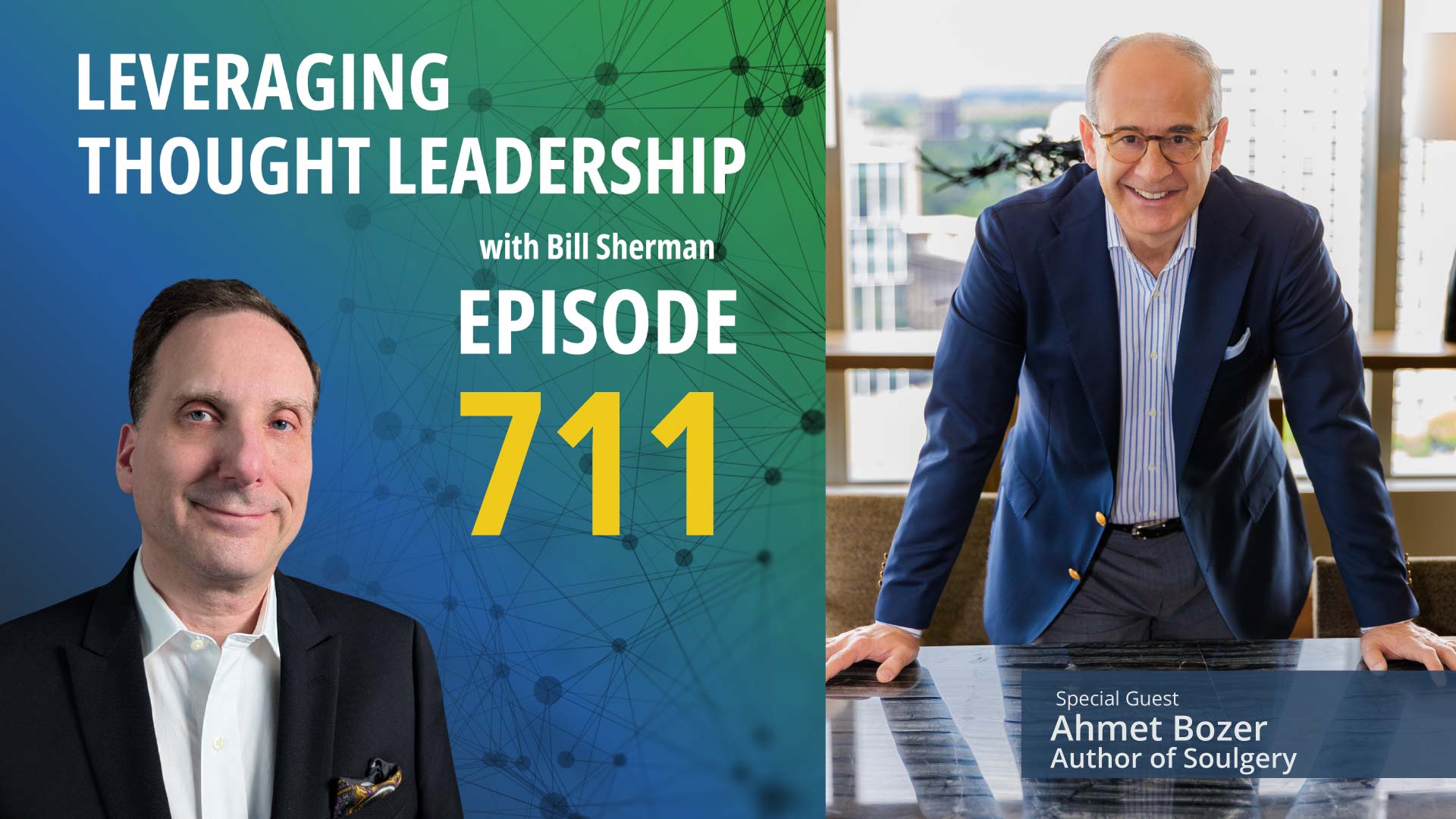



How Retired Executives Can Turn Experience into Enduring Ideas
This episode explores how executive experience becomes thought leadership, why leadership is a way of being, and how books, platforms, and institutions can help ideas scale beyond a single career.
What happens when a global executive finally has the freedom to say what matters most?
In this episode of Leveraging Thought Leadership, Bill Sherman sits down with Ahmet Bozer, former global business executive and author of Soulgery, to explore what comes after a career of leading at scale. Retirement gave Ahmet something rare: time, perspective, and the freedom to turn decades of leadership experience into a deeper contribution.
Ahmet shares why writing a book was not a vanity project. It was a commitment. A way to distill what he had learned about meaning, resilience, contribution, human connection, and lifelong growth. For him, leadership is not a title. It is a way of being.
Bill and Ahmet dig into the discipline behind turning hard-won experience into thought leadership. Ahmet explains the quality standards he used for his book: useful, legitimate, action-inspiring, clear, fluid, and accessible. The result is a leadership philosophy built to serve real people in real life.
The conversation also explores what many retired executives discover: writing the book is only the beginning. Ahmet is now thinking about platforms, partnerships, apps, institutions, and education. His goal is not simply to sell a book. It is to help ideas live beyond him.
This episode is a powerful look at executive thought leadership after the C-suite. It is about contribution, scale, humility, and the courage to let an idea leave your hands and take root in the lives of others.
Three Key Takeaways:
- Leadership is a way of being, not just a role. Ahmet Bozer argues that true leadership starts with self-cultivation: meaning, contribution, human connection, resilience, and continuous growth.
- A book is only the beginning of thought leadership. For Ahmet, Soldry is not just a finished asset. It is a platform for impact through an app, institutions, education, and ongoing conversations.
- Ideas need both courage and humility to scale. Thought leadership requires sharing hard-earned insights clearly, usefully, and accessibly—while accepting that the idea may evolve and eventually belong to others.
If this episode got you thinking about how leadership can live beyond one person, listen next to our conversation Thought Leadership for Building New Leaders with Tom Kolditz.
Both episodes explore how we create more leaders—not just better executives. Ahmet Bozer focuses on the inner work: meaning, resilience, human connection, and contribution. Tom looks at how institutions can develop leaders at scale.
Together, they connect personal leadership growth with systems that help leadership spread.
Transcript
Bill Sherman What do you choose to say if, after many years, you finally have the freedom to say anything? After decades as a global business executive, Ahmet Bozer retired. He had reached a moment in time where his voice was his own. But instead of stepping away, he stepped forward. His thought-leadership journey emerged from years of questioning leadership. From the inside of organizations. And now retired, he made a decision to turn that reflection into contribution. Ahmet is now the author of the book, Soldiery. In this episode, we explore how Ahmet moved from leading organizations to shaping ideas that can outlast him. I’m Bill Sherman, and you’re listening to Leveraging Thought Leadership. Let’s begin. Welcome to the show, Ahmet. Thanks for having me, Bill. So I’m excited for a number of reasons here, and this is part of what I would describe as a recurring series of business executives who, after they retire, realize that that space allows them to say something that is important to them. And so… My question for you is – you wrote a book you didn’t have to, after retirement? Why did you do so? And did you ever think you were going to write one when you were an exec.
Ahmet Bozer Yeah, that time that you mentioned is indeed very, very precious, especially if you’re fortunate to feel healthy, vibrant, and you feel you can still contribute. So when that time came for me, I tried to approach it with great care to make sure that I do what really matters most to me, as well as the biggest contribution I feel I can make. Based on my experiences. This idea of writing a book didn’t just emerge at that time. It really was an extension of my sort of continuing curiosity about leadership that led me there. And I went through a number of phases of that. Leadership was my position at work. Uh, for decades, I’ve been in leadership positions. It was also a fascination to figure out what makes it good, you know? And, and throughout this process, I was looking for gaps. So in myself, so that I can fill those gaps. And, um, I came to realize that we don’t develop ourselves or other leaders. We don’t develop the foundations of this leadership. And what I mean by that. A sense of meaning or a preference for prioritizing the contribution or the difference you will make genuine, authentic human connections, building your resilience and no matter your age status, wherever you are growing, continuously growing. Those were I sort of identified those as the foundations of leadership. That are never, that are talked about a lot, but really never developed to the way that I thought for myself had to be developed. So as I kept diving deeper and deeper and into all of these, I sort of met some of the basic human qualities that make these things happen. And I realized nobody can teach us these. Yes, our family influences that, our upbringing, our experiences at work, in the community, all of that influences that. But really embedding those foundations or building those foundations in a robust way requires a lot of self-cultivation of them.
Bill Sherman So let, let me jump in here because you’ve given us a lot and I want to start teasing pieces apart. So the first thing you said that I want go back to is time is precious and it’s precious in different ways when you’re an executive versus when you retire, right? So as an executive, you’re required to speak. You’ve got meetings, you’ve got town halls, you’ve gotten internal meetings, external. There are things where you have to speak on behalf of the company. You have a smaller window, I would say, of discretionary speech. 80%, maybe 90% is required. 10 to 20, if you’re lucky, is discretionary. And then when you’re retired, you have more freedom. But you also appreciate the limitedness of time and health. Right? And so I want to go back to when you were leading first at the very large beverage company, and were you doing this work for yourself? Were you creating the space for others to do the work on leadership and self-awareness while you were leaving? How did you use that discretionary time?
Ahmet Bozer You know? It is somewhat discretionary while at work, while in this role, but it depends on how you view your job. If you see this as critical to your own performance in the job, you prioritize it and work on it. And the beauty of it is because I believed in this, I believe in a couple of things. My most important role as a leader is to create the environment in which others can thrive and I thrive as well. But it’s in my, I’m in the position to influence that environment to a great extent. Well, for me to influence the environment, it starts with me. I cannot say something that I don’t live. So there is a synergy in this when you talk about, are you doing this for yourself or for others or how you have approached it? Well, I’ve approached it as a requirement of my job to be this way. And the beautiful synergy of it is because of the belief that if I live this, this will cascade. So I sort of killed two birds with one stone. That’s um…
Bill Sherman And then if I build from that, you get talent that starts looking and going, Hey, what is on it doing? I want to understand, or I want it to be on his team because I like how he leads. And that gives you as the leader, people who are interested in following and learning themselves on the journey. So there’s there was probably a self-selection process.
Ahmet Bozer I experienced that, it was more I would word it as, I hope this, by the way, this is my interpretation of what’s happening, is people want it to be in that environment where they can really flourish, they can try different things. If they make mistakes, it’s not fatal. As long as they keep learning, they remain constructive. So people who really like to be in that environment enjoyed working in our group. And it also sort of, sometimes the business world has these straight lines, business and friendship and all of that, yes, and I understand all of them. But there is huge value to the human connections that you make. We connect with each other as a supervisor, boss or peer, whatever. But… Keeping that human connection alive as part of it doesn’t mean you are giving up anything on the business side. You’re doing both. I think that also makes the environment better because I really see business as a, as the, as one of the social platforms that we get that what do people do when they retire? You know, you’re not in that social environment anymore where you work with people and all of that. That’s one of biggest differences. When you retire, when you work on your own, and there is huge benefit and reward by being in that social environment. So why not make that social environments, human, lively, fun? So yeah, that’s how I would express it. I think people and not everyone, but a great many people enjoyed being in. So then, let’s move to retirement.
Bill Sherman Like many retired execs, you have options. You could serve on boards, you could play golf, you could travel the world. There are many opportunities available. Was writing a book the first on your list? Were you ready day one to do so or did you have to think about it? You know.
Ahmet Bozer As I was, while I was at Coke, you know, we know that your time can come there or in any company to an end at any time. So one of the books I’ve read from Peter Drucker was talking about second career. Back in, I read this like in early 90s, I think, or mid 90s. This is a book old. So that second career idea had been in me. And then this writing a book was always an idea. But when I retired… I said to myself, okay, this was the idea when I was in Coke, but let me experience this being out of an executive role and within this environment, let me reconsider whether this is what I want to do. In the meantime, I did a number of boards and I’d say I was working full-time hours, 75% of which was in boards. So I kept questioning myself. I said, Ahmed, you wanted to do this. Did you not? You know, this was, you like thought all these years. And I kept, yes. And I said I can do everything just like a business exam. I could do the boards. I could this. I could that. And I spent a good four years. Spending only 10 to 15% of my time, maybe 20, on the book, and about 75 to 80% on the boards and all these other things. I was still working. But I was sort of this nagging thing. You wanted to make this contribution, and it’s been four years. You know, you haven’t progressed enough. Are you really serious? You wanna do this? And it’s hard when you come from 33 years of business. It’s hard to sort of shift and say, I’m going to put, you know, 75% of my time on this because there is demand for your work. That’s good. And that makes you happy. You get back into business. These are all great stuff. It’s you’re doing things that you’re more familiar with.
Bill Sherman Exactly. You have muscle memory. You’ve developed your skills where you haven’t spent a career writing a book.
Ahmet Bozer Yeah. Yeah. So I decided to allocate more and more time to it. And, you know, in the last four years or the four years after that, I started realizing how a good decision, decision that was 50% of my time on producing soldiery and that path was also just like any other, even if you think of it as building your business. Like building a business, a lot of ups and downs, a lot self-doubts, what am I doing? You know, is this right? Am I writing the right things? Who’s gonna read this? All these questions go through your mind. But then you experience days that you feel like you’re flowing, man, you’re just creating incredible stuff. So it was just like a business journey in a way where, you know, same human dynamics, self-doubts and inspiration. All happening at the same time. The key was to keep at it, to keep it.
Bill Sherman Well, and if I pause there for a moment, you reached a moment where you said, okay, am I serious around writing this book? And you gave yourself a period of time just to make that decision, right. And say, if so, then I need to execute at a similar standard to what I’ve held myself to before. And I think you mentioned when we talked last time. You had a set of words on style and content that you sort of, that helped guide you on that. Can you share that? And how did you come up with, okay, I’m doing this and I’m going it to this level. And you have
Ahmet Bozer brilliant memory, thank you Bill, for remembering that. Yeah, coming from the business world, you sort of produce things up to a certain standard. If it doesn’t meet that standard, you don’t serve that product. So why should that be any different in writing your business? By the way, I’ll sort of do a precursor to my answer to this is that I’ve made a very conscious decision to prioritize quality? Over meeting deadline. See, in the business world, you have to, like you were saying, you have get to that next speech and do all of that. I said, time doesn’t matter. I’m going to put out the best quality. So if I’m gonna put out to best quality, what is that quality standard? And so I’ve defined three words for the content and three words, for the style. And the content words were, it’s gotta be useful. MEANING When the reader reads this, they can do something with it that helps them. Second one I said was legitimate. How did I define that? Nobody knows exactly.
Bill Sherman That’s exactly my question, so please.
Ahmet Bozer Yeah, nobody knows what, by the way, I served these, I shared these standards with my coach and I asked him to review against these standards as tough as he could. So on Legitrix, I’ve said, if as a reviewer, whether I’m reviewing it or somebody else review. When you read what I wrote, you say, yeah, I think 90% of the people would agree with this. That checks the box. If you don’t think that’s the case, look for a conscious, humble effort to try to convince the reader to the legitimacy of what I write. That was the legitimacy standard.
Bill Sherman Well, and what I liked there is there are certain things that are valuable to share, which can be provocative. They’re not conventional wisdom. And you have to say, okay, how do I persuade a reasonable person? You can’t persuade everybody. Everybody. No.
Ahmet Bozer No, exactly. So it gives us that it just, that standard turns me, turns us inward to what we’re doing to convince the reader. The reader may not be convinced still, but at least have we done our best.
Bill Sherman Him. And then it’s rhetoric and argumentation and knowing that some people respond to data, some people respond to a story and you’ve got to meet the reader where they are, rather than your default mechanism for making an argument. I’m sorry, please continue with the third.
Ahmet Bozer The third was inspiring action. Did what I write inspire action? So Mr. Reviewer, as you read this book, do you think the reader would want to do this, would want do what the book is asking them to do? So it’s useful, yeah, but does it inspire action and is it legitimate? So those are the three for the content. And I wanted to keep it simple. And then the style, it was very good. Is it crystal clear? And is it fluid? So does it flow as you go through it? And then is it accessible? Because soldiery gets into a lot of deep concepts like meaning, love, wisdom, character, you know, all these things at the same time, it gets into things like performance and challenges and all of that. But, and it’s sometimes, if you are a philosophical thinker, you could put something out that’s not really accessible to anyone. Young, old People in Asia, people in Europe, people in America, people in Latin America. So is it accessible to the human beings? That was the third one, clear, fluid and accessible from the style standpoint. And we went back and forth and back and forth for years until we all felt now, then we had an editor that gave in before the formal edit. We also gave an editor the same task. Look at it this way.
Bill Sherman That’s why it took me 8 years to finish it well and there’s attention there right so on the content side you’re saying useful and legitimate of two of the three right you’re also saying clear useful and legitimate sometimes leads you to those deeper questions of what are we doing here what matters what is my least in the world, as you said, more philosophical? And Philosophical. If you’re trying to be helpful and clear it’s a tough balance to strike.
Ahmet Bozer Absolutely. One of the other ways I talked about this book is that it just tries to fuse a lot of things. One is fusing being philosophical and practical at the same time. I didn’t want to put something out there that’s just philosophical, but I don’t know what to do with it because that doesn’t make it useful. Right, right. So yeah, and yeah, all of these balances and sort of combining that with seemingly contradictory. In a fluid way, gave me a good standard to aspire.
Bill Sherman Well, and the book that we have coming out, the thought leadership handbook, as I was writing and exploring certain things, like why do some people spend large chunks of their lives trying to communicate an idea to strangers, right? And who may, they may only interact with for 90 minutes for a keynote or, you know, at a book reading, whatever. Why are we trying to do this? That pulls you into the philosophical very fast. And at the same time, then trying to figure out, okay, how do you explain this in a way that if someone who just is like, I’m stuck here, I need an idea to move forward, put the philosophy on hold right now, help me with today’s problem, right? And how do you serve, not just different audiences, but the same audience, sometimes on different days and different moods?
Ahmet Bozer Yeah. And this is where almost like staying true to the properties of your product. So, for example. You know, if you’re selling Coca-Cola, you’re not being everything to everyone. You can’t even have a sense for what you are, who you are. You are a delicious, refreshing drink that you can consume in this occasion, that occasion, and you stand for these values that defines who you. So soldiery, the name of my book. The nature of this is it’s building yourself holistically throughout your life. Now, that, but the model is set up in a way that it’s not something you do for years and decades and then you see the benefits later, no. The model is constructed in a ways that every little improvement you make within this model actually gives you benefits back. Now, those benefits aren’t necessarily you make more money because of this one little change you’ve made. It may be that because of this one, little change, you made, you landed a job. You know, I don’t know what happens in that job. Or it may just mean that because of this change made, you feel some weight lifted off you. You feel more free, you feel more creative. It’s a matter of recognizing that change. So. Yeah, try to define what your product is. I decided mine was a lifelong guide to building yourself as a human being that makes you more effective, more resilient in every role you play in life. And it is such an approach that if you follow it, follow it and stick with it, you will start seeing the differences in your life. Those differences aren’t always material. Although the longer-term building has a better chance of getting the material things that you look for. Now, there are also all sorts of trade-offs. I won’t get into those here unless you want to talk about them. But that’s how it is. And that is something that applies to every human being. It’s a matter of whether the human beings decide this is a good approach for them. But I’m not going to change my approach to be everything to everyone. I’m going to try to communicate that approach for those who would find it beneficial.
Bill Sherman Well, this resonates with one of the ways that I define thought leadership, which is creating impact at scale, and that if you have insights, imperfect truths, you have a duty to speak and share it with other people. You shouldn’t stay silent and just live a good life. The world is too noisy with junk and AI slot that people with good ideas have to speak. However, like you said, your ideas may not be for everyone. They have the right to go. Yeah, that’s not for me. They can stand up and walk out. They can read the first two pages of the book and put it down. They could turn off this podcast. All of those things require us when we practice thought leadership to earn our audience. And the only way I know how to do that. Is by narrowing my audience and say, I’ll try to be deeply relevant to a small percentage of the world’s population. 0.00001% is big enough for me.
Ahmet Bozer And that is so true, this was exactly the motivation that I had when I decided to put the four main beliefs that were at the foundation of this model. Maybe the second page of the book, like very first chapter, I made it very clear that four beliefs that I have about what accelerates your growth in life. Now, if you read those beliefs, at that time, if it just doesn’t resonate with you, there’s no point in reading them.
Bill Sherman Right. Please stop here, thank you very much. Exactly. Well, and I want to ask you because we’re now drifting into the conversation of thought leadership, I know when we talked, you raised a little bit of an eyebrow at the term. So how do you define thought leadership given that you have spent a lot of time thinking about leadership itself?
Ahmet Bozer And by the way, thank you for, for that earlier conversation, which sort of made me think, you know, what is my own philosophy of thought leadership? Because anything we do in life, I believe we’ve got to have a personal philosophy about it, because when you call yourself a thought leader, which I don’t, or if I do, I’ll do it with this, um, with this definition. In the society is sort of seen as it’s someone who influences others, influences, and those are all right. But what it means to me is, you know, in a very short phrase, it’s contributing to the emergence of a more accurate truth in an area, whatever area you choose. Now, it’s not a final truth. It’s something closer to it. And the term leadership, I don’t see that as a position of influence, I see it as doing the hard work, first of all, of reflecting on your experiences, distilling insights from them, and sharing them with both courage and humility. So that’s how I see the leadership part of thought leadership. And I basically landed on this, you know. It’s a form of. Carefully prepared expression of a self. That’s ever-evolving, because I’ve found… I express something as based on my experiences at this point in time three years later, I may find that maybe there is more nuance to what I’ve expressed earlier, and that’s okay so I Think of thought leadership as that if somebody calls me a thought leader as I said with you That’s the way I- the leadership part of it.
Bill Sherman So much to explore there. First of all, I agree with you on the distinction between thought leader and thought leadership and the term that I wind up using is those of us who try to put ideas out in the world are practicing a skill called thought leadership. The world can decide if they want to follow thought leaders or not. Honestly at the end of the day don’t care, right? It’s not the material. Are you bringing those little tea truths into the conversation, either shining a spotlight on something that nobody’s talking about, but needs attention, or advancing the conversation beyond conventional wisdom and saying, no, let’s go deeper. There’s a better way to think about this, talk about this do this. And it doesn’t matter if your expertise is in accounting. If it’s in leadership, whatever that is, we need voices showing a better way. And one of the things as you were talking about, you use the word influence, right? As I think about the leadership side of it, and I’d be very interested in hearing your response, leadership is often defined positionally or by role.
Ahmet Bozer And towards an outcome. But leadership with thought leadership is leading.
Bill Sherman Authors through ideas to a different place. And so many organizations use the term people leader to mean, okay, you have a direct reports, right? Thought leaders don’t have direct reports. They don’t. I have that structural piece. And so here, your tools for leadership are limited to the ideas that you have. And the value that other people see in them, right?
Ahmet Bozer I actually try to resolve that in my own mind by prioritizing leadership definition as a way of being rather than status. Because I’ve seen people in what people call leadership positions, people leaders, as you say, who don’t demonstrate that way of thing. And then I see people in a leadership role and they’re lousy leaders. They don’t demonstrate that way of being. And, and there are people who are not in formal leadership positions who do. So for me, it’s more important to. And define for yourself, I mean, I have my own definition, we can talk about it, which I’ve counted like some of the foundations of it. Trying to develop yourself in that way of being, making that the way you live in your life, whatever your position is. That is a more growth-oriented approach to leadership than thinking about it as, so when you do that, it applies very easily to thought leadership if you think of it as a way of being.
Bill Sherman Absolutely. And you use the word I believe earlier of sharing courage, humility, we might add service in there as well. If the focus is on yourself, you’re going to get tired real fast, either as a leader or if you’re practicing thought leadership. Because not only the idea needs to sustain you, but you have to be driven for impact for others and benefit. And that comes out from your useful and accessible and clear priorities. I want to turn to, let’s jump forward in time. The book is done. And you were thinking. About OK. Now that I’ve got this asset, I want to get it out in the world. And you crafted a strategy around that. And you told me, Hey, I’ve gotten four pillars of a strategy for what I’m doing with the book and why. Which is different than I would say most authors who I’ve spoken with, certainly first time authors. What were your four pillars and how have you gone about them?
Ahmet Bozer Yes, and this speaks exactly to the addition you’ve made, which was service. I called it contribution, like being contribution-oriented is one of the pillars of leadership. So I naturally… You know, coming from the business world. I’m used to the joy of seeing the effects of your decisions or your work in the marketplace.
Bill Sherman Like to go to you can get weekly if not quarterly data and know what’s working and what’s not
Ahmet Bozer or you can actually go out and meet these retailers, meet the consumers and hear from them and all of that. So whatever job I do, somehow I don’t feel complete until I see this work in reality, in the marketplace, if you will. So I embraced that as the ultimate goal. Therefore I said, writing the book is just step one. You know, my goal is. More and more people consider the soldiery approach, take parts from it that resonate with them, and reflect it into their lives. So for that, I had, I, by the way, I’ve evolved my pillars in a different language, which since we spoke, same things, but I communicated to myself in a much more compelling way. So I say to myself- I want soldiery to live on certain platforms that goes beyond my lifetime. Well, how are those platforms? The book is out. It’s written. Done. Okay. Maybe there are opportunities to make it international. And I’m working on, there’s a lot of stuff there. Well, the second one is an app. So soldiery, I’m on an app which uses an AI based app, of course, in our time, which uses soldiery to provide life coaching with soldiery fundamentals. And if the app is developed and it’s embraced, Soldiery lives there. That’s the other platform that it lives. I wanted to live on a number of institutional platforms. So if there’s a training course that people take about Soldiery for leadership development and all of that, that’s the third, institutions. The big one, the big one I’m toying with right now is… Is there’s gotta be relevance of this to our educational system. And boy, if I can make, you know, baby steps, some small steps towards that, that somehow some of these concepts finds them meaningfully in maybe in a private school or something somewhere. There’s a lot of work to be done there, but we are already doing some work so that we produce something that’s distinctive of value. So that’s my goal. And those are the pillars. NOW! There’s the, whenever there are these pillars, there’s a foundation. And the foundation is maintaining this kind of communication, whether it’s in social media, blogs, podcasts, newsletters, websites. And that’s the foundation, just to keep the conversation live about soldiery, but let it live sustainably on these platforms. And then from each of those, there are projects that are already identified. I’m now working harder than I did when I was writing the book, because it was clear to me that writing the Book was just the beginning.
Bill Sherman And this, I think, is one of the advantages of when I talk to retired executives, Fortune 500, and they’ve chosen a topic to speak on and really take these ideas, not so that they’re just a conversation today, but they’re lasting and produce impact, leaders at that level, whether you’re a mid cap CEO or a Fortune 500 executive know how to use others skills to amplify and create philosophy, right? So that you don’t have to do it all. A lot of people in thought leadership look at it and say, I can write more, I can speak more, I’ll travel the world, I’ll do more. And they wind up on whether you call it the Red Queen’s race from Alice in Wonderland or no, through the looking glass or it’s Sort of the hamster wheel effect where you’re running faster and faster, trying to reach 8.5 billion people or something. And the only recipe is exhaustion. Right. As an executive, you’re looking and say, who has audiences who needs this? How do I partner? Just like, you know, as a beverage company, how do we find distributors? How do we find channel partners? You don’t try to do it all. You’re looking for people who are closer to the consumer or in your case, the intended user of the ideas and that understanding of system velocity is almost the superpower in thought leadership of a retired executive. They know those letters. So well said. Now I think.
Ahmet Bozer I look at my sort of organization of my files, there are just so many stakeholders already in trying to do this. A number of institutions, academic institutions, agency who does this foundational work, my writing coach, the software developer, the digital advertising person, and you know, it’s a team. The only difference is like… This team is not in one organization. These are subject matter experts. You still, as a leader, have to explain what is your dream, what’s their role, how can we do this together, and all of that. So you’re trying to mobilize this team towards this vision of making your ideas live on different platforms.
Bill Sherman Absolutely. And when you get to, like you said, looking at education and institutionalizing that, whether it’s within academic institutions or K through 12, wherever, that is when ideas find home. Even some of the big consulting firms too. I mean, you look at an idea that lands there and stays. How do you leverage people who are in the process of delivering ideas to people? That’s really what education’s about.
Ahmet Bozer Yeah, yeah, and there’s a lot of sort of serendipitous stuff in this when you embark on this this kind of journey You just tend to sort of the people meet, they show up because you just meet people. Yeah, you just, you meet someone, you are actively going after talking about what you’re trying to do. You’re networking, you’re collaborating. If you feel passionate about what your doing, the person that you’re engaging with starts thinking, you know, I know someone here that you keep following up on that. I just say the universe conspires to help you. Now, there’s no guarantee that what you’re doing, you’re going to reach all of your goals, but the joy is in the process itself. Oh, absolutely. You get you get better.
Bill Sherman Results than you thought you were going to get. Well, and you’re applying personal effort to create velocity, priming that pump so that others can make that introduction and it’s easy, or they say, oh, that could fit into this event or we could partner here and the more, the way that I look at velocity of ideas is very simple. There’s only a certain finite amount of time an individual can put in, right? Whether we measure that at days, years, or a lifetime, the rest of the energy needs to come from not you, right. And so you said you’re working harder than you did with the book, but at the same time, you you’re going to be exceeded if you have a hundred people working a fraction of that energy. Right?
Ahmet Bozer Exactly, it’s the catalyst mindset you have to keep. Totally. And you can try to catalyze this from a number of different angles, meet with a lot of people. Just, this is just like business leadership, you know, it not any different. You know, you only, you have the same 24 hours and you have choose what you’re gonna focus on. You have to choose the way you’re going to make an influence and way you are going to activate. And it’s the same.
Bill Sherman Well, that’s one of the points that I was making is that executive mindset of what do I delegate? What do I let go of becomes powerful. The other thing that I want to call out for listeners here who can’t read your nonverbals, but hopefully can hear it in your voice is there’s a joy as you’re talking about this work. And I am certain that when you’re doing the work of sharing this that joy radiates. And that’s one of the powers that gets people interested. It helps sell the vision. It gets them curious and wanting to know more. And so I love how you’re approaching this on. I think you’re doing a fantastic job. And more importantly, it’s important work that’s needed to be done.
Ahmet Bozer Thank you for that Bill and I try to hold myself accountable to what I wrote. If I don’t come up authentically inspired by what I’m doing to others, then I’m not following what I’ve written.
Bill Sherman Right, right. If our ideas are putting us to sleep, and then we got a problem trying to persuade anybody else they’re excited. Exactly.
Ahmet Bozer Thank you very much for that. Very kind recognition.
Bill Sherman Thank you So I’d like to wrap up with a final question, where do you see this going? And what do you, what is your hope? Five, 10 years from now, flash forward into a future either once you have set this work down or maybe even after you’re gone.
Ahmet Bozer Yeah. So we live in a time where solving our problems can no longer be done with powerful leaders and top of organizations. We need what I call distributed leadership. People with a leadership way of being at all sectors. All levels at home in community. So my goal is that soldier becomes of the tools where we increase the number of people around the world with that leadership way of being. I am realistic to think that maybe, I’d say, the majority of the people, a lot of people, won’t be, this approach may not be resonating with, and that’s okay, because at the end of day, it’s a critical mass that creates a change. So my goal is to build this critical mass of people with a leadership way of being, living leadership every day in their lives. If I was in the business world, you’d put numbers to it. Maybe in two, three years time, I will get to that point by looking at various KPIs, how many people are using the app, what they’re doing with it. Yeah, I’d like to get to that point so I can say here is a more objective goal.
Bill Sherman But then I was touched is very objective on its own.
Ahmet Bozer Yes, yes, but I’m also more interested in, okay, if I’ve touched somebody’s lives, what did they do? What changed the day of? You know, what did the final end result in terms of making life better for more people?
Bill Sherman Are the second and third order effects.
Ahmet Bozer So that’s the vision. And my vision is if I can make these ideas live on these platforms, and these platforms are self-sustaining, and they are governed in a way that they continue, I’d like it to live way beyond me and evolve. And I don’t want soldiery to be mine. I want soldier to be people’s and I want people to modify their model if they need to. I just want it to evolve and live. That’s my dream. Not to say, oh, I’ve left a legacy or something like that. That’s just what makes me motivated. It’s what makes be inspired just for the sake of it. That’s.
Bill Sherman That’s it. I think that’s a great place to end is the ability to let go of an idea and let it fly and live in the hearts of the people that find it useful. Amit, thank you very much for joining us today.
Ahmet Bozer Thank you, Bill, it was a joy having this conversation.
Bill Sherman Okay, you’ve made it to the end of the episode, and that means you’re probably someone deeply interested in thought leadership. Want to learn even more? Here are three recommendations. First, check out the back catalog of our podcast episodes. There are a lot of great conversations with people at the top of their game in thought leadership, as well as just starting out. Second, subscribe to our newsletter that talks about the business of thought leadership. And finally, feel free to reach out to me. My day job is helping people with big insights take them to scale through the practice of thought-leadership. Maybe you’re looking for strategy, or maybe you wanna polish up your ideas. Or even create new products and offerings. I’d love to chat with you. Thanks for listening.
