Building Thought Leadership That Sells | Paul Falcone | 708
The Leveraging Thought Leadership podcast is created by Peter Winick and Bill Sherman and produced by Thought Leadership Leverage.



How practical leadership content becomes books, speeches, coaching, and scalable thought leadership offerings
A practical conversation on turning expertise into thought leadership, building multiple revenue streams beyond books and keynotes, and aligning evergreen ideas with shifting market demand.
What does it take to turn deep expertise into a scalable thought leadership platform?
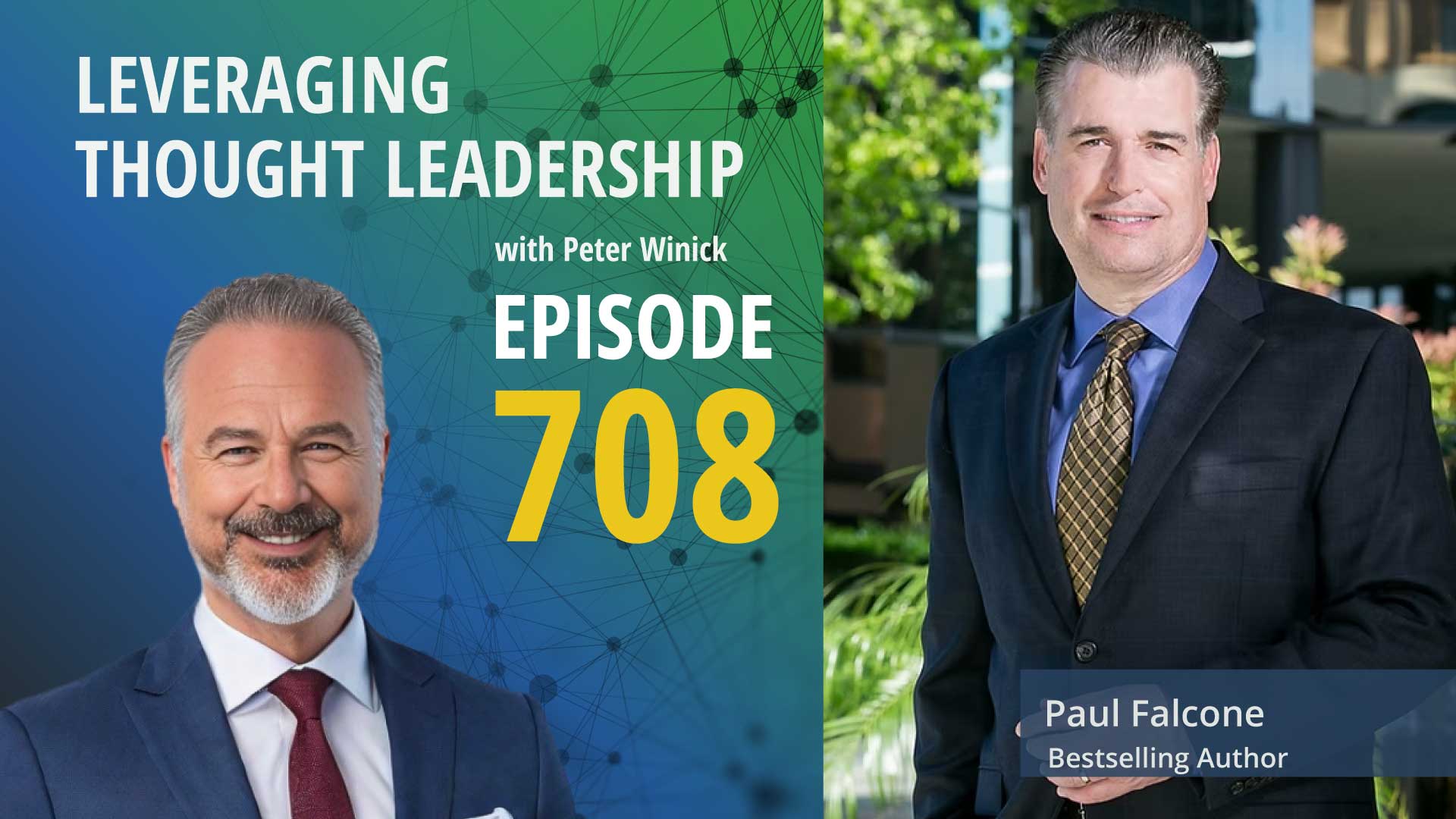
In this episode of Leveraging Thought Leadership, Peter Winick talks with Paul Falcone, bestselling author and leadership expert, about how practical ideas become powerful market assets. Paul has built his body of work around hiring, performance management, leadership development, and workplace ethics. His edge is simple: he does not deal in theory. He teaches leaders how to handle the conversations and decisions that define management.
This conversation focuses on the real engine behind Paul’s thought leadership success. He explains how decades of frontline HR experience became articles, books, speeches, workshops, and executive coaching offerings. His work stands out because it translates complex people issues into usable frameworks. Not just what leaders should do, but how to do it when the stakes are high.
Peter and Paul also explore the business model behind strong thought leadership. They discuss why authors should think beyond books and keynotes, how to diversify revenue streams, and where the biggest commercial opportunities often hide. From management training to conference speaking, coaching, facilitation, and advisory work, Paul shows what it looks like to turn expertise into a durable portfolio.
A key theme in the episode is market relevance. Paul shares how evergreen ideas stay valuable, but demand shifts with the moment. Topics like crisis leadership, hybrid work, workplace disruption, layoffs, ethics, and employee isolation rise and fall based on what organizations are facing right now. The lesson is clear: great thought leadership is not only built on strong content. It is strengthened by timing, positioning, and responsiveness to what the market needs most. This is a smart episode for anyone building a platform around expertise. Especially those wondering how to package knowledge, expand offerings, and keep their ideas commercially relevant over time. Paul brings a grounded, field-tested perspective on what makes thought leadership useful, credible, and worth paying for.
Three Key Takeaways:
- Thought leadership grows from applied expertise, not abstract ideas. Paul’s work is valuable because it is built on real management challenges leaders face every day. His strength is translating experience into practical guidance people can actually use.
- A strong thought leadership platform needs multiple revenue streams. The conversation makes clear that books and keynotes are only part of the model. Training, coaching, facilitation, advisory work, and other offers can all turn expertise into a more durable business.
- Market demand changes, even when your core ideas stay relevant. Evergreen topics like hiring, feedback, crisis leadership, and ethics do not disappear, but different themes rise in importance depending on what organizations are dealing with in the moment. Smart thought leaders pay attention to timing and position their ideas accordingly.
After listening to Paul Falcone, keep the momentum going with Episode 101 with David Benjamin. Both episodes explore the same core challenge: how to turn deep expertise into thought leadership that the market will actually value, buy, and act on. Paul focuses on packaging practical knowledge into books, speaking, training, and coaching, while David digs into how to create demand for your ideas and capture attention even before buyers fully understand they need your solution.
Transcript
Peter Winick And welcome, welcome, Welcome. This is Peter Winick. I’m the founder and CEO at Thought Leadership Leverage and you’re joining us on today’s podcast which is Leveraging Thought Leadership. Today my guest is Paul Falcone. He’s a recognized expert in hiring, performance management and leadership development. He’s the best-selling author. He now works directly with organizations of all sizes offering customized programs that range from keynote speeches and webinars. And he’s got a ton of experience across the Fortune 500. He’s written five going on six books, I believe, so he’s pretty proficient. And here he is, welcome aboard, Paul.
Paul Falcone Thank you, Peter. It’s a nice intro. I kind of liked it. But it’s 17 books, not that we’re counting.
Peter Winick Oh, 17. Okay, yeah, I think my other glasses.
Paul Falcone No, it’s fine. They came out in different batches and I advertise them different ways, but they were all with the American Management Association and or HarperCollins leadership. So, cool. Wow.
Peter Winick Wow, I think many people I know have not read 17 books, let alone written 17.
Paul Falcone Yeah, I don’t sleep at night a lot, but that’s okay, that’s fine.
Peter Winick Yes. So let me show. I’ll ask you one of my favorite questions is how do you get here? Like, how did all this happen? Because I would doubt that a young 10 year old Paul, while his friends were playing baseball, said, I’m going to write 17 books and be a speaker. And like, how did this all come to be?
Paul Falcone A little bit by accident. I didn’t know what I was gonna do when I grew up. And so I went to UCLA, I studied German, which is a long story because I’m Italian, but I ended up getting my master’s degree. Didn’t know I was going to do. Went to a recruiting firm and said, can you help me? And they said, well, why don’t you work here? So I said, fine, what do you do? And I stayed there for about six years and became the director of sales training. And eventually went in-house with a client company. I ended loving HR, because there’s such a people element to it. But because I had the master’s degree and I didn’t go for the PhD, there was still that biting piece in me, Peter, I wanted to publish. I always wanted to see my name on an article or a book. The bottom line was I ended up living two dual lives. It’s like I’ve worked during the day and I’d write about it at night. So I became a columnist for SHRM, the Society for Human Resource Management. I wrote for them for 20 years. And I was also writing for the AMA, the American Management Association. They had a book publishing division. Yep. Pitched the idea and that was the first of what’s now 17 books. So lucky for me. I’m where I am now and three years ago
Peter Winick So this is like a nights and weekends thing, mostly a nights in weekends. So what happened to this? So I’ve seen that movie before where it’s a passion, it’s calling, I kind of do it over here, and then that thing blows up. How much overlap was there between the night stuff and the day stuff? Were you getting sort of fodder ideas, whatever, from the day’s stuff that fed the night? Because they’re probably not totally a wall between the two.
Paul Falcone People would say, where’d you come up with the content? And I’d say, believe me, I’m not that creative. The content finds you when you’re in human resources. It’s like he did Wyatt. And there was a cycle to it. I ended up taking what I was seeing in real time and turning it into articles for Shurm. And then when I had enough articles for shurm, I had had enough content for a book. And it just kept going and going and go. And I would change the names to protect the guilt. But I was lucky where the companies that I worked were very supportive of my writing. Whether it was Paramount Pictures, Nickelodeon, NBC Universal, City of Hope, you know, they were all like, fine, Paul, just put a little disclosure in the air that these are your ideas, and they’re not tied to the company. They don’t make it our company to be that kind
Peter Winick I think there’s a lot of frustrated folks in the corporate world that have other creative outlets, whether it’s music, whether it art, whether it writing, whatever. You’ve got the CMO that’s in a punk band or whatever that might be. And I love the idea of you having the courage to talk to the folks at work saying, hey, I’m gonna do this, are you cool with that? And not only do they say they’re cool with it, but there’s encouragement, right? Which probably wasn’t your expectation when you first did that.
Paul Falcone Well, some companies I don’t think would take too kindly to it. One time I interviewed with a company and I disclosed it right up front. Sure. And they said, well, are you an HR guy or do you want to be Mark Twain? No, seriously, that’s what the person said. And I thought, OK, that is not going to work. It’s not going work for everybody. And there were some organizations, I’m sure, that would say, nope, when you work for us, you don’t do extracurriculars. Thank God. But I knew that in advance, Peter. That was part of my interview. That was my onboarding. If that wasn’t going to, I am sorry, this is a critical part of who I am. And I just wouldn’t stay with a company that said no to it. I just explored it in the interview process at first.
Peter Winick So at some point I’m imagining there’s a fork in the road, if you will, right? Is that the twain? Is there a twain quote there? No, that’s not a twaine quote.
Paul Falcone I like the metaphor, stay with it, I’m good. I can hold, yes.
Peter Winick There’s a fork in the road, and you’ve got to say, huh, do I stay on the corporate side or this thing’s big enough to really support me and give me the things I need? Tell me about those decisions and how you got there.
Paul Falcone It’s again, I was the chief HR officer for the motion picture and television fund, which is the healthcare nonprofit. It’s the retirement home for the people in the entertainment industry. When I got that job, it lasted about five years. They wanted someone with healthcare, and they wanted someone from the entertainment background. And I was the candidate because I had worked at City of Hope. I’d worked at Viacom, Paramount, Nickelodeon, whatever. So I thought it’s healthcare in a retirement home. How busy can be.
Peter Winick Yeah, right, right. This will be easy.
Paul Falcone Until COVID hit. And it turned out to be the hardest job I’ve ever had, probably the most meaningful. The CEO and I were connected at the hip. I will say this objectively, I think we did a great job getting the organization through that time, but we buried employees, we buried residents. It was a really heartbreaking time. When we were getting out of it in 2022, you could see kind of the light at the end of the tunnel. I gave my four months notice, found and trained by replacement, no drama. But what I realized was life is too short. I love teaching, I love training, management training, keynote speaking, coaching. This is kind of what I wanna do and I realize life is too short.
Peter Winick So stay there, because I want to talk about the journey of, OK, so now you decide, because you thought you had this job that was probably a little more cushy. You did a terrible job of planning and predicting COVID. So you had to deal with that. And it’s literally, all HR jobs, literally life and death if it’s a retirement home where elderly people are alive. That’s an awful thing, right? That’s not a phone it in kind of, oh, now we get to work from home thing anymore, right. So… What does it look like now, now that you’re on the other side of this and have been for a while, what’s the good, the bad, and the ugly? Because sometimes people, they’re afraid to make the leap because it’s that matrix of the unknown unknown. So if somebody’s on kind of where you might have been a few years ago, what would you be telling them to think about before they make the leaps?
Paul Falcone I was terrified to make the leap, full disclosure. I mean, you come off of a W-2 with benefits and whatnot, and then it’s like, okay, now I eat what I kill, and how much does that private policy cost? It was, it was, okay, three and a half years later where I am now, it’s the best decision I ever made. I’m only doing the stuff that I love doing and I’m lucky because in a way, yes, I was jumping into the unknown but I really had been preparing for it for the prior three decades with all of my writing. It does help to come out when you’re author of bestselling books and whatnot. So I’ll give you that. But it was still very hard for me and it takes a change in mindset and there is a risk that’s associated with it. My wife was the one who said, I was 59 at the time. Which he said. Honey, do it now. Don’t work till you’re 65 or 67 and then start. Because she said, you’re going to want to work till your 90. You love doing the part that you love. Use between now and 65 to kind of build your pathway, build your client base. And I married up. She was smart. And she called it. And it really did work out well for me. I mean, we’re also living half the time in Chicago, half of the year, where our kids are. So I’ve got the flexibility to do that as a consultant, what I couldn’t do if I were in a full-time role.
Peter Winick Right, which is great. So give me a sense of what the portfolio, what the mix of the services, the offerings, what’s the, what does it look like? Who gets, who’s paying you to get what done? Cause you obviously have books, it’s speaking, give me a sense, the variety of things. So sometimes people aren’t even aware of what is the life of a thought leader look like. What are you charged for? What do you do? Who do you it for?
Paul Falcone Yeah, I think the idea is you got to have A, B, C, D plans, you know, there’s your primary, but to the degree that you can diversify the better. So for me, what I love doing when I spend most of my time doing is management training. Companies can be fortune 500 could be startup can be whatever. But a lot of times the managers don’t understand how to do things. They know what to do. They just don’t know how to Do it. And if my books had filled any kind of gap out there, Peter, it was that it taught people how. The how is what’s important, how to hold the tough conversation, how to do the documentation, how to interview a salesperson versus a C-level person versus a recent college grad, just real practical stuff. And that’s the stuff that I can bring out there now. The second piece of it was, I speak at all the conferences because I’ve been doing that through SHRM, and that just kind of lent itself. And that that’s my biz dev funnel, right? Because people see me speaking. The third issue is the executive coaching, the one-on-one piece where I get to either work with an individual CEO or C-level. And or their senior leadership team. And that’s a combination of training and one-on-one coaching. Now, I also diversify. I’ll say if you need HR advisory services, I don’t get a lot of that, but it’s there. If you need expert witness testimony, I have that there. I don’t get much of that. But to me, the idea is don’t go in with only one. What made more sense to me was kind of like my books. You know, my books were on hiring, they’re on performance management, leadership development, ethics. I like writing about the full scope of whatever my discipline is, and I would recommend that for people.
Peter Winick But I like a lot of what you said. One of the things I want to expand on is most people, when they’re making that transition, they say, oh, I’m going to be an author and a keynoter. Because those are the two obvious ones. I will write a book, and then someone will bring me in and pay me to speech. But things like expert testimony, even though you don’t do a lot it, that’s interesting. So I think that what people need to be thinking about is, OK, I’ve got this stuff. Here’s the cupboard, and here’s all the ingredients. How might I format that? Because I would argue that Sometimes when somebody’s brought in as an expert witness, they’re really regurgitating something that they wrote in a book or whatever, but the value that that hiring agency is paying on you for the expert witness is crazy, right? Like it could be, you know, whatever, 50K a day or something. It could be even multiples of that because the stakes are really high and they’re bringing you in and they, you, you know whatever it is. And you look at that and go, yeah, I kind of did that for like, 12 minutes on a workshop the Tuesday before in Cleveland and got paid you know a couple thousand bucks or something is that is that an interesting way to sort of think about who places the most value on the ideas at a moment.
Paul Falcone It is one client had said to me early on, Paul, we’re going to do a corporate offsite retreat, would you facilitate it? And I was like, I mean, I’ve been to corporate offsite retreats on the receiving end. Never thought of something. I was like, sure I could do that. And you know what I mean, it’s this kind of thing. It turns out that NYU, there’s Stern School of Business, has a whole program on event planning and these kinds of things, and it’s like I had access to tools. So the funny thing to me, Peter, the way I look at it is be open to this stuff. And go to ChatGPT or Google Gemini and say, this is my background, this is what I’ve done, I’m thinking about opening my own practice. What are some of the funnels out there? What are the disciplines that I should consider that I can monetize based on my experience? Enter. And it all comes out and you’re like, I didn’t think of that. So it’s funny how a simple search on chat GPT or whatever your AI large language model is could open up things that you never even considered.
Peter Winick That’s amazing. So talk to me a little bit or about 17 books under your belt. What has changed evolved? What’s so different today when you’re writing? And when I say writing, I also mean the publishing promoting, you know, launching a book today versus five years ago, 10 years ago. 15 years ago
Paul Falcone That’s a really good question. I just feel like there’s so much more competition. There’s so much more space. I mean, there used to be the big five publishers, and now there’s the big six because of Amazon, that people are self-publishing out there. And, you know, there’s a lot of volume. It’s just a lot volume. Now, in full disclosure, I always let the publisher, like HarperCollins or the American Management Association, do the publicity. I was working full time. I didn’t have time. And even now, the only real thing is every once in a while, post on LinkedIn just as a reminder. You know, I’ve got toolkits on my website, or I’ve these books that you might wanna look into as a book of the month selection, or, you know, for your high potential emerging leaders. Yeah. Right.
Peter Winick So you’re writing on, you know, a lot of your topics are evergreen, right? Yeah. So if you’re talking about giving feedback, we could update that, tweak that in the age of AI or in the Age of Hybrid or something like that. But the core principles are the same and to some degree timeless.
Paul Falcone Yes, so one little tweak. So one of the books that I’m best known for, it’s kind of my flagship book, is called 101 Tough Conversations to Have with Employees. It came out like in 2008 when I was working for Nickelodeon. Yeah, publisher made the book Orange to kind of correlate with the Nickelodeon theme, right?
Peter Winick Yeah, yeah, yeah.
Paul Falcone Second edition came out in 2019, right before COVID. I just finished the third edition. So it’ll take till probably fall of 2026 to come out. But if you think what’s changed since 2026, you’ve got, wow, we had COVID, we had the adrenaline rush, adrenaline junkies because of everything with COVID. This idea of managing compound volatility and disruption is now one of CEO’s top five priorities, depending on what you’re looking at. Now you have this constant, the hybrid than your remote work. All union rise. Wait a second, we think we’re our employees are going to form a micro union. Listen, however you feel about unionism. Yeah. As an employer as an HR person, you don’t want to have Right, you got to handle that and represent the company, but so many of these changes, the isolation of the Gen Z Zoomers, the 27 and under crowd, they keep testing out as the loneliest, most isolated, most depressed generational cohort on the planet, more so than the retirees in retirement homes. What is our obligation as the elders, as the managers? What is your obligation to pass wisdom to the younger Gen and get them, they missed their most, their best years, they miss either their high school years or their college years. Or they miss their first years in employment, which for me was all about making friends and having mentors, they miss that and they’re not even aware of what they missed. You know, what is our obligation to help with that? There’s so much new stuff out there, it was very easy to come up with new content for the new edition.
Peter Winick So, interesting. So what are you thinking of next, not necessarily in terms of a book, but think about from the business standpoint, hey, I’d like to do more of this or less of this, or I’d to learn more about, you know, put on your Paul the CEO hat, not Paul the author hat, and say, what are, what do you looking at for the next, I don’t know, six, 18 months?
Paul Falcone Well, two answers to that one, Peter. On the one hand, there’s so much out there in terms of turn your course into a workshop or a class. Eventually, I think I do want to do that. But that’ll be right before I retire, right? Because then you can monetize this thing and repeat yourself even though you’re not working. Sure. But I don’t want to that now because I want people to hire me, not my video. It’s exactly that.
Peter Winick I think it’s an end, not an war. I don’t think there’s cannibalization. I think they’re different markets at different price points. So you say, if I bring Paul in, it’s gonna cost X. If I license Paul’s online course, it’s going to cost Y. And on a per capita basis, those are very different numbers. And I think actually feed into each other. My two cents.
Paul Falcone No, no, totally agree. I totally agree in the short term So if that’s the longer term goal, like I’m thinking about how can I make this thing live on beyond because I’m a one-person LLC I don’t want employees. I just want to do my own thing But in the shorter term, I’m thinking about, you know, what is the new content out there? So for example, one of the things I’m being asked to talk about now is leading through crisis and disruption. And it’s like, well, good, I’ve got a book on that came out two years ago. That’s the hot topic because people are like, how do we do this? We’re building the plane while we’re flying it. And like, How do we keep our marbles in place like in our heads and what do we do with employees who are suffering from this and what’s our obligations for that? There’s a lot there.
Peter Winick So stay there for a minute, because I think that’s the point that you’re bringing here. I think about that a little bit differently in that every thought leader’s got their stuff. Here’s what I’m known for, right? And then there’s a temptation to go a little beyond that. But let’s just say, here’s my stuff, right. And then you say, this is evergreen, right, like, so that book that came out two years ago was just as in vogue when it came out, right it’s universal, the principles are universal. But then what happens is there are factors beyond our control that happen in the marketplace that say, ah. Right now, crisis is more in vogue. I remember the 2008 crash, right? And right before 2008, so if you look at 2006, 2007, going into 2008, there was this wave of happiness books in the business world, right, why? Well, everybody was getting second mortgages and driving big cars and you know, they were living these large lives. So the feeling or the emotion or the whatever that was in the water was wow, we must all be happy because we’re getting all this stuff, right. Then… Market crashes. Now it’s like a bad country song. I lost my dog. I lost my wife. I lost my home, right. And the next wave of content was resilience. Now, it wasn’t like we had to create all this new resilience stuff. It was always out there. But the demand for resilience based on what was going on in the market, went through the roof, right, and the happiness stuff went away because it was almost in poor taste to be to be embracing happiness in a period when your friends are foreclosing on of losing it like it’s it was kind of not what one did. That’s like, okay, at an organizational level, how do we get people to be more resilient? How do we suck it up and get through this or be more gritty became a thing. So I think people, and not a lot of thought leaders are aware of the external factors that say, oh, there’s something going on here that’s making my stuff decreasing the demand for my stuff right now. And it doesn’t mean I’m out of style, right? It’s just, that’s the market, right. Well, for everything that goes down, something goes up. So what’s out there in the marketplace now that someone needs help on? Like. There’s always been books on remote work. Guess what? In 2020 through 2023, the demand for those went through the shelf because it went from a theoretical to a plotting, like at a lightning speed. So it sounds like you’re doing that, whether you’re aware that you’re doing it, I think you’re that nicely.
Paul Falcone Peter, the funny thing is when I switched from corporate to having my own practice, what my concern was, my biggest concern was if I’m not in the trenches, I’m gonna have content to write my articles, to write blog, to write new books.
Peter Winick Well, except you got 25 years of stuff.
Paul Falcone Well, this is true. This is true, but the funny thing is, now that I go into all these individual companies, nonprofit, public sector, Fortune 500, man, I’m getting earfuls. There’s so much content I’ve got coming at me. It’s like, it’s actually a good time to be a writer. And so some of the things that where I can see the need is when I will write one of the books I taught for years at UCLA extension on ethics, it was a mandatory course. And I like to teach the ethics class for the people getting their certification in human resources management. But there was never a book. You had to borrow articles and piecemeal stuff together. So I decided I’m writing a book on it and it’s called Workplace Ethics Mastering Ethical Leadership and Sustaining a Moral Workplace. And it’s all about managerial ethics and employee relations, fine. But it’s not the time for that right now. I’m sorry, no one’s really at the level where ethics are important. There may come a time though. But the pendulum always swings. And so my point is the diversification is critical. The book on effective hiring makes sense, but probably not right now. The book, on documenting discipline and structuring terminations and layoffs, that one could be a little bit hotter right now because companies are a bit of a downsizing mode.
Peter Winick More recently, DEI, there was so much great stuff out there on DEI. And then, like just the climate changed, right? So if you know, that was your space. And if that was what you were known for, the demand just went down without getting the politics and all the craziness of it. The demand just got cut period for stock, right, like, nobody’s buying, you know, purple socks anymore. If you’re in the purple socks business, you’ve got a problem, right. So that’s it’s part of the game. Interesting stuff. This has been a great conversation, Paul. I appreciate your time and sharing your experiences with us.
Paul Falcone Me too, Peter. Thank you. I’ve always admired the work you do. I love your podcast. To be part of it is quite an honor. So thank you for inviting me.
Peter Winick Oh, then we have plenty more time to tell me how great I am. No, I’m kidding.
Paul Falcone At least another 10 minutes. Yeah, keep going.
Peter Winick Thank you so much, Paul.
Peter Winick My pleasure, Peter.
Peter Winick To learn more about Thought Leadership Leverage, please visit our website at thoughtleadershipleverage.com. To reach me directly, feel free to email me at peter at thoughtledershipleverage.com, and please subscribe to Leveraging Thought Leadership on iTunes or your favorite podcast app to get your weekly episode automatically.
