How to lead with resilience, adaptability, and clarity when the stakes are high What can…
Designing the Long Tail of Thought Leadership | Tom Ziglar
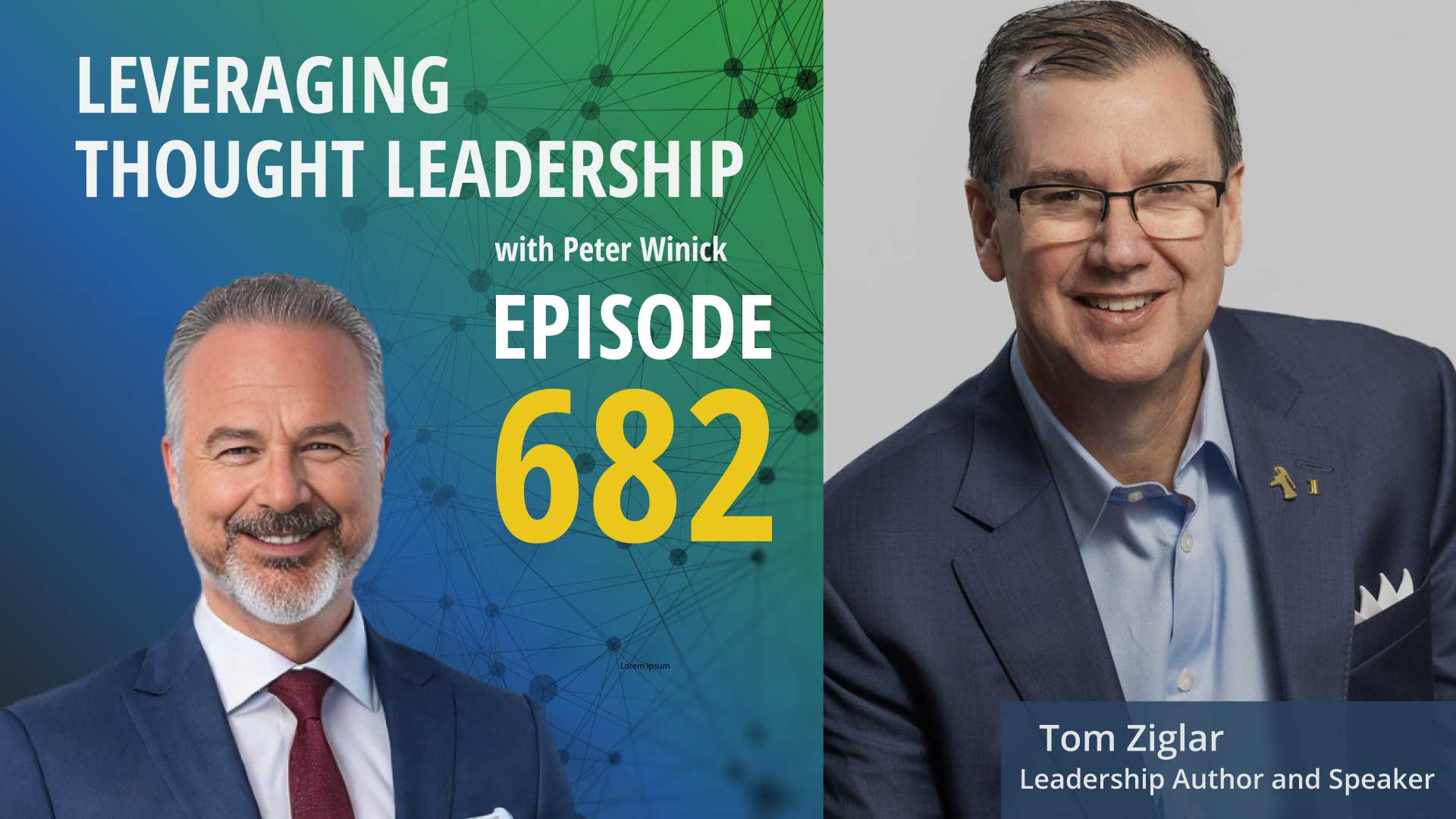



How AI, Programs, and Trust Turn Ideas into a Life-Changing Business
This episode explores how to move from being “in the keynote business” to building a scalable, life-changing thought leadership business with programs and tools. It shows how AI can codify your IP, tailor content to specific audiences, and stay on-brand without replacing the human expert. The focus is on business models, positioning, and calls-to-action that turns inspiration into implementation and recurring revenue.
What if your thought leadership wasn’t just inspiring for 40 minutes on stage, but life-changing for years after the keynote?
In this episode, Peter Winick talks with Tom Ziglar, CEO of Ziglar, Inc., about how he’s evolving his father Zig Ziglar legacy into a modern, scalable thought leadership business. They dig into how to turn big ideas into programs, tools, and revenue streams that deliver real behavior change for clients, not just applause.
Tom shares how Ziglar built an AI “digital brain” for Zig Ziglar by feeding in manuscripts and 50+ hours of audio. The result is Zig AI – a focused tool that gives only Zig’s answers to modern questions. You’ll hear how coaches are using it to adapt Zig’s classic seven-step goal system into language an eight-year-old can use, without losing the depth of the original framework.
They explore AI as a thought partner for speakers and experts. Tom shows how he uses AI to quickly understand new audiences, generate the “top 10 pain points” for a niche, and tailor stories so a talk lands with homeowners’ association leaders one day and senior executives the next. This is practical, in-the-trenches use of AI to make your content more relevant, not more generic.
Tom and Peter then break down the business models behind thought leadership. Drawing on Rory Vaden’s lens, Tom explains the three lanes of content creators: entertainers, encouragers, and educators. He argues that the long-term business is built in the educational lane—where niche expertise and implementation tools create the long tail of revenue, even if the spotlight feels smaller.
You’ll also hear a powerful distinction are you in the keynote business or the life-changing business? Tom shares what Ziglar learned after reviewing thousands of testimonials: for every one person who said a keynote changed their life, 99 credited a program or product. That insight reshaped how he designs calls-to-action, follow-through, and multi-step client engagements.
The conversation closes with a look at trust and authenticity as strategic assets. Tom brings in Seth Godin’s idea of “scalability of trust” and applies it to how thought leaders sell, speak, and serve. From customizing keynotes to building follow-on programs, Tom shows how to design a business that scales trust, not just reach—while staying the same person on and off stage.
If you advise, speak, coach, or consult, this episode will help you reframe your IP, your offers, and your use of AI so you can create deeper impact and more predictable revenue from your expertise.
Three Key Takeaways
- Keynotes don’t create most of the life change—programs do. For every one person who credited a keynote with changing their life, 99 pointed to a program, product, or course. If you’re in the “life-changing” business, your follow-on offers matter more than the standing ovation.
- AI can be a thought partner that makes your IP more usable and targeted. By building Zig AI from Zig Ziglar’s manuscripts and audio, Tom shows how AI can give only “on-brand” answers, adapt classic frameworks (like the seven-step goal system) for specific audiences—right down to an eight-year-old—and help experts quickly tune their content to different markets.
- The long-term business is in education, not entertainment. While entertainers dominate the airwaves, the real, scalable revenue it’s in the educational lane—where niche expertise, tools, and implementation support live. That’s where thought leaders build the long tail of their business, well beyond a single talk or appearance.
If this episode got you thinking about the difference between a keynote and a real thought leadership business, your next listen should be the Tendayi Viki episode “Thought Leadership Business Models”. Together, these two episodes connect the dots between inspiring from the stage and building scalable offers, frameworks, and revenue streams around your ideas. Queue up the Tendayi Viki episode next and ask yourself: am I running a talk, or building a business?
Transcript
Peter Winick And welcome, welcome, welcome. This is Peter Winick. I’m the founder and CEO at Thought Leadership Leverage. And you’re joining us on the podcast, which is Leveraging Thought Leadership. Today, my guest is Tom Ziglar. Tom doesn’t really need an introduction, but I’ll give a brief one. His father was Zig Ziglar, who is a legend in the business. Tom’s mission has he spent 30 years inside of Ziglar on both the inside of the house and the outside of the house, sort of front of the house and back of the house as a thought leader in his own right, as well as what I’ll call business operations CEO lead there. So there are very few people that have done that and done that as well as Tom has done it over the amount of years that he has. So thank you, Tom. Thanks for coming on board today.
Tom Ziglar Peter, it’s great to be here. I like hanging out with thought leaders and people who understand the challenge of communicating from the front of the room and inspiring people smarter than themselves. So
Peter Winick Love that. Love that. So give us a brief tour down memory lane, right? So you’ve been around this space long enough to remember things like cassettes and DVDs. So everybody says, well, it’s all different today, but I would argue it is, but it’s not. So give me a little bit of the history and the context by which the organization has operated and continues to do so.
Tom Ziglar Yeah, so the company we are running in our sixth decade. So think about early 70s, dad founded the company. He wrote his book, See You at the Top, came out in 1974. Wow. So 51 years now that that book has been out, just amazing. And I so I was seven when that book came out. Wait, no, I was eight. So it was seventy three, seventy four. And so I tell people I’ve been in the business sixty years because I was born into it, right? Going to all the events and you know, hearing in
Peter Winick And it’s not the typical family business where like the dad’s an electrical contractor and says, Son, I’ll teach you wiring, right? Like so that’s that that’s a thing in and of itself.
Tom Ziglar Yeah. So, you know, going and hearing the legends that I didn’t even know were legends speak, you know, Norman Vincent Peel and Paul would be an art link letter and all of that. And, you know, a corporation would have him come in and speak, and I would go and we did I remember I was a kid. This is this is really memory lane. I was like 12 or 13, and I think the Queen Mary was docked in is it Long Beach out in California? And they have they had a ballroom on there. And so he did a presentation and I’m 12 and he says, Hey, I want you to run the product table. And so it was cassette tapes.
Peter Winick Yeah.
Tom Ziglar Right. And this there’s a package and it was like a hundred dollars. And everybody paid cash back then. So think about that. Who pays cash now? I was twelve years old and we’re done. And he says, Well, how’d we do? And I’m looking around, I go, Well, we sold it all. And I pulled out of my pocket. I had like nine thousand dollars of cash in my pocket. Wow. When I was twelve. And so what twelve-year-old gets to have that experience? Went to college, started working in the business after college really to support a golf habit. Worked in the in the warehouse and then I was in cassette production and duplication. So we made our own audio programs, you know. So the cassette tapes. If you’re listening to this and you’ve got an old Zig Ziglar cassette tape, my fingerprints might be on it. I was putting I was running the labeler machine.
Peter Winick Think about in those days, right? If you were a lifelong learner, if you wanted to consume content, not to sound like an old fuddy duddy, but it’s so easy today to get access to anything, good, bad, and ugly, right? Like whether it’s YouTube or whether it’s podcast or whether it’s books or like the accessibility of information is amazing. In those days, you really had to be committed to your own development, right? And say, you know what? I’m gonna not only invest my time, but my dollars. Because, you know, a hundred bucks, you know, you mentioned that story, that was a zillion dollars back then. But the people who are committed to it, and I could I could see into my eyes of people I remember driving around with you’d get in their car with them and oops, the cassette tape would pop on and it’s oh hold on, let me pause that, because they already had the plan. I’m gonna get through the this program this week on my commuter and be seeing in between seeing clients and all that. Yeah, dad.
Tom Ziglar Called that automobile university. So you plug the tape in and you’re listening to it where you’re going. And a lot of millionaires were made. Yes. Go university, right? Just sales skills. Just to show you how different it is. We’ve got a tool called Zig AI. And all we did, we took like 15 of dad’s manuscripts, 50 hours of audio content. We transcribed, we put it all into zig AI. And so it’s in a safe environment. It’s you know, so you can ask it, you can prompt it using an AI language, but it only gives you zig answers. And so in the old days.
Peter Winick Right, but stay there a second because the in the old days to get to what you needed or what you wanted, you had to do it, you know, in in the sequence of the cassette tape. You might have to listen to like whatever, eight hours of tapes, and then you would ask somebody after, Hey, what was most valuable to you from that? And you might say five things and I might say five things and they’re totally different, but you’re not right and I’m not wrong. Right. Now that the ability to take AI to go through somebody with a depth of a body of work and say, What I need to know right now is whatever the situation is with this client, how might I respond to that? Or how might I deal with that in a professional manner?
Tom Ziglar I’ll give you a perfect example. Dad’s goal setting system is legendary, the seven step Ziglar goal setting system. Yes. And you know, you could listen to a whole hour program and get all seven steps and get motivated and inspired. Well, that’s in our Zig AI. So
Peter Winick Yeah.
Tom Ziglar I went one of our coaches went in there because our coaches use it. And this is the question they asked it. They said, Could you give me Zig Ziglar’s seven-step goal setting program? But in the language that an eight-year-old would understand. Wow. Because their client had an eight-year-old, and the client said, My kid’s starting to set goals. How do I teach them how to do this? And so boop, it pops out like two seconds, and it changes the name of the program from goal setting and achievement. It changes it to how to get what you want.
Peter Winick Wow.
Tom Ziglar So isn’t that perfect for an eight-year-old? Like here are the seven steps you gotta do that you got it to get what you want. So yeah, it’s the same content, but our patience level is so much different now. You know, we want that little sound bite. And then I often wonder, is that really the best way to learn it? I want that quick information, but I’ve got to get the mind and the heart in the same place. And when you hear somebody like an author, a thought leader, somebody like a Zig Ziglar.
Peter Winick Yeah.
Tom Ziglar And you get the context of the story and why it’s important and some of the trauma they had to go through in order to get there to make that happen. And then some examples of people who did it and what they got out of it. Yeah, that takes thirty minutes, but you walk out of there with a totally different level of belief than if it just pops out the seven steps.
Peter Winick Yeah, and I think, I’d love your take on this, that it’s not an either or, it’s context. When I have time to sit with a with a, you know, cup of coffee and as I try to do almost every day and read a read a book for an hour or two, that’s a different experience I have with that author. I’m getting their voice, I’m getting their tone, I’m, you know, I’m looking for the nuance, you know, I’m letting them take my hand and sort of guide me at their pace. Then there are other times I’m like, geez, I wonder what so and so, the world’s greatest negotiator, would say about the situation I’m in and give me that recommendation. Or actually, let me get five of the best negotiators on AI and create my own virtual border or whatever. Like that’s the kind of cool stuff we can do. And it’s not that I don’t think one beats the other. I think you need to do both if you’re if you’re an actual lifelong learner.
Tom Ziglar I a hundred percent agree.
Peter Winick Well that was boring. Okay.
Tom Ziglar Yeah. So my the reason the reason I question it isn’t that that’s the way to do it. It’s just that I don’t know if you know this, but people are lazy. Yeah. I won’t tell if you won’t, but yeah Yeah. But I mean it’s human nature, you know, oh that’s what I need, that’s all it is. And so I view AI as my thought partner.
Peter Winick Yeah.
Tom Ziglar And so I will often ask it a question and then say, Ask me five more questions that you need to get the right context.
Peter Winick So stay there with a thought partner because one of the things that you do, and one of the things many of my clients do, and many of the thought leaders we all follow do is speak, right? They’re keynoters, right? And what’s cool about being a keynoter, I think, is okay, you’ve got your thing, right? So they’re this is my this is what they hired me to talk about, blah, blah, blah. But it is ridiculous to assume that one day you’re going to be an expert and be able to connect to aeronautical engineers, the next day car salesmen, and the next day multifamily business owners in the manufacturer sector in the Midwest. So using that AI as a as a sparring partner and say, Hey, how do I bring these five ideas to life in a way that would resonate most to a newly minted MBA in a consulting background? Is that is that kind of what you’re saying?
Tom Ziglar Yeah, so there’s two things that I love to do. In fact, right after the first version of Chat GPT came out.
Peter Winick Yeah.
Tom Ziglar I was speaking to an association of homeowners associations. And of course, if you’re part of a homeowners association, you just love homeowners associations, right? Because they’re so friendly and kind and nice and they always do exactly what you want, right? Well, it’s the opposite. So these are like four hundred people who run homeowners associations. And so they’re constantly getting grief from homeowners.
Peter Winick Right. So they’re basically the school crossing guards of the homeowner community.
Tom Ziglar Yeah. And I’m just sitting there going, Oh my gosh, what a top, you know, that is a hard role to be in. And so Chat GPT had just come out. And so I write in to Chat GPT. What are the top 10 complaints that people give to their homeowners associated? Well, that’s cool. Yeah. Right. And so I go in and I do research and I interviewed the host and you know who’s the audience. Yeah, I have this whole thing of questions. So I walk in and I say, you know, normal standard intro, because I’m gonna talk about what I want to talk about, but I want to be in the context of that room. And so I said, Hey, you know, I’m just curious, do you know anybody who deals with this? And I had the 10 things on the thing. Yeah, and the whole room, because this is when AI was new, right? People in that room, probably less than three percent of them even knew how I got the list, right? It’s a little different now. And they’re like, Wow, that’s amazing. Did you used to work in this industry? What did you come up with? And I said, Well, you know, this is how I did it, and I interviewed some other people here, and here are the top three I want to talk about. Such a great way to do that. The other way that I bridged the room is and this is because of COVID. Okay. When COVID hit, I ended up doing about 300 webinars in the first or four or five months.
Peter Winick Wow.
Tom Ziglar All I was doing was calling all of our clients, all the people we support and say, Hey, do you need some energy? Genie, you know, do you want to get your team together? They’re all kind of out there. And these were not complicated or long webinars. They might be 20 minutes, 30 minutes, four they weren’t hard. So I was I was doing a lot of days, three or four of them. But that taught me the skill of presenting and reading chat at the same time.
Peter Winick Yeah. Right. Right.
Tom Ziglar I and so just by incorporating all their chat comments into my presentation and say, Hey Peter, that’s great. I’d repeat what you said and say, you know, well, what do you mean by that? Let me tell you what I think it means, blah blah blah. And then and now everybody’s kind of leaning in because they could be next. And so I started using tools in my presentations like Mentimeter and other things where people could make comments and it would start popping up on the board.
Peter Winick Right. Right.
Tom Ziglar Or if there were twenty tables in the room, I’d take a pause and say, Each table come up with one question you want to ask about that last thing and then the t then the tables would put it up. And it just let me know that as a presenter, a lot of and it’s different. If you’re just I got thirty minutes to do a keynote, you can’t do it. But
Peter Winick Yeah, yeah, yeah.
Tom Ziglar But if you got a little bit longer and you give space for to lay a foundation and then get people to interact, it’s a lot meatier for the room.
Peter Winick Right. And for me Well, and the and that relevance that can you know makes it because oftentimes you come in as the outsider and a lot of what you’re presenting to them is in their mind theoretical and they want to get to the applied. You’re getting them to that applied much quicker now.
Peter Winick If you’re enjoying this episode of Leveraging Thought Leadership, please make sure to subscribe. If you’d like to help spread the word about our podcast, please leave a five star review at ratethispodcast.com/LTL and share it with your friends. We’re available on Apple Podcasts and on all major listening apps, as well as at thoughtleadershipleverage.com/podcast.
Peter Winick I want to move to the business of thought leadership. So again, sixth generation you know, six decades. What are you seeing? What’s the same and what’s different? And where do you think the opportunities are? If you’re a thought leader thinking, what are the business models I should entertain and what are the ones I should probably give up on? It takes harder to get the same juice out of the lemon.
Tom Ziglar Yeah. I had a conversation with Roy Vaden on this, and I also had him he said, you know, in the he was talking about podcasts specifically, but I think it’s even broader, you know, other platforms as well. He says, you know, you’re either an entertainer or you’re an encourager or you’re educational. And most of the airwaves right now are being dominated by the entertainers. And it’s a rare combination of it. That is a hard skill. And so that’s why the people the authors who write incredible books that are really you don’t know about them because they don’t have that entertaining flair. And then there’s people who build a an audience and a following because they’re such encouragers, right? They’re just lifting up and lifting up. And then there’s the education people who can go into a niche and really give people the tools and the insight on how to do what that is. Now the good news is the education niche has the long tail. That’s yeah, that’s where you can build a business. Yeah.
Peter Winick Yeah.
Tom Ziglar And so when he said all of that, I said, So that explains it. And why was Zig Ziglar the force of nature? Cause he was all three.
Peter Winick Yeah.
Tom Ziglar It was the ultimate, like nobody had more fun on stage than he did. And the audience had fun watching him, right? Just from an education, I mean an entertaining and then encouraging. It’s like every five minutes, you were getting encouraged, right? Like people would leave thinking he was speaking just to me. And then when they looked at their notes and they got the program, we had a, I think the guy was from Harvard. It was a Harvard professor, and he wrote us a letter. And he said, Hey, I got your dad’s program. Or he said, Not your dad’s. He said, I got Zig’s program. I think it was how to stay motivated. And he said, he said, you know, I’m old school business academia, and I was gonna, I was gonna listen to it and write a paper on it to tear it down. And he said, But as I went through it and I saw the psychological educational scaling and leveraging and ladders that were created, he said, This is like one of the deepest programs I’ve ever seen, and you don’t even know it.
Peter Winick Right.
Tom Ziglar Right. So dad had that education ability there. And so that’s the home run. I think for mere mortals, figuring out the educational piece, even though it’s a slower build, that’s the that’s the best chance for long term success.
Peter Winick Yeah, I love that. And I think that if people are honest with themselves, they fall into probably one of those buckets. And then they need to say, what are the other ones I need to fulfill? Because, you know, I’ve been around some brilliant educators, but you know, it’s like watching paint dry sometimes. The entertainers to me are interesting, but I’m not getting enough out of that. Like, like, you know, the woo-woo and the motivational and whatever. And then the engage, you know, the encouragers, there’s a time and place for that. But I think if you’re strong in one of those categories, how do you develop the other components of it? Right. And I think that’s an interesting piece because I think the best thought leaders out there are actually educators that know how to encourage and entertain. Because if you don’t learn from them, I might as well sit here and watch Netflix, right? That’s entertainment, right? Yeah.
Tom Ziglar I’m friends with Seth Godin.
Peter Winick Yeah.
Tom Ziglar Seth has a concept. He calls it the scalability of trust.
Peter Winick Yeah.
Tom Ziglar And he says, you know, my priority isn’t profit. It isn’t revenue. It’s the scalability of trust. And so he says, every interaction I have, whether it’s a speech, a phone call, a text, an email, anything, he says, I asked myself before I hit send, is that message scaling trust? Am I building a little trust with them in this? And so that’s a huge goal, right? And that is a powerful thing. And so if you just do what you just said and you said, you know what, my goal is to scale trust to solve problems and to be encouraging, educational, and entertaining in the process, wherever your strength is, that’s going to be easy, but we all need to stretch into those other things. So I’m dry, I’m a nerd, so I’ve got a lot of nerd jokes. So my entertainment is catches people by surprise and the and they like that.
Peter Winick Well, but that but that’s interesting as well because, you know, even the word entertainment is subjective. What I find entertaining is not what you find entertaining. So, but I think when you think about it in in the context of the thought leader, entertaining is high energy, charisma, whatever. You know, I like that the self-deprecation of, hey, I’m a nerd. Okay. Well, it doesn’t mean you can’t be entertaining, right? It doesn’t mean that you can’t be do it in a way that is authentic to you. Right. Because if you tried to be something you’re not, people are going to get that. And I sometimes I see thought leaders actually I wouldn’t even more keynote or motivational, where they’ve in essence created a character that only lives on the stage. And as soon as the, you know, lights are off and you and you get them privately, it’s like, wow, that’s just a role they play at a moment in time. That’s not fun. I love the folks that are, you know, they might be a little bit more on when they’re on stage, but it’s the same whether you’re having a you know, having dinner with them after or on a conversation or on a text than when they’re on, you know, on their A game on stage.
Tom Ziglar Yep. I’m with you. That is in the industry of kind of the higher end speakers and things. Yep. That was one of the things that frustrated my father and we see more often than we like to. And that is it’s not that they’re just you know, one type of personality on stage of one type off stage. It’s actually that they teach one set of values on stage, but then they treat people different.
Peter Winick Yeah.
Tom Ziglar Yes. That is that’s very disappointing and it happens way, way too often.
Peter Winick Well, and I think it’s easy because the cadence of, you know, a keynote by its de very definition is transactional. And I think the really good keynoters, not from a are they the best on stage, but as a profession, they’re reaching out to that client saying, what can I do to make you successful? What are the points that you want to make want me to elevate? What’s the takeaway? Because I know I can put on a good show, but what would the best performance that I can give to help you meet your objectives and your goals and get your people thinking differently? Because you’re just a you’re of service to them. It’s not about you. And I think the, you know, they’re listening to certain egomaniacs that are attracted to this business for obvious reasons, but never forgetting that you’re of service to the client and they’re paying you a lot of money to help them get something done.
Tom Ziglar Yep. So I’m gonna tell a story about this exact scenario and love it. So years ago, like 30 years ago, dad called Miss Lori. Miss Lori was dad’s assistant, still works with us. She’s been with us like 47 years now. Oh my God. And he says, Miss Laurie, can you count all of the testimonials that we’ve gotten? And this is really before email. So the vast majority of them were letters that were mailed in. About, yeah. And so she called him back the next day, started laughing and said, Mr. Z, there’s too many to count. We’re gonna have to weigh them. I mean, like they were a bunch of them. But dad laughed and he said, Well, could you do me a favor? Skim as many of them as you can and find out what was it that that changed their life.
Peter Winick That’s a good question.
Tom Ziglar And for every person who said the keynote changed their life, ninety nine said it was the program or the product or the bill.
Peter Winick Yeah.
Tom Ziglar Or the course. And so this is like the first thing that we’ve got to understand if we’re giving keynotes is we’ve got to ask ourselves, are we in the keynote business or the life changing business?
Peter Winick Yeah, no, and I think that’s right. And I think the reality is, I don’t care how good you are on stage, you know, in 40 minutes, you’re not going to change somebody’s life. You might awaken them to do things. Right. And then they’ll take it on. But the programs are the ones that are going to drive the behavior change that push the business outcomes and the personal outcomes, right? Because you got to do the heavy lifting.
Tom Ziglar So then here’s another like sideways look. So let’s say you’ve got a 40-minute keynote. Some people might spend 10 hours preparing for that keynote, like honing it in, practicing it, customizing it. Some people might spend more. And then you have a call to action. And so the way it usually works is you spend nine hours and 57 minutes on the presentation and then three minutes on the call to action, which is, oh, I I’ve got a book at the book table. Come see me.
Peter Winick Yeah, yeah, yeah.
Tom Ziglar Or look, here’s a QR code. I’ll send you this thing for free. If you’re in the life changing business, it would probably be better if you spent nine hours on the call to action.
Peter Winick Right.
Tom Ziglar And one hour on that. And so I get invited both places. I get invited where I can speak and sell something from the front.
Peter Winick Yeah.
Tom Ziglar Or I go into corporations, can’t sell anything from the front.
Peter Winick Right. Right, right.
Tom Ziglar But the call to action in either situation is so important because it’s what people we inspire them to take action in that keynote.
Peter Winick Yeah.
Tom Ziglar And the call to action is the direction for them to go take that action and that action is then the life change. So
Peter Winick Yeah.
Tom Ziglar I always, when I’m talking with a corporate client, I’m like, I always ask the question. So I come in, you g you give me an A plus, great job. What’s different thirty days, ninety days? Yep. 180 days a year from now. And then how are you going to make that different? They don’t have an 90% of the time, they don’t have an answer. There is no follow through program. I said, Well, my goal is to be a significantly different a year from now. Can I show you how?
Peter Winick I love it.
Tom Ziglar I mean that’s what it is, but our mindset that’s why keynoters the keynote is a critical and you gotta land it, you gotta kill it.
Peter Winick Yeah.
Tom Ziglar But the next step is even more important because that’s where life change happens. It won’t happen exactly on the room.
Peter Winick Exactly. Well, this has been great. I really appreciate you the trip down memory lane as well as your experiences and your stories. So thank you for your time, Tom. I appreciate it.
Tom Ziglar Thank you so much, Peter.
Peter Winick To learn more about Thought Leadership Leverage, please visit our website at thoughtleadershipleverage.com. To reach me directly, feel free to email me at peter at thoughtleadershipleverage.com, and please subscribe to Leveraging Thought Leadership on iTunes or your favorite podcast app to get your weekly episode automatically.

Related Posts