
How Great Thought Leadership Begins with the Right Question What does it take to build…
How Top Sales Performers Think | Bob Kocis
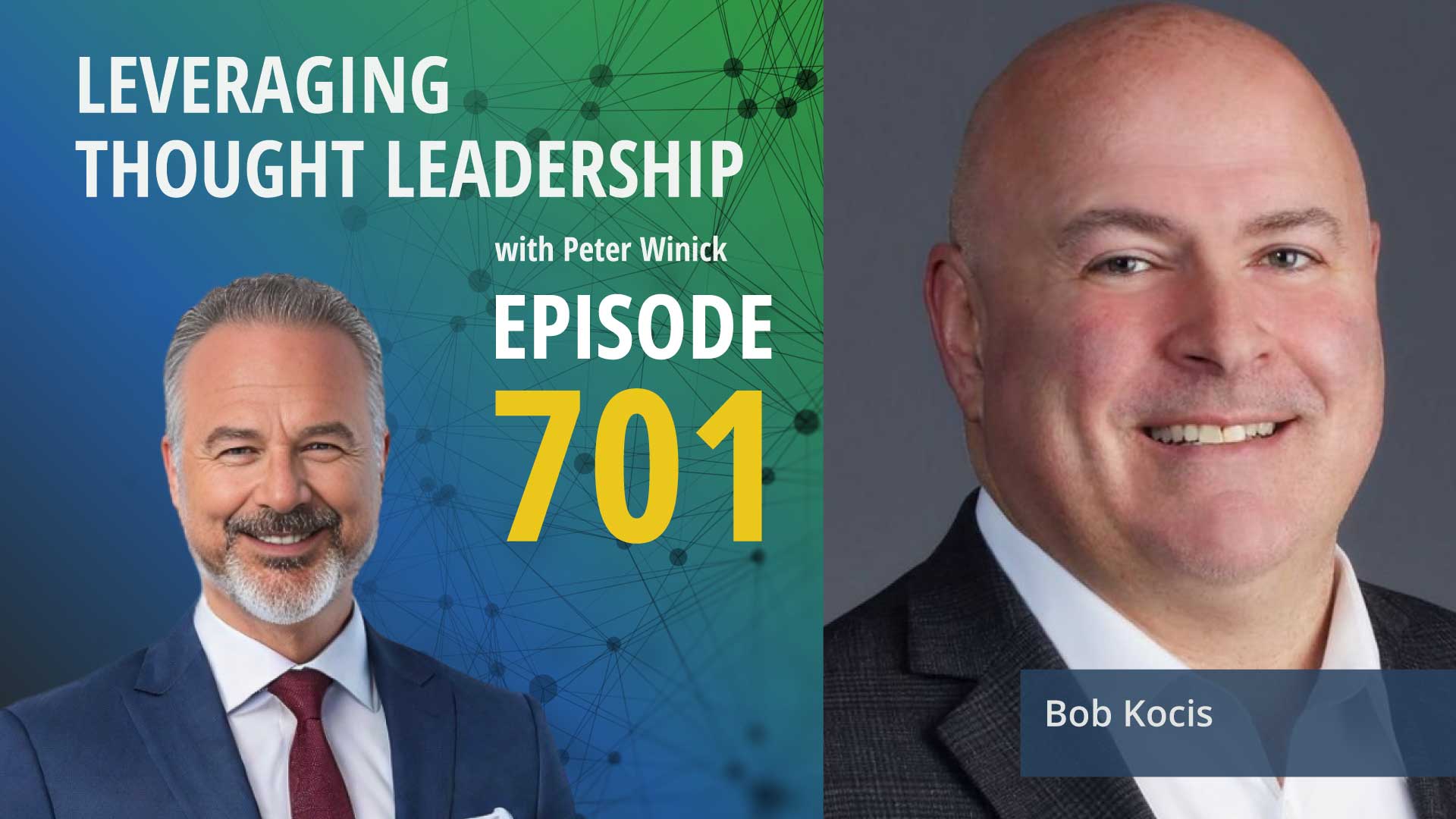



What elite sellers do differently and how thought leadership turns performance into impact.
Today we explore what separates elite sellers from the rest: deep curiosity, disciplined use of sales methodologies, and a focus on the customer’s success after the deal is signed.
What separates average sellers from elite performers?
In this episode, Peter Winick sits down with Bob Kocis, author of The President’s Club Mindset, to unpack the ideas, behaviors, and disciplines that turn sales expertise into real thought leadership. Drawing from interviews with top performers who have earned more than 150 Presidents Club wins combined, Bob shares a sharper view of what high performance actually looks like.
This conversation goes beyond sales war stories. Bob’s work is focused on codifying what the best sellers do differently and translating those lessons into practical guidance for the next generation. He points to curiosity as a core differentiator. Not surface-level interest. Deep curiosity that helps sellers uncover what truly drives client decisions and paint a clear picture of the outcome a buyer wants after the deal is done.
Bob also makes the case that elite selling is proactive, not reactive. Top performers think several moves ahead. They anticipate obstacles, understand internal power dynamics, and position themselves to win before others see the opening. His thought leadership is especially strong where sales become a team sport. Winning today requires more than finding one decision-maker. It means navigating champions, neutrals, and skeptics with precision and discipline.
Another key theme is methodology. Bob argues that great sellers do not resist process. They master it. Whether the framework is MEDDIC, MEDDPICC, or Command of the Message, the top performers learn the system, apply it well, and use it to elevate results. That message is timely, practical, and highly relevant for leaders building sales teams that need consistency without losing the human side of the work.
The episode also tackles AI with a grounded perspective. Bob is clear that technology can raise the bar, speed research, and improve execution. But it does not replace trust. His view is simple and powerful: buyers still want someone who understands their problem, delivers real value, and stays accountable after the contract is signed. That insight gives his thought leadership both credibility and staying power.
What makes this episode compelling is that Bob is not building thought leadership from the sidelines. He is turning hard-earned executive experience into frameworks others can use. His goal is not personal spotlight. It is impact. Through the book, podcast conversations, speaking, and continued content, he is building a body of work designed to help sellers think better, perform better, and lead better.
Three Key Takeaways:
- Elite sellers lead with curiosity, not pressure. Bob’s core insight is that top performers go deeper than surface discovery. They stay curious, understand what is really driving the client, and focus on the customer’s success after the sale, not just the close.
- Top performance is proactive and political. The best sellers do not wait for deals to unfold. They think several steps ahead, map the buying environment, build internal support, and neutralize resistance before it becomes a blocker. In Bob’s view, winning complex deals is a leadership exercise.
- Technology helps, but trust still wins. Bob is clear that AI and sales tools can make great sellers faster and smarter, but they do not replace human judgment, value creation, or trust. Buyers still want someone who understands their problem and will stand behind the solution.
Enjoyed this episode with Bob Kocis? Then listen to Dani Buckley next. Bob explores the mindset of elite selling through curiosity, trust, and strategic thinking, while Dani shows how thought leadership can be turned into practical sales support that drives lead generation and growth. Listen to both, and you’ll come away with a smarter view of how sales excellence and thought leadership work together.
Transcript
Peter Winick And welcome, welcome, welcome. This is Peter Winick. I’m the founder and CEO at Thought Leadership Leverage and you’re joining us on the podcast, which is Leveraging Thought Leadership. Today, my guest is Bob Kocis. He is, amongst other things, the author of the President’s Club Mindset. And let me just grab his bio because it just disappeared. He’s gone from the sales floor to the C-suite. He’s a multi-time chief revenue officer and global sales executive. He’s president and COO of Aptean. Where he leads global operations and drives strategies. So he’s sort of interesting in the standpoint that this is not just academic or theoretical. He’s really someone out there doing this stuff and then decided to sort of dive into this universe of thought leadership. So welcome aboard, Bob.
Bob Kocis Thank you, Peter. Really appreciate you having me on today.
Peter Winick So let me guess, you’re sitting around going, you know what, I don’t have enough to do. I don’t have enough hours. I’ve got too many hours in the day. Let me take on something else, right? To keep my days busy. That was probably how it started.
Bob Kocis It was a, it was a very difficult decision because, you know, in the, in these positions we’re in, you were incredibly busy, but you know when you have so much passion around the topic and also the industry has been so good to you and you see the, you see that all the folks that are out there that are looking to make a big impact and get better at what they do, get better at their craft, right? I just felt the need to give back a little bit to the community and, and get back to all the people that were great to me. So that was kind of what drove me to do it.
Peter Winick But more legacy than business driver, because I see a lot of execs that dive into thought leadership. And one use case might be to elevate their own brand, their company brand, et cetera. And another might be, wow, I really want more people to know what I’ve known or what I learned the hard way. But it seems like you’re in the latter bucket.
Bob Kocis It is much more legacy and it’s why what I did was, you know, this isn’t a book just about me. I brought in 10 people that had combined the one over 150 Presidents Club and interviewed them as part of the book because it’s not just about man. We have such great talent in the, in the tech world and sharing those stories and sharing, those insights, I think it made, it made the whole process just much better and, and much more fun for me. And I think more fun.
Peter Winick Just stay there a second because sales is one of those things where, you know, if you were looking to hire an engineer or a coder or an account, like, you know, you wouldn’t hire an attorney that didn’t pass the bar yet. Sales, I still think is in many places, a little bit of the wild west in terms of sometimes we hire for charisma. Sometimes we hire someone that can follow the process. What are the top two or three things you learned from interviewing all these presidents club folks is I like the idea of like, well, let’s learn from the top because That’s what we try.
Bob Kocis No, for sure. I think, you know, there’s a few things that I would, I would say came out of the interviews really, really cleanly. One is most of them all said that one of their keys to success was really curiosity and the depth of curiosity, the depth, of them being able to stay curious with their clients, really understand what was motivating and driving the current. So I think that’s one thing for folks listening today. They can, they can learn from that. I think some people don’t have that innate ability.
Peter Winick Stay there a minute because curiosity, lifelong learning, whatever. I’m old enough and I think you are as well to remember. Back in the day, you’d have a salesman for whatever, technology, pharma, whatever, and typically if you looked in their car, there would be cassette tape everywhere of zig-ziggler, or a bunch of these other folks, and this was before the age of podcasting. It wasn’t as convenient as clicking a button, and the smart ones were always trying to take in and tweak and and and you know, sort of get better. It sounds like that’s something that you validated from this result. Without a doubt.
Bob Kocis And I think the best ones, the elite ones, the elite sellers, what they do incredibly well is they’re able to put the customer in the state of what’s gonna happen after they partner. They ask the questions, they stay curious, they go deep. But then they’re are able to get the customer in the stage of, this is how I’m gonna be after I partner with this individual, right? And when I buy from this individual. And they get them in that end state and they focus on the end state. They don’t focus on the clothes they focus on with the customer. They’re focused on how they’re going to be successful after they buy. And with that process.
Peter Winick I love that because I think far too often too many sales methodologies are all about the pipeline get them through the pipeline Get them to the close and then well, what happens the next day? Well, then you’re on to the next one, right? But like for the client the customer the close is the beginning right? What happens that right and they should be I love how they should Be interested excited in invigorate around whatever that journey is going to take them as opposed to the salesperson going on to The next deal and handing it off to the neck speed. So that’s that’s pretty cool So in the process of writing. This book. And I’m going to assume you’re a President’s Club kind of guy. What did you learn? Does this sounds like a curio? It sounds like I’m getting a little meta here. Your curiosity drove you to this like you’re you’re good.
Bob Kocis Yeah. Yeah. It was, it was really, it was super interesting to me because like I had this, you know, lifelong of learning that I kind of was able to pull together and, and learn more. And I think what there’s a few things I took away from it. I think the curiosity thing we already talked about, but I think also the great elite sellers are incredibly proactive. They’re like, they’re looking around corners. They’re finding, they’re always ahead of everybody else in the process. And they’re, always thinking two, three, four steps ahead. Of the competition of the prospect or the customer. And they’re always figuring out like, where do I position? Where do I, where, do I put ourselves in a place to win? And the ones that, the ones, that don’t do that are probably, they’re probably struggling a little bit more, I would say. So I think that’s a really good lesson that kind of I pulled together from it as well. And then I think one unilaterally said, Hey, you don’t do this by yourself. Like you have to be, even if you’re a salesperson with no direct report, you have to be a leader. And you have to pull along all these great resources with you to go win that deal, whatever that resource might be.
Peter Winick So stay there for a moment because I think that’s both internal and external. I think selling used to be going after the quote, you know, decision-maker. Like the whole concept was it’s one person’s decision. If I take that Bob out for a round of golf and he’s the buyer and he gets the like me and blah, blah, and I think what the data shows us in the HPR articles and such show us is that buying is now a team sport.
Bob Kocis Oh, it’s without a doubt. It’s without doubt a team sport. Well, let me give you an example of that, which I think the elite sellers do better than anybody else. What they do is they, they really painstakingly understand. Let’s look at the buyer for a second. They really understand that political environment, that power base that exists. Yeah. You’re going to have. Campions who promote you. You’re gonna have people that are kind of neutral. They may be looking, but they may or may not really care. You’ll have people who are enemies, potentially. Right. Right. And a lot of Sellers will kind of not want to engage the enemies. They’ll wanna engage all the people that wanna be their champion and wanna be promoting them. Um…But the elites…
Peter Winick Well I get that. I mean I get the intellectually nobody wants to go out and be combative but if you don’t neutralize the enemy is that you know therefore they’re still an enemy.
Bob Kocis That’s the word they used. They said, look, you gotta go in there and you gotta find a way to neutralize the enemy.
Peter Winick Yeah.
Bob Kocis Find a way at least get them where they’re not fighting against you, right? And I think that was something that came out that I kinda knew, but I’m not sure I realized how important and critical that was to becoming an elite performer.
Peter Winick I want to shift now because that was a great sort of overview of the actual content and how it came to be. How does it now play a role, right? So now you’re on the other side of this, you’ve written the book, you can put author next to your name, all that sort of stuff. What does success look like for you for this, right, because it’s probably not a number of units sold, but what are the metrics that you’re looking at to go? Yeah, this was worth the energy and the effort.
Bob Kocis Yeah, for sure. Thank you for that. Oh, you know, for me, it’s, it’s really about impacting people. Like just the, the engagement I’ve got off LinkedIn and all the folks that have reached out and the people that have read it so far that have have said, Hey, this is, you know you’ve done a nice job with this. And I think there’ll be a lot more because it just shipped, you know, this week. So, you, I’m sure I’ll get more of that, more of the feedback, but that’s just very rewarding to me. You know, it’s about, it about giving back to this. No younger generation. We have a whole generation that even my kids are in that are coming in now into sales and coming into technology. And I think it’s going to get more exciting, you know, for the sellers out there with AI, right, the whole way I move that gets so much more exciting. But you can’t forget, you know, it’s still a value sell. It’s still really engaged with clients, deeply understand, deeply solve problems. And I think that’s for me, it it’s really for me about giving back and about. How I can impact that generation.
Peter Winick You know the AI piece is interesting and I think I agree and disagree at the same time so I think I agree in that it makes a sales professional’s job much easier from a research standpoint right we’ve all had who is all these databases all this stuff it’s really really easy to go in there and say I have a meeting with Bob tomorrow right what’s going on at his company where is it like whatever I can find it some really not just name rankings oh you graduated school in this year so I can figure like whatever I could find out some cool stuff and do a deep dive that might have taken me a half a day in minutes, but to me, one is it’s raised the bar because we’re not doing that. That’s a problem, but the other side of so that’s a good thing that the side that I think is bad is and you probably see this more on the marketing side. I’m getting pitched every day for all sorts of things. Many of them. No relevance to who I am and what I do and you can tell it’s AI generated right because they’re pulling stuff from. Oh, just listen to your podcast with so and so in the conversation. I’m like, No, you didn’t. Like, like, like you like, you know, so to me, it’s your starting because sales is about the relationship. And when you’re starting it artificially and authentically, and you know? It’s not even honest, right? You know, they’re using this these, this technology to try to develop rapport. How do you feel about that?
Bob Kocis Well, I think I agree 100%. I think people, you’re not going to, I even say it at the end of the book, I’m like, I comment on AI at the very end. I’m, like, look, it’s not going replace sellers, but here’s what, here’s, what the great sellers do. We’ve deployed, you know, you, we’ve seen this Peter, our whole careers. We’ve seen all kinds of technology deployed, whether it’s CRM or whether it was analytics or whether its, you know, BI dashboards, you now, and we’ve said all these. And everything’s going to save us. Everything’s going save us, and I can’t tell you how many times, and I said this in the book, can’t say how many time I’ve had a CEO or a CFO say, we won’t need salespeople anymore because this new technology has come up. I mean, I had seen that multiple times in my career, right? Um, maybe more than multiple times. And it’s funny because I always sit back and laugh and I, and, and say, look, that is not the case. But what I would say is that the elite sellers, they use technology better than anybody else. Yep. That’s what they do. They know, it’s always been true all the way back to when I started. And then, but when you’re positioning, like, you know, companies now are all, all about positioning AI, right? Yeah. Positioning it to the client. The client’s still going to want to know, regardless of whether you use buzzwords, they’re still going want to, you’re solving their problem and you’re delivering value. So that…
Peter Winick And I could trust you because I’m taking some risk by going with you to be a little could be a lot whatever and if things don’t go as planned and we all know things typically don’t know exactly is as planned are you going to pick up the phone and be there to help me when something happens. Yeah yeah cuz I is not gonna I mean I might help me with certain things cool so you know I know the book is new what do you see like if you’re thinking about the next year or two. Where because now that the book is done, some people might say, well, that’s done. Check the box. I did it. And I want the book to do well, whatever. How do you think about your journey as a thought leader moving forward in the next year or two? What might that look like?
Bob Kocis Yeah, I think I’m going to continue to engage in, in, in great, you know, podcasts and sessions like this one and, and, and allow people to engage with me and in kind of different formats like this. Now I’ve been asked to do a few speaking engagements that I’ll do next year. I can’t really do too many because I have too many, too many things going on, but I can do a, and I’ll, I’ll that for a few folks and I’ve continued to kind of, you don’t be out there and promoted and kind of talk about the lessons and, and even, you asking some of the folks I interviewed. We have a video coming out from one of the folks here in a few weeks that will share their perspective on it as well. Because I think it’s really important for young sellers and even sellers that are trying to raise their performance to learn from multiple sources. You want to hear it from different angles, from different people. Everybody learns differently and it isn’t just about me talking. It’s about this group and different folks asking different questions and that really coming together. To really allow people to take the best components of it and apply it to what they’re doing.
Peter Winick So, you moved to more of a evangelizer role, if you will. I would say. Yeah. Which is kind of cool. You know, the other thing I would think about is, you know, language, models, methodology and framework. They get really, really sticky. And I think that, and you know if we put it in the context of sales, there are still companies that talk about the blue sheets, although there are no blue sheets anymore. Like, which was an old sales methodology. That. Now, when people say that, they’re basically saying out loud, I’m over a certain age, but it also means, Oh, this was the place that I collected the data based on the like, it sort of means something to folks, right? So I think that language, those models, those methods, those frameworks do become sticky, right, because if you’re not the president’s club, one would argue, right. Because you can say, well, only, you know, half of a percent of folks make it the president club, I would argue most folks aspire to that. That’s really the market is probably not the folks that are already there They might be serious, but click that down to the next quartile and such
Bob Kocis Yeah. If I get a comment on that, what I would say is the folks, if you’re not making president’s club consistently, and that’s what you aspire to do, right? What I would encourage you to do. And I’ve seen this with the best sellers, they use methodologies better than anybody else. Yeah. And they, and they learn and they take the best components. So methodologies like medic and med pick that are out there that is nominal, like those, those methodologies are golden. You should learn those. Command of the message, which is another one, it’s phenomenal. We’ve been there in the last five, 10 years is also knows from like, there’s a lot of really great methodology, regardless of which one your company invests in you as a elite seller. If you want to be an elite seller, you need to take that, be elite and show the company that you are absolutely going to run with this. I do see folks that block it. They’re like, I don’t want to learn something new. Oh, I learned this and I want to do that. And quite frankly, Peter, those folks don’t make it because the whole company doesn’t rally around them? Because they’re trying to just…
Peter Winick Well, it’s also- somewhat disrespectful, like, hey, we made a decision as this company, whether you like it or not, or your old firm, you did this, because I think the reality is, you’re right, there’s a lot of debate around which methodology is better, this, that, the other. And I agree with you that with some small nuance, whoever’s top of their game from mastering whatever the methodology is, nobody’s going to say, oh, I went from company X to company Y and they changed sales systems on me and therefore I’m, I’m a terrible performance. You never hear that right now that you do hear terrible performers blaming the system. Oh this year. I’m horrible I’m just been all this time doing data and cruise, you know, and then you hear the other side of that Come Wow, this is giving me what I need at my fingertips be smarter better faster top of my game So I think that’s really true. I love that the concept of just master whatever it is and you can bring some Individualization, I think there is a bit of a trend to sort of automate sales right there some of these systems out there that say you know at phone call number three use this PDF here and that’s. I think a bit dehumanizing like that’s lovely for a marketing campaign but I think you have to give people a little bit of agency as well.
Bob Kocis Well, I mean, you’re pointing around humanizing it until the customer decides they don’t need to buy from buy from somebody they actually trust. We are going to be, we need to stay human in sales. Yeah. So until that day comes, I don’t think it’s coming in my lifetime. Yeah. When customers make a purchase decision, especially today, when the market is so crowded, it’s so complex. They’re solving incredibly complex problems. They, they need somebody with the intelligence that they can trust. And uh and know they’re going to be delivered so and I think this one’s right on
Peter Winick Speed I think today in terms of things that used to take you know a CRM implementation 10 years ago would take a year now it’s a month right like so you don’t have the time to do that well it’s been great I wish you the best on your journey and thank you for putting this out there thanks appreciate it really appreciate your time today.
Bob Kocis Thank you so much.
Peter Winick To learn more about Thought Leadership Leverage, please visit our website at thoughtleadershipleverage.com. To reach me directly, feel free to email me at peter at thoughtledershipleverage.com, and please subscribe to Leveraging Thought Leadership on iTunes or your favorite podcast app to get your weekly episode automatically.

Related Posts
Comments (0)