What elite sellers do differently and how thought leadership turns performance into impact. Today we…
How Top Thought Leaders Stayed Relevant in 2025
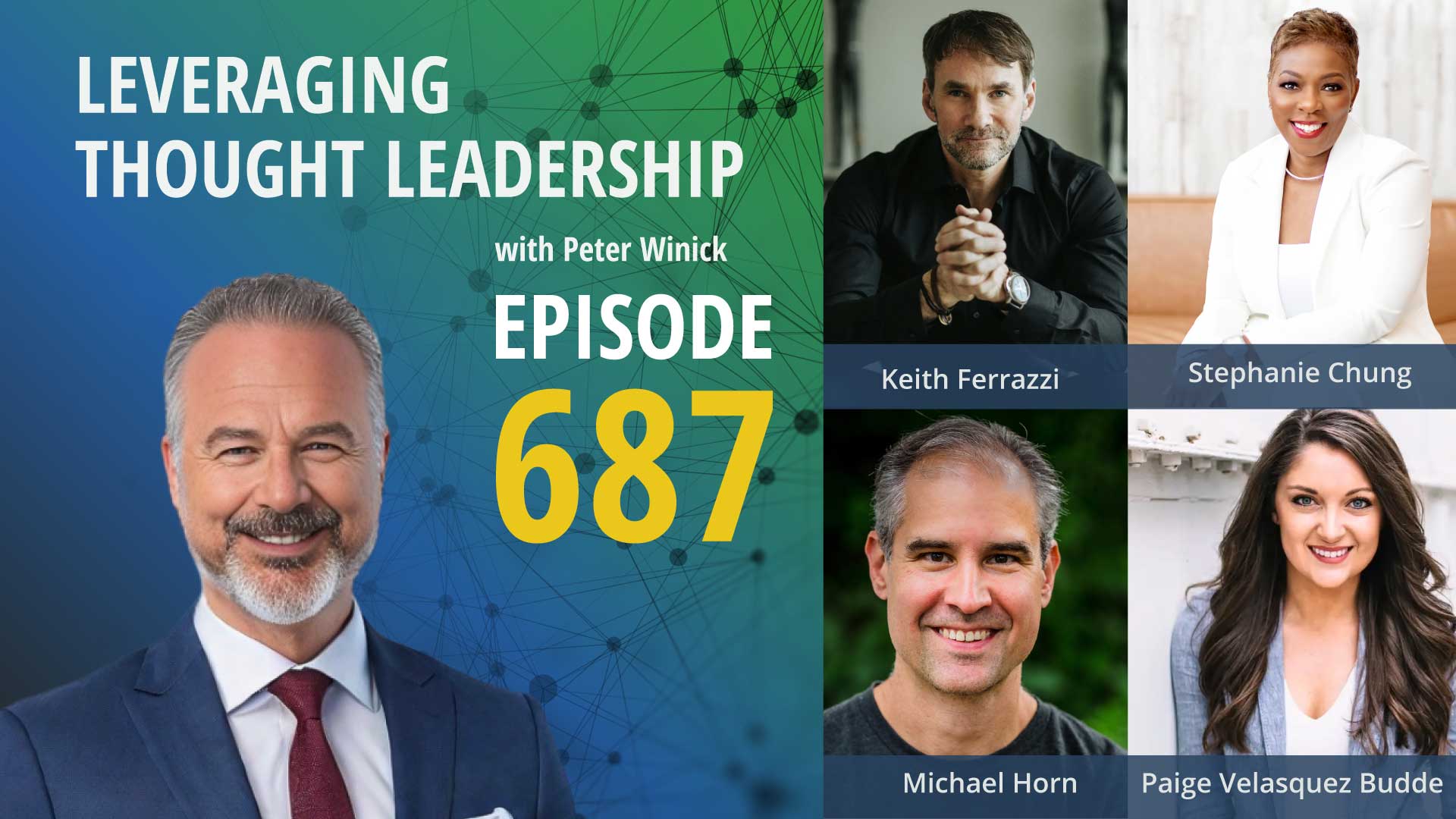



Four practical frameworks to sharpen your message, market, and metrics
This Best of 2025 compilation pulled four high-signal conversations into one practical playbook for staying relevant, differentiating your ideas, and leading with clarity in a shifting market.
What did “great thought leadership” look like when the market wouldn’t sit still, the C-suite couldn’t sleep, and yesterday’s playbook was already obsolete?
In this Best of 2025 compilation, we pulled together four standout conversations that got brutally practical about relevance, differentiation, and turning ideas into outcomes.
Keith Ferrazzi broke down the real challenge behind “evergreen” ideas: keeping the core principles intact while continuously connecting them to what leaders were worrying about in the moment—AI, volatility, and competitive pressure. The throughline was methodology. Not hot takes. Not vibes. A repeatable way to stay current without becoming a trend-chaser.
Then Keith pushed into what he called “teamship”—the underdeveloped layer in leadership thinking. Not how leaders gave feedback. How teams gave each other feedback. Not how a boss held people accountable. How
peers did. He was blunt about the data: most teams were mediocre, and many avoided conflict when the stakes were highest.
Stephanie Chung reframed a politicized topic into a clean leadership platform: how you led people who were not like you. Not as a slogan. As a set of tools for leading across real differences—generation, gender, neurodiversity, ability, identity, and more. It was a leadership operating system for a workplace where “one-size-fits-all” was dead.
Michael Horn brought the “jobs to be done” lens into career strategy with Job Moves. The value here wasn’t motivation. It was decision quality. A structured way to avoid moves that looked right on paper and still landed wrong in real life—and to reconnect your thought leadership to the unique value you actually provided.
Paige Velasquez Budde got tactical about thought leadership as a visibility engine. She called out the fantasy metrics (overnight bestseller, one big hit, last-minute PR) and replaced them with a grown-up approach: start early, build credibility over time, and use targeted “micro media” to drive the outcomes that mattered—leads, authority, and premium positioning.
We’ve learned a lot from our guests in 2025, this episode provides valuable information on taking your platform to the next level, staying relevant, and finding success in 2026!
Transcript
Peter Winick And welcome, welcome, this is Peter Winick. I’m the founder and CEO of Thought Leadership Leverage, and you’re joining us on the podcast today, which is Leveraging Thought Leadership.
Today’s gonna be a lot of fun because I’ve got a dear old friend, Keith Ferazzi, joining me today. Keith is the author of many, many books, going back from Never Eat Alone to now Never Lead Alone, and he and I worked very closely together for quite some time. When I look at somebody’s body of work, I sort of chunk it into two categories. Here is what’s evergreen, right? Here is, here is what will always be true, regardless of the stock market when it’s a recession, who’s in the white house. So again, I’ll use never alone as an example. I still give those books out to people all the time because there’s some evergreen principles, even though that’s waiting in the days before social media, there’s good, really good. You wrote it. We…
Keith Ferrazzi We rewrote it, by the way, I don’t know if you knew that. We re-wrote for the digital era. So, Paul and I dusted that off and re-did it.
Peter Winick But so where I was going is so there’s the principles that are sort of evergreen and then there’s what can you do to connect it to what’s going on in the world today. Exactly. So in your case, you know, what is the C-suite staying up late at night, thinking about what is what is AI is it going to attack my business? How do I use it to grow? Where is it?
Keith Ferrazzi You know, exactly. And so what I’m doing is I’m bringing a methodology to approach that question. Right. So the methodology and people it’s, you know, I, I I I’m saddened for people who are one note Johnny’s and you know. And by the way, let me say this. Some of those one note, Johnny’s do quite well because it is an evergreen topic. And they just stay focused and that is all they are. And it actually kind of works well for some of them.
Peter Winick Yeah. Well, and it’s also, they don’t have to have the, the things that you do in terms of the research, right? Cause if you didn’t have the research arm, you probably wouldn’t have much more to say about AI than most other people, right. The research gives you the cutting edge stuff. So you’re taking the, Theoretical and closing the gap to the applied in a way that’s of high value. Right. And I mean, it’ll be a different thing and you’ll have new research coming up, but it also makes you really relevant to the C-suite because Again, when you think about… You know, the worst place to be as a thought leader is selling training and development into the HR channel. Yawn, yawn, right? Because that’s a commodity. Somebody is going to do it for a penny less or LinkedIn learning is going to eat your lunch, whatever, whatever the case may be, but having cutting edge content out there, you can charge a premium for that.
Keith Ferrazzi No, I’ve been, I’d been very surprised and deeply appreciate where anybody can carve out some market at some level. Not everybody is looking to build a global impact brand that changes society and makes tens of millions of dollars. That’s a certain level of aspiration. Sure. Any little bit of what I’m doing. Could make somebody a very good living tomorrow morning. I’m dressing an audience at coaching.com and what I’m going to be giving them is a way for any coach. And now there are millions of them. As we know, you know, anybody who is in between jobs as a coach used to be that anybody in between, jobs was a consultant. Now anybody in-between jobs is a coach, right? And so I’m going to be giving them a simple methodology in, in never lead alone on how they can begin to step a team through transformation in a, in a set of high return practices. And I basically give away the coaching manual. I think that’s, you know, for me at this stage of my life, you know, it really is about trying to make the biggest footprint on the planet. I think never eat alone did that. I don’t think. I think the way we talk about networks and networking today was forever changed with that book 20 years ago. And I’m blessed with that on a global basis. Now I’m looking to do the same thing around leadership by focusing on teamship and what is the role of the team? I think we have radically under-indexed on what’s the role of the teen in leadership. We focus on leaders and leaders giving good feedback, but we don’t focus on teams and how they give each other feedback. We focus on leaders. And how they hold a team accountable. We don’t focus on how the team holds each other accountable, how the team keeps each other’s energy. So this idea that there’s a layer that’s under curated. And I think that’s important for your listeners who are interested in being thought leaders for themselves. They need to find the white spots. Where are the empty spots and always be looking for that gap. And I really think that my world teamship is a major gap in terms of the leadership, John. No, I think that’s interesting because…
Peter Winick All develop the skills to be good individual contributors or whatever we do, marketers, accounting, finance, whatever. And then the other thing we want to aspire to be as leaders. But the reality is we’re spending most of our time and most of our working life in teams and we’re not really taught. What is a good team? How can I create the environment and the feedback and the culture of a good team, because without a good. Hey, you know, we’ve all been on great teams and.
Keith Ferrazzi All been crappy teams, right? And that’s in most, and what I find with my diagnostics and the diagnostics are in the book, and so is the data. The average team is pretty mediocre. Yeah. And I, and meaning on a scale of zero to five, the average team, is a two in terms of its ability to be courageous and speak openly in the room. Yes. Now, if you look at that and you’re trying to double the market cap of a company, there’s no way you can do it with half your team being conflict avoidant. Yeah, the, the power of the team is overlooked. HR has spent so much time looking at employee engagement, right? Enterprise equity and inclusion. What we miss is the work level. We got just not focused on how teams get shit done. And, and yeah, you can go back 20 years ago and pull off Len Cioni’s book, which inspired me greatly and still does, but it’s a, it’s It’s a 20 year old parable that needs to be updated for, you know, the, the modern era of hybrid work, the modern era, of a global marketplace of American DE&I that still is scrambling to find its foothold and for the volatility that exists and the tools that are available today, teams have changed.
Peter Winick Today my guest is Stephanie Chung. She is the author of How to Lead People Who Are Not Like You, the short version of stellar career in aviation to thought leader, because it sounds like somebody made a hard right turn or left turn or whatever. How did we get here?
Stephanie Chung Yeah. Yeah. So great question, by the way, absolutely spent most of my career in aviation. I’ve been in aviation for about 40 years. And, um, and so what started happening is I started to get a lot of inquiry to speak on things that were aviation, you know, not aviation related from other industries. And that’s really how the snowball effect started off. And you know at the end of the day, aviation is such a big industry and it pretty much affects everyone. But we’re a very unique industry because we have zero tolerance for mistakes, right? And so we have a very type of industry and what I have found is other industries really can glean a lot from our industry because we, everything is such high stakes and the differentiator is really the customer experience, so.
Peter Winick Got it, so how does it get from that to authorship and your take, because you and I had a couple of great calls about leading people who are not like you, because it’s such a well-framed thought, as opposed to DEI’s gotten politicized and all this other craziness, but tell me, how did you get to this as a platform?
Stephanie Chung Absolutely, so when I came from private aviation, there was very few people, like literally honestly, as I was coming through the ranks, there was really no one that looked like me that I came across often. And so from a perspective of when I looked at all the different books that were out there and it was time for me to write a book, I felt like the books, honestly Peter needed to go deeper and wider because the books that I saw out there were really geared more towards men, and specifically white men, trying to share with them, here’s how you lead women or people of color. And though that’s good, right, but I felt like, well, this needs to go much deeper and wider because here I was a leader in an industry that not a lot of people looked like me, thought like me had my same type of background. And I was leading teams of people who were not like me. And so therefore it’s like, well, where’s my book? Like, I want that book, right? And there really wasn’t one. And so I decided to create one because with everything going on, and you and I have talked about this, we’ve got six generations at work. So all the intergenerational stuff, I think is really having leaders pull their hair out, right?
Peter Winick So that’s one, not like me, I’m old age, and there are people above, below me, sideways, whatever from different generations. That’s one sort of perspective.
Stephanie Chung That’s right. And then you have, yeah, it touches everything. Then you have women, right? So women are now the majority of the country’s population. So we see things differently, we think differently, we communicate differently. So that is a different dimension. Then you people in the LGBTQ plus community, or you have people with different abilities, you have physical abilities, or you have neurodiversity, and you have all the ethnic demographics, right. So I just felt like we needed to go much broader and much deeper. And then this is not a DEI book, it’s a leadership book because all of us in leadership are leading people who are not like us. And so how do you do it? And my experience is I’ve always led people who were not like me. And so here’s the tools that I use to be able to be successful and still have a team that thrives. And so I wrote a book to help other leaders to hopefully give them some tools and kind of lift the burden, if you will, of trying to figure it out on your own.
Peter Winick If you’re enjoying this episode of Leveraging Thought Leadership, please make sure to subscribe. If you’d like to help spread the word about our podcast, please leave a five-star review at ratethispodcast.com/LTL and share it with your friends. We’re available on Apple podcasts and on all major listening apps, as well as at thoughtleadershipleverage.com/podcast.
Peter Winick Today, my guest is Michael Horn. He’s the author of several books. Probably the most notable is job moves, nine staff for making progress in your career, he’s the co-founder and a distinguished fellow at the Clay Christian Institute for disruptive innovation. So, so now let’s go to your world. Right. So it’s 20, would you say 24?
Michael Horn 2015? 2015. Yeah, yeah. My twins were one years old and I said, I’m done with managing and growing the institute. I want to do my own thing and have a little more flexibility. Got it. Because a pair of…
Peter Winick Of one year old wasn’t enough to keep you busy. You said I could have more, some more uncertainty into this mix. So what did that look like and why? And, you know, because before you did that, I’m assuming that you obviously had some ideas formulated. This is what I’m thinking about. This is where I’m going, you don’t just wake up one day and say, I think I’m gonna do this, right? Like what got you to that point where you said, and now is the time.
Michael Horn Yeah, it’s a good question. I think it was a couple of things going on. One, at the Institute, you know, we were thinking, we were doing research, big thought leader ideas, right? You’d go to policymakers or entrepreneurs or whomever, and you were sort of giving these big broads brushstrokes. And for conflict of interest reasons, you never got your hands dirty yourself, right. And I realized. I actually really like some of these entrepreneurs. I want to get in business with them and be on their boards and advise them and help them in the early turns and things like that. So that was a big motivation of how do I actually use the set of thoughts we’ve developed these things about views of how the world should be, if you will, and actually advise them and as they’re building all these tools because there’d been a series of entrepreneurs inspired by the books and the white papers and the writing. But let’s get messy, right? Let’s do it. So that was one. And then she was like, yeah.
Peter Winick There are other folks that have the opposite view of, I was tired of being in the trenches, being the consultant, doing the stuff, et cetera, and I wanted to move into thought leadership because I thought I could sort of stay above it. So I just love that there’s a path for everyone and it’s not that yours is right and someone else’s wrong or better or worse or whatever the case may be. So I love that you say, I wanna get in the trench here and see, have the sausages made a little bit.
Michael Horn A hundred percent, right. And, and I will tell you, right, it’s evolved over time, right? So I’ve did that for five years. I was spending a lot of time with a venture studio. We were building tech companies, investing in them. In the pandemic, we got acquired by one of the companies we had initially incubated and invested, which is like super awkward, right and part of the deal was me going full time in with Guild Education and Rachel Romer, who was the founder. Incredibly visionary, persuasive individual. She said, it’s short term, short term was two years. And eventually I was like, or one of the themes is everybody lies. Everyone lies. I suppose so, or they’re really good. Uh, they’re good talkers, but I realized at that point, Peter, that I wanted to spend more time actually back up a level, right? Like full-time leading this work. I had sort of gone back in too far into the trenches, if you will. And I wanted to level back up to the thought leadership. Cause I, when I thought about where do you make the unique value add in the world of education and work and so forth, Michael, there were 12 people who could have come in and come up with a better comms or marketing or government affairs plan than me, like within a day, my value add, I thought was a couple levels higher. And so I’ve gone back, you know, guns blazing into the thought leadership world. Yeah. So
Peter Winick So take that to the, not necessarily the actual next step, but one of those next steps was job moods, right, was the book. So where did that come from and what has that meant to you?
Michael Horn So there’s a personal side of it. And then there’s like the research side of it, I’ll do a little bit of both. Perfect. The research side is that Ethan Bernstein and Bob Mesta, who are my collaborators. Ethan is a professor at the Harvard business school. He’s clay was his dissertation advisor. Bob Mester founded the jobs to be done theory with clay. The two of them start collaborating in 2010 after sitting through a class with clay And they start building a course together and advising people about their job moves, right. Using their jobs to be done research. And then simultaneously, Bob and I are using the work to write this book, choosing college, helping people make this choice around where to get educated, using jobs to done. And all of a sudden I find myself starting to use the work on my own career decisions. Right. So I got offered a presidency of a university a couple of years after I left the Christensen Institute. And Bob literally uses this on me. And I realized, wow, that sounds great on paper. And it’s the last thing I want to do in actuality. Uh, and I’m like, this is powerful stuff. It starts to help me avoid mistakes, help me make some moves that are counter-intuitive, but really fulfilling. And then Clay passes away January of 2020. Yeah. The three of us look at each other and we’re like, we’ve got something really powerful here. It would be a really cool. Testament to clay, if we put it together in a book, uh, and that, that, that was the conversation, frankly, like a month after he passed away of like, how can we honor him? And it was, let’s take this body of research. Let’s double down on it. You know, we were in the pandemic then. So we had three years to go super deep on coaching and studying a lot more individuals. And then we, then we wrote the book and published it, uh this past November.
Peter Winick Today, my guest is Paige Velazquez-Buddy. She is the partner and a CEO at Zilker Media. A lot of friends in PR, obviously, and they have a lot of clients that engage in it, and there’s often time this gap. So are there things that you look for or look out for in terms of a red flag of. During a early on conversation with a potential client in terms of their expert expectations, just being, Hey, you’re going to make me a New York Times bestseller or I’m going to sell 30,000 copies, right? Like what are the things that you look out for? Because what you don’t want, or I would imagine you don’t want is 90, 120 days after bringing on that client, having to have some difficult conversations that could have been a
Paige Velasquez-Budde That’s right. You know, there’s a few things that the most important thing is just having a clear understanding between us and a client of one, what are those goals? But are you clear on where we’re starting? You know a lot of people come to us. If you come to, to us four months before a book launch, had never done PR before the expectations that things are going to one, be live by the time your book launches or two, you’re going to be in the New York Times During that launch that’s not necessarily, you know, oftentimes the case that typically you need to start doing PR way ahead of that. And the first time that you’re launching the book shouldn’t be the first time you’re making a media appearance. You really start, you needed, you really need to start building up that thought leadership, ideally a year or so out and giving expert commentary thought leadership. So by the time that you’re launching your book, we’re circling around to some of those media opportunities to promote the book, we are saying to media, hey, this person has been featured on XYZ previously. This is why you should pay attention to them. This is why we want to feature in the book. That’s extremely important. You know, and another thing is a lot of people, you know, sometimes come to us and think they’re going to get rich quick on their first book. And book sales, as But if you have a clear strategy of what a book can do for you as a tool, whether it’s helping accelerate lead generation, helping you up your fees and a speaking arena, whatever that might be, that’s where you’re gonna really see the value in terms of investing in PR to get the book out there. Book sales alone are not a clear enough goal.
Peter Winick Well, stay there a minute because I think you’re a thousand percent right is oftentimes authors, particularly first time authors obsess over sales because they, they take sales as a proxy for success or validation or whatever the case may be, or they didn’t really understand the market and realize that having an expectation of selling X number of units is not realistic in the period of time that they thought they would, and I think at some level. For most, the number of units sold, you know, is really irrelevant. And this is where there’s a lot of tension in the marketplace between the author and the publisher, because in most instances, a publisher’s compensation is some function of number of unit sold times profit per book equal, is that a good deal or not? For an author, it could be, wow, at first blush, if you look at my numbers, that was awful, you only sold a thousand copies or whatever. And the author might be going, that was the greatest thing I ever did. Cause I picked up three clients that are spending a million dollars a year. And, and that has nothing to do with the publisher’s success. So your metrics for success are different than the publishers, which, which means we’re not in alignment, right? So, I think having that clarity upfront, having that strategy upfront that says, as a result of writing this book, this is the follow, this is what I want, would like to be different one year after this book is out.
Paige Velasquez-Budde Yes. And that’s oftentimes the first question we ask. It’s why did you write the book and what do you hope to achieve with a book? You know, visibility and book sales for us a lot of times is a red flag if there’s nothing beyond that. The same instance with media these days, there’s a dated mindset sometimes of I need to be on Good Morning America in order for my PR campaign to be successful. Reality is From what we have seen, you know, the past five to seven years of book PR, specifically, especially even just business PR in general, having those big TV hits do not move sales units or lead gender for your company the same way the right micro media or the right targeted media strategy will, you know, if you are interviewing a PR firm. Ask them about their industry, are they’re consistently placing both in top tier as well as micro media? If you have a PR company that is just throwing top tier in front of you, top tier is great for eyeballs. It is great for credibility. I’m talking Harvard Business Review, Forbes, Fortune, those types of Bloomberg. But if you also don’t have a micro media strategy with the right podcast, with the trade publications in certain niche industries with right blogs, you aren’t going to see as much lead generation or even, you know, at times book sale movements.
Peter Winick To learn more about Thought Leadership Leverage, please visit our website at thoughtleadershipleverage.com. To reach me directly, feel free to email me at peter at thoughtledershipleverage.com, and please subscribe to Leveraging Thought Leadership on iTunes or your favorite podcast app to get your weekly episode automatically.

Related Posts