
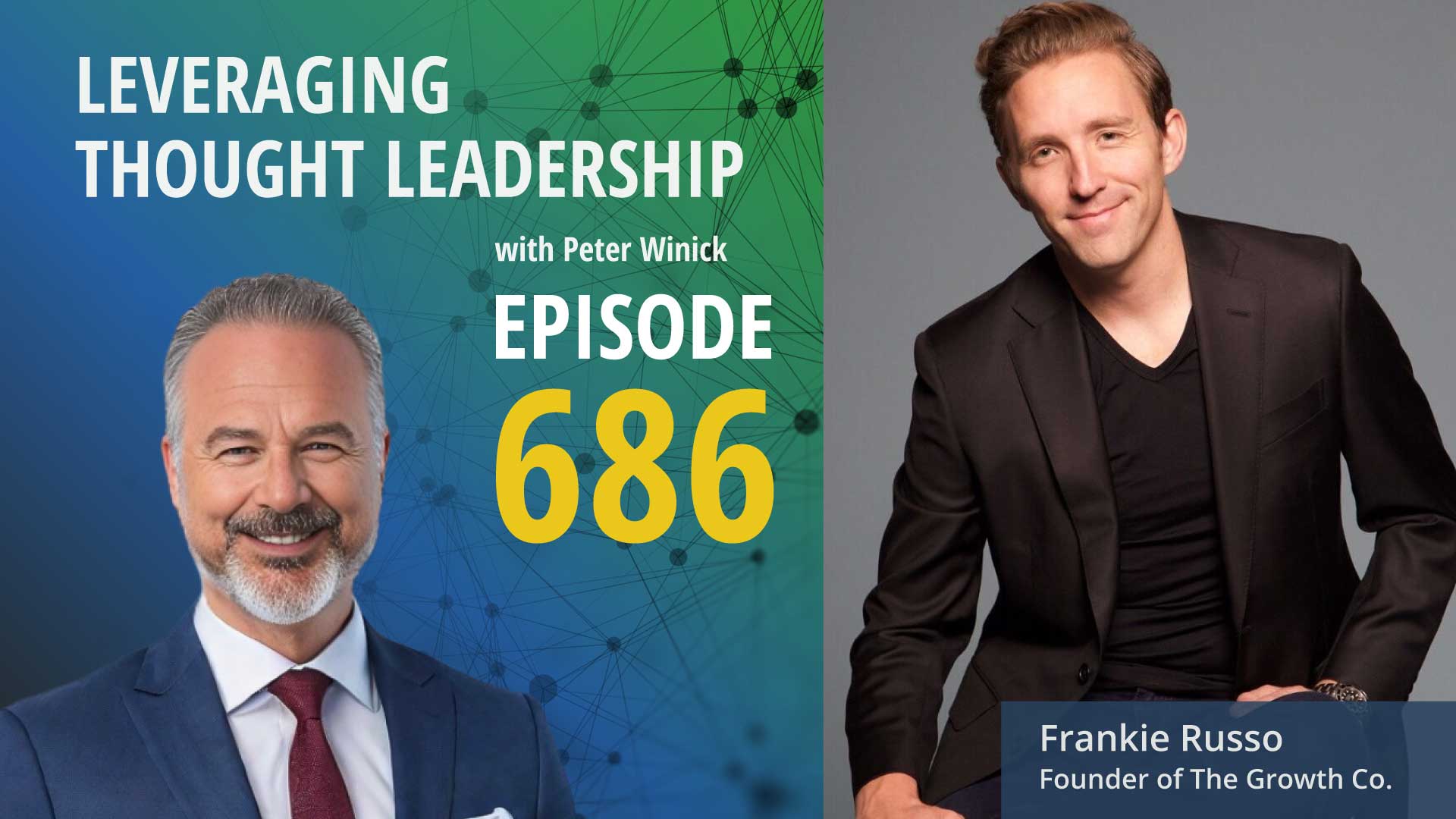
The Stakeholder Alignment Advantage | Frankie Russo
The Leveraging Thought Leadership podcast is created by Peter Winick and Bill Sherman and produced by Thought Leadership Leverage.



How “collective genius” drives continuous growth.
This episode shows how to scale thought leadership beyond the stage by turning ideas into repeatable systems. It focuses on stakeholder alignment, breaking silos, and driving behavior change that produces measurable growth.
What if the real growth problem isn’t strategy… but misalignment?
In this episode, Frankie Russo, the Founder of The Growth Co and bestselling author of “Breaking Why”, breaks down what it takes to create growth that compounds—without relying on charisma, hustle, or a one-time “big moment” on stage.
Frankie makes a clean distinction: a book is a platform, not the mission. Thought leadership is the movement behind the platforms—and the work is designing ideas that change behavior and drive measurable outcomes.
A core idea he returns to is stakeholder-first growth. Customers, colleagues, and community aren’t “nice-to-haves.” They’re the scoreboard. Frankie argues that great companies rise or fall based on one thing: how radically aligned they are to delivering their “collective genius” to those stakeholders.
Then he gets tactical about scale. Keynotes can jolt people awake—an inflection point that “shakes them out of the trance.” But the keynote is only the tip of the spear. The real lever is what happens after: systems people can use every day.
Frankie walks through his Growth Operating System using a simple visual: an infinity loop built to replace the “stagnation spiral.” Denial. Status quo. Silos. Rigid processes. Disengagement. His point is blunt: if growth isn’t operationalized, it decays—so the work is building an engine for continuous inflection points, not a single heroic turnaround.
And he’s candid about the craft of thought leadership delivery. The hardest part of a great keynote isn’t what you include. It’s what you cut—so you can land the right ideas, in the right dose, and drive adoption after the applause.
Three Key Takeaways
- A keynote is the spark, not the solution. The talk can create an inflection point, but the value comes from what you operationalize afterward—tools, habits, and routines people can actually use day-to-day.
- Stakeholder-first alignment drives scalable growth. Frankie keeps coming back to aligning the organization’s “collective genius” around delivering outcomes for stakeholders (customers, team, community). Misalignment is what creates drag and stalls momentum.
- If growth isn’t systemized, it decays. His “infinity loop” / Growth Operating System idea is about replacing the stagnation spiral (silos, rigid processes, disengagement) with a repeatable engine for continuous improvement and ongoing inflection points.
If Frankie Russo’s message hit home—growth needs an operating system, not a motivational moment—your next listen is “Creating Alignment Between Marketing and Sales” with Winston Henderson. It’s the same fight against silos, just aimed at the part of the business where misalignment quietly kills revenue: the handoff between marketing and sales.
Listen to Winston right after this episode and you’ll connect the dots between alignment as a leadership principle and alignment as a revenue discipline. Frankie gives you the “why” and the operating rhythm for sustainable growth. Winston gives you the “how” to make that rhythm real across teams—shared language, shared priorities, and shared measures—so your thought leadership doesn’t just inspire… it converts.
Transcript
Peter Winick And welcome, welcome, Welcome. This is Peter Winick. I’m the founder and CEO at thought leadership leverage. And you’re joining us on the podcast, which is leveraging thought leadership. Today, my guest is Frankie Russo. He is an author. He’s a speaker. He has built, sold, scaled, multiple businesses and a bunch of different industries, and, uh, he’s going to spend some time with us today. Welcome aboard, Frankie.
Frankie Russo All right, thank you, Peter. Looking forward to being on.
Peter Winick So let me ask you one of sort of the questions I love to ask folks, which is basically, how the heck did this happen? How’d you get here?
Frankie Russo What depends on what here is, um, from a, you mean like thought leadership? Yeah. So we can talk about all kinds of stuff. You know, I’ve got sober 17 years ago. So some people like to ask me about that. Uh, I’m a dad of six, married twice, seven, eight businesses, you know, blah, blah blah, but thought leadership. Okay. So how did we get here? So it started out a rainy day. Just kidding. It was about 2014 and I had a client that I had helped with some different things who used to be in the publishing business. And she was, um, she worked with, uh, Jack Canfield back in the, like glory days of chicken soup for the soul. Okay. And she started to be on the road. So she started an Apple store, and I had a company that was like helping Apple stores launch and be challenger brands, all this fun stuff. Uh, which is one of my many previous careers and businesses. But, uh. But anyway, I’d always kind of been the entrepreneur that would stare at the, um, books in, what do they call those things? Bookstores, uh, Bars and Nobles. Oh yeah. Bars& Nobles, they sell candles now, right? This is where you go to get candles. We were still in there. Okay. Anyway, so I was, I used to love back in the 2000s, just like looking at those books and looking at that and thinking like, what book do I need to read next to be successful? And so I always had this like, kind of like starry eyed idea of being one of those books and it wasn’t until 2014 that this person came to me. They said, look, you did, you did something special for me. You helped me out at a time that I needed a lot of help and I want to repay you some now. And I said, well, you had mentioned something about how it’s so easy to write a book. So what if we did that? And she was like, oh, yeah, all you little just an outline. We’ll get that thing written. And so I was like really? I was, like, how’s that work? It’s like, well should I talk about ghost writers? Yeah, that she’s like. I’m going to bring in Dave Ramsey’s lead ghost writer. Who wrote Entree to Leadership. And that’s going to be the Ghost Rider. I’m like, this is awesome. You know, so it’s 2014. So I’m still like seven years from my exit with the company. And so we did that. It took about two years, three Ghost Riders. It was a dumpster fire trying to get it done while trying to do everything else. But I finally put a book out called The Order of Why. Now, a couple of things. One, I was 35 and way too young. I’m not saying you can’t write a book at 35, but I didn’t know shit. Um, can we curse on this or can you get to bleep that out?
Peter Winick Well, I didn’t know, let me pause you there though. I would say that, um, you know, you can’t write a book in 35. I would argue, I would counter that with say, you know, I always wonder who’s, who’s the one hiring the 23 year old life coach. But I think sometimes the reasons you might choose to write a book at 35 depends on the book. Well, it’s the, it’ s also the book you need to read.
Frankie Russo Right. Yes, that’s exactly right. And it was, it was the book that I needed to read minus a lot of the extra stories about Jordan and everybody else’s copy and pasted ghostwriter stories that go into the, I didn’t know any of that. I was just like, look at this. We did it. We’re an author. I’m a, I have a book. It’s a best seller, blah, blah. And then that was, that was it. And like, you’re talking gigs here and there, but I thought this is it. Cool. That was it as my manifesto. And after a while, I started to realize. You know, the thing about non-fiction books, especially business books. Sure. If you’re in the outlier where you’re like, it just takes off, which rarely is the first book, a lot of books with the first book we’ve ever heard of. It was not their first book. And it’s the New York best time sellers. Like I can tell you right now for me, it’s going to be the third book, yeah, which I haven’t written yet. And I’m purposely not writing. Cause I just one, I have enough books to say I have books and I want the book to be something, a true contribution.
Peter Winick But expand beyond the book, because I would say that when I asked you, how’d you get here? Right. I’m about to tell you, as an author, I mean, a book is
Frankie Russo That’s where I’m going to. So the point is I thought I was an author and it wasn’t until I sold my company.
Peter Winick That realized I needed to be a thought leader. Tell me how you’re defining the difference between an author and a thought-leader, because I would say most thought-leaders are authors, not all authors are, can be, or should be thought- leaders.
Frankie Russo So the difference is exactly how you said it. An author is one of the platforms that I use for thought leadership. I didn’t realize until about four years ago that the premium and most important kind of closest connected to me calling of the optional platforms, which is like podcasting and books and panels and articles and white papers and all kinds of stuff you can do research. Is this thing I realized. So I was in the music business when I was a kid and I was like trying to be a rock star and all this stuff, had long hair and all of this. And there’s one thing I learned from that. One, I just can’t sing good enough. And two, if you want to make money in the music business, unless your song somehow magically makes it to Gray’s Anatomy, for all you kids out there, Gray’s anatomy was one of the first sitcoms that brought licensing music to like this like rock star status. Anyway, unless you do that, there’s only one way you’re making money as a musician and that’s on tour. And so I realized that for thought leaders, for nonfiction, if I want to make a living at this, my best bet was to pursue something that I already love to do, which is to go on tour, they call that the keynote speaker. And so that right there helped me expand to realize, okay, this isn’t about a book or keynotes or podcasts, not about any one thing. It’s about a calling and a movement that’s inside of me that I believe is worth making my career around. Helping other people with.
Peter Winick Right. So stay there for a minute. You’ve launched and built multiple businesses, your IP and your thought leadership helps many other people do that. So you’re at a stage in your life where you could, you can make some choices. You might say, I want to be an investor, you know, being a little bit more passive. I want it to be in advisor. I want you to be a board member, whatever. You don’t have to be doing what you’re doing, but the fact, and I think this is a key piece because I would argue most thought leaders are doing what they’re doing, at least partly. You know, it might be 5% of the reason could be 90% of the reason because they know what they are about to share with someone else, whether it’s on the stage or whatever the modality is, is powerful, transformative, real, authentic, et cetera. And they are the embodiment, you know, they’re eating that dog food every day. Yeah. It’s part of what, what drives them. And in many instances, it holds them back potentially from other opportunities, financially spending more time at home, totally So stay there for a minute, because I see, you know, you’re light up when you talk about it, right? Like most people, you have you talk to the typical insurance salesman or actuary about why they do what they do. They might say that it’s helping people to set the other thing. But and that may be true, but they don’t light up in the same way that a thought leader lights up.
Frankie Russo Um, and that’s, and I think that’s because, you know, we all deep down inside want to contribute something, especially because a lot of thought leadership, at least the space I’m in is in the work world, right? And I came to this place after years of being in the work world to realize that. Like, if I want to change the world, the regular full world, then my best bet is to reverse engineer that from the work world, because if you fix the work. For example, to make it have less human collateral and to be more human. The chances are, at least in this country, you’re going to help transform the whole world, or at least this country’s world.
Peter Winick Well, and stay there for a minute because my work with my clients is almost exclusively B2B. And people misinterpret that to mean that the only beneficiary of the interventions of the work they do, et cetera, is organization X that’s writing the check to the client to deliver the stuff. And I would argue, no, this is about personal transformation, development, et cetera. And to me, a litmus test of some of the best thought leadership out there is the stuff that you’re giving someone in the workplace as a manager, leader, salesperson, whatever. And without having to be told so. You hear the stories of they come back and said, you know, I tried that thing on whether it’s listening skills, empathy, resilience, leadership on my dot, dot, dot spouse, kids, partner, friend, whatever, whatever. And wow, it works after five o’clock at night, too. It works. Yeah. Like this is pretty
Frankie Russo Absolutely. And, and I think that all good, uh, thought leadership should do that. I mean, at the end of the day, there, there are certain principles in this world and I tell people all the time, it’s like, I used to think that truth was something that was like maybe like created or, you know, I have my own truth, but the fact is truth in a universal sense is not created, it is discovered, and there are a certain truths in this universe that are universal. And they are, they’re important for What I would call hacking this matrix. All right. So we live in a three-dimensional world that is mostly constrained by gravity. And in general, it’s good for us. Gravity is one of those things I have a very, uh, weird relationship with. I’ve always wanted to go anti-gravity from a very young age. So freeing people from the gravitational pull of this third dimension is something I’ve realized this is maybe my highest calling now, what that means that I don’t know that that’s going to be like star link or, you At the, you know, when you think about it, you peel it back, there’s nothing in a business that shouldn’t also be good for a human. And for example, what is the most fulfilling, the biggest high that’s natural and the most rewarding thing that a human can do while in this third dimension, and in my opinion, that’s being a maximum usefulness to other people. And that looks different for every person, but that’s the consistent universal component. And it turns out there’s a science behind a lot of this stuff.
Peter Winick If you’re enjoying this episode of Leveraging Thought Leadership, please make sure to subscribe. If you’d like to help spread the word about our podcast, please leave a five-star review at RateThisPodcast.com forward slash L T L and share it with your friends. We’re available on Apple podcasts and on all major listening apps as well as at ThoughtLeadershipLeverage.com forward slash podcast.
Peter Winick And so stay there for a minute, because in the corporate world, we, you know, we tend to break things down based on function, responsibility, et cetera, et cetera. So as you’re talking about sort of the, the human piece, how do companies sort of take that? Well, we have the experience folks, we’ve got customer experience, right? And that focuses on the customer journey. Being good to customers, making it easy for them to buy online, offline. So everything from the experience in a retail environment to the online environment, and then there’s a whole other group of people, the HR folks that deal with employee experience. And I would argue that the principles are the same. People want to be treated with respect, with dignity. They want to have autonomy. They don’t want to go through unnecessary things that they don’t see a reason for it. But we separate those two things. And I would argue. Good customer experience and good employee experience are more similar than not with some couple of caveats here and there, but they’re very, they’re, they’re exactly human experience. Yeah.
Frankie Russo I call them stakeholders. So a lot of times people think, and I thought this for a long time. I never forget when I went to the first Inc 500 conference, I thought, this is unbelievable. I’m never going to do this again. Went on to do it eight times, but I never forgot that conference. I’m like, what the hell is this? Cause I’m thinking this is like a celebration, right? And I get there and speakers are saying shit like your profits are for your community, your employees and your who else, I don’t know, it was somebody else, but it was not me. And it was not s- stockholders. That’s not what the profits were for. And that’s not what the company was for. I was like, what are you talking about? Of course it is. And, and that was the beginning of a real wake up call for me. This was 2013. Today, a lot’s changed. And it’s partly how I remained successful is that I started to realize that stakeholders, not stockholders, not owners, not CEOs, not C-suite, but stakeholders, which are customers, or if you’re in the healthcare business, patients, in the software business users, if you’re the credit union business members, whatever it is. Those stakeholders, plus colleagues, those the people you work with, and the community. Stakeholders and a great company rises or falls based on one simple concept. And that concept is how radically aligned is the collective genius of what we offer to the stakeholders. That’s it. You stay radically aligned to the stakeholders, bringing them the collective genius of what you have to offer. You will grow inevitably and you will grow continuously. And it’s that simple. And that’s the same for humans. Like if I’ve, I’m radically aligned. To the people around me that I serve, whether that’s a drug addict, whether that was my wife, whether there’s my kids, whether that’s you, whether, that’s anyone.
Peter Winick Whole point, but roll that back a little bit. Cause I want to pivot a little bit in terms of you’re clear about what the work is. You’re clear about who you’re serving now. Talk to me about you’re the scale guy, right? Your work is all about scale as a thought leader. I’m going to have you, you know, apply your own stuff to your own world. How do you scale that? Because if you’re speaking in Miami today, you can’t be in Cleveland the same day. If you’re talking to me right now, you can’t be talking to somebody else right now. So what are the derivatives of your work, the modalities, the formats, et cetera, that are both monetizable and enable you to be freed up, but also scale the ideas, the methodologies, the frameworks and such have you. Yeah.
Frankie Russo Yeah. So the scaling is multifaceted. So what can happen when I’m not in the room? A couple of things. First off, you have content that’s going to be out there that’s evergreen, mostly video in nature, podcasts, things like that. That’s part of the real outer layer of the scale. And then, so that starts to bring more and more people into this new mindset shift that’s creating this movement. You’re right. I can only be in one stage at a time. Unless there’s virtual or if we use those hologram boxes that sometimes you can use besides that. Yeah. So how do you scale beyond that? So one of the things we did was start the growth co the growth co is basically the, the activation component for multiple. Companies, multiple organizations to be activated at the same time. In addition to just the keynote, because the keynote is, is the tip of the spear, it’s very, very important because that’s the thing that changes the, what people believe.
Peter Winick Like you can talk about so the, the keynote, because it’s experiential, we’re in catalyst together. You’re literally sort of kind of grabbing me by the shoulders and shaking me out of the trance. It’s like for a moment. Right. And then you got my attention. It’s the fuck what do we do?
Frankie Russo So we had to develop over the years, and this was from a lot of our companies and then working with hundreds of other companies. We basically created an operating system. And so it’s the growth operating system and we have different components to it, but essentially it’s like think of an infinity loop. And the idea is that most of the people that come to us, they’re in what’s called the stagnation spiral. And so when you’re in a stagnation spirals, basically you’re in denial. You’ve got status quo getting all over the place. You have these silos because hell, you got successful. So now you got to organize it. Uh, you’ve got all these rigid processes and then you have disengagement. So those are kind of the horsemen of the scene. So if you’re in that something has to hijack that to get into this operating system and that hijack is, is an inflection point so that you can stop that downward spiral and bring it back up. And that’s where this infinity growth loop creates not only inflection points, but can be expanded into a full operating system. At the company to make growth not just a one-time inflection point, continuous.
Peter Winick So stay there for a minute because what’s interesting is when you think about what happens on the stage for keynoters, there’s a continuum. Some of it is, and you mentioned you want to be a rock star when you were a kid. Some of them is just purely theatrics. Somebody can do something crazy. They could juggle or they could scream or they’re really. Yeah, musician, magician, a comedian of, you know, lots of folks that get into this come, have some of that in their background because that’s important on the stage side, right? That’s right. A Keno is not a Yuck. That’s for sure. The business that thought leaders are in and not all of them articulated in this way is, you know, changing behaviors at the individual level that drive business outcomes that are measurable. That’s the business you’re in. That doesn’t happen as the result of a Keno. I don’t care how good you are. Forty minutes on stage with 300 sales guys from Kentucky. Yeah. You could keep them engaged. Or if it’s Ohio.
Frankie Russo You can do it, but Kentucky no. I’m just kidding, only in Louisiana can we do that in 30 minutes.
Peter Winick Uh, but, but yeah, you’re, you’ve got to say the, so the place for the keynote is to shake them out of the trance. And then I love things that are systems based. Cause now what do I take back to the office of the organization, to the corp, the corporation and touch every day, it’s gotta be systems based, it can’t be charisma driven, personality driven, or while Frankie’s such a special dude, cause he’s got the, um, for whatever that means. Okay. Well, I’m not, he tells good stories or he’s got a great resume. Which is all fine and dandy. But I’m worried about what do I do when I go back to my office, right? In, in, you know, two days after this conference,
Frankie Russo And even if I have the full playbook for that, I still can’t get that all in in an hour. Otherwise, it’d be the most miserable hour you’ve ever experienced. Huh, huh. And I’ve seen and tried. Ha, ha, ha. Or maybe I am. Am I early?
Peter Winick Days I tried it. One, I think the, the dosing, if you will, of when you give them what, to expect what outcome, because a lot of times as thought leaders, we’re so passionate and we know if I can sit down with you for a few minutes, I could just, I could just fill your brain up with a whole bunch of stuff. Well, the problem is the retention. You know, as soon as you get it from the chair, you’re like, I don’t know what the heck that guy was talking about. I think I like them or I don t like them.
Frankie Russo Uh, I don’t know. It’s hard, man. I’m going to tell you, like it’s, it’s hard and it’s a muscle. You got to practice a lot. We call it the reps, but, um, the hardest part of keynote speaking is what you’re not going to say. That is the most work I do these days is like, what am I cutting out of this three-day immersive experience that we should be doing together and cutting into an hour based on what I know about your problem that you’re dealing with, you know? Yeah, exactly.
Peter Winick Well, this has been great. I appreciate your time. Appreciate your effort and appreciate you sharing your story with us, Frankie. Thank you so much. Yeah, man. Happy to be on.
Frankie Russo Always a pleasure, brother.
Peter Winick To learn more about Thought Leadership Leverage, please visit our website at thoughtleadershipleverage.com. To reach me directly, feel free to email me at peter at thoughtledershipleverage.com, and please subscribe to Leveraging Thought Leadership on iTunes or your favorite podcast app to get your weekly episode automatically.
