
A Best of 2025 compilation on clarity, culture, and credibility. This Best of 2025 episode…
Lead From Within: The Operating System of High-Performing Leaders | Nina Urman
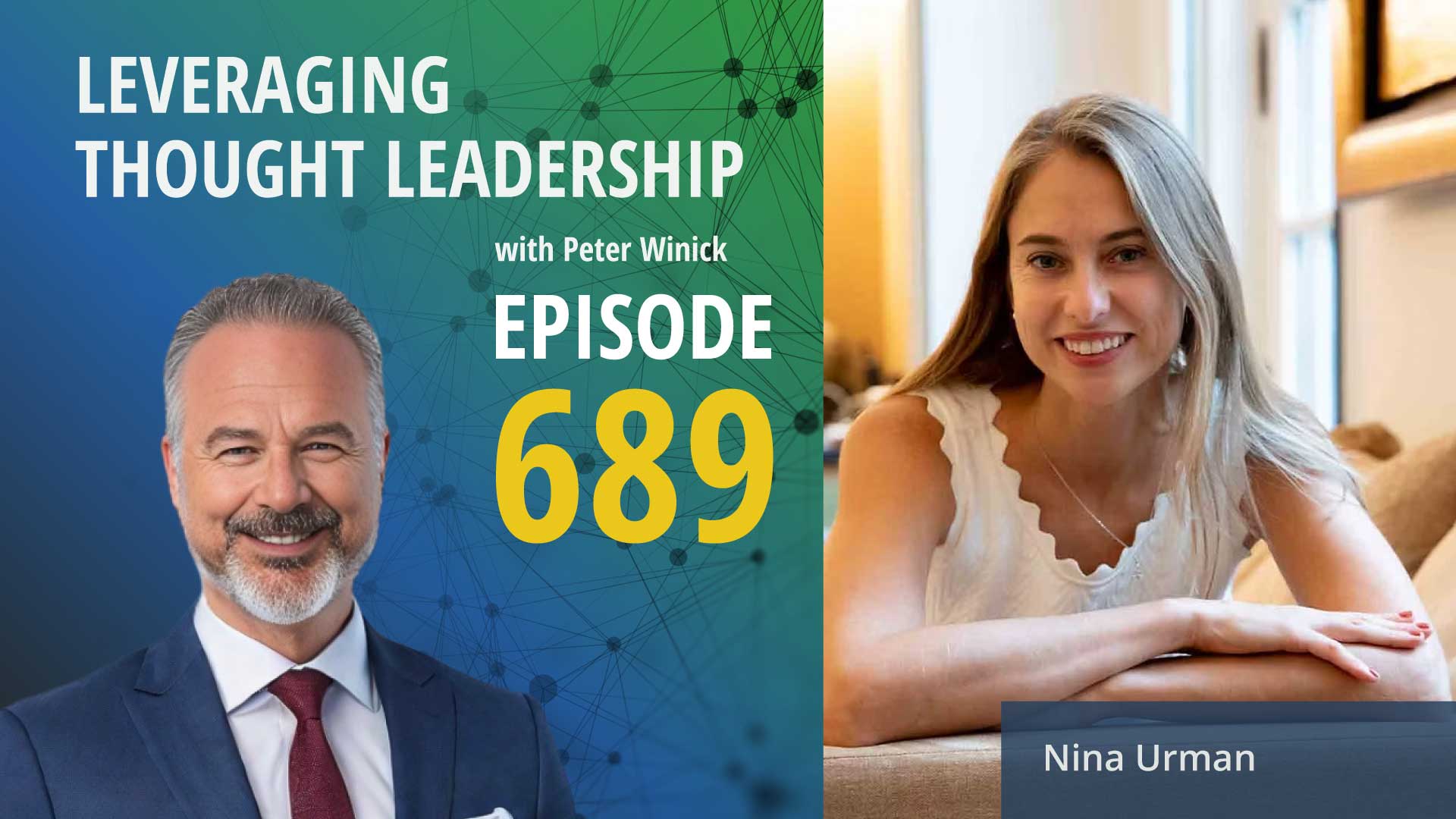



A CEO-level conversation on saying no, building frameworks, and expanding impact
This episode focuses on leading from the inside out—shifting from “mindset” to heartset so decisions are clearer, faster, and more aligned.
In this episode, Peter talks with executive coach and facilitator Nina Urman about her core framework found in her book: “Lead From Within.” She reframes “mindset” as heartset—getting crystal-clear on what you’re saying yes to, what you’re saying no to, and why that decision discipline matters at the top.
Nina’s thought leadership lives where performance meets inner leadership. We unpack failing forward as a repeatable leadership behavior, not a motivational poster—using setbacks as data, then moving again with more precision.
We also explore how leaders can “create from the future” by defining the future-self outcome and reverse-engineering the moves that make it real.
Her work is deeply practical and designed for high-performing rooms. Nina coaches and facilitates for CEOs, executives, leadership teams, entrepreneurs, and family businesses, with a focus on time and energy management and emotional mastery—because execution breaks when energy and emotion are unmanaged.
We also get into how she built demand through trusted communities like YPO (Young Presidents’ Organization) and similar peer networks—and why “belonging” and safety are not soft concepts, but performance multipliers. Nina describes her work as creating safe spaces where high-achievers can be fully themselves, which is where the real breakthroughs happen.
Finally, Nina shares a challenge every successful thought leader hits: when your calendar proves the concept, but caps the company. She’s been running nearly 50 retreats a year and is now making intentional tradeoffs—saying no to 1:1 and even some retreats—so she can scale what works, especially around family leadership.
She’s even developed a “Family Circle in a Box” board-game-style tool to help families moderate the experience themselves, and she’s exploring how digital tools (including AI) can help her scale impact without losing the essence of the work.
Three Key Takeaways:
- Lead from “heartset,” not just mindset. Clarity comes from aligning decisions to what you truly value—what you’re saying yes to, what you’re saying no to, and why.
- Make failure a system, not an event. “Failing forward” is a repeatable discipline: treat setbacks as data, adjust fast, and move again with more precision.
- Scale impact without losing the work. Trust-based communities and psychologically safe spaces drive breakthroughs, and scalable formats (tools, repeatable experiences, digital/AI) help move beyond a calendar-capped model.
If Nina’s “Lead From Within” idea of heartset and self-leadership resonated, queue up Episode 125 with Claude Silver next. Nina focuses on inner clarity and emotional mastery as a leadership advantage.
Claude complements that by translating the inner game into culture—human-centered leadership, values, and how your emotional posture shapes the workplace.
Together, they move from who you are as a leader to how your leadership lands on others. Go listen to Claude’s episode to connect personal alignment to scalable, people-first performance.
Transcript
Peter Winick And welcome, welcome, Welcome. This is Peter Winick. I’m the founder and CEO at thought leadership leverage. And you’re joining us on the podcast, which is leveraging thought leadership. Today, my guest is Nina Urman. And I want to give you just a little bit of her background. She’s a mother of seven. That’s an accomplishment in and of itself, a former professional tennis player and financial strategist. And she has coached over 200 executives, CEOs, and leadership teams across 30 countries into her. Program and has a book out and all sorts of interesting things going on. So her and I first met about a week or two ago and I was really intrigued by her story and wanted to invite her on to share some of it. So, uh, one of my favorite questions, Nina, thanks. Thanks for coming on by the way.
Nina Urman Thank you so much, Peter, for having me. I’m excited to be here.
Peter Winick So this is one of my favorite questions. And because I kind of know the answers is kind of a fun one for me is like, how did you get here? Like this, this wasn’t the grand plan of here’s how I will be in 2025 as a thought leader, but give us the brief journey. Cause I think it’s a, it’s, it has been a cool one.
Nina Urman Yeah. So I’m originally half Russian, half German. I was born in Siberia of all places. And no, it doesn’t always snow in Siberian. I moved to Germany when I was nine years old. My grandmother from my dad’s side was German and sent to Siberia. So that’s how I kind of came to Germany, nine years old, started playing tennis right then. My dad gave me the tennis racket and kind of said, you’re going to be a professional tennis player. So I became it. Fairly quickly, I was good quickly. I was a high performer, always very competitive. And so at the age of 15, I left to the U S to play at the Voluntary Tennis Academy, no more school, just tennis. The reason why I’m telling all this is because it’s kind of the prehistory to what I do today, because today I coach high performers. I coach corporate leaders and athletes, so to say. And yeah, it really builds my strength and built my resilience. I didn’t become you know, the number one in the world, because they had all of these injuries, but it opened up kind of a door to personal divide. I’m understanding that.
Peter Winick Right. So then you bring, right. So, you know, tennis has a shelf life, right? So even if I had become number one, you know, there’s a shelf like, but there’s some, some principles and some ideas and such that you took from that and then moved it into what you’re doing now. So copy that sort of what, what you brought with you into your current practice and how you apply it to the folks that you work with.
Nina Urman So I think one of the principles that talk about all the time, and that’s also the name of my book is lead from within. And I think tennis, you know, really taught me that it’s all, I mean, in your mind, we speak about mindset a lot, but it also is a hard set, right. Uh, defining what is it that you want and what are you saying? Yes to, and are you say no to. So a lot of these concepts come back in leadership teams and they come back in the ecosystem of internal leadership, like what’s going on. Also uh, in family leadership, which I’m very passionate about because leadership in general is not just one thing, right? It’s like, it’s a holistic ecosystem. Another principle I speak about a lot is failing forward, right. Like nobody likes to fail, but actually all the people I speak about, you know, that have been really successful, they tell me, you know it’s for failure that I grew is for failure is through that, you know, kind of pitting it. To top bottom that I actually learned what I’m capable of. So that’s another one I really love. And then maybe the principle of, you know, co-creating reality or creating it from the future, like, you now, connecting to the future self and then reverse engineering.
Peter Winick So let me ask you, so these are things that have obviously been polished. They they’ve evolved. They’ve been refined. They’ve tried and tested. How did you, what was the epiphany that said, okay, I’m done with my tennis career, right, and this will be the next thing. How did this, how did that happen? Cause it doesn’t seem like the day after you put down your racket, you’d put up a little poster and say, we’ll coach CEOs, like probably.
Nina Urman No, no, that journey was, I mean, first of all, I was very lost, right? I was kind of, okay, like I was trained to do this and now I can’t do this anymore. I had to go back to school, back to figuring out what is it that I want to study. And that’s where I was like, okay. I’ve studied lots of like kind of soft skills before I studied communication and, and psychology. And then I really wanted to do finance and do some hard stuff. And I met my husband at the end of my, my master degree. I studied here in Paris, one in Moscow, and I was like, okay, what am I going to do now? I became stepmom to four children at the age of 25. And it was kind of like this reinvention moment. And somebody in my environment is a good friend of my husband who said, why don’t you get a coach? And he was like believe me, like I’ve had coaches all my life, like the last thing I want as a coach. And he says, no, no no, like for your life to figure out your thoughts and what you want to do with your potential. And, you know, we have so much to offer. And that’s when I became interested in, um, like more interested in personal development, I was always interested in. You know, how does the human mind works, but always high performance there, it was more like, okay, maybe I can do something, you know, beyond.
Peter Winick So I want, I want to pivot for a moment, that’s how we got here and what the intellectual property and what your thought leadership is now let’s talk about the business side of that, right? So tell me about how, how your work comes to be and the types of folks that you’re working with and what an engagement looks like, and maybe some of the challenges and things that you’ve learned sort of on the court of business, if you will, to be as you have been in this arena.
Nina Urman Totally. So once I started my business, and first I was coaching one-on-one, you know, and then kind of worked myself towards groups. And today I work a lot with retreats. And it’s mostly CEOs, executives, you, know, family businesses, entrepreneurs, hired guns that run their businesses. And it’s almost like, okay, the topics that come up are a lot about time and energy management. It’s a lot of about emotional mastery. Those are the things that so to say teach, but it’s always in groups and there’s a lot of transfer of knowledge, a lot shared experiences. I work a lot with forums. I know you’re familiar with YPO, the Young Presidents Organization. It has 40,000 CEOs around the world. And a lot my work is either with these types of groups or then within companies or then with their families. So I kind of
Peter Winick Stay there a little bit more. Take it, take it.
Nina Urman Granule.
Peter Winick Of how, yeah, a little more granular in terms of you’re, you’re tapping into the YPO network because you’ve identified and I’m paraphrasing and push back, I’m not getting it right, that that’s an avatar, right? Like members of YPO, young president organization, right, our leading organizations in such, in such a time have teams and could benefit from this, partly because there’s a little bit of a flywheel effect. The more that you work with the population, the more in demand you become to say, I’ve worked with 20 other YPO members or whatever. I don’t think that you. Tap into the YPO network and it could be Vistage or EO or there’s a million other organizations.
Nina Urman Yeah. Yeah. Like all of these also I facilitated with the YPO is just the biggest one. How did that happen? Well, I mean, it happened very organically because my husband became a member, um, more than 15 years ago. So I kind of was like looking on the outside, like inside and outside, because once you get a membership of YPO, like the whole family just integrates. And I just became a champion leader. So in the beginning, I gave a lot of my time and energy to just be the give. And then at one point I was like, okay, I’m gonna start building these forums and these groups and I’m really good at it. And today I do like almost 50 retreats a year. So, which is a lot. I told you that this is probably.
Peter Winick Yeah, no, 50 retreats a year is sort of capped, but I, but I, I want to push them. So one of the things you said, you know, your husband was a member. Part of the, the ethos of YPO is it’s about, it’s not just about the business. It’s about the person and therefore about the family. So you fit part of that profile. You can sit there and say, I know what it’s like to be married to a member of YP. I know the challenges that he brings home from a tough days. I know. The impact that a stressful quarter has on our relationship and our relationship with our children and all that. So. There’s a signaling of, you know, I see you because I’m kind of one of you. I am one of your right.
Nina Urman 100%. Like they totally relate to me and how I see the world and, and they, they, like I get them, they get me. And so it’s, it’s there’s a trust factor, right? Like we know that in coaching to change anything, it, it always about the connection you have with other people. So for me, the most important thing, what I’m doing today, I would say like I’m building safe spaces for people just to be themselves.
Peter Winick So I want to go back, you know, and I, this kind of blew me away when we were talking earlier to earlier last week or week before, whatever it was, when you said, Oh, and do 50 retreats a year. And I’m like, holy cow, that’s a hundred plane rides or train rides or, you know whatever each one requires, not just the onsite facilitation, but, but, you, these things are bespoke, right? Like you’ve got a set of principles, but they’re not, this is not Like the job of a keynote or where you get up there, you think for 45 minutes. Facilitation is hard. You have to understand their context, their, their challenges, their, there’s struggles and all that. You got to travel there, get a prep for there and all that, and, and you and I talked about, so you have a practice and your practice is maxed out. So now growth is a function of, well, they’re not going to have a year with 60 weeks, right? There’s only so many, we have, we, we have leap year, but you know, there there’s only so many weeks in a year. Um, ultimately you could, you could increase your pricing, but the market’s going to cap you at that. How are you starting to think about your own business? I have to move from a practice to a business that’s more scalable, or are you having, considering that and thinking about that?
Nina Urman Yes, I’m like very much considering it. And I noticed one of the things that I’m trying to figure out is like, what is my frame, right? What is it that I really want to do? And then what’s my floor? What am I saying yes to? What am saying no to? And I’ve started already, like, you know, saying no to one-on-coaching and more and more I’m saying no to retreats because I do want to focus on this family component because I think this is. Where it can bring the most value and where I’m most passionate about at the moment. So it’s bringing all the forum principles that I do with executives into families and still families of entrepreneurs and CEOs, et cetera, but really tapping into that. I don’t think many people do that. It’s like this is…
Peter Winick Either a second because I think that and what I should say what I’ve observed is that thought leaders are really passionate and they love what they do and there’s an intrinsic motivation not that it’s not extrinsic and financial rewards but in general they’re really bad at saying no right so somebody comes to them with something else even though they have their vision and their plan they think well that’s interesting yeah I would like to do that or could I do that or whatever but I love the fact that you’ve got the discipline, and maybe this comes from your athletic days or whatever of knowing what to say no to. I think that’s a big thing. And it sounds like it took you a while to sort of have that.
Nina Urman Yes. In the beginning, I was saying yes to everything, but I think there’s seasons and stages in life. I think when, when you, you know, growing and understanding, you’re just learning and absorbing, it’s great to say yes, because you’re just learning and expanding your horizons. But I’m at a stage right now where I’m okay. Like it’s almost like, okay, been there, done that. Like I’ve done this thing and I’ve proven it to myself and other people that I can do it. And now I’m on a stage, okay. Where am I the most impactful and how can I scale? Because I do believe that I can reach, you know, like, hundreds and thousands of families if I do this right. And in fact, I built like a board game for families to play with, which I call it Family Circle in a Box. And this allows me then to take myself out of the equation, so to say, and, or put myself in every box, maybe with AI or digital tools that…
Peter Winick Making yourself out, I think there’s, there’s two reactions that thought leaders have to that concept. One is utter fear. Oh my god, I’m like, without me, there is no there, right? Like, it’s all about me, right, like, oh my god. It’s my identity is all I do. And then others are like, you know what? It’s time to make me irrelevant or less relevant or make them the business less dependent on I you know, if every if every proposal that you write starts with a needle with ill. You don’t have a business, you have a practice, right? And now I think you’re at a point where you’ve developed the frameworks, the models, the methodologies. Yes, it’s great that you can deliver it, but that’s not the exclusive way that people can experience and benefit from your intellectual property. That’s like…
Nina Urman Yeah, I think it’s about them now, right? It’s like, it’s most like, okay, this is me, my energy, my products, my frameworks. But now it’s like how can I make this work so like the families can moderate themselves or with guidance and with, you know, digital products that will help them with the game. I’m thinking that at one point, like I am at that stage where basically I’m doing, okay this is my frame, then what’s my floor, everything beyond the floor is a no. And then what’s the focus? And the focus has to be more than just Nina.
Peter Winick Yeah, exactly. Exactly. And how are you finding the market receiving that? Because I think part of it is you get a reputation and a brand of everybody talks about you, right? Like, Oh my God, she did this retreat for us and it was great. And you should bring her in. Like if there’s the referral piece of it, and now somebody comes in to you as a, as a client that was referred to somebody that experienced you say three or four years ago, and you’re telling that person, it’s not about me. I have this suite of tools and offerings and solutions and whatever. That’s part of the mix, are they taken aback by that or how do you find they’re reacting to that or you manage that transition for them?
Nina Urman Yeah, I think it’s, it’s a, it, it it’s happening kind of organically, right? Like people, they want value, right. Like there’s like, can you give me what I want? And I’m like, well, I can give you this. It’s almost like, okay, I, I could give you a different experience. Is it that, you know, sometimes people don’t know exactly with forum, forum retreats, and I’m happy to refer them to other people too. So, you, it was almost like. You know, you want bananas or you want potatoes? Like, what is it that you want? They kind of like, Oh, okay. Oh, this is what she’s doing now. So it’s like, okay, can you refer me to somebody else or I’m interested in what you’re doing.
Peter Winick I think is great, but it takes a level of confidence that like, Hey, if you’re in the market for bananas and I’m a potato, like I’ve got a friend that’s a banana, like, like because I think all too often the potato says, the thought leader says, well, I know the attributes of a banana. I can kind of do the banana thing for a little bit if that’s what they need. But I like what you said earlier, there are seasons and it sounds to me you’re at a fairly developed and mature season of knowing sort of what you’re about, what your works about, who you serve, how you want to serve them. And going back to what we said earlier, the flip side of that is, I’m not a banana.
Nina Urman Right. It’s also, and also like one of my mentors said to me, I think she used the peach. So it’s interesting. She’s like, you know, you can be the most juicy peach. There’s always going to be people that are going to be allergic to peaches. So it was like also this other way, right? It’s like. Okay. Like identity is about like, who am I and what can I provide? And that can be reinvented several times, but I think at your core, you’ll know what season it is right now. And so. It’s interesting like but this is new and I want to be the people that are listening to this to know that this is not Kind of like Oh a revelation and there you go
Peter Winick It’s iterative. Yeah. Approximately. Yeah, and if we were to schedule a call a year from now, I’d ask, hey, what’d you learn in the last year and what’s the same and what different? And you’d say, oh, I was really right about this, but I was wrong about this or I had to iterate on this and change on that. I think that’s really. The important piece, because, you know, we weren’t having the conversations four or five years ago, but how is AI going to impact thought leadership? And at some level, it feels like that’s the only conversation too many people are having, because, at some levels, the better question is, how do I, as a thought leader, use or not use AI to be better at what I do? Is it a research partner? Is about systems is about like, there’s a lot of things to do with it. So
Nina Urman Yeah. Yeah. I think AI scares many people also in my field. Like I see them. They’re like, how could they use it? But then it’s like, is it going to make me irrelevant or not valuable anymore? And I don’t see that at all. I’m like, I’m, you know, riding the wave and kind of trying to see how you use it.
Peter Winick Well, this, this has been great. I appreciate your time, and I appreciate your transparency in sharing your journey with us today and good stuff.
Nina Urman Thank you so much, Peter. Thank you for having me.
Peter Winick To learn more about Thought Leadership Leverage, please visit our website at thoughtleadershipleverage.com. To reach me directly, feel free to email me at peter at thoughtledershipleverage.com, and please subscribe to Leveraging Thought Leadership on iTunes or your favorite podcast app to get your weekly episode automatically.

Related Posts

Comments (0)