Frameworks for connection, accountability, and performance This episode examines how psychological safety drives performance, how…
Mindsets, Not Maps: Rethinking Corporate Innovation | Richard Braden




A Hybrid Model That Blends Capability Building with Business Outcomes
This episode explores how to democratize innovation, so it becomes a repeatable, teachable capability across the organization rather than a mysterious black box. We dig into the mindsets that drive real problem solving—moving beyond “innovation theater” to everyday, practical breakthroughs tied to real business outcomes. You’ll hear how a hybrid model of consulting plus capability-building helps teams at every level embed innovation into day-to-day work.
What if innovation wasn’t reserved for a handful of “geniuses” in hoodies and turtlenecks? What if every person in your organization could solve real problems in bold new ways?
Today’s episode of Leveraging Thought Leadership, I’m joined by Richard Braden to explore how to democratize innovation inside the enterprise. We dig into his practical framework from “Innovation-ish: How Anyone Can Create Breakthrough Solutions to Real Problems in the Real World” which was co-authored with Tessa Forshaw to challenge the myth of the lone genius. Innovation stops being a mysterious black box and becomes a repeatable, teachable capability across the business.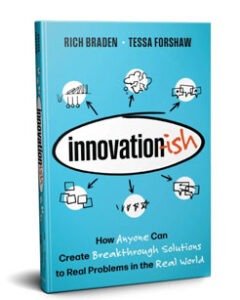
Rich explains why most organizations over-invest in “innovation theater” and under-invest in mindset. Instead of obsessing over yet another step-by-step process, he focuses on the mental shifts that actually drive breakthrough thinking. From “shopping” vs. “buying” mindsets to the difference between learning, iterating, and executing, you’ll get language you can use with your teams tomorrow.
We also unpack Rich’s hybrid model for innovation: part consulting, part capability-building. You’ll hear how a global quick-service restaurant brand redesigned its supply chain using cross-functional teams—everyone from restaurant crew to executives—working on real projects over nine months. The result? Tangible business outcomes and an enduring lift in problem-solving capability, long after the external experts left.
Rich shows that innovation isn’t just about moonshots. It’s about orbit shots, cloud shots, roof shots, and jump shots—small, targeted changes that add up to massive impact. Imagine your finance team “innovating” the expense-report process so it’s fast, accurate, and painless. That may not land you on the cover of a magazine, but it can unlock time, energy, and engagement across the organization.
If you’re tired of one-off workshops, “innovation labs” off in a corner, or expensive programs that don’t stick, this conversation with Rich Braden offers a better path. You’ll learn how to embed innovation in day-to-day work, build your own obsolescence into client engagements, and turn innovation from a slogan into a core competency.
Three Key Takeaways
- Innovation is a teachable skill. It’s not the domain of lone geniuses; with the right mindsets and language, you can help people across the organization solve real problems in new ways.
- Mindset beats methodology. Most organizations over-index on processes and “innovation theater,” but sustainable breakthroughs come from shifting how people think, learn, and experiment in their day-to-day work.
- Capability-building must be tied to real work. The most effective innovation programs blend consulting with hands-on projects, so teams deliver tangible business outcomes and build enduring problem-solving muscles at the same time.
If this conversation on democratizing innovation resonated with you, your next listen should be the episode with Michele Zanini. In that one, we take the same core ideas—moving beyond “innovation theater,” distributing problem-solving across the organization, and building real capability instead of one-off programs—and apply them to dismantling bureaucracy and unleashing talent at scale.
Listen to both episodes together and you’ll get a powerful one-two punch: a practical framework for everyday innovation, plus a blueprint for removing the structural and cultural barriers that keep your people from using it. If you’re serious about making innovation everyone’s job—not just a select few in a lab—queue up the Michele Zanini episode next.
Transcript
Peter Winick And welcome, welcome, welcome. This is Peter Winick. I’m the founder and CEO at Thought Leadership Leverage. And you’re joining us on the podcast today, which is Leveraging Thought Leadership. Today, my guest is Rich Braden; amongst other things, besides being at Stanford and doing all that sort of cool stuff. He is the co author of Innovation Ish with Tessa Forshaw. And the subtitle I love is How Anyone Can Create Breakthrough Solutions to Real Problems in the Real World. So let’s just dive in. What’s going on today, Rich?
Rich Braden Just excited to be here and talk with you and get the word out to people because it really is about how anyone can create breakthrough solutions. And the re a lot of why we wanted to write this book is in our work teaching in universities as well as going out and working with a number of clients, we kept hearing the same messages over and over, which we’re trying to introduce people to creative problem solving and innovation. And there was this huge resistance. Who am I to be an innovator? This I’m not a creative person, or it’s for other people. And well, stay there a minute.
Peter Winick Yeah. So I think that one of the every subset of thought leadership has its own quirks, right? So I’ve done a bunch in the innovation space as I have in in other spaces. And what’s weird about innovation, there’s not this big anti-innovation movement, you know, exo-ludites, right? Yeah. Right, right, right, right. Which is literally what they do, right? But then kind of what you were saying, the who owns it piece and who am I to sort of take that on is a little vague and fuzzy. So some companies might have a chief innovation officer where they say, well, that’s product development, whatever. But I love the way you’re sort of reframing it to say it’s sort of this democratization of an innovation mindset, is what I’m hearing.
Rich Braden Absolutely. Yeah. And there’s sort of two pieces of that. One is we’re kind of fed a constant diet of who an innovator is. And we did a general population survey and asked a very open question of who are innovators. And the resounding answers came back with about five names. They were Steve Jobs, Elon Musk. Right, right. Thomas Edison. So it’s all these iconic people. They were, and they all happen to be men. So it’s kind of ridiculous on its face, but that’s what we think of because we’re fed this constant diet. And so there are a lot of people that are like, but I’m not Mark Zuckerberg. I can’t innovate. And that’s just not true. And the other thing is what you alluded to. They think of innovation as the big idea that starts a company that creates a unicorn is this giant thing. Right. And the reality is once you have that big idea and you start that company, the majority of the people in the company are in the sort of enterprise enablement or operation space supporting that main big idea. So there’s far more potential for innovation in every organization across all of the people that can do. Big and small innovations.
Peter Winick So stay there for a minute. Because if most of us were honest, we’d say, I’m not Musk, I’m not Zuckerberg, I’m not Jobs. Like, okay. Sure. Nor about right. But then the next part shouldn’t be, so therefore I shouldn’t even try. No. So I think there’s a scale and scope to what you’re talking about, innovation. Right. So most of us won’t invent the equivalent of the iPhone. Like it’s just not gonna happen. But you can be an innovative dentist, whatever that might be. You can be an innovative actuary. So tell me a little bit, because I’m sort of a junkie on models and methods and frameworks. So if you if you go from Jobs to Musk just sort of the everyday dude and woman thinking about this, right? Sure. There’s a model, there’s a method, there’s a framework here. So tell us about that. Right.
Rich Braden Yeah, absolutely. So, first of all, let’s dispel the fact that Musk and Jobs and all those people, they are impressive individuals, but they are not a lone genius that invented everything. They brought together teams. It is a collaborative idea. And the key to that in terms of models and frameworks is you’ve got to get everybody moving on the same page and working in the same way collaboratively. And that’s done. Right now, there are we’ve looked at over 80 different creativity frameworks that are out there. There’s a ton of them. And we did some analysis.
Peter Winick By the way, the world probably doesn’t need another one.
Rich Braden We don’t need another one. No. But we don’t need another one, but another one is fine because what all of those are trying to accomplish is they’re trying to get people to look at problems in a different way to take on a different mindset. Now they do it as a side effect predominantly. But what we are try saying is the mindset approach, the how you look at your problem is the key to how they all work and how you should do it. Many of those, because it’s easier, or because you can, you know, wrap your proprietary framework around it, give you a series of steps, kind of like I don’t know, a recipe for cooking or a piece of classical music. Okay. Instead, we take the approach of you gotta look at the mindset that you need next. And an example. So, first of all, a mindset is it’s a perspective, a way that it guides your behavior by how you look at a situation. Yeah, and that changes your behavior. So if you go out to a retail location, if you have a shopping mindset, you might be ready for you know a couple hours of browsing and looking and seeing what’s there. Sure. If you have a buying mindset, it’s about I want to get in, get the thing and get back out so I can move on with my day, and that guides your experience. The same is true with innovation. If you put on a mindset of I want to go and learn from others. That changes how you approach it and what you do next, as opposed to a mindset of iterating and building and tearing down and getting feedback over and over. That would be more of an iterations mindset. So all of those processes and frameworks are all trying to get you to do those mindsets, but they present it in it as like a map, like a here you go from step one to step two to step three. And while the analogy we use is if I have the world best map of New York City and a great itinerary, and I give that to you, I’m like, you should use this on your vacation. That works really well if you happen to be in New York. But if you open that map up and you’re in Bangkok, Thailand, that map does you good. And so depending on the problem you’re solving, the people you have, the resources available, the process map that you got from some creativity piece may not be helpful. It’s better to be a navigator to decide what you want to do next.
Peter Winick So that does a very good job of sort of at a at a very basic level, sort of what is the it? What is the thought leadership that’s underlying the book, that’s underlying what you do, et cetera. I want to shift to sort of the business side of this, right? Because you were your your co-writer, there’s an academic piece to this in terms of where you spend your time, where she spends her time. But give me a sense of the underlying business model. And I always like to ask sort of, well, who’s paying you to get what done?
Rich Braden Right. So traditionally with engaging innovation, there are a couple of routes people take. One, they spend a lot on development and send people out to programs, try to hire in and build their capability of innovation so that they can try to use it. Often that happens sort of in an innovation wing or center or position. Yes. The other is we need to innovate. Who can innovate? And they go hire a defined design firm or consulting firm and they brim their army and they do it for a while and then they go away. The approach that we use is a hybrid of the two. We know from the academic side that the best learning happens when you’re working on real work that is meaningful for you and it takes effort. And if you’re going to outsource, you need to keep outsourcing, it builds a dependency. So instead
Peter Winick So stay there for a minute because that framing is typical for lots of things that companies do. Sure. We need X. So if we outsource it, we’re gonna pay a premium, we’re gonna get X done, it’s gonna get done on time at a high level budget, but we’re not interested or haven’t don’t have the time or haven’t framed it this way to say, we want to learn how to do this organizationally. We might say, hey, listen, we’re a company that does we’re a manufacturing company, we’re not good at building web websites, we need to do it every so often. Let’s hire a great website firm. And that there’s logic to that, right? Totally. There is a place for that, absolutely. Yeah. But I like what you’re saying to say at some point, many organizations should say, whether it’s about the dependency or the economics, does this become a core competency or could it, should it become a core competency for some to many of our employees? And in the absence of that, are we a competitive disadvantage in the market for not understanding how to how to look at the world in innovative lens? And like
Rich Braden Think there are places and websites a good example where outsourcing can be a reasonable option, unless that is the core strategy for your business. But now, in the pace of change, that everything is moving and there’s new technologies and there’s AI and everything is going so fast. Being agile and being able to adapt as an organization across the whole organization is a competitive advantage. So for innovation, infusing innovation into your day to day, your business as usual, allows the whole organization to adapt if you build that capability.
Peter Winick If you’re enjoying this episode of Leveraging Thought Leadership, please make sure to subscribe. If you’d like to help spread the word about our podcast, please leave a five-star review at ratethispodcast.com forward slash LTL and share it with your friends. We’re available on Apple Podcasts and on all major listening apps, as well as at Thought Leadership Leverage.com/podcasts.
Peter Winick No, I wanna push on that because I love that thinking because I think if you if you were to map out and you’re better qualified to do this than I, sort of the history of innovation in corporate America, right? So there’s the Edizens of the world, right? These crazy innovators that do cool stuff, right? Sure. But then it matured. And I would say, I don’t know, idea and all that sort of maybe 30 years ago. People were like, Okay, this is a thing. We need to figure this out. So they would create the chief innovation office or whatever, but it would be such a small percentage of the total population. And it’s also absurd to say, let’s, you know, let’s make that the responsibility of these nine people, you know, in Silicon Valley or something like that. Right. Well, I mean even if you’re generous.
Rich Braden So it’s the small strategy team, it’s the product development team and research and development. Like that whole group, maybe that’s several hundred people. It’s still seven hundred people in what could be a ten-to-fifty-thousand-person organization. There’s some weapon potential we’re missing. And so many of those people are closer to the problem than those people in the innovation unit. Yeah.
Peter Winick Yeah.
Rich Braden So we worked with one of the largest quick service restaurants in in the world, but in North America, to help them redesign their supply chain. Okay. We worked with people from the restaurant, like owners and crew in the restaurant, to people who were pulling cases sometimes out of the freezer in a distribution center to executives and executive boards at owners. We had a huge team and we led them through, we split them into subteams and we led them through a process to help look at their supply chain. So we had all these different perspectives and we had people from all walks of life and background and experience. They were all able to do innovation. Okay. What what’s more, by the time we got through the first piece of work we did with them, took about nine months. They had changed how they talked about problem solving. They had adopted this because they’d used it in real life on problems that were meaningful to them. And they something we couldn’t do. If they tried to outsource to us, we are never gonna have thirty to forty years of experience in a supply chain like that. So the hybrid
Peter Winick Yeah.
Rich Braden Incredibly.
Peter Winick Well. So when you when you talk about your hybrid approaches, I’m trying to understand the business model here. There’s the outsource piece, which you can do kind of some of that, right? We could do. Yeah. And two but structurally your answer is we’re not outsourced our capabilities development. It’s both. We’re gonna get the thing done. We’ll help we’ll support it. But your people are gonna do some of the stuff too. Absolutely.
Rich Braden Let me make it really concrete. We took a core team of about 45 people from across the supply chain and we broke them up into small teams. We met with them two to three days at a time, every couple months, every about six weeks, across nine months. Every time we got together, we heard what they had done. We introduced some new concepts. We helped them make the decisions on how to move forward. We released them back into the wild. And then we’d have coaching calls along the way to just keep them on track. So we guided how they move forward because we had the experience to help them make the judgment decisions that they weren’t quite ready for, but they had the depth of knowledge and experience in supply chain that we didn’t to be able to pull out the insights. So that’s the hype. Yeah. Absolutely.
Peter Winick Yeah.
Rich Braden Yeah. So this was not education. This was not an exec ed program. This was they had real within the business unit problems they were trying to solve and we helped guide the work that they did and helped keep them on track. So we owned a portion of the outcome because we were rolling up our sleeves with them to get them where they needed to go.
Peter Winick But what I what I love about that is when you’re doing education, what I would call education in isolation, the issue is really engagement. People are good, people work hard. But if I’m doing this exec ed thing and my company paid all this money, blah, blah, blah, I’m gonna do my best because I’m a smart person and I want to do my best. Yeah. But if I have to, you know, sort of balance out the demands of okay, we just had a lunch break during this exec ed and I got nine emails and my team’s on fire, I kind of have to deal with that. But if there’s no sort of artificial boundary between the educational component and the applied opponent, it’s just kind of what we’re doing over the next couple of months. Yeah.
Rich Braden Exec ed has its place. And I teach at Stanford Exec Ed program. And it’s great for awareness and background and being able to understand what’s going on. But what we were doing was something that was different. It was capability building along with driving a business outcome. So they got to do both. And along the way, they built their capacity. And we kind of build in our own obsolescence. Because after a while, they don’t need us anymore, but that’s fine. What we want is to help people come up to speed. And this is why we wrote the book, is so that they can take control. They can be a genetic and control their own destiny and drive it forward themselves. Because anyone can do this. They just need to get their practice going and we can help accelerate that.
Peter Winick Got it. So on the business side, so I’m I I love the model. What are the things that you’re doing to increase awareness of there’s a different way to look at this, right? You know, what how are you putting thought leadership out there deliberately, strategically, et cetera? So the people that are sitting with these problems, they’re probably not Googling this way of being because they probably don’t know it exists. So how do you push that out there? So somebody goes, interesting. I should give Rich a call and have that conversation.
Rich Braden Yeah. I think what we’re doing is giving a different approach to what they’re already looking for, which is how do we incorporate innovation, creatively self problems? How do we keep up with the pace of change and not let somebody disrupt us by staying ahead? And I think the tests that they are not, they maybe are less aware of are a different set of problems where innovation is hot. Innovation, the executives are saying, do innovation, but I’m sitting in a function that isn’t traditional innovation. How do I even start or do that? And I mean that’s where you talked earlier about scale, where we see innovation as a spectrum. There are moonshot ideas, the iPhone, yeah, the big company making ideas. But underneath that, if you’re gonna deliver on that, there are a whole bunch of orbit shot ideas. And below that are cloud shots and roof shots and jump shots. And so depending on where you are, you need more or less capability in doing innovation. If you get everybody a little bit of innovation, you can solve a bunch of thorny problems. The example I always use is if the finance team could get a little innovation and solve the expense report workflow so it was easy and accurate for everyone, they would be heroes. It’s not gonna change the company. They aren’t gonna be an expense report company. But in every company, if they could solve that and the dozens of little things like that that cause so much friction in organization.
Peter Winick But I you know that’s quite innovation. But I would argue that that could I mean not that one example, but if you had that mindset and said, let’s set you know, like Peter’s got a bunch of things he can do today. You know, spending twenty seven minutes getting reimbursed 300 bucks for the Ruth Chris dinner he took somebody to is not going to drive the business, but it needs to get done. Right. We have to brush our teeth, we have to take out the track. So you if you can free up that gunk to let me do the things I want to do, you know, or absolutely the best at doing.
Rich Braden Yeah. It’s the aggregation of that portfolio of in innovation that I think is the real value. And that can transform a company. It can transform how you interoperate, how you work together. But it also can change the bottom line. You can save a lot of cost in making those small corrections and doing them in a way. I mean, how many how many initiatives have we seen where they come up with the new expense report thing? It’s no better, and they never talk to anybody about what it should be. That’s just wasting money implementing programs. There is a better way by adopting this approach of the innovation creative problem solving toolkit to make all your problem solving better. So whatever it is, wherever it is in the organization, it just works.
Peter Winick Well now wasting money is the big piece of it, but it’s also another ding to engagement and creativity and blah, blah, blah. So you know, there’s more pieces to it. Well, this is this has been great, Rich. I appreciate the conversation and I love the way you’re a not to get meta, but it’s an innovative approach to getting the idea and the work out there. Because I think that in oftentimes there’s an either-or mentality. I’m either in the capabilities development business or I’m the getting stuff done business. And I love that. Why does it need to be that way? Or situ you know, there are times it might w need to be one or the other, but from a client’s perspective, they don’t put that wall between the two. Why shouldn’t we as service providers? So I love that.
Rich Braden That’s right. Yeah. Both have value, but this hybrid approach gives something more.
Peter Winick Awesome. Well it’s been great. Appreciate your time and best of luck to continued success with the book. Thank you.
Peter Winick Thanks.
Peter Winick To learn more about Thought Leadership Leverage, please visit our website at thoughtleadershipleverage.com. To reach me directly, feel free to email me at peter at thoughtleadershipleverage.com, and please subscribe to Leveraging Thought Leadership on iTunes or your favorite podcast app to get your weekly episode automatically.

Related Posts