The Apple Effect: Turning Hard Lessons into Scalable Systems | Apple Levy
The Leveraging Thought Leadership podcast is created by Peter Winick and Bill Sherman and produced by Thought Leadership Leverage.



A field-tested framework for leaders who want better margins, cleaner operations, and a stronger culture.
This episode explores how to turn hard-earned business experience into a clear, scalable framework. Bill and his guest unpack how systems, KPIs, and process discipline can move a company from firefighting to predictable growth. They show how a well-structured book can double as an operating manual for consulting, speaking, and building a stronger legacy business.
What if every hard-earned lesson in your business came with a simple mandate: how dare you do nothing with what’s been given to you?
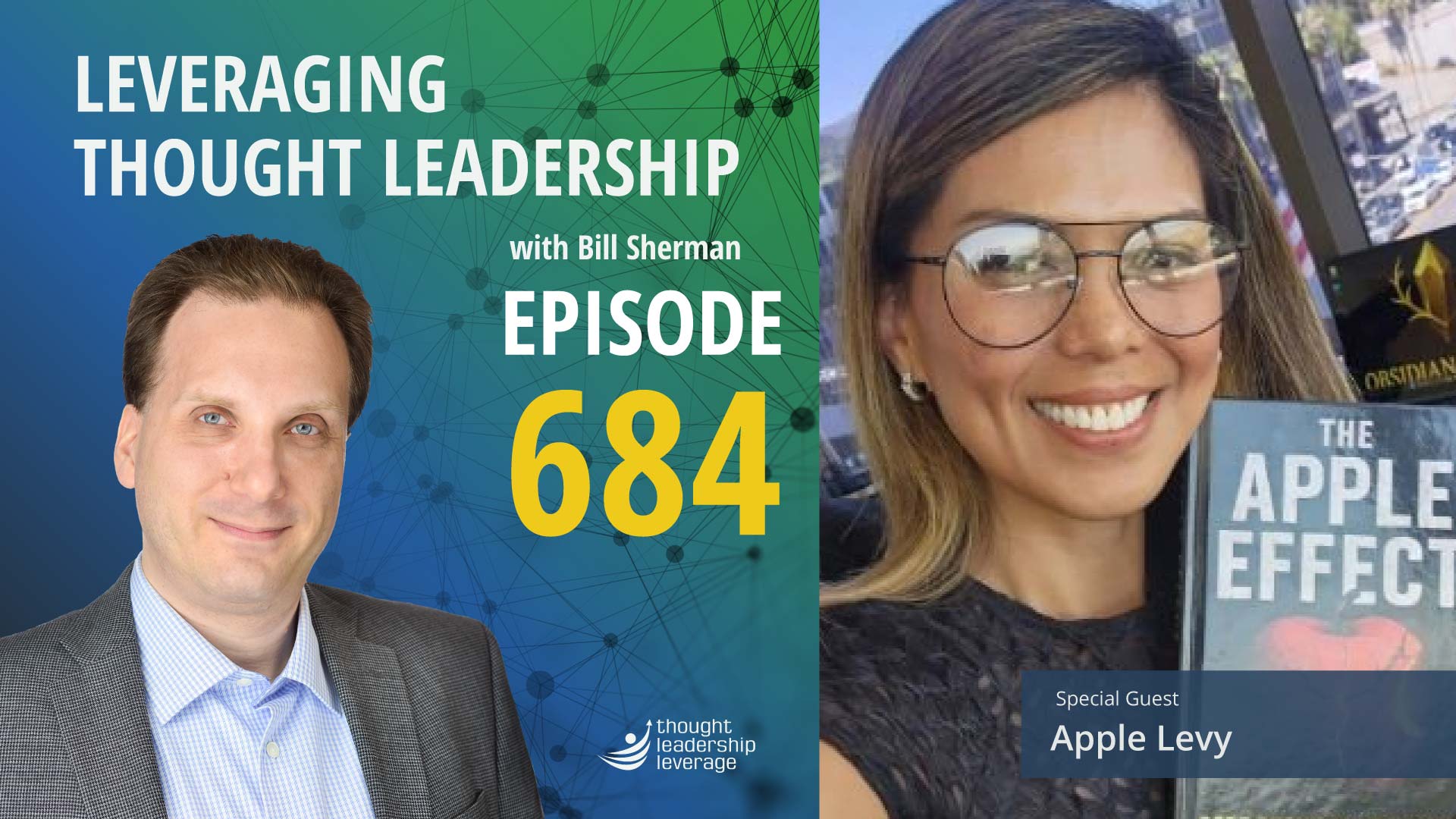
In this episode, Bill Sherman talks with serial entrepreneur and systems strategist Apple Levy, author of “The Apple Effect”. Apple has spent decades in construction, manufacturing, home flipping, and retail. She combines operational grit with financial discipline to help entrepreneurs stop firefighting and start scaling with intention. Her core belief is simple and provocative: if you know something that works, you have a duty to share it.
Apple walks through how she turned years of wins and failures into a repeatable framework for growth. She explains why she began capturing notes, call recordings, and data from every client, and how that archive became The Apple Effect—a practical playbook for owners running businesses from $1M to $40M in revenue. The book distills what actually moves margin, cash flow, and culture, and she uses it as the backbone for her firm, Obsidian Thorne, when helping companies scale.
You’ll hear the real problems that keep owners up at night. Not just cash flow and margin, but rework that kills profit, weak follow-up on sales, and the emotional landmine of hiring family you can’t hold accountable. Apple shows how to move from “leading by personality” to “leading by systems,” so the process becomes the bad cop—not you. That shift frees leaders to exit someday, build a legacy, or simply step
out of daily chaos.
Apple and Bill also explore the mindset required to grow. Apple challenges entrepreneurs to ask, “How badly do I want this?” and to accept that scaling may mean dismantling what no longer serves the business—including long-standing people, habits, and assumptions. She shares how she applies her own advice inside Obsidian Thorne, using automation, hiring a business development lead early, and treating every pain point in her firm as data she can use to better serve clients.
Finally, Apple looks ahead. She talks about taking her message to bigger stages—through construction trade shows like Build Expo, her growing calendar of workshops, and future events she plans to host herself. She’s already filling the next scratch pad with insights for future books and building a team of people who share her attitude: hungry, accountable, and obsessed with helping entrepreneurs go from $1M to $10M and beyond.
If you’re an owner who’s tired of firefighting, wrestling with family in the business, or worried about what you’re leaving to the next generation, this conversation—and The Apple Effect—offers both a wake-up call and a roadmap.
Three Key Takeaways
- Systemize your expertise. Turning real-world lessons into a documented framework is the foundation for scaling any business.
- Measure what matters. KPIs and process discipline reduce rework, protect margin, and move the company out of constant firefighting.
- Use your book as a strategic tool. A well-structured book can double as a thought leadership platform and an operating guide for clients and teams.
If this episode has you thinking about systems, scale, and getting out of firefighting, the next step is to focus on your leaders. Pair this conversation with the episode “Scaling Leadership: Making Coaching Accessible at Every Level” with Kristin Lytle and you’ll see the other side of the equation: how to build repeatable, scalable ways to grow people, not just processes.
Both episodes explore how to move from one-off heroics to structured, repeatable solutions—whether that’s tightening operations and KPIs or creating blended coaching and learning programs that reach leaders at every level. Listen to them together and you’ll walk away with a more complete roadmap: how to systemize the business and build a culture of high integrity, accountability, and leadership growth across the organization.
Transcript
Bill Sherman How do you know when it’s time to stop accumulating hard earned lessons and start sharing them? For Apple Levy, it started when she asked herself one question. How dare you do nothing with all that’s been given to you? From construction sites to boardrooms, Apple turned years of trial, failure, and persistence into a powerful message for entrepreneurs. Her thought leadership grew from the belief that sharing systems, strategy, and mindsets can change not just businesses, but lives. I’m Bill Sherman and you’re listening to Leveraging Thought Leadership. Let’s begin. Welcome to the show, Apple.
Apple Levy Thank you so much, Bill. I’m so happy and excited to be here. Thanks for having me.
Bill Sherman Absolutely. So there’s a number of things I want to talk to you about and we’ll cover in this conversation. But I want to start with a quick question and let’s go with a short answer. How’d you get into thought leadership?
Apple Levy I got into thought leadership earlier on when really I realized that everything that I was learning there was a bigger purpose for it. That it was almost it is my duty to share everything that I’ve learned that I’ve seen to be effective. And it just, you know, dominoed from there. I was heavily involved in philanthropy earlier on. And learning from other philanthropists and being around mentors really drove me to understand that everything that you do, your purpose here is not just for yourself, it’s to h also help others in whatever sense that might may be in in their life, in their business, in their livelihood in general. And it’s just it led me to that because of purpose.
Bill Sherman So let me build on that because you used a word duty to share, which is language that here at Thought Leadership Leverage, we resonate with and we call it almost a duty to speak. You don’t have to have perfect knowledge. You don’t have to know everything about your subject. But if you know more than those who need help, there’s almost a duty to speak because it’s a noisy world. People don’t know what’s necessarily accurate versus not accurate. And if the people who have good knowledge stay silent, that hurts. And it impacts the entrepreneur. And I know you are you care a lot about entrepreneurs. There’s this duty component of I can’t stay silent. Does that resonate with you?
Apple Levy It absolutely does. I heard a saying once from one of my mentors who said, How dare you do nothing with what’s been given to you? And that that hits really hard with me because I already felt that the things that I see to be effective and helpful with other business owners, I already feel that that’s my duty to share that. So when I see it with working with one and it’s like, wait, I know somebody else I can share this with, and it’ll work the same. And if I keep silent as to your point, how dare I? How dare I not see anything with what’s been given since.
Bill Sherman And so let’s level set for a moment. Where is your expertise and who do you serve? Help fill the audience in. I know you and I have been talking, but just give a little bit of context of what is your thought leadership and who do you serve?
Apple Levy Absolutely. So in the past couple of decades, I’ve really been into the construction side of things. I also served as a financial controller for businesses and therefore and worked on operations as well. So the combinations of oper the combination of operations and a strong financial acumen really helped me develop my process and framework. But for the past couple of decades, I’ve been in construction, I worked in manufacturing. I flipped homes myself in Steubenville, Ohio, where I was hiring the crew, handling the budgeting for the projects, and sourcing out material. So I really got down deep into what it takes to do that. I also owned a retail company. So I had to go through branding and digging through what it actually takes to be heard from all this noise, as you’d mentioned earlier. So there’s a lot of different I’m I guess you can say I’m a serial entrepreneur because I don’t want to start an account, all my past businesses and
Bill Sherman Right, right.
Apple Levy And all the successes, wins and failures from each one. And then having to compile all the things that I’ve learned. That is one thing I continue to still push through and make sure that I’m mindful of is learning a lesson from every failure that I come across. And also tracking all the wins that actually that actually work. And that’s what led me actually to writing my book, The Apple Effect, and which is a compilation of all the most impactful things that I’ve seen work with businesses from leadership, from mindset, from setting KPRs, from setting or KPIs and to setting the objectives and key results for the years and target all the things that I’ve seen that have worked that have that was quantifiable, I’ve compiled into the Apple Effect. And so I use that now as the framework for my business at Obsidian Thorn when I’m walking through scaling a company. So it’s been it’s been a journey the last couple of decades of falling nine times and getting up the tenth time to continue to go and continue to learn. And I really believe that because I am willing to fail and I’m willing to take bold actions, that I’m ahead of the game because of it. Because I I’m really not scared to fail because I can just reset. You know, what’s the big deal? Just reset.
Bill Sherman So if your focus is on mostly the entrepreneur in construction, and I know there’s a little bit of an expanded beyond that as well, but if that’s your focused audience, at some point during your journey, you said, Yeah, I can write a book. Yeah, I can consult. When did that switch flip for you? And you say, Yeah, either I’ll do speaking and consulting or it’s time for me to write a book.
Apple Levy That really hit when I found myself scrambling through my notepads and notebooks and like my recordings of calls. Cause I would be speaking to a client. I’m like, wait, there’s something that I need to tell you about that I know work for another client. And I just started to compile notes and scratches, and I was like, golly, I’m gonna have to organize this a little bit better. And so I that’s when I started putting things together and really started going back to the data of what worked and in what manner did it work, and in in what phases do you need to follow in order for it to be affected. And that’s what really got me to start writing the book is just seeing the things that work and having an organized location for me to just basically say, okay, anyone that I meet, really, like you don’t have to bring me into your company, but here’s the book. Follow at least four or five things from this book, and you’re gonna see an impactful change.
Bill Sherman So we’re recording this at the end of September 2025. The book came out when? June. June. Okay. So we’re three months in. Okay. Typically that’s about the end of a book launch period, 60 to 90 days. What have you seen so far? What have you been doing to get the word about the book out there? And how’s the reception been?
Apple Levy The reception from the book has been really, really great. I’ve gotten some great feedback from it. It’s on Amazon now, so I can see all the reviews on Amazon and the market that’s actually reading it varies from one million in revenue all the way to a 40 40 million dollar company. So it works from any range of revenue wherever you are in the business. Because even though you are, you know, let’s say you’re at 40 million, you forget what it took to get there. And you’re scrambling and you’re trying to figure out what is, you know, what is it? And it’s just a good reminder to go through it because I have exercises in the book also asking, you know, asking these certain specific questions that make you really start think to think about your business. And that’s what I’ve found to be the most effective is asking the right questions. And it’s not always about here’s what I’ve I got to tell you, listen to everything I’m saying. It’s more of me, like when I have conversations with clients, asking them the questions and them realizing like, oh, shoot, great question. Because now that just reminded me that this is actually where I’m bottlenecking.
Bill Sherman Mm-hmm. So let me ask a question from you where you described your intersection between when you were working in finance as well as operations, right? And you said, hey, I’m scribbling down, taking notes for my own, you know, processes as well as then, you know, pieces of insight as I’m going, right? What are those questions that you’re asking those business owners? Is it the ones a controller would be asking, should be asking, or are you asking a higher order question about the business?
Apple Levy My first question is usually what keeps you up at night in your business? Okay. And from there, there’s usually two to three things that keeps up a business owner. Rework, they they’re losing margin because of mistakes that’s happening. Follow-ups on sales is not happening, so they feel like revenue is dropping because there’s not enough follow-up. And a frustration because there’s a family member that they hired that they can’t have hard conversations with.
Bill Sherman Which is interesting because I could have seen cash flow, margin, or even having one account that’s too much of the business. Those are two three that came to my mind instinctively.
Apple Levy Mm-hmm.
Bill Sherman That people might say what keeps you up at night.
Apple Levy Yeah. I mean it and the pe and it really doesn’t matter the business. It’s the same things usually that keep ’em up at night. It’s that cash flow, it’s that margin to your point. And then all the other things are like not being able to f fire a family member. It all ties those are the little problems that tie up to the big. But it’s yes, it’s
Bill Sherman But why you it making you stressed out because you have to deal with that family member not only in the business but beyond the business.
Apple Levy Absolutely. Absolutely. So it’s definitely all those things and the answer is usually the same thing, which is systems. So you can walk away. Systems. So that that’s the police versus you having to tell your brother that they’re not doing their job. The systems will tell them that they’re not doing their job. The systems will make sure that your margin is protected.
Bill Sherman Right, right, right. And so that transition from lead by personality to lead by system becomes essential, but is often hard for an entrepreneur to do and hard for an entrepreneur to let go.
Apple Levy Oh, absolutely. It’s it starts with mindset. And it starts with that before you can even go into the systems. Because you have to be able to understand first off, how bad do you want it? How bad do you want to scale? Do you actually want to exit this company in a year, as you say, in five years, as you say. Well, it takes some it takes some guts to do that. Meaning you have to actually dismantle what doesn’t serve you and rebuild if you have to. And in dismantling means firing your brother-in-law because they keep missing invoices and you know they’re not billing out properly. That’s part of it. That’s part of those hard decisions, those hard conversations. So when I say this, it starts with mindset. You have to really understand how bad do I want this? And is it fair that I’m actually just allowing these things to happen where I can actually build not just my business, but a better life for my team, because I stepped up as a leader. Because I’m making these decisions, knowing that it’s not just for me, it’s for my team too. And giving them the reasons for the why and letting them understand that they’re part of this growth.
Bill Sherman If you’re enjoying this episode of Leveraging Thought Leadership, please make sure to subscribe. If you’d like to help spread the word about our podcast, please leave a five-star review at ratethispodcast.com forward slash LTL and share it with your friends. We’re available on Apple Podcasts and on all major listening apps, as well as Thought Leadership Leverage.com forward slash podcasts.
Bill Sherman So I think there’s an overlap between the work of an entrepreneur and the work thought leadership. Because thought leadership is often done as an individual, maybe an individual with a small team. And so that question of how much do I want it? How much do I want to scale becomes common because often you need to be in the room or the Zoom, and you’re doing this as well, coaching and running workshops, right? How are you able to hand off to systems and how much of this is Apple right now?
Apple Levy So especially starting a business where Obsidian Thorn is four months old. So I am the one I’m the revenue generator. I am the marketer. I am the you know I’m the process girl. I’m all of it. But I also learned from all the things that I’m sharing with my clients. So every yeah, every new move that we make, we have systems in place. I have automation in place. I know that it’s not just gonna be me. So I brought in a business development person. So now it’s not just me in charge of repongs. So yes. So I also have to practice what I preach. So I know that it’s not just me. And I have a team that does help me with making sure that we get our content out. So it’s not just me, you know, yapping all the time. I have content that we record and we continue to share out there, but definitely is a process and I am very appreciative of every pain point that I’m going through as an entrepreneur because it does remind me and it gives me that better understanding when I speak to some of these clients that are struggling to get to that next revenue. When you think, gosh, I mean, I’m pushing so hard, I’m pushing so hard, like I get a no every, you know, every time when’s that yes gonna come? Well, it’s around the corner. It’s around the corner. Just don’t give up.
Bill Sherman So the reason I ask you on that tension is that many of the thought leadership practitioners, especially when they write a first book, will write about something they’ve struggled with rather than something they shine on, right? They’ve sort of like wrestled with it themselves for years, and that’s given them expertise. In your case, it feels a little bit different that and you can correct me if you’re like, hey, process is something I’ve struggled with and forced and had to learn, but it’s almost like that process has been your strength through organizations. Am I hearing that correct?
Apple Levy So yeah, you have a great call out there because I have struggled through processes myself, but I didn’t know that that was what my struggle was. I just thought that, oh, marketing is different or it’s difficult, or it’s finding customers is hard. I just thought that it was hard, but I didn’t know that it was because I needed processes until I started really digging in with clients and really looking at things, tracking the data behind it and making sure that every move that I make is quantifiable so that I can track it and I can pivot if I need to, because one way isn’t working. So I give it a I give it its time and I said, okay, it’s not working as much as I’d like. I need to change it a little bit. But also knowing that, especially when it comes to sales, I’m not gonna change five things because I don’t know what work, right? So I just change one little thing, step back and check to see like, wait, did that work? Okay, that was good. I’m gonna change another little thing. So yeah, writing this book was not because of so much pain. It was because, as I mentioned earlier, I found it to be my duty to be to put this together because I’ve seen it work in this exact framework, in this manner, and you don’t even have to do all of it. Just do some of it. And watch your margin change, watch your revenue change, watch you the culture in your in your business change. So that’s That came from it came from winds.
Bill Sherman Came from so a couple of things here. One, normally I listen for where a person’s passion is, right? And that’s one of the tells of thought leadership. And that duty to speak or that duty to share is if you’re watching someone in person or over the screen, do you see their eyes light up? If you’re just listening to the audio, like in this podcast, you can hear the energy where someone will talk about that idea and be joyful and willing to share it, either on the entry level, the 101 level again and again to people, right? That’s the marriage, if you will, of sort of that purpose and passion and calling with also the expertise. And I hear that in you. And I’ve also heard from you separately that you’ve started doing speaking as well and doing workshops, and you’re getting more demand for that. So if you would share a little bit about the workshops and how those have been going and how they’re growing.
Apple Levy Absolutely. So I came from the Los Angeles Build Expo just a few weeks ago. And from there I was able to meet a lot of business owners struggling in cash flow, struggling in margins. And they were just looking for answers, looking to be educated. So that was a really, really great experience because I was able to share some examples from clients that I’ve had of the things that we do to, you know, get them passed through specific hurdles, but specific bottlenecks. So I had a 45 minute workshop and that was really great. And then was able to speak with business owners after that to touch base. And I still continue now to have conversations with them. I just number one, I enjoy it so much because I can see, as you had mentioned, their eyes light up and they’re nodding while I’m while I’m you know sharing all this information, sharing all this data. And I can see that it helps, you know, and yeah, will it turn to business? Yes. I a lot of the clients I’ve talked to will absolutely turn into business because there’s things that they need more than just what I share in the book. They need accountability, they need somebody to say, okay, this is this is our target for Q4. Where are we on it? It’s every single week. We have to take action and make sure that we are moving the needle. A lot of business owners do need that because they get lost in the day to day. They get lost in the fire fighting. Everyone’s firefighting. That’s the main thing that’s happening, especially in construction. And the squeakiest wheel gets the most attention, right? So that was really wonderful. And I’m actually joining build expo for Charlotte in October, so I’m looking forward to that. And then November, I will be in Florida, and then in December I’ll be in Phoenix. So I’ll be hitting up these construction, this construction trade show and meeting other business owners. A lot of why one of the reasons why I chose this vertical is there is absolutely a need for the structure within this vertical because a lot of them started, they’re family-owned, they started just from an idea because they know how to do framing and they know how to build a house and they know how to do this thing and they’re excellent at it. But then there’s the business side, right? And then they start with hiring family members to do it, and they’re chugging along. But now what? I want to exit in five years. I want to leave this to my kids in five years. Right, you know, what’s the plan?
Bill Sherman How do I prepare my kids so that they’re not knuckleheads who inherit the business and don’t know what to do with it, right?
Apple Levy Right, because as the original owner, I didn’t set them up to win. I didn’t set them up for success. That’s your responsibility, isn’t it?
Bill Sherman Yeah.
Apple Levy Yes, it absolutely is. So if you are looking to build a legacy, if you are looking to exit, it is your responsibility to set up your team to win. What does that look like? Well, you hire somebody like me or, you know, another read the book where you learn how to build these systems so that you don’t have to be firefighting every single day. You know, you don’t have to you can go back to the passion of why you started this business to begin with. You can step back and work on the business instead of in the business because you have systems in place.
Bill Sherman So, Apple, I want to move the calendar forward a few years from now. Where are you going with this? I hear the passion in your voice, but paint a picture, say three years out from now. What does this look like? And what are you doing in thought leadership at that point? Or have you left thought leadership behind?
Apple Levy In three years, I first off, I feel that thought leadership is always going to be a part of me. That’s I don’t know how to even leave that behind if I try. So that being said, in three years, I see myself sharing this knowledge and being even sharper with this knowledge, being even more intentional, being even more granular in the data that I have to be able to help these businesses, their livelihoods, their team’s livelihood, and be able to share it at my own events. So I will be running my own event in the next three years where I can help business owners that are struggling trying to figure out what’s next, how to jump from one revenue to another. Without just needing direction and accountability and that that mindset. I have conversations with business owners now or after our call, they’re like, man, I’m pumped. Like I’m excited now. Like after we talk, you should be. This is such a great time. This is such a great time for your business. And you have such a great opportunity. And look at all you’ve done so far already. There’s more. Want more. Take more. So in three years, I see a bigger audience where I can share this knowledge, this information, and then have. You know, the people that’s part of a city in Thorn sharing the same and growing and growing and growing. Because there is no reason why somebody who is at a one million revenue can be in ten million revenue in a year. I just don’t see the reason for that. If you have the systems in place and if you want it bad enough, and if you if you’re accountable for yourself and you are disciplined, there’s no reason why you can hit 10 million from one million.
Bill Sherman So as we begin to wrap up, I love this energy and passion that you have. I want to drill down to something. What do you see is your role of that in three years from now? Are you speaking more, writing more books? Are you doing executive coaching? Do you have a team under you? What does that look like? Paint that picture.
Apple Levy Absolutely. I will be writing more books because there is still more to share and I could I will continue to learn. I continue to learn every single day. So I’ve already started a brand new scratch pad. But like, gosh, this is going on the next one because this is a really good one too. So I do see myself writing more books. I do see my myself being on stage and sharing this information with a crowd of people, but I also see a large team underneath Obsidian Thorn sharing this this information. I can already w when I meet people just from experience from networking, I already think like, Oh, you’re my git give me give me a few months and you’re with me.
Bill Sherman Right.
Apple Levy Right.
Bill Sherman Right.
Apple Levy I already know the energy of the people that I want here because I look for the attitude before anything else and I tell my clients the same thing. Listen, you hire for the attitude, you train for the results. And once when I meet somebody with that fire, like, no, you go on my list. Like I you will be mine.
Bill Sherman Very cool. Very cool. Apple, I want to thank you for joining us today to talk about your journey and the leadership.
Apple Levy Thank you so much. That was wonderful.
Bill Sherman Okay, you’ve made it to the end of the episode. And that means you’re probably someone deeply interested in thought leadership. Want to learn even more? Here are three recommendations. First, check out the back catalog of our podcast episodes. There are a lot of great conversations with people at the top of their game in thought-leadership, as well as just starting out. Second, subscribe to our newsletter that talks about the business of thought leadership, and finally, feel free to reach out to me. My day job is helping people with big insights take them to scale through the practice of thought leadership. Maybe you’re looking for strategy, or maybe you want to polish up your ideas or even create new products and offerings. I’d love to chat with you. Thanks for listening.
