
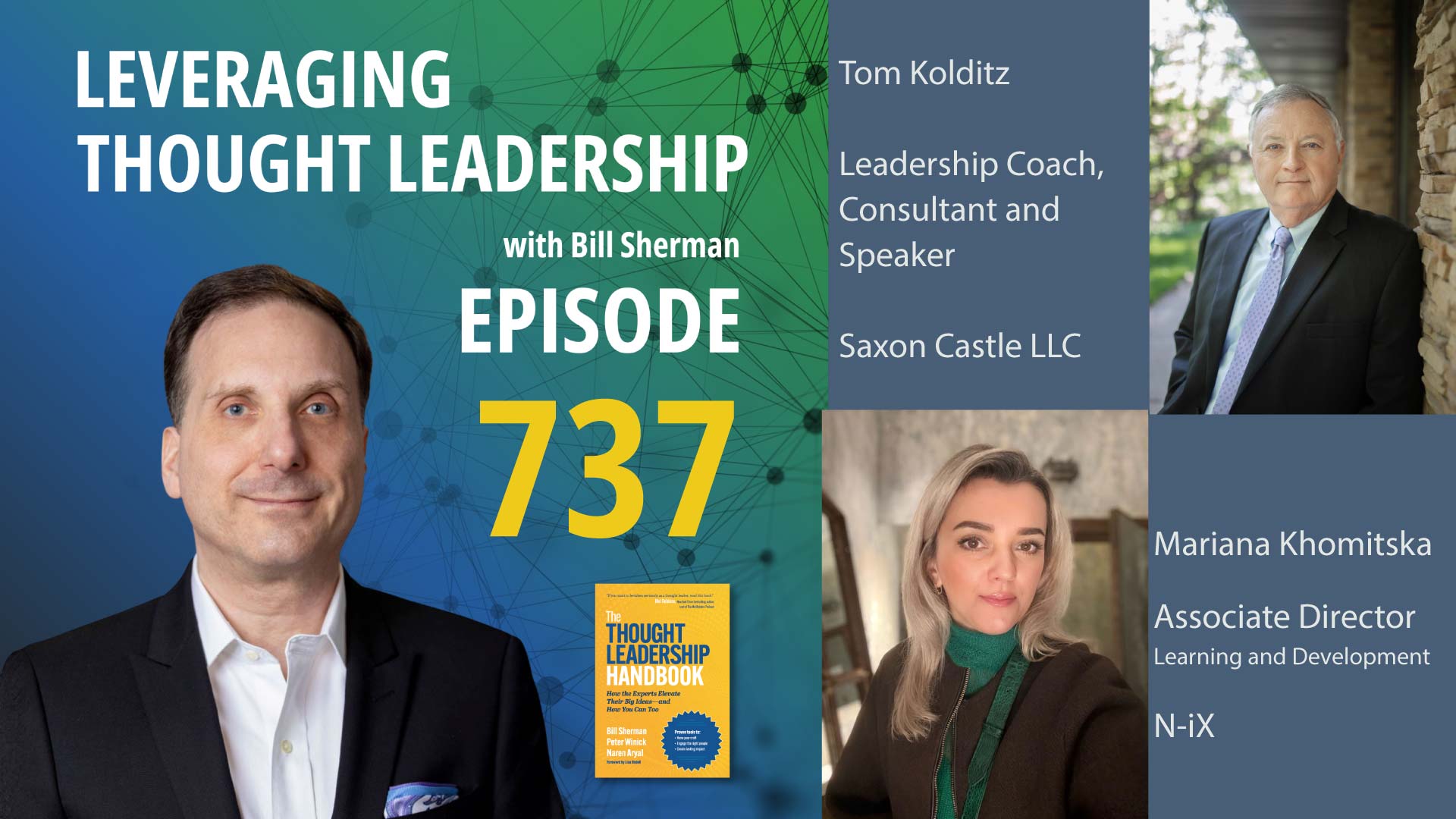
Leading Through Uncertainty: What Crisis Really Reveals | Tom Kolditz & Mariana Khomitska | 737
The Leveraging Thought Leadership podcast is created by Peter Winick and Bill Sherman and produced by Thought Leadership Leverage.
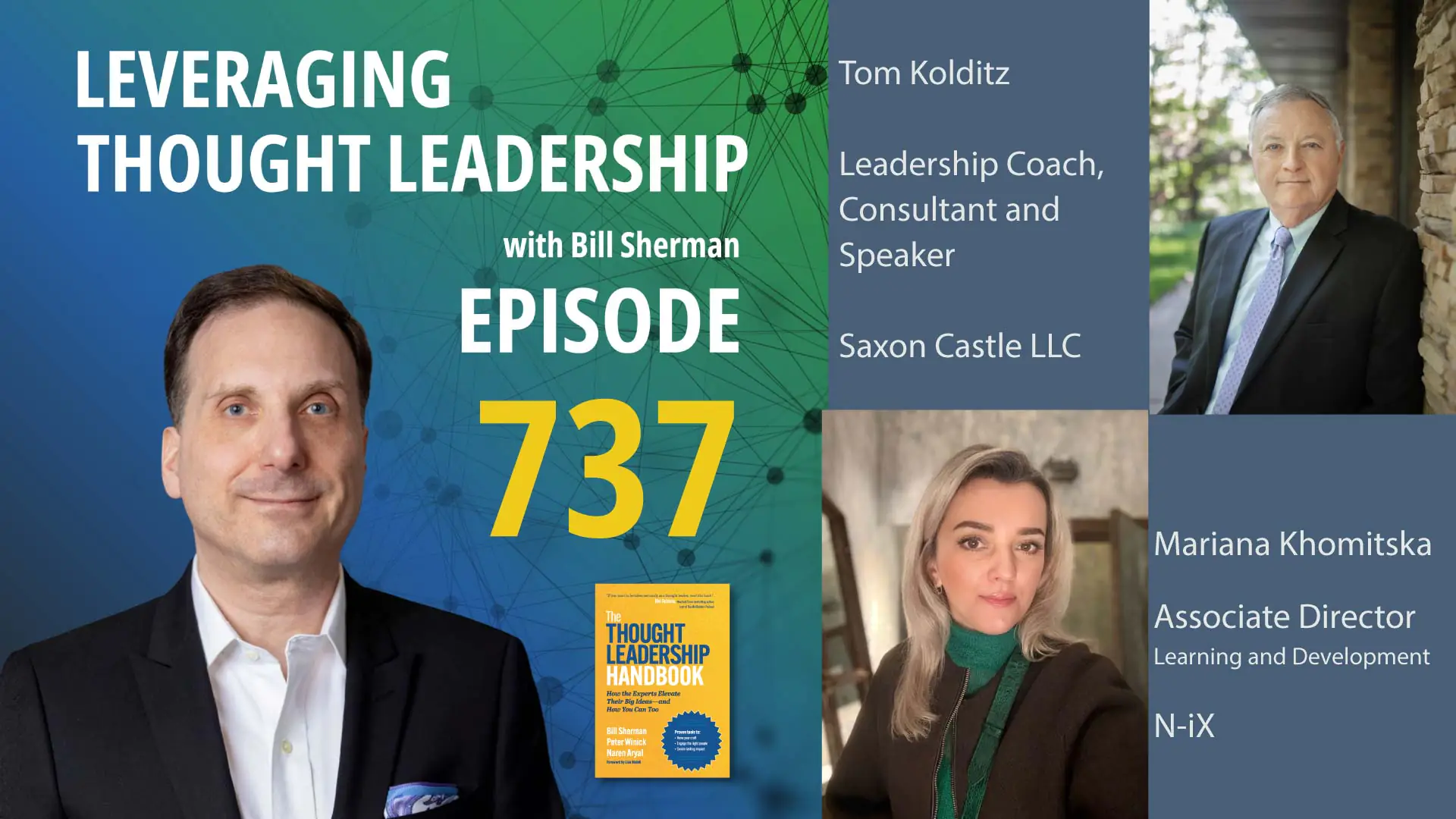



Lessons on trust, crisis, and “who will lead if not me” from Against the Storm
When crisis strips away titles and paychecks, what’s left is authentic leadership. This episode explores why trust must be built before uncertainty hits, how servant leadership emerges under fire, and why “who will lead if not me” becomes the defining question when the world shakes.
What separates a leader from someone who just holds a title?
This episode goes looking for the answer with two people who’ve watched that question get answered under real pressure: retired Brigadier General Tom Kolditz, who spent 40 years building leaders at West Point, Yale, and Rice, and Mariana Khomitska, a Ukrainian leadership development expert who has spent the last several years watching leadership get tested in wartime.
Their new book, Against the Storm: How True Leaders Prevail When the World Shakes, comes out September 15 — and this conversation gets at the “why” behind it. Mariana makes a distinction that reframes the whole discussion: leadership isn’t about the title or the paycheck. It’s what happens when someone can’t stand aside. She shares a striking example from Ukraine’s energy sector, where teams under shelling did “the job for three” — not because they were told to, but because leaders had built enough trust, presence, and transparent communication that people wanted to step up.
Tom brings the counterpart to that: you can’t build trust in the moment a crisis hits. You have to be putting “money in the bank” every single day, long before you need it. That idea — what he calls the time value of leader development — runs through the whole conversation, along with a candid look at how the book’s structure came together: real crisis stories paired with the core leadership techniques Tom has taught for decades.
This isn’t a book only for executives navigating a market downturn. As Mariana puts it, everyone can find something useful here — for their team, their family, their community. It’s a conversation about what authentic leadership actually costs, and why it’s worth paying that cost before you’re forced to.
Three Key Takeaways:
- Trust is “money in the bank” — you can’t build it in a crisis. Tom Kolditz frames leadership preparation like a financial investment: leaders who build trust and communication habits daily are the ones who have something to draw on when uncertainty hits.
- Authentic leadership shows up because it can’t stand aside, not because of a title. Mariana Khomitska argues that crisis strips away the trappings of leadership (status, salary, formal authority) and reveals who leads simply because someone has to.
- Leadership development compounds like an interaction effect. Tom explains that developing leaders in multiple areas — like communication and decision-making — doesn’t just improve each skill in isolation; the skills interact and multiply each other’s impact over time.
This episode isn’t just a conversation about crisis leadership — it’s a live example of thought leadership in action, watching two experts take decades of lived experience and turn it into a book that can scale far beyond their own careers.
If you want the playbook behind that process, pick up The Thought Leadership Handbook: How the Experts Elevate Their Big Ideas—and How You Can Too, written by your hosts Bill Sherman and Peter Winick along with publishing expert Naren Aryal. Drawing on more than 700 conversations just like this one, it breaks down the frameworks experts use to move an idea from personal insight to lasting influence.
You can find it on Amazon, Bookshop.org, Amplify or wherever books are sold.
Get Your Copy:
Amazon
Barnes & Noble
Bookshop.org
Amplify Publishing
Apple Books
Transcript
Bill Sherman The work of thought leadership is to advance the conversation and create impact. When Russia launched its full-scale invasion of Ukraine in 2022, Ukrainians were tested at every level. Ukrainians in both formal and informal leadership roles faced challenges and decisions few of us will ever encounter in our lives. That’s why I was so interested when my friend Tom Kolditz told me he was writing a book with Mariana Khomistka, titled… Against the Storm, How True Leaders Prevail When the World Shakes. Tom Kolditz has led and studied leadership for 40 years as a general officer in the U S army at Yale school of management and at the door Institute for new leaders at Rice university. Tom’s a speaker and author and a coach. He’s also been one of our thought leadership clients, and he’s featured in our book, the thought leadership handbook, Mariana Homytska. Lives in Ukraine where she has practiced organizational development and executive education and leadership development for over two decades, supporting and guiding companies’ leaders through COVID-19, the full-scale invasion of Ukraine, and the energy crisis. Together, Tom and Mariana have co-authored a book that studies leadership in times of extreme uncertainty and crisis, all grounded in the real-world challenges of leaders defending Ukraine against invasion, keeping the lights on, and people safe. Today, we talk with Tom Kolditz and Mariana Homicka about the process of sense-making, pattern recognition, writing collaboration, and storytelling. I’m Bill Sherman. This is Leveraging Thought Leadership. Let’s begin. Tom and Marianna, welcome to the show. Thank you. Thank you Tom, I wanna begin with a question for you. You’ve been in leadership for 40 years at West Point, Yale, and Rice. And when we met, you used a phrase that has stuck with me and inspired me, okay? You said, the world needs more and better leaders. What does that mean to you? And How do you define that?
Tom Kolditz Right? Sure. Well… Leaders have to do with the quality of most people’s lives and they’re not only responsible for the companies that they work for or the governments they work or the military or what have you, but they are also responsible for the quality life of the people that they lead. And so my focus, while I have worked with leaders, my concerns and my, and my contributions are more towards the people being led. If I can improve a leader, if we have better leaders, it’s going to not just affect the hundreds of leaders that we work with, but the thousands or tens of thousands of people that those leaders have working for them. So that’s sort of that background, how I viewed that.
Bill Sherman And that’s something that echoed with me. So the phrase, more and better leaders, as I thought about it, and you advocated for evidence-based as well, and say, hey, let’s not just think about this, but what really works. Let’s measure it. Let’s care about it. Inspired me when I was thinking about thought leadership and said, we need more and Better Thought Leaders. And we need a conversation as to, because I agree with you, if you influence the influencers, you create much more impact, right? Better leaders mean better lives for the people they lead and better thought leaders makes an impact on thought leaders and they influence the leaders because they have the leaders here. So Mariana question for you. If I may, you have been in leadership and organizational development now for near somewhere 15, 20 years, if I understand right. And my question is, how did your perspective on leadership change because you had been leading before war time and then after the russian invasion. You were seeing leadership. I would think through a new lens.
Mariana Khomistka Thank you. Thank you for this good question. I’ve been thinking about that. And you know, the deep crisis, such as war crisis, they really highlight and show what real leadership mean and how real leaders should behave. Quite often we substitute the notions or the words of management and leadership. So people like to be leaders or like to the same as leaders because they like the status. They like, I don’t know, like managing people, setting the direction. But the crisis shows that the real leadership or the authentic leadership is the one, the kind of serving leadership. When you are leading because you cannot, you cannot stand aside and not lead. You’re leading not because of the title, you’re leading like not because of the salary, you’re not leading even not because of business goals. You are leading, because who will lead if not you? And probably during this war time that there were so many situations that have shown this real leaders who led people who stand at the frontline in direct and indirect meaning of this word, who managed the threats of the team, who managed the worries of the teams and teams stayed with the company, teams stayed the with the leader, team didn’t stay with the company, so teams stayed it with the leaders. And that was like even one of the topics of our discussion with Tom about authentic leadership, that the real authentic leadership is a kind of humble leadership, like you are doing it because you cannot stand aside. So that’s probably the main message and the main point which I wanted to highlight.
Bill Sherman So you talk about servant leadership there. You talk about who, if not me, right? And how do I become a better leader? Because I see the need. And this book speaks to crisis. It speaks to leadership in uncertainty, where certainly the era that we’re Living in, globally, it is hard to figure out what’s going on, even when you pick up your phone and say what happened overnight, right? Tom, how, when you approach this book, did it impact you as you were thinking about, because there are plenty of leadership books out there. This one is relevant for this time in this moment? There’s a large amount of literature and I could talk about the OD and leadership literature with both of you and the two of you more in depth than I am. But when you looked and you said, what does the world need to hear now? What does this book need to say? How did you approach that question?
Tom Kolditz Well, you know, I thought there were at least two things that needed to be well put into the book. And the first thing needed to be some examples and some thinking about major uncertainty and major crisis leadership like was ongoing in Ukraine. And that was why I thought it was essential to have Mariana included in this because her chapters, and she wrote, I believe, five chapters, do that. So they would take the reader into an experience that most of them never had before. And it would prepare them for major uncertainty, major crisis. And then the other thing that needed to be in the book is the principle leadership techniques that I’ve taught over the years at Yale Executive Education and in speaking myself after that needed to be aligned with our uncertainty situation. And so I put together 10 chapters that covered really all the important things that I have through the years. And When the book was put together with those two segments, it became something that a, you know, a leader developer in a company could use for 20 days of training. I mean, there’s so much content in it that it’s worth it for them to use. And so that’s kind of how the book got put together, how we thought through what it needed to be.
Bill Sherman And as I looked through, at least on the business literature side, there were things like commanders intent, leaders intent, and really being clear on what the goal is and spending time rather than the directive, I need you to do X, Y, and Z in that order. You framed it as look, reality is going to change tomorrow is going to be different than today. How do you adapt when I’m not around? And that was really one of the things that resonated with me is leading and preparing people to make decisions in the moment, Mariana, I assume have many, many examples and stories. What stood out to you as you were curating those stories? Which ones did you want to tell and how did you pick?
Mariana Khomistka Well, you know, I tried to reflect and there were so many stories and there are stories every day because like what is happening, we are not managing the uncertainty or dealing with uncertainty. We are living in uncertainty. And probably before answering your question, just to add to what Tom has mentioned, I would like to say that what is specific about this book for me that That’s not about like dealing with uncertainty and forgetting and like moving forward. That’s not about managing the uncertainty. That’s about living in the uncertainty because the uncertainty is a new reality that’s permanent or not temporary, but probably our permanent state, unfortunately. So times change. And I’m the one who is witnessing this living in uncertainty, not only like Ukrainian, but also from the business perspective. Managing the team by myself, helping leaders manage their teams by themselves. And like while writing this book, we were trying to include examples, success and fail cases. You know, while working with business leaders, they all the time ask about the cases. They don’t ask about this theory.
Bill Sherman Right. Could you share maybe a story or an example that stood out to you that you said, Okay, this one has to go in.
Mariana Khomistka Yeah, probably one that was the most striking when this huge uncertainty with the war started and we had to work somehow was in the energy sector when I worked at the time. That was the very much executive presence of the top leadership and very much human communication to the employees, which didn’t happen before. It wasn’t like something typical that they had this human and very transparent and open communication on the daily, on a weekly basis. But probably this executive presence, human and transparent communication on the regular basis was something that people needed as a support. And like the understanding, like I can trust this leader. He tells me what’s wrong, what’s right. He tells what are the risks and we are navigating these risks together. And this, that approach gave a very huge engagement and involvement of people around who were eager and able to do extra, to do things which they were not able to before. And also it encouraged a lot of leadership from inside. When I speak about leadership, it doesn’t always mean a formal leadership. It may be informal as well. So what I’m trying to say now, that this leadership behavior, I do believe that the formal leader was an authentic leader and his leadership was true. And that inspired many people not only to stay aside, not to leave the company, not of the country, but also like inspired them to. Probably to be leaders as well and like think like who if not us like we have to do it who if not us and there was like a very good example when they were doing extra they were evacuating thousands of people from Kiev when the war started and they were doing some enormous things which probably when you look back you analyze it’s impossible so under the chalene. In huge uncertainty, the people who were able to work, who had good internet connection and were secure, they were doing the job for three. And that was not, that wouldn’t happen if they didn’t have this example from somebody else and this person to rely on and trust on. So that is why coming back, what is the main and probably idea of this book? That’s about a scientific leadership and how to. To realize if you are a Santic leader or not, like how to move to that state, what does it mean to be a Sactic leadership, to be Santic leaders, and how to, like taking our lessons learned, good and bad, like what is better to do in such conditions? You never know whether it will work in your conditions. So every person is unique, every situation is unique. And unfortunately As many cases we have, usually people make mistakes on their own experience. But still, if you just have some cases, you may remember that case in some time and think like, okay, there is example when it worked, let me try. Or there is an example, it didn’t work, let me not try. So what I’m trying to say, that’s probably coming back to the book and to the case. It was important for me and for Tom to show the examples of the people for whom the leadership was not only the word, it was like the goal and the mindset, yeah? And how they navigate and survive in this uncertain situation.
Bill Sherman Thought leadership doesn’t happen by accident. It takes clarity, consistency, and a path for your ideas to move through the world and create impact. I, Bill Sherman, and my co-authors, Peter Winnick and Naren Ariol, wrote the Thought Leadership Handbook to help you understand that path and choose the right business model and the right frameworks and tools for your thought leadership work. Learn more about this book at ThoughtLeadershipHandbook.com and order today an Amazon, B&N, Bookshop, or Amplify. Mariana, can you talk about that? And one of the things that struck me as I was reading the stories and reading the work that the two of you put together is it’s a very grounded book. Okay. And as a reader, I was humbled in a way that I haven’t felt. And Tom, you talked about leadership and a reference for a leader that they could use for 20 days of teaching, right? What struck me was whatever challenge I’m facing. Oh, sales needs to meet a goal. Or production is having a problem. These examples that you curated, Mariana, really stood out to me and said, if you can lead in these moments, surely I can get through my problem, whatever it is, and reminds me that leadership rises to the occasion on that.
Mariana Khomistka Yeah, that’s, if I may, yeah, that please. Well, no, that exactly that sometimes comes to my mind. And what I hear from many leaders when we have some meetings, gatherings, or just just talk to them. Total uncertainty and the necessity to live in this total uncertainty because there wasn’t definitely we wanted, there wasn t definitely we have chosen for, that gave us even a good lesson, probably like a healthy understanding that if we can survive this, even like we, then all the other problems, this is business, this life, we just have to have a healthy attitude to that. So the most important thing, people stay safe and healthy. Well, you know, definitely the book is not only about war, because there are many, many other things. But what I like about this book, that the book, is not just for business leaders. I guess everyone could find there something useful for himself. Because again, here this leadership in the broad meaning of the word. So you can be this leader for your family. You can be the leader for you neighbors. You can the leader of your community. And like, if we have more such leaders at leadership positions in the business, the teams will be healthier. The companies will be healthy. And probably what Tom has mentioned at the beginning, the influence will be better because people will be focusing on the values.
Bill Sherman Todd, let me circle back to you on that. You’ve. Focused on leadership and improving lives for those who have been led for 40 years. What have you learned and what keeps you going? Because I see this spark that you’re constantly wanting to act, but I see it from the outside. What fuels you on this, on a daily basis, on leadership.
Tom Kolditz Well, you know, there’s a principle that we have in the book that I refer to called the time value of leader development. And we all understand the time, value of money. When you, when you invest it, it grows and grows and grows well, when it comes to leader development, whatever you do for begins to interact. In their personality. So for example, if we develop them in communication and we develop in decision making, they would improve in those two areas. But. There would also be interaction between communicating and decision-making. Right. And in research, that’s called an interaction effect. The whole becomes greater than the sum of its parts. And so I have always felt that it’s important to develop people as leaders, particularly young leaders, because over time, the development that they have will interact and become bigger and better. It’s the compounding effect. Yeah, so I view that as one of the things that motivates me, that drives me, in that successful leader development doesn’t just stop with whatever you did. The other thing that… Drives me and I’ve been working on crisis type leadership circumstances for 25 years maybe. My first book in extremist leadership was in 2007. The leadership you develop on a daily basis has to give you preparation for uncertainty and crisis as it comes. You can’t suddenly try to be a crisis leader or work in uncertainty in some different way. You have to do it beforehand. And I kind of referred to that as money in the bank. You know, as a leader, you have to get money in the bank so that when your leadership is necessary, you’re prepared for it. That means that everyone who’s leading, whether it’s the mother of children or CEOs or senators or what have you, everyone who is leading has to build trust on a daily basis so that it’s there when uncertainty and crisis hits. And that’s something that I learned. Early on and that has continued to drive me over time is that people have to have this preparation have to build this trust and have money in the bank so that when bad things happen they’re ready and that’s me that’s that’s kind of how I’ve approached leadership.
Bill Sherman And that’s a piece that also compounds not only with one leader, but scales over generations. We all remember the people who led us at a hard time or guided us, and they inspire us. Mariana, I wanna ask you the same question. What is it that motivates you to do this work? To not only today, but to have spent as much time in it as you have.
Mariana Khomistka Well, you know, probably it might sound a bit ordinary, but like I like seeing that what I do is helping people a little, what I mean influences them, changes them and transforms them a little. So that is why having been in executive education, management development, or learning and development as a head or director of this stream for many years. I mostly focus on midterm and long-term programs because I do believe that only them can have some transformative effect. So what I mean like I do not believe that having one or two day trainings like will change something. Right. Do believe that a person first should have a need to do it like a request. He or she should want it by himself. Then he or she has to be among the peers, among like-minded people, hearing their experience, their examples, getting motivated and inspired, having good and bad cases, loss and success cases, practicing, trying, being given the feedback and follow-up. How it’s connected with the book. So I do believe that devoting some time to gathering all our experience in the book could be this means which will help people either to realize the need if they don’t realize it yet, that they have to change something or to be this navigator while this transformative journey All to be this. Kind of somebody’s experience because you know sometimes you know that it has to be you do it this way and it works but like when you read the book or when you talk to white-minded people it may give you the confirmation well it works not only for me it works for 10 more people or i don’t know six more people
Bill Sherman Thank you. So, as we wrap up, I want to point readers towards the book, which comes out September 15th, and it’s titled, Against the Storm, How True Leaders Prevail When the World Shakes, by Tom Kalditz and Mariana Chmicka. So, I found the book incredibly powerful, both in terms of the resources and the thoughts on leadership. As well as then the applied stories and examples. Tom, Mariana, thank you for joining us today.
Mariana Khomistka Thank you for inviting thank you. It was a pleasure to talk to you. Thank you
Bill Sherman Wait, before you go, take a minute to think about your own thought leadership. Are you building thought leadership for reach, revenue, legacy, impact? Whatever you answer, thought leadership skills are the way that you reach those goals. And the Thought Leadership Handbook can help you find your path. Visit thoughtleadershiphandbook.com for a free chapter, the thought leadership profile quiz, worksheets. And even more resources to help you move your ideas through the world. Again, go to thoughtleadershiphandbook.com and also order your copy of the book today at Amazon, BNN, Bookshop, and Amplify Publishing. Thanks for listening.
