
Are You Ready to Write a Thought Leadership Book? | Dan Gerstein | 752
The Leveraging Thought Leadership podcast is created by Peter Winick and Bill Sherman and produced by Thought Leadership Leverage.
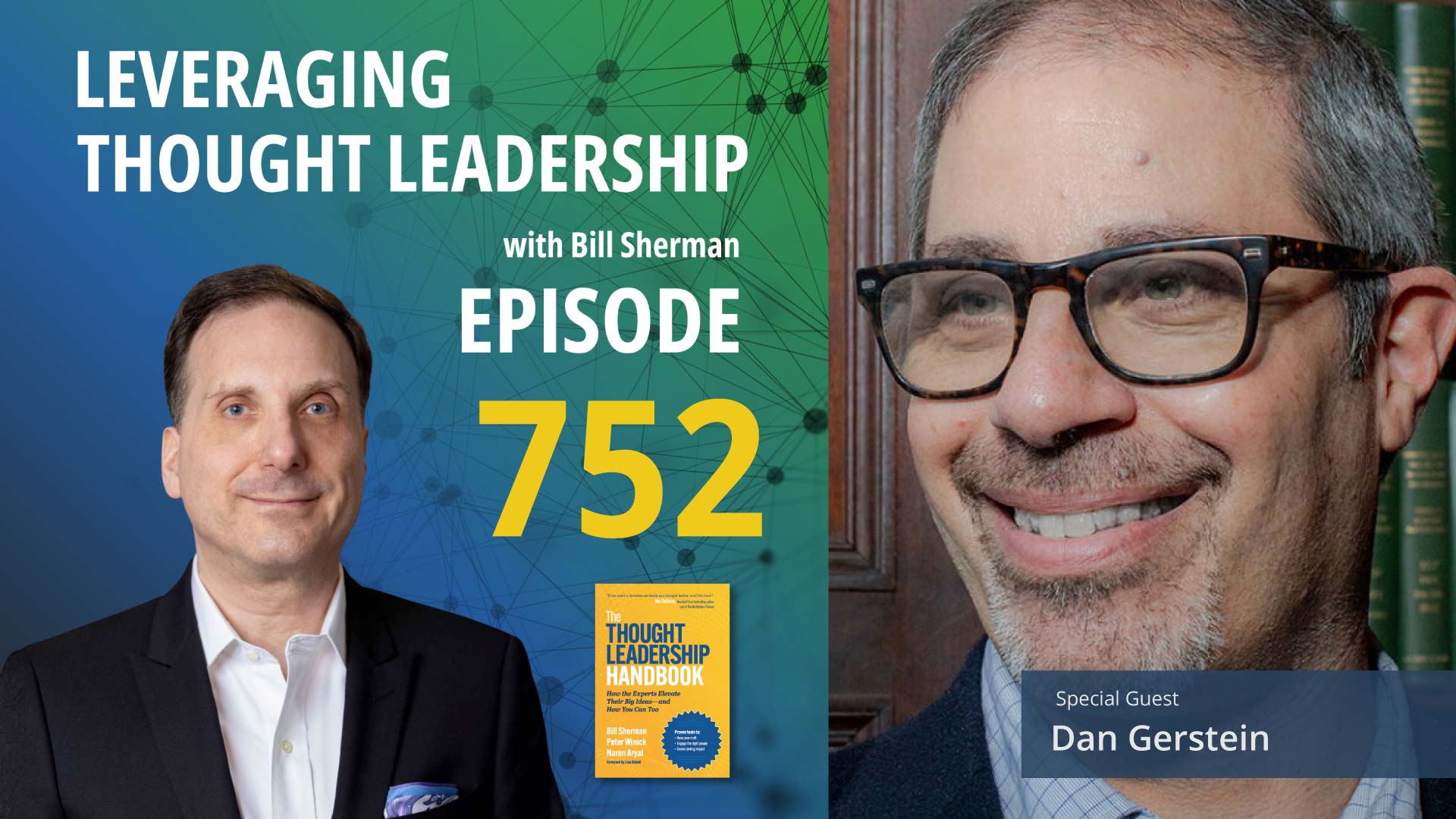



Gotham Ghostwriters CEO Dan Gerstein on timing, testing ideas, and avoiding the half-baked book
Writing a book is easier than ever, and AI has flooded the market with forgettable content. This episode explores how to know when you’re ready to write, why ideas should be tested before going long-form, and why a human thought partner sharpens thinking in ways technology can’t.
Many experts who want to be thought leaders tell themselves the same thing: a book will be good for me. Far fewer stop to ask the harder question: do I have something meaningful to say at book length?
In this episode, Bill Sherman sits down with his friend Dan Gerstein, founder and CEO of Gotham Ghostwriters, for a practical conversation about books, writing, and the work behind real thought leadership. Dan sees aspiring authors at every stage. Some arrive with a clear strategy, some have a rough idea, and some only know that someone told them they should write a book.
Bill and Dan agree that strategy and clear ideas come first, not after launch. Dan explains why he often tells clients to test their ideas in articles, LinkedIn posts, white papers, and podcasts before committing to a book. Bill compares it to off-Broadway: you don’t book a theater for a year before you know the show works. Dan also explains why his agency will sometimes turn down a client’s money, and how that honesty builds the trust a ghostwriting relationship depends on.
Then the conversation turns to AI. Dan has long championed the democratization of publishing. But with AI speeding everything up, the market is flooded with formulaic, generic content. His view: authenticity is table stakes. What sets you apart is being distinctive and delivering real value, and AI, which pulls everything toward the average, works against both. He’s seeing more and more first-time authors arrive with AI-written manuscripts they can’t use. Fixing them takes far more than a light edit.
Both of them argue that the best ghostwriters act as thought partners. They push authors to tell the stories they’ve overlooked, to go deeper, and to show some vulnerability. As Dan puts it, a Fortune 500 CEO already has enough sycophants. The last thing they need is another one telling them every idea is brilliant.
They close by looking ahead. Dan draws on his years as a speechwriter to argue that writing is more than content: it’s a discipline that forces you to make choices, set priorities, and sharpen your thinking. Bill adds his own experience of writing The Thought Leadership Handbook. Writing for readers who couldn’t ask him questions made him sharpen frameworks he had used for more than a decade.
If you’re thinking about a book, or wondering whether one still matters when audiences prefer video, this conversation will help you think it through.
Three Key Takeaways:
- Test before you publish. Short-form content like articles, posts, podcasts, and talks lets you check your ideas and refine your story before you invest the time, emotion, and money a book requires.
- Authentic is table stakes; distinctive and valuable is the goal. AI-generated content pulls everything toward the average. Thought leaders stand out by offering original ideas that deliver real value to an audience.
- You can’t outsource the thinking. A ghostwriter can shape your words and story, but the author still has to be committed, curious, and invested. Projects usually fall apart when they aren’t.
Dan Gerstein’s advice is simple to say and hard to follow: before you write the book, be clear on your ideas, your audience, and your strategy. That’s what The Thought Leadership Handbook is about. It’s a practical guide to finding your path and building the systems that help your ideas move from your head to an audience and create impact. If this conversation left you wondering whether you’re ready to write, or what should come before and after the book, the Handbook gives you the frameworks to work it out. Get The Thought Leadership Handbook by Peter Winick, Bill Sherman, and Naren Aryal at thoughtleadershiphandbook.com, where you’ll also find a free chapter and the Thought Leadership Profile Quiz. Copies are available at Amazon, B&N, Bookshop, and Amplify Publishing.
Visit thoughtleadershiphandbook.com for a free excerpt and to discover your thought leadership avatar. Order your copy today from Amazon, Barnes & Noble, Bookshop, or Amplify Publishing Group.
Get Your Copy:
Amazon
Barnes & Noble
Bookshop.org
Amplify Publishing
Apple Books
Transcript
Bill Sherman Many experts who aspire to thought leadership want to write a book. And as today’s guest explains, these experts tell themselves, a book will be good for me. Yet fewer experts on the verge of thought leadership pause and ask if they have something meaningful to say at book length. Today, I want to have a practical conversation about books, writing, etc. Thought leadership with my friend Dan Gerstein. He’s the founder and CEO of Gotham Ghostwriters. In today’s conversation, we’ll explore the democratization of ideas, how it’s easier than ever to write some form of book and get it out into the world, but it still takes significant work to create a book that’s valuable to your readers. We’ll also explore whether the book will remain relevant. To today’s digital natives who often see video as their preferred platform. And we take a look at the relationship between author and ghostwriter. I’m Bill Sherman. You’re listening to Leveraging Thought Leadership. Let’s begin. Welcome to the show, Dan. Thanks for having me, Bill. So I’m excited for this conversation because we see thought leadership almost every day but through different lenses. And my question for you is when people come looking for ghost writer and not everyone looking for a ghost writer is trying to practice self leadership. Some people want to write a biography in that, but do they know what thought leadership is when they come to you or is it sort of a fuzzy thing?
Dan Gerstein The answer is yes, all of the above. Say more, yeah. There is definitely a universe of our new clients who have really investigated what it means to be a thought leader. Have a plan, right? And the missing pieces, they don’t have the time and or the talent to create the content that they know is necessary to credential themselves as a thought later. And they’re looking for… A well-matched expert writer and thought partner to help them execute on that strategy. Those are the easiest. Is that 10%, is that 50%? I would say it’s less than 50% and more than 10%. It’s a meaningful minority, but it is still the minority, right? And then there’s a second tranche, which they generally have an idea of what thought leadership is. But they don’t necessarily have a fully-baked plan on how to establish themselves, nor do they have a full-bake set of ideas and thoughts that are actionable. That makes it tough. Can be translated into content. And then there’s the third tranche, which is just like someone told them, or they recognize that it will be in their interest to either establish themselves or enhance their credentials as a thought leader. BUT they have no idea where to start. And in some ways, those also are easy clients because we’re in a position because of the unique nature of our agency and our business model to help them on the strategy side, connect them with an elite writing part or thought partner to help then produce the content and then make connections to experts like you and Peter on the strategies side to really hone what they’re doing and do it the right way.
Bill Sherman Yeah, we’ve seen plenty of people who come to us either shortly before the book goes to print, like they’re in final galleys, or it’s 60 to 90 days after the book is out. They’ve gone through launch and they’re like, now, what do I do next? And I think for you and I, the strategy and the clarity of ideas is the first step rather than. You know, something that you baked in post-launch.
Dan Gerstein Oh, a hundred percent. And to be honest with you, there’s a number of our clients where we strongly recommend to them that even before they consider a book that they start road testing their ideas and honing the story they want to tell through other forms or shorter form content, be it, you know, fellowship articles, posts on LinkedIn, white papers or even, you know, going on podcasts.
Bill Sherman Talks in front of groups, etc. It’s the reason why off-Broadway and off-off-Broadway exist. You don’t just open and say, yeah, we booked a theater for a year. We’re going to fill the house every day. No.
Dan Gerstein And to be honest with you, for most thought leaders, I think that is the optimal strategy and approach and will produce the most ROI for them. That said, there are certain thought leaders either established or aspiring who that’s not an option. Right there, for whatever reason, time is of the essence and they want to get a book out fast, in large part, to, in essence, turbocharge. Their status as a thought leader and accelerate the process. And in those cases, more often than not, it’s less important to them to build an audience before they release a book. And more importantly, to use the book as their badge of credibility right up front and then build from there.
Bill Sherman Well, and it’s an interesting question to challenge, right? Because like for Peter and me, we’ve been in the world of thought leadership now 20 years, right. Could we have written a book earlier? 2008, 2010, 2013. Yeah, probably. Would it be this book? Absolutely not. And so that question of when becomes a tough one. In terms of what are your goals? What do you have to say that is actually worth someone’s time on that? And yeah, there are some models in here that we first created in the book back in 2005 and 2013, working with clients. Are they as mature now? Or were they as immature as they are now? No, not in the least, right? So. Let me flip that to you. When’s the right time? How do you know?
Dan Gerstein Again, I think it is case by case, and it’s gonna vary based on what the authors, where they are, their arc or their professional journey and what their goals and priorities are. And then… I think the better question is, you know, establishing those goals and priorities. A hundred percent. And assessing, you now, what are, what’s the right path to get to where you want to go? And then as we’ve discussed before, like having a well thought out strategy that is not cookie cutter, but is tailored to your position in the marketplace, where you are in your professional journey, what assets you have now. What other assets you might need to really capitalize on writing and publish people.
Bill Sherman Well, and I think about it from a goals perspective, I think about it as context perspective as well. And you mentioned some of this. If you don’t feel strong as a writer, writing a book can feel incredibly intimidating, even if you’ve got world-class ideas. Right. We’ve also had people come to us for strategy who say, you know, I have ADHD, I have dyslexia. If you tell me I have to write a book, I’m just gonna feel nauseous. But if you tell my I can make a documentary film or short films, that’s exciting, right? So you have to be aligned, whether it’s the speaker who wants to be home on weekends and figuring out how do I spend more time with the kids, that context. Matters so much when you’re getting into that strategy phase. And then it’s like, okay, then you can ask questions of who you’re trying to reach. How much time are you willing to put into getting this message out there? Because the book on its own just doesn’t, know, land on the right person’s desk and they read it.
Dan Gerstein That’s right. And also, you know, but if you have a half-baked book, not only is that there an opportunity cost to that, it can backfire on you, right? It can degrade your reputation rather than enhance it. And that’s why, you know, again, we’re very, we try to be really upfront and honest brokers with the new clients we’re working with and helping them understand that this is a major investment of time. Emotion and often capital, and therefore, you have to be prepared to have something of value to deliver to an audience before you’re ready to make those investments. And I think, again, one of the most common mistakes we make, someone told me I should write a book, start writing a book and you don’t have something distinctive and value adding to say. And that’s something I think for aspiring ventilators to avoid at all costs.
Bill Sherman Absolutely. And there’s different layers or levels of things to say. There are things that make a good LinkedIn post or a sub stacker, right? There are. Things that make it good chapter or at HBR article or something, but to get to book link and to have something that’s worth reading from beginning to end in an age where a lot of people think tech talk. Is the long form, right? That’s tough. How do you sustain value, whether or not your audience is gonna sit down and read it at one sitting, that they could almost flip it into any page and find something worthwhile?
Dan Gerstein No doubt.
Bill Sherman Yes. So tell me a little bit more, Dan, how do you coach that process when someone has a book aspiration, but not the underlying ideas? How do you deliver that message?
Dan Gerstein Well, it’s more, I think, about convincing them that you’re invested in their success, right? And that, and giving them the best honest advice you can that, you know, if you were going to do this and you’re going to make this an investment, you got to be worth it. Well, we will at times tell clients, we’re not comfortable taking your money because there needs to be some additional work done. We can help you with that work. But if you’re gonna insist on going straight to a book when we don’t think you’re ready, then we’ll say to clients, we’re not. We don’t feel comfortable taking you on as a client. And for the most part, when you are willing to sacrifice a contract to do right by the client, that builds an instant level of trust that you do care about their success. And therefore, opens the door to a kind of more constructive criticism to talk about, okay, so how can you close that gap and do the spade work necessary to then capitalize on a book? We can help you with that. And so again, I think it’s a lot of it is, and you know, as you will know, Bill, when you’re in the ghost writing business, it’s, it is a trust dependent relationship, right? The author, whether, you know, it’s with our agency as. An advisor and a resource in sourcing a partner or working directly with a ghostwriter. You have to have that baseline trust for it to be a successful relationship. And once you have that trust, then it becomes a lot easier to persuade the aspiring thought leader about what’s in their best interest to achieve their goals.
Bill Sherman So here’s a question, you get a number of books that would be classified as business thought leadership or adjacent in professional development on ghost writing. How many of them really turn out to be close to the original idea or concept of the book and how many need significant workshopping or polishing? The end. Discover the ideas along the way and say, that’s the book really.
Dan Gerstein Right? Right! This is a rough estimate. I would say that the clear majority of them fall into the lab category where they where they really do need work and some evolution. And that’s not necessarily a bad thing, right? Because, you know, again, no, not at all. The best book collaborators, the best ghostwriters are ones that function as thought partners and sounding boards for the author and to really help them hone their thinking. And in those cases, the idea, the concept and the narrative arc of the book can evolve over time. And that can be a very healthy process. I would say the authors who fall into that first quarter category, where it’s very close, they tend to have done a lot of the thinking on their own or with their team before they start working with a collaborator. And they come with a clear vision for the book and a clear understanding of what they hope to accomplish from it? And the value proposition behind it to the reader. And in that case, right, the blueprint is there. The ghostwriter may help kind of like, you know, fine tune that blueprint. But the thinking behind the book is sound. And again, for a ghostwriter, you know, those are the not necessarily the most rewarding projects all the time, but they tend to be the easiest to execute. Right. And so we do see that, but I would say that Not the exceptions, but the clear mind.
Bill Sherman What I wind up looking for, both on the strategy side and then when we’re helping people find their core ideas and their platform, I look for the things that give them the spark in the eye. You hear the energy in their voice as they start talking about it. And you realize that, oh, they could talk about this topic for hours and they’re not gonna get tired of it. Because, at least in my mind, One, for writing the book and going through the book journey, you have to be really fired up on the book because your audience is never gonna be more interested than you are. And then when it launches, you’re gonna be talking about those ideas often at that 101 entry level for a number of years. And if you get sick of that and you’re like, no, that’s not my passion, that not my lane, you’re going to hate it.
Dan Gerstein Yeah, I mean, I think about in terms of commitment, right? Yeah. And, you know, the people ask like, well, you know. Do all your projects go to completion, right? And I would say in the overwhelming majority do in large part because we’ve done a lot of work upfront, both in kind of educating the prospective author about what it takes to succeed, helping them find the right writing partner for their needs and priorities, and they’re committed to doing the book. But where the projects tend to fall apart, and this is not universal, but I would say that most of the time is when the author is really not committed and they’re not invested in the project. And again, they’re doing it because someone told them to do it or, you know, they…
Bill Sherman It’ll be good for their career and it’s a career step rather than because they have something they want to share with others.
Dan Gerstein And unfortunately, they, despite our best efforts, they are, they have a misunderstanding of what it will take from them, even if they’re working with a ghost writer, right? There’s only a handful of authors, not a handful, more than a handful. There’s a subset of first-time authors who think, oh, I’m working with the ghost writer. I don’t have to do much. And that is a cardinal error and a comeback to the bite that you know a lot. And again, when projects fall apart, either the author is not fully committed or they fail to appreciate how much work it is even if they’re working with a ghost writer. And either they lose interest, they get frustrated, or they just, you know, can make a determination, oh, this isn’t worth my time. We do our best to avoid those situations, but it’s, you there’s some cases, no matter what you do, you now, I use this phrase in different contexts, but I think it’s particularly out here, is you can lead the thought leader to water where you can’t make them think.
Bill Sherman Yeah, yeah, absolutely. And you can have a ghost writer or someone else as an intellectual sparring partner, that can be a book coach, that could be strategy work, but you can’t outsource the thinking and the curiosity and the desire to be of service and share the idea because For most, the ghost writer can help you shape words, shape the story, but they are not the messenger, right? It’s the difference between a speaking coach and the speaker. Every idea has a journey, but not every expert knows how to move that insight to an audience and create impact. That’s why Peter Winnick, Naren Ariyal, and I wrote The Thought Leadership Handbook. It’s a practical guide for finding your path and building the thought leadership systems that help ideas scale. Learn more at ThoughtLeadershipHandbook.com and order today at Amazon, B&N, BookShop or Amplify.
Dan Gerstein So I have a question for you, Bill. Yeah. You say you’ve been doing this for 20 years, right? So for the thought leader slash aspiring author, what’s the biggest change you’ve seen in that generation of time?
Bill Sherman The obvious ones would be the modality changes, right? So Spiegel’s bureaus were far more prominent in the 2000s. Traditional publishing served much more of a gatekeeping and editorial sort of checklist function, right, that if you got a deal with one of the majors, you probably had been vetted for having something worth saying. Those hurdles have come down and I think that’s a good thing, but just because it’s easier to put content out there and to put ideas out there, AI for example makes it, AI plus social media means you can put it out there. The algorithm may or may not pay any attention to what you’re putting out there so you have to understand how do I reach my audience And I think One of the shifts is a lot of people are now leaning more on technology rather than still understanding thought leadership is about conversation and relationship. So I think the pendulum has swung and I think it needs to come back a little bit to center.
Dan Gerstein I agree 100% and I’m glad you brought up the impact of AI because on the one hand, I’ve been a cheerleader for the democratization of publishing ever since I started off at Microsoft. I like to call it the evolution and what digital platforms and the fall of gatekeepers has meant for the ability of people who may never have had a chance to reach an audience now have that opportunity, and that overall is a good thing.
Bill Sherman And that’s been the trend through human history, right? Where with oral tradition, you had to be there with the speaker who had the story, knew it. Writing, the printing press, all democratizes it in some way. Anyway, go ahead.
Dan Gerstein But now that with not just the rise of self-publishing and social media, but with AI as the turbocharger, right? The consequences of democratization for aspiring thought leaders is, first and foremost, that the marketplace is just flooded with content, and so much of the content, because of the temptation to be able to do it fast and easy with AI, is a formulaic, generic, and of no value to an audience. And that means that there is such a premium on, forget about, I think one of the most overused words in our time is authentic. And that’s not to say you shouldn’t be authentic, but it’s table stakes. It’s not the end goal. You have to both be distinctive and have something that is unique to you to say. But more importantly, you have to have something of value to deliver to an audience. And that’s what the AI can’t do for you, is… Because what the technology is doing right now is it’s regressing everything to the me, right? It’s the most common homogenous and that is working directly against the interests of a thought leader that wants to stand out as someone who has something original and meaningful to them.
Bill Sherman Especially if you’re trying to advance the conversation on a topic or a field or cause people to start a new conversation about something that deserves attention in their field, but no one’s talking about, right? You can’t ask AI to say, what’s the thing that we’re all missing that we should be talking about? At least not yet, right?
Dan Gerstein And so what we’re seeing is, you know, it’s a little bit of a canary in the coal mine about what’s coming is there is now a whole legion of aspiring first time authors in the thought leadership space, who, for different reasons, but are leaning on AI to write their book. It’s cheaper, faster, or whatever, than using a collaborator. And… They’re coming to us in growing numbers, saying, you know, the output I got is not usable. And they’re in various degrees of honesty with themselves about how unusable it is. Some of them are just, oh, it’s not usable!
Bill Sherman Work needs to be done to take it from what AI put out to.
Dan Gerstein A real book. Yeah, and in many cases it takes, again, this is where the honest broker or somewhat tough love conversation has to happen where it is sort of say, well, it’s gonna take a lot or they’re just a little editing. Right, right. And you need to open your eyes to that. It’s not about removing M dashes here. Yes. And so, you know, cause I get the question all the time, is AI gonna replace what we do? And maybe I’m a little Pollyannaish, but I actually think it’s the opposite. I think. The proliferation of AI and therefore the proliferation of slop content is going to make the service we offer and the work our writers can do for the people that much more valuable and in demand.
Bill Sherman And I tend to agree because a lot of what you and your team do and work that we do is really help people understand the connections that are in their head that they’ve seen. Which stories will land and be relevant? How do you take a few stories and weave them into a pattern that others can see and learn from? And really… The craft of storytelling, the craft of separating signal from noise. I haven’t seen AI do that yet, right?
Dan Gerstein Yeah We like to say that the weakness of AI is that technology needs to be prompted. But the reality is for a lot of thought leaders, they’re the ones that need to be prompted to tell stories that they may not think are relevant, to go deeper, to make themselves vulnerable, to engage in a creative dialog that will hone their thinking. And that’s the only way to do that. Is to have a real thought partner, a human thought partner and write a partner who can push you in a way that the technology can’t.
Bill Sherman Absolutely. So when that thought partner sparring partner says, tell me more, right. Cause that’s an interesting story. Or they’re asking and saying, yeah, no. Do you have a better story than that or a better example? They’ll push and challenge where at least in 2026, we still have AI, which will tell you, no, that’s brilliant. Right. And regardless of the level of statement, you know, we have all jumped to standard deviations in IQ points because we now use AI and it tells us we’re brilliant.
Dan Gerstein And to be super blunt, Bill, if you’re a CEO of a, you know, 4-500 company or a major tech startup, you have enough sycophants in your life. The last thing you need to write a great book is another sycophant.
Bill Sherman Mm-hmm that tells you all of your jokes are funny. All your ideas are brilliant. And yes, the world wants to hear them Yeah, those are not true So Dan before we wrap I have a final question for you sure and that’s this Where are we going with thought leadership? And what’s the conversation we need to be having that we’re not among the community of thought leaders?
Dan Gerstein Well, obviously most immediately it’s around what AI can and can’t do for you in terms of furnishing your credentials and building a platform and all things that we like to talk about. I think a part of it is going to be helping the next generation of thought leaders who are not just digital natives but are coming to the public eye with preset idea that attention spans are shorter and video is the best platform for communicating with today’s and understanding. The holistic content ecosystem and the role that writing, not just as a form of content, but a way of disciplining your thinking, right? So like I, my initial training, you know, in my entry into like, you now, being a ghostwriter or writing for someone else was as a speechwriter, right. And one of the first things you learn in the speechwriting process is, and in the Super Bowl of this is the state of the union for the president, right? Right, right. Is when you have to give a speech as a political leader, you are making choices, setting priorities. It’s a disciplining process. It forces you to think about that’s not just the stories you want to tell and the headline you want to get out of it, but the ideas that you want to share and how you’re going to persuade your bottom. And that to me is the thing that I think among the next generation of thought leaders is they’re going to have to be, I think to some degree, educated about that particular value proposition of writing That. You know, doing fireside chats or, you know video, video conversations, misses. And that it has to be part of your toolkit as a thought leader to be producing written content. And particularly, you understand that the book is the most enduring distinctive form of thought leadership content that you can put out there because of its legacy value it creates.
Bill Sherman Absolutely. And I want to touch on two things. When you talk about the next generation of thought leaders, there’s been a culture of pay it forward among speaking communities, among authors, etc. Right? I think we need to figure out from those of us who are ready to pay it for to this generation that’s looking in different modalities and find the way for that bridge. The second thing, to your point on the book, I went into the writing process thinking, okay, I’ve got my frameworks locked. I’ve used them for consulting for years. They’ve been client tested, battle tested, they’re there. But there’s something about when you sit down and you say, I’m creating a book, which is designed to pass on what I know, but by definition will not have me in the room. To explain it? How do I make it accessible? That was tough and forced me to look at frameworks I’d used for a decade or more and still sharpen them. So cool. Dan, thanks for joining us today.
Dan Gerstein This is it. Always good to talk about this stuff with you, Bill.
Bill Sherman Take care. Thanks for listening to Leveraging Thought Leadership. If this conversation sparked a question about your own ideas, where are they going? Who are they for? How can they scale? Then we invite you to visit thoughtleadershiphandbook.com. That’s the book we’ve written. You’ll find resources from the Thought Leadership Handbook, including a free chapter, the Thought leadership profile quiz, and digital tools to help you take the next step. Learn more at ThoughtLeadershipTanbook.com and order your copy of the book today at Amazon, B&N, Bookshop, or Amplify Publishing.
