
The Psychology of Leadership: What Executives Can Learn from Athletes | Sébastien Page | 751
The Leveraging Thought Leadership podcast is created by Peter Winick and Bill Sherman and produced by Thought Leadership Leverage.
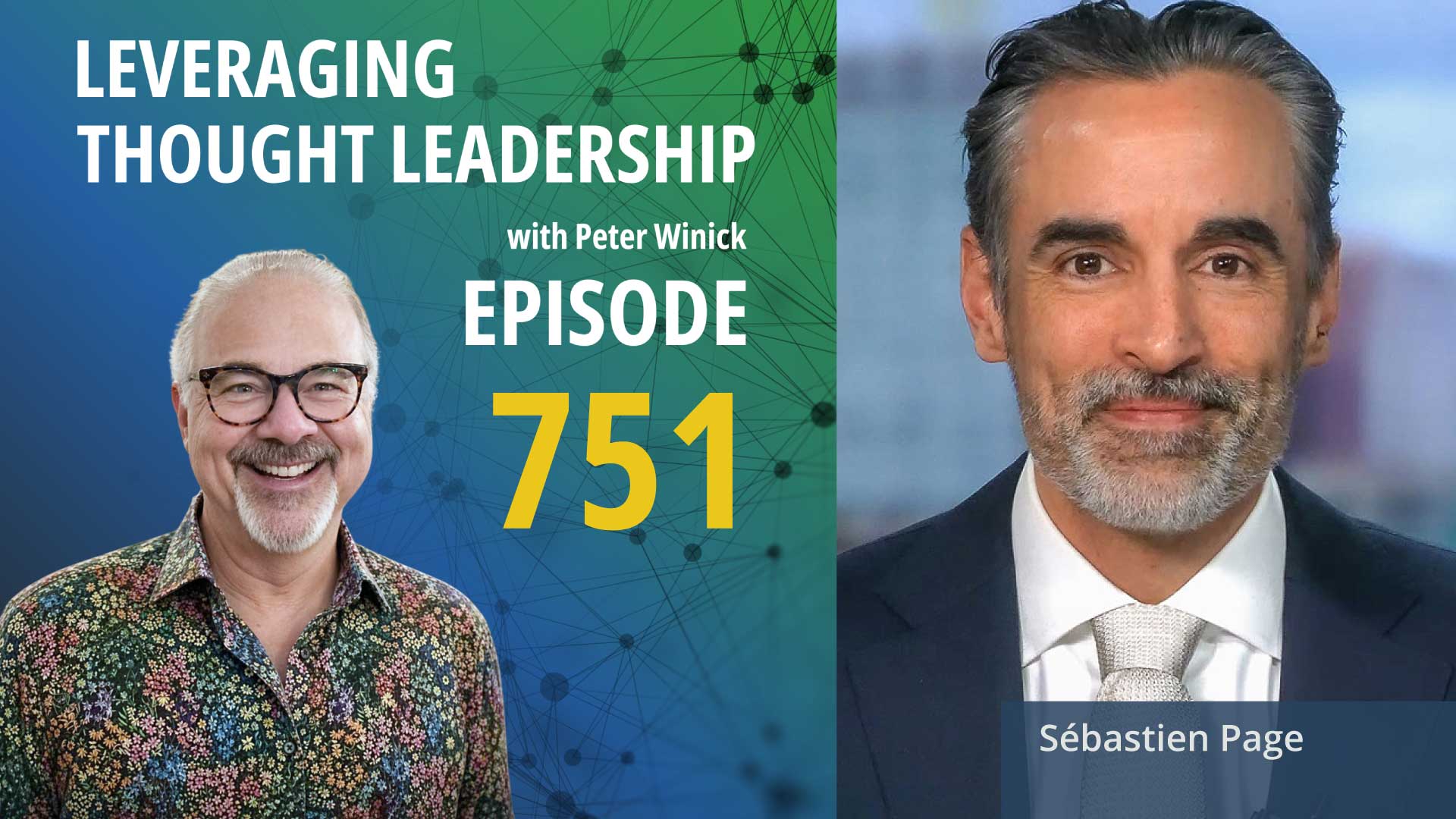



Sébastien Page on balancing branded and personal thought leadership on LinkedIn
What happens when a top investment executive turns a personal passion into published thought leadership? This episode explores how sports and positive psychology sharpen leadership, why authentic content outperforms polished branding, and how executive thought leadership builds client trust and strengthens the employer brand.
What does a man overseeing $1.9 trillion in assets know about stress? More than you’d think, and he’s willing to say so on live national TV.
Sébastien Page is co-head of Global Investments and Chief Investment Officer at T. Rowe Price. He’s also the author of The Psychology of Leadership, one of the top leadership books of 2025. If his title makes that pairing sound unlikely, that’s exactly where this conversation starts.
Early in his career, a mentor told Sébastien to build his “human capital,” because it goes with you even if the job doesn’t. That advice led to research papers and two finance books. Then a promotion and a lot of stress he couldn’t shake took him somewhere unexpected: a sports psychologist’s office. What he found there, and in the wider field of positive psychology, changed how he thinks about leading teams. One reason: athletes get feedback every minute and know how to absorb losses. Most executives get neither.
From there, the conversation turns to the business of executive thought leadership. Sébastien describes how he splits his LinkedIn presence between branded content the firm posts for him and personal, passion-driven posts. He explains why the two work better together than apart. The suit-and-tie CNBC appearances build credibility. The run-and-talk phone videos build connection. Together they make something neither could on its own.
There’s also a story every CMO will recognize. In a room full of blue-chip marketing chiefs, the one question they all wanted answered was: How do I get my executive to do what you’re doing?
Peter pushes hard on the line between content marketing and thought leadership, and why marketers who blur the two ends up faking authenticity. The episode covers a bond manager whose candor about near-zero bond returns earned more client trust, plus a widely mocked CEO burger taste test that shows the opposite.
Sébastien also explains why a book he makes no money from still pays off for his firm: it strengthens T. Rowe Price’s employer brand and its ability to recruit top talent.
If you’re an executive weighing whether to show more of yourself publicly, or the marketer trying to convince one, this conversation offers a clear and commercially grounded case.
Three Key Takeaways:
- Build human capital that travels with you. Thought leadership is a career hedge. When people know what you stand for, and not only where you work, your reputation survives any job change. It also benefits your current employer.
- Authenticity amplifies credibility rather than replacing it. Polished, branded content earns trust. Personal, unscripted content earns connection. Executives who do both get a combined effect neither delivers alone. The biggest risk is blending product messaging into “authentic” content and ending up faking it.
- Non-commercial thought leadership still has commercial value. A leadership book that earns its author nothing directly can strengthen a firm’s employer brand. Top talent notices when senior leaders are given room to explore and publish ideas beyond their day jobs.
Sébastien Page shows that thought leadership works best when ideas are authentic, credible, and built to last. That’s true whether you’re a CIO overseeing $1.9 trillion or an expert with an idea you want the market to take seriously. Turning expertise into influence takes more than good content. It takes a clear strategy for making your ideas visible, trusted, and scalable. That’s the playbook behind The Thought Leadership Handbook, written by Peter Winick, Bill Sherman, and Naren Aryal for experts ready to move from insight to real impact. Learn more at thoughtleadershiphandbook.com, and order your copy today from Amazon, Barnes & Noble, Bookshop, or Amplify.
Get Your Copy of The Thought Leadership Handbook at:
Amazon
Barnes & Noble
Bookshop.org
Amplify Publishing
Apple Books
Transcript
Peter Winick Welcome, welcome, welcome. This is Peter Winick. I’m the founder and CEO at Thought Leadership Leverage and you’re joining us on the podcast today which is Leveraging Thought Leadership. Today my guest is Sébastien Page. So Sébastien is the co-head of Global Investments and Chief Investment Officer at T. Rowe Price where he also co-chairs the Asset Allocation Committee and serves on the Management Committee. He’s been with T.Rowe Price since 2015. He’s received multiple awards and, and this is where it starts to get. More interesting. He’s also the author of a breakout book from 2025 called The Psychology of Leadership. So welcome aboard, Sébastien.
Sébastien Page Peter, I’m really excited. I’ve been looking forward to this. You know, I spent my entire career working on thought leadership Sometimes as part of my day job sometimes beyond my day jobs. So I’ve looking forward this discussion.
Peter Winick Oh, thank you. So yeah, so that’s what I wanted to, where kind of I wanted it to start, because if I were to just describe you, you know, co-head global investments, blah, blah blah, and say, okay, here’s this guy, and he’s got thought leadership. I would never guess what your body of thought leadership is in terms of the psychology of leadership. So talk to me about sort of the, your interest and your use of thought-leadership sort of during your day job, and then obviously sort of more of this passion project that’s leaking over. How has that played for you?
Sébastien Page Early in my career, a mentor sat me down and said, Sébastien, you need to build your human capital. You know why? Because if you lose your job, you’ll still have your human capitol. You can take it with you. This was a great mentor because he also explained to me that it’s good for the company as well. We’re in the thought leadership business and money management. Maybe even more than in other industry. But that advice, Peter, stayed with me through the years. I published articles in journals to share my knowledge. Clients want to know how we’re thinking, how we are managing their money. And I published two finance books. The first one was co-authored. The second one was solo with McGraw-Hill. And then I hit a point where in my life and career, I was much more interested in self-improvement and leadership.
Peter Winick So stay there a minute, because that’s… So everything you’ve said up until then makes a lot of sense, and differentiating yourself vis-a-vis thought leadership, or personal brand, or whatever we’d like to call it, is an interesting career hedge, right? So if something should happen at job X, people would still know you, not just because of where you were, but of what you stood for and what you said, and you’re writing about these things, you’re doing these things et cetera. How do you take the turn, though? So you took an interest into sort of personal leadership, personal development, et cetera? Which makes sense, but it’s not necessarily what one would expect, again, based on your title. So how did you find that passion? And then were there challenges or things you had to deal with inside of the company to convince them that this is good for them, for you, clients, and all the various constituents at T. Rowe Price? Two things.
Sébastien Page I was climbing the ladder, I recently got promoted to co-head of investments. It’s a 1.9 trillion investment platform. And so for me, I wanted to get better at leadership, even more than investing at that point in my career, moving from being a player to being a play or coach to focusing on being a coach. The second thing I was stressed at work Okay. And I was beating myself up about my stress. My self-talk was not good. It was, why are you so stressed? You’ve been doing this for 25 years. You shouldn’t be stressed. And those two layers of stress were helping. I ended up through someone near where I live, getting in touch with a sports psychologist. And there, I discovered sports psychology and more broadly, positive psychology. And because I’m a nerd, you see my background researching, publishing. I kind of got into a nerdy fascination with this field of positive psychology and ended up doing the research and writing about it in my free time. And that’s what eventually became the book because my point is, in business. We completely underestimate the positive side of psychology and all the research that goes behind.
Peter Winick But now it’s a about performance, right? So when you think about, you know. What is at the root of, you know, sports psychology, right. The root of sports psychology is to get people and I’m clearly oversimplifying this, to get out of their heads, form at their optimal level. And we can measure that in real time. Will you run faster, swim faster, jump like all that, which isn’t very different than business, right, so you’re performing 1.9 trillion, you say that as if it’s lunch money, that’s a lot of money with a lot of responsibility. And an increase in performance of, you know, a basis point is a big deal. Right? Yeah. That increase in performances what you’re sort of striving for. So did those two sort of merge together and help you become a better leader and therefore for you and your team and funds to perform better?
Sébastien Page Yes, there are direct links between sports psychology and money management and leadership. You know, we need to learn to lose because in money management, you can’t always get it right. No one knows the future. Athletes are really good at understanding setbacks and losses. That to me might be one of the most important links. I interviewed an Olympic gold medalist. In the sport of aerial skiing, you know when like they jump and they do quadruple flips and triple twists. So I interviewed her two weeks ago on stage and she said, you when I was an Olympian, I would get feedback from my coach every minute of every day on how to get better. And now she’s retired, she’s in business, private equity. She goes, I haven’t received feedback in six months. And she goes, this doesn’t work, I wanna win here too. I need the feedback. So you see the mindset of the athlete is very different from our mindset in business. I think, and I explained this in the book, The Psychology of Leadership, we can bring more of that mindset to business practices.
Peter Winick Love it. So now tell me, because I can imagine there’s two reactions the firm might have to this. Oh, that’s cute, you have this little hobby and this little thing and this little interest and all that. But 1.9 trillion, we need you thinking about that 24 seven. That would be one end of the continuum. To the other being, we trust you, we love you, whatever you’re gonna do is gonna be good for you, good for us. What can we do to support you? Or somewhere in the middle. How did that, how did you land that?
Sébastien Page It was easier for me to make it a personal project, but the firm indirectly, I don’t know what the right word is. It’s probably supported it in the sense that it’s good for our employer brand. Sure. If I go, and this about thought leadership, LinkedIn is an interesting place for thought leadership. If I got on LinkedIn, I share my presence between branded content that the firm posts on my behalf three days a week. And more personal passion content. This is a great ecosystem to intersect your personal thought leadership with your firm, more branded. No, I love that.
Peter Winick So I love that, stay there for a minute, because I would argue that the three days a week they’re posting as what one would expect coming from you. Yeah. Your equivalence at the top 10 other firms. Yeah. That stuff probably doesn’t look incredibly different or radically different. We’re talking about interest rates, we’re talking the market and geopolitics, like the things that one would except. When I’m tuning into a jazz station, I want jazz. So not that yours is better of course, but it meets an expectation. However, I would also argue that Tuesday, Thursday, or the other two days stuff, that’s where people are gonna go, this guy’s really cool, this guy is, wow, that’s kind of interesting. And I can see where it would bleed over because that’s a better worm on the hook to get interest and attraction and attention and people paying attention to you.
Sébastien Page Well, there are two ways to look at it, and I’ll tell you why the firm and I were embracing this together. One way to look it is you see what content performs the best, and it’s clear on social media including on LinkedIn that the more authentic the content, the better it performs. But that’s a simple surface interpretation. My view is that to have slick branded content. Videos of me on CNBC, by the way, you said 1.9 trillion. I was there a couple days ago on CNB and the host, Joe Kernan said, how do you sleep at night over seeing 1.5 trillion? No, about stress. Live national TV. Hey, Sébastien, how did you sleep? But so you have this content that’s buttoned up. I’m wearing a tie, I’m on CN BC, right? And that’s credible. Sure. There’s some magic that happens when you also show your authenticity when I talk about my leadership book or my leadership thinking, that there’s an interaction there. You know, the guy that’s serious and has an important job overseeing teams of investment professional also likes to run, also thinks about leadership that way. Also, I did one, you know, it didn’t perform that well, but that’s, I was just trying. I did the one when I was out running and I pulled out my phone and talked about a few thoughts. So, but it takes, doesn’t it take some.
Peter Winick A different type of courage, not that being on CNBC doesn’t take some courage, but I can imagine, like you’ve developed those capabilities and muscles over the years. It takes a different type of courage and to some degree vulnerability to say, you know, I’m gonna try and experiment and do a videotape while I’m running. Maybe it’s a flop, maybe I look silly, maybe I’m sweat, whatever, but like, it is relatable, because a lot of us are doing things that are like, you know I wish I could. Be sharing other aspects of my life other than what’s expected of me in the confines of the boardroom or the role that I’m in or whatever. So it gives you a little bit of freedom there and a little a bit of wiggle room.
Sébastien Page Yeah, and some leaders want nothing to do with it, but I’ll tell you an anecdote. I was invited to a group of Blue Chip Company’s Chief Marketing Officers, and I was the one business person. It was about 12 Chief Marketing officers. It was organized by LinkedIn. Okay. And it was- Well, let me just-
Peter Winick Let me just give you an opportunity. Some might argue that CMOs are business people, but we’ll take that on the side.
Sébastien Page Yes. Point taken. I stand corrected. By business people, I meant the process of the CMO promoting the thought leadership of whatever the business is, whether it’s engineering or money management. I’m there. They’re talking about how to make this work, how to make LinkedIn perform, make it more authentic. And the one question they all wanted to ask me was. How do I get my executive to do what you’re doing? Because I think a lot of executives aren’t interested in that and I respect that and sometimes I ask myself, well, am I sharing a little too much? There’s some platforms when you get trolling and that’s hard, right? And whether it’s authentic content, branded content, LinkedIn is a good ecosystem because you have people’s faces and names behind what they put on. That you take away the anonymous part, but there’s a real desire from chief marketing officers to make this balance work between personal and professional thought leadership.
Peter Winick If you ever wondered how strong ideas become visible, trusted, and scalable, that’s the work behind the Thought Leadership Handbook. Bill Sherman, Nara Narell and I wrote it for experts who are ready to move from insight to real impact. Learn more at ThoughtLeadershipHandbook.com and order it today at Amazon, B&N, Bookshop, or Amplify. So stay there a minute, because from a CMO’s perspective, there’s a place for content marketing, but content marketing isn’t thought leadership. And I’ve had this discussion, debate, argument, whatever, with many over the years, that content marketing is great, right? Like if I’m selling X and I want to give people. Marketing materials or support or whatever, right? If I’m selling hair gel, I might wanna put out content marketing on how to apply the hair gel to make your hair look better or something. That would just make sense. But that isn’t thought leadership. And I think sometimes CMOs confuse the two, that all content that you put on LinkedIn is the same. But that hair gel example, that’s not thought leadership unless there’s some new chemistry or some new whatever. What you’re talking about in terms of the psychology of leadership. Is thought leadership in that, okay, I wanna be a high performing leader and there’s some psychology I need to understand to do that. And by the way, most of you out there that have been thrust into leadership roles or are new in leadership roles or struggling in leadership rolls, you have the technical acumen, whether that is programming or whatever it is, you are good at what you do. But now you’re changing into a different place where your job really is to make those that work with you and for you perform at their optimal. So you’re almost this sort of coach, this performance coach. So what better way to do that than understanding the psychology? So I think that’s different than content marketing. Do you see people conflated?
Sébastien Page I love that distinction and I agree that a lot of people conflate the two. It’s very different to, I’m going to try to pick on your example, to talk about the features of the hair gel versus to talk to about trends in men’s hair and how they use gel. To me the latter would be, you’re not pushing a product, you are just talking about hairstyles. That would be the thought leadership part. Mean, I don’t know if it’s the best example. I’m just
Peter Winick No, but the feature might be, the feature might be oh, this is a vegan hair gel. Okay, that’s a feature, let’s apply to certain people, whatever, but what are, you know, here’s some different ways to think about hair gel and it also does this, and yeah, so I get that, but I think there’s sometimes marketers are forcing what is in essence a feature of a product to be thought leadership, and the market’s smart.
Sébastien Page Yeah, and that’s a huge risk by the way Peter the biggest risk you take when you try to blend authentic and more branded Or a feature content is that you end up faking? Authenticity
Peter Winick Well, and that, to be honest with you, when you go to a more consumer-based platform, a TikTok, an Instagram, whatever, that’s where the influencers come in. And something bothers me about that term influencer because on the one hand, it’s really honest. Hey, I’m here to influence you to do something, to buy something, to whatever. Does anybody wake up any day and say, I’d like to be influenced to buy a feature, a product, a service, or whatever? It’s almost- Why wouldn’t they call them coercers? Because that’s kind of what they are. And by the way, they don’t necessarily have your best interest at heart because they’re getting paid to sell the new cookie or the new thing or the whatever. Where thought leaders, I think a lot of what drives thought leaders is not that they’re not getting paid and whatever, is the belief in the power of their ideas and their real want to, I would imagine as you went down this road on high performance and psychology, You’re not monetizing that directly, but you have this passion and wanna share it with others because you know it will help them do what they’re doing. Is that?
Sébastien Page Yeah, look, I don’t make money from the book, The Psychology of Leadership. I actually ended up being one of the top 10 leadership books of 2025 when it came out and it’s performing really well. But really, I didn’t make any money from that and you’re a book author, maybe you do and congratulations, you do. But that is thought leadership in the sense of I’m thinking about in a non-commercial way how to help people. Self-improve and become better leaders using positive psychology. It’s not about selling any product or service, but I will say one thing, Peter, that we should not underestimate for large companies. It does help our employer brand. Yes. Large companies want to recruit top talent. If top talent sees that Tiro Price cares, the Tiro price leaders care about these things deeply. Then it enhances, indirectly, the employer brand, which is your ability to recruit the type. Well, hey.
Peter Winick And there’s one thing where a company might have a policy that says, okay, everybody gets three days a year off to do something for the community, Habitat for Humanity, which is lovely, right? And that’s fine, so I’m gonna take off and go work in a soup kitchen today, or do this or do that, whatever. It’s another thing when someone at your level, right, has been given the freedom and the agency and the runway to explore something and publish something and post it, that says like, wow. If they’re letting a guy like Sébastien at that level with that level of responsibility and 10 levels above me do it, wow, that really says something about the firm. And I love that thinking around it’s about talent attraction, it’s the employer brand, it’s all those other things, not just the typical clients and attracting assets under management and all that other things. Because I would imagine the smart talent says, hey, listen, I could work for you or three other firms, but there’s something about the statement that it makes on behalf of T. Rowe Price. That they’re having you out there doing these things that are so far beyond what one might expect, that there’s a second and tertiary benefit there.
Sébastien Page Yes, and there’s an imperative to not really blend the two aspects of this, the commercial, the product, the selling, and the authenticity. And the best example, the hair gel example is a bit stressed for me because I’m not in a consumer goods business, but this is day to day in money management. At my prior employer, one of the top investors would go out in the media and talk to clients and give his real honest view that he thought that bonds, fixed income investments, would generate very low returns because rates were at zero for many years after the financial crisis. So he would go out and say, bonds are gonna generate zero return. Do you know how honest that is when your job is to sell bonds? Yeah, right. And what’s counterintuitive is you build trust. And then clients realize, yes, bonds are going to generate very low returns because rates are at zero. But at least I trust this investor because he’s looking at this from a clinical perspective and maybe they should be managed.
Peter Winick Is very counter also think about that so so if you were to measure the efficacy of something like that. One might say well short term and midterm oh my god that’s a silly strategy because here goes the quote bond salesman saying bonds are a crappy investment but the realities if you if you brought in that lens and say well what does that mean for us over five years that you were into long term relationships here you know what the fact he was truthful at that moment in time because now it’s a different moment in with different variables and different… Circumstances that when he talks, I’m going to listen because he speaks the truth even if it’s not self-serving
Sébastien Page Peter, there was a big one recently where that fails. And it kind of went away, and we’re not talking about it, but as recently as three, four months ago, the McDonald’s CEO.
Peter Winick Oh, when he almost choked on the Burt radio, he almost vomited.
Sébastien Page Yeah. They launched a new burger and they tried to make it this authenticity thing. I’m going to taste it then, but clearly he’s uncomfortable. And maybe there’s something in the body language is just such a small bite that it kind of looks like he’s not the, he looks very fit. He looks very fed too. Doesn’t sound like he calls it a product, not a burger. This, I’m gonna try this product and the bite, it just feels like he is not excited to taste the burger. So that that’s very dangerous and it becomes funny because then the competitors jump in and I think it was Burger King they had like there’s that there’s
Peter Winick But if you think about that versus Howard Schultz back in the day in the early Starbucks days where he created this third space and he had a vision of taking the ultimate commodity, the blue and white cup of coffee that was 50 cents on every street corner and every bad deli to this micro-luxury that we can enjoy the aromas and the flavors, whatever, you would never see him sip a cup of coffee in a cringe-worthy like. You know, oh my God, what is he doing? But there were a lot of lessons in the McDonald’s piece where, right, calling it a product. Do most people go into McDonald’s thinking I’m buying product? No, you’re buying product, but you’re like, now I’m grabbing a meal for the kids or a lunch, or this is an unhealthy treat, but I understand it’s an unhealthy tree, or I’m an unhealthy person, whatever. But nobody, it was so clinical, and so if you were to look to say, hey, give me the average Joe eating a Big Mac, that would be the last guy on the line. And they, and by the way, I think to your point was, Everybody saw through that like, oh my god, it was comical the way he handled it. It was almost like somebody excised a kidney and said, hold this kidney, please.
Sébastien Page I know, and to make it even a bit meta, right now we’re having a conversation, you and me. Yes. We’re not, I didn’t write a script. You didn’t ride a script and we’re flowing back and forth, right? And I think that makes, if I say so myself, I’m your guest, your, our audience will judge, but I think it makes for a better podcast.
Peter Winick You know, I love that you said that because I go out as do you and am a guest on many podcasts and I turn down the ones where, you know, it’s gotta meet my criteria and certain market and whatever. But then they’ll say, well, here’s the format here. These are the five questions they’re gonna ask in this order, can you answer them by email in advance? And I’m like, no, cause I wouldn’t wanna listen to that. I wouldn’t wanna be a part of that. Like, why would I do that? If you can’t engage and have an actual, hopefully interesting conversation. What’s the point now it doesn’t mean you might say hey at the end of every show we ask every guest what blah blah blah okay that’s cute that’s fine but for it to be so scripted that could be an email exchange right that could be a bad i know yeah anyway
Sébastien Page You and I are on the same page, but I’ll reveal something to you and to our audience. There is something that I do. I have a lot of stories in the book, The Psychology of Leadership. It’s a storytelling book in a way. I have sheet of paper in front of me when I do podcasts. I didn’t use it today because we’re having a real conversation. But I have small words, little notes to remind me of the different stories that I like to tell. And if something comes up and I look down on my sheet, and I remember that specific story that I like to tell, and it’s like a menu of stories that I have in front of me. So I’m cheating a little bit.
Peter Winick I’ll give you my cheat sheet. So this has been new for me, not podcasting, I’ve been doing that for a long time, but we just launched our book in July. So I’ve on the other side of the microphone a lot. And I’m like, oh, okay. So now I’ve got a seed control and whatever. So I got my little cheat sheet of different things in the book that I, and I never quote from it or anything, but I’m just like, oh yeah, it just jogs the mind to say, oh, this is a good story and this is one, or just keep this framework together or whatever. So I have my little cheatsheet. Quite frankly, 90% of the time, I don’t use it, but maybe it’s a security blanket or a little bit of a reminder or whatever, but this has been amazing. I appreciate your time, Sébastien. I will give you your time back to go back and manage $1.9 trillion. That might be a world record on the show. Hopefully, by the end of the show, it’s two trillion. When is it gonna get to two trillion? When are we rounding up? We’re getting there, Ricky.
Sébastien Page I gotta go back and make the doughnuts.
Peter Winick We’re gonna go make the doughnut. But I appreciate your time, and I love your transparency and sharing your journey as a thought leader with us. I wish you the best.
Peter Winick Likewise, thank you.
Peter Winick To learn more about Thought Leadership Leverage, please visit our website at ThoughtLeadershipLeverage.com. To reach me directly, feel free to email me at peter at ThoughtLeadershipLeverage.com, and please subscribe to Leveraging Thought Leadership on iTunes or your favorite podcast app to get your weekly episode automatically.
