
The Seven Trust Languages: Building Trust Through Communication | Minda Harts | 749
The Leveraging Thought Leadership podcast is created by Peter Winick and Bill Sherman and produced by Thought Leadership Leverage.
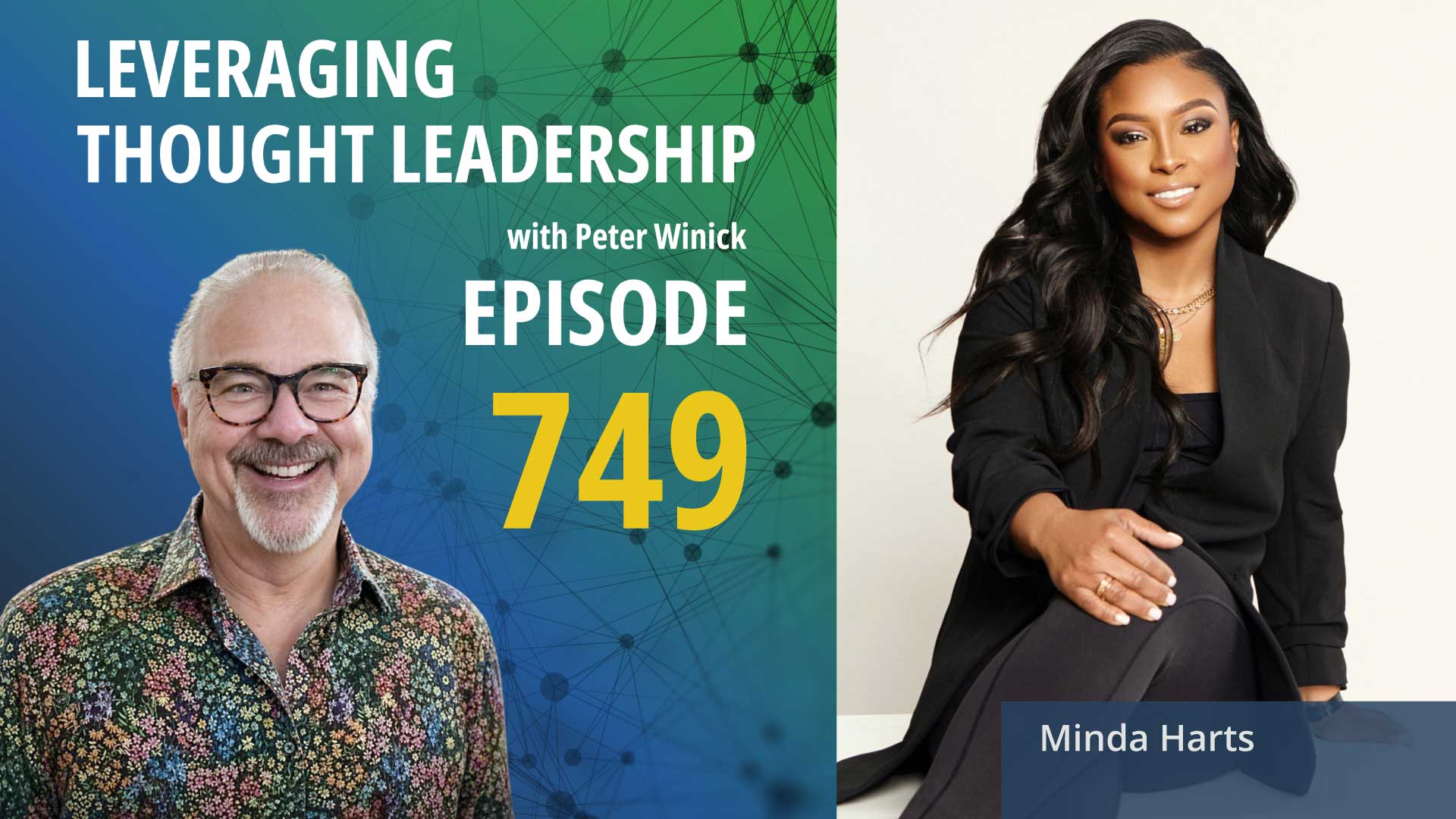



Minda Harts on why every email, comment, and silence shapes workplace trust
Trust is one of business’s most crowded ideas. This episode reframes it as a communication problem, exploring how tone, AI-drafted emails, and silence erode it, and how a trust framework grew from a newsletter into a licensed, scalable business. The lesson: codify your IP so it travels without you.
Trust is one of the most crowded ideas in business. Everyone agrees it matters, and plenty of thought leaders have planted a flag in it. So, what does it take to say something new about it, and then build a real business on top of that idea?
Minda Harts found her angle by asking a different question. Instead of treating trust as a value or a culture initiative, she looks at it through the lens of communication. Every email, every comment, every silence after a reorg either builds trust or erodes it. Most of the damage isn’t intentional. It’s the curt reply sent between flights, or the promotion decision nobody explains. Her Seven Trust Languages framework gives leaders a practical vocabulary for getting those moments right.
Peter and Minda dig into one of the timeliest pressure points: AI. When both sides of an email exchange are letting a chatbot draft the reply, the information may get sharper while the warmth disappears entirely. Minda’s advice is simple and pointed. Use the tools, but don’t outsource your humanity.
Then the conversation turns to the business side, which is where this episode really earns its keep. Minda’s work started as a newsletter she wrote while still in a nine-to-five job. It grew into career boot camps across New York City, then four books, then a consultancy, and now an interactive experience called the Trust Catalyst. Peter calls it the classic path of the accidental thought leader, and he presses on the moment that matters most: when an organization stops nodding along and actually writes a check.
The most useful part for anyone building a thought leadership practice is how Minda is scaling beyond herself. Through train-the-trainer programs, licensing, and a growing group of trust ambassadors, her IP now shows up in onboarding, feedback training, and multi-year client partnerships without her in the room for every session. She’s candid about the emotional side of that shift, too. Letting clients buy everything but you is harder than it sounds.
If you’ve built a framework and wondered how to move from being the only delivery vehicle to being one premium option among many, this episode gives you a clear look at how one thought leader is making that move in real time.
Three Key Takeaways:
- Trust is built or broken in communication. Tone, word choice, and silence during moments like layoffs or promotions either enhance or erode trust, usually without anyone intending harm.
- Asking “what did you mean?” beats writing your own worst-case narrative. Use AI, but don’t outsource your humanity. AI-drafted emails can be smarter and still feel empty. Before hitting send, check whether it sounds like you and how you’d feel receiving it.
- License your IP so it scales without you. Train-the-trainer programs, licensing, and trust ambassadors let a framework live across the employee lifecycle, while premium pricing reserves the founder for high-stakes moments like kickoffs and executive work.
Minda Harts turned a newsletter into the Seven Trust Languages, then into books, a consultancy, and licensed IP that now works without her in every room. That path from insight to framework to scalable business is exactly what The Thought Leadership Handbook was written to map. Built on the same kind of frameworks Peter and Minda discussed in this episode, it shows experts how to make their ideas visible, trusted, and scalable, and how to stop being the only way clients can access their work. Pick up The Thought Leadership Handbook: How the Experts Elevate Their Big Ideas, and How You Can Too by Peter Winick, Bill Sherman, and Naren Aryal at Amazon, Barnes & Noble, Bookshop, or Amplify Publishing, and learn more at thoughtleadershiphandbook.com.
Get Your Copy of The Thought Leadership Handbook at:
Amazon
Barnes & Noble
Bookshop.org
Amplify Publishing
Apple Books
Transcript
Peter Winick And welcome, welcome, welcome. This is Peter Winnick. I’m the founder and CEO at Thought Leadership Leverage, and you’re joining us on the podcast today, which is Leveraging Thought Leadership. Today, my guest is Minda Harts. And before the keynotes, the frameworks in the books, this work started with a simple newsletter. She was writing about something she was experiencing and what so many others were navigating at work, that moments don’t always make it into the performance reviews, these moments or leadership conversations, the miscommunications, the hesitations, the things left of set. This is sort of the back story to how she got into this work on trust and she’s developed this methodology called the seven trust languages, which came from years of listening, observing and asking. So without further ado, let’s let’s do this. How are you today?
Minda Harts I’m doing good. Thanks for having me, Peter.
Peter Winick So we talked a couple of weeks ago preparing for this, and I said, oh, OK, well, here we go again with trust, right? So trust is never going to go out of style, one would imagine. Like, great, we could live in a no-trust environment. But I think as a thought leader, to throw your hat in the trust ring is interesting, courageous, et cetera. So tell me how that came to be, and obviously what’s different about your mass trap, if you will.
Minda Harts Yeah, you know, I was a little apprehensive to throw myself into the trust arena, because I’m like, you know, I didn’t coin trust and I definitely didn’t like put my my fork in the ground at the moment. But I thought, how can we talk about it in a way where it hits everybody? And to your point, I’ve spoken at countless companies. And the one thing that everybody has in common is they know what it feels like when trust is present and they know what it feels like when it’s gone. But when I started to ask the questions, I realized that trust was really tied to communication. And so that was like the leverage that I had to offer a little bit different perspective to the trust, you know, zeitgeist and understanding that, you know, if the way that we talk to each other, we’re never going to get to a trustworthy environment. If we’re always like punching down and we see that online and in the workplace, not intentionally, right? But the way we talk to people and communicate.
Peter Winick So stay there a minute because you’re so your your approach is to look at trust through the lens of communication, right? Yes. And I would argue or ask that in every communication you have, whether it’s face to face or whether it there it’s an email or a comment that you leave on a LinkedIn, whatever, there’s the potential to increase the amount of trust someone has with you, or in some instances, either wipe it away or decrease it. Say more about that through the lens of Communication, because that’s obviously an interesting take.
Minda Harts Yeah, well, so the way that I see it is we have all these choices in our workday and in our regular lives. But we’re either what our behaviors, our tone, our actions, our words are either going to enhance trust with someone or erode trust. And so I realize that many of us enter our day not saying who can I erode, trust with today, but some do.
Peter Winick Some do.
Minda Harts We’re gonna we’re gonna pray for them Peter, but you know, but it happens right the email that you send off really quick And not really thinking about what that other person might be feeling when they read it or how we make decisions on who gets promoted and who doesn’t and then somebody who’s been there for 15 years or a layoff or a reorg right that we say nothing when it happens and everybody’s like Sitting wondering when the next shoe is about to drop and so I thought okay communication. That’s something that’s happening in Tokyo, it’s something that’s happened in North Dakota, but we need to do a better job of how we communicate with each other. So I wanna.
Peter Winick I want to double click on the tone thing, right? Because you and I are having a conversation now, and we’re recording it on Zoom, so I could see that you’re smiling, you appear to be engaged. We’re having a nice conversation. If you were pouting or sad or distracted or started thinking at your iPhone, I’m like, oh, we’re actually not having a great conversation or maybe I did something to bot, whatever, right, like my head would start going elsewhere. But tone is one of those things that until you, like I know there’s people I’ve worked with for years and I can tell from a certain email, oh okay. All right, they’re in a hurry and they just got off a plane and don’t take that personally. They’re saving thumb prints or whatever by typing that quickly. But if you don’t know somebody and you receive something and you’re not sure, the tone is a big deal, right? It’s like, uh-oh, why was that so short? Why was that curve? Why was it so snarky or wasn’t, I didn’t get the warm, fuzzy, smiley face I got on the last time. Talk a little bit about tongue, because I think a lot of it’s unintentional, like when we push tone out in nonverbal communication.
Minda Harts Absolutely, and I think it’s getting even more lost in translation when we’re using, like, AI to help us write our emails or draft up our talking points. So I think the one thing I would say is let’s not outsource our humanity, right? Let’s not assume that somebody is out to get me. During my day to your point everybody’s had a busy day we don’t know what just happened right before they hit send so instead of me assuming what that meant what what it looked like for me to actually pick up the phone or say hey can we have a quick chat because i want to understand what you meant when you said x y and z because listen yeah if you let me create the narrative peter i’m going full blown like game of thrones they’re out to you know take my throne But if I call you and find out what’s going on, then that may keep trust intact, right?
Peter Winick So you said something that was, you said a couple things that were interesting, but I wanna focus on one. So everybody’s in this phase now where they’re trying to figure out how to best use AI. There isn’t anybody that doubted, they’d say, I’ve been doing this for 10 years, so these are the best practice. Like, we’re all figuring out, like, do I use it to polish an email? Do I use to, like? And that’s all fine. And I think that’s good, and I think that’s healthy. One of the things that I’ve noticed is some emails that I get from folks, they’re more informative, intelligent, analytical Whatever so I could tell that they’ve their AI bots have done a lot of homework on me because there’s no way that they you know that they did that on their own right, but it lacks tone and emotion and warmth and maybe you can train your AI and do it so I look at and go okay all that’s true that’s really insightful it’s really cool they probably didn’t do anything other than ask an AI bot to say before I send an email to Peter tell me what you know whatever so tone doesn’t only have a negative potential negative. But it could be like just neutral, like, wait, there’s no love in that email. There’s no warmth. There’s nothing that gets me to say like, I know from our first conversation, like there’s an energy that you put out. I like it, right? Like, it’s like, this is cool. If you were using AI to increase the communication you have with people, but taking that away somehow, I’d go hmmm. Does that sound like something she’d like to touch on that? Am I not sir? That might be.
Minda Harts No, no, you are and I talk a lot about this at companies like all of us are pretty much trying to stream light our day Right. So yeah, I get an email from you Peter I put it in my box my chat box and I say hey Respond to Peter in a nice tone in my voice, right? And I barely read it when it spits it out and then I send it to you and you might do the same thing Right. And so now we’re going back and forth and we never really read that Wow Peter is a best-selling author we just know what it said and we shot it out right or That chat bot wasn’t in the meeting so they don’t know the nuance behind what happened in the background only my perspective of what I told them so what would it look like to say you know what before I send this off let me scan it. Does it sound like me right if I were reading it how would I feel on the other end of it and I think we’re just moving so fast Peter that we have to slow down okay slow down it’s okay to use it right but don’t outsource the humanity let your. Tone like you, like who you are shine through, make a couple tweaks, right? Make it,
Peter Winick that dopamine hit that we have to, ooh, it can automate that and something else can respond to my, I can get through a hundred emails quicker than that. Yeah, you can, but at what cost? If you ever wondered how strong ideas become visible, trusted, and scalable, that’s the work behind the Thought Leadership Handbook. Bill Sherman, Narin Ariel, and I wrote it for experts who are ready to move from insight to real impact. Learn more at thoughtleadershiphandbook.com and order it today at Amazon, BNN, Bookshop, or Amplify. I wanna pivot a little bit and talk about the business side of this, right? So we’ve got a thread of thought leadership, you have a different perspective, you’re making your way in the marketplace. Tell me about the business and the journey that that’s taken you and where it will be taking you, where you hope it will take you.
Minda Harts Yeah, that’s a great question. I well, I will be honest, when I first started that blog, Peter, I wasn’t thinking about a business, right? I was in my nine to five job. And I was just like, this is just, you know, this cool. I’m helping people who might feel similarly as me. And then once I realized that I was gaining mass opportunities with different people inside their inbox to help solve a problem that they hadn’t been able to articulate, then I was able to say, Oh, actually, I’m on to something. And so the newsletters created what I would call career boot camps throughout New York City. And I would host these, these sessions of how do you negotiate your salary? How do you advocate? And so I would then start to slowly see the business build. And then the business took on books, right? And I’ve been able to write four, four books. And so that was another stream of income and business. And then, the consultancy and realizing, Oh, you know what? I can really help leaders communicate better so that we don’t. Lose our really great staff and we have retention and we have productivity and I realized.
Peter Winick And I realized that along the way, market validation, because this is sort of the path of the accidental thought leader, right? Hey, put this out, because I was trying to solve a problem that I’ve got, right, so then I decide, let’s be generous and share it. And a bunch of people raised their hand and said, hallelujah, I get you, I have this thing too. But then the next wave is, okay, I could get you and I could dig it, am I willing to, and when I say I may be the organization, write a check against this? And allocate time, energy, and resources of my people to learn these capabilities so that they can perform better. That’s a whole different hurdle. And you’ve passed that hurdle, right? So now it’s like, OK, where do you see the business going or where would you like it to go in the next, I don’t know, year two, three?
Minda Harts Yeah well one of the things we talked about in our call was that I created this game called the trust catalyst out of the seven trust languages so that was another extension and so now I’m working with global companies around how we make sure that we are communicating effectively with from top down bottom up you know and so using these frameworks to really dig deep So for example, feedback, working with. First time managers, how do you give and receive feedback? And so now I have this IP and now I can train the trainer and now, I can license my trust catalyst game. So it really opened up again, all planting that seed, Peter, with a blog. And then now, I have a lot of different products in the chamber.
Peter Winick The stay with the framework is where big framework wonks right in fact our book is a handbook which is built on frameworks. One of the beauties about a framework and i love to hear your thoughts on this so you got the seven trust language framework so you could take one piece of it feedback or whatever and say what does that mean in a customer facing situation oh here’s a version for hospitality right what does it mean. Internally peer-to-peer okay, I can create some work around that. What does it mean? What is a feedback loop mean like when I need to give negative feedback or difficult feedback or whatever up sideways down? So it really helps you by adding these constraints and then it’s kind of a Rubik’s Cube, right? Right start to move it around. Is that how you’ve been experimenting once you knew you had the solid framework?
Minda Harts Absolutely. And I make the joke when I’m doing workshops, Peter, that you’re going to be bilingual in the seven trust languages. But let’s start with the first one, right? So when I am working with sales teams, one of the things that they really value is one of these trust languages called transparency. So how am I transparent with my customer in a way that builds trust, right. And so we talk about some of those things and then maybe what that customer needs not only. Transparency, but they also need follow through, which is another trust language. Right. And so now we’re compounding the frameworks and we see that now we are trilingual or we’re, you know what I mean, bilingual and they work together.
Peter Winick And what I like is the transparency. You’re not saying, OK, every salesperson, here’s the three things to achieve optimal transparency. They have to have agency. So transparency is relative. So depending on the situation, I could be on the sales side and be totally transparent with the client. Say, listen, we don’t make any margin on this thing that I’m saying, let me show you. This is all we got. I’ve got nothing to give you. Where in other instances, if it’s a new relationship that you’re selling into, you might not open the kimono and go there, right? You might be- You know, so, but I think that what I love, part of what I learned about your framework is, it says, you know what, Mr. And Mrs. Salesperson, you’re smart, you the situation better than I do. Let’s play with that transparency dial a little bit, and you’ll decide your Goldilocks there, right, which is cool.
Minda Harts You you named it and that’s the thing right how do how do i provide you with some clarity and some honesty so that you keep trusting me right but i don’t have to show you all under the hood for everything because that’s not going to that’s going to enhance the trust that’s going to make you even more anxious if i show you everything
Peter Winick Well, that’s that’s the the over sharing thing, right? So you don’t want to be the salesman that says to the client and if I don’t close this deal My boss is gonna be happy in my boat like blah blah blah. It’s like, okay, you give me a headache That’s too much. Like you got to give me the right amount. So I love that So where else do you see the business going is is it and and where I’m going with this Maybe is there’s lots of things that you do to deliver the work and now you’re moving into Things that you don’t do meaning you personally don’t do where you’ve got these tools. You got the gamification you have scalable, solid solutions. My guess would be you’re doubling down there, not saying Minda wants to add 30 things a day to her calendar, because that’s how we’re going to go with it.
Minda Harts No, and I think part of growing the business is the train, the trainer and licensing. So maybe I’m not the one that does the trust language facilitation. It’s but I have all these trust ambassadors, right? I have these trust officers that are going across the country and leveraging that. And so that’s my hope, Peter, is that we get in that I am a go to source and product for professional development inside every workplace. Because trust trust is agnostic or industry agnostics.
Peter Winick Yeah. And part of your role, I imagine, is not just to continue to create and polish and refine the intellectual property and the thought leadership, but to be a lead generation tool, right? They fall in love with you, whether it’s on a podcast or speaking or whatever. But the answer to everything after that isn’t and then you will come in and do X because there’s only so many there’s only one of you, right. So. Right. Very, very cool. Now, how have you dealt with so a lot of clients when they get to that phase, it’s careful what you wish for. It’s like, Yeah, I don’t want this to be about me. Then they’re like, Oh, my God, my clients are buying everything but me. Like, Oh. You know, am I less important? How have you sort of processed that or dealt with that?
Minda Harts You know, I’m starting to process that now, Peter, because I’m like, wait a second. But I actually like coming there and doing the thing. But I also know that I don’t want it to just be a one off, because I think that’s sometimes where businesses fall short is when they can one and done right. But I actual want this to be part of your onboarding process. I want this to be party or exit interview, you know, I want it to be part of the whole employee cycle and journey. And I can’t be there for every bit, you No celebration or no.
Peter Winick Stay there a minute so you can’t be there you could be wherever you wanted to go right so you have to use price as to some degree discriminatory piece to say hey there’s a manager sitting somewhere today in a company that you worked with a year ago that could use your help for a conversation they’re going to have in an hour okay that doesn’t make any sense they’re not going to pay you the big bucks now if there is a ceo that has an issue with their board that might be a case where pays to have you on retainer and say This is high stakes. This is big stuff. I want to go to the creator of this. So I think price becomes a way to say, okay, is this high value high stakes? Maybe it is worth bringing me in or a big thing. Is that part of the business side of this?
Minda Harts That that is part of the business side. And right now I’m able to take on the bigger clients or the ones that allow me to have, for example, I have one client and we have a three year partnership. I come to the big kickoffs. I have, you know, start the conversation, but I also now have other. Associates on their team that i’ve trained that are part of their department where they can funnel it out and that’s something that they’ve licensed from me and so i think that i would encourage a lot of you know entrepreneurs or thought leaders to think about their ip and license it because that’s a a great sometimes passive and active stream of income right and so um but the expectation.
Peter Winick But the expectations are set. So this is a long-term client. And you mapped out the three-year journey and say, here’s the x number of events per year that are high stakes, high visibility, whatever. That makes sense to have me in there. And that’s going to impact the pricing. And here’s a whole bunch of other stuff where the ideal solution is not me. Because it’s easy as a thought leader to say, well, the answer to every question is, well, and I will, right? And I think you have to change your impulses.
Minda Harts But I think that came with time, Peter, right? You start to learn.
Peter Winick Time and the confidence that you’ve codified the methodology and frameworks in such a way that make you less relevant, right? That you’re just one delivery vehicle at one price point, not the delivery. Not the delivery vehicle. Well, it’s been a lot of fun, I love this. You and I could spend hours on this stuff because it’s just, I don’t know, maybe we’re both wonks or whatever, but it’s a lot fun. I think we are. Yeah. Yeah, yeah, exactly. So there’s been a lot of fun. I appreciate your sharing your story and your energy and thank you for spending some time with me today.
Minda Harts Well, thank you for having me. Thank you for trusting me.
Peter Winick Thank you
Peter Winick To learn more about Thought Leadership Leverage, please visit our website at ThoughtLeadershipLeverage.com. To reach me directly, feel free to email me at peter at ThoughtLeadershipLeverage.com, and please subscribe to Leveraging Thought Leadership on iTunes or your favorite podcast app to get your weekly episode automatically.
