
Why Our Brains Chase Novelty and How to Push Back | Eric Athas | 748
The Leveraging Thought Leadership podcast is created by Peter Winick and Bill Sherman and produced by Thought Leadership Leverage.
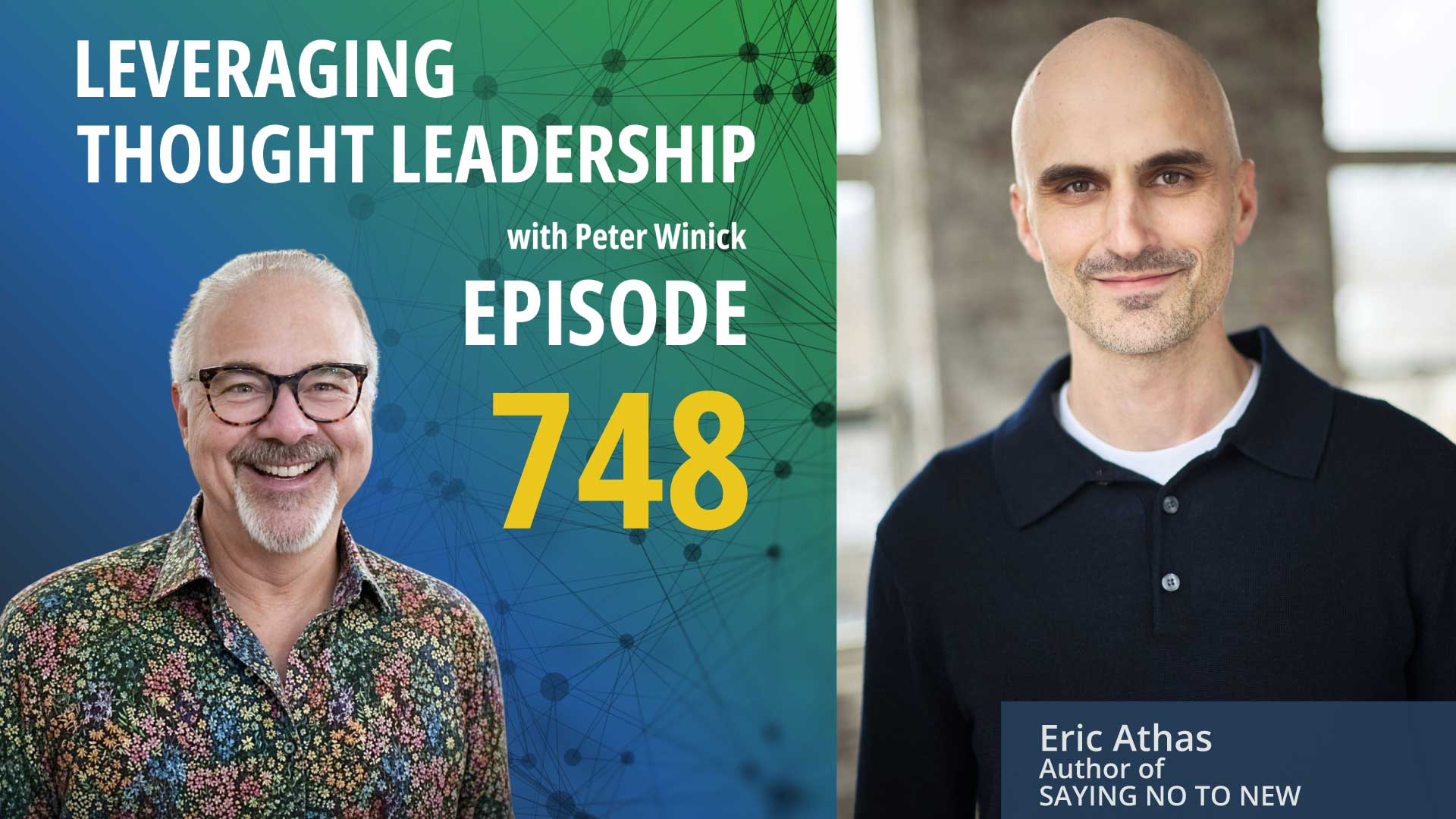



NYT editor Eric Athas on reclaiming time, money, and attention from the next new thing
Our brains are wired to chase novelty, and today’s world makes saying yes instantaneous. This episode explores why new things hijack our time, money, and attention, how to write ideas that won’t expire, and why building a decision process before adopting anything new is the real advantage.
Eric Athas used to be the guy waiting outside the Apple Store on release day. Then he wrote a book telling the rest of us to slow down.
Eric is an editor at The New York Times and the author of Saying No to New: Why New Things Are Stealing Your Time, Money, and Happiness and How to Take Back Your Life. In this conversation, Peter Winick and Eric get into a problem every thought leader recognizes: the constant pull of the next platform, the next tool, the next big thing.
That pull isn’t a character flaw. It’s biology. Our brains evolved to notice what’s different, and that instinct helped us survive and innovate. But in an environment where anything new can land on your doorstep in a day, the same wiring becomes a liability. Eric’s answer is deceptively simple: have a process. Just pausing to ask whether something is useful starts to short-circuit systems designed to keep us acquiring. Peter connects this directly to how he advises authors and speakers who ask about every new platform: start with strategy, decide how to experiment, and be clear about what you’re willing to give up.
The second half turns to the craft and business of ideas. How does a journalist used to filing stories in an hour or two commit to a book? And how do you write about novelty without your examples going stale before publication? Eric’s iPhone anecdote was outdated by launch day. The phone now folds. His solution was to anchor the book in repeatable practices rather than specific products, and to imagine a future reader picking it up years from now. Peter shares his own two-bucket test for any body of work: what is principle-based and evergreen, and what makes it relevant to this particular moment.
They close on the shift from writing a book, with one clear objective, to launching one, with a thousand. Peter even offers a positioning idea for a book about newness that Eric seems ready to adopt.
If you’re building a body of work that needs to outlast the current news cycle, or you’re tired of chasing every shiny object in your market, this episode offers a practical lens on both.
Three Key Takeaways:
- Novelty bias is wired in, not a willpower problem. Our brains evolved to prioritize anything new, which once aided survival and innovation. Today, instant access to endless new products and tools turns that instinct into a drain on time, money, and focus.
- A process is the antidote. Simply having a deliberate step before adopting something new, asking whether it’s useful and what it will cost you, disrupts the systems built to keep you buying. For thought leaders, that means tying every new platform or tool back to strategy and naming what you’ll give up to try it.
- Build ideas on principles, not products. Writing about a fast-moving topic means accepting that your examples will date quickly. Anchoring the work in repeatable frameworks, and imagining a future reader, keeps a book relevant long after the latest gadget or chatbot has been replaced.
Eric’s challenge was building ideas on principles that last, not on whatever is new this quarter. That same discipline sits at the core of The Thought Leadership Handbook, written by Peter Winick, Bill Sherman, and Narin Aryal. Where this episode shows why evergreen ideas matter, the handbook shows how to shape, package, and scale your expertise so it keeps creating value in a crowded market. Learn more at thoughtleadershiphandbook.com, and order your copy today at Amazon, Barnes & Noble, Bookshop, or Amplify.
Get Your Copy of The Thought Leadership Handbook at:
Amazon
Barnes & Noble
Bookshop.org
Amplify Publishing
Apple Books
Transcript
Peter Winick Welcome, welcome, welcome. This is Peter Winick. I’m the founder and CEO at Thought Leadership Leverage and you’re joining us on the podcast which is Leveraging Thought Leadership. Today my guest is Eric Athas. He’s a journalist. He’s been at NPR for a long time and the last 15 years he’s been at the New York Times. He’s got a new book out which says, say no to new but not to the new book obviously but why new things are stealing your time, money and happiness and how to take back your life which is Kind of a pretty cool title, and we’re exempting your book from the Say No to New because your publisher wouldn’t like that, but welcome aboard, Eric, how are you?
Eric Athas Well, Peter, thanks. It’s great to be here. And I appreciate you not saying no to my book. That’s one thing I want to say.
Peter Winick Right. You don’t say no to say no, to everything new, but my book. So I’ll buy into that. So we were talking, getting ready for this. And you gave me a little bit of the backstory, which I thought was really cool. So you’re not a lot. I, you know, believe in electricity and the engine, all that kind of stuff. So how did this come to be? And what is this phenomena of? I guess the inverse is saying yes to everything, which I feel that I get sucked into as well.
Eric Athas Yeah, we all do. And, and in fact, I’m not a lot, I, and I would even say that for most of my life, I’ve been an early adopter and I’ve been proud to call myself an early adopter. I usually was the person first in line to get the new thing. Sometimes literally I would go to the Apple store on release day. This is like my thing. Like I would be out there waiting in line. I had to have it first. I loved all the gizmos and, and to some extent I still like some new things and I still find technology interesting. And I still buy new stuff, but to your point, we are programmed, our brains are programmed to, to gravitate to new things, to pay attention to new things and to ignore old things. And today we’re just surrounded by novelty, novelty in terms of new products to buy in terms technology to use, and also not just physical goods, but, but digital experiences. And so it’s just very easy to get. Out into this trap where you’re constantly chasing new thing after new thing, not really stopping to think is this actually useful as a serving some kind of purpose.
Peter Winick So at some level, it’s a biology chemistry problem, right? So if you were hunting antelope and every day it looked the same, but today it looked a little different. Oh, that’s new. I should focus my attention on that because that’s a survival piece. And then you add the dopamine hit like new feels good. Not that we don’t have any control over it because we certainly do because we’re kind of what but we are kind of wired for it, right.
Eric Athas Yeah, exactly. Just describes the evolutionary driving force behind this and for most of our existence, like you said, that’s been very useful. It’s useful to pay attention to new information. That’s both for our survival, but also so that we can innovate and we can invent new things. And we are where we are today because we have had this focus on, oh, what’s the next new thing? How can we continue to evolve and innovate?
Peter Winick So I find, and I’d love to riff on this with you a little bit, in my work with all sorts of authors and thought leaders and keynoters and stuff, they also like to be on the cutting edge, like we all do. They like to on the, all the new stuff. And they’ll come to me all the time and say, what do you think about, you know, dot dot dot, right? And it could be a new platform. It could be an, a new tool. I mean, there’s like new tool, if you were to spend all day keeping track of the new digital tools coming out, we’d have nothing else to do. And I always sort of slow them down and say, okay, if it’s a new platform, let’s talk about our marketing strategy. How does this fit? Is this your market? Is this, okay. And then let’s not turn everything else off, but how might we experiment? And what are we willing to give up in order to do that? And that, to me, is just being a consultant. But when I was diving into your work, similar thinking of like, okay, well, if your instincts are say yes to everything, you still only have 24 hours in the day. Is this a better mousetrap? Is this is a different mousetrap? What is it gonna? Where’s it going to get you? So how do you force yourself to sort of go through that process before just hitting the buy now button?
Eric Athas Right. In some ways, just having a process is the solution. It’s so easy to acquire new things today without thinking. And that’s one of the things that’s changed in our environment. Yes, there are lots more new things than there were, let’s say, when our, you know, ancient ancestors were roaming the land, but also they’re so easy to get, you can get them instantaneously. And so what that means is that we can consume new things, buy new things, start using new things. Without really ever stopping to think about, is this going to be helpful? Is this the right one? So having what you just described, having some kind of thought process into why you’re going to adopt something or start using something is one of the big first steps that you would wanna take. And then of course it’s then there’s the decision process and actually digging into it. But just doing that on its own, is starting to short circuit some of these systems set up that are trying to drive us to just keep acquiring new things without really thinking too much about it.
Peter Winick Very cool. So I want to pivot for a little bit and talk about part of your life, part of portfolio is being a thought leader, right? So you’re a journalist first and foremost at the Times, right? So that’s like one of the world’s coolest jobs, world according to me, right. But then this idea came to you and I’m sure you weren’t sitting around going, wow, I need another five hours a day to fill about my life or I don’t want to. Do anything other than do this on the nights and weekends. So how did you really decide to go in on this idea or what is your process, right? Because there’s lots of things that I’m sure you’re curious about or would find interesting or whatever, but you’ve got a pretty busy day job, if you will.
Eric Athas Yeah. And by the way, I have a wife. I have two young kids. Yeah. I didn’t have a lot of extra time to fill. I wasn’t just filling my time, you’re exactly right. But I’ve always wanted to, one of the things I love about journalism, just at its core is, and by the, I learned about you, Peter, as you’re a long time New York Times subscriber, so that’s very cool. But one of things I loved about journalism at its core is a reporter goes out into the field. And they witness something or they talk to someone and they gather up the facts. That knowledge of what is happening around the world. And that can take a lot of different forms. It can literally be something that happened in Brooklyn or something, or it’s what did this scientist learn from this experiment that they did? What is this business? This, this organization, this company doing that’s really interesting that others could learn from. Journalists go, they gather that up. And then they bring it back and they share it out to the world in a way that makes it much more easy for you, the reader, the listener, the watcher, the audience to learn about the world and learn how the world works. And so that’s sort of journalism boiled down to its core and doing that in a way in which, you know, where the facts really and the truth kind of shine through. And so that’s what I love about journalism. And what I found is I was. Starting to shift my perspective on new things in my own life. And I personally became curious about, well, why do we gravitate to new things? What is it about them that really draws us in? And why is it so easy to be hooked on the next new thing? And so that’s, I was driven by my own curiosity and my own problems that I wanted to solve. And that’s really what motivated me to go out and not just write this book, But… Go out and talk to close to 100 people.
Peter Winick So you’re trying to answer a question that you had, or dive deeper into something that you’re curious about. If it was about something else that you aren’t interested in, you might say, well, that’s an assignment. I got to do it, and I’ll be done with it in three days, and I will do a good job and move on. But something about this was like, yeah, why is this a thing? Is this a me thing? Or what’s the impact on other teams, on other individuals, on other families, on other organizations? So that’s pretty cool. So you took your. Obviously your journalistic skills and said, okay, now we’re gonna do this at 60,000 words or whatever the book landed, right? Which is a whole different thing and a different timing and a difference cadence and all that. Great idea is only the beginning. In the thought leadership handbook, Bill Sherman, now and Ariel and I share what it takes to shape, package and scale your expertise in a crowded market. It’s available now. Learn more at thought leadership hand book.com and order it today at Amazon, BnN bookshop or amplify Talk a little bit about the difference in creating sort of traditional short form journalism and committing to a book, which is a much longer-term commit in terms of authorship and writing.
Eric Athas Yeah, well, first off is just the time scale of it all. A news story can be written within an hour or two, but also the content of the book I had to be really conscious of. I’m writing a book about newness and novelty, right? But I’m write it for like two years from now. So how do I do this in a way where I’m written about new-ness? But not outdated myself instantly because this because whatever I’m thinking right now will no
Peter Winick Let me interrupt you there because this is a big problem that thought leaders have. So when I’m looking at somebody’s body of work that’s a thought leader, I look at it and I’m trying to sort of categorize it into two buckets. Okay, what in this body of works, whether that’s an article, a book, a Ted talk, or whatever, will be true regardless of who’s in the White House, what did the stock market do today, are we gonna, like what is evergreen around these things, right? What is principle-based and evergreen? And I’m like, okay, there’s some evergreen stuff here that we’re not just trying to catch a wave or it’s Monday morning quarterbacking or whatever. And then the second thing I do is, okay. Well, what makes this more or less relevant given what’s going on in the zeitgeist of the universe today, right? So it could be, hey, in Q1 and Q2 of 2020 early COVID, people were really interested in work from home. Why? Because most people hadn’t done it that much before. So this was a problem that needed to be solved. Prior to that, it was a thing, but it was lowercase thing. So how do you, sounds like you’re wrestling with that as well, like how am I gonna write this book that’s gonna be evergreen, but if the things that you were talking about when the book started, were three versions later into Chad and the iPhone foldable is now out, it wasn’t out, like, so what was your sort of process? Okay, I won’t touch on that specifically, but I can touch on it in a principle-based way.
Eric Athas It was one of the big challenges of writing the book. And there was one truth that I knew would remain, no matter what I was writing about, which is that there’s always going to be new. New is always going to be something that shapes our lives. And you mentioned the iPhone, it’s a great example. In the book, I go and I go to the Apple flagship store on Fifth Avenue. This is a couple of years ago now at this point, it was maybe the iPhone 15 or something. And I just talked to people online, I knew when I was using that as an anecdote, that by the time this book came out, there would be some new-fangled iPhone and here we are, now it folds. So what I tried to do is base all of the ideas, all of the concepts into sort of repeatable practices that you could apply to whatever the new-fangled thing is. AI was a great example, when I got the idea for the book, that was around the time when Chat GPT was first launched. And so the world has changed so much since then. So it was really all about, okay, how could I apply this framework? How can I apply these lessons? No matter what the next new thing is, and there will always be the next thing. Thing. And so that’s how I was able to do that. And also to make sure I was avoiding using specific examples as sort of the central driving force behind this. In other words, if I tried to explain what you should do about XYZ chatbot that just got released, I would be dating myself because I could write because somebody.
Peter Winick Right, because somebody already figured that’s no longer a problem that we’re thinking about. It’s hard to solve a problem. That they don’t specifically have yet, right? So that’s really the. Yeah, you almost have to imagine. But what was that? That might be a better place for an article that, you know, you’re going to write in the in the science section of the Times on a Tuesday, because the expectation is that only has to be relevant for a moment and a brief moment in time.
Eric Athas That’s right. Yeah, you can you know Humans have this great Incredible ability where we can imagine Ourselves our future self we can do that. I can try to and it’s not I’m not saying we can predict what’s gonna happen But while I was writing this book, I was trying to imagine myself in some future state reading this and Assuming much has changed in the world because of course it will this still be useful will this to be relevant? So that’s it you can take and you can apply that very simple practice to a lot of different assignments you’re trying to complete or anything you’re trying to do to try to not date yourself in your work.
Peter Winick Love it, love it. So any other thoughts or reflections you’ve had now that you’re on the other side of it? Because now, and this is where my author friends will probably agree, now the hard part begins, right? Writing a book is easy, and writing a book is not easy, but relative to the next phase is you’ve launched the book, you’re launching the book. That’s a whole different universe and world and skill set and all that. How does that part of this process feel for you and what are you doing differently than you thought you might be doing?
Eric Athas Well, one of the biggest differences that I found is when I was writing the book, I had the singular objective, which of course is writing a book. It was very difficult objective, but it was one objective, right? The book, right. Well, now there are like a thousand different objectives. You know, I have to, you know, think about what, what will the life of this book be like over the next years? And part of that for me. Because this is a book about new things, part of that is trying to imagine, okay, when is the next new thing coming and how can this book potentially help people as they’re wrestling with that next new think it happens to be at the moment, there is this new iPhone that’s coming out, but there are, that’s it, that sort of the easiest example, the cleanest example, but
Peter Winick But that’s the soup du jour, right? Like that’s what that is.
Eric Athas But there are exactly, there are constantly new things that we’re wrestling with that we don’t even necessarily think about. And so the idea is this book can help people, I’m trying to think of ways in which this book can help as they wrestle with the daily onslaught of new things in their lives, at home, at work, wherever it might be, the small new things that they’re looking at on Amazon, but also the big sweeping new things such as AI and what that means for our lives. So I think. In the same way that it’s a challenge to write a book about new things, given the time scale, I’ve also thought of it at this point as an advantage because we’re all gonna continue to be, this is not gonna change. In fact, it’s only gonna get faster and more powerful.
Peter Winick Maybe from a marketing standpoint, you shouldn’t market the book as a new thing but a future classic, maybe that would be a way to play the game here future classic. I like it. Yeah, it’s good There we go. This has been fun. I appreciate your time and your thoughtfulness and learning a bit from you today. Thanks, Eric.
Peter Winick To learn more about Thought Leadership Leverage, please visit our website at ThoughtLeadershipLeverage.com. To reach me directly, feel free to email me at peter at ThoughtLeadershipLeverage.com, and please subscribe to Leveraging Thought Leadership on iTunes or your favorite podcast app to get your weekly episode automatically.
