
Why Your Best Leadership Work Is Still Ahead | Doug Conant | 747
The Leveraging Thought Leadership podcast is created by Peter Winick and Bill Sherman and produced by Thought Leadership Leverage.
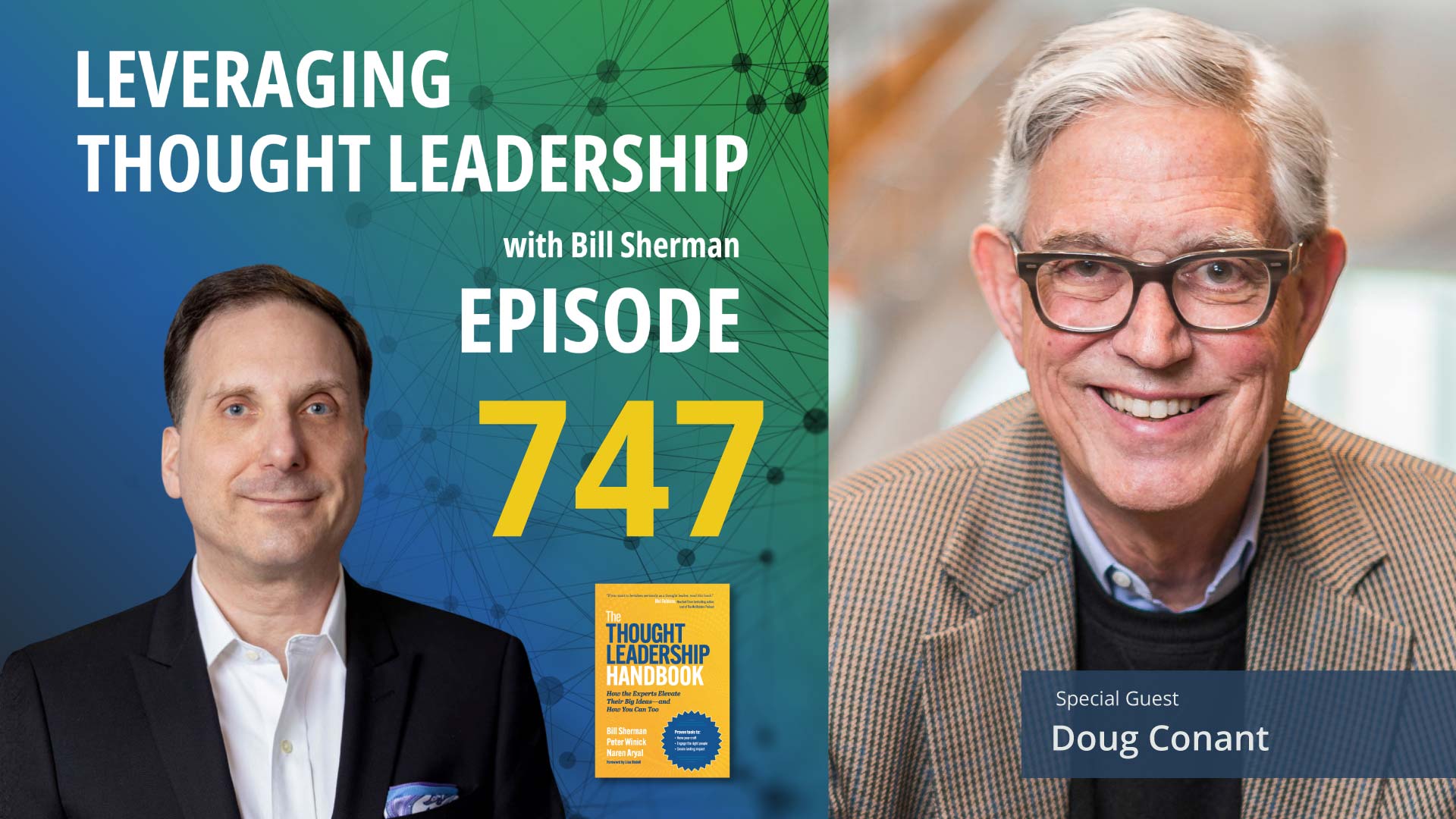



Doug Conant on turning 50 years of leading people into a lasting second act
What happens to a lifelong passion for leadership when a Fortune 500 career ends? This conversation looks at how decades of teaching leaders inside companies became a second act of thought leadership. It shows why ideas only matter once people can act on them, and why your most important work may still be ahead.
Most CEOs treat leadership development as something to delegate. Doug Conant taught the classes himself, and kept doing it while recovering from a near-fatal car accident.
In this companion episode to The Thought Leadership Handbook, Bill Sherman sits down with the former President and CEO of Campbell Soup Company, founder of ConantLeadership, and NYT bestselling author of TouchPoints. Together they explore a thought leadership journey that didn’t start at retirement. It ran quietly alongside a 50-year career.
Doug’s view of leadership is simple: put people first. If you invest in your talent, your talent invests in the agenda. That belief carried him from a political science classroom through Nabisco and Campbell’s. Along the way, 52 people who once worked for him went on to become CEOs themselves.
The conversation also goes to harder places. Doug talks about being fired ten years into his career, and how an outplacement counselor pushed a self-described introvert to stop being who everyone wanted him to be. He describes his first day as Campbell’s CEO, alone in a wood-paneled office, realizing he depended entirely on people in a thousand rooms he would never enter.
Bill and Doug also dig into a question every thought leader eventually faces. With hundreds of leadership books out there, what can you uniquely add? Doug’s answer is the “been there, done that” perspective of someone who had to show up every Monday and deliver. Bill offers a framework for how ideas move: awareness, acceptance, and activation. Doug adds a humbling truth: most people get it wrong the first time, and that’s part of the process.
Doug also shares why he’s more energized than ever. Inspired by a nudge from Alan Mulally and by Stephen Covey’s idea of living life in crescendo, he’s launching the Higher Ground Leadership Success System, a new framework built from five decades of practice.
This episode suits anyone building a second act around their expertise. It’s also for anyone wondering how to make their ideas travel when they aren’t in the room, or who suspects their best work hasn’t happened yet.
Three Key Takeaways:
- Understanding is important, but insufficient. An idea only creates value when people can apply it on Monday morning. thought leaders need to design for activation, not just awareness.• Your distinct contribution comes from lived experience. In a crowded field like leadership, Doug stands out by speaking as an operator who carried real responsibility week after week. That perspective is hard to replicate.• Thought leadership is a continuous apprenticeship. Doug calls himself an apprentice even after 50 years. Ideas keep evolving after a book is published, and the best thinkers keep refining how they explain what they see.
Doug Conant’s story doesn’t end with this episode. His journey from Fortune 500 CEO to leadership thought leader is one of the case studies in The Thought Leadership Handbook: How the Experts Elevate Their Big Ideas—And How You Can Too. Drawing on more than 700 conversations from this podcast, authors Bill Sherman, Peter Winick, and Naren Aryal map the patterns behind journeys like Doug’s. The book covers how to find what you uniquely add, how to choose the right business model, and how to move ideas from awareness to action. If this conversation got you thinking about your own next season, the Handbook gives you frameworks and tools to plan it.
Visit thoughtleadershiphandbook.com for a free excerpt and to discover your thought leadership avatar. Order your copy today from Amazon, Barnes & Noble, Bookshop, or Amplify Publishing Group.
Get Your Copy:
Amazon
Barnes & Noble
Bookshop.org
Amplify Publishing
Apple Books
Transcript
Bill Sherman Thought leadership’s journey changes across the seasons of your life. It can be part of your career or, at other times, can take center stage. Meet Doug Conant. He’s a former Fortune 500 CEO who, when he retired, founded Conant Leadership and has authored books on leadership. Yet, as you’ll soon hear, leadership wasn’t something that Doug focused on just after leaving his C-suite role. He’d focused on leadership development within the companies he’d led, not as a mandate, but with him leading courses for new leaders personally. And when he retired, his passion for leadership continued. His focus expanded to helping more leaders across many organizations. Doug’s Thought Leadership Journey appears in our book, The Thought Leadership Handbook. And, in this companion episode… We explore his story so you can hear him tell it in his own words. I’m Bill Sherman and you’re listening to Leveraging Thought Leadership. Today, my conversation with Doug Conant. Let’s begin. Welcome to the show, Doug. Thank you. It’s great to be with you. So you have sort of a parallel track. You’ve run very large organizations, both as CEO, Ben. Responsible on the board, but you’ve also had a passion about leadership your entire career to the point when you were at Campbell’s soup as CEO, you were running high potential leadership development classes. How did you find time to do that? Because when I think of a CEO, I think their schedules are usually clocked down of the minute? How do you make the space?
Doug Conant Well, you know, it’s funny, uh, I’ve always believed that you need to make the space because I believe it’s a people first responsibility as a leader. And I found if I’ve got great people who are wildly engaged in the work, my job is easy. If I don’t, my job can be exhausting and, uh, I just wear me out. My approach is to pour myself into helping create a talent pool that’s second to none, helping them learn and grow and prosper, and as I pour myself into their development, they pour themselves into the agenda of our company and everywhere I’ve been, that’s worked. So to me the That was the success formula. People first, you take care of the talent and the talent takes care of the agenda and everybody prospers.
Bill Sherman Did you have a moment early on in your career or an epiphany around talent? Or was this something where you just started noticing the pattern and going, oh, I need to spend more and more time on talent and leadership?
Doug Conant Well, we don’t need to do life history here, but when I was in undergraduate, I was one of my majors with political science and I was fascinated by leaders. And all the great accomplishments seem to be associated with leaders. And I started to see that the most effective leaders who are building things that promise to be enduring, which is very important to me, not episodic, not about them, about… The enterprise, all those leaders had some common traits. And I was thinking, boy, leaders make a difference. And I’ve always believed that you give me a team and we will outperform the same team by multiples in terms of growth, top line, bottom line, and management of the business. We will outperformed that team. Because we’re gonna create an exciting agenda that they’re gonna be fully enrolled in. And basically, then I discovered Gallup years later, and that’s what Gallup found in the Gallup survey work, the whole notion of employee engagement. You get the right people, get them wildly engaged, and they can do amazing things. And leaders are the ones that do that.
Bill Sherman So it’s a through line through your career. I want to go to, as you’re preparing to leave Campbell’s suit, right? Many people are planning. What do I do next? Some CEOs go off to the golf course, go find board opportunities. You had a book that was about to launch because as you were retiring, you had a booked coming out and you were starting a new company. Tell me a little bit about what was going on in your mind when you were looking at retirement and the next step. You were thinking about thought leadership and continuing the work.
Doug Conant My career has been to be a student of leadership. And, you know, to be honest, I’m, I I’m still an apprentice at it. I work at it hard and I’m better than I used to be, but I’m not as good as I will be. And, uh, so I found myself studying leaders well before my retirement, but it was interesting. I was retiring. I was recovering from a near fatal car accident. I was publishing Uh, New York times bestselling book on leadership and I was the most fulfilling thing I was doing was running a CEO Institute for high potentials at Campbell. And I love that work and I never missed a class, even though I was in and out of surgery, getting put back together again from my car accident, I made every one of those CEO Institute sessions and I I was the teacher. I wasn’t hiring somebody to come in and teach. We had partners that came in, but I, I let it, and I love the work. And I saw these people lifting themselves up in an exciting way. And I thought, why, I don’t need to stop doing this. I can keep doing this forever. I love this. And I was also at the time, uh, working with some friends who we were about to start a higher ambition. Leadership Institute up in Boston with some friends from Harvard. And so I went on the board of that. I started that. I was also recruited to be the chair of the Kellogg executive leadership Institute at my alma mater, Kellogg school of management in Northwestern. And so it was a natural flow to get it to stay in the leadership space while I also did board work.
Bill Sherman And I’ve wondered, and you may have a perspective on this, did you think about it as thought leadership for the time or was it, I’m just doing work on leadership because I’m passionate, right? Rather than being a voice.
Doug Conant I didn’t, I didn’t intent. Look, I just know it’s hard out there. It’s a tough world, you know, back. One of my mentors, who actually was part of his book series, our first book, Warren Benes, coined the phrase, it’s a VUCA world, right? Right. In 1987, it was volatile, uncertain, complex, ambiguous. That’s VUCO. Right. And, and it’s just tough. And I had a slog through that for 40 years. And I see all these leaders having to deal with it. And quite frankly, they weren’t getting much help and, uh, performance review process was not going to change their leadership profile appreciably, my opinion. And going off to get an MBA wasn’t going to necessarily change it. They needed to work more on themselves and get themselves ready to lead in a more courageous way. And I didn’t see anybody doing that. So the space we’ve chosen to go into is a space where we’re trying to help leaders one at a time, develop the courage of their convictions and lead in a more compelling way. And that was motivating. That’s been motivating to me my whole career. And now it is my career.
Bill Sherman Yeah, and I want to ask this question. How has the work since retirement with leading Conan leadership continuing the work? I know you work with a number of different organizations. You continue to speak. As you said, you’ve had bestselling books. How has thought leadership impacted you? You described yourself as a student, But what are you learning? What is it that you’ve experienced in this season.
Doug Conant Well, you know, my version of thought leadership is about, okay, let’s talk about what you think and how you want to show up for people. All right. Now let’s, talk about how you’re actually showing up. What’s working. What’s not what’s needed. And it’s really trying to help leaders from a been there, done that perspective, find their way through the thick of thin things in a very messy world, and that’s where… I can add value that many of my best friends can talk about it, but they’ve never had to do it. They never had a show up every Monday, 52 weeks a year, and talk about what we’re doing and how How did we do last week and what are we doing next week?
Bill Sherman It’s a different world when you’re the operator and you’re the person who has that responsibility.
Doug Conant Yeah, and people are counting on you. I mean, all of these folks. Their career, it’s sort of in your hands and you’ve got to show up and you got to be the best version of yourself and you have got to serve them wildly for them to be best version themselves and that’s a huge responsibility.
Bill Sherman So that’s that’s leading and whether it’s leading people are leading through ideas. I always see as a role of service.
Doug Conant Yeah, first and foremost, I’m not demeaning ideas. I’m just trying to, yeah, I can bring is absolutely moving from ideas to action and being able to work with people who have to go back to work on Monday morning and, and figure out, okay, now how am I going to deal with this?
Bill Sherman So you’ve been celebrating your golden anniversary in leadership and you’ve had pieces online about it, 50 years as a leader. My question for you is where are you going next? What’s the next challenge? And I’m assuming leadership is probably part of it in some way. I don’t see… That spark fading from you as you talk now? What are you thinking?
Doug Conant Well, I’m telling you, one of my mentors was Stephen Covey and, uh, Stephen and his family were, have been very kind to me now for gosh, going on 40 years and, a Stephen’s last book that he wrote with his daughter, Cynthia, how Covee Haller was sort of speaks to where I’m at. And the book is a living life in crescendo while your best work is always ahead of you. So right now I believe my best work is ahead of me. I have so much to offer. So my focus is on helping leaders lead better in a way that works for them and serves others and that I can’t think of a better thing to be doing. That’s the focus and it’ll never fade. And the joy I get from seeing people prosper. We keep track of the people who worked for me when I was, uh, in my corporate life and we’re up to 52 people have gone on to become CEOs. And I think of those 52 people, we had some influence on them and I, I’m betting they’re leading a little better because of the time we spent together. And I love that. I love. That they’re, they’re having a positive impact on thousands and thousands and thousands of other people. So, uh, that’s why I do what I do just to be of service. And. So I can make a difference and so I do. And that’s my future and I can’t think of a better one.
Bill Sherman I can hear the joy in your voice as you talk about that. You are clearly, at least from my perspective, energized by this. And for those listening on the podcast, Doug has a spark in his eye as he’s talking about this.
Doug Conant I do, and I want to give some credit to Alan Mulally, the retired CEO of Ford, who just did an amazing job at Boeing commercial and then at Ford of lifting the culture to a whole new level. And he’s, he was kind enough to spend time with me this past year. And he challenged me to get in the game in a more substantial way. And so. If he hadn’t in his own way, I don’t think he would say he challenged me, but he did. If he had challenged me. I probably wouldn’t have leaned into what I’m about to launch in a few weeks. My higher ground leadership success system. I would still have a, I would still have, a spark, but I have a bigger spark now it’s, it’s on fire. And, uh, so, you know, I’ve got some fresh thinking around all the work that I’ve done over the last 50 years and it gives me energy, you know? And it’s, I feel like a door’s opened as I started thinking about, hey, you know what? My best work is ahead of me. So that’s where I am now.
Bill Sherman Thought leadership doesn’t happen by accident. It takes clarity, consistency, and a path for your ideas to move through the world and create impact. I, Bill Sherman, and my co-authors, Peter Winnick and Naren Ariol, wrote the Thought Leadership Handbook to help you understand that path and choose the right business model and the right frameworks and tools for your thought leadership work. Learn more about this book at thoughtleadershiphandbook.com and order today an Amazon, B&N, Bookshop, or Amplify. And as I listen, you talk about being the person who had to go back and do things on Monday morning. You found not only your voice, because there’s a lot of voices on leadership, you found the place where you can add something different. Because yeah, you could find hundreds of books on leadership. But what does Doug do?
Doug Conant They’re right here
Bill Sherman Yeah, yeah. Uniquely add to the conversation. Why should you write a book? Why should write a second book? You found that answer and have clarity on it.
Doug Conant Well, you know, we’re all on a journey, you’re on a journey, I’m on a journey. Ten years into my career, I was fired for my job. And I’m a introvert and, uh, so I would just keep my head down, try and make everybody happy and be of service. But I didn’t really know who I was. I was just trying to be who I thought everybody wanted me to be. And when I was fired, I had an outplacement counselor who challenged me to get in touch with what I believed and to start showing up in a more authentic way. And then that was 10 years in my career. The last 40 years I’ve been working on that I’m slow, but I’m getting there. And, uh, I, this is something that I, I think we all sort of live into on our journey, we develop, we try things, we developed perspective, we ask ourselves questions, we answer them and we’re typically wrong and we learn a little more, a little better, it’s all continuous improvement. I’m just curious about how can I do a little better tomorrow than I did today? And that’s been carrying me since I lost my job 40 years ago.
Bill Sherman And I’d agree with that sentiment. So for me, I stumbled into thought leadership 20 years ago, right? And had a former C-level exec who had retired, written a book, runaway bestseller. I was brought into how do you help them scale it because he had more demand, speaking workshops, et cetera, than he could fill. There was no way to explain what is thought leadership, how it worked, or, you know. There was no graduate course on it. And so for me, it was talking to people, it was learning by trial. And like you said, there are days where you are deeply driven to try and understand the topic you want to understand, and you can only see a part of it, but you wanna see a little bit more each day. And understand it a little clearer.
Doug Conant Yeah, you’re right on. And that’s, uh, that I don’t believe leaders are born. I think they can be born with certain attributes that enable them to lead more effectively, but I think there, they are more often than not made by experience and, uh and by study. I, I
Bill Sherman They’re called and chosen, right, in the sense that they answer a call they feel inside, wherever it comes from or however.
Doug Conant Yeah, several people have actually called it a calling and, and I do get that. I do got that. And, but I, you know, I, I hungering to better understand how I can be more effective and I started spending time with Stephen Covey out in Sundance for years, I was hungering, to understand how, I could be a more effective leader. And I started, Bill George pointed me to Warren Benes and I connected with Warren and my college professor, Ram Charan had an influence on me as did my another college professor who was the king of marketing, Phil Cotler at Kellogg. And it just goes on and on and I learned from all those people. Oh, absolutely. And then I started trying to find a way to apply it to the way I was trying to show up for people. I used their principles and their thoughts and I tried them on. And then I found how they fit for me and I’m better for it because I was a student of it as well as a practitioner. And I think the same is true of you. I’ll bet you, you know, you’ve been a student of this now for 20 years, how can I do better? And you’ve also been a practitioner of it. And you know what, you have a better idea of what works and what doesn’t work and what you can do better.
Bill Sherman Exactly. And I know, like you said, I want to be better at this 20 years from now that I am today. Oh, and you will be. Exactly. And that’s what drives me forward is I know I can see a little bit further over the horizon each day. And whether you mentioned Carol Dweck or Ram Charan, one of the things when I read a book these days and I may read a chapter or really fall in love with a two-by-two diagram that helps me see something, but one of the questions that goes through my mind is I wonder what they’re thinking about now because even when a book is newly published The amount of time it takes for the book to get out They’ve already gone on thinking
Doug Conant Oh yeah, you don’t stop.
Bill Sherman And so it’s a record of a conversation rather than where they are today.
Doug Conant You’re, oh, you’re absolutely right. We wrote touch points, New York times was bestseller and we had really good thinking in there, but by a week later, I had better things and so we keep building on it, the fundamental principles are the same, but we have insights today that didn’t, that I didn’t have only published those books.
Bill Sherman And every time you have to explain something, you try it out in a different way, or you jot down a note afterwards and you’re like, Oh, that landed for this audience, maybe I use it that way. You’re constantly, as you’re talking about the idea, finding better ways to explain what it is you see, because that’s almost as hard as understanding the idea yourself. Can you help other people see what you see?
Doug Conant Yeah. And can you share it with them in a way that enables them to move forward with it? Understanding is important, but insufficient. I’m glad they understand it. Yeah. They understand the concept now. How can I apply it to how I’m going to show up on Monday morning? Exactly. I’m saying that it’s not that easy, but now that I’m checked out of the book and I’m done with the chapter or I’m dumb with the course. How can I apply it to my real life when I go back to work on Monday?
Bill Sherman And when I think about that, it’s awareness. Are you aware this topic exists? Acceptance. Do you look at it and say, hey, that’s useful for me, and then activation, I’m gonna use it.
Doug Conant Yeah, I’m going to use it. And I, and the one thing, which is interesting to me always has been. However, you’re going to, use it nine out of 10 times. You use it wrong the first time. Cause you don’t know you have.
Bill Sherman And you have to be willing to do it the ten times.
Doug Conant To figure out, Oh, what did I do wrong? And what can I do about it? Right. And is, so you, you sort of have to have conviction around it because I believe it, but when I go do it the first time, I know I’m going to look at it and say, I could have done it better. And, uh, but that doesn’t mean it’s a bad idea. It just means you got to do it better and, uh that’s what I’ve enjoyed about the whole leadership process, helping people become aware of these ideas. And then helping them get to a place, a frame of mind, where they’re gonna act on the ideas in a way that will work for them, knowing that it’s not going to be smooth sailing. You know, I’m a real student of this stuff and I screw it up all the time.
Bill Sherman Yeah, there’s power in saying I don’t know let’s think it through and see right because either it’s a new situation or You have to make a quick decision and maybe it’s not the right one
Doug Conant Yeah, there are times where you can, where you have to make quick decisions and you do the best you can with what you have and you move on. And there are time where you say, well, let’s think about that and talk about it tomorrow, uh, where can take a little time with it and allow it to percolate for a bit before you act on it and. That’s what makes the whole challenge of leadership. So fascinating to me. It’s there’s just so much going on. There’s so much complexity attached to it. You’re dealing with people, not things. And people are incredibly dynamic and, and challenging in a way to connect with all under pressure. And that that’s what it makes this whole leadership challenge. So intriguing. And, and so many people need help. That’s why I do what I do. And so far we’ve been able to help a lot of people. We’re at a stage now where 15 years into current leadership, we’re basically in dialog with about 500,000 people a day through social media and newsletters, everything. And we’re talking about a leadership philosophy that I think will hold them in good stead if they, if they can find a way in that works for them. The key is it has to work for them, so, uh, all of this leadership thinking we’re talking about has got to nest perfectly in a place for you where you can do it consistently and feel good about it. This is not an episodic thing. This is something that’s gonna require extraordinary discipline to act on. And that’s part of the excitement about finding something that works and then doing.
Bill Sherman As I listen, Doug, I hear you not only talking about being a student of leadership, but also a student.
Doug Conant Well, I am because I’ll tell you, when I, I became CEO of Campbell Soup Company when I was 49 years old and I went down to Camden and sat in my wood paneled office behind a big wood…desk…and… I realized I’m all alone in here. And quite frankly, I don’t know my ass from my elbow, but what’s going on in this company and I am totally, totally dependent on all the people that work here to get anything done. It’s not about me. It’s all about them. And it just reaffirmed for me, the whole challenge of engaging a workforce that will take the enterprise to higher ground. It’s, it’s just not about you. It can’t be about you because for every room you’re in telling people what to do, there are a thousand other rooms where you’re not, and they have to make decisions and act on those decisions without you and, and so
Bill Sherman How do you make those ideas and the skills that you want travel when you’re not in the room? That’s the challenge and I think that’s where you and I share common ground and common passion is how do you equip people so they’re ready when the moment comes if you’re out there.
Doug Conant Yeah. And, and, and you won’t be there because the customer will be calling and they don’t have time to call you to see what, and plus you don’t know what you’re doing, you don’t know the situation they have to be prepared to lead on demand and. So, and how do you prepare them to lead on demand? Well, you prepare. Before it demands it. So you’ve got a sort of train and develop and create a mindset so that when they encounter these challenges, they’re prepared to act on them, which is why I believe leadership development is so critical that you, we’ve got to get our leaders incredibly well anchored in how they want to show up, they’ve got to be aligned with the expectations of the enterprise. And they’ve got to be poised to go into battle every day in a way that creates value for all of the stakeholders, not just their little team. And that takes work and that takes discipline. And it’s not just shooting from the hip or, it just won’t work. So that’s why I believe leadership development is so mission critical today.
Bill Sherman Doug, I want to thank you for joining us today to talk about your journey in thought leadership, your commitment to building better leaders, as well as then the impact it has had on you. Thank you very much.
Doug Conant Thank you, happy to have the conversation with you. I admire what you’re doing.
Bill Sherman Thank you. Every episode of this podcast explores a different thought leadership journey. And now, many of those lessons have been brought together in our new book, The Thought Leadership Handbook. To go deeper, visit thoughtleadershiphandbook.com where you can read a free excerpt, discover your own thought leadership avatar, and access tools designed to help you sharpen your strategy. That’s thoughtleadorshiphandbooks.com. Order your copy today at Amazon, B&N, Bookshop, and Amplify.
