
Why Systems Thinking Beats Siloed Problem-Solving | Ilene Fischer | 746
The Leveraging Thought Leadership podcast is created by Peter Winick and Bill Sherman and produced by Thought Leadership Leverage.
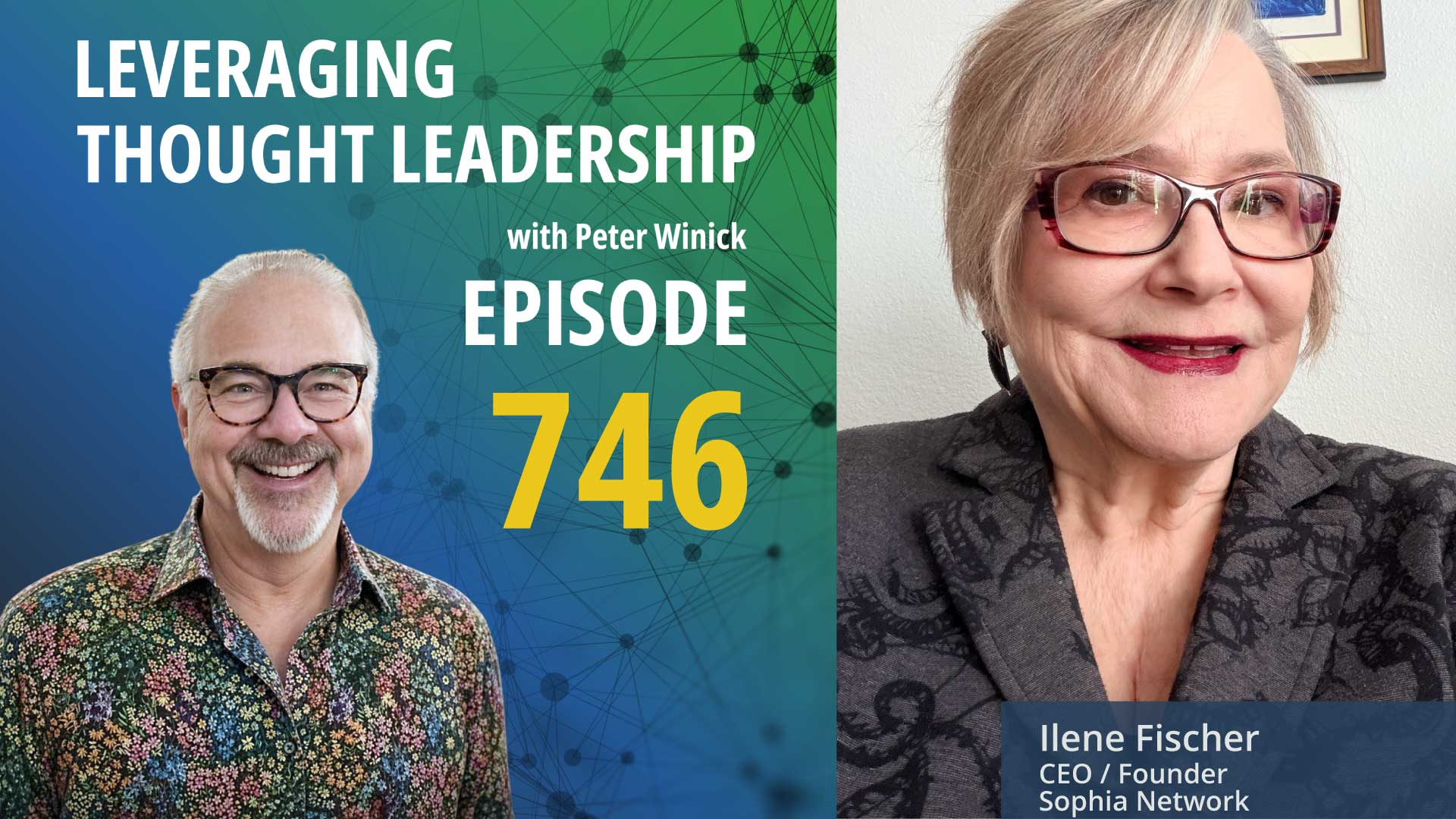



Ilene Fischer on building collaborative cultures that make change and innovation stick
Most change efforts fail because organizations solve problems one at a time and people don’t feel safe speaking up. This episode explores innovation ecosystems: cross-functional teams, deep listening and weekly iteration. It argues that thinking and acting systemically is now the most important leadership skill.
Seventy percent of organizational change efforts fail. Ilene Fischer has spent 35 years working out why. Her answer has less to do with strategy than with whether people feel safe enough to say what they actually think.
Few people have had a front-row seat like hers. Ilene Fischer started as a chemical engineer and moved into quality management. Then she spent a decade with Peter Senge’s Innovation Associates and eight years at the Tom Peters Company. Her new book, Innovation Ecosystems: A Dynamic Blueprint for Organizational Success and Engagement, combines systems thinking with a bias for action. The idea first took shape when she watched fearless, collaborative teams at NASA Langley Research Center.
In this conversation, Peter Winick pushes on the “why now.” Ilene’s case is that the structures that worked in 1990 can’t keep up with today’s speed and complexity: silos, linear problem-solving, fixing one thing at a time. She points to nine disruptive forces reshaping business. One is a Gen Z workforce that demands purpose. Another is a talent shortage that is really a shortage of people with deep expertise in two unrelated fields.
Then it gets practical. At a healthcare insurer, cross-functional teams with no formal leader went after a $15 million gain in operating margin. At a pharmaceutical company, a 25-person team of PhDs and MDs met once a year and took 12 years to develop a drug. Moving to a core team of eight that worked in weekly cycles cut that time.
Peter also raises the positioning question every thought leader faces: is this change management, culture or innovation? Ilene says it’s all three, because changing how people work changes the culture. That leads to a sharp exchange on why “change management” has become a damaged brand, and why every client claims to be “ready to rock and roll.” Her organizational readiness assessment, taken by at least 50 people inside a company, is built to separate perception from reality.
For thought leaders there’s another layer. Peter does an “archaeological dig” into how Ilene’s ideas build on Senge and Peters while still standing as her own distinctive IP.
Ilene is clear about her ambition: this isn’t a book, it’s a movement.
If you lead teams, advise executives or build ideas meant to change how organizations work, this episode is worth your 20 minutes.
Three Key Takeaways:
- Change fails when people don’t feel heard. Resistance is the biggest obstacle to any change effort, and it usually comes from people who don’t feel safe to speak up. Deep listening at the start turns resisters into your strongest supporters.
- Silos can’t keep up with today’s complexity. Linear, one-problem-at-a-time thinking worked in a slower era. Today, cross-functional teams that include customers and vendors and work in weekly cycles move faster and drop fewer balls.
- Culture determines whether innovation happens. In a culture of fear, people stop experimenting and stop using their talents. Change how people work and you change the culture, but check honestly whether the organization is ready before you start.
Ilene Fischer’s story shows that a great idea is only the beginning. She spent years absorbing the thinking of Peter Senge and Tom Peters before shaping it into a framework that’s distinctly her own. If you’re working to turn your own expertise into IP that stands out, The Thought Leadership Handbook by Peter Winick and his co-authors Bill Sherman and Naren Aryal shows how to shape it, package it and scale it in a crowded market. Learn more at thoughtleadershiphandbook.com, and order your copy today from Amazon, Barnes & Noble, Bookshop or Amplify.
Get Your Copy of The Thought Leadership Handbook at:
Amazon
Barnes & Noble
Bookshop.org
Amplify Publishing
Apple Books
Transcript
Peter Winick And welcome, welcome, this is Peter Winick. I’m the founder and CEO at Thought Leadership Leverage and you’re joining us on the podcast which is Leveraging Thought Leadership. Today my guest is an old friend, Ilene Fischer, and let me give you a little background on Ilene. She’s got a book that’s coming out called Innovation Ecosystems, a Dynamic Blueprint for Organizational Success and Engagement, which is by Hachette. She has been around this thought leadership world for quite some time. She’s involved with Tom Peters for a long time. And Ilene and I met by a swimming pool in Orlando 20 years ago. I think it was 20 years. So welcome Ilene, welcome aboard today. Thank you very much. So give us the quick sort of two minute career path if you will, like from consultant to innovation to all the things that you’ve done in two minutes or less.
Ilene Fischer Okay, great. So I started my career, actually my degrees in chemistry and my bachelor’s degree, and I started in my career as a chemical engineer. I was one of the first women engineers at Raytheon in Andover. And it was not much fun. I then moved into, yeah, I then moved into quality and I got into being a quality manager. And, and we were trying to implement process redesign and there was so much resistance and I kept scratching my head saying, what is this about? Then somewhere along the line, I started doing consulting, using my chemical background, working with Duracell and places like that, and their R and D place. And then I read Peter Sanghi’s book. Yeah. I said, this guy really gets it. And I was leading a personal growth seminar and the CEO of his company was in my seminar and at the seminar, he said, you should come work with us. So I did. And I got into organizational change right after the book came out. The fifth disk. I worked with Sankey for 10 years. I worked with Tom Peters for eight years and the combination of the two.
Peter Winick So wait, just stay there a minute. So like, I don’t know if there’s anybody else on the planet that’s worked for, let alone either of those two, both of those two legends, like that’s just the coolest gig ever.
Ilene Fischer Oh yeah. And you know, I have to say that working for both of them, it was like a silver box experience so far when I worked with Sangay every month we had learning date, so we’d bring in all these people. You know, we had Chris Ardress’s daughter, Diane, she worked with us for a year training us. I got to go to Meg Wheatley dialog, all of them for the whole time. I was at IA and I learned from Diane. And Fritra Capra was there for one of them. It was wild. I mean, I got to meet these incredible thought leaders and I absorbed everything. Yeah, yeah. And I guess the genesis of the innovation ecosystem model came from when I was working for Sange and I was at NASA Langley Research Center and it was there that I saw collaboration, ecosystems, people working together and innovation. And there is no fear of making mistakes. People could swing out and pretty much test whatever they wanted to. And that was my first taste of it. And I said to myself, there’s gotta be a way. And then working with Senge and Tom, and Tom had WoW projects. So I basically evolved everything I learned and started testing it with clients. And it was a home run. I mean, we had clients- All right.
Peter Winick So fast forward a little bit, so you’ve got to be sort of in the front row, in the room where it happens and all that sort of fun stuff. But you’ve also got your own thinking. You’re incredibly wise and smart and you’re able to put together all these amazing ideas. Why now to write the book? Like, okay, so, you could be sitting around hanging out with your kids, chilling out in Denver, doing anything you want to do now. This is a big undertaking at this stage. Like why now? What drew you to this, to get this off your plate?
Ilene Fischer Well, I started to see that business is really the whole paradigm of business is shifting. If you think about it, you know, when, when Peter’s book came out in 1990, we didn’t think he introduced things, systems thinking to the world, right? Because it was only an FBT. It’s very as a terror. But in those days, things were moving really slowly. You could solve problems linearly one at a time, the silos and organizations work. That’s not the case today. Wait, but let me push on that.
Peter Winick So 1990, right, you’re saying things were moving slowly. I think if I were to transport myself back to 1990 when I was starting my career, I would think it was moving pretty quickly. Right, relative to what? So, you know, speed is relative. Now that we look back, nostalgic land, oh, the days of 1990 where you’d finish something, you know you’d leave the office and your files would be there, there’s no BlackBerrys, there’s not iPhones, maybe there’s a fax machine but you probably don’t have one at home. So it is a nostalgic sort of. Norman Rockwell as quaint kind of thing, but I don’t think at the time we thought it was like, wow, this is really slow and easy, right? So.
Ilene Fischer No, I don’t think at the time we did either. However, what my point is about this is the structures that we had in place in organizations, working in silos, solving problems one at a time that work in that day, because although it looked fast to us, it wasn’t moving at the speed and with the complexity that we’re facing today.
Peter Winick Got it, so that I’ll that I will violently agree with so then tell me about the sort of the ideas underneath The book that addressed that
Ilene Fischer So if, you know, I talk about in the book nine disruptive forces that all businesses are facing today, and I’m not going to name all of them. I’ll name a few of them, okay. So one is Gen Z, all right. Your Gen Z folks, they are not going work for companies that are just out to make profit. They want to work where one, they can make a difference. Their talent is really admired and appreciated and the company has a purpose. And that purpose fits with their purpose.
Peter Winick So again stay there if you go back to 1990. Yeah, and you were interviewing a candidate or wore that candidate Those were not three things on your list or if they were they were items number 78 and 102 and don’t talk about them During the interview right now. I love aging. These are the top three. So therefore if an organization is not Understanding how to get those needs met for the high level candidate. They’re gonna lose
Ilene Fischer That’s right, that’s right. Another one is we have a talent shortage. Now, you might argue and say, no, we don’t. We have lots of talent. But what I’m pointing to isn’t a talent shortage cause we don’t have enough engineers or we don’t have enough biologists. We don’t have people that have multiple talents. So they’re not thousands. They’re more like hundreds of people that have really strong and deep AI and biotech backgrounds together. Or medical and engineering backgrounds together. And that’s what’s missing today. So there are a lot of jobs that aren’t able to be filled because people don’t have multiple talents that are needed today. So that’s another disruption that’s happening.
Peter Winick So the multiple talents is not the generalist, right? Because that’s somebody that’s sort of fun at a cocktail party and give you the whatever. You’re talking about multiple functions or disciplines or whatever, where you have deep expertise in two things that are not typically next to one another. That’s right, that’s right. So that’s kind of odd, right, like how do you find, like. Said the former chemical engineer who’s been through all that. So how does one find those? Or if you were looking to succeed in today’s world, how do you become one of them?
Ilene Fischer Yeah. Well, I think, first of all, I think there has to be a shift in the education system because it’s really important that people have multiple deep expertise given all the connections. You know, if you talk about ecosystems in the book and ecosystems are, you know, collaborative groups working together. All right. Like if I think about the way things are now they’re in silos, right? Yes. And so, you know, HR goes and makes their decisions and engineering makes their decisions, and sales makes their decision. They don’t necessarily talk to each other. And in not talking to each, a lot gets dropped in the cracks. So if you’re working on a project, and this is in the book, you got to get everybody together, all the stakeholders, you now, so including your customers and your vendors, right? Right. Because whoever needs to be. In the conversation about that project needs to be in the room. So let me push, not push, but let me.
Peter Winick Ask, throw out a thought on the silo piece. So, silos have always existed, right? You would have finance on the third floor and marketing on the seventh floor and whatever. However, the traditional ways of working is we all went to the office building, downtown, Monday to Friday, eight to four, nine to five, whatever. There were more opportunities for serendipity. I got in the elevator with someone from accounting and we’d have a chat or I’d grab my coffee or hey, the schedule, it was really easy, right. Now, even when we’re working. At the same organization, in the same function, well, you’re remote three days a week, I’m remote two days a weak, and then when I come in, all this stuff, you don’t have as much serendipity. You don’t as much spontaneity relative to the physical place that we’re in. So how do you overcome that, create that, compensate for that today? A great idea is only the beginning. In the Thought Leadership Handbook, Bill Sherman, Nala and Arielle and I share what it takes to shape, package, and scale your expertise in a crowded market. It’s available now. Learn more at thoughtleadershiphandbook.com and order it today at Amazon, B&N, Bookshop, or Amplify.
Ilene Fischer Okay, good question. So the model really brings together teams that are working on projects or it could be not even projects, implementing strategy, implementing a strategy. There could be a team. I worked with a number of companies that used it for strategy implementation. So one of them wants to increase their operating margin by $15 million over a year. This was a health care insurance company, okay. And they got a team, they got, they had five, five strategic initiatives. So I had five teams, each one different. One was this operating margins team. So we got a group of people together from different parts of the organization, not just finance, right, but different parts, looking at different things. And they created this team. There was no head of the team. They use the methodology, which cause, which has you iterating every week. It’s not very different from design thinking. But what is very different is this, we start in any organization by deeply listening to people. So if you look, 70% of all change efforts fail in the US. Why do they fail? I think for two reasons. One is because they’re trying to solve problems individually instead of looking at a whole system. And the other is because the biggest, deterrent to change in an organization, the biggest pushback is when people resist change. Resistance was there when I was trying to get processes implemented. It’s always been there. But why is it there? Because people don’t feel safe to speak up and say what’s there for them. When they are really heard and they can do that, they let go of it. And guess what? They become your biggest proponents in any change. So that’s how we start our work with folks. We start by your.
Peter Winick Sort of on one level, tackling an old problem of let’s call it change management. I think change management as a brand has gotten its teeth kicked in, right? Because nobody, if a company says we’re going to roll out our change management initiative, everybody starts to twitch and have flashbacks of the seven change management initiatives they’ve gone through.
Ilene Fischer That never went anywhere. Yeah, right. Other than cars that.
Peter Winick Stress and frustration and all that so at some level the application of what you’re speaking about writing about is really a change management solution.
Ilene Fischer Or no. Well, it is, and it isn’t, it’s a way to implement any change. It’s any, any project and innovation, which is really important. Okay. And the methodology doesn’t like have this separate innovation group here. It actually embeds the way people work. You know, I always say, if you change the way, people work, you change the culture of the organization. Right. Right. So in changing the way people work by working in teams. Thanks. Bye. By getting everybody’s feedback, by iterating with that feedback, by going back out and getting more ideas and bringing it back in, right? And building this ecosystem and talking to all stakeholders. They may not all be in the room. I use this at a pharmaceutical company. I left when they said, well, it takes us, you know, 12 years to develop a new drug. And I said, yeah. And then I found out they had 25 people on the They’re all PhDMDs. And they met once a year. Once a year? Once a, and I’m like, well, no wonder, you know, I said, what if we had a core team of eight? Yeah. And the other 17, you now, they iterated through on a weekly or a bi-weekly basis. Sure, sure. And that’s what they did, and it actually worked to cut the cycle time down on this drug.
Peter Winick I so but now it sounds now we just went from change management to culture, right? So there’s, there’s not an easy box to fit this in, which is kind of part of my part of the problem here, right, if it was just one thing, it’s easy, right? I would say management to cultural innovation, like seamlessly.
Ilene Fischer Right. Well, culture is going to dictate how well you can implement innovation and change. It is that’s it. Cause if you have a culture of fear where you don’t experiment and write our heads down and they can’t express their talent, you know, they’re kind of shuffling to work every day and they’re really impressed, but not even realizing it like a boiled frog. Right? Sure. Right. Right. One of the guys that read my book said, you know, I’ve been working as a software manager for 15 years. And didn’t even realize how suppressed I was until I read the book.
Peter Winick Right, because we’re not, because whatever, you know, the frog analogy, wherever you go to work, you become normalized to what an outsider, which is kind of the beauty of being a consultant, you know sees the obvious, right? An outside consultant, like you or I would go in and say, oh my God, this is a low trust environment, or they’re operating out of fear, or they don’t have enough, and it’s not that we’re super smart, we don’t a horse in the race. So we could say it out loud, because it’s my bonus, my promotion, I’m getting paid regardless as a. Consultant, but when you’re there, you’re like, well, the way they do things here, a little bit different, right? Just a little different than what I’d expect. And the little bit becomes a little more and becomes a little more before, before long, you normalizing the abnormal. That’s right.
Ilene Fischer So, you know, but the point is that with, in the book, I have an assessment, an organizational readiness assessment, right? And that is there because there’s a continuum. On one end, you are not ready to implement, you got to really look at your culture and make some changes in how you operate. The other end is you’re ready to rock and roll and then everything in the middle. So, you know
Peter Winick But again, stay there. So I think when you’re talking to a lot of clients and you say, okay, well, where are you? They say, no, we’re ready to rock and roll. Everyone’s gonna self-select and say, no, no no no, yeah yeah, the culture thing. Yeah, you know, it could be better, but we’re to rock n’ roll. But it’s like building a house on a faulty foundation. Right. You then have to go in and say well, let’s discuss what ready to rock n roll really is. Let’s discuss before we lay the concrete if the, you now, it’s gonna take, right?
Ilene Fischer Yes. So the continuum actually shows you if you’re ready or not. And I say, it’s not like one person takes this assessment. We want you to go out and get at least 50 people in your group, take it. And then we’ll look and see what people say and what area is you need to work in. So, you know, it it’s all connected. The culture pulls for if the culture is one where people can experiment. Where they can express their talent at work. Yeah. You know, then, you know, where they work collaboratively, then you have a good shot at being successful. But again, I think the most, there are two really important things. One is without that deep listening part, without having people let go of all the failed attempts at innovation that we’ve all tried to, you now, without that, all right, it’s not gonna turn out.
Peter Winick So this has been great, but in my mind, it kind of brings it back to, let’s say, your start as a thought leader was the exposure to system thinking, right? Usually, it’s an occasion. So to me, it is always amazing to talk to great thought leaders like you because you can do sort of an archeological dig through their thinking, and you can see some of Sengei’s stuff in what you’re doing and a little bit of Tom Peters and a bit of your, you know, like, what is the recipe here? And it couldn’t have happened. Any other way than your way, right? Because you’ve got this exposure and then you put it together uniquely. So I think that’s really part of the beauty of carving out your space as a thought leader, saying this is my little piece of it and I stand on the shoulder of giants and all those other things. So before we shut down here, what is your vision, what’s your hope? It’s a year from now and you’re done doing the aggressive promoting of the book like we all need to do. What’s different?
Ilene Fischer Well, I, for me, it’s not a book for me. It’s a movement. Yes. Okay. Yeah. I think the most important skill a leader can have today is to think and act systemically. Yes. So now things are moving too fast and too complex. We cannot, cannot solve things one by one. We have to look at it systemically.
Peter Winick And that’s, I can see in your body, that’s your cruise ship, you’re banging your shoe, right? Not necessarily analytically, or this way, or like, you’ve gotta be a systems thinker today, or it’s just not gonna happen.
Ilene Fischer Right. And so I say it’s a movement because I really want to see companies adopt this and start to make the shift because the shift’s already happening, whether you like it or not.
Peter Winick Get with the program. Well, this has been great. It’s been too long since we’ve had one of these fun chats that I always love having with you and I’m glad we did it with the microphone on for a change, so.
Ilene Fischer Oh, great. I really enjoyed it and I really enjoy working with you, Peter. And if there’s any other occasion, let me know because I think you’re great. And I really am appreciative of being on this podcast.
Peter Winick Oh, my pleasure. Great to have you. Good to see Ilene.
Peter Winick Thanks. Bye. To learn more about Thought Leadership Leverage, please visit our website at thoughtleadershipleverage.com. To reach me directly, feel free to email me at peter at thoughtledershipleverage.com and please subscribe to Leveraging Thought Leadership on iTunes or your favorite podcast app to get your weekly episode automatically.
Peter Winick To learn more about Thought Leadership Leverage, please visit our website at ThoughtLeadershipLeverage.com. To reach me directly, feel free to email me at peter at Thought Leadership leverage.com and please subscribe to Leveraging Thought Leadership on iTunes or your favorite podcast app to get your weekly episode automatically.
