
Rivers, Rocks, and Rubies: A New Career Model | Dan Pontefract | 736
The Leveraging Thought Leadership podcast is created by Peter Winick and Bill Sherman and produced by Thought Leadership Leverage.
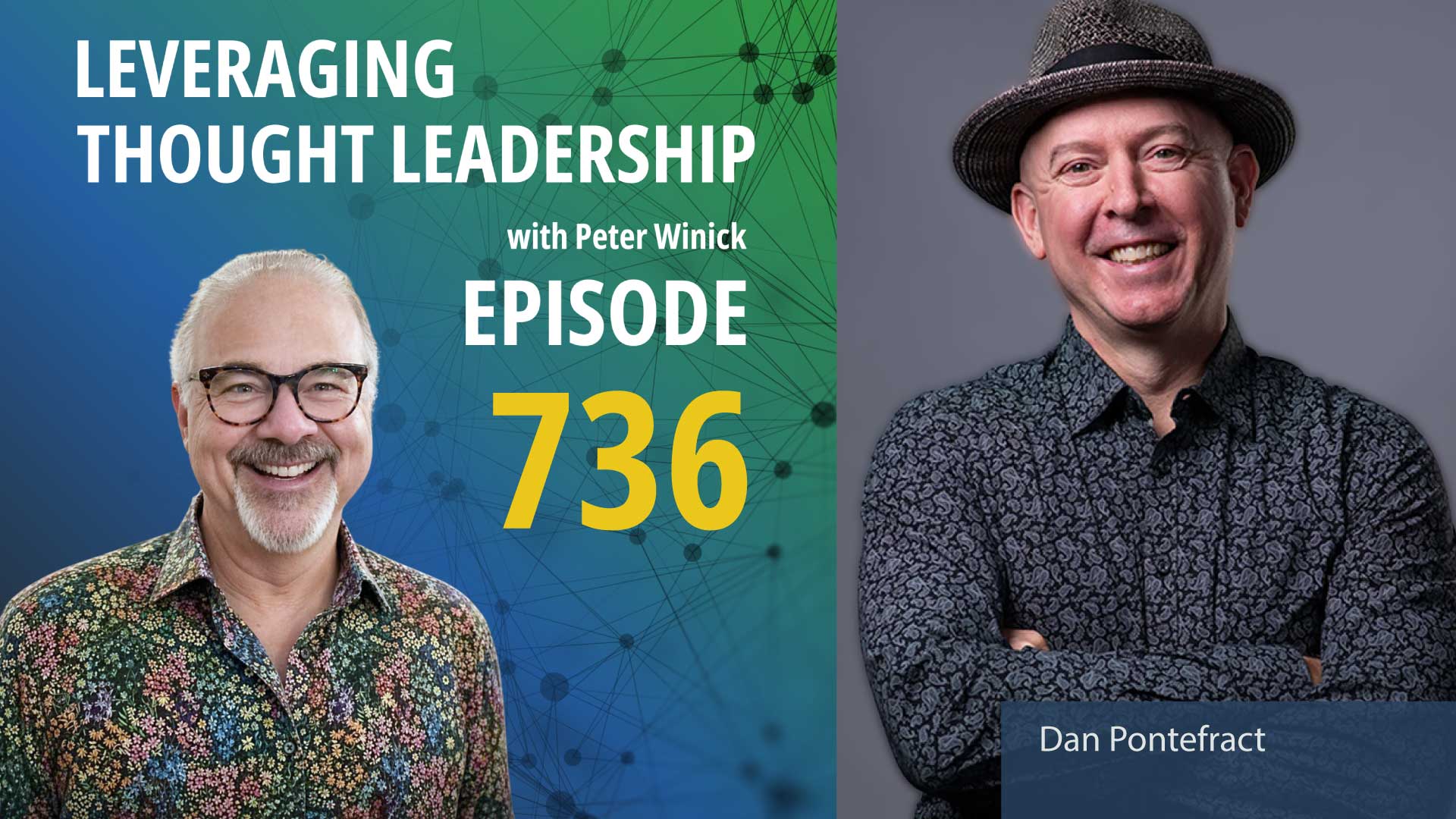



Author Dan Pontefract reframes generational stereotypes for a multigenerational workforce
A leadership strategist unpacks the hidden bias in how organizations invest in — and discard — talent by age, introducing a framework for valuing experience at every career stage. The conversation also explores what it takes to build a sustainable, multi-topic career as an independent thought leader.
Here’s an uncomfortable question: if you replaced “Gen X” with a racial or ethnic label in a hiring conversation, would anyone tolerate it?
Dan Pontefract — leadership and corporate culture strategist, six-time author, and former Chief Learning Officer at SAP and TELUS — thinks the answer says a lot about how casually organizations discriminate by age.
In this conversation, Dan traces the arc that led to his sixth book, The Future of Work Is Grey — from a “reverse ageism” encounter as a 26-year-old college administrator to a career-defining moment when, at 51, a longtime speaker bureau dropped him because they were “refreshing the roster.” That sting, he admits, forced a reckoning: for two decades as a chief learning officer, he’d poured development dollars into younger employees without ever questioning who got left out.
The centerpiece of the episode is Dan’s “Rivers, Rocks, and Rubies” framework — a model for career stages that replaces rigid generational labels (Gen Z, Millennial, Boomer) with a fluid, non-linear way of understanding where people are in their working lives, regardless of age. He also cites new polling data on how dramatically less likely companies are to hire older candidates for AI-related roles, despite AI itself being only a few years old.
Beyond the book, Dan and Peter dig into the business realities of running a solo thought leadership practice: why Dan resists being boxed into one topic, how he splits revenue across keynotes, workshops, and consulting, and why speaker bureaus often struggle to sell someone who doesn’t fit a single, easily marketed lane.
This one’s for anyone who manages people across generations, anyone building an independent expert career, or anyone who’s ever wondered whether the workplace quietly wrote them off too soon.
Three Key Takeaways:
- Age bias hides in plain sight in training budgets. Organizations routinely front-load learning and development spend on younger employees while quietly deprioritizing workers past 45 — a pattern Dan admits he ran for years as a CLO without questioning it.
- The Rivers, Rocks, and Rubies framework replaces generational labels with career stage. Instead of sorting people by birth year, Dan argues everyone moves through fluid (river), stable (rock), and wisdom (ruby) phases at their own pace — and no phase is superior to another.
- A multi-topic thought leadership brand is harder to sell but more sustainable. Dan’s refusal to niche down to one keynote topic makes him a tougher pitch for speaker bureaus, but it’s let him build a business across consulting, workshops, and keynotes rather than one
repeatable speech.
Dan’s episode is a case study in exactly what Peter, Bill Sherman, and Naren Aryal explore in The Thought Leadership Handbook: a powerful idea — in this case, that age is an asset organizations are squandering, not a liability to manage around — only creates impact once it’s shaped, packaged, and built into a sustainable business. Dan’s Rivers, Rocks, and Rubies framework, his refusal to niche down to one keynote topic, and his deliberate choice to run a solo practice rather than scale a firm are all decisions the Handbook helps thought leaders navigate in their own work. If this conversation had you thinking about how to package your own expertise for a crowded market, The Thought Leadership Handbook is the field guide. Order it today at Amazon, Barnes & Noble, Bookshop, or Amplify, or learn more at thoughtleadershiphandbook.com.
Get Your Copy of The Thought Leadership Handbook at:
Amazon
Barnes & Noble
Bookshop.org
Amplify Publishing
Apple Books
Transcript
Peter Winick Welcome, welcome, welcome. This is Peter Winick. I’m the founder and CEO at Thought Leadership Leverage. And you’re joining us on this LinkedIn Live, which is a special edition of our Leveraging Thought Leadership podcast. And today, I’m really excited because Dan is not only an amazing thought leader, a killer speaker, but a friend and someone I admire very, very much. And we’ve known each other for what? Eight, 10 years, maybe? Yeah, yeah. Yeah. So I’ll give you just the quick, for those of you who don’t know Dan, you should, but if you don’t, he’s a leadership and corporate culture strategist. He helps leaders become better leaders. He said senior roles inside of large companies like SAP and TELUS, and he just released his sixth book, which is called The Future of Work is Gray. Prior to that, he had Work Life Bloom, which was awesome, Lead Care Win, Open to Think, The Purpose Effect, and The Flat Arm. So this is not his first rodeo. Welcome aboard, Dan, what’s going on?
Dan Pontefract Peter, I mean, friends first, so I hope everything’s going well. Thank you for that. It’s always it’s just, you know, fun hanging with you, whether we’re having a cocktail, those old fashions or gotten leadership strategy. So either way, it’s just a pleasure to hang out with you.
Peter Winick Sometimes we do both at the same time. I recall London. Yeah, exactly. So I just let’s I want to stick to for a little bit. Well, actually, let’s go backwards. Give the world sort of your the world like the three people listening to us, whatever, but we’ll call them the world because they mean the world to us. How did how the hell did you get like is your journey from like musician to chief learning officer to like I did this isn’t a nonlinear, you know, follow the recipe. So how did you wind up here today?
Dan Pontefract It is, yeah, you know, I never thought of it that way. It is very non-linear. Um, there’s a couple of First Nations, indigenous bands that have this metaphor essentially is that we’re all meandering on our own river to the waterfall. And I think that’s pretty apropos for me. I have definitely meandered my own river. Uh, how did I get here? I guess I’ve been a lover of people forever, Peter. And platonically, there was only one lover lover in my life, but, um, I, yeah, like as a kid, I kind of always was gravitated to the kid who is not doing well at school or on the court or on the pitch. You know, I don’t know how, but I always end up being like captain of all the teams. I used to be president of all the student councils. Like, I always just kind of naturally.
Peter Winick You were that guy?
Dan Pontefract Yeah, I was that guy.
Peter Winick I remind the teacher, were you the one that reminded the teacher on Friday afternoons at about two 30? Wait, you forgot to give us the homework you told us about. Were you that? Were you wild? Why?
Dan Pontefract While I was cleaning the chalkboard brushes. That guy would be that guy.
Peter Winick And one of us on this call may have been the class clown. We won’t tell you who it is.
Dan Pontefract It’s not Jess, it’s definitely not Jess. So yeah, I just kind of, anyway, I’ve found my way into that and I, I had a really serious injury as a kid when I was playing soccer, I was at the tryouts for the Canadian national team and my, my knee blew out essentially. And so I had surgery for six months and physio and it was just not great. So, but through all that, I I was like, oh wow, these doctors and physios, they help people, maybe that’s what I’ll do. And so I kind of pushed myself to go be a doctor. And then I thought I’d be a physio and I was like, huh. I don’t think that’s good enough. Now I have all respect for doctors and therapists and healthcare practitioners, but here I was at McGill University of Montreal. I was like, I’m going to switch. And so I went to the guidance office and I said, hey, I don t want to be what my dad is. My dad’s an engineer. I want to get out of this healthcare stuff. What do you got? And they’re like, well, you’re like smart. So you should go be an I was like, no, I don’t want to be an engineer. And they’re like, you should stay. You should stay where you do it. I was like, no. And then I kind of. Flip through the list, essentially Peter.
Peter Winick Kind of looked at the menu and said you know I don’t like the veal do you have any sea bass tonight?
Dan Pontefract Yeah. And we’re not sure if you’re allergic to shellfish, but let’s have, let’s give it a go. So, so I said, Hey, you’ve got education. And this woman looked at me like, yeah, well, maybe I’ll be a teacher. Yeah. I was like, Yeah, I’ll be a teacher because that helps people get better than what they were. She’s like, you can’t be a teacher. I’m like, why? It’s like you’re too smart. I was there. Oh, okay. I’ll show you. So honestly, I kind of meandered as to your point, I, I fell into a B.A.B. Ed, so bachelor’s of arts, bachelor of education. She was right, eventually, because I only lasted being an educator, like a high school educator for two years. I was like, what am I doing? So that was when I was 22 and 23, 24. I had married my beloved French babe, Denise, right after university. We got married right then.
Peter Winick Wait, wait, I don’t like when the guests get technical. French babe, is that a technical?
Dan Pontefract Technical term my french baby denise la mache say tu parles français peter uh no okay that’s fine
Peter Winick We got it, we got it.
Dan Pontefract So Denise and I moved from Montreal to Vancouver and we’re teaching at this high school together in the same school. And I’m like, what am I like, it’s not, I’m not against educators surely, but it’s just the clientele. I just wasn’t made for 14 to 18 year olds. So after, after like six weeks in the gig, I say to these, I am going to have to retool and re vector here. She’s like, What? Yeah, don’t worry. We’ll figure it out. So we moved to Ottawa, so we spent two years in Vancouver, we moved Ottawa, and I take one of those, you know, 18 month all you can eat tech certifications. So I had my Microsoft, my Novell, my Tromtea, all through this college.
Peter Winick If the teaching thing didn’t work out, I’ll be the Novell networking.
Dan Pontefract I’m gonna be the guy that lays out cable, I guess. Now I’m beginning to piece it together. So now I’m 25, I’m like, okay, I like business, I like tech, and I like people, like the educating of people. So now, I’ve now just about turned 26, I finished this thing, and Denise and I also loathing winter in Ottawa Because Vancouver is a rainforest, it doesn’t have winter. So I put together, this is how old I am, a VHS tape that is a five-minute introduction to Dan Pontefrac to the Dean of Computing and Academic Studies at the British Columbia Institute of Technology at BCIT. And he gets this VHS type that basically says.
Peter Winick But that was a risk because what if he was a beta guy? Like it would have been lights out, right? If he was beta guy.
Peter Winick Or laser disk. Yeah, like you didn’t get the format right.
Dan Pontefract Yeah, well, it didn’t get sent back, but I did get an invitation, uh, because in the video I had realized that the Institute had just opened up a downtown campus in Vancouver, it was eight floors, brand spanking new, and I was like, you need someone with ideas maybe to sort of help career changers. So they
Peter Winick As a friend, we’re going to rebrand part of that story that you were the pioneer in short form content and video.
Dan Pontefract Yeah, see, I’m not I’m Canadian. We’re not very good at marketing, you know, it’s like.
Peter Winick That’s why you and I have worked together, right? So you were one of the pioneers in short form video content. Let’s just take that away.
Dan Pontefract Right, so I still need Peter in my corner to help me with my narrative, right? Yeah, that’s basically what I’m hearing. OK, so so they hire me. And this is now 1997. And I’m like unleashed. Like there’s the academic campus, you know, 20 minutes away by car. And then there’s this downtown campus and it’s some of the floors are rented out already. But there’s basically these three floors where the team at BCIT said, all right, like figure it out, essentially.
Peter Winick Part of academic like that’s kind of right like that.
Dan Pontefract It was wild then, totally wild. And it was, get this, it was cost recovery, meaning there was no government funding. So anyone that came through the doors came with a check and it wasn’t subsidized by the government. So long story short, that was like a six or seven year training ground where I built, with a team, I had a great team, high tech business program, like change program. So it could be. 12 months, six months, nine months, I was helping executive assistants become better executive assistants. I was help people with a degree become business development technology guys and gals, right? You name it. We were doing it.
Peter Winick Now it sounds like all the pieces are coming together.
Dan Pontefract I am now thriving. So team was amazing, we built it up to be like a $5 million business, like it was.
Peter Winick Oh, okay. Yeah.
Dan Pontefract But that I had, again, the meandering part of the river, you know, what was happening kind of by year four or five, I was like, okay, so they paid for my MBA, fantastic. But now I’m thinking, if I wanna be a really good professional and even a better academic, I better go into the real world.
Speaker 5 Meaning corporate, a little bit of dark. Yeah.
Dan Pontefract Yeah, so I started listening to calls like people would phone because they’d hear me hear of me or I’d meet them. So long story short, then in 2002, on the fall, I decided to leave this cushy, awesome, fun, family like entrepreneurial team and entity that we had built for what eventually
Peter Winick This is the part where we cut to the French babe rolling her eyes going here we go again Dana
Dan Pontefract Yeah, she’s like, What? We don’t have any kids. You’ve got a pension. What are you doing? So, so, so I joined a company called Crystal Decisions. It was a business intelligence company. It was about 350 million rev. It had about three ish thousand people, of which there’s about 600 headquartered in in Vancouver, which is where it was founded. Yeah, yeah, real it is? Six months after I joined as its global education director, they were purchased by a French company called Business Objects. And so, you know, now I’m having now, so I’m getting my real world experience here, Peter, right? It’s like, oh, so that’s how this real world works. There’s acquisitions and things. So they make me the now the head of what we eventually called the University of Business Intelligence, UBI. So I have, I have an internal team of about 100-ish people. We are working on the development of people inside the company, but also the production and delivery of software trading for clients and partners and consultants. So I have revenue generation, Ed services, if that’s what we used to call it. Then I have internal development of People. So I’m running a corporate you. And it’s, it’s fun. Like it’s again, built up this culture is wild is awesome. And Then, uh, and then the summer of 2007, SAP knocked on the door and purchased business objects. And so, so now I’m in like, and by the way, during the business objects era, we’ve made like 18 acquisitions. So I’m going through post-acquisition integration stuff, learning all those things. Again, countries all over the world, I’m flying to, to learn about culture and I don’t know. So I just, it’s an amazing training ground. And that’s where a lot of my thinking is beginning to form. I have the academic side. So I’m a high school teacher for two years. I’m higher ed for six years. Now I’m in high tech and I’m going into my seventh year in this.
Peter Winick With a concentration in M&A, right, integration. Totally.
Dan Pontefract So I’m in Palo Alto a lot, like I’m down in the valley riding that 101 a lot. Just, anyway, so SAP purchases business objects and I try, it’s kind of one of my failures in life, I think, I take umbrage with this on myself, but I tried really, really hard to help the senior leaders of SAP see that, yes, they bought now a 11,000 person, $1.1 billion revenue company, But what they inadvertently acquired was like the best damn culture that you should repeat. Right. And, um, yeah, it just didn’t work. They didn’t see it that way. They thought, No, we’ve acquired you. Thank you very much. You know, so So I had a couple options, right? Which is my boss at the time, Dan Klein was so good. He’s like, look, you should stay because you can grow your career here at SAP. It’s gonna be wild. Or you’re this manila envelope that I’ve procured for you. And, you know, give it a couple months, decide what you wanna do. There’s no deadline, but just see what you want to do. So after about a year of me trying, I went back to Dan. I said, I think I’m gonna take the envelope. Yeah And so I took, I took six months off and was a free agent. And we had a five, a three and a one-year-old and my French babe Denise was like, are you, are you ever going to work again? Like what’s happening? But I was trying, I was to decide through the interviews and the discussion, do I go back to academia and run like executive ed or, you know, UBC or McGill or someone like that, who I was chatting with, or do I? Do I continue with my evolution of understanding what the corporate world’s all about? And I had offers from a big bank in Toronto, Adobe in San Jose, and Telus in Vancouver. So it was like banking, Toronto, high tech again, this time in the US, and that was an interesting opportunity to be living in the U.S. As a Canadian, or sticking around Vancouver and helping this telecom who wanted to change its culture. I chose option C. And so I became Chief Learning Officer at TELUS in the, right when Fannie Mae Fannie Mac blew up and the fiscal cliff crisis occurred, I became the guy to help people, you know, go through the storm of that in 2000, the end of 2008. I’m really rambling, but then eventually 10 years later in various roles at Telus, both producing books and beginning to unleash myself externally, I left the CLO role after about five or six years, created my own external consulting firm at Telus to help other clients, and then went on my own since 2018. And that’s where we sit today, my friend.
Peter Winick So I want to just, on the teller side, because I know the back story here, you’re at that point the in-house guru, right? So you’ve got a job and a P&L and things that you’re responsible for. And simultaneously, you’re doing a TED talk, you’re starting to speak a little, you’re writing a little. You’re doing your thing. And they were really, and tell me if I’m recollecting work, they’re supportive, they’re digging it. You know, it’s good for you, it good for them, because you’re really. Sort of telling the stories of the culture that’s built, and it’s good for them to do it. And then at some point, you hit a fork in the road and say, wow, and sorry, French babe, here I go again. I’ve got this great gig, but I want to do something else. There’s a theme here. I hope she gets good gifts on her birthday and anniversary.
Dan Pontefract Flu Vogue shoes, man. Flu Vogues shoes. Oh, there we go. Okay. It’s all about
Peter Winick But then you’re like, wow, I like this speaking thing. I like the head thing. I like his writing thing. I think it’s time to go. And I remember you told me a story once where you went to your boss and said, okay, sorry boss, but this is where I want to go and your boss kind of said, well, you can’t do that. Like, why do you, why does this need to be binary? And they became your first client, right? Which was, which is really, really cool. And even I would say to this day, a lot of the things that you do come from, you know, there’s still a dividend or a halo effect that goes back to tell us from their culture and all.
Dan Pontefract Right And that’s that’s spot on, mate. I mean, we parted full time way is the end of 2018. But on January 1st, 2019, I became what’s called an X IDT member, like the letter X. So I was a T IDT member, T for TELUS, X is a contractor, essentially. That’s what they use it for. And what are we 2026? So that’s been eight years. Yeah, I’m still I’m still running the TELus MBA that I cooked up when I was CLO for Telus. And I still do things for TELUS leaders in various ways on occasion.
Peter Winick I mean, I’m really there because I’ve shared that story with many other thought leaders that are at that place where I think I need to go and like, well, maybe you do, but you know, redefining a relationship. And I see thought leaders do all, do this all the time where a client becomes a vendor, right. And a vendor becomes a friend and a friend becomes publisher and your former employer becomes a client. Like my point here is be creative because as long as everybody’s getting what they. What need desire the only way to work for companies not w two or you know nine to five or whatever there’s other ways to redefine those relationship so. A great idea is only the beginning. In the Thought Leadership Handbook, Bill Sherman, Nala and Arielle and I share what it takes to shape, package, and scale your expertise in a crowded market. It’s available now. Learn more at thoughtleadershiphandbook.com and order it today at Amazon, B&N, Bookshop, or Amplify. I wanna move into your, sort of, now you’re a thought leader, now you are a speaker, now you an author, right, and I called you a thought leader, you didn’t, because you can’t call yourself that. That’s like, violating rule one. One of the things, and you and I have worked together, is you do a little bit differently than many thought leaders, is you don’t only stick to the thing. Right, there’s clearly themes of what one expects from you, but- Yeah. The new book is not necessarily the logical thing I would have expected from Dan based on flat army and called like all the other things. So tell me, you know, why you won’t take my advice or tell me why you do that. Why does this? It might not be the easiest way, but it clearly, and you’re not the only one like Dan Pink that like there are, I would say, very few thought leaders that can successfully move and you not going into like baking. I mean, it’s still in the business genre, but if you’re a radio station and I left you in my car is jazz and came in the next morning and it’s like Sid Vicious, I’d be like, whoa, who messed with the dial? Right? That’s kind of a little bit of you. Tell me how that happens and then I want to talk about.
Dan Pontefract Peter, well First of all, I have an insatiable curiosity quotient. I mean, I am constantly poking holes, reading, trying to flip up rocks and see what’s under it. And I think that’s the duty of someone that self-appoints themselves as a leadership strategist. When I’m at SAP or when I’m a TELUS or Business Objects BCIT. A leader’s, at least I think, my responsibility is to be wide and deep. And if ergo, I am into an individual career now, particularly so, and I get hired for consulting or retainers or a teach, you know, I don’t want to be known and that’s just me, I mean, but I don’t want to known as the change guy. I don’t want to know as the thinking guy. I don’s want to to be known as The Coach. That is just it’s not helpful to me and the people who I work with and nor a guy who wrote a book about purpose is that being true to what what makes me tick. Right, right. I would be miserable if I only wrote about longevity.
Peter Winick Okay, so of all the topics out there, because there are many that are interesting, that cue your curiosity, that you dive into, then you land on the future of work is great, right? Yeah. So, obviously it’s topical, right, you know, the aging work, I mean, there’s a lot, there’s demographic piece to this, although you’re not a demographer, right. But like, the way you come at it, really, when I read it, it’s like, okay, this, only Dan could write, that there’s cultural piece to these, there’s performance piece to those, there’s the people piece to that. You know, you’re this isn’t a, you know, and I hate that, you know, okay, boomer, right? Like it’s, isn’t that right. Or one of the things I love is you’re the few people that say it out loud. Cause I, and, I totally believe it a thousand percent. It is absurd that we label people by their birth. Right. Right. Like you and I are the same, you know, Jen X with clarity, but we’re really different. And just to say, well, Adam, people, Peter are both gen Xers therefore treat them like this. Like. That is so absurd and ridiculous and offensive. And, you know, if you change Gen X to a racial thing or an ethnic thing, you take you know how dare you say that. But it’s it’s almost come it is acceptable. Oh, well, we have Gen Z and Gen Y and this one doesn’t do this. This one doesn’t do that. So give me the. Give me the sort of the back story and the what is future of war, the world, according to Dan.
Dan Pontefract So a couple of really short stories that after mentioned BCIT, so I get the job. I’m Because I’m 26 at that point in that fall I’m downtown and the campus for the first couple of weeks and then I go to my first faculty and staff Meeting at the big campus on the sprawling kind of campus out there in Burnaby, British Columbia I go I go at the time they had staff washrooms and student washrooms. So I go in the staff washroom There’s an older gentleman in there. He looks at me.
Peter Winick The older gentleman, meaning probably younger than you and I today.
Dan Pontefract Uh, maybe I don’t like, he had grays, so I’m not sure. Like I can’t, I can tell age these days. I have no idea. This is definitely older than me. And maybe by 20 or 30 years, I’ve just no idea, yeah, maybe 30 years. So, so he looks at me and he says, um, son, so right away, you know, son. Uh, mind I remind you that this is a staff washroom. So I pull out my lanyard and, uh, so we looked at me, looks at me at the lanyards, he’s like, Oh, well that’s a shame. And then he says.
Peter Winick Dang it. Out.
Dan Pontefract I didn’t know we were hiring people so young these days. So I got this reverse ageism really early on in my now new higher education career, I was like, Whoa, what is like, who is this? What is happening? Am I the young?
Peter Winick It’s a nice onboarding. That’s thank you. Welcome aboard. Good luck. Can I help you, right? That’s, you know.
Dan Pontefract Week two, I was like, whoa. So fast forward to just a couple of years ago, just at turn 50 or 51, and I get a form letter from one of my speaker bureaus. Now I’m past TELUS, now I’m on my own. And the speaker bureau letter goes something like this. Hey Dan, loved working with you past tense. Just so you know, we’re no longer gonna have you on our roster. Thanks for everything. Love, X. So I follow up with a phone call. I’m like, what is this? Like we’ve been together 10 years. I mean, I know I’m not exclusive, but I just, I don’t understand.
Peter Winick Yeah. Right.
Dan Pontefract And so, so then I get the, oh, well we’re, we’re refreshing the roster. Ouch. Yeah. I was like, okay, so 25 years later, right. I got the other end of it. So that irked me. And however, Pete, honestly, like me a culpa because I just told you my whole career, right? I assure you that never once, whilst being a chief learning officer, chief envisioner, whatever the executive roles I had, in charge, Peter, of leadership development, culture, and so forth, I never once thought about age. And meaning I was, I’m a hypocrite, at least back then, where I said that I was here to develop people and leaders and culture, But because I was blind, naïve… Ignorant absent about people both younger and older than me. I was just like doing my jam I’m trying to rectify something that I missed also with this book and I now I realize because I can look in the rear-view Mirror, I I know there will be other 20 30 and 40 year olds maybe even 50 year olds that are as blind as I was and The key thing about this book is not just a love letter to fix what I got wrong But it’s actually enlighten all people of all ages to the very precise, absolute facts that are happening in every single organization. And then hopefully with an antidote on how to fix that.
Peter Winick One of the things that I took from the book that really surprised me is you talk about how most organizations spend their development dollars, their learning dollars, right? And it’s front loaded to the younger folks. So they, and, and whether it’s by intent design, history, this is the way we’ve done it, whatever the curiosity thing says, well, okay, I have resources as the CLO and I’ve got people do, how do I spend them? Okay. Well, the younger need more stuff because they’ve been doing this less. So that would make sense. But then. The flip side of that, does that mean that once you’ve hit 45, we’re going to stop investing in you because you’re a short-term, you’re leaving soon? Why would I continue to upskill you or whatever? So I, you know, I thought about that and thinking, you know, hey, as a leader, how do you not do that? Right. And I don’t know if the answer is because I think that answer is very contextual to the organization. Do you divide equally? Do you spend more money on the hold or probably like, I don’t know, but I think you need to just rethink and say, are we investing our dollars in a way that are aligned to what our business objectives are in an age blind way. Right? You know, like, I think that’s just a new question, which is a good question.
Dan Pontefract There’s a poll that just came out with YouGov actually. Funny you should bring this up. And they asked a thousand hiring agents in America what their likelihood to hire a 60 plus individual for an AI related job versus someone who was 35 and younger. And it’s a 90 10 split.
Peter Winick Which is absurd because AI has only been a thing for the same, you know, is it what you debate, whether it’s three years or five, it’s not 30. Exactly.
Dan Pontefract And so there’s my point is that the biases that we have, like to your point about how we invest in the training and development dollars, right? The bias is, similar to that, just new YouGov poll, that, well, the younger people definitely are gonna stick around longer. So we’ll invest in them and they need the Delta gaps, of course. Why would we invest in the 45 or 55-year-old when they’re not gonna be around longer? But that data suggests that, the 45 year old stays longer than the 25 year old because they’re off looking at other gigs and wanting more different experiences. So.
Peter Winick Again, the 45 year old is also less risk averse. They might have other than if they’re Dan and, you know, the French baby’s rolling her eyes, they have a mortgage, they have kids, they have like, they’re probably less likely to be churning every 18 or 24 months or 36 months, because the time to do a lot of that is, is quite frankly, in your, in the beginning of your career. Hey, if you don’t like it, move on. If you don, you don t change or, you know, you’ve gotten what you need out of here. The culture is in jive or whatever.
Dan Pontefract Yeah, which is why I go back to like my own biases. Like here’s a guy, CLO and a couple of big companies not thinking about it. Yeah. So I think, and then the fact of the matter is way more so than my time as CLO, but right now and going forward, we weren’t talking about demographic disruption back in the day. And now you can’t pick up New York Times, Atlantic, Federal without demographic disruption actually, societally being a conversation point. Yet we’re not having a conversation in the organization make that make sense to me
Peter Winick Yep, so I want to go back to the breaking or the shattering of the sort of that generational thing that you do in the book Okay, and then so now it’s like okay if this whole Gen Z millennial if that doesn’t exist anymore Okay, so that’s cool. Let’s go. Let us move forward, but you really come up with this really beautiful Analogy which is the rivers the rocks and the rubies and I remember when we talked about this a couple years ago When you were starting on this book, I’m like that’s pretty cool because a A river is not better than a rock, and a rock is not. There’s nothing inherently wrong with any of it. They’re all good. A river, it’s supposed to flow, and rock is stability, and a ruby is this polished, beautiful thing. And you don’t have an exact date, expiration date, that a river can only be 21 to 28, whatever. So talk to me, how did you come up with that, and then maybe unpack it a little bit to find it?
Dan Pontefract So paying homage a little bit to a theory that’s been out there, which I’m trying to debunk a little bit, which is two types of intelligence in our workplaces. One’s called fluid intelligence and the other is crystallized intelligence, right? So Dr. Polanyi back in 1948, if I’m getting my math right. And so it basically goes to show or says, it stipulates that you’re young. And then you have ideas and questions and then you get old. And you have wisdom. And I was like, well, that’s not really true because if you think about a Taylor Swift eras tour, she actually did a fantastic job of saying, well, here was when I was young and here’s my middle age and here is my current potentially, right? I was playing around with that because two of my three kids are big Tay-Tay fans. I was, like, eras’ tour, actually we’re all on an Eras’s tour.
Peter Winick Yeah, and so I think also the litmus test that I just did on that is I know a lot of people my age That were out the day the wisdom was handed out So there’s no guarantee Correlation is not causation. There’s a lot of Other my best friends
Peter Winick We’re out that day, like.
Dan Pontefract But in fairness, too, like the wisdom might not be deep, but they may know the tacit knowledge, right? Where the bodies are buried, the how we always did this, and, hey, we did this in 2008.
Peter Winick Any of the escape is. What a VHS tape was.
Dan Pontefract Way does it go in? I mean yeah. Be kind. So basically I was like okay and again paying homage really to some of my First Nations friends and they’ve helped me immensely in my thinking over the years and this idea of the river again came back to oh yeah we’re all in a river so we’re all in the river chasing our way down to our own waterfall that is life right that’s you have your own path I have my own path but we’re all rivers nonetheless. So we’re full of that fluidity. When we start, maybe you start 16, maybe start 23 after college, whatever, whatever, right? Who cares? But you’re full. Ideas, questions, mistakes, looking for answers, trying to figure out how this whole quote work thing works. And it might be in your first gig, third gig, fifth gig, doesn’t matter. But eventually you start to develop some rocks that to your point, the stability, like the, oh yeah, this is what I believe in, or this is I’m good at. And so in your own river that continues to flow, you’ve now developed rocks along the way. And so your rocks era, maybe it starts at 30, maybe it’s 40, maybe you’re a leader, maybe you are not, doesn’t matter. What matters, however, is that you have developed stability, you’ve developed a cadence and processes that begin to work. People look up to you, you can, whatever, right? But what I also realized eventually that you’re continuing your river. And you continue to develop rocks, but the river is continuously flowing against the rocks in which you’ve developed. And then over time, those rocks crystallize into rubies. And the ruby is the depth of wisdom. And again, maybe you’re 50, maybe your 60, maybe 70. It doesn’t matter. It’s up to you when you think you’ve evolved into the Ruby era. And that might be at the workplace, you might be retired. Doesn’t matter again. It’s just that. I realize I’m having chatted with a bazillion people for this book in Japan, in Korea, in Germany, in the US, in Canada, that this tracks. This is what we all go through, like it or not. It’s just that when you’re a river, you can’t see it yet. And when you are a rock, you’re usually the sandwich generation and you’re so stressed from raising kids and dealing with old aging parents and just the workplace. You don’t know that you’re this rock. But eventually, when you get to the Ruby, everyone can look in the rear of your mirror, Peter, and say, oh yeah, That makes sense. So I guess. Long story short, I’m trying to create this metaphor so that more rivers and rocks, more younger and middle-aged workers can see where they’re at, and then maybe they can make a difference for their team, maybe some of the organizational processes and traits, whatever it is.
Peter Winick Love it. Love it all right, so the last sort of Segway here is you’ve been around the business of thought leadership not the business and business But the business you this weird business of fought leadership for a while right couple of neck. What are you seeing? Work what’s not working? You know at the end of the day you’re still doing you know I and tell me if I get this wrong the majority of your revenue. Let’s say comes from keynote That’s the thing that probably pays the most Is that a fair?
Dan Pontefract I paste the most on a per instant basis, but my three streams are retainer slash consulting, workshops, and then keynotes. And it’s, it’s a 50 50 split actually between the keynoted and workshops and then the consulting.
Peter Winick Okay, got it. So. Tell me about the business side of that and what you learned along the way, right? Because you’re a Ruby of that right now. If I was going to give you your own stuff, right. Yeah, because a lot of people say, oh, I wanna be a Keen, I want to do this thing. I wanna to be a thought leader, but it’s usually driven by the work, the ideas, the models, like that piece. And then, which is great, right, like that’s what gets you out of the bed every day. I wanna do the research. I remember talking to you multiple times during this book. You were so jazzed and pumped and figuring it out and then you get stuck. And then like, that’s fun. But, but a lot of thought leaders or those that want to be professional thought leaders, like, huh, like what’s the business, like how do these guys make them like, what do they do? So tell me a little bit, you know, whatever you’re comfortable with, like, What does that look
Dan Pontefract Okay, so I think you got to make a decision first and foremost. Are you looking to build a business and a practice like with staff and people, or do you want to be a solopreneur? Yeah. I chose soloprenure. I chose company of one. I actually mocking myself about it.
Peter Winick And we write about that in our book, that you’re making that deliberate decision of company of mind. Because it’s not a right or wrong decision, it’s the right decision for Dan.
Dan Pontefract The irony is my business is called Pontefract Group.
Peter Winick One person. And the group can fit on a…
Dan Pontefract Unicycle. Exactly. So that’s kind of decision one. Now you can, you can evolve or retrench, right? You could say, Oh, I want now, Dan, I want to create a business now of people and build up a practice. Okay. I have, I’ve reserved that right. Hard to dial it back, but I have seen some thought leaders build up, a practice and say, ah, not for me. And they, they dial it back down to being themselves. Okay. So that would be kind of decision number one, but then you gotta, I, I always talk about the trivial pursuit pie graph, right. And so what’s, what are your pie pieces? If you’re- If you’re just a key noter, then my advice is to have a speech and sell that speech a billion times. Yep. Now for me, that’s boring as hell. Never do that in my life. I in fact, I’ve never given the same speech twice. I tell everyone everything’s curated and tailored for you. But if you want to go out on your own as a quote, thought leader, and you want to make a bunch of money doing keynotes, the event planners and the euros. They need to know how to sell you and you can be much more sellable when you have a singular topic and a singular speech because that’s rinse and repeat territory. That’s not me. My biggest gap between working with bureaus and event planners is like, you do what? What? No. Can you, can you tell me what’s your topic? What’s your speech? So I have to do a heck of a lot of convincing If I so choose on why they might hire me and what I can do for them. The thing that is really the Ruby wisdom coming out now, the really big takeaway, and I’m okay with it, but it’s the bureaus and the event planners who can’t make the connection between how I can tailor and curate and customize anything in any realm, basically under leadership arena.
Peter Winick But the deal there, with all due respect to those lovely folks, bless their heart as they say down south, is they’re tasked with doing an event. And I call them checklist people, right? They’ve got, what do we need for the event? Oh, we need food. OK, great. Oh, vegans are going to be here. We need food for the vegans. The hotel needs to be. Oh, need to speak on something. What’s the something? One word, innovation, resilience, grit. Oh, yeah, I think, check, check. Check. So that’s one person. That you need to satisfy, but the real person you need to satisfy is the buyer, that business leader that says, I’m bringing in Pontefract because this is the guy that speaks to whatever that thing is that we’re working on. And he could, it’s not that he’s gonna give the same performance, this isn’t Broadway, eight shows a week, he’s going to make the points that I need to be made for this group at this moment in time, and I have to trust that he is going to help get me there. And I think that’s a different, it’s just different. It’s a difference.
Dan Pontefract So you’re right. And it’s and so what I’ve learned over, you know, the last 15 ish years, is that there’s a very unique, different type of buyer that’s more interested in me than maybe some of my colleagues that are just keynote speakers of their one book and one topic. I have nothing against the change speaker or the speaker, right? But I am a also more than a speaker. So That’s the other thing. I don’t brand myself as a speaker. I just happen to do 20 or 30 keynotes a year. Great. But I when I do work with groups who are trying to get to know me or beginning to get the know me, they’re like, oh, you do psychometric assessments. Yeah. Oh, you can do organizational design. Oh, well, you could help us with our board strategy. You can help us with our purpose like then that’s the good stuff that I get to do, which is, oh my gosh, Dan, you’re an onion. Oh, yeah. I’m terrible at branding, but yeah, I’m more like an onion.
Peter Winick Exactly. All right. Well, this has been great. I appreciate your time. I always appreciate your work and we always have some fun when we have the opportunity to chat or connect. Thanks for coming on today, Dan.
Dan Pontefract Peter, thank you always for the love and support and can’t wait to support your new book coming out in July 21st. Yes, thank
Peter Winick Thank you. Appreciate it.
Peter Winick Great.
Peter Winick To learn more about Thought Leadership Leverage, please visit our website at ThoughtLeadershipLeverage.com. To reach me directly, feel free to email me at peter at Thought Leadership leverage.com and please subscribe to Leveraging Thought Leadership on iTunes or your favorite podcast app to get your weekly episode automatically.
