
How Career Pivots Really Happen | Mary Olson-Menzel | 735
The Leveraging Thought Leadership podcast is created by Peter Winick and Bill Sherman and produced by Thought Leadership Leverage.
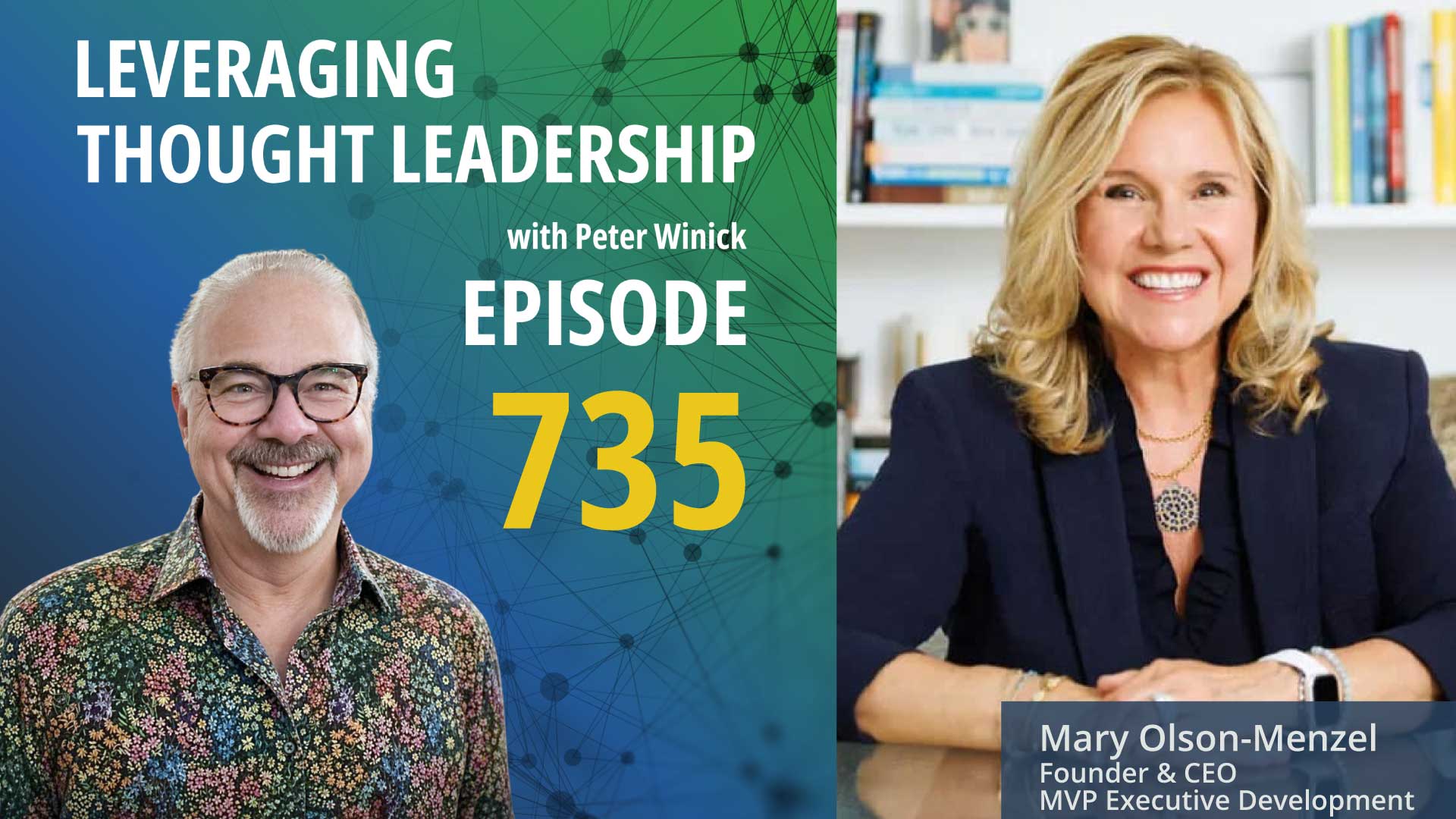



An executive coach on turning pattern recognition into a proven career-pivot methodology
A career coach traces her winding path from TV reporter to executive recruiter to founder of her own firm, revealing how her signature coaching methodology emerged from pattern recognition, not planning. The conversation digs into the strange economics of publishing a book meant to inspire, not just sell.
What does it actually take to build a coaching methodology that thousands of people rely on?
According to Mary Olson-Menzel, Founder and CEO of MVP Executive Development and author of the national bestseller What Lights You Up? Illuminate Your Path and Take the Next Big Step in Your Career, it wasn’t a strategic plan. It was fourteen years of watching.
This episode traces Mary’s career from local TV news reporter through executive recruiting to founding her own coaching practice, one built on pattern recognition rather than a whiteboard plan. Mary describes herself as a kind of “business anthropologist” — someone who spent years sitting inside the career transitions of hundreds of people at MVP, noticing what worked and what didn’t, long before she ever called it a methodology. When her husband pointed out she was doing all this work for free, that observation became a business, and eventually, her book.
But the conversation with host Peter Winick doesn’t stop at origin story. Peter pushes into the weirder mechanics of the thought leadership business: why a book is a strange kind of product, one that can be a commercial failure by publishing standards and still be the single best lead-generation tool a coach ever built. They talk through the tension every author faces between reaching the broadest audience and reaching the audience that pays the most, and why “low ticket to high ticket” isn’t really a ladder so much as a portfolio.
The most memorable moment might be the one neither of them planned for: a call from a prison reentry program, using What Lights You Up? to help incarcerated women build a path back to meaningful work. It’s a reminder that thought leadership, once it leaves your hands, often does things you never designed it to do.
If you’re building your own methodology, writing a book, or trying to figure out how the pieces of your business are supposed to fit together, this one’s worth the listen.
Three Key Takeaways:
- Methodologies get discovered, not designed. Our guest didn’t set out to build a coaching framework — it emerged from years of “business anthropology,” watching hundreds of career transitions unfold and noticing the patterns clients couldn’t see in themselves.
- A book’s commercial success and its business value aren’t the same metric. A book can sell modestly by publishing standards while still generating a waiting list of high-paying clients — the real ROI shows up in the funnel it builds, not the royalty check.
- Thought leadership travels further than you plan for it to. Content built for one audience (in this case, corporate professionals) can end up serving entirely unexpected populations — in this episode’s case, a prison reentry program — which is a sign the ideas have real, durable value.
If this conversation had you thinking about the difference between a book that sells and a book that actually builds a business, Peter’s own book is the natural next stop. The Thought Leadership Handbook: How the Experts Elevate Their Big Ideas—and How You Can Too, co-written with Bill Sherman and Naren Aryal, draws on more than 700 conversations just like this one to map out exactly what Mary Olson-Menzel described living through: how experts turn hard-won pattern recognition into a repeatable methodology, and how that methodology gets shaped into a book, a platform, and a business. It’s the playbook behind the questions Peter was asking in this episode.
Get Your Copy of The Thought Leadership Handbook at:
Amazon
Barnes & Noble
Bookshop.org
Amplify Publishing
Apple Books
Transcript
Peter Winick And welcome, welcome, this is Peter Winick. I’m the founder and CEO at Thought Leadership Leverage and you’re joining us on the podcast which is Leveraging Thought Leadership. Today my guest is Mary Olson Menzel. She’s a renowned career expert, a seasoned executive coach, and the author of the national best-selling book, What Lights You Up, Illuminate Your Path and Take the Next Big Step in Your Career. She’s an active member of the Marshall Goldsmith 100 Communities and she’s done a lot of amazing and interesting things that we’ll talk about. So welcome aboard, Mary, how are you?
Mary Olson Menzel Thank you, Peter, it’s great to be here.
Peter Winick So let me ask this sort of my favorite question. It’s my show, so I get to do what I want sometime. The only place I think. How’d you get here? How did this happen?
Mary Olson Menzel Oh, my, what a loaded question. It was a circuitous path. And that’s part of what I think is the most beautiful thing about it. You know, started my career as a television reporter many, many years ago and was innately curious about getting the story and figuring out what kind of makes people tick and what makes people do the things that they do from there.
Peter Winick What kind of reporting, was there any specific, was it investigative? Was it any particular type that you focused on? If you’re under 35, Google television reporter, just by the way. It was a thing. It was cool thing.
Mary Olson Menzel Anchor. No, you know, I was so young. I was just out of college. I had done a couple internships at TV stations, and then got hired by one of the stations that I did my internship in. So I was I was low man on the totem pole, literally. I was the field reporter who went out and covered, you know, the anniversary of the Girl Scouts, you know, you know, USA and the, you know, all kinds of different things, local community events. I think. Yeah, it was fun, but it was a lot of running around. I’ll tell you that.
Peter Winick Cool, very cool.
Mary Olson Menzel So from there, so that was a great question. From there, I actually kind of fell into recruiting, believe it or not. I went to go interview for a job because I was, as a reporter, young reporters don’t make too much money. So I was teaching aerobics and reporting clues and working at the clinic counter at Lord and Taylor, all to make ends meet.
Peter Winick Now we also have to tell people to Google Water and Taylor because they no longer exist
Mary Olson Menzel Oh gosh, yes.
Peter Winick Yeah, and aerobics is what we did before Pilates and fitness instructor, fitness instructor.
Mary Olson Menzel Thank you. Yes. Oh my gosh. I’m really aging myself, aren’t I?
Peter Winick No, no, no. I’m feeling right at home, but there might be, you know, I think there’s two young people that listen to this. So I’m just want to ensure they feel included so they don’t whine and cry and all that.
Mary Olson Menzel Yes. Young people happy to help in whatever pivots you’re going to make in your, in your life. But did I went to go interview at a recruiting firm to take a job at an ad agency and follow in my dad’s footsteps. And I was actually the first runner up, you know, I was like, they offered the job to somebody else, but literally I was their number two candidate if that person turns down. And so after I nursed my disappointment, that search from actually offered me a job.
Peter Winick Oh wow, that’s unusual.
Mary Olson Menzel It was very unusual, and it’s one of those things, Peter, I think, for young and people of all ages is, you know, be open to the opportunities that are around you, because sometimes they show up in the funniest of places where you least expect it, and it could put you on a trajectory that leads you to your next greatest career.
Peter Winick So let me ask you this, I would imagine the reporting piece, because reporting isn’t all that different from consulting isn’t all that difference from being an author, right? There’s a curiosity, there’s a research piece, there’s storytelling piece, right. But then you go to recruiting, right, and then the honor, like what do you think some of the common threads were that maybe the folks at the recruiting company said, ooh, she’s got talent, she could win at this, because recruiting’s not an easy game.
Mary Olson Menzel No, no, I think what they saw was the drive that I had, you know, the working free jobs. Yeah, not afraid to work hard, but also the way that the guy Rich Bradley, I’ll throw that out. Rich Bradley gave me this chance in recruiting and the way he framed it was he said, take your interviewing skills and just put them in a different direction. Right. To help people get jobs. And so it was a pivot, but it was using my existing skills. Of interviewing and just doing it in a different way.
Peter Winick I would call it more of a a context shift. Yeah, like, so if you were to set the context to to a candidate of, hey, I’m going to just prep you for this interview and I’m qualified to do that because I’ve interviewed blah, blah, blah, and, you know, and you’re probably giving them pointers on how to communicate, get to the point, be prepared. How do you handle things when you like there’s some things there? So it’s not like you went off and became a yak farmer. Sometimes when we look backwards, there’s a red dot that’s there that at the moment seems like this is craziness. We’re like, kind of makes sense.
Mary Olson Menzel Yeah, absolutely. And that thread has taken me through every job in my life. So thank you for even pointing that out. And I think that’s the really interesting thing is that innate curiosity and those interviewing skills and the desire to help people. That’s the other thread. You know, into even reporting the news, I was always driven by it. The desire to help people live better lives and understand their lives better. And then I got to do that in recruiting and help people find jobs.
Peter Winick Right. That’s very cool.
Peter Winick Yeah, cool. So and then so now fast forward a Couple of weeks till today or maybe Yeah, so the coaching Writing books all the things that you do now talk about like who you serve and how you What kind of problems they come to you or what are they hoping to get done as a result of interacting with you?
Mary Olson Menzel Yeah, I’m going to just take that thread once there and also say, you know, that recruiting and all of that launched me into a career in corporate America. I had a boss and a mentor who believed in me.
Peter Winick Okay.
Mary Olson Menzel And supported my career development. So I did 10 years in a corporate environment where the recruiting and the coaching became simultaneous. And so that then led me to when I had three young kids at home 14 years ago to jump off that cliff, leave corporate America and start my own company. Got it. And that’s where the pattern of watching what it is that illuminates people, what it that lights people up, what it it that gets people excited to go to work every day, became kind of my life’s work and study. And so I created a coaching methodology to help people pivot into new jobs or get promoted in their existing jobs.
Peter Winick Stay there a minute because when you say I created a coaching methodology I would push back on that and say if I were to look at your calendar from 14 years ago It didn’t say this two-week block. I’m gonna create a coaching methodology. They tend to kind of happen like Yeah, so how There’s a million coaching methodologies out there. So it’s not like the world was begging for a new one Yeah, what is it about your methodology? That’s different that gives people something some insight or some value that the others that are out there. Because a lot of coaches use other people’s methodologies, which is fine, but you gotta create something new. So what was behind that?
Mary Olson Menzel So what I saw as an executive recruiter was a clear path about how people could either get promoted or get new jobs. OK. And what happens, Peter, and you know this because you’ve been in this world of thought leadership for so long. But people, when they’re at that precipice or that inflection point of like wondering what’s next for them, they often can’t see it themselves. Right. So, I was helping. Hundreds of people, okay, their job search or getting promoted and and I was doing a lot of it because it was referrals and it was also, you know, people I just want to
Peter Winick You’re spotting patterns a bit emotionally detached from the person looking for a job that might be stressed or upset that they’re losing a job or… You don’t have, not that you’re emotionally detached from the client, but you have the ability to look at it emotionally and say, it’s clearly obvious that when you say X, it doesn’t come across like this or whatever those patterns are, right? So you’re sitting in the middle of this as a big life experiment observing this, right.
Mary Olson Menzel Yes, we always call it business anthropology.
Peter Winick Yeah, exactly.
Mary Olson Menzel We’re in there like really watching it all unfold and learning from it and helping others learn from it. And what a lot of my clients have said is, you saw the path before I did. Yeah. But that is because I’m this observer of watching what’s happening for them and then knowing how to create success and having done it, not only myself, but help hundreds of other people do it.
Peter Winick So then you port that into a coaching framework and methodology, right? Yeah. Yes Okay, we called it the 10-step pivot program for many Got it. And who were the ideal clients for that program? Because there’s usually another pattern there right like not not our coaches for everyone
Mary Olson Menzel Yeah, yeah. For us, in the beginning, it was executives who were looking to make a career change, or executives who are trying to get promoted within their own corporations. Okay. And so that it started with just executives, but then it led to an executive saying, can you help my wife? Can you help my husband? My daughter? Can help my niece? All of that. And then my husband said to me, Mary, you’re not a nonprofit. You have to actually do something with all these people you’re helping. And, um,
Peter Winick and send an invoice, which would be nice, right.
Mary Olson Menzel Yeah, that was kind of the impetus for creating that framework for not only those executives who could afford it, but creating working groups and all kinds of different things for people who maybe couldn’t afford an executive coach. And that then led to the impetuous for the book, because then I really wanted this to get out for more people who didn’t even have access to a coach.
Peter Winick If you ever wondered how strong ideas become visible, trusted, and scalable, that’s the work behind the Thought Leadership Handbook. Bill Sherman, Nara Narell, and I wrote it for experts who are ready to move from insight to real impact. Learn more at thoughtleadershiphandbook.com and order it today at Amazon, BNN, Bookshop, or Amplify. Right, so the book is a way to democratize the intellectual property to the thought leadership and anybody that can come up with whatever the 25 bucks or whatever the book costs, they can get those ideas, right? We’re not gating them behind a paywall and any of that and whatever. I think oftentimes thought leaders are trying to figure out how to serve multiple markets and the CEO of the hat of the thought leader says, well, go for the maximum value, right, go for that. Clients that’ll pay you the most, which is a logical, rational, economic piece. But then the hard side says, oh, I wish I could help more people. This is kind of where I see the voice of your husband going, oh my god, how do you? And there are ways to do many of those things. It just doesn’t mean that you’re not gonna take higher paying clients that will pay you the big bucks because you’re good and really good at what you do, and not do a ton of pro bono work. Read my book, do it yourself, or here’s an online course, or how we have filled out the gap between. You have book and then you have working with you. Think of those as sort of two ends of the low ticket, high ticket. Is there stuff in the way?
Mary Olson Menzel There is, there is. There’s, there’s workshops, facilitate a lot of workshops, many in corporate, but also for associations and conferences where we can help guide and package some of this. It is funny, but you bring up, you know, like my want to help people. And my stepdaughter calls this, you know, what lights you up is Mary’s love letter to the world. Cause I knew that I wasn’t probably going to make a ton of money, you know, selling books, authors who Publisher publishing houses just don’t the publishing houses make the money
Peter Winick If there’s any money to be made.
Mary Olson Menzel Yes. Well, what it has led to, though, is tremendous opportunities where I can walk in and help guide people in corporate America who are needing to adapt in a way that is future ready. We call it future fitness for a corporation, but also online training, group coaching, all of those things.
Peter Winick So stay there minute right so so a book is a weird if we if we think about a book for a moment as a product because it is something people buy Most products if I were you know in the business of selling whatever you know pens right my P&L would be Some function of the amount of profit. I generate per pen less the cost per pen sales marketing general You know G&A and all that and I mean they’re gonna make a good pen or not and make a profit or not It’s kind of easy, but books are weird in that You could have a book that’s wildly successful but commercially doesn’t do much for you, or a book through the metrics that a publisher uses, how many units did we sell, right? Maybe it’s mediocre, I’m making up 3,000 books, 5,000, under 10,000 book, whatever, that made you a fortune, right. Yeah. People don’t understand how bizarro that is. Like if I didn’t sell the pens to make a profit, I’d be a failure in the pen business. But I could sell 1,000 and pick up, you know. 50 clients and I’m like, wow, I’m golden, right? Like it’s, it’s odd.
Mary Olson Menzel Yeah, well that’s so funny because that’s going to lead us to the conversation about the next book, right? But this book was difficult. I wrote it for all the right reasons because I wanted to help people and because we had a listing list of clients and when somebody is looking for a new job, they can’t wait for a waiting list. You know, they cannot wait a year to do that. So that’s kind of why the book went out there. What was interesting is the publisher, of What speaking events and bulk sales could she get? It’s all about book sales for the publisher, of course. That’s the business they’re in. Yes. What I struggled with when this book came out is that it is a book about finding a new job and then how do you create success and lead. The second half of the book is all about creating success once you’ve landed that job. And I think that’s what makes it a really nice, well-rounded book. But I had a really hard time. I struggled with, okay, I can’t walk into, I’ll use IBM as an example because I have done speaking events at IBM.
Peter Winick Right. And I want to teach your people how to get the heck out of here. They don’t want to pay.
Mary Olson Menzel Yeah, I don’t want to do that. IBM doesn’t want me to come in and say, hey, everybody, look for a job that lights you up. But what has the bonus product of this is that it’s created or led to a lot of talks around career resilience and the path of reinventing and reigniting your light within the organization that you’re already working.
Peter Winick Comment on that, then I want to get to the new book. So it led to, to you seems glaringly obvious, but to me, it only is when you listen to the market. And I think far too often thought leaders, I don’t say stubborn, but they don’t hear the signals, right, they put out a book, and they think the purpose of the book is X, and you’re looking at X, but when the market gives them other signals, right, and tells them other things, and tells us them whatever, because it wasn’t their design or what their desired intent was. They’re like, nah, I don’t think so, right? And then thinking four or five times, they’re like huh, okay, yeah, okay. That’s cool, right.
Mary Olson Menzel Yeah, I mean, it was really fascinating. I mean I think my biggest surprise ask was through a contact at the 100 coaches, one of my friends and colleagues, Jennifer Fondrive, she had spoken at a prison. So suddenly I got a phone call from the head of this prison who has a program for women going back to work. I wrote this book as a inspirational business book. Yet it was helping women in prison create a career path. Path forward. And so.
Peter Winick That never would have been on your whiteboard of right, right. That’s my point. Yeah, I love it.
Mary Olson Menzel It’s these moments of like, wow, oh my god, this is touching lives that I can’t even fathom it would have taught.
Peter Winick So tell me about the new thing.
Mary Olson Menzel There’s a couple of new things in progress, and I think there’s one that I’m going to be writing with a friend and a colleague, a former client actually of mine, that I can’t talk too much about yet, but the one I can talk about is the one that is currently in proposal stage, and that is more of a kind of like what lights you up for leaders, right? Okay. How do leaders continue to motivate and inspire and make sure that no matter what’s happening around them in the world or in the company, that they can kind of stay on this path where they’re keeping their teams ignited.
Peter Winick So it’s an extension of what lights you up, but for the specific leader population, right? Because they have different nuances and things to be aware of, and you’re really building on the IP that’s in the first book there.
Mary Olson Menzel Right, right. And as we know, Peter, and for most people who are going to be listening to us today, leaders of any age or any stage are having to adapt to unprecedented things. And even more so, I mean, we thought, you know, the global pandemic was one thing, but it’s not stopped since then. And so the idea of leaders having to navigate uncharted territories and unknown waters. Giving them that guide and that, you know, kind of flashlight to help them light the way.
Peter Winick But that’s really, to me, I think a lot of leadership literature, if you will, was really glorified management stuff. The way to do things around here is the way to things around there. With true leadership, we can’t go as, say, a 40-year-old high performer and say, well, let’s go talk to Peter and Mary, who’ve been here longer, and say how they dealt with AI when they were at my stage of their career. Like, it just, right, so he was going into the wilderness going, I don’t have the answer. I don’t know. I think I’m going to figure this out together and be to say they don’t know what they don’t t know. I mean, it takes courage. It takes that’s different than a manager that has the expertise to do the thing, the task, the whatever versus the leaders like, listen, we’re going to take this path. Who knows? Maybe there’s lions and tigers and bears and you know, like whatever.
Mary Olson Menzel And how do I help those people, you know, the people that work for me in my organization, navigate the lions and the tigers and the bears along the way and keep them motivated too.
Peter Winick Yep, totally very very cool So look forward to seeing the new the new thing and the secret thing that you you’d have to kill me if you told Me what it was. I don’t want that. I want that on my head or yours, right?
Mary Olson Menzel Next podcast, next podcast.
Peter Winick The next podcast, okay, we’ll have more on that. This has been cool. Thank you for sharing your journey and your story, and we’ll see if we can Google Mary Olson Menzel aerobics instructor. We’ll see there’s any bad video on YouTube.
Mary Olson Menzel There we go, there we go. Thanks. You Peter, great to talk to you.
Peter Winick To learn more about Thought Leadership Leverage, please visit our website at ThoughtLeadershipLeverage.com. To reach me directly, feel free to email me at peter at Thought Leadership leverage.com and please subscribe to Leveraging Thought Leadership on iTunes or your favorite podcast app to get your weekly episode automatically.
