
The Difference Between Opinion and Real Thought Leadership | Lisa Bodell | 734
The Leveraging Thought Leadership podcast is created by Peter Winick and Bill Sherman and produced by Thought Leadership Leverage.
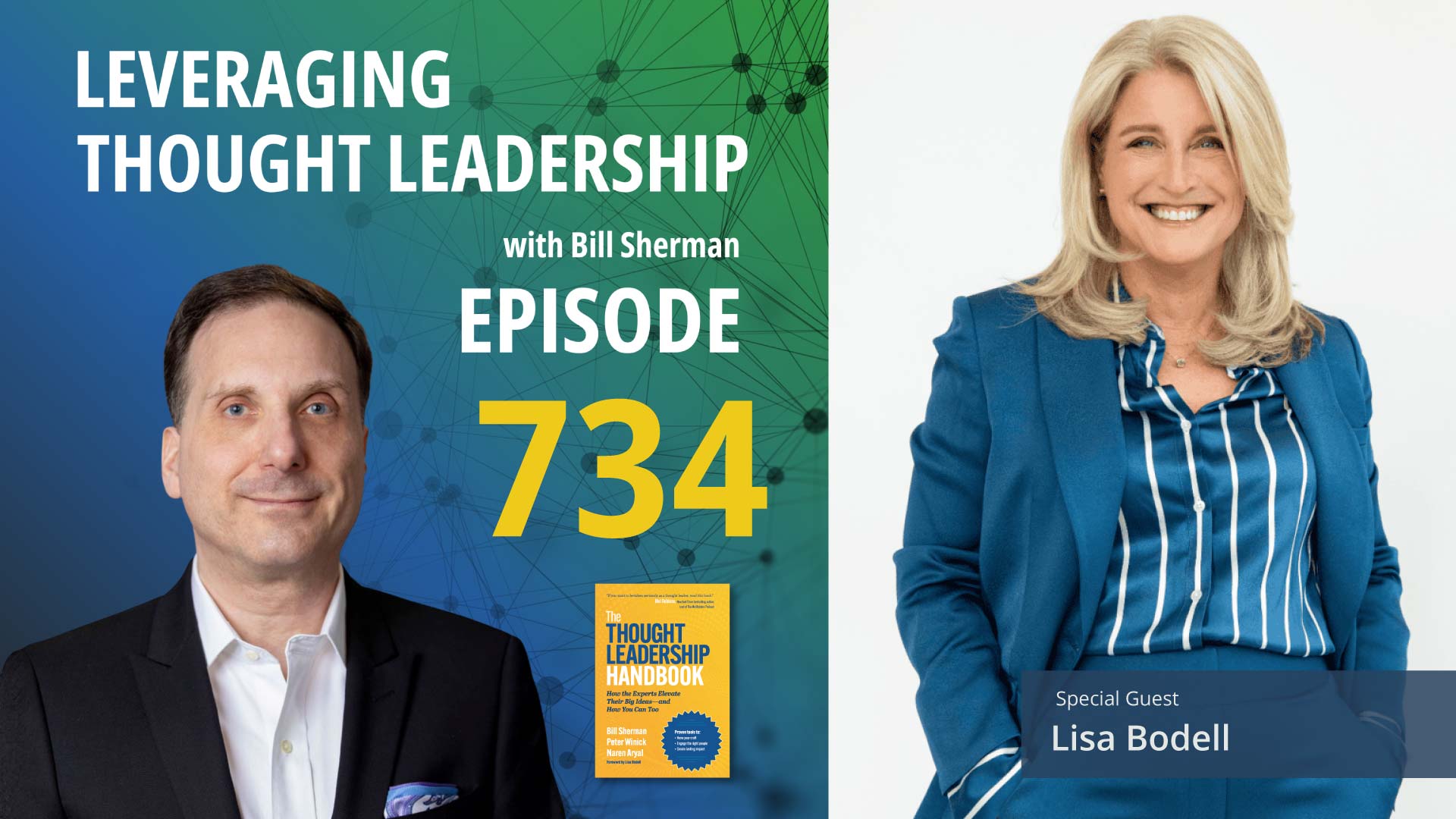



Bestselling author Lisa Bodell on practitioner credibility in the age of AI content
A veteran author and speaker unpacks the real story of writing a business book — the imposter syndrome, the messy middle, and the years it took to feel ready. The conversation explores what separates genuine thought leadership from empty opinion, and why vulnerability has become the new authority.
She was skeptical about writing a book for years. Not because she lacked ideas — because she’d watched too many people write books for their ego rather than for their reader.
In this episode, Bill Sherman sits down with Lisa Bodell, CEO of futurethink and bestselling author of Kill the Company and Why Simple Wins, to talk about what actually happens between “I should write a book” and “I finally did.” It’s not the tidy origin story most authors tell.
Lisa walks through the real arc: the excitement of a new idea, the trough of doubt that follows (“Oh my God, this sucks. What am I doing?”), and the slow climb back out. It took a CEO telling her directly — get this into a book — before she finally said yes. Even then, she describes the process as “easy, hard, transformative,” all at once.
The conversation turns into something bigger than book-writing advice. Bill and Lisa dig into what separates real thought leadership from the noise flooding LinkedIn and social feeds right now. Their shared conviction: an opinion isn’t thought leadership. Only lived, tested experience earns you the right to speak — and if you have something of real value, staying silent isn’t neutral. Someone else will fill that space, often with ideas that sound smart but have no practical foundation underneath them.
They also get honest about imposter syndrome — something Lisa says never fully goes away, even after decades on the world’s biggest stages and inside the highest levels of government and Fortune 500 leadership. The fix isn’t confidence. It’s proof: doing the work long enough that you can defend it when someone pushes back.
If you’re sitting on an idea, you’re not sure is “ready,” or you’re wondering whether the publishing world still rewards vulnerability over polish, this episode will change how you think about the whole process. It’s a grounded, generous conversation about what it actually costs — and what it’s worth — to put your ideas into the world.
Three Key Takeaways:
- An opinion is not thought leadership. Lisa draws a hard line: you earn the right to speak on something only after you’ve actually done the work and understand what people go through — not from reading about it or having a hot take.
- Imposter syndrome doesn’t disappear with success — you work through it, not around it. Lisa describes years of testing and bulletproofing her ideas before publishing, until she realized the real question wasn’t “am I ready?” but “how much more proof do I need before I take the leap?”
- Vulnerability has replaced pure authority as the credibility standard. Both Bill and Lisa note that today’s most resonant business books admit what didn’t work, not just what did — inviting readers in rather than lecturing from on high.
Bill knows firsthand what Lisa is describing in this episode — because he lived it. His own book, The Thought Leadership Handbook: How the Experts Elevate Their Big Ideas—and How You Can Too, co-written with Peter Winick and Naren Aryal, grew out of the exact same doubt, discipline, and vulnerability Lisa unpacks here. Drawing on more than 700 conversations from this very podcast, the book turns those lived, tested stories into practical frameworks — including five “thought leadership avatars” — for anyone trying to move from having an idea to actually building influence with it. If Lisa’s honesty about imposter syndrome and the messy middle of writing resonated with you, this handbook picks up right where that conversation leaves off, with the
tools to get you through it.
Pick up The Thought Leadership Handbook published by Amplify Publishing Group, wherever books are sold — including Amazon and Bookshop.org.
Get Your Copy:
Amazon
Barnes & Noble
Bookshop.org
Amplify Publishing
Apple Books
Transcript
Bill Sherman Some of us never plan to write a nonfiction book. That was true for me and my co-author Peter Winick before we wrote the Thought Leadership Handbook. And it’s also true for Lisa Bodell, whose first book, Kill the Company, originates in a moment where she called an audible during a workshop. Lisa has practiced thought leadership in many different ways. She’s authored multiple books, she delivers keynotes, and She’s a thought leadership business builder who has built a team and crafted solutions for enterprise clients. Lisa was also one of our first readers for the Thought Leadership Handbook. And she graciously agreed to write the forward to our book. In today’s episode, Lisa and I have a conversation around unplanned authorship in the writing process, how to find your voice in thought leadership and what thought leadership is, and must become. I’m Bill Sherman, and you’re listening to Leveraging Thought Leadership. Let’s begin. Lisa, I’ve wanted to ask you this question for a while. You’ve shared that when people suggested to you, hey, you should write a book. You were kind of skeptic on that idea back in, what was it, the 2010s?
Lisa Bodell Yeah, it was 2012 believe it or not. Yeah, seems like it was just yesterday. It’s a long time ago but yeah, I was skeptical I was very skeptical about it because I Well, first of all, I didn’t think I’d have the time and second of all I had this very I know I had a preconceived idea that the people that write books Have egos and basically they were just doing it for themselves, you know to get out there to say that they had a book And many do by the way
Bill Sherman Right, it’s a credentialing thing.
Lisa Bodell It’s a credentialing thing and I, you know, I’m somebody that likes to balance sizzle and steak, like I really am a down to earth kind of person. And I said, I am not going to share something unless it really has substance. And so it took me a long time before somebody convinced me that I should write a book. I was very, very resistant.
Bill Sherman What convinced you? What was the thing that flipped it?
Lisa Bodell Because after a while enough people said to me, I have this, this exercise that I was doing with all these companies called kill the company. And basically it was a very provocative way to get them to attack their own problems before somebody else did it to them. And it was really cathartic and I’m very good at provoking people, but in a comfortable way. And when I had enough people from enough different backgrounds say to me you should share this with others. That made me realize, oh, so this isn’t about writing a book so I can feel like I’m important, which is how I perceived people do it, but it’s about sharing ideas so more people can benefit from them. And that’s what really convinced me is I had one CEO, actually, it was the CEO at Merck, at the time, Ken, say you really should get this into a book and get it out there more. And I went back to my publisher and said, okay, I’ll do it. That’s what put me over the edge.
Bill Sherman So the journey on writing the book.
Lisa Bodell Oh, no.
Bill Sherman Easy. Hard.
Lisa Bodell I truthfully, yes, all of it. I mean, the first part I would say is that I hated it at the beginning. And that’s like, no one wants to hear that because you’re supposed to say, it’s wonderful. It’s cathartic and transformative and it was, but you know, the joke of anybody that is in a creative field is when you start with an idea, you’re excited about it. And then As you get into it, you fall into this trough of like, oh, is this good? Maybe it’s not good. Oh my God, this sucks. What am I doing? I can’t believe I did this. And then you start to come out of it and you come onto the other side of, you know, it’s that bad. Maybe this will work. I guess I do have something to say, but until you go through that journey and really think through your ideas and bulletproof them, you know it can be really hard. And that was the journey that I had. I was really excited. And then I realized how hard it is to really put your ideas into words in a way that will appeal to everybody, not just to yourself. So I would recommend to anybody doing it, but I wouldn’t think for a minute that it’s gonna be simple.
Bill Sherman You mentioned something that resonates with me on my journey, you know, you’d been running the workshop for a while and you’d had feedback, you had your activities, you have your frameworks, but there’s something different about having to put it in writing and the rigor that a book requires rather than, Hey, I can just sort of dash this off and run it for 45 minutes. And then we move on to the next activity.
Lisa Bodell Yeah, because it’s more than the exercise. It’s the, like the psychology behind it. It’s, the emotions that people go through. It’s. The fears that they might have, and it’s needing to address all those parts, not just to somebody who facilitates an exercise or an idea, but how people receive it and what they may be going through in that process emotionally. And so I had to think that through and that’s what really took a lot of time because I wanted to make sure that I wasn’t being flippant about anybody’s perspective or their emotions. And I’m really glad I took that time to think it through because otherwise I don’t think it would have been as rich or relatable. Did you find that?
Bill Sherman I did, I did. So from, well, what’s now the thought leadership handbook, we’ve been using our frameworks and consulting back into the 20 teens, right? Yeah, for years. And so those are the tools that we’ve been using, put them behind the consulting paywall. And you know, if I even go back further, back in the early 2000s, my first big thought leadership consulting project was working with Keith Frazzi on. Never eat alone, I’m taking that to scale, right? And I quickly realized moving from a consulting perspective into thought leadership advising, there were no tools, there were no real frameworks on how do you make thought leadership better or how do you scale it. So I went to building it. That was in the 2000s, used it through the teens and it wasn’t until drafting started 2024, 2025, where I thought I had it locked down. Mm-mm. Went through everything and had to tighten it.
Lisa Bodell Well, I think you have to tight it up. To me, it’s like, you first have this doubt of like, there’s already all these other frameworks out there, so who would want mine? You know, that’s the kind of thing I went through, which is like, so who’s mine? But then somebody said to me, well, why not yours? Like, what makes theirs different or better than yours? And it wasn’t that it was better, it’s just mine was different. Like I had something to say. And you and I have talked about this, which is, you know, I thank if you have something that’s unique, you do have a duty to speak. It’s not like everyone’s entitled to an opinion, but if you have something of substance, I think you have a duty to speak if it could benefit others. That’s the idea.
Bill Sherman Absolutely, and this is where you and I deeply align, is that if you hold ideas to yourself and you don’t share them, somebody’s gonna still fill up that space. They’re gonna put an AI LinkedIn post out there, ideas that maybe they work, but they have no practical foundation underneath them.
Lisa Bodell That and you know it’s interesting because i think especially now and when it comes to thought leadership so much of thought leadership is bs and i think that the reason i really aligned with what you were talking about the book is is that you come from like i do a practitioner’s standpoint which is you know an opinion is not thought leadership until you have actually done it and know what people go through i don’t think you understand and so What you did, what I did, is you don’t get to a point of publishing a book until you’ve actually done the work. There’s too many people that get out there, whether it’s self-help or some of this other opinion leaders or influencers, where it sounds like a pithy phrase, but it’s not real in its practicality or its application. So I respect the people that actually go out there and they have a duty to speak because they know that what they’ve done can make a difference. And that… That to me is the human experience. Like we are here to make a difference. And if we have something that can make a difference to people, then we should share it. If we don’t, and we just have something vapid and light to say, I think you keep it to yourself until you really know that it has value.
Bill Sherman There’s a tension there with either imposter syndrome or content insecurity. My ideas aren’t good enough, or I’m not the one to speak. And that can silence people who have good ideas and they’re saying, oh, someone else will cover it. So there’s this tension.
Lisa Bodell Yeah, there is this tension and it’s interesting you brought up imposter syndrome, because I have that. I mean, I don’t I don’t know how you feel, but I think it’s a very natural. Right. It’s a very natural human thing to have imposter syndrome, which is, all of a sudden, people are going to see my ideas and they’re going to think they’re total crap, right? They’re going, Oh, who am I to think that I was what kind of ego must I have to want to put it out? But and so that’s why I think it took me so long to get to the point of publishing, because I wanted to make sure that I had the goods. That I really had tested it like I could back it up if somebody pushed back on me. And then at some point I’m like, well, how much more do I need before I’ve proven myself? So you just at some time have to take the leap.
Bill Sherman Well… And the place that I also reached was, let’s put them out there. Let’s have a conversation about the ideas. Let have a discussion in the field of thought leadership of what’s the language we’re using, what tools, what frameworks. I think of it sometimes like the field is a bunch of early Renaissance Venetian accountants, each house having its own sort of way of keeping the books before double entry. And it’s like, if we can’t have a conversation among ourselves as to what is the leadership and how it works, how do we explain it to our friends, our families, our clients, anyone, right?
Lisa Bodell I mean, to me, thought leadership is people that have actually done the work, right? That’s the difference to me in this age of social media and everybody having an opinion that sets it apart is to me you’re allowed to have an opinion if you’ve actually stepped in those people, that person’s shoes and been there. Because again, it’s not just about the actual action of doing thought leadership, but it’s understanding the emotion and the perspective and the humanity that comes around it. That’s what makes a difference in a leader. That’s the difference between reading something in Harvard Business Review and actually running a company. So, and I think they’re very different things.
Bill Sherman On leveraging thought leadership, we’ve talked with hundreds of authors, speakers, executives, and experts about how ideas create change. And then we wrote a book. The Thought Leadership Handbook brings those lessons together in a clear, practical field guide. Whether you’re just starting thought leadership or you’re ready to move to scale, this book will help you take the next step. Learn more about the book at thoughtleadershiphandbook.com and order today at Amazon, B&N, Bookshop, and Amplified Publishing. I have talked both in writing and in person now about thought leadership being an act of service, of generosity, of giving and elevating others rather than look at me, look at
Lisa Bodell Right there. That’s the difference. That is the difference and you can tell it when you know somebody who spends a Significant portion of my life on the speaking circuit and like you consulting and writing books you know very quickly when you meet other speakers and other authors what their motive is and Whether it’s real or not So if everyone has you know, if they can’t go off their talk track or their sound bites or go deeper I know that they’re not the real deal And if they’re not willing to admit a fault or when it hasn’t worked genuinely, I know they’re the real deal and they haven’t done it. No good leader or thought leader is worth their weight if they haven’t had an experience that’s made them question themselves.
Bill Sherman Well, and that was one of the challenges, is I was curating the stories from our podcast into the book. And so we had a number of guests who had shared moments of profound vulnerability. So either the moments of self-doubt, Janet Fowdy at Deloitte, CEO and board chair, describing one of the scariest moments of her career? As when she sent out emails asking to interview clients for her book. That was not high-risk consulting project strategy or anything. It was, can I talk to you about my book?
Lisa Bodell She was terrified. But it’s vulnerable. And what’s so interesting is that, and I get this a lot too, you probably do too, is somebody now who, I have a few more city miles on me and I’ve racked up a few titles in my life, people will say, I can’t believe that you’d be intimidated by something. And I said, you’d been surprised. Because, right? I mean, like I’m human, I would think, why does somebody want to give me their time? And it’s true, you would think that. Like I’ve been able to go in at the highest ranks of some of the you know our national intelligence agencies one of the biggest CEOs but some of them biggest. I’m headaches you ever some of biggest concerns you have when you just have to ask for something simple from a friend or from a colleague or a favor because it’s putting you in the position of. Asking vulnerability being told no and that’s a very human thing.
Bill Sherman So a second example on that, Stephen M. R. Cuffee. So the son of Stephen R. Said for a number of years, he was content to let his dad, implicitly even after his dad had passed on, to continue to be the thought leader and he could run the business because he didn’t want to be a poor man’s Cuffe.
Lisa Bodell Yeah, I mean that that feeling of like he couldn’t live up to it, right? I’m sure your dad’s shoes, right Yeah, how could you but versus being in different shoes? You know what? I mean, that’s the difference, right so
Bill Sherman And with quotes like that, then I had to look and say, okay, and this goes back to your point on vulnerability and to admit the mistakes. I had the mirror that same level of vulnerability as an author and own up to the, yeah, tried this, here’s what it didn’t work. Not from a, wear the hair shirt and beat myself up. To show here’s where people stumble. Here’s where I stumbled, right? I had to mirror the same vulnerability that our guests had.
Lisa Bodell Yeah. And I think, you know, it’s interesting because I think things have evolved a little bit versus when I first, when I wrote my first book, you know, the first publisher I had was a lot more structured in terms of how a business book had to be. Right. And, but it’s evolved now over time, and I think you’ve probably seen a little bit of this too, to be more accepting of people being human and to be vulnerable. It used to be you could only be the authority. And now it’s I can show you what worked and what didn’t, so you feel comfortable and I’m inviting you in to do it with me.
Bill Sherman Absolutely. And that’s that practitioner piece.
Lisa Bodell That’s right. And so that’s the practitioner piece. And that’s what I really, you know, again, liked about your approach to the book, which is, you know, the books that always come from on high, I don’t believe that they resonate with the widest audience because they don’t invite you in and make you feel like you could ever be that person. And if really our job is, duty of care and duty to share, we have to be able to say, look, it’s not going to be an easy journey. Here are the things you’re probably going to go through. So you’re human. But you will have to try hard, you do have to have something unique and you do you have to do this for a greater purpose, then people get on board. And I think that’s how things have evolved in a much better way than when I first started writing books.
Bill Sherman So, Lisa, I want to ask one question before we break, and that’s this. You had your sense of what thought leaders were, what they did, why they wrote books in that moment where you’re like, no, no no no, that’s not me. If you had to sum up in a sentence or two, why you practice thought leadership now? What is it that keeps you going when you look at a travel schedule to go, okay, that’s insane or you know. How you have to push yourself to a new level? What does that mean?
Lisa Bodell Because I think there used to be just one way to be a leader. You know, it was again, that authoritative leadership. And I think what I’ve learned is, especially as you get older, that’s absolutely not the case. So if I can give people a more human way and practical way to go about it that makes them feel like they can do it, I think we’re gonna leave the world a better place because there are many different problems that need to be solved and that requires many different kinds of leaders. And so if I could share how it worked for me and it helps them, I’m gonna leave things in a better a place. That’s what I think it’s my job to do. To inspire people to want to lead in the way that they think they should lead.
Bill Sherman Fantastic. Thank you, Lisa.
Lisa Bodell Thank you. Thank you for your book. I appreciate it
Bill Sherman Every episode of this podcast explores a different thought leadership journey. And now, many of those lessons have been brought together in our new book, The Thought Leadership Handbook. To go deeper, visit thoughtleadershiphandbook.com where you can read a free excerpt, discover your own thought leadership avatar, and access tools designed to help you sharpen your strategy. That’s thoughtleadorshiphandbooks.com. Order your copy today at Amazon, B&N, Bookshop, and Amplify.
