
Why Personal Branding isn’t about You at All | Vanessa Errecarte | 733
The Leveraging Thought Leadership podcast is created by Peter Winick and Bill Sherman and produced by Thought Leadership Leverage.
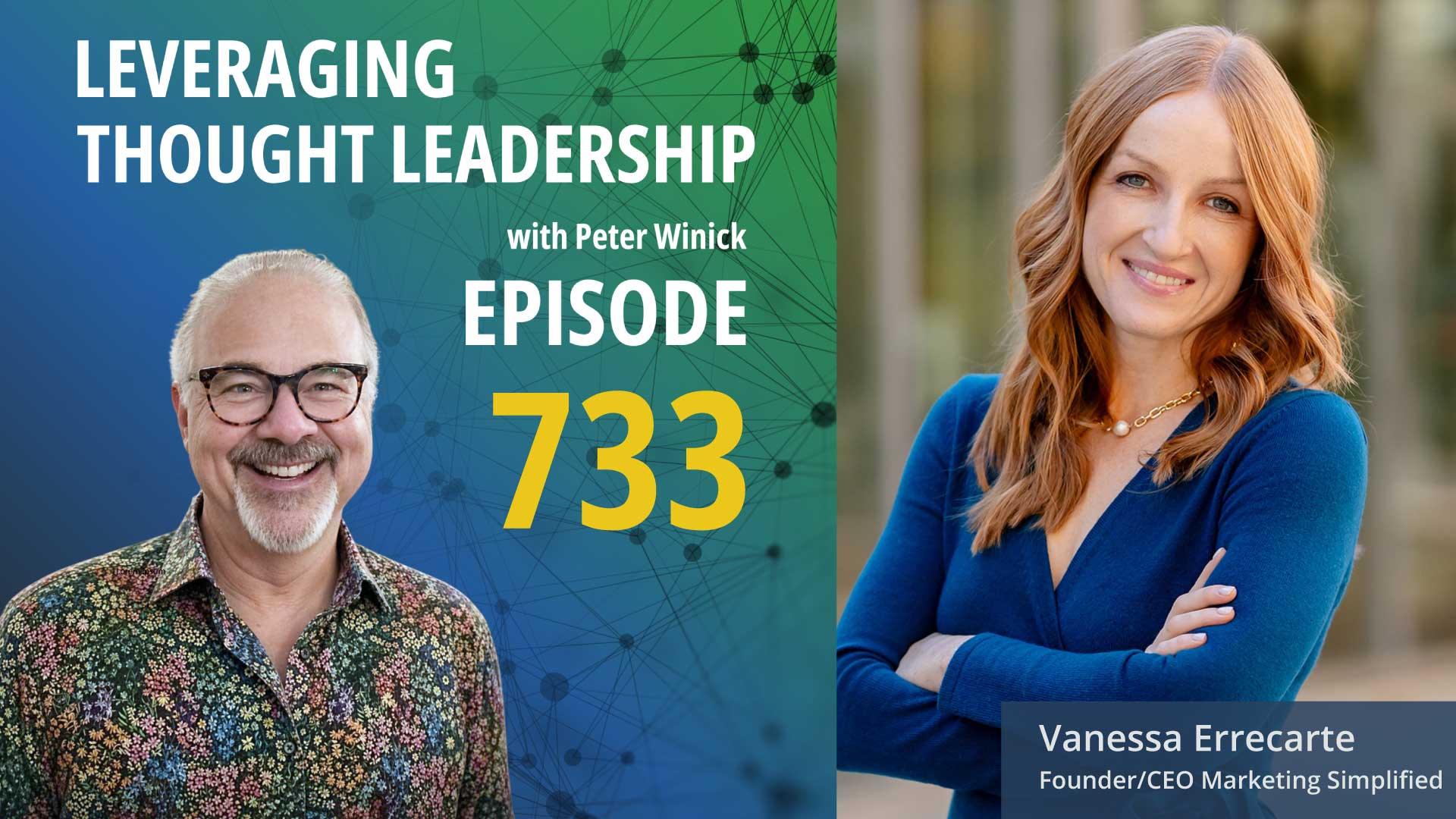



Vanessa Errecarte on service-first branding, frameworks, and treating your career like a lab
Why does personal branding make smart professionals cringe — and why is invisibility no longer an option? A marketing lecturer who built one of the first MBA courses in the subject reframes it as service, not self-promotion, and shows how frameworks (not talent alone) make expertise memorable.
“Personal brand” might be the most cringe-inducing phrase in business vocabulary. Say it out loud to a room of accomplished professionals and watch the shoulders tense — it sounds like self-promotion, follower counts, and algorithm-chasing. Vanessa Errecarte, Founder of Marketing Simplified, the UC Davis Graduate School of Management lecturer who built one of the nation’s only for-credit MBA courses on the subject, thinks the term isn’t wrong — it’s just been hijacked.
Her argument is simple but reframes everything: a personal brand was never about you. It’s about intriguing people with what you know. Errecarte walks through how she teaches this to students who assume they need one more degree, one more title, or ten more years of experience before they’ve “earned” a point of view — and why that assumption is backwards. Disney didn’t wait to explain who Walt Disney was before telling the story of a mouse and an idea. Neither should you.
The conversation gets tactical fast. Errecarte shares the story of a Master’s student — a Division I pitcher with “no experience” — who discovered his own expertise by describing how he coaches Little League kids through overcoming self- consciousness on the mound. The insight wasn’t buried in a resume; it just needed the right questions to surface it. That’s the throughline of Errecarte’s approach: frameworks, not talent alone, are what make thought leadership teachable and repeatable.
She and Peter also dig into why hesitancy is a signal worth paying attention to rather than a reason to stay quiet, why a small audience is actually the ideal place to test new ideas, and why AI is compressing the timeline for professionals to move from “great at the skill” to “great at the thought.”
If you’ve ever bristled at the phrase “personal brand” but suspected your best ideas were going unheard, this episode offers a genuinely different way to think about it — and a workable starting point for the back half of a career.
Three Key Takeaways:
- Personal branding is about service, not self-promotion. The most memorable professionals aren’t the ones broadcasting their credentials — they’re the ones sharing what they know in a way that helps others think more clearly. Reframing “personal brand” as “what value can I offer” removes most of the discomfort people feel about it.
- You don’t need more experience to have a point of view. Errecarte’s framework helps people — from first-year MBA students to seasoned executives — surface expertise they already have but don’t recognize as valuable. The right questions, not more credentials, are usually what’s missing.
- Treat your career like a lab, especially early on. A small audience is a feature, not a limitation — it’s where you can test ideas, get honest feedback, and build confidence before the stakes get higher. Waiting for a “finished” idea before sharing anything publicly is a bigger risk than sharing something imperfect.
If this conversation got you thinking about how to actually build and scale your own expertise, Peter’s new book is the natural next step. The Thought Leadership Handbook, written with co-authors Bill Sherman and Naren Aryal, breaks down exactly what it takes to shape, package, and scale your ideas in a crowded market — the same “framework over talent” thinking Vanessa talked about today, applied to your whole body of work. It’s available now at Amazon, Barnes & Noble, Bookshop, and Amplify, and you can learn more at thoughtleadershiphandbook.com.
Get your copy:
Amazon
Barnes & Noble
Bookshop.org
Amplify Publishing
Apple Books
Learn more at thoughtleadershiphandbook.com
Transcript
Peter Winick And welcome, welcome, this is Peter Winick. I’m the founder and CEO at Thought Leadership Leverage and you’re joining us on the podcast which is Leveraging Thought Leadership. Today my guest is Vanessa Ericarty and I’ll tell you a little bit about her because she’s really interesting. She’s an award winning lecturer and marketing consultant who created and teaches one of the nation’s only four credit MBA courses in personal branding which is kind of cool at UC Davis Graduate School of Management. She also teaches an array of other popular marketing courses and has been twice named teacher of the year. She’s a poet and quants best and brightest, and she does a lot of other cool stuff, but I’d rather talk to her than tell you about her. So welcome aboard today, Vanessa. How are you?
Vanessa Eccecarte I’m doing well, how are you? Thanks for having me.
Peter Winick I am good. So wait, I actually buried the lead. So we’ve got a new book out which is valuable and visible. So I buried the link there a little bit. So give me a sense of how did we get here? How did all this happen? Because it seems like one of those interesting, not necessarily linear roads.
Vanessa Eccecarte Right, right. It wasn’t, it wasn’t. So when I started teaching at the UC Davis Graduate School of Management, I was asked to teach digital marketing and corporate branding. And so I taught that for a few years. I still do. And then I started realizing, and this was before AI, a tidge before AI, but, you know, pandemic time, how hard students had to work. To stand out and find jobs. And this is like the story of the market right now, right? But we were starting to see it then. And if you make it to the UC Davis Graduate School of Management, you are exceptional. I mean, it’s a top tier school and you’re really a talented human with quite a lot of neat, wonderful standout experience, right.
Peter Winick Well, let me ask you a question on that, though. The ability to stand out has gotten increasingly more difficult. Was that moment in time sort of that COVID post-COVID? Do you think summer was attributable to the loss of the face time and now shifting to being recruited and interviewed on Zoom or not really?
Vanessa Eccecarte It may have been. I think so. You know, your guess is really as good as mine on that. But I just kind of realized that it just seemed like there was this toil. In fact, I’ll tell you. I’ll Tell you why. And I do think lots of FaceTime is part of it because I think recreating that FaceTime in another way is how a lot of students successfully replace that these days, but we’ll get there in a moment. So you know what kind of got me thinking in particular is a star student in my corporate branding class. Like if she was struggling, everybody is struggling. Right. Right? And so I said, let’s work on your personal brand. And I could kind of see her shoulders go up and she’s cringing. And I cringe too. Like I don’t love the term personal brand, but I lean into it because I want to change it. And I said. But what if I said your personal brands, not about you. What if your personal grand is intriguing people with what you know? And, and this is where I think we put the word personal in front of brand and we get cuckoo because you know, You know, brands.
Peter Winick Stay here a minute, because I love this. So I’m old enough to vividly remember, I don’t remember the year, because I’m that old, but like, 96, 97, when a copy of Fast Company magazine, if you’re under 40, Google magazine, there were these tablets, right? And it was a brand new, it was, you know, brand new computers, and it looked like the Tide logo and all that stuff. And it started like a movement, like, and this was pre-social media, right, that there was internet, but it was not, you video. The whole personal branding thing exploded. And the takeaway from it was, you gotta do something to stand out. Because being smart, like you’re saying, all these kids at the school, they’re smart. Like, you didn’t get there by being a dope. That’s not enough anymore. And I clearly remember, second point of the story is about five years ago, I was lucky enough to be able to interview Tom Peters on this show. And I went to sort of get his take, and I said, hey, Tom, I remember this personal branding think, and I say. And the way a lot of people interpreted that at that moment in time is, OK, well, if I’m a smart analyst, first year lawyer, whatever, and all my colleagues are just as smart, just do something. So wear a purple bow tie or bring cinnamon coffee buns to every meeting or don’t wear socks. And people would remember you for that. And I’m thinking, I actually think thought leadership is a better way to describe what personal branding is, could be, and should be for someone.
Vanessa Eccecarte Yes. Yes. And you do such a brilliant job, which I’m so honored to be here, by the way, when you talk and teach about thought leadership, right? And so I think, though, that we can become thought leaders. If we know something, we can be come a thought leader, but we don’t always realize it. And so when I, when I talk to students, I think sometimes there’s this feeling and I don’t think this feeling goes away ever for some people, but until a lot later for many of Well, I need this one more degree. I need these three more years of experience or whatever it is I need before I become a thought leader, right? But let’s think about the corporate brand, right. And let’s about Disney. And Disney started as a mouse and an idea and Disney didn’t wait. And Disney didn’t talk about who is Walt Disney. Disney talked about the story of this mouse and idea because that mouse and a idea brought comfort and happiness and magic to a lot of children and families. And so, you know, in a way, you never have to know who Walt Disney is or what his qualifications are because he had such a cool little mouse. And so sometimes when we’re feeling hesitant, and sometimes I think the people that are the most hesitant have the most to share because they’re wondering if it’s good enough, which is a signal right there, as you know.
Peter Winick But there’s also a catch-22. There is a point in time in your career where, I mean, there are other times in your life where it may be imposter syndrome or insecurity or talk to your therapist and figure that out, and we’re all still wrestling with that. But then there’s another time where, hey, I’m only, whatever, a year out of school, and I’m in this place, I am at Accenture or McKinsey, like one of these intimidating Google, fill in the blank. And there’s people here, like I’ve always been the smartest in the room, and now I’m not. And I’m surrounded by greatness and brilliance and whatever. So I probably should feel a little insecure. And what I’ve seen really, really smart people do in that instance is say, hey, you know what? I might not be the expert that’s got the 10 years in the thing, whatever the thing is. But I know that right now, everybody’s interested in something, something AI. Maybe you could be the one that just asks the question out loud to others and comes back to the organization, the team, whatever, and say, hey, I’m not telling you to listen to me, but I went and talked to five people in this field. And here’s what I curated. So I think it depends on how you’re defining thought leadership. Some of it is original and some of it could be curation. Does that make sense?
Vanessa Eccecarte I love that you said that because I actually think that we have a huge misconception out there about thought leadership. We all think it’s a magic thing that these smart, distinctive people have, but we can learn it, you know? And that’s what I started thinking about is I teach this rigorous corporate branding class. Why not apply that to the personal brand for these students, right? Because when that student did, she found a job within a few months that she really wanted. And the thing that I think a lot of people miss. That you just alluded to is this idea that thought leadership means you’re a genius. Actually thought leadership means you think, thought leadership means you are memorable, thought leadership means you ask the right questions, right? And so I always tell students, in my book I have many case studies but they’re all normal. People but varying levels of experience because a lot of my students have varying levels of experience you have executive nba programs you have full-time people going right in you have masters of management going right and you have kind of mid-career working professional programs so i have like doctors to people with no experience and so i’ll tell you about Carter for a second because Carter’s intriguing in this way because Carter uses that thought part of it because Carter went straight into a master’s in management degree. And so when Carter was in a workshop with me, you know, he’s saying like, okay, but I don’t have work experience yet. But Carter was, he was in the master of management program because he had a fifth year of NCAA eligibility for playing division one baseball. And he’s a pitcher, a very good pitcher. He was recruited to UC Davis to be the pitcher. And so… He said, you know, I just, what do I even talk about? Right. And, and so he actually, it wasn’t quite like that because he was, I could see the gears definitely turning and so I knew I could put them on the spot and I said, well, what, do you know? And he said, Well, I mean, I do think that I know how to help people stop overthinking things. And I’m like, how do you that? And he said, well. There’s a time when you know i volunteer i coached at little league and there’s a time when a lot of people quit and my son had actually that season taken the spring off little league because he was feeling self-conscious and so i’m like continue you know and he said well whenever we teach kids to pitch you have this coach usually a dad standing there on the mound next to the kid and every little thing they do with little arm is being coached. And he said, what I like to do and how I learned to pitch best is I like to stand next to the child and just show them where the strike zone is and tell them, grow as many balls as you can right in that area. And then I have them start throwing them. And the first time they make a strike, I say, stop for a second and explain to me what you did. And then I praise them and I ask them to remember that and I don’t ask them to do it again. I just say, okay, keep throwing and then I stop them the next time. And he said, you know, within 20 minutes, by the fourth time they’ve grown a strike, something like that, they’ve taught themselves how to pitch strikes. And he says, couldn’t we do that in business meetings? Don’t you think? Don’t, you think if we observed other people’s styles, we could all work in a way that’s more comfortably for us and have more natural ideas. And all of these pitches and meetings would be. More effective. And I’m like, well, Carter, I want more of you. Right? And in this world of AI, you know, those people that can think in different ways. And we have frameworks to tease this out, right? Because Carter was following a framework that I was giving to him to step by step, think about what are things you know? And then what’s the real problem that people don’t get? And how do you do it different, right, we can take these steps and hammer out these ideas. It’s not magic, but when it comes out, when you actually stumble on it, then it’s pretty cool, right? It’s a good moment when you realize who I can do it to.
Peter Winick So I want to, I mean, to me, that really speaks to, from a thought leadership perspective, the power of frameworks, right? Because if Carter was a pitcher that could throw a fastball faster than anybody else, and he got up there and threw a 100 mile per hour ball and handed it to me and said, just do what I did. I’d be like, I can’t do that. I don’t have the physical capabilities to do that, now if the promise to me is I can help teach you to throw a ball as fast as you are capable of. And I’m gonna break that down into steps that you can follow, even if I only get to half of what he’s capable of, at least I have a framework to follow. And people find comfort in that. A great idea is only the beginning. In the Thought Leadership Handbook, Bill Sherman, Nara and Arielle and I share what it takes to shape, package, and scale your expertise in a crowded market. It’s available now. Learn more at thoughtleadershiphandbook.com and order it today at Amazon, BNN, Bookshop, or Amplify. I wanna segue for a moment into sort of the, you know, you’re an academic, that’s what you do. What are the doors that have opened or possibilities or opportunities that have open for you now that, and this is a little bit meta, you’re sort of in the thought leadership world, if you will. And I called you a thought leader, you didn’t, so that’s a key distinction.
Vanessa Eccecarte Yeah. So I, it’s interesting because I think that the doors that open are sometimes doors you don’t expect. So going back to, going back, to the moment where I’m like, yeah, I, I’m going to turn this into a class because she said, the students said, geez, you should turn this into a class. Right. I actually never imagined myself teaching personal branding. Like the term makes used to make me cringe as well. Like I said, I’ve trying to change the definition. Yes. But I realized how important it was. And so stepping into that, like, I guess for me, because I’ve had a consulting business for a really long time and digital and corporate marketing, et cetera, et cetera, I never imagined becoming kind of this personal branding person. But with AI changing the economy, and, you know, I don’t think destroying jobs, but definitely shrinking jobs, I think we all have to become kind of our own mini consultants, I think that big full time role. Is more of the rarity and that, you know, pieced together type existence. The gig economy is the economy. Right. And so, you, know, that’s the unexpected path, right? So going into academia, like after being an industry and now having a foot in both, you know that academia, you think a lot, right. And you’re always trying to be, you need to be on the front end of anything happening or else like, why are you there? And so… Being on the front end of kind of this new wave of how should we do personal branding and redefining it whatnot. I never expected that, but I enjoy that door so much because you know this better than anyone else and you embody this. In the back half of my career that I’m embarking on, this is now my love and my goal. I want people to realize as soon as possible that they have a spot on the internet too. Because we do spend more time online than anywhere else. And we don’t make a plan for that. When you think of your week on Sunday or however you manage your time, you’re thinking of where you need to be and who you need talk to. And the vast majority of us aren’t really planning where the online network comes into that. And so what I want people to do is… Yeah, take an hour to three hours a week and plan that out in a very systematic way, you know, not in that influencer way that I think has hijacked the definition of personal branding. That’s a job you are putting out.
Peter Winick Well, the people say, I could hear it all right, oh, but I don’t have time, I don’t have time. And I guarantee you, 999 people out of 1,000, if I actually looked at how they spent their time versus what they said, I’m like, I could find you three hours a week where you’re scrolling TikTok, or binging Netflix, or whatever, whatever, that you could reallocate strategically, deliberately, in a focused way to get you a better outcome. And you know, in terms of the, you know the ROI. People forget that one of the reasons one invests in a personal brand or any brand, particularly a personal band, is it’s transportable. The fact is you’re probably not gonna be at your first job for 20 years. You might not be there for two years, but a lot of the stuff that you do from a thought leadership, from a content perspective, goes with you. Asterisk, check your attorney, make sure you’re not stealing anybody’s IP, whatever. But you become known for like, hey, I saw your stuff on LinkedIn, or tell me about that time you interviewed. Five senior executives at your firm. That sounded like a gutsy, like, that becomes part of you to go to the next place. And I can guarantee you that all things being equal, that’s more than a tiebreaker, right? If I’m looking to hire someone with X years of experience from an Ivy League school that’s got this and this, and you know, you’ve got that and the others don’t, that’s a win. That’s going to get you across the finish line.
Vanessa Eccecarte Yeah, do you also think it’s a lab? I always tell my students and clients. I think that view this one to three hours a week because I purposely wrote the class thus the book and You need to be able to actually do this or what’s the point and I said view it as a lab Because if you can get good online at hey You know in the past when I’ve done R&D for like a particular product like I take these same four steps that most people do. But here’s how I do step two differently. And this is the outcome when I do Step Two differently. And so if you wanna try doing Step Two differently and you’re a product manager, here’s three steps put in a framework that you can take to do Step two differently, right? And if you can get in that habit of again, being a little contrary, finding the real problem, you have better solution and talking about it, then you start becoming that person in real life too.
Peter Winick You know, so I’ll tell you that the lab doesn’t stop when you’re a student. I work with a lot of clients and they’re known for X, right? And when they produce something, it’s top notch. The research is there. It’s validated. The book is like blah, blah, and then they’re coming up with a new idea and like, I can’t talk about it until it’s locked and loaded. I’m like, that’s wrong. As long as you put the disclaimer out there and say, Hey, you know, let’s say like, like your book, you wrote a book, I read it. It’s a great book. So if you were thinking about something else and said, you know, Hey here’s something I’ve been thinking about lately. And in the spirit of that, here’s a couple ideas I have, versus saying, this is finished product, I spent five years on it, and it is what it is. If you tell me, like, let me get under the hood, and almost say, hey, you know, I know the recipe’s probably not right yet, and it might be a little too salty or spicy or whatever, but I wanna share with you what I’ve got, and I want you to tell me. Because it’s great market validation, right? Because it easier, I’d rather put out a LinkedIn post, that’s a bomb. Than spend two years of my life writing a book that nobody cares about. So I think the world is a lab. I love that thought.
Vanessa Eccecarte And if your audience is small, if your audience is a small to start, that’s a perfect lab because your mom and your best friend, they’re going to kindly tell you that that sucks. And they’re gonna kindly tell you what’s good and then you can do more of it. Right. And as your audience builds, so does your ability.
Peter Winick Yep. And your confidence any as we wind down here, give me a tip that you would give to you five or six years ago when you were a little bit earlier.
Vanessa Eccecarte Yeah. Yeah. I, this is my biggest tip ever. Start sooner. I wish I’d started my business sooner. I wish had everything I’ve done in life. I wish it started sooner. And so I tell people use hesitancy as a signal, because when you have a new idea, a new way of doing something, like I definitely have a different approach to the marketing funnel for my clients. And, you know, definitely this new approach to personal branding is a little different. When I say everyone says personal branding’s about you, everyone’s wrong. Right? And so it’s scary because you are doing and saying things that people haven’t said before. And that’s purposely how we teach people to form thought leadership frameworks, right? Is to be a little contrary. Take that as a signal. I mean, I grew up playing the Oregon trail, right. Like the Oxen died when they were pioneer, right, we had to try and be a pioneer is scary and unknown. And so instead of imposter syndrome and hesitancy, take that as signal because there is a time and you know this so well. That time in someone’s career, when it goes from being so good at the skill, which AI is slowly making this moment come sooner, you go from being great at the skills and a little greater than everyone else to get all your promotions, and then you have to be great at the thought because you’re a leader. And so did you see the New York Times when they were writing about John Ternes and him being favored for the next CEO of Apple? And there’s this sentence in there. And it said… Now Apple needs to choose if they want another deft manager or an innovator. And you and I know that deft managers are great. Like the term doesn’t sound great, but they do keep the company going well, right?
Peter Winick No, and the wheels on the bus stay and, you know, the planes take off on time and the toilet paper gets shit. Like we need that. Bless their rule.
Vanessa Eccecarte And so it’s not a bad thing, but he’s both if he’s around 50 and being considered for the CEO, but he just was never told by anyone that he could become distinctive, you know, and that there would be formulas to do it. And so I always tell people, gosh, you don’t know when that moment is that the New York Times might write that sentence about you per se, right? But be ready for it because they’re going to find it no matter what. So start soon.
Peter Winick Great stuff. I appreciate your time and your coming on board and sharing a bunch of wisdom with us today, Vanessa. Thank you so much.
Vanessa Eccecarte Thank you for your time and all the wisdom you share with us. I can’t wait for your new book.
Peter Winick Thank you.
Peter Winick To learn more about Thought Leadership Leverage, please visit our website at thoughtleadershipleverage.com. To reach me directly, feel free to email me at peter at thoughtleadershipleverage.com, and please subscribe to Leveraging Thought Leadership on iTunes or your favorite podcast app to get your weekly episode automatically.
