
Turning Unpredictable Referrals into a Predictable Pipeline | Mark McIntosh | 732
The Leveraging Thought Leadership podcast is created by Peter Winick and Bill Sherman and produced by Thought Leadership Leverage.
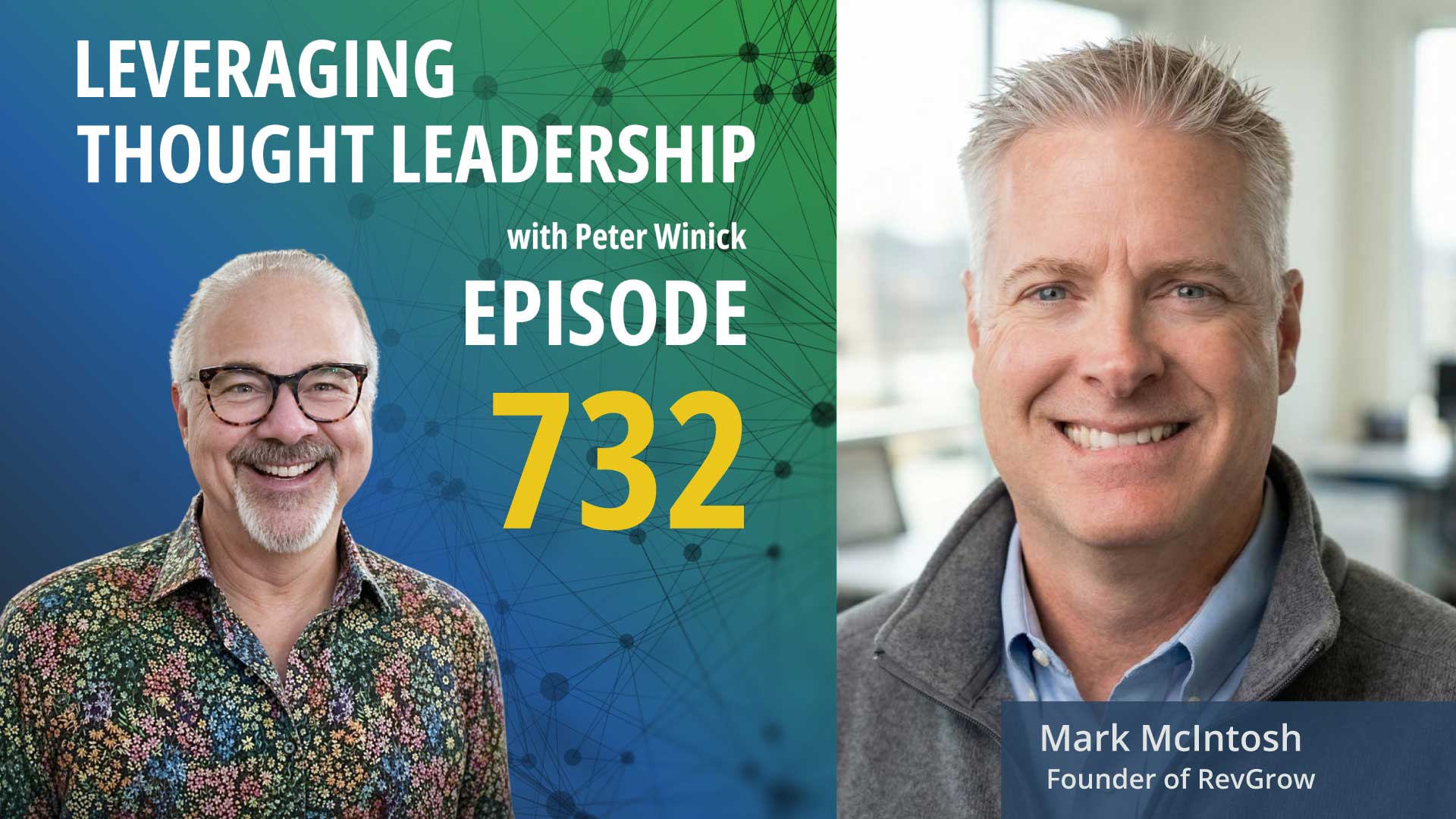



How thought leadership shortens long sales cycles into predictable client wins
Founder-led advisory firms often thrive on referrals — until unpredictability catches up. This episode explores how disciplined LinkedIn relationship-building and consistent thought leadership convert scattered referrals into a repeatable pipeline, showing why trust and reciprocity outperform one-off networking or pitching.
Every founder-led advisory firm knows the feeling: business comes in waves. Referrals and word-of-mouth are lovely — until the pipeline goes quiet for three months and nobody can explain why. In this episode, Mark McIntosh, founder of RevGrow, joins the show to break down why that unpredictability isn’t a mystery to solve, it’s a system to build. A CPA by training, Mark spent years watching talented advisors get referred business only when it happened to occur to someone else — because their expertise “lived in someone else’s memory.” His answer was to build a repeatable playbook: get ruthlessly clear on who you help and who refers you, then use LinkedIn and thought leadership to stay visible with that specific group, consistently, over months and years rather than days.
The conversation digs into what separates this from the “bullhorn” marketing most people associate with LinkedIn — the cold pitches and connect-and-sell tactics that erode trust instead of building it. Instead, Mark and the host unpack a longer-arc mindset: treating visibility like a compounding asset rather than a 30-day campaign, so that when a prospect’s need finally surfaces, you’re already the obvious call.
There’s a sharp, practical discussion of the 80/20 rule as it applies to referral partners — why a handful of relationships typically drive the majority of business, and what it actually takes to earn and keep that position. Mark shares how his own firm operates on this model, including the deceptively simple habits (an immediate thank-you, a follow-up on how an introduction went) that keep referral partners confident enough to keep referring.
If you’ve ever wondered why your best relationships don’t reliably turn into business, or you’re trying to move your firm off the referral rollercoaster, this episode offers a clear-eyed, commercially grounded way to think about it — plus a live example of someone who, in the host’s words, genuinely eats his own dog food.
Three Key Takeaways:
- Referrals are a memory problem, not a trust problem. Good work alone doesn’t generate consistent referrals — your referral partners have to be able to instantly connect your name to a specific problem. Without deliberate positioning, even strong relationships stay dormant until something jogs someone’s memory.
- Visibility is a long-term asset, not a short-term campaign. Marketing campaigns get measured in weeks; staying top of mind with referral partners has to be measured in months or years. Founders who quit after “posting for two weeks and not getting 10 deals” are applying a campaign mindset to a compounding process.
- Trust compounds when you’re the one who follows up. The advisors who get referred repeatedly aren’t the loudest — they’re the ones who close the loop: an immediate thank-you, a proactive update on how an introduction went, and genuine care about the referral partner’s whole business, not just the transaction in front of them.
This episode’s lesson — that thought leadership pays off through consistency, not campaigns — is exactly what Bill Sherman, Peter Winick, and Naren Aryal codify in The Thought Leadership Handbook. If Mark’s approach to building lasting visibility resonated, this book gives you the frameworks to do the same with your own expertise. Out now.
Get your copy:
Amazon
Barnes & Noble
Bookshop.org
Amplify Publishing
Apple Books
Learn more at thoughtleadershiphandbook.com
Transcript
Peter Winick And welcome, welcome, this is Peter Winick, I’m the founder and CEO at Thought Leadership Leverage, and you’re joining us on the podcast today, which is Leveraging Thought Leadership. Today my guest is Mark McIntosh, and he solves a pretty interesting problem that we see often. His company is RevGrow Works, and it works with founder-led advisory and professional services firms, whose growth depends on trust, reputation, and long-term relationships. And it’s really about going from Unpredictable to predictable, but I’ll let Mark dive into a little bit deeper what he does and how he does it. So welcome aboard today, Mark. Thanks very good to join you. So as I understand it based on previous conversation we’ve had, you know, there are lots of founder led consulting advisory firms. I’m guilty of doing that. That’s what I do. Right. And you know the problem they have is it’s good until it’s not right. You know, business comes in and, and, uh, low hanging fruit referrals and all those things are lovely. But oftentimes the revenue or the P&L is a little bit choppy and spiky because the pipeline’s unpredictable, right? So talk about how you saw that opportunity and where you’re playing there and where thought leadership comes in to solve that.
Mark McIntosh Great. Well, about 10 years ago, I launched RepGrow and like you had mentioned, you know, those people, they, they get a certain level through referrals and word of mouth, which is amazing, but they’re unpredictable and there’s not nearly enough of them. And they’re not very consistent usually. And so we recognize that and sought out to solve that problem for our clients. Uh, my background is in professional services. I’m a CPA by trade and just found it to be our, you know, people I was talking with who are now our clients. They were really good when somebody had an immediate opportunity and especially when they were referred in, but where they struggled is their pipeline lived in someone else’s memory to connect the dots and say, Oh, that sounds like something Peter could help you with. Let me introduce you to Peter.
Peter Winick And they don’t fancy themselves or might not have trained at all or studied, you know, just basic marketing, right? You know, if you’re right. Yeah. I think CPAs have it a bit easier than some in professional services because not that nobody wants to see their accountant, but it’s sort of mandated that April 15th coming along where most of us don’t have that in professional service is where there’s a mandated time that you need to do something and then, you whatever, you attorneys, it’s more situational Opportunistic. Advisors, consultants, et cetera, similar thing. So how do you go about doing that? What’s the approach, what’s the method I’m holding?
Mark McIntosh Yes, so we leverage primarily LinkedIn to help our clients basically stand out from the crowd, become known with the right people or in front of the right audiences, and then be remembered, start conversations, get meetings, one-on-ones going, sharing thought leadership that turns into conversations and staying top of mind. So a lot of our clients. The person, like you said, doesn’t have a compelling reason or an urgent need to engage. So it’s like, how do you convince this person that what you’re offering will solve a problem for them? And oftentimes if somebody has an immediate need, yeah, it’s great. Those are easy, low-hanging friends, but it’s like if, if it takes six months, eight months, 24, 36 months, how do ya stay top of mind? So that you’re remembered and ultimately chosen. And so we’ve created a playbook on LinkedIn that leverages thought leadership. First of all, expert positioning and getting clear on your uniques and your audience, your ICP, your ideal customer profile and your ideal referral partner.
Peter Winick Yeah, stay there a second because there’s a lot there and I want I want to unpack some of it. Number one, oftentimes in my conversations with clients about the use of LinkedIn, they cringe. And the reason that they’re cringing is I think we’ve all become victims of really poor, call it etiquette, whatever, on LinkedIn, right? You wouldn’t show up at an event, grab a bullhorn and scream, look at me, look, at me come buy what I have. But in essence, that’s what, you know, so when we think about, you The brand LinkedIn is phenomenal, but when I think about how I get solicited on it, LinkedIn, I put it into a couple of buckets. One is, why the hell did you pick me? You know, you’re offering me sort of outsourced, I don’t know, logistic operational services, not relevant. So that’s, I just call that like stupid, lazy marketing, right? You went right in for the kill. Hey, I’m an accountant, can I do your accounting? No, like you don’t anything, like whatever. So I think and I don’t want to put words in mouth what you’re talking about is if you’re consistently putting out high quality thought leadership to the right people because by the way not everyone cares about what you do could use what you do whatever then when the time comes they’ll automatically go to you in fact I had a conversation with somebody early this morning and his approach which I which I totally love is listen I know who my people are I just don’t know the when do I know what they’re worried about I know what their struggles are so I’m consistently putting our high quality stuff when they need me. On top of mind and his space was in high stakes communication for senior executives so we don’t know in that executive needs you know a communication coach but we know that if they’re following that person’s newsletter they’re reading the things that they’re writing on when a situation comes that they determine is time when they call you you’re on third base from a sales pipeline so does that align with your mindset.
Mark McIntosh 100%. 100%. So it’s adding value, it’s staying top of mind, and ultimately getting chosen and doing it the right way. So many people out there, what you’re referring to, we call it pitch slapping, or connecting and pitching, doesn’t work. But to your point, you got to be clear on who your people are. Who’s your audience? How can you help them? What’s it for them. To read your thought leadership or engage in a conversation. And your ideal customer is one piece of that. A lot of our clients, they’ve grown through referrals like we chatted about. So we spend as much time or even more time getting clear on your ideal referral partners or those COIs, centers of influence. And it’s more of a. Less of a volume game, but more of a quality over quantity, although both are arguably important. And it’s about giving first, sharing insights and offering points of view and things that might be contrary in nature, but they really get the audience to think. But the top of mind awareness and just being front and center with your referral partners and your prospects. Is what we found that our typical clients, they don’t do a very good job at that. So we helped them.
Peter Winick Couple things there. Yeah. Yeah, so one, there’s a there’s a mindset of generosity, right? But I want to I want to unpack a little bit, you know, part of the downside, I don’t know downside, but part of the bug in the referral world is the unpredictability, right. So I, you know, I think we all have most of us should have great referral partners that are important to us, right, we just don’t know, you know, hey, is that person going to refer me? Three times this week or nothing for three months and whatever. And it’s not a top of mind thing. It’s just, you know, opportunistically, their flow, whatever is going on there. So one of the things I want to unpack on what you’re doing, there’s a similar bug in that, in that yes, if we’re consistently putting out in a generous way, high quality content to the people that matter most to us, the outcome will be when the time is right for them will be top of mind and we’ll at least get an at bat, right? I think that for many CEOs and entrepreneurs, there’s an impatience factor. Wait a minute, I’ve been doing this for a week. I posted 10 times on LinkedIn and I didn’t get 10 new deals. Talk about sort of the compounding effect, the flywheel and that, because that’s what I speak to a lot.
Mark McIntosh Yeah, no for sure. It’s to your point it’s about leading first with service and trying to help people and kind of that go-giver mentality and Then it’s a bowel being consistent and intentional With a handful of people throughout the year And I want to say handle that might be eight people that might, be 20 people or 30 people But it’s that consistency and the intentionality and doing things to help them go first, make deposits into that relationship, obviously. And that, that leads to the reciprocity factor. It helps you stay top of mind. It’s fun to help people. And it goes way beyond the checking in or the touching base or the monthly newsletter, which are fine. But not for your inner circle, those people that prospects and referral partners that will most likely refer business your way. Right.
Peter Winick I think about it in a couple of different ways in that there’s a time and place to have what I would call sort of the marketer’s campaign mentality, right? And I don’t mean that in a bad way. Like if you’re doing a marketing campaign, there’s different touch points and you want to see, you know, like a newsletter. One of the things that you need to look at is, well, what’s my open rate, right. What’s the growth rate of that newsletter? What does that look like? But that’s a predictive indicator, right? So if you say, oh, my open rate is only 20%, but it should be 40%, OK, let me do that over time. Or if you’ve got a specific campaign that’s going to be, say, five emails over eight months or whatever it is, you want to see those things happening. I think what happens and what you’re advocating is you have to get out of that campaign mentality and you have the look at it more over the long term. Because if you have a campaign the last 30 days, You have 30 days and maybe there’s a cultural touch points to tweak it what you’re talking about at least for me I don’t I look at it maybe over six months over a year and I say okay here’s the things I’m doing over a year right and it cost me this much time energy and money and here’s the return over that year and when you brought in the scope the math works if you say oh I only did that you know i did it for 60 days and it doesn’t work you’re doing a lot of start and stop speak to that if it or tell me I’m wrong but
Mark McIntosh No, I, um, you’re the campaigns, the regularity, then all that’s very important. I think that’s great for top of the funnel activity to bring awareness to those people that may not have ever heard of you. There’s also a top of mind element that I think is valuable for some of that. What we found to work best is that it’s all about relationships and that no like and trust factor in going deep. With a handful of people and going, not something you can necessarily automate or funnel, it’s about genuine relationship building and regularity in your contacts and I know Lady Marsha, she grew a $1 million business just by making five personal phone calls every day. That was her secret sauce, Anne. It was the intentionality and the personal connection and just doing it consistently that enabled her to build a $1 million advisory practice. So.
Peter Winick And I would imagine for her, there were points along the way where she might have said, oh, this is discouraging. This is exhausting. Nothing’s happening. And the problem today, there’s always a new shiny thing to jump on. So I love that there’s a place for short-term transactional campaigns. And this has to sort of layer into what you do and how you do it. And I like your point of saying, Don’t focus on the many, focus on the few. So there’s leverage in saying, who are my most important referral partners? They’re out there doing their thing every day. And what do I do with them? If you ever wondered how strong ideas become visible, trusted, and scalable, that’s the work behind the Thought Leadership Handbook. Bill Sherman, Nara Narell, and I wrote it for experts who are ready to move from insight to real impact. Learn more at thoughtleadershiphandbook.com and order it today at Amazon, BNN, Bookshop, or Amplify. Bye. I wanna sort of switch this a little bit and talk about, you know, you’re in essence, a target market for you. So therefore you have to eat your own dog food, right? So tell me about your use, how are you using thought leadership and what you do in your frameworks and methodologies, et cetera, to a lead by example and, and you know how impactful and effective is it for your business?
Mark McIntosh Great question. A lot of our business does come through referrals. So we have 30 referral partners that have made intros and referred business to us more than once. And those people we touch through phone calls, through LinkedIn engagement, through regular gifting throughout the year, not gifts of gratitude, you know, thanks for your referral. Thanks for being part of the network. Not, hey, send me some more.
Peter Winick So let me, let me for a second. I’m going to guess, but maybe not, that 80-20 rule applies to those 30. They’re not, it’s not all, it is not equally distributed, right?
Mark McIntosh None of the 100%. So we have three or four referral partners that probably about 60% of our referrals come through them. Now, it may take months or years to identify who those referral partners are. And we got those primarily through being part of CEO peer groups, like Vistage and people we’ve met through. EO and Goldman Sachs and different programs and networking. And we just were very fortunate and blessed to find people that serve a similar ICP. And they had that same mentality, a give first, they’re offering sampling complimentary, and a lot of their clients struggle with. Pipeline consistency and over-reliance on referrals and things like that. So over time, you can develop those sorts of fly wheels where it’s like, you may get 30 introductions and referrals a year from those four or five, three or four, whatever the number is for you. And then we reciprocate, obviously. And so I think. Identifying those referral partners where you serve the same audience with complimentary and like-mindedness and things like that, that’s where we see the biggest value in that flywheel take up back.
Peter Winick Don’t let me ask you this so you talk about reciprocity and being a good partner so i can take from experience i’ve you know i have program. Five or six really strategic referral partners. And the reality is half of them could refer more to us than we can to them because that’s just the nature of the work yet they still appreciate it because they’re looking at it. Now some are looking at and maybe there’s a revenue for them or something for them or if I give Mark he’s gonna give me back. Others looking and say, you know what? It just makes me look good to my client to refer. My you know people that I’m working with their prospects to other smart providers that can be helpful for them and if that’s all that happens I’m cool with that so I guess my point is you have to understand what they want out of it if all a referral partner wants is I want you to send me more dollars and that’s not practical based on the dynamics of the two businesses, that’s going to lead to disappointment.
Mark McIntosh Yeah. And to your point, our referral partners that send us the most business, they’re not being compensated, but they have elevated themselves as a trusted advisor and they’re, not the hero in the relationship they’re introducing their client to me who can help solve that issue and help them achieve their goals. So I’m not the here, but the hero is the client that they’re referring. And it’s about just being that trusted advisor and caring about their entire business and not just, so a lot of the people that refer us, the most business they’re going much deeper and much broader and helping their clients with their entire business instead, just worried about tax compliance, for sample. And so yeah, yeah. It’s about, you know, I always send an immediate thank you. I let them know after, you know, how it went, you know, what next steps are. So I think that’s obviously important.
Peter Winick Well, you say obvious, but, you know, common sense is in common, right? So if I referred you to, you know, so-and-so, a colleague, friend, first of all, I’m at risk, right. Like I, you know, in the trust, the relationship, whatever. So I wouldn’t do that unless I knew you, I knew your of integrity. I knew that you do what you say. So I might not say to you, hey, that guy, Bob, I referred you to two weeks ago, how’d that work out? But somewhere in the back of my head, I might be thinking, hmm, I wonder if I wonder So for you to be ahead of it and say, hello, hey, Peter, that guy, Bob, you introduced me to two weeks ago, we had a lovely conversation. And here’s how I think I can help them or I can’t help whatever the outcome was. It closes that uncertainty. So I know, OK, well, that was handled really well. And whether that whether something came of that or not, Mark gets more points because Mark’s doing the right thing. He’s following up. He’s making me feel comfortable. Guess what? I’m going to want to send somebody else tomorrow.
Mark McIntosh 100%. And, and a lot of cars that we receive are introductory in nature, kind of good guys should know good guys type of thing. But again, that having trust that, Hey, you’re not going to just hop on a phone and pitch them, you know? So I think that’s the key. I mean, the referrals, when somebody has an immediate need that someone in your network can solve, that’s one scenario. The other scenario would be, you should meet Peter. You guys serve a similar audience, you’re both go-givers, if you will, and you guys may have some referral synergies. So a lot of it is introductions, proactive and targeted introductions to other referral partners who serve the same audience. And we found that A lot of people out there, they’re really good at making referrals that three times a year or one time a year where it comes up. But we found a lot of benefit by just introducing and connecting other referral partners that together could exponentially grow their business. So we do a lot that as well. So it’s not strictly referrals, it’s introductions and doing these. Warm introductions and LinkedIn is great for that.
Peter Winick Yeah, yeah, exactly. Well, this is great. I appreciate your time. And you know, the last that I’ll say is Mark does eat his own dog food. We met I think a month or so ago and you know unsolicited. He made, I don’t know, two, three, maybe four introductions. And it’s, and, uh, you know that, I think that says a lot when somebody show me, don’t tell me, right? There’s a reason when you go to the bakery, they give you samples of the muffin instead of describing how great it is. Give me a damn sample. So I appreciate that. Anyway, great stuff. Thank you for coming on today, Mark. Appreciate it.
Mark McIntosh Thanks, Peter
Peter Winick To learn more about Thought Leadership Leverage, please visit our website at thoughtleadershipleverage.com. To reach me directly, feel free to email me at peter at thoughtleadershipleverage.com, and please subscribe to Leveraging Thought Leadership on iTunes or your favorite podcast app to get your weekly episode automatically.
