Building Books That Strengthen Brand and Influence A sharp conversation on publishing strategy, book positioning,…
Stop Closing Deals. Start Winning Consumption. | Art Fromm



How SaaS leaders rethink sales for retention, adoption, and expansion
We explore how B2B sales is shifting from “closing the deal” to earning a customer’s commitment to consume—driven by SaaS, recurring revenue, adoption, and retention.
What happens when the real “close” isn’t the signature—but the customer’s commitment to consume?
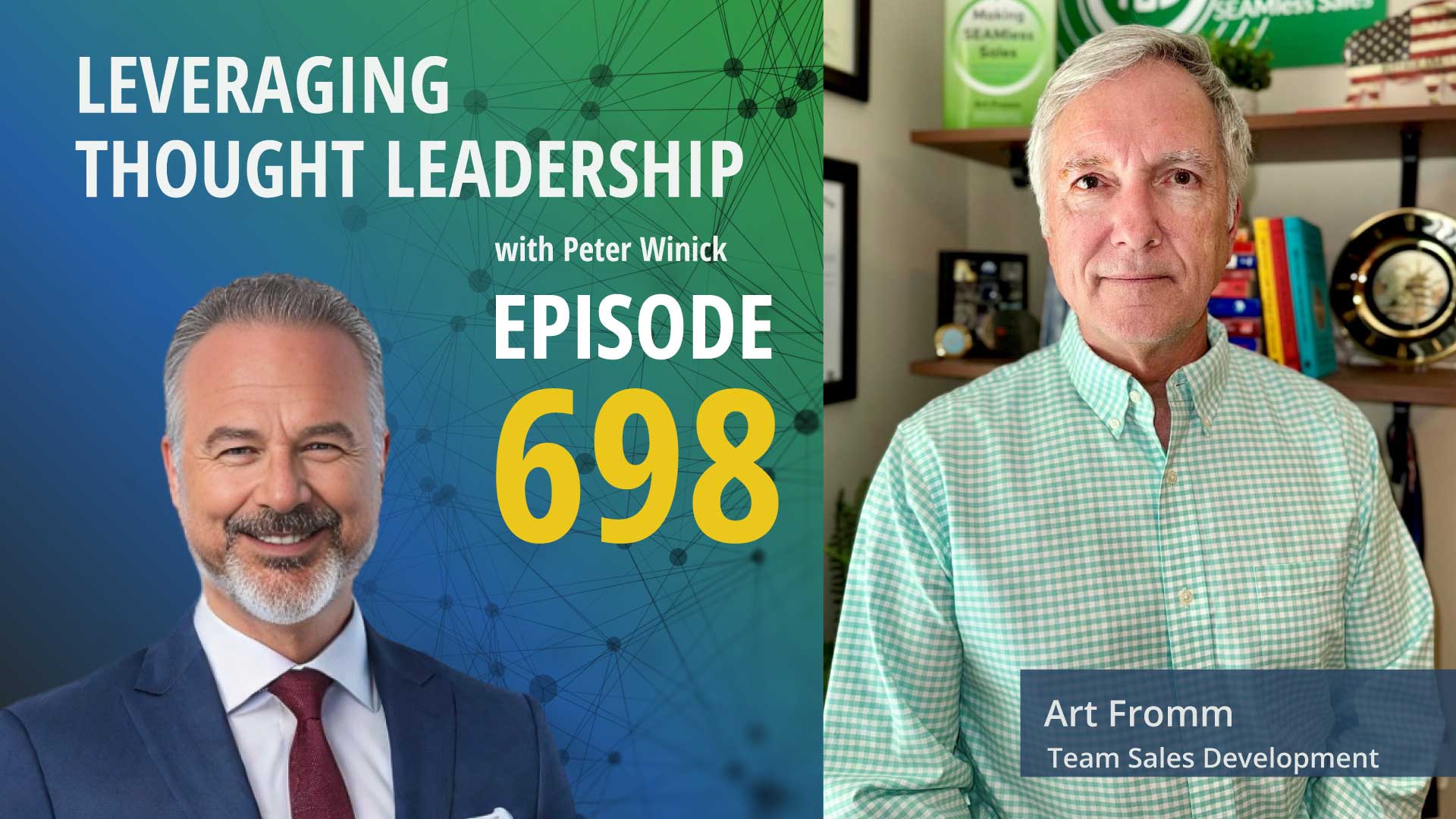
In this episode, Peter Winick talks with Art Fromm, a keynote speaker and sales enablement leader focused on what many B2B organizations still miss: the costly gap between pre-sales and sales. Art’s thought leadership centers on building seamless partnership, not a messy handoff, so clients win sooner and revenue sticks longer.
Art makes the shift unmistakable. The market moved from one-time enterprise transactions to SaaS, recurring revenue, adoption, retention, and usage-based economics. That means “closing” is no longer the finish line. It’s the starting gun. If customers don’t adopt and succeed, the deal never really happened.
From there, Art outlines his core platform: aligning pre-sales and sales into a true divide-and-conquer team. No delegation games. No dictation. Just shared ownership of the client outcome. He points to research suggesting seamless collaboration can lift sales impact materially—because the biggest unlock is often already sitting on the table.
This is also where Art’s content engine comes in. He’s clear that thought leadership isn’t a “someday” project. It’s a practice. Write. Publish. Learn what lands. Then refine. He shares how he captures and distributes ideas through posts, podcasts, and a dedicated hub on his website (teamsalesdevelopment.com) with events and articles that keep the thinking accessible.
Art’s book “Making Seamless Sales” plays a central role in the platform. He describes it as a labor of love and a high-leverage calling card—less about book sales, more about clarifying the model and creating a door-opener for bigger engagements.
If you lead sales, enablement, customer success, or go-to-market in a subscription business, this episode will challenge your definitions. The question isn’t “Did we win the deal?” The question is “Did we build the conditions for sustained consumption and retention?”
Three Key Takeaways:
- Closing” has changed: In SaaS and recurring revenue models, the win isn’t the signature—it’s adoption, usage, and retention (a commitment to consume).
- Alignment is the lever: The biggest performance unlock is often true partnership between pre-sales and sales—shared ownership of client outcomes, not a handoff.
- Thought leadership that sells: A repeatable writing engine (book + ongoing blogs/articles) clarifies the framework, builds authority, and creates higher-quality conversations that lead to revenue.
If Art’s “commitment to consume” mindset resonated, queue up Steve Watt’s episode “Using Thought Leadership to Earn Your Way into Sales Consideration” next. Steve digs into how thought leadership earns you a seat in the buying conversation before prospects are ready to buy—the same strategic shift from “pitching” to building credibility and momentum. Listen to both and you’ll get a one-two punch: how to align your revenue team for outcomes (Art) and how to use thought leadership to generate and accelerate demand (Steve).
Transcript
Peter Winick And welcome, welcome, this is Peter Winick. I’m the founder and CEO at Thought Leadership Leverage and you’re joining us on the podcast which is Leveraging Thought Leadership. Today my guest is Art Fromme. He is a keynote speaker. He’s an MC, he’s a facilitator and he lives at the intersection of engineering software and sales leadership which is an interesting place to be. Let’s just dive into it, Art. How are you today?
Art Fromm I’m Joe. Well, thanks for having me and welcome everybody. That’s listening going to be a fun 20 minutes here and provide some insights that are actionable. That’s the goal.
Peter Winick Yeah, so let’s start with how did this happen, right? How did you get here? Because usually this is not a deliberate intentional plan. Like when we talk about how someone came, SVP of sales, they’ll tell you about their day in the trenches of being a salesperson and then got tapped to do leadership and on and on and on. But this is sort of a different game, if you will.
Art Fromm It is. And it really formed where I’m, I definitely formed where I’m at, but it’s not where I expected to be or intended to be. Let me put it that way. I started as an engineer way back in, you know, early eighties. And that was the time when a lot of the engineering software was starting to become viable. 2D drafting, you, know, was now on the CAD system. 3D modeling was now transformed from plastic models to inside the computer system. Information management and product lifecycle management was starting and that captured my attention more so than even engineering. So I began implementing systems inside of the companies I was at. I moved over to the applications department and was the provider of the technology that supported the engineering that led to working with some leading software companies. And one of which I did a lot for their user group and all that. They recruited me to do essentially a sales role. Initially, it was a application engineer type role where I was helping their sales people with the technology and then that eventually led to me going into sales enablement at one of the companies I was at because they loved what I was doing with my sales experience and my sales engineering experience for my team. So for the last 25 years I’ve done sales enablements and in 2009 I went on my own and I have my own company team sales development based on all of that background and history. And experience.
Peter Winick So some of that sounds like sort of time and place, right? Like you’re sort of the rare bird that gets engineering, that gets sales, that gets technology at a moment in time where those things were sort of converging in a different way, right. So that’s kind of cool. Absolutely. Talk about, because I think a lot of the folks that I work with and clients and such have gone from sort of the inside guy or gal to the outside. And a lot it is fun, exciting, invigorating, you have more agency, whatever. But a lot if it’s scary as heck. So when did you decide to make that leap and what was that like?
Art Fromm I mean, I’ve always wanted, you know, once I was in doing the sales enablement roles inside of a company, I was like, I have so much knowledge already that I could share and leverage across many different clients. So I wanted to go on my own. It turned out at the time that I initially went on my own, which was 2004, uh, the company that I was with was doing some downsizing and things and had some opportunities to do a package type deal, so I wound up using that as my launching point, my, my leverage to. Cover myself for a while as I transitioned and I had developed a relationship with a really promising third party that I was not allowed to use because we weren’t allowed to do third party training anymore. So I just joined up with him and literally within a couple of months, I was already doing things together. We got brought into a global learning company for three years and then they, they disbanded and I went on my own in 2009 again. So again, right time, right place, and not without. A lot of intention, except for following one footstep after the other. Uh, it was, it, was a scary at first and it still is. I mean, you know, for the last 16 years, I’ve been relying on having clients and things, but it’s through partnerships. And that’s one of the big takeaways for me, as I reflect on my career is so many partnerships and really what would be considered multiple streams of revenue. So I wasn’t dependent on just what I was finding. In fact, most of my business is incoming and referral from other clients. So that really was a big thing to help and that’s what I’d encourage.
Peter Winick So that’s a great strategy, right? Because I find a lot of thought leaders are transactional, not as a reflection of their personalities, but the business is transactional. They get them on your notes. And then every January one, it starts at zero and you know, all that sort of thing. But having a strategy that says I’m going to have distribution partners, strategic partners, referral partners, etc. Is really lovely because it’s basically sort of a diversification of a portfolio, if you will, right. So there are times where the market For speaking isn’t there, hello COVID, right? There are times where various of the offerings don’t work well, but if you have some balance from the partnership standpoint, that helps alleviate the risk.
Art Fromm Yeah. Well, and it’s beyond just the type of things I deliver. It’s about the, the, uh, audiences that I deliver to. So I cover, since I have a broad experience from sales engineering or pre-sales through sales or account manager and account executive and everything in between my portfolio consists of things from multiple partners and sources. In fact, my book making seamless sales that came out at the end of last year is my, you know, bottling up all of the information I’ve had. And I highlight three main partners of mine where I can either do pre-sale stuff, I could do sales stuff and most right. And what I really want to focus on is pre- sales and sales working together better, which almost nobody’s doing that. So it’s an untapped area that’s very important for sales teams. I call it the last frontier of sales enabled because anybody either does one or the other and not both. And so I had that luxury of drawing from any of that portfolio and a variety of different clients. That’s great.
Peter Winick Talk about, you know, you’ve been at this, particularly even on, you know, on the outside for quite some while, almost 20 years, right? For over 20 years. What are you seeing that’s the same and what are you seeing that different? And don’t just tell me AI, cause it’s the everybody AI now. Fuck. But like, what are your seeing? Like, if you think about it as, you know, aren’t the CEO of his business, where’s the opportunity? What’s harder to make happen? Where do you see, you know, where are you placing your chips down?
Art Fromm Yeah. And, and really I still am on the inside quote unquote, cause I have my own company and I need to sell my own stuff. Right. So I still act as a sales person. And you know, when I engage my clients, since I’m going to help them with sales, they look at the way that I sell and they’ve had numerous people say, we love the way you approach that. That’s what we want to do for our clients. So that’s one revelation. The biggest change that I see is, and it’s really more about the changes I see in my clients and how I’ve adapted to help them out is. The idea of B2B sales now is much more about SaaS, recurring revenue, client retention, and those types of things. You know, back in the day when I started and when, you know, in your history too, you sales was like a once and done thing. You could do a huge enterprise deal. It might take you six months or nine months. And at the end of it, you close the deal, you deliver the software or whatever it is, and then you move on to the next deal. Yeah, how you have to do that now. In fact, I’ve coined a phrase in my book that I talk about. It’s we’re now closing the deal anymore. It’s really getting a commitment to consume. So the whole approach to how.
Peter Winick I wait, and that’s because the compensation is based on good. So closing the deal is no longer ring the bell. That’s okay. Well, we got permission to consume, but we really get paid on consumption. So the party’s not over yet. Even that term, I like the way that you pick up on that because we’re all, you know, I’ve been in sales my whole life, basically closing, right. Is what the term that we use. Well, what does that mean? There’s ink on the contract, whatever it’s done, ship it, whatever. But yeah, now we have permission to consumer. That’s a whole shift in mindset. And it required a whole different set of capabilities to say, okay, if our objective is to maximize consumption, we better be delivering value.
Art Fromm Correct, and it’s got to start from hello. So this is a big difference. And this is where the pre-sales and the sales aspect comes into it, which is my experience. And I’ve been so frustrated because I’ll be doing a workshop for just pre- sales and they’ll be like, why isn’t my sales person doing more qualification and discovery? Or I’ll do a session with sales people and they’re like, why don’t my asses just listen to me and do what I tell them to do? And you know, that’s maybe based on old ways of doing things. The new way of doing things is that everybody’s got to be focused on client success. It’s got be on client success, not you and successful in sales, helping your client because once they say yes, now they need to consume. And that’s why I say commitment to consume is what we’re going for. Cause if they don’t consume, then we don’t make any money. And maybe you’re not commissioned on that, but certainly your company relies on that revenue and you working for your company needs to make sure the client successful. So that’s a big different.
Peter Winick But it’s also a mindset shift in short term to long term. So like, even if you’re not commissioned, well, what that’s going to mean, if there’s no consumption, eventually, whether that’s in six months or renewal or whatever, it fizzles out and it’s not good for you. It’s not for the company. It’s good for the customer. Someone’s going pay the piper. It might not be for a year or two. And I think a lot of tech sales people are so focused on the quarter that they’re not thinking short-term, mid-term and long-term. They’re thinking, okay. Closing the quarter, closing the quarters, you know, push the pipe or never.
Art Fromm Yeah, unfortunately, a lot of sales leadership and the things that are measured now are more based on the old system and the measurements need to start to change toward what is that recurring revenue and some companies are moving to total client, a total contract value and things, but nonetheless, I think anybody that’s in the sales role should be getting the benefit of those recurring revenues because you’re setting it up for success and it’s often at renewal of a license. It’s often consumption of some kind of thing. You know, AWS and other companies, yeah, yeah. You’re charged by the gigabyte of what you use or the bandwidth you use over the number of connectors. Exactly. It’s, it’s literally, you know, and so we don’t know what that’s like. If you have an ad that you don’t like, then you don’t pay for it, you know, we’re doing that with all of our streaming services and everything else. So yeah. And other big factor to this too, Peter is the idea about client retention. So, you know, getting another client is, is obviously very expensive. So the more you can keep those current clients, the better. And here’s the thing. What I’m, and this is my mission right now, based on all my career and everything else, getting sales and pre-sales to work together, which sounds trivial and it’s like, oh, just get to know each other. It’s much deeper than that. Recent studies have shown that just getting pre- sales and sales to work together seamlessly. Where it’s not a delegation or any type of dictation of what’s going on, but a true partnership of divide and conquer and knowing each others, can complete each other’s sentences. That alone can increase the sales impact by 37%. And that worked with any methodology. That’s like what you already have, it’s sitting there on the table, but a lot is conspiring against it. And that’s why I wrote the book, which does describe what I went through in my career somewhat and my transition to understanding. These different ways of doing things for sure. So speaking of the book, how many have you published now? Well, I, I did my, my making seamless sales and then I just got published in a number one international bestseller that happens to be a book that the, uh, author of men are from Mars and women are from Venus wrote. So, uh John Gray is at the beginning of the look. So two books so far, but I’m a lot of blog posts that a lot of content that I have on my website that can be tapped into for sure
Peter Winick So talk to me a little bit about your strategy, your use case for thought leadership to elevate your brand, drive your business, get new clients in the door cost effectively. How do you, what’s, do you get me under the hood on that a little bit, if you would.
Art Fromm Yeah, well, I’m in a unique position because, you know, a lot of people are saying to me, Art, are you retiring? And I’m like, no, I am actually rebranding right at this point in time. I have so much to give, and I really do believe that the right thing to do, and this is the correct philosophy for sales, is it’s always about being helpful. And if that helpfulness turns into something that somebody wants and they’re willing to engage you and pay for it, that’s wonderful. It’s win-win for everybody. So for me right now, it was the book was a labor of love to capture all this information and also the shift that we’re going through. You don’t make, you know, this, you don’t make money off the book. The book is to help me share the information and then a calling card for people to get me involved.
Peter Winick So stay, stay there a minute because if the labor of love peace, I would say, if you expand on that, it’s also a forcing mechanism to get you to think clearly and tightly and figure it out. Right? Because when you sit down to do it, you realize, wow, there’s 10 ways I could tell this story or what is what’s the best and what’s the worst. And there’s only going to be, you know, whatever 60,000, like there’s a finite limit against your body of knowledge. What makes it to the book? What doesn’t? So I love the forcing mechanism. What I hear over and over again is, if the book never, you know, I never printed a copy, there’s still value and benefit to me as the author because my models are tighter. The way I articulate is tighter. The journey and the path that I see people going through is more clear. Selling the book is that point. Like the book, it’s the only product and service that I know that everybody puts a ton of work, energy, and effort into it. And it’s not about how many units of X some margin per X. Like every other business in the world or service is, it’s about, you can give away the book or somebody to buy the book and then spend a million bucks with you. Right. So the books were right there for a million dollars.
Art Fromm And you’re, you’re absolutely right about the journey. In fact, some people said to me, boy, I’d like to write a book. And what I say in my experiences, don’t worry about writing a book, just right. Don’t think about a book just.
Peter Winick I say more about that because a book, you know, I, I hear that all the time is where someone hasn’t really done much on the default leadership side, right. And they wake up one day and say, you know what, I’m going to write a book. And it’s like, that’s like me waking up today, 25 pounds overweight going, you know, there’s a marathon in town next week and she’s getting shaved, so I’m gonna do the marathon. Like my trainer would say, listen, fat, so like, how about waddle through a five? Like there’s steps that you should do. So I love it. You want to write, right? So you do a lot of blogging, short form, whatever. Tell me about your process and your thinking and all that.
Art Fromm Underneath that. Well, yeah. So I went back and I looked at the stuff that I wrote. I also just started writing all kinds of things and I did hire a company to help me write the book to, to have that discipline and to have it’s like personal trainer marathon, right. And as I went through it, I did have a big investment in that, you know, definitely time. It was incredibly time consuming, but it all was, it was the harder thing was like you say, not what to put in it, but what to take out of it. Cause I did have a limit. I was shooting for, I think it was 60,000 words. I can’t remember what the number was. It was a year ago since it got published, but I probably have at least 40 or 50 pages of stuff that I had in there that I took out to tighten it up. And that’s all stuff that’s now fodder for other type of blog, blog posts and all that. I ask ideas keep coming, you know, and I would just say, right. And post it on LinkedIn or I have a great webpage team sales development.com. Where I’ve captured a lot of this stuff. I have one page that’s events and articles and it’s the webinars I’ve done and the podcasts I’ve Don and the other things. That’s why I love meeting you and having the ability to share this with you and all of your listeners. It’s another sharpening of the ideas and also getting the word out there because it’s about what we can do for our clients, which then helps us, helps our families, helps our communities.
Peter Winick And- and what- what are you-
Art Fromm That’s the theory.
Peter Winick And what do you think of, I find that as thought leaders, we’re really, really bad at predetermining what’s good and what’s not. And what I mean by that is you put something out on LinkedIn and you worked really, really hard on it for a long time and you’re like, this is like brilliance. I am so proud of this thing. And it goes out there and it flops. Like there’s just no resonance. It doesn’t work. It’s not that it’s not smart, but like it just doesn’t connect. And then there’s another thing that you put out. You’re like, I don’t know. I’m kind of lazy today. I got the, here’s what I got. I said I would post something today. I’m sort of embarrassed-ish, not totally embarrassed, but like, it’s not my best, but let me just hit send. And then that thing blows up and you’re like. What was it about that that resonated? Like, have you had that experience?
Art Fromm Well, I did a 12 week podcast that ended on October 23rd. And that’s also on my website, if anybody wants to take a look. And I was surprised at which shows resonated and which one didn’t. And one of the biggest ones was my very first show. There was a lot of excitement in my family and my neighborhood. Oh, art’s doing a podcast, you know, whatever. And so even my mom tuned in, my neighbors tuned in and they, and they took stuff away from it. And I, I was really pleasantly surprised about that. Now, I did do the first one as a more It was more about persuasion. It was a more about influence, which are elements of sales. So it could be more relatable to everybody. But I, I, again, I think, you know,
Peter Winick But relatable ideas, profitable, but like relatable, like I would argue that I doubt your mom is your target market, right? Right. So just because it resonated with her, right. There’s a lesson to be learned there. Yeah. Maybe there was something universal in the principles that you were talking about, you’re like, oh, wow, this is like beyond my scope, but the objective is to a share the, share the knowledge, but B share it to those that could then come and pick up the phone and say, art, can you help me? Right. Yeah, of course. Of course. Did mom become a client or no?
Art Fromm Uh, no, she’s not the client she’s just a great supporter. Uh, but yeah, and again, that, and what I’m saying is that episode applied to many, many different people. I just got contacted by somebody who said they’re between jobs. They found my stuff and they said at, I forget what they said. Minute, you know, 23 minutes into your podcast, that was the revelation of, of episode number one. So it is resonating out into the community. And my whole point to your question is. Don’t worry so much about how it’s going to resonate. Well, if you have a point of view and you’ve seen it in action and you know that this is helpful and you want to get the word out, then either write a blog post and let it land where it lands because you never want.
Peter Winick I was thinking, yeah, it’s not so much worrying about where it’s going to resonate, but listening to the market and listening to the signals and the response and then doing something with that because that’s data. Guessing where we’ll resonate is, you know, that’s gambling, if you will, right? Like listening to the real data that says, wow, for some reason, you know, mid-level sales folks in this space are talking about this. What, you know, I, I hit a nerve somehow, so that’s cool. Yeah. And that would have been a lot of fun.
Art Fromm Book is that that’s the content of the book is, that book is all of those aha moments that I’ve seen in action over and over and again, that I wanted to share so other people could get the same aha moments.
Peter Winick Well, I appreciate your time. Thank you for sharing some of your journey and your stories. Art, I appreciated.
Peter Winick To learn more about Thought Leadership Leverage, please visit our website at thoughtleadershipleverage.com. To reach me directly, feel free to email me at peter at thoughtledershipleverage.com, and please subscribe to Leveraging Thought Leadership on iTunes or your favorite podcast app to get your weekly episode automatically.

Related Posts