
How leaders simplify strategy, speed up choices, and stop second-guessing. A practical look at making…
Story Precision: The New PR Advantage | KJ Blattenbauer
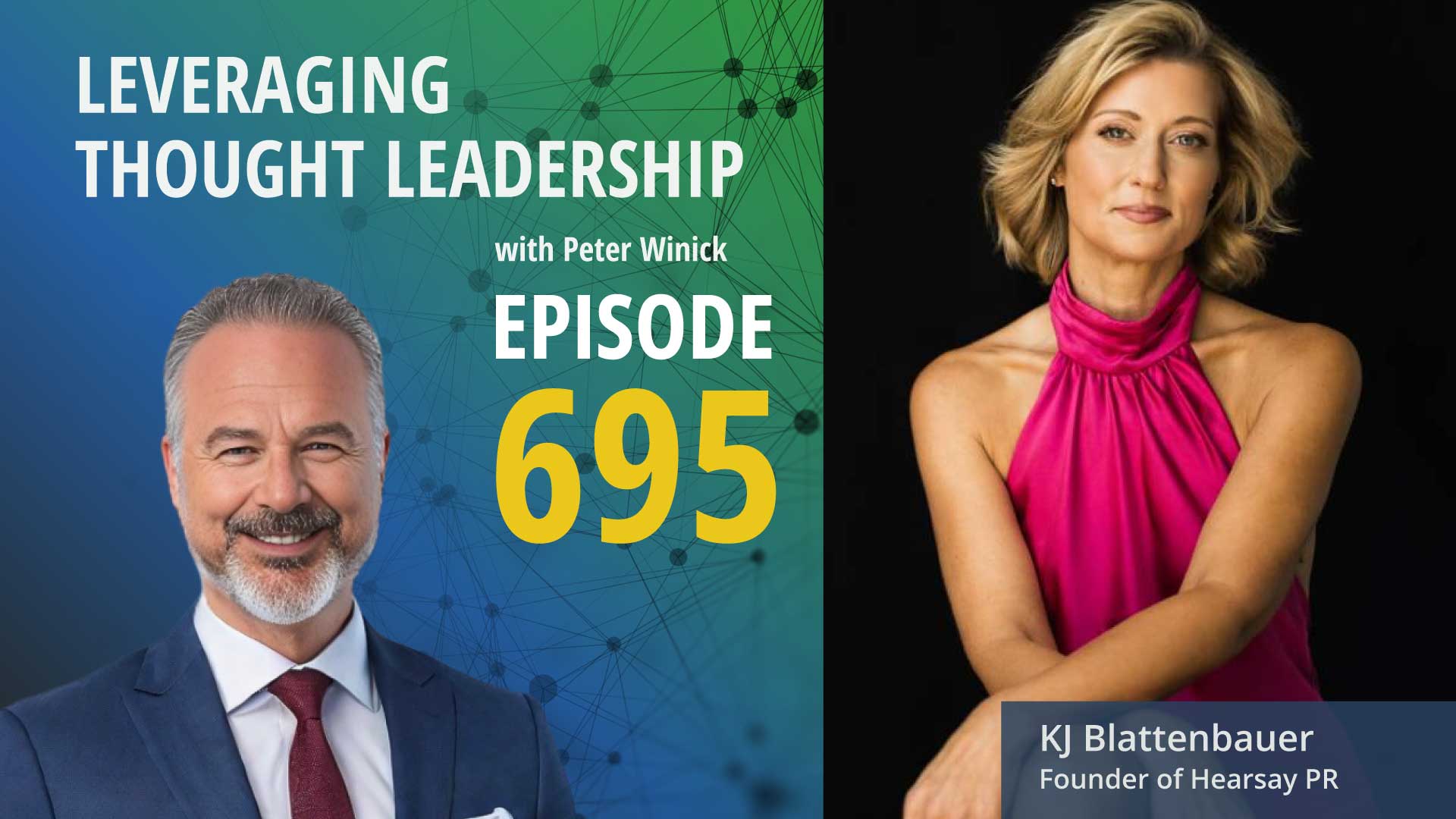



Why Authority Compounds When You Show Up
How PR turns expertise into authority: consistent visibility, clear story packaging, and measurable systems that drive demand.
What if “getting PR” isn’t about hype at all—but about engineering trust at scale?
In this episode, Peter Winick sits down with KJ Blattenbauer, founder of Hearsay PR and author of Pitchworthy: The No-Fluff Playbook to Publicity That Pays Off, who helps founders, creatives, and experts turn clear storytelling and smart media strategy into real authority—without the fluff. She breaks down what PR actually does: find the story behind your expertise, explain why it matters now, and package it for real-world attention spans.
KJ makes the case that your work doesn’t “speak for itself” anymore. Not in a market where everyone is being commoditized and AI is accelerating sameness. You still need great work. But you also need amplification. And you need it across the channels where your buyers learn, compare, and decide.
We get practical about what “good PR” looks like when you’re building a thought leadership platform. Not one hit. Not one logo. Repetition that compounds. One appearance leads to the next. Visibility builds recognition. Recognition builds preference. It’s the gym, not the lottery.
KJ also brings discipline to measurement. Systems first. Message alignment across platforms. Tracking links so you know what’s working and where demand is coming from. Because “branding” is not a strategy when you’re accountable for revenue.
And if “promotion” makes you cringe, this part matters: KJ reframes PR as service. If your ideas can help people, hiding them is the real ego play. The goal isn’t fame. It’s getting your work into the rooms where it can do its job.
Finally, we tackle the AI question. KJ’s take is sharp: AI can support systems and repurposing, but the human story is the differentiator—and audiences are hungry for it.
Three Key Takeaways:
- Your work won’t speak for itself—amplification is part of the job. Do good work, yes. But you have to shepherd it into the right rooms, at the right time, with the right message. PR is the tool that helps that happen
- Authority is built by consistency, not a one-time splash. Waiting until you “have something to promote” costs you money, recognition, and momentum. Start now. Show up regularly. Trust compounds when people see your ideas repeatedly across formats.
- PR is story + packaging for short attention spans—and it can’t be a black box. The core job is uncovering what’s interesting about your expertise, why it matters now, and presenting it in a way people will actually pay attention to. Then put systems around it (including tracking) so it ties back to real outcomes.
If this episode got you thinking about amplifying expertise into authority, go cue up Episode 13 with Pete Weisman next.
You’ll get a practical playbook for turning strong ideas into executive-level visibility—including how to diversify your offerings, focus your audience, and claim a clear niche so your thought leadership lands with the people who can say “yes.”
It aligns perfectly with the themes you just heard: amplification over hoping, consistency over one-off wins, and strategy over random activity—all aimed at building recognition that actually supports growth.
Transcript
Peter Winick And welcome, welcome, this is Peter Winick, I’m the founder and CEO at Thought Leadership Leverage and you’re joining us on the podcast which is Leveraging Thought Leadership. Today my guest is KJ, I screwed up the easy part, KJ Blattenbauer, and I wanna give you a little bit about her because I’m really excited about today’s piece. She specializes in turning founders, creatives, and experts into recognized authorities. By building thought leadership that’s rooted in story precision and media strategy, not fluff. After nearly 30 years shaping narratives for brands and leaders, she’s developed a clear framework for how modern authority is really built. And she’s helped generate 50 plus speaking invitations for herself. So you’re sort of crossing over to the dark side of not just being the behind the scenes person, but being front of stage as well, right?
K.J. Blattenbauer I am, you know, one of my clients challenged me earlier this year that if I was going to make her go be in front of the camera and a podcast and all things, she’s like, well, why don’t you do it? And I said, I’m busy behind the scenes. I’m making you the star and making you shine. And she said, yeah, but I see all this bad PR advice out there. If you were doing it, then we know what the right advice was. And it really kind of hit me like, oh, well. She’s right. If I’m going to make an employee, I should go through the things. And so I’ve just applied the same principles I use for clients on myself. And it’s been, it’s been a success.
Peter Winick Yeah, so walk me through, I want to understand, because you and I work with similar folks, right? So this, let’s start with the models and the framework, because I think that, in my experience, a lot of PR is sort of magic in a bottle, mystery, don’t look behind the curtain, you know, all this fluffery, and I think what happens is you have intelligent, yet uneducated clients, meaning uneducate relative to, them bought PR services before. And then you talk to them on the other end of it and they’re frustrated, disappointed, et cetera. But tell me about the models and the methods and the framework, because I’m kind of a model junkie.
K.J. Blattenbauer Well, you know, I think the models and the methods and the framework of PR have not changed in however long PR has been since Barnum and Bailey.
Peter Winick Hehehe
K.J. Blattenbauer decided they were gonna lead the circus out of town, right? I think it’s been the same. All PR does is help shine the spotlight on the story behind the business or brand or person that’s the expertise. I am basically an expert at looking at your business, figuring out what is interesting to people, why it’s interesting now, how you make it happen, and then packaging that in a way that people’s short attention spans wanna pay attention to.
Peter Winick It’s been there for a minute though, because I think that today, more so than ever, it’s probably always been true, but today more so then ever, we’re all being commoditized, right? No matter what you do or who you are or where you are, there’s somebody that does it probably just as good for a similar price, and I’m not talking about PR, but just the clients, right? So how do you help them find that story if I’m in professional services or technology or things that we’ve seen a million times before? How do you how do you pull that out of them?
K.J. Blattenbauer Well, I think it’s, look, if I have to have brain surgery tomorrow, am I going to the cheapest brain surgeon? You know, I’m the brain surgeon that knows what he’s talking about, right? So I think that applies across the gamut. Yes, you’re always gonna have bargain shoppers when it comes to certain things. However, if you know your stuff, if you let people know that you know your stuff and then you have the extra benefit of someone like me helping amplify that so you’re on every single channel and they can’t get away from you, people are going to go. Your route, whether you’re the most expensive person on the block or the least expensive person on block, it doesn’t really matter. People want to trust experts, especially now in the time of AI, and your work can no longer speak for itself. Do good work, but you need to amplify that work, and that PR helps push that message out there.
Peter Winick And a lot, you know, and I love that because I hear that often of, well, my work, you especially from the more analytical or the more academically inclined, well my work speaks for itself. And it’s like, no, it doesn’t. Right? Like your job is to shepherd your work. Your job is, to amplify your work, your job is to make sure that to get it to speak for itself, you actually have to get in front of the right eyeballs at the right moment. And I think it’s a very, very different skill set for thought leaders, right? So thought leaders are really good at creating the ideas. Writing, speaking, etc. Many of them, not all, but in general, many of them feel uncomfortable promoting what they have because it’s an extension of promoting themselves, which feels for some sort of the anti PT bottom, if you will.
K.J. Blattenbauer Yeah, yeah, yeah. Well, I think the hardest thing to do is promote yourself, which is why public relations exists, right? Because if everyone could promote themselves and we were all out there boasting and bragging about what we’re good at, you wouldn’t need to hire someone to do it. But I think it’s kind of like, if you’re inside the bottle and you’re trying to read the label on the outside, you’re so close to your own business. You’re so your own brand, your products and services. Sometimes you can’t see the forest for the trees. And I think that’s why it’s good to hire someone else to. Hone in on what makes you special to see what’s great. I talk to so many business owners every single day and they’re like, there’s nothing special about my business. I do the same thing as the guy next to me. But what’s special about every single business and brand is the reason why you started the business, the reason you started brand, the reason that you show up every single. Like there are a million podcasts out there. Your podcast focuses on very specific things and people tune into your podcast for those very specific thing. No one else can replicate that.
Peter Winick No, I love that. So give me a, maybe an example or a composite of who comes to you and what working with you looks like and what sort of success might look like. Cause I think defining success from a PR standpoint is also a weird thing. Is it one placement in one notable brand? I don’t think so.
K.J. Blattenbauer I don’t think so either. The glory of PR, which is also the curse of PR is that it’s an art, not a science. So like you could go on social media and post and immediately see your stats, right? We can immediately see how many people have downloaded your podcast episodes. And while they know if you’re in Forbes how many technically read Forbes, we don’t know how many specific eyeballs have seen your article. But I have authors, artists, interior designers, I have coaches, I have podcast hosts, I have celebrity athletes, Fortune 50 companies, and sometimes just executives in Fortune 50 companies that want to separate their brand from the company, all come to me for either one-on-one intenses, messaging help, or ongoing public relations where I just promote them constantly and get them media placements. Or if they have, heaven forbid, a crisis situation, I help on that side, too. Come to me because they want more attention, more visibility. They want to stand out and become the known person in whatever their industry or their niche is. You know, there’s sometimes you can measure that. I have a beauty brand. We just got them in a huge beauty publication. It was an immediate 200 to 400 sales the second that oracle went live and it started to get shared. Like sometimes you see that. I know if my client is gonna be in Forbes tomorrow, it’s gonna be at least a 34% increase in traffic for them. Just straight from that oracles, just from being in Forbes. But what the key to public relations is, it’s like going to the gym. I don’t go to the gym one time to look like Elle McPherson. I have to go a couple times, maybe two, maybe three, and then I look like Elle McPherson. But it’s repetitive. Public relation is you go on one podcast, it leads to a guest spot on another podcast, it leads a guest on another pod cast, that starts to snowball. You’re building the recognition, you’re leveling up your visibility, people are starting to see your name everywhere, and it’s helping accomplish the marketing touch points where people need to see or hear you multiple times.
Peter Winick Half a step backwards, because I think there’s two levels that PR plays for a lot of organization. There’s the branding level, which to me is is sort of lazy man or woman’s PR, like, oh, it’s good exposure. It’s branding. And, you know, like if you can’t measure anything, then you say it’s branding and, you know whatever, and it’s not a bad thing. And you know just the question is Is it a good thing? And I think it depends by what standard. What’s the ROI, what’s the impact, whatever. The case you gave before led to 400 sales. I think what happens is, you have to have the tracking mechanisms in place, right? So you could do 30 podcasts in a year, right, and then you say, you know what, at the end of that year, six, eight months, I got nothing, right. I didn’t get any new business. But then a year and a half later, because podcasts, they live forever, unlike other media. People don’t realize that. It’s like, yeah, the release date and all this and that, But like people. Get into a podcast and then they go backwards to the back stuff and all that. But you have to have the tracking mechanisms in place to be able to ask people, where did you hear about me? Now, sometimes it’s, it’s not a fair question because people just don’t remember or they’ve heard about you in four or five plays, but they can see, you know, there was this interview you did with so-and-so and you’re like, geez, that was four years ago, right? Those, I think you have, you have an obligation as a business owner, you know to be tracking those sorts of things. Or how do you encourage your clients to do that?
K.J. Blattenbauer Well, the first thing that all of my clients do is they go through an audit, right? Like you have to have the systems in place. You can’t be an Oprah’s favorite things tomorrow and not have your website set up correctly, your link set up correct. Like everything’s, if you don’t have enough product, like you’re not going in there. So, but you also have to have the same messaging across the board. Like what you would have on your website, you have have to on your social media bios, LinkedIn has to match, everything has to be working. But you also have to have the tracking mechanisms, right? So for most of my clients, if they’re gonna appear somewhere, but people won’t remember where they’ve seen them before, but they’re going to click the link. And we go for specific links. Like if you’re going be, if I’m gonna be on this podcast, I’m going to use a specific link to direct the people so I know when they’re clicking that link, exactly what part they came from. Because I want to track those mechanisms. But you, it’s just uniformity. PR is. Telling people what you do and the way you want them to say it back to you so many times that they are talking about you exactly how you want in rooms you’re not even in.
Peter Winick And I think there’s a, call it a flooding phenomenon, but maybe there’s better term, where sometimes if PR is doing their job well, that target market that’s very well-defined, because that’s critical, right? It’s not every woman over 40 with a college degree, like it’s really, really defined. Those people should feel like everywhere they go, they hear you and see you. Their trade association, their conference, like in their microcosm of a world where they’re getting their information from, and in the format they’re get it from, they should feel like I’ve heard that voice before. How do you deal with clients that are reluctant to try new mediums? So like, I have a clients, a lot of clients and you do as well, that are authors, guess what authors like to write, guess what, authors might not be comfortable on video. But if you’re an author trying to reach the TikTok crowd, the Instagram crowd, whatever, you can’t just make you could, but it’s not wise to make the decision, well, I’m just not going to do that, because it’s Not my thing. Right? So how do you push them to get out of their comfort zone a little?
K.J. Blattenbauer I don’t always push them to get out of their comfort zone. There’s certain things I won’t ever make people do. I’m never gonna pick a client down on TikTok. I might not even make a client join TikTok. It’s identifying exactly where their true audience is and then honing in on that. And there’s a million ways, I think, to position that, push things out, that won’t make, like, you’re gonna have to do video. That’s just the way it is. You have to, you know, podcasts have video, but we’re gonna work around the ways that. Shelter, do things. I have a lot of introvert clients. And so I schedule their media pushes and then I schedule them a couple days off so they can retreat to their holes like
Peter Winick So stay there a minute though, because it’s almost by definition, PR is an extroverted activity. You’re getting on a thing to talk about you or the work that you do, that’s hell for an introvert. You tell them like, what’s going to cause them to break out in hives. But many authors, many followers, even, you know, I’ve got a ton of clients that are keynoters and people think, well, they make their living getting in front of a thousand people. And I’m like, yes, they do. But take them off stage and put them in a cocktail party or social environment. They’re literally physically exhausted and need to go and like curl up in bed for a little bit.
K.J. Blattenbauer It’s a mindset thing for me. So I’m an extroverted introvert. I am, if you put me in a cocktail party, I am in the corner, I’m by the snacks, I’m hiding underneath the bar. That is just not where I shine. But I come from a place of service. I’m excited about what I do. I’m passionate about what do. I think it can help a lot of people. And so what I try and help my clients see is public relations and putting yourself out there in the media, it’s not about fame, it’s about the spotlight, it not about the attention. It’s coming from a a place a service. If I’m good at what I do and I keep my gifts to myself, I don’t share them with you or other people or people that could benefit from it, I’m not helping anyone. That’s just selfish of me. If you are an author and you have a book and you want people to read it and you’re proud of what you’ve written and it’s amazing and you wanna share it with people, all you gotta do is talk to people for 20 minutes on a podcast. And honestly, we don’t need to talk again for two weeks till I make you go on another podcast. And so I feel like it’s that trade off. It’s not about you, the person. It’s about you being famous like a Kardashian. It’s sharing your work, your gift, your business, your brand, the thing you’re passionate about with the world, with the word. And it’s, you know, two nerds nerding out, talking about whatever you think is cool.
Peter Winick I love that. So tell me a little bit about what you’re seeing now with respect to non-fiction authors. What’s the same and what’s different? Because everybody’s talking, everything’s changing in AI and whatever, and I think there’s some truth to that, but I also think there is some truth to there are evergreen principles that work. So how are you seeing that?
K.J. Blattenbauer I don’t buy into AI as changing anything. I think it’s making it easier for people to think that they’re authors and write things. I think that’s making easier for people to use the excuse they don’t have to hire a copywriter, or they don’t have to higher a marketer, or they might be able to tackle or answer questions easier. But what AI takes out of the equation is the human aspect. I feel like now more than ever, all of us post-COVID are starved for human interaction. We’re starved for the storytelling, and I don’t think that AI can create that. I think it’s great for systems. I think its gonna be great for technology. I do think it is great for honing in and how to reuse content multiple ways. I don’t think it great for creating the content itself, and I dont see it replacing you. I don’t see it replacing me. I don’t see it replacing authors, because human beings like you and I are never going to be like, you know what I want today? A robot to read me a story.
Peter Winick Well, but I think there’s a difference between replacing. So what I’ve seen is when you can tell something was produced by AI, that’s a total failure. Like whether it’s an article or a piece of marketing content, you’re like, oh my god, this is awful. Or even if it’s not awful, it’s soulless. It’s just, you know, whatever. But where you can’t tell that AI was used in the process, that where the beauty comes and the depth of the research that can be done and the speed. Yeah, and the number crunching and the, you know, find me another case study or tell me how to tell this story to a group of engineers versus a group of social workers or whatever. I think that’s really the beauty when it’s a behind the scene thing where nobody knows that not that nobody knows because you’re lying about it, but it’s just yet another tool in your toolbox.
K.J. Blattenbauer Yeah, I think that, wonderful for that. Do I see the rise in authors now on Amazon where it’s just a completely AI-generated book because they had a one-sentence idea? That just makes me sad.
Peter Winick Yeah, and I that’s been happening for a while, whether it’s book in a box or 24 hours, or, you know, you could leave me six voicemails and I’ll make a book out of that. Well, you know, guess what, you can say, is it worthy of reading? And more importantly, is that worthy of putting your name on? Right? Like, that’s really the issue because quality still matters more than ever, right? Like this. Yes, I don’t really care if I buy a book and spend 25 bucks and the books terrible, you I can make another 25 bucks if you waste my time. Now I’m pissed off. Right? Like if I start to read that book, and it’s going nowhere quick, I’m like, done. I’m not going to invest six, seven hours in this.
K.J. Blattenbauer No, I agree with you. I agree. And I’m also bitter about, you know, AI has killed the M dash and I’m going to be forever bitter about that.
Peter Winick There was just a bunch of stuff I was reading with a group of ghostwriters on that, that you know, the death of the M dash, but maybe even enough people feed chat that, you know bring back the M Dash. Yeah, you could overcome the algorithm. But yeah.
K.J. Blattenbauer Sometimes it’s the only punctuation that matters and now we can’t use it.
Peter Winick Yeah, that’s interesting. Well, but you could say texting destroyed, you know, punctuation altogether, right, so.
K.J. Blattenbauer True, true. It was a deep one. I don’t feel before this.
Peter Winick Exactly. Any other thoughts that you have or observations around nonfiction authors and thought leaders in terms of bad ideas when it comes to PR versus things they should start thinking about and when
K.J. Blattenbauer Well, I think the biggest thing is they should start thinking about it. They should be thinking about PR. I think too many people are worried about, oh, you have to be famous. You have to have money. I have to wait till I get to X. I have wait till, I’m six looks, right? That sort of thing. And it’s not about going viral or having a huge following or having an agent, it’s costing them money and time and book sales and recognition. To stay invisible, to not be putting themselves out there, to not be promoting themselves. And so I guess my big stance is. Authority is built by consistency. Start now. Put yourself out there now. Be promoting yourself now. Now is the time to get started, not.
Peter Winick And I think, you know, we’re like, promoting might be the word that irks up, right? So I love that authorities built our consistency. So I would say be consistent in sharing your ideas on LinkedIn, be consistent in your blogging, be consistent and whatever it is. Cause I think too many authors and thought leaders, they, they do the groundhogs day thing. You don’t hear from them. And then they pop up when they’ve got a book or something. And then go back in the cave for three years and they pop up, it’s like, we want to shoot, but then you look at the great ones that do it with the Daniel Pinks, the Malcolm Gladwell. They’re always flooding them. No, I shouldn’t say flooding. They’re always putting out amazing ideas in multiple formats. And it’s not around when they have something promote and then when they drop in there, oh yeah, I got a book coming out in October. Of course I’m like, Oh, go to the buy now button and make sure it lands in my, like, how would I not? I built a rapport. I built trust. Anything they say is interesting to me. So I didn’t even get to the point where they’re telling me the idea of the book, I know they will put something in front of me. That’s a good product. Like I know when I go to my favorite restaurant, it’s a good meal, right?
K.J. Blattenbauer Right, right, and it’s not even genius what they’re doing because Malcolm Gladwell’s not creating more content for himself, he’s not burning himself to the ground. It’s not because, I mean, he has a team, but it’s because he has giant team. He literally takes the book he just wrote, or the draft of a book he’s writing, and he’s just bread-crumbing different platforms, and you’re seeing it multiple times, and that’s why it keeps registering with you, so he’s even not giving himself more work to do, he’s putting it where people can see it.
Peter Winick Yeah. And in different formats for different people, right. It might be on a podcast or might be under a short form article or might be, yeah, might be in his keynotes, whatever. Interesting. I, this has been awesome. I hope it’s been fun for you and helpful for those listening because PR like, Hey, you know, it’s a tool, no one to use it, know how to use it and don’t be afraid to use. It would be my thoughts.
K.J. Blattenbauer Perfect summary, loved it, thank you.
Peter Winick Great, good stuff. Thank you.
Peter Winick To learn more about Thought Leadership Leverage, please visit our website at thoughtleadershipleverage.com. To reach me directly, feel free to email me at peter at thoughtledershipleverage.com, and please subscribe to Leveraging Thought Leadership on iTunes or your favorite podcast app to get your weekly episode automatically.

Related Posts
Comments (0)