How AI, Programs, and Trust Turn Ideas into a Life-Changing Business This episode explores how…
Building Champions: The Playbook for Scaling Thought Leadership | Daniel Harkavy
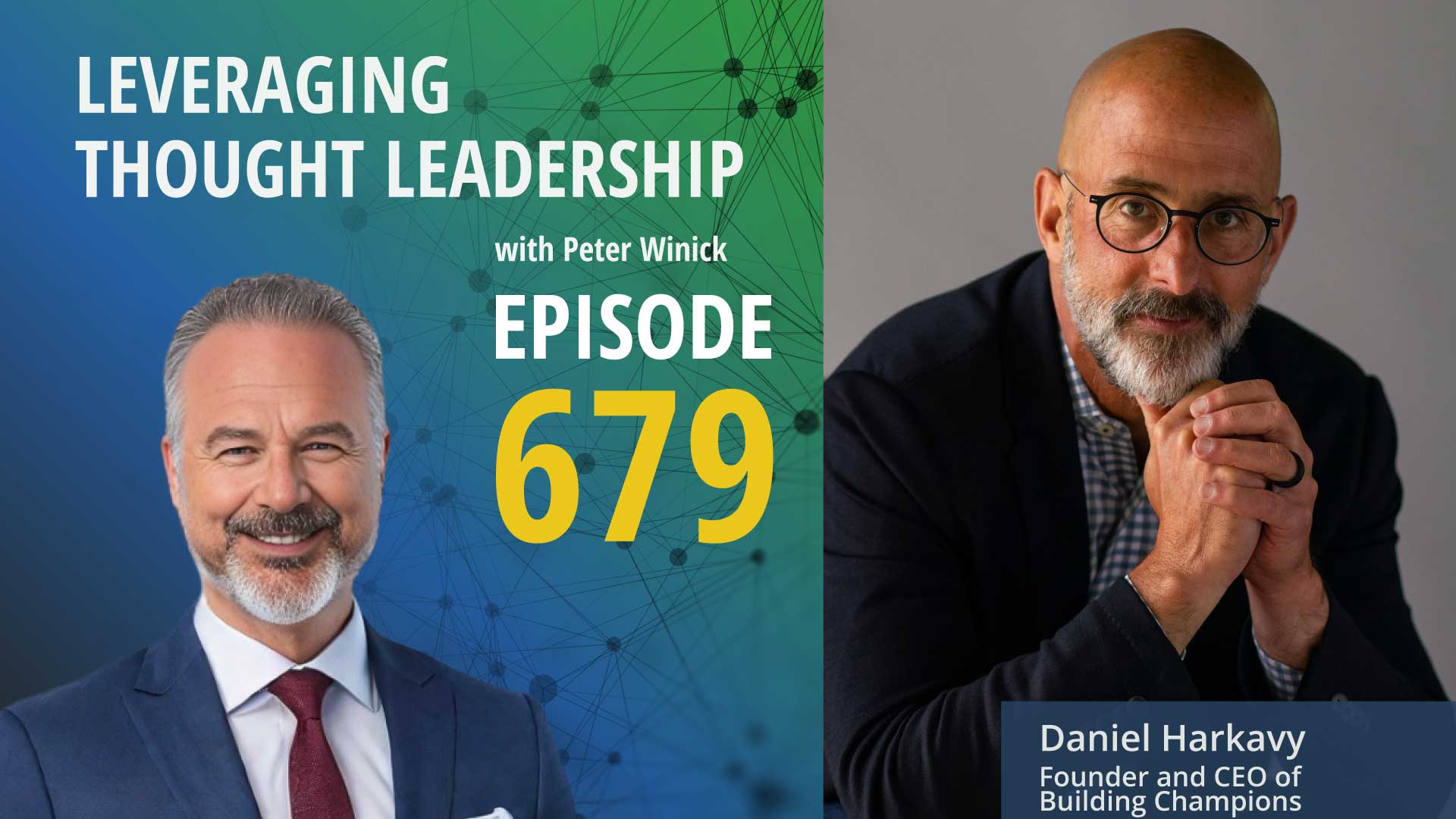



A roadmap for leaders who want to multiply their impact — not their workload.
This episode explores how to turn leadership into a scalable system that drives meaningful impact across organizations. It examines the power of codifying intuition into frameworks, the role of discipline and resilience in building lasting businesses, and how technology — especially AI — is transforming the future of coaching and executive development. The conversation highlights practical ways leaders can use structure, purpose, and innovation to elevate both their people and their performance.
What does it take to transform leadership into a calling — and build a business that transforms others?
Today, Peter Winick sits down with Daniel Harkavy, founder and CEO of Building Champions, a pioneer in executive coaching and leadership development. Daniel shares how he turned the lessons from his early career in mortgage banking into a structured, scalable system for growing leaders — and why his success is rooted in helping others unlock their potential.
Daniel’s approach to thought leadership isn’t about pedigree or credentials — it’s about proof. He took what worked in one high-performance environment and codified it into frameworks, checklists, and playbooks that any leader could use to create lasting impact. From Becoming a Coaching Leader to Building Champions’ current programs, Daniel’s work continues to shape how organizations coach, communicate, and cultivate leadership at every level.
The conversation dives deep into what it means to scale a mission-driven business without losing its soul. Daniel opens up about the “near-death” moments that almost derailed his company — from failed partnerships to market crashes — and the resilience it takes to rebuild stronger each time. His story is a masterclass in balancing faith, strategy, and discipline in pursuit of a greater purpose.
Peter and Daniel also explore how AI is reshaping the future of leadership and coaching. Daniel sees it not as a threat but as a copilot — a tool that, when mastered, can amplify human insight, accelerate problem-solving, and deepen relationships. His message is clear: technology can enhance thought leadership, but it can’t replace
the leader.
Three Key Takeaways
- Codify what Works: Turning personal insight into repeatable frameworks allows leaders to scale their impact, build stronger teams, and create lasting organizational value.
- Lead with Purpose and Resilience: Sustainable success comes from aligning business strategy with personal values and staying adaptable through inevitable market and operational challenges.
- Leverage AI as a Copilot, not a Replacement: The future of leadership depends on mastering technology to enhance human insight, accelerate decisions, and deepen relationships — without losing the human touch that defines great leadership.
If Daniel’s episode inspired you to think differently about leadership systems, purpose, and resilience, you’ll want to listen next to “Becoming Resilient Through Thought Leadership” featuring James Harold Webb.
Both conversations explore how true leaders turn adversity into an advantage — Daniel through codifying leadership frameworks and James through channeling personal reinvention into influence and impact. Together, they reveal the blueprint for thriving in uncertainty: build systems that scale, lead with purpose, and use your story as fuel for growth.
Transcript
Peter Winick And welcome, welcome, Welcome. This is Peter Winick. I’m the founder and CEO at Thought Leadership Leverage, and you’re joining us on the podcast, which is Leveraging Thought Leadership. Today, my guest is Daniel Harkavy. He is amongst other things, the founder of Building Champions. He is an author. He’s a CEO. He’s coach and he’s an all-around good guy. So welcome aboard, Daniel. What’s going on today? Good to be with you, Peter. Good to me with you. Appreciate it. So tell me about the journey. How did all this happen? How’d you get to where you are today as a thought leader, as a business leader, or as a coach, CEO, author.
Daniel Harkavy Yeah, that is a, you know, how much time do we have? Because, you now, first off, I’ll say it’s just a big God story. I can’t believe I’m here. Right. But the way I look at it is, you know, if you were to look at kind of the Genesis where I look back at all the bread crumbs along the journey, all the trail, I was first told that I had influence when I was probably 10, 11 years old by an aunt. And it was because I was an awful kid. And she flat out told me, she said, Daniel, you got a lot of influence. And my concern is if you don’t figure out how to use it for good, some bad things are going to happen in your life. You’re going to hurt a lot. A lot of people. And I remember that as clear as day. I can remember where I was standing, where she was in the kitchen. So let’s go from there to, okay. I figured some things out, but not all that quick. It took a probably another decade or so. I was always hardworking. I got into a mortgage banking at the age 20. I was given an opportunity to lead and build a branch at 22 because the first two years had gone really well for me at 22, uh, I now have an opportunity P and L responsibility to build an entity that would be a micro entity amongst a macro corporation. It really did well. It was me and one other employee and, uh through a style that I would now call coaching leadership. I attracted some really good, hard-working, honest, amazing young men and women. And, uh, within the ensuing years, my one office represented more than half of the overall organization, the volume. And there were 17 offices at about age 28. I was given the opportunity to lead all of production. So now I’m overseeing all the offices in the Western U S at 28, 27. Uh, there’s talk of me becoming the next CEO as the company had just gone public. And in the backdrop, I’m married at 22, I start at 23, I start having kids and I am just a work machine. Age 30, I have some sort of a crisis of faith where I just realize I’m chasing the wrong things. I take a one year sabbatical. I leave the whole mortgage banking career, which was an insane move because the, uh, the, um, compensation was more than I could have ever dreamt of as a young man, where I had the homes and the nice cars and yeah, you know. But I took a one-year break during that one- year break, really just through prayer and trying to figure out who I wanted to be when I grew up and how I wanted love my wife and my kids. What happened was a lot of my old employees and colleagues, they started asking me for input. They wanted to have these one-on-ones like I had had with them, really from the age 23 through 30. And back then, that was 1996, Peter. There was no such thing as a coaching organization. But I started charging to speak to ex-teammates, to help them to start companies, to help them to improve, and here we are 30 years later and Building Champions is one of the two entities that I run, but Building Champions is an executive coaching and leadership development organization where through listening, through synthesizing, through being curious, A lot of what I learned when I was in my 20s, which was all about helping people be the best they could be when I’m in mortgage banking, I created a career around it.
Peter Winick So stay here for a minute because in my work working with lots of different thought leaders from around the world, a lot of what I hear is, you know, the name dropping of the prestigious universities they attended, the research institutes, the, you, know, fill in the blank, right? Like all the like, Whoa, that’s pretty cool and impressive. Of course that’s why you’re here. But here you are like, here you were like some 22 year old dude working your butt off, cranking it out and mortgage broking, not the most sexy business out there, not the most. Glamorous business out there, right? It’s not McKinsey, it’s not a lot of things, right. But you weren’t taught a framework or a methodology to say, this is how to coach people. Something and you just said, hey, I’m just doing this thing. And then, you know, fast forward the 10 years or plus whenever it was after, you start to write, you start not just coach people, because coaching is sort of, so what I’m looking for, it works in flows. But now you’ve codified the methodology And you actually paused and said. Let me actually write this down, because a lot of this stuff lives between my head or in my heart or wherever. Tell me about what called you to do that and like get it on paper and codify, because that’s ultimately what building champions is about now is teaching people how to do the things that you did intuitively.
Daniel Harkavy Yeah. So when I first sat down to map out what building champions could be, it was side by side with two other businesses. I was thinking, all right, how do I want to invest my days? And I actually had this vision that, you know, I could probably build something where I go deep into mortgage banking, where I’ve got a name. And you’re right. There is no, you no prestigious pedigree with me. I went to a community college, never graduated. San Diego state, which back at the time was the biggest party school around turned me down. So, you know, the dear, you weren’t a big party or that you got, you got turned down, it was already because I exceeded expectations of partying. I was, but, um, you, know, there’s a lot more to that story. But what happened was I saw that if I could, uh, effectively help the industry that I understood the, the vernacular of, I understood the frameworks and what a day in the life was. I, at that time in 1995, 96, when I was dreaming about this, I thought there’s five businesses that I could go in that are all adjacent and a day in the life of a financial planner or an accountant or, uh, you know, uh somebody in real estate or insurance, they have similar realities than do mortgage bankers agent or anyone in sort of solo production kind of stuff. Yeah. So I thought, Hey, proof of concept. Well, at the time I’m 31 years old. And I’ve never held a CEO job. I was VP of production for a company, but, uh, you know, what happened was I started coaching originators and then branch managers and, and it started to grow. And I had somebody who believed in me, a guy named Todd Duncan, who I think you know of, you Know, Todd puts me on a stage in front of people and all of a sudden, I got people lined up. I put a few clients up there and they tell their stories of impact and transformation. Next thing you know, there’s more business than there can be just for one person. And I saw that coming. So what I did was early on to answer your question early on, I read that book, the E-Myth Revisited by Michael Gerber. I remember that, you know checklists and, and really how to build the business and I did that as a 31 year old, I brought a guy in who was a former CFO, I bought him in as a consultant and I said, Hey, build a database for me, I know how to use act, customize it for a coach. And then I said okay now This is what I say and this is what I do and here’s the framework. And we started to build checklists for it. So what I did was I built building champions, this leadership and executive coaching company and a binder where I had checklists for every step of the way. And I was a complete, complete disciplined individual with regards to how we use that, that playbook. And I then as demand came, I would have, I’d have a six month wait.
Peter Winick Hiring clients. Stay there a minute because this is an interesting part of not just your journey but others that I’ve seen there. Okay, so you’ve got this gift, it’s yielding results, it’s a yielding opportunity, you’re making a living, you are helping people, life’s great, right? Then you’re at capacity because even if you’re a monster, in terms of a workaholic, there’s only so many hours in the day, right? There’s only simply people you can work with and there’s so many planes you can get on and all this other stuff, right. So now you have to transition a little bit to say, okay, if I want to scale this, if want to leverage this, right. Whether that’s to generate more income, which is cool. And, or to increase the impact that you’re thinking and work could have because me talking to me right now, you can’t talk to five other people. So how did that click happen for you?
Daniel Harkavy Well, so I have always been motivated by making a difference in the life of people. So the purpose of building champions, we exist to use and build our God-given gifts to make a positive and lasting difference in the life with each person we coach. But I look at it as a leader, you know, and I grew from like loan officers to branch managers to then CEOs. And then you fast forward to 2008 and now I’m in, I wrote becoming a coaching leader, which was really my story. Up from how I built my whole coaching mindset, framework, et cetera, in banking. And I was now selling that in corporations, but all of a sudden now we’re in all sorts of different businesses. So the thing that shifted or that I just took, you know, I took advantage of was it, it just flat out work. So it works, you have demand. And I believed that if I could find people… Who were somewhat like me, you know, and I had a profile for what I was looking for. I figured I could train them. And I started building a team and training coaches. And you know I think you look 30 years later, there’s probably close to 30 coaching companies birthed out of my one company and we have a team of 30 and it’s a much different business today.
Peter Winick I’m going to assume, and tell me if I’m wrong, that the journey wasn’t always up and to the right, linear and perfect. We had near deaths, Peter. Yeah. So tell me about some of the, and one is, let me back that up a little bit. If you’re coming off of the mortgage brokerage industry, that by its very nature is cyclical. So I was around Todd and all that stuff back in the day. Then 0809 hits. That’s not a business you want to be in, right? Like- in 08, 09, but tell me about, you know, some of the things that didn’t work out so well, either on the macro level that were beyond your control, like the market crash of 08 or things that decisions that you might give from
Daniel Harkavy So there’s a few near deaths and I could tell you what I did and how I got wrong and then how I got right. So the first near death was 2001. And what happened was John Maxwell had taken an interest in me and he and I were doing these events around the country. We were getting these things called real teams and we were sitting at dinner cables, talking about merging companies and we were talking about, you know, him promoting building champions at a simulcast where we’d have 2,500 leads. Sure. Well, I built everything. Like I doubled down and invested. I trained 18 coaches who were not employees of mine yet. I upgraded our system from act to sales logics. I mean, I was deep in getting ready for a tsunami and then things happened in his world and the simulcast didn’t go like we thought and, uh, and it almost tanked us. Almost tanked. And, uh, it was a humiliating time, 2001. I’m five years into the business. I’m probably 36 years old and I’m questioning everything. Like, what the heck? Then you go to 2008. Well, in 2005, one of my clients at the time was Michael Hyatt. Yeah. Michael Hyat was the publisher, uh. The business publisher at Thomas Nelson books. And he was a great client. Turned out to be a wonderful friend. And he, you know, as I’m mentoring and coaching him, he’s telling me, Hark, if you’ve got a book and you’ve gotta write a book. Why wrote Becoming Coaching Leader? Well, it came out in April of 07. August of 0 7 is really when the market crashed. Yeah. My book is now in the hands of all sorts of different business leaders. In comes Chick-fil-A. Chick-Fil-A reads the book. They had tried to do business with in 2000, us with in 2001. I said, no, they wanted something that we weren’t 2008. They read the book and they say, Hey, would you reconsider working with us? They fly out. They spend a day with us. We, we map out a possible plan a day. They’re still a wonderful client. You know, we’ve coached maybe thousands in that organization and I still get to work with their executive team. So right now, 2008 generations, uh, it’s been wonderful. That was a near death, uh 2008. The mortgage banking industry dried up. We were launching, becoming a coaching leader. As a certification, a train, the trainer and businesses had to shut that down because everything really the spigot turned off and it took a while. Chick-fil-a to come in and consume some capacity. Yeah. That was a near death. We had a near-death in 2019 for other reasons. You know, last year was tough. Last year, after some really great years, laughter last year was tough because we allowed one client, a global client to consume too much of our capacity. They faced headwinds. I knew it was going to happen. I always had a diversity barrier, but we let it go through. And, uh, and then they had to make some pretty significant changes. And, you know, we were upside down in 60 days.
Peter Winick If you’re enjoying this episode of Leveraging Thought Leadership, please make sure to subscribe. If you’d like to help spread the word about our podcast, please leave a five-star review at ratethispodcast.com/LTL and share it with your friends. We’re available on Apple podcasts and on all major listening apps, as well as at thoughtleadershipleverage.com/podcast.
Peter Winick So I want to have you sort of tell that or think about the journey now, Len, through the lens of technology, because a lot of things that you talked about here, I’m fluent, because I’ve been around the block a couple times here. But like, simulcast, what was that right, you know, back of the so you started in the days of Todd and all that back of The Room literally meant someone would speak and in the back of the room, they were selling other products, offerings and solutions, usually in a in a tiered structure, right? If you came in for the day, that might be 50 bucks, the next things. 500 or then five, that like, whatever. Simulcast were literally through, I think that was sort of Maxwell’s creation. Simulcasting through the capacity in churches which tend to be vacant on days that aren’t Sunday, right? So tell me what you’ve seen on the technology side and you had to stay in the game there because that’s changed and it’s changing now once again with AI and lots of other things.
Daniel Harkavy Yeah, so I was always the, the fortunate recipient to where I was always a guest, I never hosted. I never produced a simulcast. I was just a fortunate guest where through divine relationships, I started working with some of the most well-known influencers, you know, I started coaching Patrick Lincione, Donald Miller, John Maxwell’s executive team, Kevin Small. Yeah. We have one. Next thing you know, I’m doing I’m collaborating with Dr. Henry cloud and we’re doing things together. So, you know and then Michael Hyatt, I helped Michael go from his career and then spent time with him, helping him sitting in office for a day to craft the Michael Hyatt organization, which is full focus. Yes. So, You know, look at the journey and how we’ve had to adjust the, the stage, whether it was in person. Or whether it was simulcast, what it did was it gave me an opportunity to talk about the impact that takes place when you have one-on-one transformation. So it was a really loud megaphone. Our coaching company was started with just phone-based coaching. We never traveled. Rather than me going and speaking. But we weren’t live with clients. Well, today, a third to half of our business is us being face-to-face with clients In the executive team room my next call here, I will be Zoom, watching a team, an executive team function, and then debriefing with the CEO to help him and the team to improve. And I’ll watch them every month, take notes, then I’m with them. So, you know, technology, when COVID hit, it forced something that I always saw happening, which was we’re going to move to a Zoom I mean this is so much better than talking on the phone and it works It’s not as good as us spending a day together and breaking bread and having a glass of wine at night, but it works and it’s way better than just the phone.
Peter Winick Well, I think it works. But I mean, part of what you were alluding to as well, it’s not a binary world. So I’m sure most of your bigger clients, you have had a glass of wine with, or what, oh yeah, so you have broken bread with them and now, you know, maybe it’s 80, 90% this is a compliment. Yeah. It’s a comp.
Daniel Harkavy Supplements, the relational stuff. And that’s the thing about business. I mean, it’s always going to be, business will be about relationship. It’ll be about competence. It’ll about trust. Now let’s talk 2025 and beyond. Let’s talk AI. Yeah. This is different. And yes, it still going to all of that, but it’s going to commoditize so many different businesses because it’s so highly effective. Yeah, I think what’s going take place, I’ve got a dear friend who has been just investing. She’s runs a PE firm out of the Pacific Northwest and for, for a decade, she’s only been focused on Pacific Northwest AI and ML companies, and she’s part of my CE round table and, you know, a term she shared with myself and my colleagues a few years back is for those who, of us who are in businesses like ours, or those who are listening to us or watching us, what we need to do is we need to make sure that we are masters in how we leverage co-pilot. If you don’t have a copilot being AI and you don’t master that copilot, well, you’re gonna get smoked. But if you know how to use that copilot, it will make you even more effective and more valuable as you go forward.
Peter Winick Well, I think that’s a key point because I think 18 months ago, the debating, which was kind of a silly debate was I’m not using AI versus I am using AI. That’s all the questions we’re all going to use and are using and have to use AI. We have to figure out how to use it in a way that aligns with our integrity aligns, with our brand and serves our clients. Well, because I mean, do you want, would you work with someone as a coach? Where does it, no, I don’t, I don’t do that AI thing, like I don’t Do that internet thing. No, because that’s a Luddite, like that’s not someone, you know, how you integrate it in your business might be similar to how I’m doing it, or it might be different, but it’s a great separate conversation for us to have, hey, what are you doing, Daniel, in terms of serving your clients better, or polishing your IP, or whatever it is, creating new programs, whatever. There’s a ton of things that you can do, and I think where I’m learning a lot is what people have learned not to do with it, because it is not the Swiss Army knife of everything, right, you know.
Daniel Harkavy Yeah. Yeah. For people who are following you, you know, it’s thought leaders, it’s consultants, it was correct. Yes. So I think that the opportunity for all of us is there’s three areas for us to really take a look at how do we leverage AI. The first area is in the back of the house. How do we use it to optimize everything from accounting to marketing to any of the processes that if we were to just make them faster, make them better, we would actually have more margin. That’s never one. I think the second way that we need to be using it has to do with how we get our message out there. So how do we use it for brand enhancement? And I think that that’s evolving so quickly that I feel somewhat concerned for my agency friends who, you know, it’s already making a pretty significant dent in their world. Then the third area is how do use it to be better? It is what we do. We are just better. Our IQ increases as a result of this lightning.
Peter Winick Resource center. And that’s I like the way you frame that. And that last piece is the place that I’m fascinated with because I was talking to a buddy two weeks ago has got a new book coming out whatever. And to make this book better, he created his own advisory board of Jack Welch and you know, it’s like the old if you can have dinner with 10 people and it’s actually better you can ever conversation with those 10 people anytime you want and he had Simon Sinek on this but like all the dream team of Who would I like to tap in on? And you’re seeing them cross collaborate. But ultimately, you know, the key is it’s just input, right? Just because the chat said, do this, do that, whatever, or the Jack Waltz chat bot said this and the, you know, whatever it’s just a way to, to spark the neurons. So that you, as the thought leader, cause there’s a leader part of thought leader that too many people forget about that, you know, you are leading your thoughts in a different direction to new markets, et cetera. So all the input, whether it’s AI or people, wherever you’re doing it is just input, your names on it, right? Your name’s on the damn book. So you got to stand behind it.
Daniel Harkavy Yeah. And that’s why I say, you know, I like what plug for Heather Redmond, the one that invests with flying fish AI and ML. Yeah. Copilot. Yeah, not the pilot. Yeah pilots in charge of making the decisions the pilots ultimately responsible for flying this thing. That’s me. What kind of a copilot do I have and how masterful am I in using the copilot? So, you know, real, real world stories. I was with a board a few months back, probably first quarter of the year. And in the board meeting, I’m helping this board come together so they can really better govern the organization. And they’re amidst a significant transition. There are some rapid succession work. And, uh, and they weren’t all that season together. So I’m helping them to align and we’re running through all sorts of different exercises and we’ll using AI real time is they’re putting their responses up on the board. I’m having, I’m taking pictures and downloading that into AI, having it synthesized so that we’re coming up with the best common themes. So, yeah, I mean, it’s real time. What would have taken me four hours on the plane to put together? Two minutes live time. And then we’ve got it, now we move on. So now I’m more effective as the coach for that board. I’m like, hey, this is what you all said. Now I don’t need to schedule another meeting. I can actually.
Peter Winick Well, this has been fantastic. Appreciate your time and your transparency and sharing the story and the journey with us today, Daniel. Appreciate that.
Daniel Harkavy For having the confidence in me and allowing me to share with you.
Peter Winick To learn more about Thought Leadership Leverage, please visit our website at thoughtleadershipleverage.com. To reach me directly, feel free to email me at peter at thoughtleadershipleverage.com, and please subscribe to Leveraging Thought Leadership on iTunes or your favorite podcast app to get your weekly episode automatically.

Related Posts