
How Great Thought Leadership Begins with the Right Question What does it take to build…
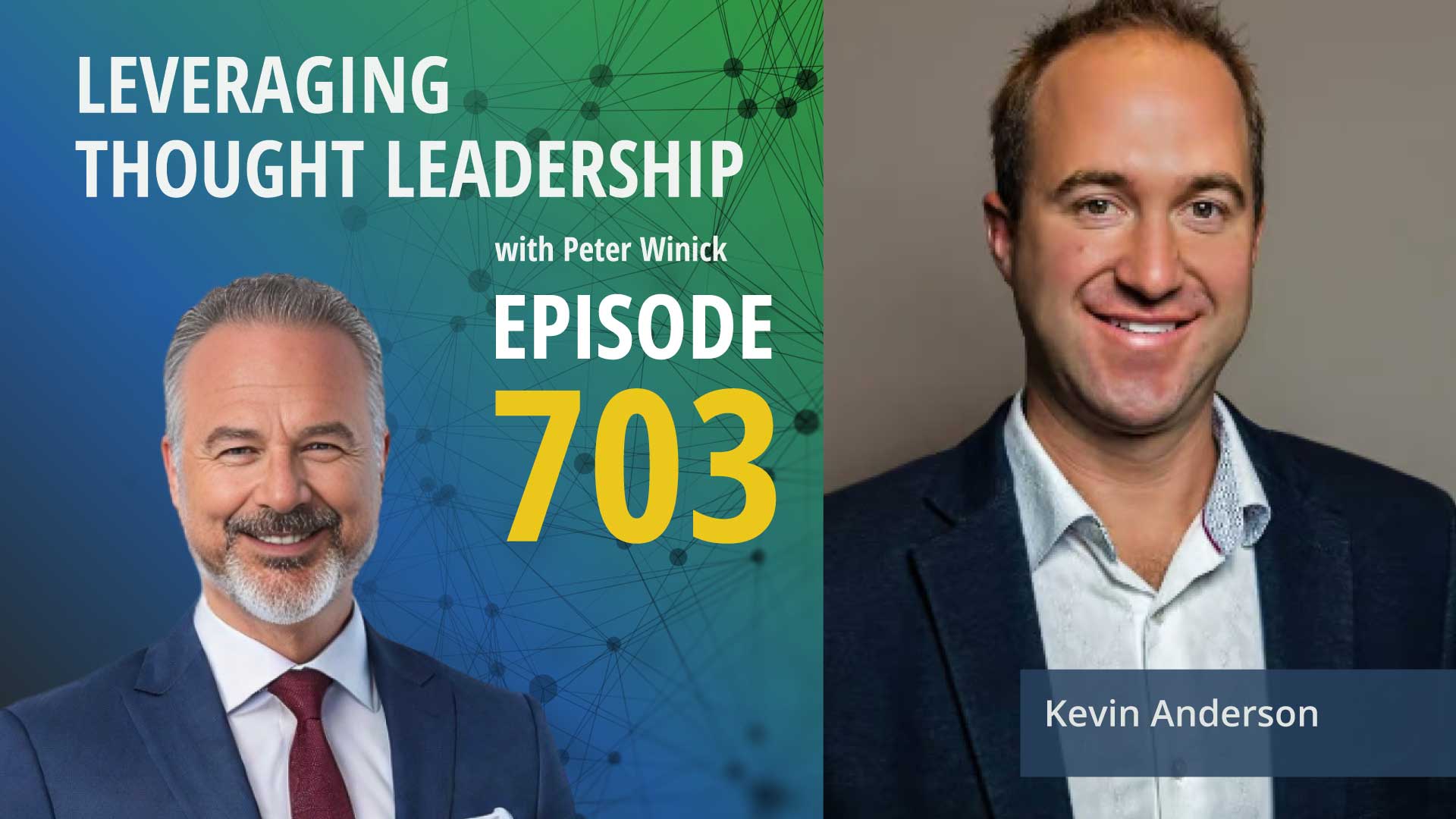
How To Turn Books into Thought Leadership Assets | Kevin Anderson



Building Books That Strengthen Brand and Influence
A sharp conversation on publishing strategy, book positioning, platform building, author visibility, and how thought leadership books create business value beyond sales.
What does it really take to turn a book into a business asset instead of a vanity project?
In this episode of Leveraging Thought Leadership, Peter Winick sits down with Kevin Anderson, CEO of Kevin Anderson & Associates to unpack what authors get wrong about publishing, platform, and the real role a book plays in growing authority. Kevin makes the case that a strong book is not just about writing well. It is about aligning the message, the market, and the outcome from the very beginning.
Kevin brings a practical lens to the publishing world. He explains why authors should bring in expert guidance earlier, not later. He breaks down how the right support can sharpen the concept, avoid wasted effort, and increase the odds that a book actually achieves its business goal. This is not about writing for writing’s sake. It is about building a book that works.
The conversation also goes deep on platform and promotion. Kevin is clear that publishers are not looking for passengers. They want authors who can reach an audience, activate a network, and contribute to demand. Whether the path is traditional, hybrid, or self-publishing, the core issue stays the same. Authors need a strategy for visibility and buyers.
Peter and Kevin also tackle one of the biggest misconceptions in thought leadership publishing: the idea that book sales alone define success. Kevin reframes the ROI. For most nonfiction authors, the real return comes from credibility, client growth, speaking opportunities, market differentiation, and the authority that a well-positioned book creates.
They also explore how authors should think about publishing models, ghostwriting, and AI. Kevin offers a smart, grounded view of where AI can help, where it can hurt, and why authentic voice still matters. He also shares why the best nonfiction books do more than tell a story. They deliver lessons readers can apply, which is what turns expertise into lasting thought leadership.
Three Key Takeaways:
- A book should be built as a business asset, not judged only by book sales. The real ROI comes from authority, credibility, client growth, speaking opportunities, and stronger market positioning.
- Platform and promotion matter as much as the manuscript. Publishers want authors who can already reach an audience and help drive demand, not authors who expect the publisher to create the market for them.
- Publishing strategy has to match the author’s goals. Timing, control, speed to market, and desired outcomes should shape whether traditional, hybrid, or self-publishing makes the most sense.
If this episode on Kevin Anderson got you thinking about what it really takes to turn a book into a true thought leadership asset, Bronwyn Fryer’s episode is a perfect next listen. Both conversations dig into what strong business books have in common: clear positioning, sharp audience focus, and the right support to turn expertise into a message that actually lands. Bronwyn adds another valuable layer by exploring the role of collaboration, editorial shaping, and what it takes to create a book publishers and readers will both respond to. Listen in to go deeper on how great thought leadership books are built to create credibility, impact, and opportunity far beyond the page.
Transcript
Peter Winick And welcome, welcome, Welcome. This is Peter Winick. I’m the founder and CEO at Thought Leadership Leverage. And you’re joining us on the podcast, which is Leveraging Thought Leadership. Today, my guest is Kevin Anderson. He is the founder, and CEO of Kevin Anderson and Associates, which has offices in New York, London, and soon to be Dubai. He works closely with writers, literary agents, publishers, and a long list of public figures and aspiring authors to help them write and launch their books. And instead of going into his long and very prestigious bio, we’ll just talk to him because he’s sitting here. So welcome, Kevin. Thank you, glad to be here. So in this sort of world of authors, thought leadership, all that sort of fun stuff that you and I both play in, but differently, tell me, describe your land. Like what’s the perfect scenario for you and the perfect sort of client situation for you?
Kevin Anderson Yeah. We work with authors at any stage of the journey, whether they were just starting out or whether they have a completed manuscript and we just help them figure out the best way to achieve their publishing goals. So, and we do this, we work really on the creative side with the book itself. So if they’re an author that can’t write or doesn’t have the time to write, we can do a ghostwriting approach. If they want to write we can a book coaching type of approach. And also just if they want find a publisher, we can help them navigate that. We do agenting for clients as well. And we just look at the whole big picture in terms of how to help an author elevate their book to the highest level and achieve their publishing goals. And we’re not, we’re agnostic. We don’t just feed traditional publishers, even though we have done million dollar deals with traditional publishers. We, we understand that it’s really our client’s goals that come first. So if that’s a self-pub or hybrid option, then we’ll push them in that direction, whichever way is going to make sense for them.
Peter Winick So it’s, it’s a bit different because it’s sort of a one-stop shop, right? Or in many instances, they’d have to find an agent and then a ghostwriter and then, and then and then. So I sort of like that holistic piece. Tell me the things that first time authors sort of think are true that aren’t. Like let’s burst the bubble of the Easter bunny, if we, if we shall.
Kevin Anderson Yeah, I think one of the mistakes that a lot of authors make is that they think that they need to make a whole bunch of progress first before bringing in a professional, which is a really big mistake because what you end up doing, you’ll hear these advice guys say, oh, you just gotta get started is the biggest, most important thing to just start writing. And there’s some truth to that, but you’re bringing in a professional early. In a half hour, 45 minute conversation with a professional coach, they help you figure out exactly which way you’re going wrong, which way your going right and give you some really good advice and reality checks to help you to figure out your journey so that when you do really put the pen to paper or focus on your book that you’re not wasting your time and going in the wrong direction and just having that confidence that comes with professional advice. You know, the biggest mistake is authors don’t get a professional involved early. We’ve seen too many times where it comes in like, Hey, great news. I finally finished my manuscript. I did it all on my own. And you look at it and you’re like, Oh my God, like if we were here early on, we could have saved you some real heartache here. Cause we’ve got to rewrite this whole thing. Cause it’s not going to achieve your goal the way you’ve done it.
Peter Winick Well, let’s go to the other side of that as well, which is a lot of authors, be they first time or not, don’t really wrap their heads around sort of the marketing side of this thing, right? And it’s like, oh, I’m gonna write a great book and then the publisher or some other mystery person will take care of that, whatever that is, right. But how important is it to build that followership to whether it’s on social, whatever the case may be, and how much weight does a potential publisher give to that when evaluating sort of a proposal with a strong following versus without.
Kevin Anderson Oh yeah, it’s critical. You know, you know, one of the, one of my favorite literary agents, Jim Levine, who, uh, presented a Brighid Alio and Tom Brady, you know, he always says, do not ask what publisher can do for you, but what you can do.
Peter Winick Sure.
Kevin Anderson And you know, a publisher can help you leverage a lot, but they are looking for turnkey solutions. They’re looking for authors that are going to be promoters that are going find an audience. You know, they’re not looking to make all that happen for you. They’re, looking to help leverage what you already have built and what, what platform you’ve kind of established. So especially if you’re going to a traditional model of publishing, you absolutely have to have some way to reach an audience doesn’t mean you have to, have a million followers on social. But it means that you have to have some kind of plan and ability to find buyers for your book because a publisher makes money on selling books. So if you do a hybrid approach, it’s a little bit different because you’re paying the hybrid to publish your book for you, you’re paying for the services. However, again, you can’t expect them. They’re not going to be able to just create your platform and your connections and your network and the marketplace for your book, they’ll help you better reach them. But yeah, even with a hybrid approach, if you want to, if book sales and visibility is an important thing for you, it is really important to think about the strategy of how you’re going to reach actual book buyers.
Peter Winick So let’s go there on the book sales piece. So one of the things that I find is sort of the, when you really get down to it, what is the rub between, let’s say, the publisher and the author, right? Because everybody wants more book sales, right, like nobody’s against that, no author comes out there and says, I’d be happy if it sells 500 copies, whatever, right. But the publisher only gets paid on number of units sold times some profit per unit. The author gets paid on that as well, but dot dot dot. There’s lots of other things and lots of other revenue sources and opportunities. That an author has as a result of getting the book out there, and they’re not allowing to the publisher. Yeah, absolutely. And therefore, I’ve talked to authors, many of which you know, and they say, hey, I sold millions of books, but there have been five that have made me millions of dollars. I just don’t know which one they are. So talk about what authors should be thinking about, because if you try to justify the investment of your time and energy and resources into this thing based on outcomes and profit just on a book basis. It’s silly math. Like it just does kind of doesn’t work.
Kevin Anderson You know, book sales, yeah, if you’re looking to make money on the book sales and that’s your primary goal, you might just go into the S and P 500 instead with your money, because your return, it’s going to be better than whatever you’re going to make on book sales most of the time, but that’s not the real ROI for most authors. For most authors, especially in the non-fiction space, the ROI is what it does for their business, what it doesn’t for their personal brand or their professional presence. And it’s the clients that you earn over time. And that’s why so many clients are going to the hybrid approach because it’s really having that book and having it available and showing that thought leadership, showing that authority in the space, showing what separates you from your competition and able to leverage that on your socials or on your speaking gigs or wherever it is, what clients you earn through having that book, and the authority that it’s
Peter Winick So, so stay there for a minute. Let’s sort of do a quick overview, educational touch on publishing, right? Because I think a lot of folks are delusional early on saying, oh, I’m gonna get an agent and then the agent’s gonna go sell this book and then I’m going to get a big fat advance and then rainbows and unicorns. And then again, here’s reality, right. Like, so the idea of getting an advance, you know, they’re smaller and smaller and smaller today than they were in the past, right, right And in advance, when you think about it from a business standpoint, is really just a cashflow issue. It’s an advance against future sales, right? So hybrid means the business model is the quality is the same, right. There’s no difference in it used to be different, but, but the quality and the integrity and the editorial piece, a hybrid is you’re poning up the cash as a business owner and you’re keeping the vast majority of the revenue down the road and then self is you are publishing whatever you’d like, you’re burning all the costs and all that. Where do you see people getting most confused or frustrated when they’re trying to make the right choice for them? Cause there is no, people ask me all the time, well, what’s the right way to publish? And I’m like, well the better question is what’s the right way for you to publish.
Kevin Anderson Yeah, exactly. A lot of it comes down to timing, timing and control. So for instance, this book right here, the Oz Perlman book, Read Your Mind, it’s been a New York Times bestseller. It got a near million dollar deal with Viking. He had a big platform. He’s been all over the place, 60 minutes everywhere. Yeah, we worked close with him through the whole process. And that book, like I said, it got a nearly million dollar deal, but he also had a huge platform. He had way of selling, and he wasn’t in a big hurry to get the book out right away. He could wait a year and a half. From the time that through the journey until that made sense for him. However, this, this guy, this is the CEO of Calvin Klein. It’s hard to see book, but it’s called a great fit. This was published by a hybrid publisher, Greenleaf, which is a great hybrid publisher. Tom Murray, CEO of Kelvin Klein for 14 years. He did, he did not want to wait a year and a half and he wanted to tell it just the way he wanted to tell, you want to have a little bit more editorial control. Whereas
Peter Winick With which, by the way, sounds like your typical CEO or entrepreneur, right?
Kevin Anderson Right, and the value for him was to have it soon because he wanted to immediately give it to friends, go on a speedy tour, that was important to him. So that made a lot more sense for him to do a little quicker, more hands-on-the-wheel approach of the hybrid publisher. So different platforms, different goals mean a different process for the, or a different publisher that might be a better fit for the author.
Peter Winick And what are you seeing now in the marketplace that’s different or creative or innovative from a publishing standpoint?
Kevin Anderson Yeah, well, there’s good and bad innovation right now. Yeah. Well, there has been a lot of bad AI innovation and yeah, I don’t know how much you want to get into that, but there are a lot hybrid publishers, a lot, a lot scam hybrid publishers and ghost writing firms that are really utilizing AI and turning out really bad content. And there’s a lot just mistakes being made as we’re kind of learning the curves with it. You know, I mean, there is a lot that’s beneficial. I mean the book covers and the, the creative side or the digital, like the visual side of this has been absolutely a game chat in a good way, you know, for publishers and, and helping figure out titles and stuff, you know, like AI has been really helpful to kind of figure out that. And also to help you with strategy.
Peter Winick But stay for a second, I think any tool could be used for good or used for harm, right? And AI is so new in this world that there is a lot of garbage out there. You read stuff like, oh my God, nobody talks like that, nobody speaks like that. This was clearly written by AI. But to me, the great use cases for AI are sort of, I would say, invisible, but the research that can be done or we’ve got a book coming out in a couple months. And we went through, we have over 600, almost 700 episodes of our podcast, 2.3 million words. We used AI because we’re humans, we’re limited to our memory. And say, if I’d be a couple of times that we spoke about this topic with this type of person, we’re like, holy cow, that would have taken an army of interns a lot of time. And by the way, it was trust but verify. Everything it put out, we put through sort of a rigorous process. So I think as a sparring partner, I think it’s a research partner. I like the design piece that you talked about. But I also think, like you said, you know, there’s been this, and this hasn’t gone away, this whole industry of, you know, book in a box or you can. We’ll get great, a great book for you in 24 hours. Like, no, you can’t. And why would you want to put your name on something like.
Kevin Anderson Yeah. A lot of that kind of backend research process. I mean, it can really save you a lot of time. Like you said, you got to verify everything and double check. You also want to be careful what you put into AI because you, you really put a lot trust if you’re putting, if you put in original content into an AI, you know, there’s leaks there’s, you really got to, I mean it’s early stages. So yeah, just be careful. What you’re kind of putting into, uh, to the machine, into the sludge pile.
Peter Winick What should I be thinking about if I’m thinking about calling you and your firm? Like, cause you get lots of calls every day from folks and you’ve got to make choices of who do you want to work with? So what are, what are the things that, that are intriguing to you when you’re having an initial conversation or someone on your team is, and what are the things they’re like, uh-oh, this is going to be a disaster.
Kevin Anderson Well, yeah. Okay. So, well, number one is the why, right? They will, you know, the Simon Sinek, uh, you’ll start with why, you know, why do they want the book? What, what’s it going to do for them? That’s always where we start because that’s where we, we always want to start from the goal and figure out what’s the, what the best path to get there and, and, I mean, this industry is the best because you just meet so many incredible and interesting people, incredible stories and reasons why they want to reach people with these stories or these messages. So, you, our, our perfect fit client is always going to be one that. Has a burning desire to get this book out and a reason, raison d’etre, for why this book needs to be in the world and, and who it needs to change and, and, help and, or what it does for them, you know, and their, and their preferred, where we get, you know, where, where are we kind of turn clients away is, you know, I mean, anything unethical or, or racist or, I mean, that’s, that stuff just right away. And we get tons of that, you know, tons of requests for, you know, for that stuff. But where it can get complicated is when… An author just hasn’t, doesn’t understand what they, they, they know they want to write a book, but they have no idea what they want it to be. We can always start there, but yeah, they really have nothing to give. And they just want someone to write the book and then, then just stamp their name on it. That’s just, that is not, that’s not what we do. You know, what we’re doing is, is extracting.
Peter Winick Let me unpack some of that because I think there is some confusion around, well, what’s a ghostwriter? And when people ask me, and I’m not as deeply involved in as you are, obviously I say, there isn’t one answer to that question. I look at it as a continuum from like, on the one hand, like you said, Oh, some of them will do all the work and just put your name on it. Probably not good. Right. And then there’s folks that are more sparring partners. There’s other folks that have more wordsmiths. So there’s not one. One answer to that question that there, I think the better question is what would the right type of ghostwriter for me be given how much time I have, where I go, what I want to achieve, et cetera.
Kevin Anderson Yeah. And how involved you want to be within the writing process. So yeah, you’re right. It’s a real sliding scale. It could be everything from just doing interviews or even accessing the existing content, like maybe you’ve written 60 blogs or something and a data mining, all of that and putting it into a cohesive narrative that that’s in their authentic voice. But yeah, I mean, it’s a lot of collaboration. It’s a, a lot people hire a ghost writer. Mostly the number one reason usually is because they want to have a really high quality product that really resonates with readers, but also is in their authentic voice and a lot authors are, they’re great speakers, they are doing business minds, but they are just not great at putting the pen to paper in a way that’s going to connect with
Peter Winick I mean, it’s a profession. It’s a craft. I mean the art of the storytelling. And I think some people think like, oh, you know, my colleagues or peers will think less of me, right? And it’s like, no, they won’t write like, like every CEO has a CFO. They might be great in finance, but they’re not going to do it all. Like, I think they have respect for the, the profession and the art and the science and the craft of, of writing, what else would you throw out there now, like give us some things that we should be thinking about if we’re in this space or. Are considering writing a book.
Kevin Anderson So you want to just think about the reason for your book. Again, back to the why. I mean, if the goal is to elevate your profile and to make you a thought leader, then you want make sure that what you’re creating from that book is serving that purpose. So sometimes a lot of authors in the non-fiction space. They really want to share, um, some element of themselves. They get lost in the memoir side of it without the lessons and your stories are great and stories are really important and they help connect to the reader, but if there isn’t like an actual takeaway, and of course I’m referring to like prescriptive nonfiction for the most part.
Peter Winick Yeah, yeah, yeah.
Kevin Anderson If it’s not a clear takeaway to the reader that they can actually apply in their own lives, then you’re probably not going to reach a lot of people. And also it’s going to be a lot harder to get a publisher or even help the publisher find your audience, because if it’s, you know, everyone has a, trust me, I’ve heard a million crazy stories and we get those calls all the time, once you hear my story, you’ll pay me to write my book.
Peter Winick Yeah, yeah, yeah.
Kevin Anderson So much. But that’s just, trust me, there’s so many amazing stories out there. What readers want to know is how can it apply to their life? How can it make their life better? How can it help them live a better life in their everyday experience? And so, I think that’s an
Peter Winick Yeah, I think because you listen to lots of people that you and I both work have had amazing lives and if they want to talk about that, that’s in our biography, right? You know, but if you’re talking about sort of nonfiction in business, it should be okay, as a result of reading this book, what can I or my team or my organization do differently to grow the business, drive the business attract talent, all the things that we need to do in business. If it’s just, wow. And then there was the time, like, you know, this, this braggadocious, you know, or craziness or Whatever. Yeah, that might make an interesting Hallmark movie, but probably not a great film.
Kevin Anderson Or you do it as your follow-up book. Like grab another one here. So this one there, that’s a Paul that’s Tom Golisano.
Peter Winick Yep, yep, yep.
Kevin Anderson Founder of Paychex, a $40 company. He came to us wanting to write a memoir. And, and he had, cause everyone told him, you know, and this happens with success story. Ever told all your stories are amazing. You’ve got to write. A memoir and he wasn’t wrong. But the problem was that no one knew who, no one knew who he was and he didn’t have a real following. He didn’t have a big source, even though he’s the head of a giant company. So what we did was we said, well, look, you know what, you can definitely write your memoir, but you’re not going to find a publisher for this unless you write your business book first, because people want to know, how did you start a business? I mean, you started a $40 billion business on a $3,000 credit card. So how did he do that? Like that’s what people want know. How did Arger learn from you? So we did the business book. First sold it to Harper for a couple hundred thousand. And then once we had the readership, once we had him, he was all over, did the whole media circuit. It was on blue, it was everywhere. And then we sold the second book to Harper Collins. The memoir, the memoir that he always wanted to write at the beginning. But now it had actual home because he had already built a following. He had built a readership to make, you know, to actually be able to sell the memoir.
Peter Winick Yeah, that’s interesting, the sequencing of that. Well, this has been great. I appreciate your time, Kevin, and I appreciate with your expertise in this space. Thank you so much.
Kevin Anderson Oh, my pleasure. Thank you so much.
Peter Winick To learn more about Thought Leadership Leverage, please visit our website at thoughtleadershipleverage.com. To reach me directly, feel free to email me at peter at thoughtledershipleverage.com, and please subscribe to Leveraging Thought Leadership on iTunes or your favorite podcast app to get your weekly episode automatically.

Related Posts
Comments (0)