
How to lead with resilience, adaptability, and clarity when the stakes are high What can…
Punks and Pinstripes, Reinvention, and the Future of Leadership | Greg Larkin
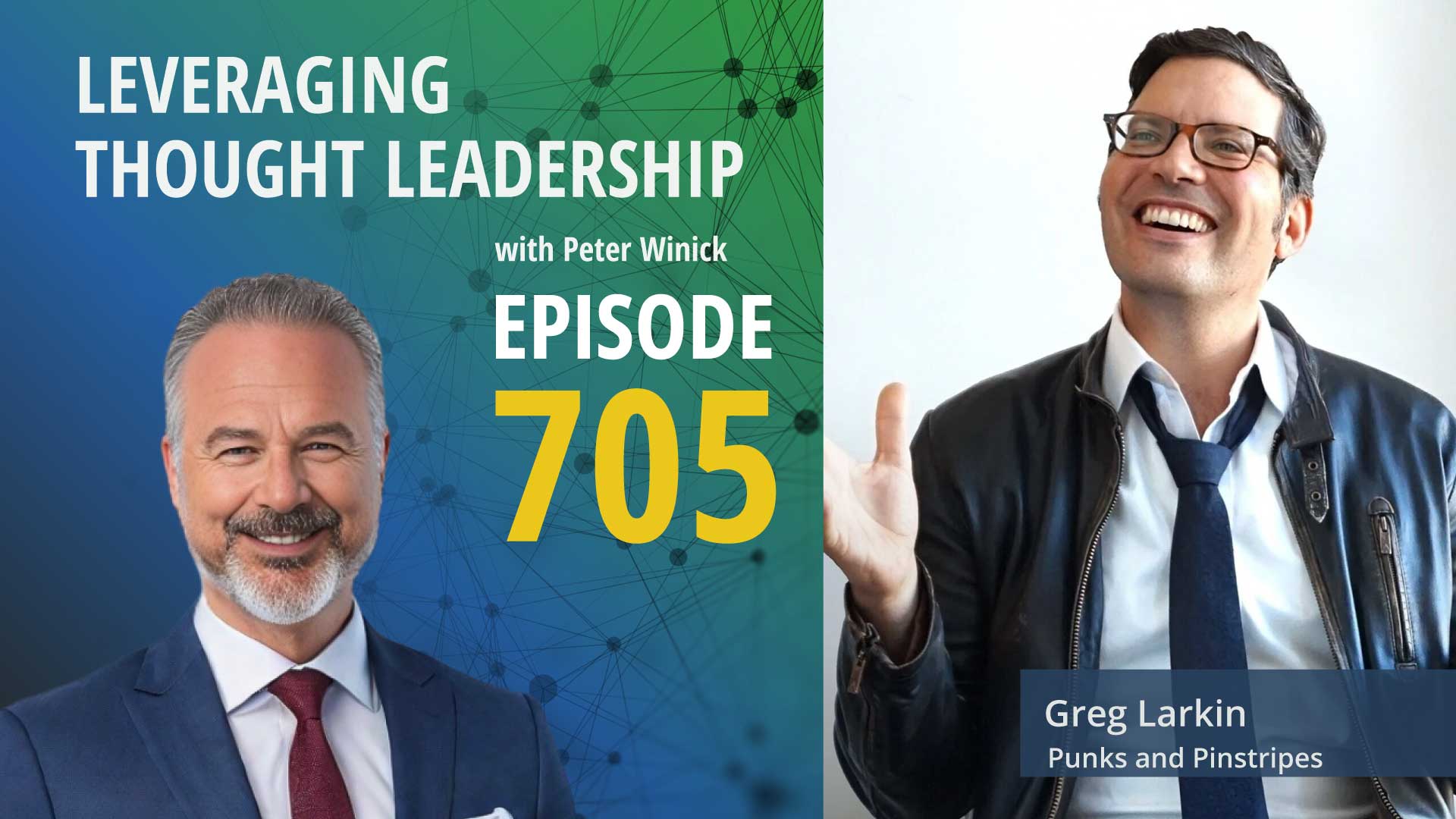



How leaders build community, navigate resistance, and do transformative work
A candid conversation about career reinvention, authentic leadership, building community in a post-loyalty economy, and the realities of driving change inside organizations.
What happens when success no longer feels like enough?
In this episode, Peter Winick sits down with Greg Larkin, author of “This Might Get Me Fired” and founder of Punks and Pinstripes, to explore what it really takes to reinvent yourself when the old rules of work, loyalty, and leadership no longer apply.
Greg’s thought leadership is centered on a challenge many high achievers face but rarely talk about openly: what happens when you have already climbed one mountain in your career and realize you are being called to climb another. His work focuses less on career management and more on transformation. He makes the case that in a post-loyalty economy, leaders must stop waiting for institutions to define their future and start building their own path with intention, courage, and community.
Through Punks and Pinstripes, Greg has created a community for entrepreneurs, innovators, and executives who are navigating that next chapter. The idea is powerful and practical. Reinvention is hard. It is often lonely. And it requires more than tactics. It requires a trusted circle, honest conversations, and the willingness to build something more authentic than the traditional career script ever allowed.
Peter and Greg also dig into the deeper substance behind Greg’s thought leadership. This is not abstract theory. It is rooted in lived experience. Greg challenges the flood of polished business advice that skips over the real obstacles leaders face inside organizations: politics, resistance, fear, obstruction, and the personal cost of trying to create change in systems designed to resist it.
That is where This Might Get Me Fired becomes especially relevant. Greg’s work speaks directly to leaders who are trying to do bold, meaningful work in environments that do not always reward honesty or transformation. His message is sharp: real innovation is not clean, safe, or linear. It is messy. It is human. And it demands a level of authenticity that many organizations say they want but few truly support.
This episode is a strong listen for executives, founders, and thought leaders who want to move beyond conventional success and into more transformative work. It is a conversation about reinvention, community, and the kind of thought leadership that matters because it comes from scars, not slogans.
Three Key Takeaways:
- Career reinvention is now a leadership necessity, not a luxury. The episode argues that in a post-loyalty economy, people have to build their own next chapter instead of relying on institutions to define it.
- Community matters more than credentials. Real loyalty is created through authentic relationships, mutual support, and showing up for others beyond transactional gain.
- Strong thought leadership comes from lived experience, not polished theory. The conversation emphasizes honesty about resistance, politics, and the hard realities of innovation inside organizations.
If this conversation on reinvention, authenticity, and building a more meaningful next chapter resonated with you, queue up Andy Craig’s episode next. It extends the conversation into what it means to feel stuck, redefine purpose, and build a career that creates more fulfillment, more freedom, and a better fit for the life you actually want.
Transcript
Peter Winick And welcome, welcome, this is Peter Winick. I’m the founder and CEO at Thought Leadership Leverage and you’re joining us on the podcast, which is Leveraging Thought Leadership. Today’s gonna be fun. My guest is Greg Larkin. He is on a mission to empower entrepreneurs to do their most transformative work everywhere they work, even when it’s hard. He’s the author of the international bestseller, This Might Get Me Fired. He’s a speaker and he’s the founder of Punks and Pinstripes, which is a global community of entrepreneurs. Entrepreneurs and punks who support and power each other. As a side note, in 2006, he was the first person to publicly predict the sub-prime financial crisis. And then he started a company called Innovest and lots of other interesting things. So welcome aboard, Greg. And anything to predict today, like you wanna get that off your chest?
Greg Larkin I was the head of product at InnoVest, by the way, not that longer. Um, I have nothing to predict now that everyone else hasn’t caught onto, which is that, um, you know, the AI bubble is a bubble and it will deflate and, uh, we don’t need to talk about that. Everyone, everyone’s that’s a fully baked prediction.
Peter Winick Exactly. Yeah. Yeah, just right. You could hear it. I mean, it reminds me of. The. Crash of. Oh, one when there was that New York Times cover story on the UPS drivers day trading and all that, you’re like, OK, this is going to end soon and it’s going to be bad. Yeah, anyway, back to our regular schedule broadcast. So how did you get here? Because this is an interesting spot that you’re in speaker, advisor, thought leader of punks and pinstripes like This was clearly deliberate and planned, right?
Greg Larkin Camera. No, I’ve been planning on this since I was six.
Peter Winick That’s what I wanted, right.
Greg Larkin I had a really roundabout career. I started out in a startup that startup was acquired and through that acquisition of the startup, I went from. Pirate ship of miscreant innovation to the epicenter of post financial crisis, Wall Street, truly a pirate inside of the Navy. Okay. And, um, and I became the head of innovation at Bloomberg, but I think there was a, an understanding that I gathered at that moment in time that I think. Was the beginning of a really zeitgeist moment, which is that there is no such thing as loyalty anymore, not in a corporate environment.
Peter Winick But say more about that. Is that the company to the employee or the employee to the company or all of the above? So nobody’s loyal to anybody anymore. That’s fun.
Greg Larkin You can earn it. There’s loyalty for the mission. Sure. You know, there’s in dispensability for spurts, but, you know, I was there when Lehman collapsed because of, you know, and, and we’re living in a moment right now where Amazon announced plans to let go of 30,000 employees. They have, they’re doing the best they’ve ever done Amazon. Right. They’re like, they felt like it. They felt like it, they don’t have to, they just choose to. And we’re living in a post-corporate loyalty economy. Gone are the days where our parents’ generation worked for mother Meryl and IBM, where there was a very, maybe never explicitly stated, but it’s like, if you work here for the rest of your life, you will never have to worry about money again, nor will you or children that is dead.
Peter Winick Yeah, yeah, that world hasn’t existed in probably 15, probably in my lifetime in terms of my career and yours as well. So how does that influence you as a thought leader? Because there were two or three generations which was the implicit contract was, do the right thing, work hard, paternalistically, mother Meryl or IBM or whoever it was will do the thing and take it, even if you don’t make it to the top. You could kind of stay in the middle and do the right thing. You’ll be sure everything will be fine. You get to go to watch in 30 years and then and then you get that pension check. Right. Like and like it’s all going to be good. You can go play golf like. I mean, you’re kind of going the opposite with punks and pinstripes, which is sort of reflective of your thinking of the way it is today.
Greg Larkin Because it now falls to the individual to create loyalty and it falls to the individual, to master the art of reinvention. Once you do everything you were told to do on the first mountain of your career, you ascend into the C-suite. You make a lot of money. You’re dutiful and diligent, invariably myself included, every person I know who has ever experienced that kind of success, something happens. Love, birth, divorce, illness, they get fired. Something shatters their perception that that’s the right way to spend the rest of their finite time on earth, and they have to start over. They’re still working, but how do you channel your fire and reinvent yourself in a post-loyalty world? How do you create your own community of loyalty?
Peter Winick That split is sometimes voluntary and sometimes involuntary, right? Like you said, 30,000 people on Amazon, they were probably doing a good job and got a great review two months ago, now probably got fired by text or something. Because that’s the efficient way to do it, right, or an AI bot told them you’re no longer needed or whatever. But let me sort of flip that a little bit. I think that the loyalty is now more selective. So I know in my work, It used to be that, oh, here’s how a relationship’s defined. Greg is my vendor, or Greg is boss, or right? And once that’s defined once, it’s defined forever. But now what I have found, at least in my work, is someone that used to a vendor is now a partner, and someone that use to be a partner is now a partner. So you create your own loyalty, and it’s not this loyalty to the brand or the logo, but people that you find cool and interesting. The context changes, right? Someone that was a client might be your boss down the road or whatever. Is that more the new norm today?
Greg Larkin I think you need a community, you have to build your community. And I think the basis of loyalty is community and sometimes you’re building community between vendors and suppliers, you know, um, sometimes it’s between your former colleague who becomes a consulting partner. Um, but how you, but I think that the, the underpinning bedrock of it is can you show up and be authentic? Can you create an oasis of authenticity in a world of performative bullshit?
Peter Winick And that’s a technical term.
Greg Larkin And, and can you be of service who are being, uh, for people where there’s no immediate return on investment, it’s just like one day and we don’t know when I’m going to need this back. You know,
Peter Winick Or I might not need it back, it’s not so measured sometimes.
Greg Larkin Right. And I think having community is the bedrock of loyalty and the bed rock of reinvention because the forcing factor that makes you reinvent is an inevitability.
Peter Winick Stay there for a minute because when I think about community and you think of it on like a continuum you have associations and that was usually sort of a professional guild the association of whatever physicists or engineers or whatever that’s not what I’m talking about right but then you might have on the other end hobbyists people that play frisbee you’re going more psychographically with punk and pinstripe right so absolutely but what that was about because it wasn’t just. I’m an alumni of a Ivy League school or something like that. Like, how did you find, you created Punch and Pin Strike because you wanted that community, so you created it, but how would you define the members of that or what the type of people that are attracted to something like that?
Greg Larkin They are all people who are climbing the second mountain of their career. Now that doesn’t mean they’ve left their job. Some of them are staying inside of huge companies and reinventing themselves and doing their best to be an engine of transformation there.
Peter Winick But let me push on you as a marketer. So when you say the second mountain of their career, I sort of get a picture of that in my head. But then if I were to make a note to myself, create a campaign to find people on the second mountain of the campaign and go to LinkedIn, that’s not a check the box, right?
Greg Larkin Really hard.
Peter Winick Hard company, like, well, we’re like, did Lincoln about that box? Like, how do you what are the signals that you would know or find whatever?
Greg Larkin So it’s a thing where you have to, it’s a program of attraction, not promotion. And that’s a very important thing to understand. What I have come to realize is that, that moment where this first mountain is no longer satisfying and you feel a sense of urgency to start reinventing yourself and climbing and finding what’s next and climbing that next mountain. That’s almost a ubiquitous experience in every successful person’s life. It’s not something that they advertise. Something they go through quietly. And the, the pain of it is that you very often are left borrowing first mountain communities, first mountain tools to climb your second mountain.
Peter Winick Because that’s a bit of what got you here. That’s what you know, right? If you know that I’m surrounded by people like this and that’s gotten me here, let me take them to the next mountain, but they might not be the mountain climbers for the next mount.
Greg Larkin Sometimes I think most of the most damaged professionals, successful people I know are people who had the second mountain Pang and like just shoved it down and were like, can’t allow that to surface, can acknowledge that must power through, but I think the Clarion call is it’s up to me as a marketer. To share. The second mountain reinvention journeys of the most notable people who have climbed that second mountain and share that of our members in punks and pinstripes. Because most great reinvention, most great innovation starts with someone where it’s not just they were like born a genius, no, they very consciously walked away from safety, security, stability, because it wasn’t fulfilling and it felt like golden handcuffs. Cindy Gallup, the banned public enemy, Duff McKagan. Duff McHagan, the basis from Guns N’ Roses, is now running a billion dollar hedge fund. You know, you could start the movie about Steve Jobs at him meeting Steve Wozniak and starting out in a garage. That’s not where you start the movies. You start the move where he quit his job at Atari. Exactly, yeah, yeah. You know where he walked away from Xerox. That’s where you start the movie. Right, right. And then what happened and then who did he allow into his life? And then how did he evaluate the capital that was available for him?
Peter Winick So I want to segue now into as a thought leader, right? You’ve got this these ideas, you’ve got these concepts, you’ve Got these passions. How do you decide there’s a business model here or not? And how to like you could go back to corporate, God forbid, right, and go to do all that. But like, how did you decide, like, OK, here’s the thing. There’s a market and here’s how I’m going to monetize it in a way that feels right for me.
Greg Larkin A couple things. Number one, I started with very radical differentiation, both in idea and in tone. I think a huge volume of thought leadership is focused on first mountain problems.
Peter Winick It’s probably right, yeah.
Greg Larkin Um, I’m talking about second mountain problems, which is decidedly ubiquitous, but unsexy the people who are in that phase of their life or older, which is not the prime demographic. It’s not necessarily what fast company is talking about on the front cover.
Peter Winick Isn’t it also in the sort of, you know, hashtag first world problem boohoo you made, you know, 20 million bucks, but you’re, you’re left your soul at work.
Greg Larkin That’s not true. Okay. It’s an emotional problem. It’s an existential problem. Everyone experiences it. Whether you have, are able to act on that realization with money and whether you have prepared for that inevitability, that varies. I was doing great when I quit my job at Bloomberg. I wasn’t rich. I had to work. I had the go and figure out what was next. Um, I definitely had financial stress with that decision.
Peter Winick But how did you figure out then that the business there? Because sometimes there’s thought leadership that’s out there. That’s a solution in search of a problem How did you realize that this is a real thing and it’s validating the business here?
Greg Larkin Let me back up a second, Peter. Sure. We live in a world where experts without experience sell advice without accountability.
Peter Winick That’s the 24 year old life coach.
Greg Larkin Everyone it’s the Harvard professor who speaks about innovation who’s never innovated a goddamn thing in their life.
Speaker 3 Thank you very much.
Greg Larkin It’s the pundit, it’s the inability to differentiate between pundatory and analysis. Okay. It’s, it, it it’s fake data describing fake hero stories, describing made up story arcs. There’s a guy, I’m not going to mention his name. He’s one of the most renowned business authors in the world. Everything he writes about is fiction, literally fiction about imaginary consulting firms and imaginary hero journeys. It’s like… Meet Meg, Meg runs a Brownie factory in Spokane, Washington. Meg is struggling, but watch me coach her through to Cushing. There’s no, and they’re like, they’re, they are clear, like who’s benefiting from that, you know, and the reason I say that Peter is that
Peter Winick Aren’t they usually done in the form of a parable? Meg is a mouse. Right, like it’s even more offensive, right?
Greg Larkin Like who are you being of service to? You’re being of service to yourself. Right. Um, but I think the ability to be honest about how much pain you’re going to endure when you’re solving a really hard, really ubiquitous problem, and you’re gonna have to figure out a way to get through to the other side and you know, not afraid to show your scars, any thought leader who can speak from the first Perthnesson singular. About… Dude, this isn’t easy. I’m not going to feed you some fake easy bake recipe about…
Peter Winick To solve this problem? I find and I hear you on the, you know, Meg, the Brownie CEO, whatever. But I think a lot of the thought leaders I’ve been fortunate enough to work with and know when you really get down to why did you do this? Why did you write this book? They wrote the book that they needed most, right? It was almost you know they wrote the book that they would have used there. Or it’s the journey they took or you know it’s something around. They needed to solve this problem once they solved it. Oh yeah, I might as well put in a book as others could benefit from it, right? Versus let me craft a hypothesis on a book that will sell because middle managers in this space struggle with having difficult concrete, whatever.
Greg Larkin I think that’s true to a point that I was the global head of innovation at Bloomberg. It was my job to launch. I had to give birth to a 13-year-old every six months. That was my job, you know, and, and Clay Christensen, smart man, good man. May he rest in peace. He had no idea what my life was like, despite having written the innovators dilemma. He had no idea the magnitude of obstructionism that I had to navigate in that role. He had no idea that The real hard part was not product market fit or technology fit. It was that for everyone who wants things to change, there are three very powerful people who want things to stay the same.
Peter Winick Their own agendas or motivations or whatever it is.
Greg Larkin It ranged from total craven self-preservation and self-promotion to risk aversion. I don’t think, I think this is going to get us all killed. You know, some of it was legit, some it was illegit, but like, honestly, the job was to navigate the obstructionists. The job was not getting Agile right.
Peter Winick Right, and there are a lot of business books on how to navigate the obstructionist, right, which is…
Greg Larkin No one wrote it because I don’t, everyone who was the like on the stage of thinkers 50 was on the outside looking in at what they thought I was going through, you know, and, and God bless them. It’s like, you know, if I can build up a follower base and leverage my, my, my relationships with HBR, this seems to be where the market is going. So I’m going to just pontificate on it. I’m gonna win the punditry prize. Yeah. I don’t think that’s actually doing any service to the person who really is. Owns that problem and has to solve it. And I also saw that that was a gigantic opportunity in my own book and in my own life to speak with rare honesty and integrity about what it’s like. When one of the wealthiest, most powerful humans in the business world throws a fucking chair across their conference room, cause they don’t like your prototype. Like, let’s just start there. Like start in the room when that happens. And, and, and the, the glass walls of the conference room, like bang, because he threw a fucking chair. Right. I’m not saying who this person is. People can interpolate.
Peter Winick You probably have you might be driving one of those products or have one in your pocket.
Greg Larkin Let’s leave it. Just leave it there, but like, what are you, what are you doing after that? You know, how do you go back to your desk after that, how do you wake up the following morning and go back to the office after that start there? Cause that’s actually what’s really going on.
Peter Winick Yeah, but then they throw the term around, like, genius, which is like French for a hole, right? That’s not genius. That’s horrible behavior. That’s unacceptable. Like, if most people did that in most contexts, you’d be arrested, right. And there would be real.
Greg Larkin No, that’s actually it’s assault. It’s legal. It is actual assault.
Peter Winick Right. So you would be right. Most people that did that at a PTA meeting or their regular whatever.
Greg Larkin Be bad.
Peter Winick Yeah, they’d be banned handcuffed, you know, searched out, never to work again. You’ll never work in this town again, right? Interesting, all right. As we start to wrap here, what are the things that you’re toiling with today that we might see you give birth to either as a teenager or not as a 30-year-old? I just have this vision of you giving birth to like bar mitzvah boys or something, I don’t know, it’s a beneficial one.
Greg Larkin Become born with P.A.S.
Peter Winick Yeah, exactly.
Greg Larkin Uh, a couple of things. So we do a salon in New York. It’s limited to 50 people. It’s a great monthly event where we interview some of the most famous people in the world about their own reinvention journey. Right. Um, our next one is on the 22nd of January. Not sure when this episode’s going live, but it’s with Peter Toney. And then on February 5th, we’re talking to Stephanie Trunzo. She’s the CEO of Merge. She used to be the CEO or Oracle healthcare. How she left Oracle and started merge and what that journey of reinvention with is, is incredible. So we do that on a monthly basis and very exciting news. We just got picked up by the, um, live from tomorrow podcast network. That’s run by Matt Hooper. Matt Hoopr is, uh, he’s been to a bunch of our salons and heard a bunch of our interviews and, um, we are going live with our punks and pinstripes podcast very soon. The other thing that we started last year in stealth mode and are now not stealthy about anymore is that we have amazing retreats and they come in two factors. One is like a reinvention retreat. Where we all go to this beautiful house in the Catskills and it’s three days and two nights. And it’s kind of dealing in very intense ways with where are you trying to move away from? What are you moving toward? Why is it hard? How can we help? And this coming summer, we’re doing a creative retreat in Italy. Five days, we’re renting a giant, beautiful farmhouse. You wake up, you meditate for a half hour. From nine until one, it’s total silence. You can just write or paint or draw or build the app that has no business use whatsoever, but you can’t get it out of your head. And so that’s coming up. Cool. The red thread that ties all of these things together is the greatest innovators, transformations, breakthroughs of our time come from people who have had the courage and focus and chutzpah to reinvent themselves and get out of the comfort zone. Cool. And we just, it’s my job and my calling to create space for them to be able to do that and to help one another do that.
Peter Winick Well, appreciate your time. This has been a lot of fun and wish you the best on all the things you got going on. Thanks. Thanks, Greg.
Greg Larkin All right, my pleasure.
Peter Winick To learn more about Thought Leadership Leverage, please visit our website at thoughtleadershipleverage.com. To reach me directly, feel free to email me at peter at thoughtledershipleverage.com, and please subscribe to Leveraging Thought Leadership on iTunes or your favorite podcast app to get your weekly episode automatically.

Related Posts
Comments (0)