
From High-Stakes Flying to High-Impact Leadership | Merryl Tengesdal
The Leveraging Thought Leadership podcast is created by Peter Winick and Bill Sherman and produced by Thought Leadership Leverage.



How to lead with resilience, adaptability, and clarity when the stakes are high
What can leaders learn when the path forward is uncertain? This episode explores resilience, adaptability, and authentic leadership, with a sharp focus on how failure, flexibility, and real-time decision-making shape stronger leaders. It is a practical conversation about leading under pressure, connecting through story, and turning hard-earned experience into insight that helps others grow.
What does it take to lead when the plan breaks, the pressure spikes, and failure is part of the mission?
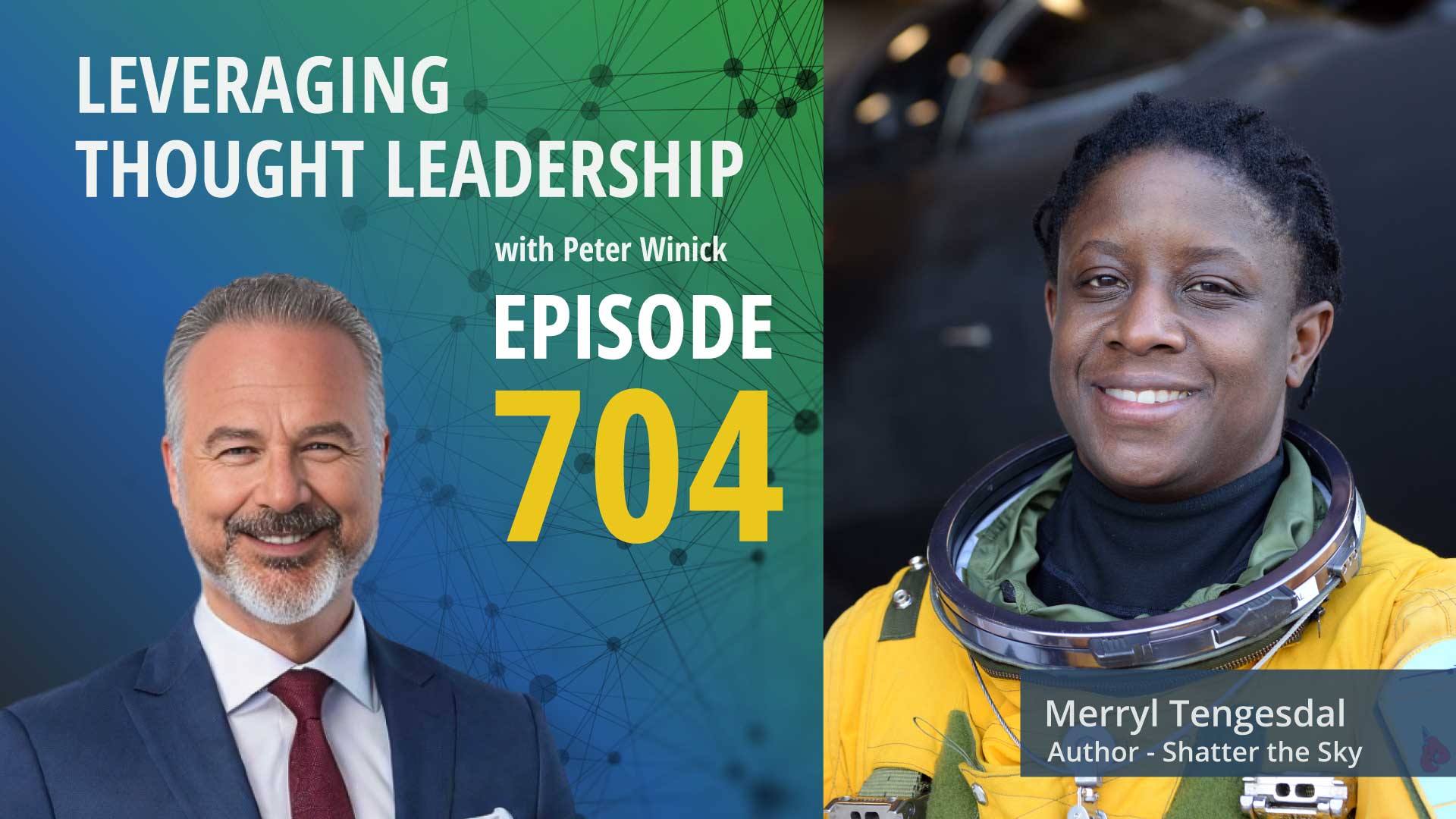
In this episode of Leveraging Thought Leadership, Peter Winick talks with Colonel (Ret.) Merryl Tengesdal, author of Shatter the Sky: What going to the stratosphere taught me about self-worth, sacrifice, and discipline about the ideas that drive her work today: adaptability, resilience, authentic leadership, and the courage to keep moving when the outcome is uncertain. Her message is clear. Success is never a straight line. The leaders who thrive are the ones who learn to adjust in real time.
Merryl brings a powerful framework to the conversation. She treats leadership like flying. You prepare well. You know the mission. But you also stay alert, read the conditions, and make smart adjustments when reality changes. That perspective makes her thought leadership practical for executives, team leaders, and organizations facing constant pressure to perform.
She also makes a compelling case for rethinking failure. Not as a verdict. Not as an identity. But as part of the process of building something meaningful. Merryl challenges the idea that top performers avoid setbacks. Instead, she shows that real growth comes from how leaders respond when things do not go according to plan.
What makes this conversation stand out is Merryl’s ability to turn high-stakes experience into usable insight. She does not rely on polished theory. She speaks with clarity, candor, and conviction about what it means to lead under pressure, recover from disappointment, and stay focused on the larger mission. That is what gives her message relevance far beyond aviation or the military.
Peter and Merryl also explore the role of story in leadership. Merryl explains why great speaking is not performance for its own sake. It is an act of connection. It is how leaders help people see themselves differently, think more clearly, and take the next step forward. Her approach to keynote speaking is grounded in authenticity, not persona, and that is exactly why it resonates.
This episode is a strong listen for anyone building a thought leadership platform around leadership, culture, resilience, or performance. Merryl’s work reminds us that strong leaders do not promise perfect conditions. They help people navigate uncertainty with discipline, perspective, and purpose.
Three Key Takeaways:
- Adaptability matters more than perfect plans. Strong leaders prepare well, but they also adjust in real time when conditions change.
- Failure is part of growth, not proof of defeat. Setbacks are inevitable. What matters is how you respond, stay persistent, and keep moving forward.
- Great leadership connects through authentic storytelling. The most effective messages are grounded in real experience and help people see challenges, decisions, and opportunities differently.
If this episode resonated with you, listen to Deborah Gilboa’s next. Both conversations center on resilience, adaptability, and what it takes to lead when the path is uncertain. Merryl’s episode shows why flexibility, failure, and real-time decision-making matter. Deborah’s builds on that by showing leaders how resilience can be developed, how to manage change more effectively, and how to help teams move through resistance instead of getting stuck in it. You’ll come away with practical insight on leading through change with more confidence, clarity, and competence.
Transcript
Peter Winick And welcome, welcome, this is Peter Winick. I’m the founder and CEO at Thought Leadership Leverage, and you’re joining us on the podcast, which is Leveraging Thought Leadership. Today my guest is retired Colonel Merryl Tengesdal. She was born in 1971 in the Bronx, or the B Bronx as we say, as a kid from Queens like me might say. She’s a trailblazer in the field of aviation and a symbol of perseverance and excellence. She is notably recognized as the first and only African American woman the pilot, the YouTube dragon lady, a high altitude reconnaissance aircraft in the U S air force. She started as a Navy commissioned officer, excelled as a naval aviator. And we’ll let her tell the rest of her story. So I don’t botch this bio any further. So welcome aboard, Merrill. Thank you so much for having me here. Oh, I will concede as a kid from Queens that I should be a Mets fan, but I am still a diehard Yankees fan.
Merryl Tengesdal Then we are friends, I’m a Yankee fan, so there’s no problem with that. You know, I still, what, the last Subway series was in 2009, so I wish there was another one. Yeah, one day.
Peter Winick Maybe in our lifetimes at this rate. No, maybe, maybe the Yankees are struggling, man. Yep. So tell me, where did this, how did all this happen? Because there’s a lot of firsts next to your name, and there’s lot of, when you and I were talking a week or two ago, like, really, that seems different. Like, it hasn’t been the typical path or journey. So how did this stuff happen, and how did you wind up as a speaker, thought leader, and all that other sort of fun stuff?
Merryl Tengesdal It happened when I was seven. I watched too much science fiction. I watched so much structure, and I was very drawn to the concept of to boldly go where no one has gone before. And so when I saw that and heard that and saw the missions that the crew of the Enterprise did, I said, I want to explore space. And so at seven, I decided, I’m gonna go do it. And it’s funny, as I’m now, Did you just call me out being born in 1971? As I look back on my life, um, I realize that a lot of the things that I do, I look at it and I go, oh, this is cool. Let me go do it. And then I figure out the tools that are required to get there. And I say, okay.
Peter Winick Like reverse engineering, because I would imagine as a seven year old from the Bronx, you can’t take the six train to go into space. Right? Like, right. So you got this a lot of I got to figure that out. And I would also imagine not a lot of your neighbors were astronauts.
Merryl Tengesdal Correct, so that one looked like me at the time, but the cool thing is, is that Star Trek, even though it was science fiction, it still had a method at which it needed, and I picked up on that. So I knew they all went to Starfleet Academy because I read so much, I was so. Lactobacillus hyperfixated on Star Trek, so every break Star Trek I consumed they all went to Starfleet Academy They were all different backgrounds different races extraterrestrial, we had Spock from the land of Vulcan. Yeah, right. You know, they all did certain things, but their childhood, they had this dream. So for me at seven, I realized that, okay, they all do math and science, so I got to be good at math and the science. So I’ll focus on that more than probably everything else. I knew they went to Starfleet Academy. I knew I had to go to college. And then since I wanted it to be like Chekhov or Sulu, the Navigator or the Helmsman, I said, man, I gotta fly planes because you gotta fly plans to fly spaceships. So that makes sense. And that’s what I started to do. And I said okay, let’s do this. And that was my starting point.
Peter Winick Very cool. And then, let’s go to the other side and we’ll come back to this. So now, it’s years later, you’re retired from your military career and you decide now what? Speaking book, like how did this whole next chapter?
Merryl Tengesdal So, you know, once I get to the, you know, I’m in the Navy first, right? So I fly right Navy. I’m an instructor. I’m going to resign my commission in the Navy cause I wanted to go back to school. Cause I want to still be an astronaut as I’m flying my boss at the time it was in air force, uh, Lieutenant Colonel was like, come to the air force and fly. And I see the YouTube program. My boyfriend, who’s now my husband at the time was talking about the YouTube and I look at the community and I, and I love it. Fast forward, I switch over to the Air Force, get picked up for the U-2 program, and I’m still climbing the ranks. I was a Lieutenant Commander Select when I entered into the Air force. So it’s a line number, so they switched it from a Lieutenant commander to a Major Select. And I started-
Peter Winick Well, stay there a minute though, because so I’ve worked with lots of folks from various branches of the military over, over my career, right? And never have I heard one switch from one branch to the other. Maybe I just wasn’t asking the right questions. You say that as if like, yeah, that kind of happens. That’s really unusual.
Merryl Tengesdal It is unusual in the U-2 community. We have a lot of inter-service transfers. So the U2 program, you have to be a previous pilot and instructor in another aircraft. So we have Marine Corps pilots that have flown F-18s, and we have had an army person, a Coast Guard person. So there’s been a couple. I just happened to be one of them. At one point, when I got picked up for the program, there were quite a few Navy and Marine Corps people that they closed the program to us Because we started taking over And so, you know, I still was doing well in leadership and giving more leadership opportunities. I found that I’m actually, I do well in leadership. People listen to me, what I say resonates with them. I can connect with people on levels that maybe other leaders can’t. And so as I’m going up the ranks and I’m retiring, I was like, man, I would love to do this, but more focus on mentoring youth. Because throughout my career, I had mentors. I had people who mentored me. Yep. You know, the little girl in the Bronx at nine years old, to now working in the Pentagon, who I had a three star, who was one of my sponsors, mentors there. And so I started doing that. I started just speaking, speaking to groups and I did very well at it. I was able to share stories as if we’re sitting in the heritage room having a beer and people enjoy those things. So I decided I wanted to do it through personal training. I wanted to… I love personal training. It means a lot to me, martial arts, boxing. That’s stuff that grounds me, especially during times of stress or if I’m thinking or something’s heavy. So I felt I can reach people better that way and nothing is as great as a teenager who is so tired from punching a bag that they have to listen to what I have to say. Now, wait, is that parenting advice or mentoring advice? That’s both. That is both. Um, my, my daughter right now is pushing boundaries and yesterday she understood how much she could be PT. So she was very quiet last night and so she was very receptive, but you know, just started morphing from personal training to talking, to talking to women’s groups, to talking to bigger groups, to being on the reality show. Because I did do social media to you know get my training I worked at a local gym and once I got
Peter Winick Let me throw something at you that, to me seems, because I’m always looking for the thread, right? So I would imagine, because I know other pilots as well, one other thing pilots are really good at is receiving and dealing with real-time feedback, right. Think about the controls and the data and you can go in with the plan and if you’re stubborn and stick to the plan, you could be stubborn and dead, right, so whatever that feedback is, you’re gonna have to adjust literally in real time and anticipate and take that data, process it, et cetera. It sounds like that’s what you’ve been doing in other areas as well. If you set out to be a boxing instructor or this or that, but like try something, get the feedback and then process it and react to that. Is that a fair?
Merryl Tengesdal So some of it, you have to come in with a little bit of a game plan, a framework, a base. Sure, yeah, yeah. Yeah, so I knew, I mean, I’ve been doing martial arts since I was 19. So a lot of it I’ve done Muay Thai, I have done boxing. So when I knew I was gonna be a trainer, I found a gym that didn’t have that niche because I knew that I had to be a salesperson. Sure. So I knew if I offered that and they were receptive, I can bring clientele that were different than what people were looking for. And It actually worked really well. Unfortunately, the management there, they don’t have a lot of creativity. They like, they like to swim in mediocrity. Um, so, you know, I moved on for that, but I still have clients to this day eight years later that come to my house that I train with. And I’m talking about clients that are over the age of 65 or younger clients that still come see me. And I still get, you, know, the teenagers that come in.
Peter Winick So. Very cool. And then how did you just discover that you’ve got the ability and the passion and you enjoy keynote speaking, because that’s what you’re doing a lot of these days as well.
Merryl Tengesdal I think when I, before I retired, I did one of my first kind of bigger engagements at University of Idaho in Boise. And I was asked out there while I was still in the military to talk to a women’s forum, it was about 700 people. And it was the first time I was doing this. And I just told my story. I spoke to people as if we were sitting on the couch And I’m, I’m a little sark- Not sarcastic, I’m a little funny in places. I make people laugh, but I also make people think. And it just, the response was so, the response from the people there, like some women would come up to me almost in tears, like from the story that I had given. And I realized that I can reach people on certain levels or I can disarm people with the way I say things. And so,
Peter Winick But wait, was that, but it sounds like-here was an authenticity to that. It wasn’t that you created, because I’ve worked with hundreds of keynoters. Some of them almost create a persona that’s only a real thing on the stage for 45 minutes. Then when they come off the stage, they’re not that thing anymore. But it sounded like to you as an extension of your, the quirks of your personality, your style, whatever, and the authenticity as opposed to, in order to be a speaker, I have to act like this and be this and do that.
Merryl Tengesdal Yeah, I can’t act a certain way. I’m just, this is who I am. There’s right sides of me, there’s bad sides of. Sure. There’s sides of that need improvement. When I interact with you, you’re gonna get the side that’s most appropriate. So, you know, it’s not, and I don’t mean to say that in a negative way. It’s just, we’re gonna connect on a level and I’m gonna find these connection points with you from my journey to your journey to help you on your journey, because I’m all about. Let’s find some common ground, let’s connect, let’s uplift each other, let us motivate each other.
Peter Winick Okay. So once, once you figure out that you sort of enjoy this experience, because to some people that experience of getting on a stage in front of 700 people would be terrifying, right? They would rather do anything. But, but you get up there and you’re like, that was kind of fun. That was kind cool. Right. So then you have to sort of figure out two things. All right. I want to do more of that. And wait a minute, I can make some money doing that. Like, cause not everybody gets both sides of that coin. How did, how did you decode that?
Merryl Tengesdal So to decode that, I just started, I just said, oh, okay. You go online, you type up with speakers, what they make, what they do, and you start realizing there’s a huge world. There’s people who help train speakers, there’s people- True. And again, I go back to the seven-year-old kid who’s like, this would be cool, what tools do I need? Okay. And you just start absorbing that. The motivation for me was the look on people’s faces. The motivation, for me, for being a good leader is the fact that I can help people be better versions of themselves. And that, for, me, even though getting on stage sometimes can be daunting and exhausting, and you give so much, the fact I can make someone a better version, like, that makes my day. Like, that’s, that is what-
Peter Winick But talk about that exhaustion. Cause it’s so funny. So if I said to you, you’re going to train five people had a box today and get punched in the face a few times, you like, yeah, it’s Tuesday, whatever. But that you would say getting on stage for 30, 40 minutes is something that’s exhausting unpack that a little, cause there’s, there’s something like that’s interesting.
Merryl Tengesdal So it’s to give, to tell a good story to me, you give a part of yourself. You give a party yourself to the audience, right? So you’re putting yourself back into that situation and you’re building the, you’re like a dungeon master. You’re setting the stage, you building the stage. Everything that’s happening. And that takes a lot of energy and not a lot people can do that. So there are times that it could be exhausting. There are times when You know, you’re just on and you’re just feeding everything and making all the context. You’re painting this picture for someone. And that’ll wear you out. And it’s in a good way because it makes you very reflective. And sometimes in the moment when you’re speaking, and depending on what’s happening during your life at that moment, you make certain connections. And I go, oh yeah, that’s why I’m doing that right now. I forgot about this story. You know you’ll speak about so.
Peter Winick Again, there’s a game plan there. If I said you tomorrow, you’re going to go to speak to this type of group, newly minted MBAs or new managers in a software company, you can come up with a game plan, you going to figure out the timing, the cadence, here’s the four or five stories I’m going to tell. But then in the moment, you might realize, you know what? There’s that other story I wasn’t even thinking about, but I can tell by the way they’re leaning in or leaning out, I’m gonna throw an audible here, right? And I’m to pop that story.
Merryl Tengesdal So it’s like, yeah, so it’s like flying an aircraft, right? You know what the weather is. You, you do all your pre-flight planning before. Sure. You know, what’s going on, but maybe that day, the, the coal front is not moving as fast or maybe there’s a little bit more turbulent. You get a feel of the aircraft. You fly, you know, you’re flying the numbers, but you’re overshooting the runway, so you know you have to bank a little bit more in the final turn to line up with the runway. Those little nuances, those are the things that you do in that pilot-ish, at those moments, real time, to have that perfect landing, to finesse that landing, because every approach is not the same. And so, that’s how I look at speaking. You know, I do have the overall picture of what the mission’s gonna look like, but it’s the fine-tuning parts, the trimming of the air. That’s the-
Peter Winick If I were to say to you, because one of the things that I believe the good speakers do is not change an organization, not change anyone’s behavior or whatever, but they plant some seeds and some ideas that some subset of the audience might consider later in that day or that week or that month, right? Like, ah, there’s a way of looking at the world that might be slightly different for me. It’s not going to be this radical black and white sort of thing, but Like, what are the? You know, if I were to find a hundred people that had seen you speak and asked them a survey, what are the three things you think that would bubble up to the top as an outcome of seeing you speak live?
Merryl Tengesdal I think one of the things is flexibility and adaptability. Like, things will never, there’s a lot of people have, especially nowadays, this really firm expectation about what they want the outcome to be. Sometimes it’s not like that. If you have kids, there’s so many things I don’t want them to do, but they are, they’re a little insane. Like we were, we were kids. They’re just like random molecules that just bounce off of anything. So you have to be flexible and you can’t, you can be upset when it doesn’t go your way.
Peter Winick So and that’s relatable to any industry and that could be, you could be talking to a group of kindergarten teachers or CEOs, right? So what that means to each of those might be different, but flexibility and adaptability, what are the other concepts that you think people would, would be thinking about as a result of seeing you speak?
Merryl Tengesdal The other thing is, is that failure, if you have high expectations, failure is one of those things that’s going to happen to you. And it’s not a matter of if, it’s a matter of when and how you respond in that moment and what you do afterwards will define the type of person you are and how successful you are. You know, I always wanted to be an astronaut, but I did not. I put on a pressure suit, spacesuit, but I didn’t make it as an astronaut. That doesn’t say that I was a failure. It just says, look, I didn’t make it, but man, I tried hard. There’s still time in my life that it can happen that I will go over space. But in the meantime, and this is the last part, enjoy the journey of what you’re doing. Because I will tell you, I’m sitting here now and we’re speaking. I didn’t think 40 years ago, 50 years ago that I was going to be in this position. There are just things that have just happened that have been amazing. A book, have my son, we adopted my daughter. Like, it’s like mind blowing. And if I had said to myself when in flight school, oh, I didn’t get, or before I even got into the military, oh, the Navy didn’t want to speak to me and I didn’t keep pushing. I would not be here, I wouldn’t enjoy the view. And the view’s spectacular wherever you’re at. Like, I show people the view of the U2 above 70,000 feet, and it’s amazing.
Peter Winick Right, right. I want to go back to the failure piece for half a second, because if I were to go on Amazon or the bookstore, whatever, and say, let’s look at some of the top business books out there, right. They’re all good to grade or whatever. They’re about success, success, and yeah, nobody wants to go into business to lose, but the reality is some of the most amazing business people I know, the lessons that they’ve learned have come more from the failures, the wins, because sometimes those grand slam home run wins, when you push on them a little, the, it’s a higher percentage of luck and skill than it is their ability, their intellect, their, their strategic thing, whatever it is. So I think it’s an interesting piece as a business person to say, you know, you do need to study failure and if you’re not failing, something’s wrong.
Merryl Tengesdal Absolutely. I, I laughed because I just came out with a graphic novella. So I’ve been working on that for years and I’ve, I’ve tried to get into contracts with different illustrators, right. So I was going to happen, failed. It didn’t, it didn’t work out for one reason or another. And I didn’t stop. I was like, eventually the timing is going to work. I I’d say to myself, okay, the timing’s not right now. I’m going to still work on it. I’m gonna still push in every meeting that I met with people. I would listen to their stories. Is there a connection? Is there something? And eventually it happened. And eventually, it was local. And eventually I met my illustrator who we’re now friends and we’re working on book two. You know, it just, but it took two years. It was like, you gotta be persistent and consistent and just not give up on that. So failure is temporary. It can be permanent if you let it bog you down and you get depressed. But it can also be just something very temporary and it can bring you to the next thought.
Peter Winick Well, I think in the moment, it’s overwhelming, but in the rear view mirror, it was like, oh, that was kind of a hiccup in the journey of life. But at that moment, when you didn’t get into the school you wanted, or that relationship, whatever the thing was, your whole life was a wreck for a day, a week, a month, or whatever. Then you look back and go, oh yeah, that, you know. That was like a bad burrito. That was no big deal, right?
Merryl Tengesdal It’s like driving in New York, right? You hit a pothole, you’re not going to let it destroy the whole undercarriage, right, so?
Peter Winick Depends on the bottle. Anyway, this has been awesome. I appreciate your transparency and sharing your story and, uh, good stuff. Thank you so much, bro.
Merryl Tengesdal Thank you for having me. It’s awesome. It was great meeting you.
Peter Winick To learn more about Thought Leadership Leverage, please visit our website at thoughtleadershipleverage.com. To reach me directly, feel free to email me at peter at thoughtledershipleverage.com, and please subscribe to Leveraging Thought Leadership on iTunes or your favorite podcast app to get your weekly episode automatically.
