
The Marketing Dilemma Every Author Faces | Rand Selig | 725
The Leveraging Thought Leadership podcast is created by Peter Winick and Bill Sherman and produced by Thought Leadership Leverage.
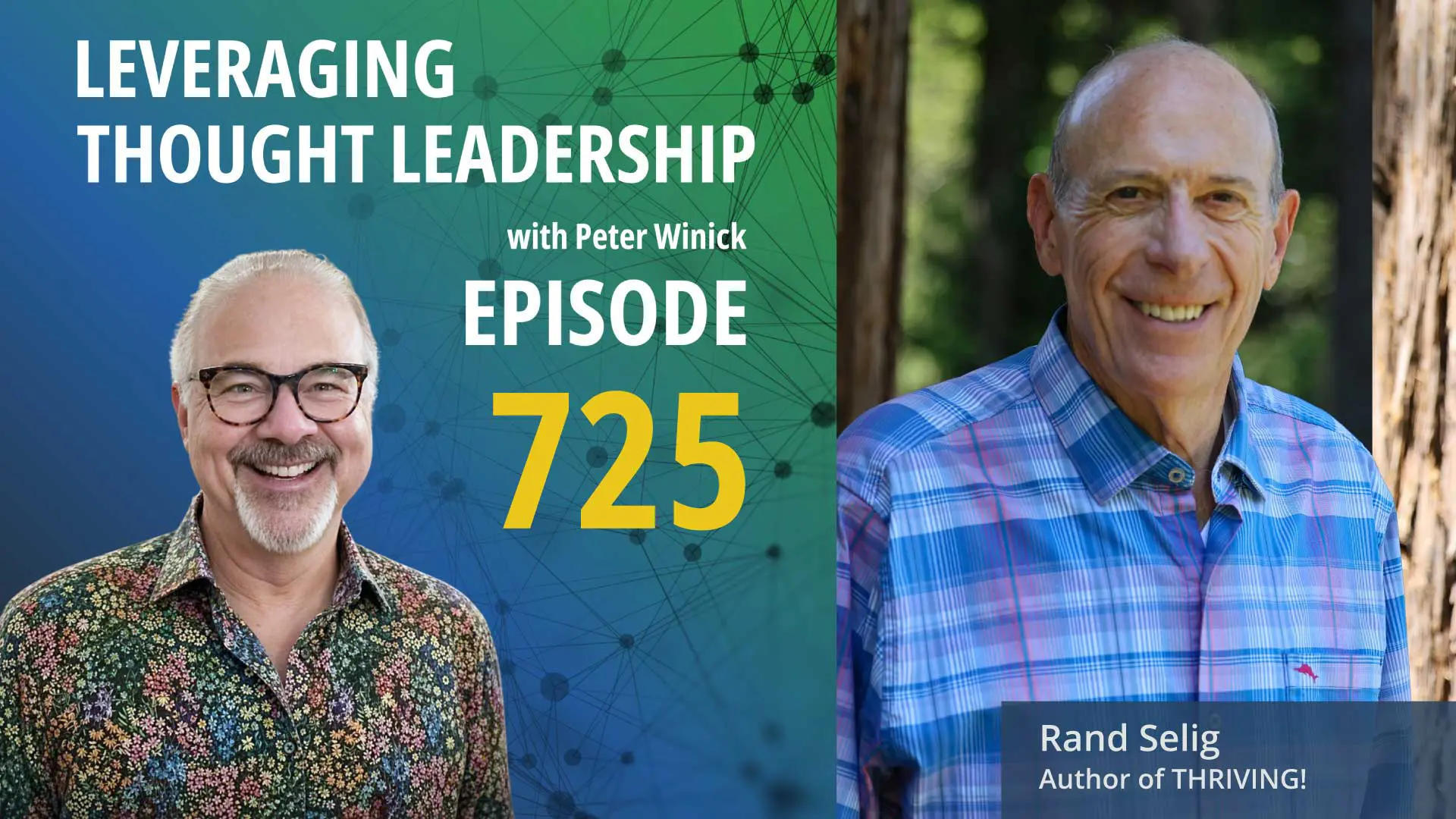



Balancing mission-driven visibility with the discomfort of self-promotion, from an author’s perspective
This episode unpacks what happened when he tried to self-publish a personal legacy project — and why trusted readers pushed him to release it widely, sparking a new mission around purpose, meaning, and lifelong reinvention.
What happens when the metrics you were taught to chase — title, bonus, prestige — stop adding up to a life that feels good?
In this episode, Peter Winick sits down with Rand Selig, a Stanford MBA, former Wall Street investment banker, and founder of The Selig Capital Group, to trace his path from a jarring first job at Lehman Brothers to a self-defined version of success built on peace, gratitude, and deep relationships. The conversation opens with an unusually candid account of what it was like inside a major investment bank in the early days of Rand’s career — a place where talent was abundant, but the culture rewarded pushing others down to get ahead. That experience became a turning point, eventually leading Rand to launch his own firm, run on his own terms.
From there, Peter and Rand dig into the origin of Rand’s book, Thriving! — a project that started as decades of collected notes, quotes, and reflections never meant for commercial release, until early readers flatly rejected the “small legacy project” plan and insisted it reach a wider audience. That pivot raised a harder question: how do you promote something meaningful without it feeling like self-promotion? Peter pushes Rand directly on this tension, exploring podcast appearances, AI-assisted content tools (including his use of the platform Inkflare), and a growing circle of “collaborators” as alternatives to traditional marketing — and where that approach still falls short.
Listeners get a real-time consulting moment too, as Peter reworks a piece of Rand’s speaker bio live, showing how thought leaders can connect their message to concrete value for individuals, teams, and organizations — not just personal transformation. The episode closes with Rand’s hard-earned lessons about the business side of publishing: the lack of transparency, the costlier detours, and the operators who prey on first-time authors navigating unfamiliar territory.
If you’ve ever wrestled with putting your ideas out into the world while resisting the instinct to “sell” yourself, this one will resonate.
Three Key Takeaways:
- Redefining success is a decision, not a discovery. The guest describes consciously rejecting the industry’s default definition of success — money, title, bonus size — early in his career, choosing instead to measure his life by peace, gratitude, and the depth of his relationships.
- A “legacy project” became a book because trusted readers said no. What began as a private compilation for family and friends turned into a public release only after early readers insisted it had value far beyond his inner circle — a reminder that outside perspective can reveal a bigger opportunity than the one you set out to build.
- Avoiding “marketing” and building visibility aren’t mutually exclusive. Podcast guesting, AI-assisted content creation, and cultivating collaborator relationships let the guest grow his reach without the traditional playbook — though the conversation also surfaces where that passive approach still needs sharper packaging to convert interest into real opportunities.
These two episodes wrestle with the same core question: what happens when conventional markers of success — a title, a bonus, a placement fee — stop being enough? Where Rand Selig found his answer after walking away from Wall Street’s zero-sum culture, Gene Rice has spent a career inside executive search watching leaders hit that exact wall. If Rand’s story of redefining success resonated with you, Gene’s episode gives you the data and the executive-search vantage point behind why so many high achievers feel unfulfilled — and what actually
fixes it. Listen to “Purpose Driven Thought Leadership” with Gene Rice.
Transcript
Peter Winick Welcome, welcome, welcome. This is Peter Winick. I’m the founder and CEO at Thought Leadership Leverage, and you’re joining us on the podcast, which is Leveraging Thought Leadership. Today, my guest is Rand Selig He has an MBA from Stanford, and got an undergrad degree in mathematics and psychology. That’s an interesting mix. He’s managed hundreds of complex projects in his career and has run his own financial services firm for over 35 years. He’s lived all over the world. He’s coached little league and has been a scout master. And his book has been recently released, which is called Thriving. We’re gonna wanna talk about that and maybe kids and grandkids and all that other fun stuff too. So welcome, Rand, thanks for coming on.
Rand Selig Peter, I’m very much looking forward to our conversation.
Peter Winick So tell me, how did we wind up here today as sort of Rand the author, Rand the thought leader, as opposed to Rand the Stanford MBA mathematician, financial services expert?
Rand Selig Well, I think it’s very important to keep evolving, you know, evolving in terms of being a lifelong learner, learning new things, meeting new people, but also evolving your sense of identity. So Stanford MBA, very big deal, opened a lot of doors. And in fact, you without disclosing too many secrets, my 50th business school reunion is coming up in October. And I’m hoping actually to do a talk with them. About many things that could be very pertinent, maybe a workshop, very pertinent to where they are in life. And so that opened a lot of doors. It’s a key. And it didn’t define me.
Peter Winick It just held me interesting. So I mean, there’s the growth mindset piece because I think, you know, unfortunately, lots of times today people, even successful people get into their space, whether it’s their function, their industry, whatever. And not that they stop learning full stop, but they’re so myopic, right? Like they become they have to stay on top of whether it is the law, if they’re an attorney or accountable or finance or market, whatever it is. And the lens gets… Smaller not broader, but you’ve sort of gone the other way. So talk about that a little bit.
Rand Selig Well, I think I started off pretty early with the view that there’s a way to define success that is my definition and not just the common definition. And that was an idea that I’ve had and sort of an iconoclastic kind of person, certainly since high school.
Peter Winick Wait, so you can’t leave me hanging there. So what is your definition? I’ve got to ask that. Oh, oh, ha, ha. Very good.
Rand Selig And fulfilled, being a certain kind of person, which is being kind and respectful, being grateful. There are a group of things. There’s a long list of those qualities on how I’m feeling, having deep and enduring friendships. There are certain metrics that I can apply to that way of I can’t count the number of smiles I’m giving, I can’t count the number of hugs or fist bumps, but they are in some way measurable and they’re measurable by the amount of energy that I continue to have and build and look forward to a very positive person. Those kinds of ways of thinking about success are different than having a list of accomplishments. Yes, I have.
Peter Winick Stay there a minute. So stay there a bit. So on the one hand, we can say, well, you know, I get like, I’m not the best at math. But if your 50th is coming up, I’ll guess you’re a little beyond middle age, right? You may like me be a member of ARP, right. So I’m wondering if we were to have been having this conversation 30 years ago, right, would it be the same or is it different? Because sometimes there’s a point in your life where you’re going for the stuff, you or the thing or the accomplishments. But has that been a through line throughout your career and your life?
Rand Selig Pretty much with some very helpful experiences that were negative. Okay. So when I finished business school, I went to Wall Street to affirm Lehman Brothers doesn’t exist anymore. Right. It was a horrible fit for me. It’s the nicest thing I can say about those folks. They’re very smart, very talented, but it was about money. And a lot of that industry, the investment banking, corporate finance business, about making money. And that was not, I thought this is an opportunity to be the fulcrum in capital formation for really great companies.
Peter Winick Well, but stay there a minute. When you say making money, I think what you really mean is making money for yourself vis-a-vis Irv. So it wasn’t about, because you could be the fulcrum, but the driver there is my bonus needs to be bigger than yours or bigger than it was last year. That’s the mentality.
Rand Selig Nailed that one. Absolutely. And it very quickly moves into is there enough for me? Is I need more? And, you know, there’s the word greed that comes along to exerting yourself in a way that sort of positions you to push somebody else down and push yourself up. There’s a lot of behaviors there that I think are unattractive. I saw that very quickly. And looking back, I said, wow, that was a very unpleasant period of time, but I learned a lot. Yeah, it’s became clear who I was. And so, you know, it took me a dozen years. But I finally figured out, yes, I really want to stay as an investment banker. I’m really good at it. But I’m going to do it my way. I’m gonna have my own firm. I don’t like meetings, so we’re not gonna have stupid meetings. And I never liked to have a boss. The other. I can only think of one boss that I liked and that’s the guy who called up and said, what resources can I send your way?
Peter Winick Right. I love it. So, let’s go to the book for a little bit. More from the standpoint of not so much about what the book’s about, we’ll get to that, but why? Why now did you feel the need to write a book and what was that about?
Rand Selig Well, my original thought, and this is going back maybe five years, was to take this four-foot-high stack of papers that I’ve been collecting since high school, articles that I’d read, thoughts of my own, many, many quotes. My book is filled with really great quotes, nicely located, my readers say. And I was going to make a book that was kind of like a legacy project for family and friends.
Peter Winick Okay.
Rand Selig And when I had the manuscript ready, I very wisely sent it to three friends, knew me well, several were authors and said, please give me feedback. I’m not interested in typos, but I am interested in what doesn’t make sense, what’s missing, those kinds of higher level issues. And they all came back and basically said no. And I thought, oh, God.
Peter Winick What do you mean no?
Rand Selig They said, no, you know, I said, I’m just going to make this a little legacy project and, you know, send it to, uh, you in a hundred people. And they said, No, this is a great book. It’s enormous value. You have to publish it. You have get it in as many hands as you possibly can. And I so appreciate it. Of course, they had really great constructive comments about the book too, which I incorporated, but that really sent me off on this course. It’s become my mission. To engage with people on the possibility of taking more steps down the path of thriving. And, you know, not that I have all the answers, but I’ve had a very rich life. Right. I’m full of life.
Peter Winick And what is, if any, is there a business model underneath or people, I mean, other than buying the book, are there other things people can do to learn from you, work from you engage with you?
Rand Selig Well, I’m playing around with a couple of models. You know, I thought, OK, for a while, I thought, well, I’ll go on the speaking thing and be keynote speaker. And I’ve kind of pulled away from that a little bit. Although being in front of the right audience is definitely what I’d like to do. But I don’t want to mark it myself. There’s something about that that people reach out to me. I will absolutely take a hard look at that.
Peter Winick But I want to pause you there for a minute because I’ve heard those words and variations on that theme dozens and dozens and thousands of times. So on the one hand, I would say this is mission driven. This isn’t about, you know, rants, a narcissist or an egomaniac or it’s me, me, you want to get the word out there. It’s almost evangelical, right? Because bright benefit from what you’ve put together and you’re willing to do whatever it takes. I give these stacks of material you spend hours and hours and months and months polishing it and getting it out there. But that pushback on the marketing, almost visceral, is pretty common because it gives many people either the ick factor, or I don’t want to be that guy, or I just don’t like it. But that’s a circle that you need to square because if it is true that you want to get the book out to as many people as possible, whether it’s for intrinsic reasons or extrinsic, there needs to be some strategy. There needs to some marketing because other than people banging down your door saying I heard about this book Can you sell me a copy? You know, so tell me about that a little bit. How are you balancing that?
Rand Selig Okay, well, it is a very legitimate question. Thank you, Peter, for asking and trying to square that circle. You know, what I am doing, and I think I’m happily doing it, is being on podcasts. This is 123 as guest. So it’s, you know, I’ve been in front of lots of people all around the world in different kind of domains. Some are about stress, some are about health, some are very business focused, and on and on. So. I like that. I enjoy these conversations. I’m meeting interesting people and people are then coming to me because they’ve seen me on a podcast and they want to link in with me or something. The second thing I’m doing again, I think very, very, well, I like it is I use an AI platform, Inkflare. These are run by two amazing people, super smart NASA engineers who Inkflared read my book in 16 seconds, which is a little faster than I can read it. Ha! And… That every week they’re putting out five posts, a blog, a YouTube, an Instagram, and two LinkedIn things. And I can edit and review those, I can reject it, and off we go. So that’s getting out, and people are seeing that and commenting and saying, hey Rand, would you be interested in doing this with us? So that the second. The third thing, those are the two primaries. The third things is I’m collecting people I call collaborators. This is where I have something to teach me that they’re interested in learning, the kinds of things I have. So the output is good, but the relationship is there too. And, you know, we know each other’s stories, we know how our hearts are beating, and you know the moral compass is in front of us. So that’s that would be a third thing. Now to dress that up to continue the four sides that square. Then I’m looking at some other things. So, you know, before the recording started, I mentioned that a couple of people reached out to represent me or to buy the rights to the book for a film or documentary. Very interested in exploring that. That’s early stages. It may come to nothing, I don’t know, but I’m very keen on that. One of my collaborators said, I wanna be the younger Rand.
Peter Winick Well, I want to go back, though, because you just accidentally contradicted yourself, right? So you said, oh, I don’t want to do any marketing. And then I said, well, what are you doing? And you’ve been on 123 podcasts, you’re using this ink flare, using the content generation. I’m going to make the argument, well that smells like some marketing to me, Rand.
Rand Selig Oh, well, I think what I said is that I don’t want to do marketing when it comes to keynotes. I don’t Yeah, it was very specific to that. Got it. And the same, I’ve reached that same conclusion, at least for the time being about building a workshop. Yes, I’d love to have a workshop, I could, you know, get some assistance. I’ve got a lot of material. Yeah. Or either a three hour thing or maybe a two day thing, that would be fun to build and then deliver it. But I don’t wanna be knocking on doors and saying, oh, here it is, here’s this shiny new toy. Got it, got it. So it’s that edge that I’m working with a little bit.
Peter Winick Okay. So it seems like if a byproduct of the activities are you doing that you are doing lead to someone emailing you and saying, Hey, I heard podcast number 32 or whatever that you did. Have you ever thought of doing a workshop? No, they have to put that together. Could you come in and help us? Whatever. I think I get that. I think that works to a degree, but I also think that the onus and the burden is on the thought leader to say, Hey here’s three things I could do for you, not in every instance, but these are the type of type of ways I can work together, collaborate with you. If these ideas resonate, let’s have a conversation, whatever the case may be.
Rand Selig Peter, absolutely correct. I think that’s very staged and a lot of experience coming for you when you say that. And so what I need to do with my profile, my bios, and so on is make that a little clearer, that step of what it is that I have to offer in terms of the message.
Peter Winick And it’s really a packaging issue, right? Because they can fall in love with the idea, but they’re not gonna stay up late at night going, oh, I heard him speak and that whole piece on A, B, and C really felt like something that makes me comfortable and I’d love to bring this into my company and share it with people, but I don’t see that on a site and I don’t even know, but all right, I’m not gonna write about that.
Rand Selig I need to make it easier and clear, a little more through line. So here’s something that is a revised bio that I’m doing. Through his talks, Rand bridges the worlds of performance and purpose and the worlds of doing and being, offering practical, experience-based insights on how to move forward beyond external measures of success, and creating a life rooted in meaning, alignment, and impact. Audiences walk away with a new perspective, a deeper understanding of what drives their choices, what’s holding them back from thriving and clear principles they can apply immediately to begin living a more intentional and fulfilling life.
Peter Winick So one thing I would change, I’ll give you some free consulting, right? Please, please. I would. That last piece, when you talk about the audiences, yes, I would change that to, and the benefit of participating in one of these programs is blah, blah, blah, whatever, or to the individual, it’s X to the team. It’s Y and to the organization. It’s Z. Right. Then what happens is the, you know, the organization go, wow, this makes sense for us as an organization. It feels good for the individuals. A team that thinks this way will be more productive, more collaborative, more high performing, whatever, whatever. And an org that works this way is going to retain a set. Whatever. You got to put the pieces together, but how does that work at an individual level, a team level and an org level? And now what you’ve done is you’ve crossed that bridge into sort of the well, what is an organization? Right. And you made that like, oh, this fits that.
Rand Selig Thank you. Thank you if you want to pop an invoice in the mail, it’s okay
Peter Winick There we go. What’s your email? Okay. Ha ha ha ha.
Rand Selig There you go. No, that’s good. I appreciate that.
Peter Winick Cool, great. As we start to land the plane here a little bit, what’s been, what are some of the things, because you’re a lifelong learner, you gave that up in the beginning, what are a couple things you’ve learned along the way from the book, maybe one that was really surprising and one that is less surprising?
Rand Selig About becoming an author.
Peter Winick Yeah, becoming an author, whether it’s the writing side or the getting the ideas out there side or however you want to that.
Rand Selig Well, this has been an enormous adventure and I’ve really enjoyed it and learned a lot. Well, one of the things I’ve learned is, you know, what it takes. It takes a lot to get a book written and edited, published. And guess what? Congratulations. You’re a third of the way there. You got to get the word back. So there’s not a lot of transparency around this. And it is a business for a lot organizations, a lot of people. And so there are a lot of, I don’t know, charlatan comes to mind. They offer stuff, but the connect to ROI is very unclear. And they can get very pricey kinds of propositions.
Peter Winick Lessons. Those are expensive lessons and it feels like they are somewhere between predatory and crawl out of the woodwork, right? Because there’s lots of things you haven’t done. Writing a book isn’t one, so obviously you’re a novice when it comes to being on the receiving end of that versus if it was in a space that you have deeper experiences.
Rand Selig Exactly right. And then, you know, because we’re living in an AI world, it’s very easy to have some pretend person write up an amazing email, saying they’re representing somebody that they don’t really represent. And off you go. And if you make the mistake of opening up your wallet, you could be out those bucks. So there’s
Peter Winick The expense could be financial, reputational, lots of damaging you can do. Well, this has been fantastic. I appreciate you sharing some time with us and telling us about your journey. Good stuff. Thank you, Rand.
Rand Selig Well, pleasure to speak with you, Peter. You’ve got a lot of wisdom going on in that receding hairline head of yours.
Peter Winick It has receded. I think it’s yeah, it’s maybe there’s more to go, but we shall see.
Rand Selig Thank you so much.
Peter Winick Thanks, Rand.
Peter Winick To learn more about Thought Leadership Leverage, please visit our website at thoughtleadershipleverage.com. To reach me directly, feel free to email me at peter at thoughtleadershipleverage.com, and please subscribe to Leveraging Thought Leadership on iTunes or your favorite podcast app to get your weekly episode automatically.
