
Why Your Book Launch Is Just the Beginning | Sandy Smith | 726
The Leveraging Thought Leadership podcast is created by Peter Winick and Bill Sherman and produced by Thought Leadership Leverage.
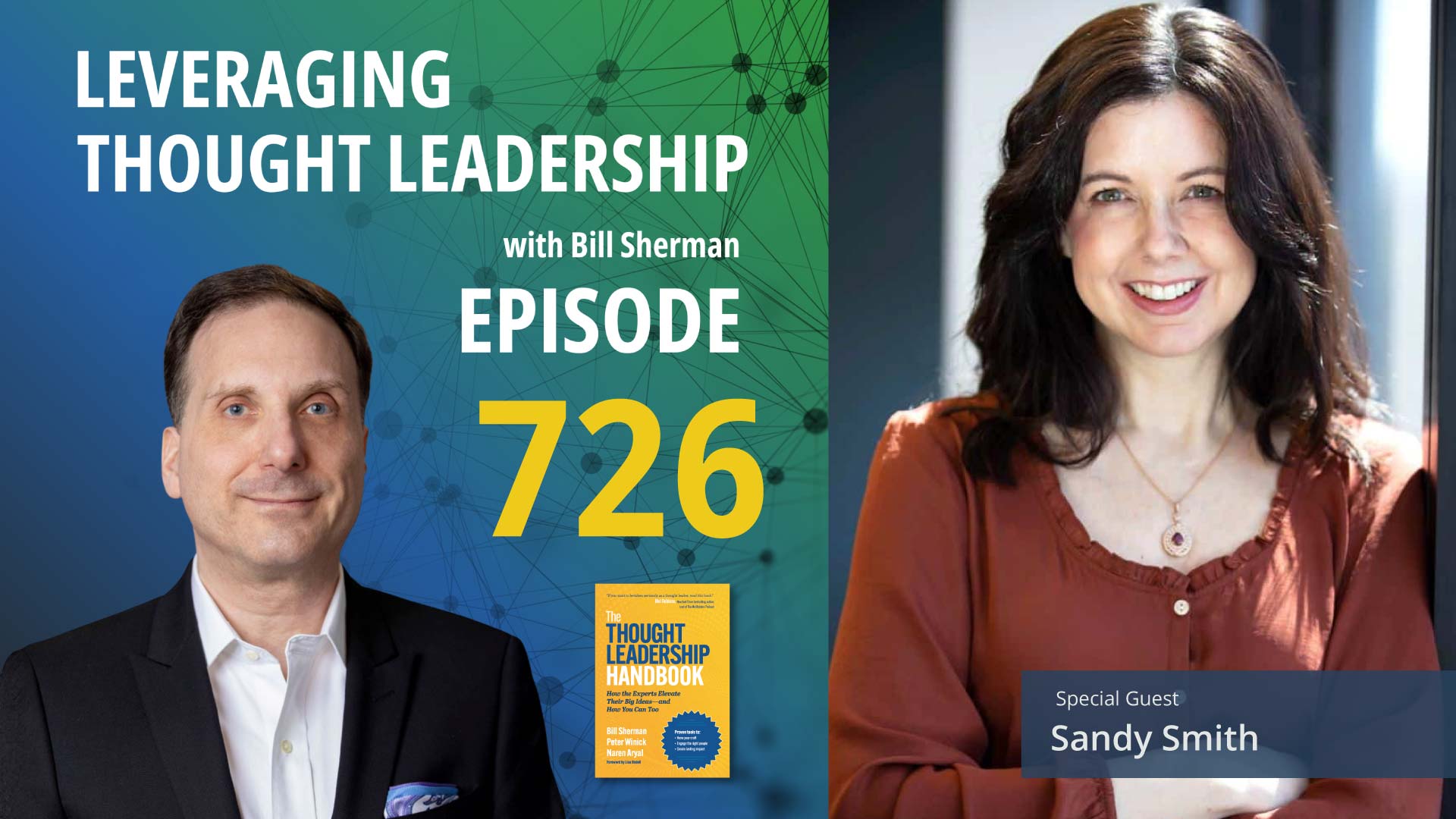



A book marketing expert on audience readiness, relational thought leadership, and long-term visibility
This episode examines realistic expectations for book publicity, why publication day marks a beginning rather than a finish line, and how books build lasting relationships with readers — plus why audience readiness determines whether a big idea takes hold.
You just spent two years writing a book. Now what?
That’s the question at the center of this conversation about book publicity, expectations, and the long game of building a body of work. Bill Sherman sits down with Sandy Smith, CEO of Smith Publicity, to unpack what a smart book launch actually looks like — and why most of the excitement (and anxiety) authors feel in the 60 days around publication misses the point.
Sandy’s first move with any client is to ask what success looks like a year out. That reframe — from launch week to long horizon — shapes everything else: how to define goals, how to find the right audience for a big idea, and why a book should be treated less like a product drop and more like a two-to-three-year (or longer)relationship-building asset.
The conversation moves through sharp, practical territory: the difference between an audience that’s ready for your message and one that isn’t (yes, even when they need it most), how publicists match authors to podcasts, bylined articles, and expert commentary opportunities, and why revisiting an author’s earlier books can sometimes be more valuable than pushing the new release. Sandy and Bill also talk through the emotional arc of a launch — the pre-launch momentum, the 60-day flurry, and the letdown that can follow once the initial push ends.
Underneath the tactics is a bigger idea both return to again and again: books create relationships. They let readers spend time with an author’s thinking in a low-stakes, high-trust way, and that trust compounds over years, not weeks. The episode also touches on what makes an idea worth an audience’s attention in the first place, and why generosity — not ego — tends to separate thought leaders who build lasting influence from those who burn out chasing a moment.
Whether you’re planning a first book launch or trying to get more mileage out of one published years ago, this episode offers a grounded, experience-based look at what actually works.
Three Key Takeaways:
- A launch is a beginning, not a finish line. Treat the book as a two-to-three-year (or longer) asset rather than a 60-day sprint — the real payoff comes from what you do with it after publication week ends.
- Define your goal before you plan tactics. Whether the aim is sparking conversation, building visibility, or attracting clients, that goal should shape everything from media targets to messaging.
- Audience readiness matters more than audience size. The right strategy meets people who are already primed to hear your idea, then lets them bring others along — rather than forcing a conversation an audience isn’t ready for.
This episode landed right in the middle of launch week for The Thought Leadership Handbook — the new book from Bill Sherman, Peter Winick, and Naren Aryal — and everything Sandy Smith unpacked about goals, audience readiness, and building a lasting asset is exactly what’s behind it. If you want to see those ideas in practice, head to thoughtleadershiphandbook.com for a free excerpt, your own thought leadership avatar, and tools to sharpen your strategy. Then preorder your copy today at Amazon, Barnes & Noble, Bookshop, or Amplify — and become part of the conversation this book is meant to start.
Transcript
Bill Sherman Welcome. This podcast comes out just two days before our own book, The Thought Leadership Handbook, launches on July 21st, 2026. This special podcast episode is part of the companion series to the book. And so, during launch week for our book, I thought it would be wonderful to speak with Sandy Smith, the CEO of Smith Publicity. Sandy is a good friend and an expert. On how to launch a book into the community’s conversation and keep it there. In today’s episode, Sandy and I talk about book launch. We explore author’s goals and the relational power of books. Finally, we explore why an idea is worth an audience’s time and attention. I’m Bill Sherman and you’re listening to Leveraging Thought Leadership. Let’s begin. Hey Sandy, welcome to the show.
Sandy Smith Thanks, Bill. Happy to be here.
Bill Sherman So you and I have had conversations over the years, and it’s around expectations on books. And I’m in a weird liminal state right now where the books have come back from the printer to the publisher. I don’t have them in hand. And so you could think of me as one of your clients in some ways. Okay. I got book launch coming up. What’s reasonable to expect and what’s unreasonable?
Sandy Smith Well, the first question I’m going to ask is, what are your goals? And what I always ask is if we’re talking a year from today and, you know, spring of 2027, how are you going to look back and define this book was a success?
Bill Sherman Fair. Would you like me to answer that kind of question? Yes, absolutely. Okay. Yes, so Thought Leadership Handbook works on several levels. One, it’s a sharing of the frameworks that we have that we built the tools because you’ve got to put the knowledge out into the world for people to A, know that you exist and B, choose whether or not they want to use those ideas. Secondly, in terms of goals, we want to spark conversation around thought leadership among practitioners, and then people in the thought leadership ecosystem. Places like Smith Publicity, places like Thought Leadership Leverage. There are a number of publishers, agents. Ghost writers, et cetera, that are adjacent to thought leadership, but we don’t use the same terms when we describe it. We struggle to explain what thought leadership is to family and friends. And then most importantly, we segregate ourselves by I’m an author, I’m a speaker, I am a consultant when we deeply believe that why you practice thought leadership is far more important than how. So, sparking conversations in, yeah, we’d love to pick up some clients along the way.
Sandy Smith So if that is your goal to start conversations, add to conversations and build visibility within the publishing professional ecosystem, all the people who might touch an author, touch a speaker, touch a thought leader so that they have this information and hey, let’s make some money. Let’s monetize this and attract the right clients and help them. If that is you goal. If you’re looking at this from the thought leadership publicity, book publicity perspective, what we’re going to do is find those ideal audiences. And, and the system fun and creative part is to find those headaches, those aha moments that allow you to shine, to spark that curiosity, to say, I like what Bill said, I want to learn more. So let’s put together a plan to get you on the right podcast. To get you writing some by-lined articles, which are between 800 and 1,000 words, where you’re giving the five biggest mistakes people make with their thought leadership brand on, you know, fill in the blank. Get you out there and expert commentary where there are studies to cystic seasonality talking about this wonderful world of thought leadership and get you out, they’re giving your insights. These are the kinds of things we do. Yes, we get your book out there to people interested in new books. More importantly, we’re getting you in front of new audiences and audiences who already may know who you are, but want to learn more about it. That is what we do. And, you know, leading up to a book launch, it’s time to tap into your network as well and showcase your book and to help them celebrate it. Did you know Bill, that there are so many people, as I’m sure you know. Who like thought leaders, like authors, and are looking for a way to help celebrate. So. That’s something that we do is we say, all right, let’s get your friends in high places. Who are they? What’s the app could be a podcast, a newsletter, a bulk purchase by. And this is what you should be doing at this date. And then who’s going to be asking, is it you directly, a friend of yours, your publicist, what’s the timing, what does it matter? So these are all the things we’d be talking about now. If you’re coming. Right. So you.
Bill Sherman Yeah, and this is something that you and I have both seen, right? Where there’s momentum and this excitement coming up to launch, and then there’s the 60 days of business flurry, right, and you’re trying to go everywhere, tell everybody, and then, there’s almost a moment of exactly that sigh.
Sandy Smith I’ve worked for two and a half years to get this book and the publication dates here and it’s great. I’ve been on a few podcasts. I got some beautiful LinkedIn posts. I got my friends and my mailman writing book reviews on Amazon. Now what? And so what we say is your publication date is your birthday. This is the beginning. I love that. This is an asset that you have spent. You get your name on this. You’ve invested in this. And if you have a good publishing partner and a good thought leadership partner, it’s evergreen topic that’s not going to be outdated in three months, six months. We look at this book. As a two and three year asset. It’s something that we celebrate. And that’s funny, because.
Bill Sherman Because we usually say five to seven.
Sandy Smith Five to seven. Okay. So we want them to write another book. No, but, um, and even if they don’t, and we’re saying, Hey,
Bill Sherman And we’re saying, hey, monetize that first one before you go and spend another couple years writing.
Sandy Smith And here’s another secret to when we’re working with a thought leadership expert author, and they’re coming out with their latest book. Yes, we’re talking about the new book, we’ll go back two or three books, if there’s a topic that’s in the news. We’re going to go back to the book you published seven weeks ago. I’m so cool.
Bill Sherman Unless you wrote about Y2K, you know, there are cycles in thought leadership. So if I think about the Great Recession in 2007, before that, there was Dan Gilbert doing In Search of Happiness. You had Gretchen Rubin with the Happiness Project, right? And all of these books focused in 2007 coming out around happiness. 2009’S titles were about resilience. There’s a seasonal
Sandy Smith will come back. We hope it will, because there are new generations that are looking for strategies and if it worked in 2008, it’s probably going to work in 2026. If you were intentional in your writing, right? Exactly, exactly. Based on sound case studies, human emotions, human struggles are not changing that dramatically in, you know, 20 years. That the poor. Of your advice, your solutions, what you’re uniquely known for, you’re just gonna add to that conversation. So we don’t go just for the pages of the book. If you have experience outside the book in a previous book, that’s what we’re talking about. So this book has, when done right, it has such beautiful asset for any thought leader to use. It gives you credibility, it sets you apart, and it’s something you can hand to people and Again, showcase what makes you brilliant, what makes you unique, that aha, this is what I need to solve my problems.
Bill Sherman So one of the things you talk about, and we also believe in is that relational aspect, right? That books really open, nourish, and support relationships and opportunities come from those relationships. And I know that impacts how you work and how we think as well. I want to give you some space of. Why that outperforms the sort of rainbows and unicorns frenzy of 60 days, right? Post-launch.
Sandy Smith Right. Yes, whether it’s in your book or any other way that you’re sharing content as we in this field like to know, you got to talk, you got to get some things away, free from your knowledge in order to get people To know you like you and trust you in a book. Let’s face it. It’s not a big investment for someone to know it is that you get years of research and knowledge and you know, just think of how long you’ve been on this earth, practicing what you’re practicing. It’s not about the last six months of your life. It could be 10, 20, 30 years of experience, all in a book. And the way that you write a book, it has the lived experience. It shows your values. It shows you perspectives, the many case studies on how you took someone from A, with a problem, through BCD, from ugly, messy in the middle, to a resolution that builds that. Aha moment that trust and why should they listen to me here’s what I’ve been able to do and here’s my personality my prudential so these books allow you to build that relationship in a very inexpensive way people can go to your bookshelf and we all have them here and go back and revisit the book and also the thought leadership book and we always they hear at work. Not always read like a novel, right? You can pull out a chapter, a section, a worksheet, an illustration. So the value of the book and that relationship you have with the reader, it’s just so, the longevity is there, that the potential to really talk about.
Bill Sherman That that multi pathway through the book, right? I’ve bought books where I’ve been in a bookstore I see a two by two, you know diagram and I go, okay, that’s worth the price of admission alone Whether or not I read the whole book that framework is useful. I want it on my show, right When I was writing the book that how to read it section that authors have to write and it’s sort of impulsory? You know, I don’t know if it’s written in stone tablets somewhere, but I said, okay, you could read this book linearly, like a regular book. You could read the first few chapters. Then you could turn into the section of thought leadership avatars and choose the one that resonates most with you. Or if you’ve been practicing thought leadership for a while, read chapter one, hop straight to chapter 12, which explains what we see about the industry, where it should be going. And why it needs to change. Choose your own adventure and let the reader choose, right? We can do that on websites. We should be able to do that in books. What happens when your idea is bigger than your current reach? That’s the question behind the Thought Leadership Handbook. Peter Winnick, Naren Ariel, and myself wrote it to help experts, authors, speakers, and executives understand their thought leadership path and build the systems that help ideas scale. Learn more at thoughtleadershiphandbook.com and pre-order the book at Amazon, Barnes& Noble, Bookshop, or Amplify.
Sandy Smith Speaking of your avatars, who do you think of your avatars are the ones that this book will be the most surprising that that may be the underserved avatar that don’t realize that kind of leveraging their thought leadership and really build dividends for them.
Bill Sherman So it depends. I mean, we work with people at different stages. You’ve got the emerging leaders who they’ve gotten their first speech, whether or not they got paid for it, or they’re writing their first article and people say, give me more. Right. And they’re like, well, do I have more? What do I do? How do I build it? Right. And then you’ve got folks who are out on the road. They’ve been doing thought leadership. They’ve written books that give speeches. They live in hotels as consultants or speakers. They’ve got it. Some road warriors. Right, right. And we’ve had them and I’m sure you’ve had them as well as clients say, can I replace my revenue mix and spend less time on the road? Cause I’m tired. I’ve got a kid that’s growing up and I don’t want to be absent. And then you’ve got the seasoned thought leaders who are looking going, I want to retire. I want this idea to survive me. And those levels are different questions. The third is almost a philosophical question in some ways of what does it mean to spend a lifetime in service to an idea? Why in the world does any of us spend so much time in our careers talking to strangers about ideas? Right? So the challenge of the book was threading value for all three of those levels, right? Okay. And that was draft one, draft two, draft three, so that as you said, it can be evergreen. Yeah, there are things that if you’re just looking for a handbook and an activity, sure, turn to the page with the activity of how do you organize your content library. Right, it’s applied, use it, done. But if you want to explore stories of people who have done this, and there are moments of fear and doubt, that’s there. If you want explore the question of, why does this field matter and how do we explain it or defend it against critics, because there are a lot of people that bag on thought leadership as a term. Rightly or wrongly, that’s the name this field has.
Sandy Smith Right, right, as we’re redoing our website, it’s like, leader, expert, expert brand. And it’s like, how can we say the same thing? So can you come up with the term that we’re all going to universally use?
Bill Sherman That would be great. I wound up landing on practitioner of thought leadership or thought leadership practitioner because I make the argument that it’s a lot more like mindfulness, meditation, yoga. You embrace the values, the generosity, the service, the creating value for others, but you never get a badge that says you’re done. You are in service of your audience and your ideas rather than check the box I updated my LinkedIn profile and it says thought leader.
Sandy Smith But right, right, that’s such a great perspective, not having that badge or that degree or that certificate that I have arrived. And in your opinion, and we see this too, when do you see that tipping point from someone who’s an aspiring thought leader to really making that difference? Is it in a book? Is it the generosity? Is it in their discipline to keep learning and growing themselves?
Bill Sherman I think different people get different ways and I’m going to connect with a couple stories of people that we both know and are known in the field. So you talk about Stephen R. Covey, senior, Seven Habits, Stephen Cove. And Stephen M.R., his son, who was running the business and he talks about saying, And hey, I’m happy to let Dad be the thought leader. I’ll stay behind, I’ll run the business because I don’t want to be the poor man’s Cuddy, right? Until he knew he had something to say of value to an audience and was passionate about it, he didn’t need to be the thought leadership voice. Turn to someone like Eduardo Brasenio, right. Eduardo constantly asks himself, what do I know? He’s introspective, almost in a way He’s like a modern philosopher in a number of ways, always focused on self-improvement. And then you have people like Marshall Goldsmith and Chester Elton. So Chester went to Marshall and asked him to write the foreword for a book. And Marshall, of course, said yes, because that’s what Marshall does. Right. And they were at a speaking event and he’s like, I say yes. And you know what, Chester? You should too, because the goal is not to the top, but to help other people rise on the ladder in the whole leadership, right? So when Peter and I launched the podcast back in 2018, we went to a few usual suspects of people we knew and trusted and were names in the field. Chester not only said yes, but he insisted on being our first guest.
Sandy Smith I love that because that is showing that you have arrived understanding that generosity and the power of community, right?
Bill Sherman And my argument is that the community of thought leadership is much larger and needs to be more integrated than, oh, we’re ghostwriters, we are publicists, we are authors, speakers, no. We’re all doing this work of taking ideas to scale.
Sandy Smith Yes, yes. And when people play well together, the synergies and the ideas and the amplification of the expert brand, the thought leadership brand, because when that happens, when that magic happens, you’re touching more lives and hopefully improving them in some way with your advice, with your solutions. I always say, tell me about your book and What? Other stresses that you’re going to take away from someone. Are you informing them? I say people buy business books to either make more money for themselves, make more for their business, or to decrease stress in some way. Take away the parts of work that you are just not enjoying. And when we can get into those conversations, you can see these experts, these authors, they just light up because they never quite looked at themselves. With that kind of like, superhero cape.
Bill Sherman Well, and the other thing that you can see, and I look for as well, is do they have their spark in their eye when they’re talking about their topic? Because if they don’t have that spark, they’re gonna get tired on book tour, let alone the next couple of years. You’ve got to wake up on Monday morning and go, who do I get to talk to about this topic? Rather than, oh dear God, I gotta write another article.
Sandy Smith Exactly. And not to say that if you’re not a great writer, you can’t get some support and help out there. And the same thing, we’ve got offices that I don’t like to write articles, because I have to be so exacting and rather have a conversation and vice versa. But you’re exactly right, Bill. It’s the excitement to want to get out and kind of, you know, shout from the rooftop, how I can help you
Bill Sherman It’s small, evangelical. You know a fragmented, imperfect truth of how the world works, and you put it out into the world hoping that the people who will find it helpful will tune in, but you have no right to an audience. They’ve got to choose to tune in. They can walk out and go, yeah, this isn’t interesting. This isn’t for me. They put the book down. They stop reading the article, whatever.
Sandy Smith That’s a gift. Yes. And our work with the Bookable City, out of it all, we have to coach our clients that there are some have these big ideas that maybe the world’s not quite ready for yet, or all audiences aren’t ready for them yet. So we have an approach where we bring in their perspectives to conversations that are already happening. Here’s an issue, say, should we work remotely, or should we be in office? And, you know, that’s one of the books that we worked on and one of the topics, and instead of coming in with a brand new conversation of why an office is better, which is what this author said, you have to come into the current conversations. But then you get the opportunity to start a brand-new conversation and knowing how to pivot between both. It’s really exciting. And with that, we talk about your idea of target audience. And I’ll say, who do you want to work with? But I’ll also say, who’s ready? Who’s right for your message? And part of the joke I use is, and especially a lot with bringing hope and care and mental health to, say, a workplace. And the joke is that lawyers need it the most, but they’re not an audience because they’re just not ready to hear this and not ready to embrace this, so who are? The really understanding. Who is ready for your kind of big idea is part of the.
Bill Sherman Starting a conversation is hard. Starting a conversation with an audience that isn’t ready is incredibly hard, right? And so being able to understand who’s going to lean in, who will become advocates for this idea and talk about it themselves, because if you’re the only one creating momentum for this idea, you’re going to get really tired. There’s only so much you can do.
Sandy Smith Exactly. It’s a lot of heavy lifting to do. So that’s part of the fun of this is understanding how you’re serving people and then take that energy bill and go out and talk to the right people who are ready and that are open to the ideas so they can then take it on and go alongside you.
Bill Sherman You said something there that lands very close to my heart, which is thought leadership is about doing the work and finding the joy in it. It’s not easy, but if you’re targeted and seeing impact and you’re helping others, you can make a good living and also make the world a better place, which is a whole lot of fun.
Sandy Smith Right. And come back at the end of the day and say, I made a difference. I had just read an article this morning in New York Times about depression and people under 30 when it relates to work. And it wasn’t because they had a bad boss. It wasn’t, because they weren’t compensated to a level that they’d like. It was because they felt they weren’t making a difference
Bill Sherman Wow Yeah, that on its own is an answer to why I thought leadership Mm-hmm Sandy I want to thank you for joining us today and talking about the world and work of ideas
Sandy Smith Well, thank you, Bill, for having me. And I will be sharing your book with many, many aspiring and thought leaders and those who are ready to take their work to the next level. So thank you for writing this book.
Bill Sherman I’m deeply touched. Thanks, Sandy. Every episode of this podcast explores a different thought leadership journey. And now, many of those lessons have been brought together in our new book, The Thought Leadership Handbook. To go deeper, visit thoughtleadershiphandbook.com where you can read a free excerpt, discover your own thought leadership avatar, and access tools designed to help you sharpen your strategy. That’s thoughtleadershiphandbook.com. Order your copy today at Amazon, B&N, Bookshop, and Amplify.
Bill Sherman Okay, you’ve made it to the end of the episode, and that means you’re probably someone deeply interested in thought leadership. Want to learn even more? Here are three recommendations. First, check out the back catalog of our podcast episodes. There are a lot of great conversations with people at the top of their game in thought leadership, as well as just starting out. Second, subscribe to our newsletter that talks about the business of thought leadership, and finally, feel free to reach out to me. My day job is helping people with big insights take them to scale through the practice of thought leadership. Maybe you’re looking for strategy or maybe you wanna polish up your ideas or even create new products and offerings. I’d love to chat with you. Thanks for listening.
