
Why Thought Leadership Needs Real Experience, Not Theory | John Winsor | 727
The Leveraging Thought Leadership podcast is created by Peter Winick and Bill Sherman and produced by Thought Leadership Leverage.
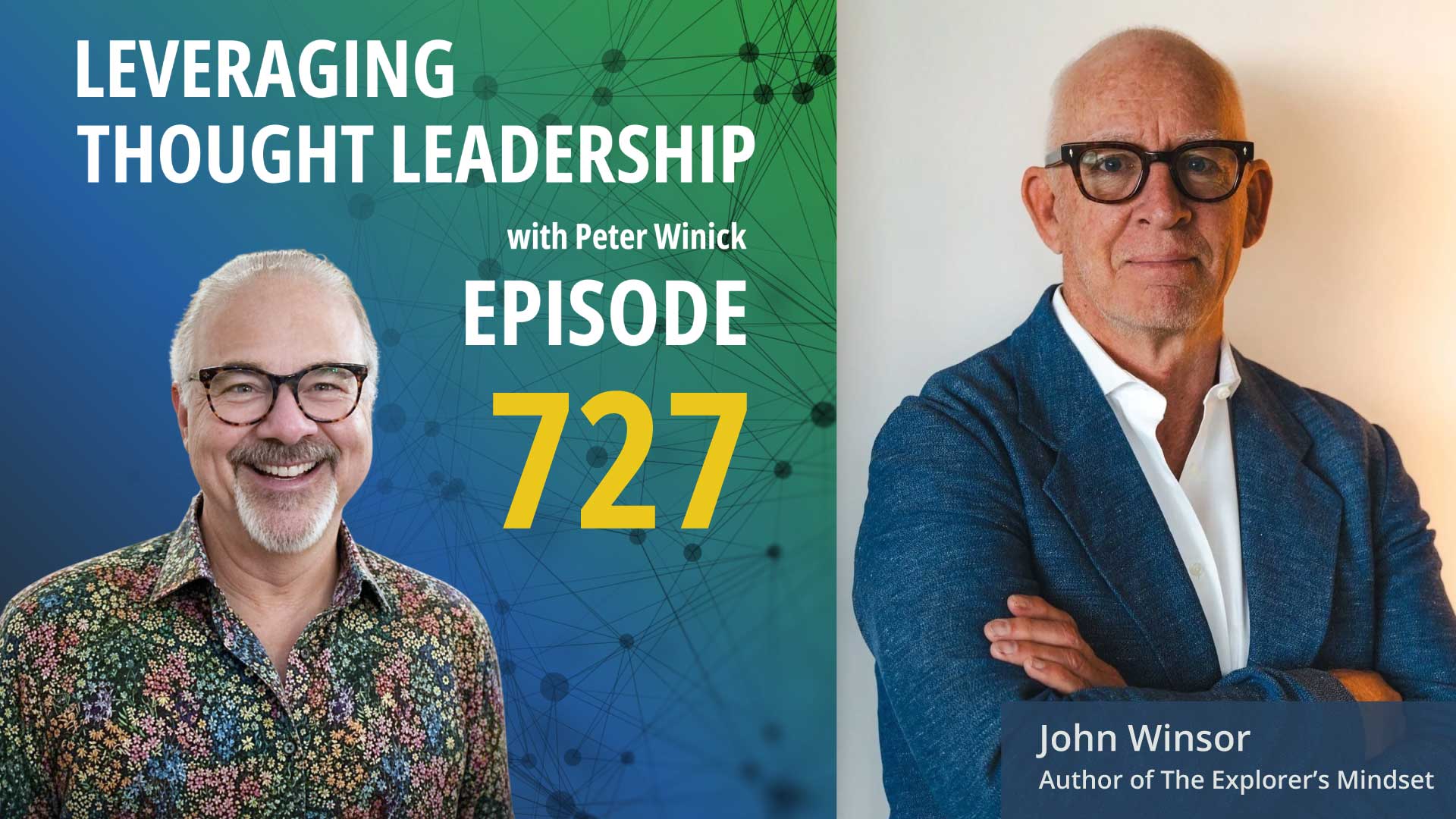
Harvard’s John Winsor on why firsthand experience outperforms borrowed insight every time
The conversation explores why authentic, hands-on experience beats theory, how AI is driving execution costs toward zero, and why human relationships remain the real differentiator.
What happens when the metrics you were taught to chase — title, bonus, prestige — stop adding up to a life that feels good?
What happens when the person telling your success story wasn’t actually in the room?
That’s the moment that pushed John Winsor — Founder and Chairman of Open Assembly, Harvard Business School executive fellow, and author of six books including the bestselling Open Talent — to write a widely discussed piece questioning the entire thought leadership industry.
In this conversation with Peter Winick, Winsor traces his path from launching a regional sports magazine (sold to Condé Nast) through decades of building and exiting companies, to his current work at Harvard’s AI Institute studying the future of work. Along the way, he unpacks a tension every expert eventually faces: when does an idea deserve a blog post, a keynote, or a book — and when is it just filler dressed up as insight?
Winsor and Winick dig into what separates “thought leaders” from “thought doers,” using everyone from Malcolm Gladwell to Domino’s Patrick Doyle as examples of how firsthand experience — not borrowed theory — is what actually earns an audience’s trust. They also tackle a question with real urgency for anyone building a business around ideas: if generative AI can produce a working website, investor deck, and full brand in a single prompt, what’s left for humans to do? Winsor’s answer centers on relationships, judgment, and the irreplaceable value of live, human-to-human experience — a case he backs with striking data from executive AI workshops at HBS.
This is a candid, occasionally pointed conversation about ego, authenticity, and the mechanics of building influence in a market flooded with polished — but often hollow — expertise. Worth a listen for anyone deciding what to write next, whether to take the stage, or how to stay relevant as AI eats the easy parts of the job.
Three Key Takeaways:
- Experience should come before the platform, not after. Winsor argues that credible thought leadership starts with real, specific experience — “go have a bunch of really killer specific experiences” — rather than reverse-engineering content to match a trending topic or keyword.
- AI is pushing execution toward zero cost, which raises the value of judgment and relationships. Winsor points to tools that can generate a full company’s assets — website, investment deck, brand — from a single prompt in under two hours. What AI can’t replace is the human trust required to sell, evangelize, and validate an idea.
- Format should follow curiosity, not ambition. Rather than deciding upfront that an idea “deserves” a book, Winsor tests ideas publicly through Substack, HBR, and Forbes articles first, using audience response to gauge whether something is worth developing further — or whether it was only ever his own curiosity.
Before you go — Peter has a new book. The Thought Leadership Handbook: How the Experts Elevate Their Big Ideas—and How You Can Too, co-authored by Bill Sherman, Peter Winick, and Naren Aryal, draws on more than 700 conversations from this very podcast to map out the patterns that separate thought leaders who build lasting impact from those who never scale past their own curiosity. It introduces five thought leadership avatars — Growth-Minded CEOs, Impact and Legacy Executives, Thought Leaders on the Run, In-House Experts, and Hall of Fame Thinkers — and gives readers the frameworks and tools to find their own path.
Endorsed by Mel Robbins, Ken Blanchard, Stephen M. R. Covey, Marshall Goldsmith, and 50+ other leading voices, with a foreword by Lisa Bodell.
Order now:
Amazon
Barnes & Noble
Bookshop.org
Amplify Publishing
Apple Books
Learn more at thoughtleadershiphandbook.com
Transcript
Peter Winick Welcome, welcome, welcome. This is Peter Winick. I’m the founder and CEO at Thought Leadership Leverage, and you’re joining us on the podcast today, which is Leveraging Thought Leadership. My guest is John Winsor. He’s a globally recognized leader in the future of work and AI-driven workforce strategies. He has been recently appointed as an executive fellow at Harvard Business School’s Digital Design and Data Institute. He has known for his ability to translate complex innovations into actionable strategies. He’s advised Fortune 500s and done a bunch of other cool things that we’ll find out about, including writing a couple books along the way and some other fun stuff. So welcome, John, what’s going on?
John Winsor Hey, thanks, Peter. Good to be here.
Peter Winick So let’s start with, how the heck did all this happen?
John Winsor Right. So give me, give me the, how did we wind up where we are today? Uh, man, man. Uh, you know, well, I mean, if you go way back, I started a publishing company because I just had this desire to, yeah, I worked for a publishing company, but I really wanted to kind of, I, I saw a magazine, I wrote a book called fitness on the road and was out in the West coast, saw a magazine that I thought would be applicable here called city sports. And you know decided to kind copy that and started in Colorado and that launched on this 15-year journey, magazines.
Peter Winick For those of you under 40 or 45 people, magazines, they were similar to like, not quite stone tablets, but we liked them. We used to get them delivered and they would be in doctor’s offices and we liked them actually for a long time.
John Winsor I know. We’d wait a month for the information, right? It was that crazy. What a crazy concept. Yeah. So did that for a while and sold that to Conde Nast and became pretty successfully. And it was really interesting. This idea of early adoptive consumers, like, you know, the, you know, there’s ever Rogers back in the fifties had this thing called the diffusion curve and in early adopters, you know, like innovators back to laggards. And so I found that the women we worked with at women’s sports and fitness were all early adopt if consumers that influenced a lot of other people. And after the publishing journey, I set up a company to do, and I coined the phrase co-creation with a book called Beyond the Brand and wrote a bunch of other books around co-Creation. Thinking about how do we take, you know, as a leader, how do think about connecting with early adoptive consumers that were gonna drive like insights into where the market was going and then the product innovation.
Peter Winick So let me ask a couple things here. So given that you come from publishing, right? You’ve written a bunch of books. So one question that comes to mind is, how do you know what is the right modality for the right idea at the right moment in time? And what I mean by that is, it used to be a great compliment to say to someone that gave like a TED Talk, like, wow, that’s awesome, that should be a book. Yeah, I think the opposite is often too true where you read a book and you’re like, you know, it kind of could have stayed at Ted talk.
John Winsor I know, I know.
Peter Winick So how do you decide that because you’ve also figured out what’s good for short-term, medium length, long-term.
John Winsor Yeah. I don’t know if I figured it out, but I, you know, I think that’s one of my biggest frustrations of books, right? Is like, man, that could have been a 20-page pamphlet or an article, right. So much filler. You know, the way I look at books, I’m very selfish. The reason I write books is I’m trying to figure something out. And a book is a great device to create a discipline around creating a system or a framework.
Peter Winick Okay, but that should always be a reason. It might not be the reason. But I think for why would you write a book if it’s not something that you’re wrestling with? Like, what’s the point? Right? Yeah.
John Winsor Yeah, that’s true. That’s true, although I think a lot of books are written because people want to, you know, use it as a platform to go speak and things like that. And so.
Peter Winick But they’re trying to reverse-engineer and get the lightning in a bottle of, ooh, what does the market want right now? For sure. Let’s throw the word AI into my expertise. Exactly. But that has no stand. My humble opinion, maybe. Yeah, yeah, no, I agree. There’s a lot of people. That has no legs, right, if you’re being opportunistic there.
John Winsor I agree. Yeah. I mean, I think, you know, I, I think thought leaders need to go have a lot of experience. I mean I wrote that PCU and that’s why you call, you know, yeah, I connected to this thought doers. And I think thought leaders are really powerful. I think that, but it’s based on their experiences. And so go have a bunch of really killer specific experiences and go kind of into the mock of the future or wherever. Sure. Figure stuff out and then come back and tell the story. Right. That’s to me the power of thought leaders. That’s why.
Peter Winick But go back to the modality. So one school of thought, and I just want to get where you land on this, is if you’re not trying to catch lightning in a bottle, one school thought is, hey, I’m kind of thinking, maybe wrestling with this thing. Let me throw out a blog post. Let me through out a couple little things and see if there’s resonance, or am I the only one who cares about it? Because if I’m the only who cares about it, it’s not worthy of, other than my curiosity. And then sometimes what happens is, you put some stuff out there, and you’re like, The thing that you thought was like, eh? Is really far more interesting. And then you double click on that, and you double-click on that and double- click on it. Is that, did you subscribe to that?
John Winsor I, I, you know, I publish a lot, right? Publish a Substack and an HDR and, and, and Forbes and a lot of it’s just to test ideas. You know, a lot is just to say, huh, what’s resonating? What’s not, how does that add to my research? I’m not really trying to say. You know I need desperately to find an idea that scale is more like my curiosity to say wow. You know? I have all these ideas. Like, is this like you just expressed? I think really well is like, is this an idea that other people are having or is this something that There’s general kind of a concern in the market or is this something that’s just my fantasy or my anxiety or it’s not that big.
Peter Winick So then it’s almost like if it was supply and demand that selfish curiosity against market interest or exactly is really that set point that we’re looking for. I want to go back because you went through it quickly is yeah you and I connected because I saw an article that you put out basically crapping on thought leaders which I’m like oh this is cool right so talk about that article and what it was about because I didn’t necessarily agree with everything in it, but I got.
John Winsor Yeah, I mean, I, you know, this, this was a, uh, like a really long gestation period to write that article. Cause I, I showed up at, you know, I like I’ve done a bunch of speaking and I guess people are considering me a thought leader, but I haven’t really ever done any chart, you know speaking for money for a long time. Cause I always had companies that would, that would benefit. And so I would, I would do all this stuff. And so one of my friends, Peter Sheehan, who’s a really well-known Speaker, great guy. I love him. He challenged me. He’s like, he’s like well, why don’t you know, you could make money at that. Why don’t she come, you know? Hang out with our group. And, and when I was in his group, I, you know, the first meeting I went to, it was really great. There were all these guys making like, I couldn’t believe the amount of money that people were making from speaking and this one guy gets set up until, you told this great story. He was like, told the story about, you know, Patrick Doyle at Domino’s and how he re-engineered Dominoes to make it into a tech company. And, And it was a really fantastic story from the stage. But I stopped there and s- myself going like, well, Pat and I and Alex Boguski were all in the room. And we did that strategy and Crispin Porter Bogusky, the agency I was a partner in, did all that work. And, but you know, this guy on stage was talking about as a professional speaker had nothing to do with the truth, had nothing to do.
Peter Winick You know, well maybe it was a better story the way he crafted it.
John Winsor That probably was, but, you know, I, I love authentic stories. And I think that’s why when we think about storytelling, at least in my world, you know that’s, why outdoor stories, that’s why adventure stories. That’s why, you know, climbing and surfing and like a hundred foot wave, you know, the, the new dark wizard out on, on HBO, those are really resonant because they’re, they’re authentic. They’re they’re like experiences and people telling stories from the experiences that they’ve had. And those are the things that I love. Right. I love like those firsthand, like I love listening to people, thought leaders love, like what, what was it like? What really happened? How did you skin your knees? How did figure that out? What does that mean? Not something that read somebody read in a HBR article or wherever, but you’re in the door.
Peter Winick The, I think one of the points that you were making in that article is stop just being a thought leader and you were meaning that like in the abstract, in isolation, in whatever, but the theoretical has no value until it’s applied, the scraping of the knee, right? So like you were saying stop being a thought leader being a though doer. My take on that is, well, it’s not an A or B, right. Actually there’s a time and place for both.
John Winsor For sure for sure. I guess I’m just trying to say that it starts with some real experience, right? Like again, I went to that
Peter Winick It doesn’t always though, so wait, stay there a minute because when I look at the landscape of thought leaders, they come from lots of different places, and I don’t mean geographies, right? So you can have an academic that everything they put out is validated to the 11th decimal, but you put them into the wild, and they couldn’t get lunch on their own, right, like they wouldn’t, that wouldn’t work. And then you have other folks that are, they’ve been running a business, they’re gritty, they’ve in there, whatever, and they might not have the, the language or the research or the way to show that something is validated, but they know they took a company from back of a napkin to fit totally right. So I think it’s like, how do you get everybody to learn from everybody else?
John Winsor Well, no, I totally agree with that. I mean, I, and I think, you know, throw in another one, like Malcolm Gladwell is a great example of like being a journalist. Right. And I, I would say that my history, when I think about my career, at the end of the day, the thing that I really resonate with is being a journalist and being a journalists means being radically curious and going out and having that kind of firsthand conversation, I don’t mean that you have to go skin your knee is like, you know, what was the outlier? I think it was a book that Malcolm Gladwall talked a lot about. Like age group for hockey players. It’s not like he went and played a lot of hockey. It’s just that he was super curious and he started thinking about like the data and dug into the data. And then, yeah, then made this really, and so that, you know, the story.
Peter Winick No, and his observation was, wait a minute, why is it like, I forget, and my math can be wrong, like 65% of professional hockey players in Canada are born in January, February, or March. Right, exactly, exactly. And it’s like, oh, they were the oldest kids in the cycle, so if you’re four, you’re 4 years and zero months, there’s a big difference between 4 years in zero months and 4 years in 10 months, right? At my age, nobody says they’re 58 and 3 quarters, right? Exactly, exactly! But that gets extrapolated because they get the resources and more tension and da-da-da, then the poor kid born in October that may have been just as good, but he’s a little bit shorter, not as developed yet. So.
John Winsor Yeah, well, and I tried to apply it really to AI because I, one of the things I’m really, you know, intrigued with is this real, you know that this kind of permeable membrane now between academia and actual work. And a lot of the guys that I work with that at, you know, the newest, like to me, the best professors that are coming up through H HBS are ones that are way into building stuff. And, and, and what I think, what I observe is that you know, the cost of execution is, is going to be zero with, with all these agents.
Peter Winick So stay there for a minute, because I agree that there are a lot of amazing academics there, MIT, other places, where they’re actually doing stuff at the same time that they’re teaching, and then a variation on that is, and I’m thinking of Harry Kramer, I’m think of Bill George, folks that come out of running real, real, fortune 100 businesses and say, you know what, I don’t wanna ride a flint to the sunset, I wanna go and teach a little bit now. Totally. And it’s like, okay, cool, but I think the classic, traditional academic was they never left campus. It was like they were born with a tweed jacket and whatever. If you ever wondered how strong ideas become visible, trusted, and scalable, that’s the work behind the Thought Leadership Handbook. Bill Sherman, Nara Narell, and I wrote it for experts who are ready to move from insight to real impact. Learn more at ThoughtLeadershipHandbook.com and order it today at Amazon, B&N, Bookshop, or Amplify.
John Winsor For sure. But I, but I think it’s kind of getting back. It’s got full circle, right? Like the bill George’s of the world had the experience of teaching and that’s why they’re teaching so valuable because it’s real, right. It really, you know, and his judgment is so finely tuned because he’s been through that cycle thousands of time. What you’re seeing now, at least, you know, to, to guys like, uh, Rem Kooning and some of the other guys that at a, at HBS, they’re just living the examples. They’re just out there like the experiencing building stuff. You know, teaching executives how to build their own stuff. And so this rapid iteration is just really fascinating. And I think that’s, you’re not going to hear from round up some theoretical thing, it, it always goes into, to a place where it’s validated. It’s statistically significant. It’s all those things, but…
Peter Winick But it’s after the fact.
John Winsor It is after the fact.
Peter Winick I want to go back to something you said about sort of the journalist in you. And I think actually, I think that’s right. But I also think that when you think about you break up, what does a thought leader do all day? Right? I think it’s there’s a part of it’s the journalism, there’s part of that’s the consultant, right? There’s part that’s a researcher, there might be a part that a marketer or promoter. Or whatever, and I think when people look at all the, well yeah, it’s part consulting, part this, part that, they sort of poo-poo the promoter and marketer part, right? And a lot of what I’ve seen, and I’m in an interesting place, where this is like the water I swim in, I’ve see some amazing, amazingly brilliant stuff, but because people don’t have either the skills, the guts, the courage, whatever to market, it doesn’t see the light of day, and they just look at it like, oh poo, I don’t do that. Like I don’t. The other side of that, there are plenty of people that are hucksters promoting garbage that’s useless and has no value, but I’m talking about, as a thought leader, if you’re not spending some time promoting, marketing, being the evangelist for your idea, nobody else will.
John Winsor No, I agree. I think it’s super important. I mean, I, you know, all business, I was just on a conversation with a client this morning is like, I think with AI that’s happening is execution is going to go to zero, but where the real, the real value is relationships and sales. Like that’s, that’s like very human thing, right? The relationships, the, you…
Peter Winick I love that idea because I think what was happening not all that long ago, maybe early COVID or whatever, people were going, oh my god, why would they ever pay me 50 grand to be a keynote or when I’ve got my stuff on YouTube or I can do it on a Zoom or I could do it there or whatever and in fact, although the quantity of total events has gone down, the quality and the highest quality speakers are making more now than they ever did, why? It’s not because like, you know, Gladwell’s amazing. Pretty much everything that he’s done, I can either read, listen to a podcast, listen to whatever, but when he’s speaking live, there’s something amazing about the human experience and the connection of being in a room with others, whether they’re like-minded or not, being exposed to ideas, and that’s never going out of style.
John Winsor No, I agree. I think that, you know, that experiences are going to be human, human experience are going be more and more valuable. This kind of, this kind of collective learning. And I would suggest a lot of, because of the technology we’re seeing, at least in my experience at HBS, the things that really resonate with people are kind of these, these mass, you’re 200 person, you know, uh, workshop experiences to build stuff together. They’re just so incredible. I mean, you walk into a room, right? Well, the hackathons and the, Right, exactly, but executive level hackathon, right. Like, you know, Rem’s got this great speech where he says, Hey, I’m going to, in an hour, I’m gonna go from teaching you what agentic AI is to giving, getting you 200 people on a pro on a platform. And then your job in 45 minutes, it’s to save 20% of your week, the time of your weak and people, you see these C level. Fortune 500 executive is going like, there is no way, no way. No way. 45 minutes later, there’s a demo and everybody says, 75% of the people say I saved 20% of my week. Right. And, and, and that’s awesome. Right. To me, it’s like, you know, the best thought leaders can drive change. Like whether it’s, like, they inspire people, their stories inspire people. They change the way.
Peter Winick Well, yeah, at a minimum, you have to inspire someone to think, act, do, believe, behave, something different than they did before you were exposed to their ideas, right? For sure. Otherwise, it’s pointless, right, like, you know. What did you mean, I just want to clarify, because it was an interesting sort of throwaway, and I think it’s more than that. Well, execution goes to zero. What did, what did you meant by that?
John Winsor Well, I’m just seeing it every day. I mean, I listened to a guy by the name of Nate Jones. He has a sub stack and, you know, it’s like yesterday it was like, Hey, this new set of technologies, you know, if you’re in, in a marketing department, it will, it will save you five hours a week. Right. And then today there’s a thing on, uh, testing on GP GPT 5.5 and it was like, it was, like, here are the prompts I did build this, you know, dingo, right, like pet company, you know, and, and do it from like. Idea with one prompt to all the assets for the website, you know, a real website that works and an investment deck and everything, 28 different assets off one prompt in about an hour and a half. You know, and, and it’s like, it’s everything from, you know, thinking about it, the idea of launching a company to have everything ready to go to a, to a investor meeting with a live website, everything, you know that would have been months worth of work. And it’s, it’s one prompt and, but it’s awesome creating all this, this stuff’s awesome. Somebody’s got to go out and sell it. Somebody’s gotta go out. And evangelize it. Somebody’s. Got to go do it. And that’s the really tough.
Peter Winick And somebody’s got to look at somebody else and say, you know what, John, I’m not sure about this idea. It sounds a little cockamamie to me, but I get you and I trust you. And I know you wouldn’t bring me something that’s crap because we’re exactly in a relationship.
John Winsor Well, exactly. It’s all about relationships and that, that to me, the human value, it’s the human judgment is like, what is good? What is not, you know, but there always been ideas through history that just don’t seem to scale my best, you know, bonus thing. Do you know about the Korty keyboard story? Yeah. Yeah. Which I don’t, I don’t know if your audience has, but, you know, if I look at your, yeah, if you, if you look at you, the, you know, the upper left-hand corner is Q W E R T Y. Well, the reason it’s that. Is that back in the day when typewriters had arms that threw up, you know, letters that they were going, people were going too fast. And, and so they needed to figure out a way to slow people’s typing down so that the arms didn’t get stuck. And so by creating the keyboard that we have now, it’s actually slower than other ways to type. Yet it’s so ingrained in our culture. Many, many, many people have tried to make a faster keyboard. It’s very easy to make. A faster keyboard None of us can change culturally to want to type faster than we do. So these cultural things, the innovations just die because culture just won’t accept them and it’s just, it’s just the way it works. Right. Yeah.
Peter Winick Yeah, I love it. Well, this has been awesome. I appreciate your time and your thoughts.
John Winsor No it’s super great. I have a lot to learn about being a thought leader, so I look forward to tapping into your resources and listening to your podcasts and please teach me more.
Peter Winick Great, oh, I hope to do that, thank you. Good stuff, thank so much.
Peter Winick Yeah, thank you. Take care.
Peter Winick To learn more about Thought Leadership Leverage, please visit our website at thoughtleadershipleverage.com. To reach me directly, feel free to email me at peter at thoughtleadershipleverage.com, and please subscribe to Leveraging Thought Leadership on iTunes or your favorite podcast app to get your weekly episode automatically.
