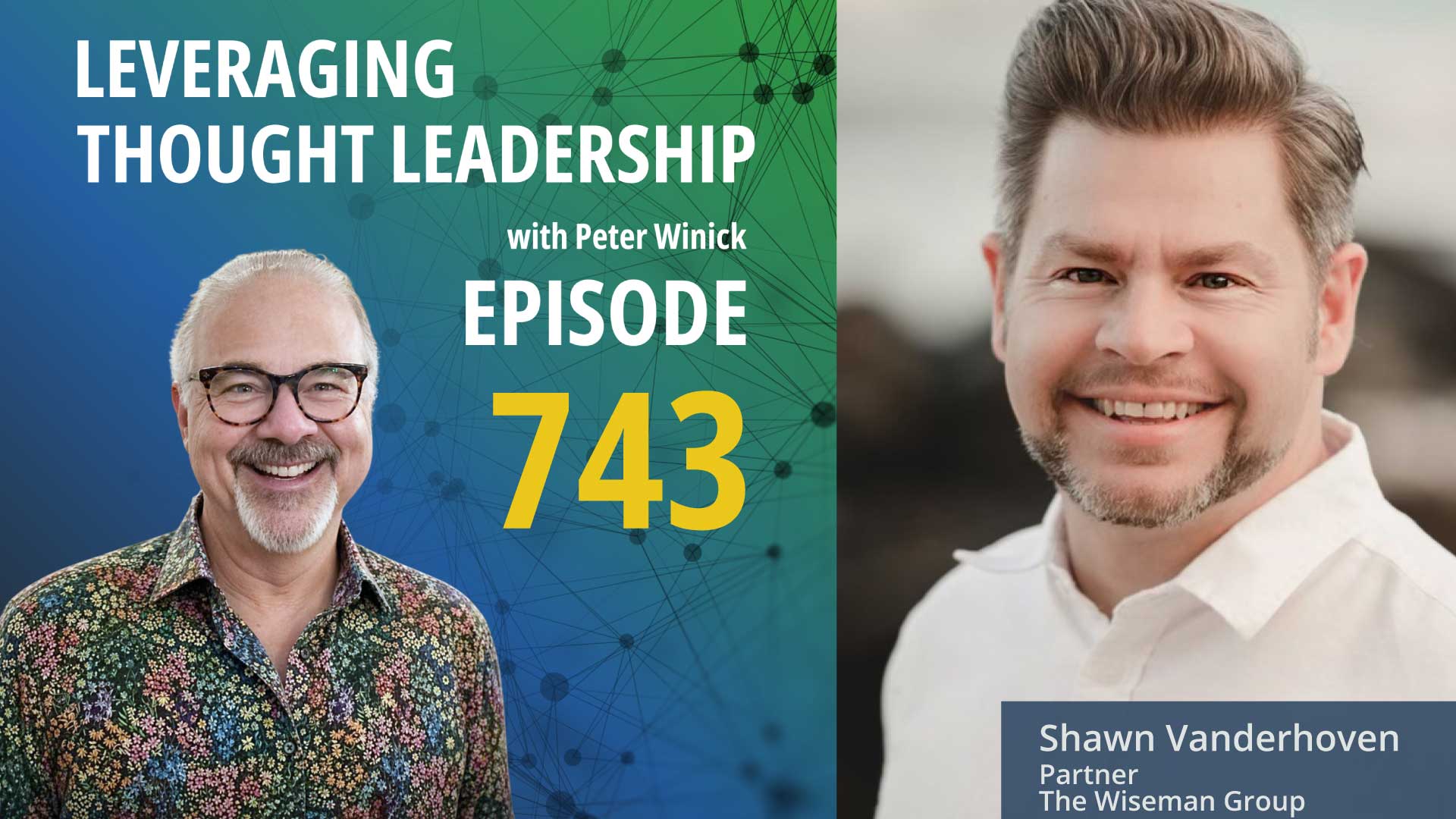
Why Focus Is a Team Problem, Not a Personal One | Shawn Vanderhoven | 743
The Leveraging Thought Leadership podcast is created by Peter Winick and Bill Sherman and produced by Thought Leadership Leverage.



Research-backed team practices that increase focus, output, and impact at every level
Most knowledge workers can’t do their best work. That isn’t due to a lack of effort. Their environment rewards speed over focus. This episode treats productivity as a social problem, examines team-level practices that reclaim time for deep work, and shows how research-backed ideas become a scalable product line.
A leader stands up in the middle of a 200-person workshop, slams his hand on the table, and says out loud what everyone in the room is feeling: I can’t do great work here anymore. That moment helped start Pause: How to Lead Brilliant Work in a Busy World, and it’s where this conversation gets interesting.
Shawn Vanderhoven leads the executive development practice at the Wiseman Group and collaborated on the second edition of Multipliers. His argument is simple and uncomfortable. The productivity crisis in knowledge work isn’t mainly personal. It’s social. When the medium is speed, speed becomes the message. Teams learn that responding fast signals value, and deep, cognitively demanding work gets crowded out.
Peter pushes on the practical problem. One person can’t opt out of team norms without paying a career price, so the smallest unit of change is the team. Shawn agrees. That’s why his research looked at two sets of behaviors: what leaders do to create space and clarity, and how contributors “pause up” to make the case to their bosses. The book covers 12 tested practices, and teams are meant to pick a few rather than all of them. One of them, “house rules,” produced large gains in what Shawn calls traction time: time spent on the top priority.
The conversation also addresses AI directly. Shawn argues that for most people, AI’s productivity benefit is marginal, and the real risk is producing a lot of mediocre work very fast. He also has a line that reframes burnout: it often comes less from doing too much than from having too little impact.
For thought leaders, the business side is just as useful. Shawn explains how Pause was built as a product line, not only a book. It includes a free team quiz and distraction inventory, partner-led workshops from 15 minutes to a full day, coaching materials, keynotes, and an AI tool called Jam that runs a fast, low-friction team 360 and coaches leaders on one distracting behavior at a time.
There’s also a story here about building your own IP inside someone else’s firm. Shawn expected to leave the Wiseman Group to pursue this research. Liz Wiseman’s answer was, “Of course you can do this here. I’ll coach you.”
If your team is busy but not moving the work that matters, this episode is worth your time.
Three Key Takeaways:
- Productivity is a social problem, not a personal one. Individuals can tweak their habits, but team norms set the pace. Lasting change means building a team “bubble” that puts clarity and space ahead of constant connectivity.
- Small, tested behaviors beat big resolutions. Pause offers 12 research-backed practices, and teams pick only the few they need most. Practices like “house rules” produced measurable gains in time spent on top priorities.
- Great IP needs a product line, not just a book. Pause scales through a free quiz, a distraction inventory, partner-led workshops, coaching tools, keynotes, and an AI assistant. Each gives buyers a different way to engage with the ideas.
Shawn Vanderhoven didn’t stop at writing Pause. He turned his research into a free team quiz, partner-led workshops, coaching tools, keynotes, and an AI assistant, so buyers have several ways to put his ideas to work. The Thought Leadership Handbook by Peter Winick, Bill Sherman, and Naren Aryal explains the thinking behind moves like these: how to test an idea, choose the formats that fit your buyers, and build a lasting business around what you know. If this episode got you thinking about what your ideas could become beyond the page, the Handbook is a practical next step. Learn more at thoughtleadershiphandbook.com, and get your copy from Amazon, Barnes & Noble, Bookshop, or Amplify Publishing.
Get Your Copy of The Thought Leadership Handbook at:
Amazon
Barnes & Noble
Bookshop.org
Amplify Publishing
Apple Books
Transcript
Peter Winick And welcome, welcome, this is Peter Winick. I’m the founder and CEO at Thought Leadership Leverage and you’re joining us on the podcast which is Leveraging Thought Leadership. Today my guest is Shawn Vanderhoeven. He is a partner and collaborator. He leads the executive development practice for senior leaders and rising talent at the Wiseman Group, that’s Liz Wiseman’s firm. He’s the author of Pause, How to Lead Brilliant Work in a Busy World. And he was a collaborator on the bestseller, Multipliers, How the Best Leaders Make Everyone Smarter, the second edition. He’s a partner at the Wiseman Group and he does a lot of work in executive development and he is spending some time with us today. So welcome, Shawn.
Shawn Vanderhoven Hey, thanks for having me on, Peter.
Peter Winick Yeah, no, my pleasure. So I wanna, yours is a bit of a different path, which is interesting in a field filled with people with different paths, right? So you’ve been part of the Wiseman Group for a long time, and now you’ve got your book out, which is not really part of what’s called sort of the wiseman umbrella, but you’re still part of The Wiseman Family, if you will. So talk about that, because I think that’s really cool that you’ve gotta leeway to do different things, but you are still part of Liz’s team and how you made some decisions.
Shawn Vanderhoven Liz is like true to the sense of a multiplier. She, we’ve had a lot of people on the team that have a colleague of ours, a master practitioner, Alyssa, she wrote a book on innovation for education. And we’ve got several actually that have done significant pieces of work. And so she’s a, she’s like your, like your classic, like legacy coach. She wants people, she believes people are smart. He’s very demanding and, um, and has always, you know, pushed people that want to do pieces of work in the firm to do something significant. And you know the fun thing about PAWS is you know we’ll be able to, people will be able to get it through the Wiseman Group as well, the workshops and the keynotes that we’re offering. So there’s this abundance mentality that doesn’t always exist. And it’s for real.
Peter Winick So I think that’s so smart and evolved because I think I’ve seen a lot of frustration or anxiety from thought leaders where they’re in an organization, and typically not another thought leaders organization, but they’re an organization and they’ve got this thing and it’s growing and growing and it growing and it either gnawing at them intrinsically and it getting some traction or it’s starting to reward them in ways that the role that they’re just can’t compete with. So they have to have that conversation and they think the world is binary. And I’ve seen many examples where actually it’s not binary. You could reconfigure the relationship with your employer. You could show your employer that it’s aligned to out my objective, your objective, and the firm’s objective, or even sort of some combination thereof, like listen, just be open-minded and practice what you preach and say, it’s all good. That generosity mindset. So I just wanted to touch on that for a minute because I think it’s really cool and unique and speaks a lot of. Not just the Wiseman Group, but Liz and you.
Shawn Vanderhoven And, and I’ll tell you the moment. So I, we had been working together for a couple of years and I went to her and I said, Hey, I’m just thinking about the best way for me to, you know, this research that, that we’re talking about. There was a, it was the precursor to the project pause. Yes. I said, I think about how to structure this and maybe what’s the best way for you to think about wrapping up my role here. Cause I, you, I just, I know there’s probably not enough room for me do this work here. And she goes, what do you mean? Right. Well, you know, I can’t, you know, like I know that like for me to go and do this leadership research, this leadership development research on this topic that I’m interested in. I you know I know that probably won’t make sense here because of the previous experience that I had with a with a different firm. And she goes, why not? And it was just she was just stunned. She was like, no, I’m confused by this. What are you not stunned? She was confused. She’s like, what are you saying? Like, you know, of course you can do this here. As a matter of fact, I’ll coach you so.
Peter Winick And how stressed were you before that of, uh-oh, I love it here, but it’s time, like, uh, how’s she gonna react? I admire her, she’s my favorite. Like, you probably sleepless nights, right? You can’t turn that stuff off.
Shawn Vanderhoven As a matter of fact, one of the in pause, we’ll hit later, one of the practices that came back that helped people focus is we called it put growth on the agenda and it’s where a leader once a month at least just talks for a few minutes with the person they’re doing a one-on-one with about what is that next thing they’re trying to accomplish and if they’ve clarified that what’s the one skill or piece of experience that they need in their current job to unlock that door And what that does is if people can’t see their future in your work, they’re currently in, that’s going to be distracting. And that, and Liz was so good at that. She wanted to talk about my future. She wanted talk about the pieces of work that I wanted to do. And that made it to where I gave her my soul, man. I gave my discretional effort on the projects that mattered most to her because she created space for my growth.
Peter Winick So in terms of just your engagement, there’s an intrinsic component to this. There’s an extrinsic component. Very, very cool. I wanna move to pause, right? Because this isn’t the, what I would call, logical extension of the Weisman Group. It’s clearly different, it’s clearly unique, it’s not an extension of that brand. So tell me what it is and where the idea came from.
Shawn Vanderhoven I was teaching a workshop and I had been hearing prior to this workshop, this continual sentiment saying, I can’t do my best work because I can focus. So I’d been hearing that over and over and again. But in this one workshop, I’m in San Jose, I’m at a cloud computing company, there’s 200 people in the room, I’m the front of the room facilitating. And at this moment, this leader stands up in the middle of. The workshop stands up. He’s the only one standing now except for me, and he slams his hand on the table. Right. And, and says, I’m so pissed off right now. Everybody looked at him and then me, I froze. They looked back at him. Luckily he kept going. He filled in the, in what was, what had him on his feet. And he said, you know, I, I’ve made my career on deep work focus. And how that’s why I got promoted. Cause I know how to do great work. But he said around here, we’re hyper-connected. We’re addicted to speed. We’ve got this bias towards action. I’m just saying yes to everything because I feel like I’m expected to say yes and go fast and I’m passing that on to my team and they are not doing great work and I am not proud of it.
Peter Winick So stay there a minute, right? So I’m old enough to remember the time where if I walked by way early in my career, my boss’s office and they were engaged in something, right. You know, and, and that might be, they’re reading something there. They’re reviewing something in the pre email, whatever, but you can tell that they were concentrating, that they were focused, that they were doing something. You wouldn’t be likely to interrupt. You would sort of try to give a signal and they’d either give you the okay or the no. Okay. Right. Now, if you walk by somebody’s office and they don’t have a screen up, a phone in their hand and their slack is binging away and they’re just sitting there looking out the window, you’re thinking it’s time to call 911. They must be having a stroke. They can’t just be in deep thought. You’re thinking, what’s wrong with that person? And that’s the boiling of the frog. It’s just so crazy where it used to be, uh-oh, that’s The Boss. They’re probably thinking deep thoughts or. Bringing out a problem or whatever, but it’s so unusual to actually see it in the moment of, wait, don’t interrupt Shawn. Now it looks like he’s in deep thought versus multi-tasking and jittery and you know, whatever. So what’s the impact of that on the individual, the team, the organization, this inability to just pause and because pause doesn’t mean stop and do thing in me you know like yeah what’s the impact of that
Shawn Vanderhoven Well, I mean, we’re all swimming in it and we know what it’s like. We can’t do our very best work. We are pulled in a lot of different directions. We feel the pressure to be on all the time and do more with less and with generative AI to take on things that maybe we don’t even know very well, but we’re assuming that somehow we can learn to do that, to do awesome, you know, in some completely new thing.
Peter Winick And so worse or worse, it’s going to do it and put us out of work. Like when a lot of people.
Shawn Vanderhoven About that and here’s the thing you know in so many industries I think we can push back on that because you know the data is in we know that productivity is not skyrocketing for people we can say that that for so many people with AI there are of course there are some tasks that you know can be completely automated right away but for most people the benefit is in the margin and what you really need is for people to be able to focus more deeply to determine what great work looks like because the likelihood with AI is you’re gonna produce a lot of work very fast, that’s not very good. And so, what is the consequence of this? The consequence is that people aren’t doing their best work and so often, burnout doesn’t come from trying to do too much, it comes from having too little impact. But if you combine that with trying to do too many, you got issues. And so people are feeling-
Peter Winick Let me just, so I’m trying to do 100 things, but none of them are complete or done or my little piece of it, whatever. So there’s, there’s this sort of why does it matter? And why am I so frenetic and, and one plus one equals it, right? Like that’s the formula, okay. The great idea is only the beginning. In the Thought Leadership Handbook, Bill Sherman, Nara and Ariel and I share what it takes to shape, package, and scale your expertise in a crowded market. It’s available now. Learn more at thoughtleadershiphandbook.com and order it today at Amazon, BNN, Bookshop, or Amplify. So first someone has to accept that that’s true. I don’t think that’s a tough argument to make just say hey look around How do you feel what your days like whatever? How do? You get them to? Adopt a new framework and Reprioritize the power of pause and then develop a pause practice if you will
Shawn Vanderhoven Yeah, thanks for that. This is an important question. So for everybody that’s listening, first, we’ve got to ask ourselves a question. Do we believe that it’s difficult right now to do for people to do their best work is the environment that we’re in asking for people that disconnect and think deeply on a few things to do really great work. Now, if you’re working in that environment, bless you. But for most of us, we know that this is not the case. So it. It’s not going to ask us to do our very best work. It’s not gonna ask us to get into it and get momentum. So then we can face the second thing is the productivity problem therefore is mostly social. If you have a painting shop and no one bothers you and you’re off in the woods, then you’re probably okay. But even if you’re working at home in knowledge work world, you’re hyper-connected to a lot of people and you are expected to be on all the time. And we know this, that when the medium is full of speed, then that becomes the message. That what is valued is that you do things quickly and therefore you’re good, and you are valuable in the team.
Peter Winick But that’s true for some things that we do, some tasks, but you can’t schedule 325 on a Tuesday, I’m gonna have a breakthrough. Yeah, there’s no question. So you can, I mean, certain things that are maybe they’re process-oriented or tactical-oriented or whatever, that’s true, where it’s, I don’t know if it’s fast brain, slow brain, you don’t need to be fully engaged, you can kind of go through the motions, whatever, but most of us are knowledge workers, most of it requires thinking and being reflective and you think about, okay. If I were to design the environment that’s optimal to that and compare that to how I currently work, whoa, there’s a compare and contrast there that’s not pretty.
Shawn Vanderhoven And I would say that’s, that is the argument we just said is that it’s not about producing units, it’s about getting deep and doing something cognitively demanding and challenging and that your morning brain with space and time and focus. And so if you recognize that the environment is, is prioritizing speed and connectivity and being on, then you’ve got a social problem. And then the question for leaders and teams is, okay, how do we then create a subculture, a sub environment, a bubble, if you will? Where on our team, we prioritize clarity, we prioritize space, we clear out the things that are bugging people and stealing their attention.
Peter Winick So I think it’s first mindset. Okay, so there are things that an individual can do and they have agency to do, but that’s gonna butt up to the team norms, right? If your team norm is you’re always on Slack or we respond with it, like whatever those things are, whether they’re written or not, and you just randomly come in one day and choose, I’m not gonna do that because I’m in pause mode, that’s probably gonna be a career killer. So sort of the smallest unit really is that team. You might wanna do a couple things on your own is sort of. You know, maybe I have time to schedule thinking in the morning versus the afternoon, which is better for me, whatever. But really, until you have a team embracing this, it’s kind of pointless.
Shawn Vanderhoven You are absolutely right and as a matter of fact, that’s the reason why we did this work we grabbed two sets of behaviors the behaviors that leaders were doing at all levels and all sizes of organizations that created space and clarity for deep focus and the conversations that Contributors were having with their leaders to encourage this to sell their leaders on this idea that we’ve got to tap the brakes To get clearer to create space Yeah, clear out the things that are bothering us. And so pause in the, in this collection of behaviors, we’re going to give people both. The behaviors that you can do at any level of management, any team can do to create more space for deep work. And also where do you start the conversation? We did every single one of the 12 pauses, they have a pausing up practice where you reverse the direction where it’s like, Peter, let’s say you work for me. It’s how do you… Have that conversation with me to help me recognize that you need more space, more clarity, and you need to clear out some distractions in a way that we found to be statistically very effective.
Peter Winick I love that, I love it. So I wanna segue a little bit to, okay, so what is your vision for the business models for PAWS? Obviously you wanna sell a lot of books and blah blah blah, but what are the other ways you’re productizing, packaging, and potentially distributing the underlying models and methods and frameworks in PAWS
Shawn Vanderhoven Yeah. So there’s the, at the book level, you get the book, there’s a quiz that you can do with the team to figure out what are the most distracting behaviors that everybody on the team is doing. And the idea is to get them into a level of awareness so they can build out what we call a distraction inventory where they can, at least as a team, just have the, just get the, book, do the quiz, do with a distraction inventory, at at least get a few things that are having like big offenders, if you will, that are in your control to deal with. Okay, so this is step one. So the model was get people the book and give them some tools at no cost to be able to help them identify the biggest distractors. And what are the things that they get? How can they immediately capture back some time for deep work and focus? So beyond that, we have, we’ve got partners around the world that we’re building, that we’ve built some workshops with so they can be facilitating those all over. And it’s the idea is You’ve got, you know, as short as an hour, as long as a day, but most of these modules are built that practitioners can take as short, as 15 minutes to, you know, half a day to build out a leader lab where teams and leaders are working through this process of where can they claim back space, how can they increase clarity and how can learn to clear out emotional distraction. And then we’ve got a coaching model where we’re giving coaches the materials as well. To have that conversation. And then at the top of the product line is we’ve got keynotes and seminars and webinars that we’re running.
Peter Winick Okay, so a fairly traditional way of getting it out there interesting.
Shawn Vanderhoven I’ll add one bit, if you don’t mind, Peter. We built out an AI called Jam. And what Jam does is, the design is for Jam is to, you can, with, let’s say you and I were to take the quiz and we’re like, I mean, we really like this. But the truth is, we need to find out what everybody else thinks about how we’re distracting each other. You can just click a button to turn Jam into a, to have Jam do a 360. So you put in all the people’s team addresses on your team. It emails them out. They don’t have to do username or password or anything. They’ll fill out. The question here, it’s very short. And then you get back, so we’re talking like, within a couple hours, but with no crazy overhead in some big 360 tool, you get feedback from your team on what pauses do they need from you in a very short period of time. And then, you can say, okay, Jam, what are your recommendations? How would I deal with that? And then Jam provides this nice little coaching tool, which is one of the things we can take advantage of with these large language models, to be able to help a leader think through just. Just remedying one distracting behavior.
Peter Winick Right, and if you could chip away at one, little wins lead to big wins, right? That’s right. And that’s the model. The whole model’s around what you just said. Yeah, because you’re not gonna wake up tomorrow and just, like, I think that’s part of the thing. It’s kind of New Year’s resolution. I’m going to get in shape, lose weight, here’s, you know, manage my finances, but I’m gonna do 12 things better. And by mid-January, like yeah, maybe not so much. But if you chip away, if you go from, you know walking 8,000 steps a day to 10,000 step a day, that’s pretty reasonable. Right. So I think it’s that focus on that. So that’s very cool. And I also think that it would be cool to see over time, some research and studies saying, oh, here’s a company or a team that did acts and look at their performance, their levels of engagement, their are levels of productivity, their level of. Cause there is a counter to intuitiveness to this. Like the more you pause, the more productive you are. It’s like,
Shawn Vanderhoven Yeah, and we, to make sure that we were reporting on something that was learnable and had an impact, we took the 12 behaviors that had the biggest impact for people to spend more time in deep focused work. You don’t have to do them all. You just pick a few that you think your team needs the most, or as a team, you pick it. And so we tested these. Some of them tested bigger than others. Like there’s this one called house rules where you get your team together, you pick a view distractions. And you say, okay, let’s create a couple of operating norms as a team on how we can, maybe we don’t email after six o’clock in the night, right? But when you come up, you pick a few things, or maybe we email until 11 every morning and mornings are sacrosanct and- Catch up time, yeah. So these, well, we collected these examples. So you do these house rules and then you test them just a few. And that particular pause had wild increases in output. And impact. And so we test, we only put the books that pauses in the book that teams could, they learned when we taught it to them and that it created an increase in what we call traction time. Time spent on the top priority.
Peter Winick What I like that it’s not the, you know, everybody wants the five hacks too, right? And that doesn’t work because not sending emails to 11 in the morning is great, except that probably wouldn’t work in a whatever manufacturing environment where there’s three shifts a day and there’s transit, you know whatever, or in an emergency room setting. We don’t take in new patients between not, you know, go schedule that car accident for 1101 would be better for your health. Like so. Obviously certain things work in certain environments. This has been cool. I appreciate your time and sharing your journey and your story with us, Shawn. Thank you so much.
Shawn Vanderhoven Hey, thanks Peter, it was fun.
Peter Winick To learn more about Thought Leadership Leverage, please visit our website at ThoughtLeadershipLeverage.com. To reach me directly, feel free to email me at peter at Thought Leadership leverage.com and please subscribe to Leveraging Thought Leadership on iTunes or your favorite podcast app to get your weekly episode automatically.
