
How to Scale Executive Coaching Across an Entire Organization | Billy Hoogterp | 742
The Leveraging Thought Leadership podcast is created by Peter Winick and Bill Sherman and produced by Thought Leadership Leverage.
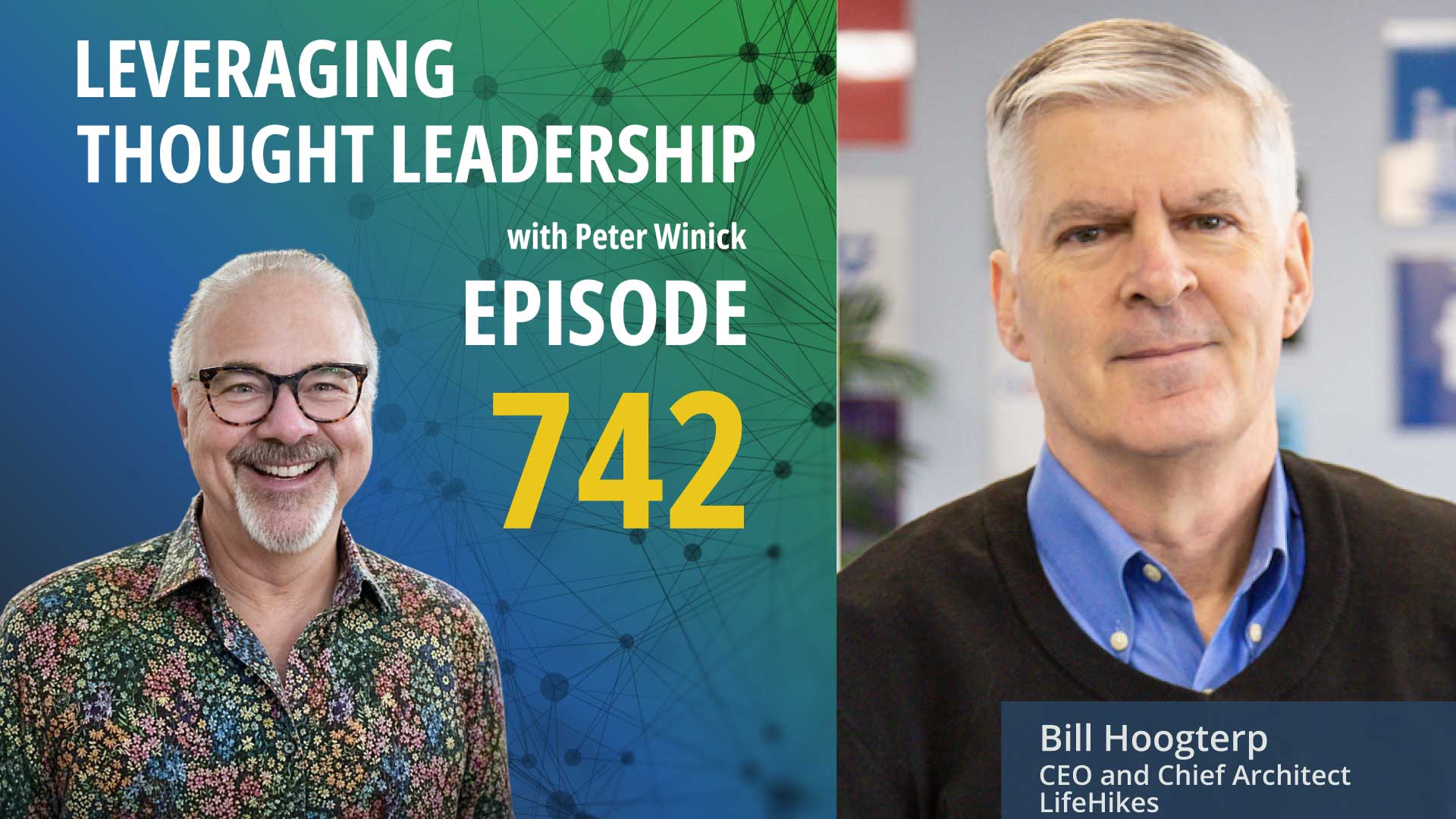



Bill Hoogterp of LifeHikes on executive coaching, lifelong learning, and a 401(k) for career development
Almost no professionals have a plan for their own growth, even at the world’s largest companies. Free coaching samples exposed the gap and inspired a 401(k)-style learning model. The takeaway: fulfillment comes from growth and challenge, not income alone.
Ask professionals at the world’s biggest companies whether they have a plan for their own learning and growth, and Bill Hoogterp says the answer is almost never yes. He built LifeHikes around that gap, and in this episode, he shows how a happy accident turned into a scalable model.
Bill’s career reads like a series of rivers rather than a roadmap: a decade of living cashless and keyless, nonprofits that mobilized over a million student volunteers, an internet company that grew into Raptive, and, 12 years ago, a pivot into training and coaching. Peter presses him for the through line, and the answer says a lot about how ideas take shape.
The pivotal moment came at a public speaking session with a room full of Hollywood agents. Bill’s coaches had started offering ten free minutes of executive coaching during breaks. When one agent asked for an honest read on himself in front of the group, a line formed. Peter calls it the free sample model, the same play bakeries and Costco have run for years.
Those short conversations surfaced a bigger problem. Learning is highly structured until school ends, and then people are on their own, with no system for mapping what to learn, what the business needs, and where they want to go. As Prudential’s Charlie Lowrey put it, it’s the 401(k) before the 401(k). LifeHikes is Bill’s answer: a model any company can customize, shaped by regular conversations with a couple hundred learning leaders. He is also moving his shares into a foundation, which is now working with the Mastercard Foundation on workforce skills for young people in Africa.
Then the conversation gets personal. Bill has coached celebrities and CEOs, and he is direct about what he sees behind the titles: plenty of people who look like they’re crushing it are running on empty. Beyond a certain income, he argues, fulfillment comes from growth, challenge, meaning, and adventure, and how society keeps score shapes what we chase. He even asks Peter to guess how much potential most people leave on the table.
If you build ideas for a living, or lead people who do, this one is worth your time. It’s a candid look at how a small experiment becomes a model, and what a model is ultimately for.
Three Key Takeaways:
- Give people a taste and demand follows. Ten free minutes of executive coaching at the end of a training session revealed a hunger most people didn’t know they had. The sample became the on-ramp to a much larger business.
- Growth is a missing system, not a missing desire. Once school ends, nobody maps out what you should learn or where you’re headed. A customizable, 401(k)-style model gives companies a way to fill that gap for everyone, not just the top tier.
- How you keep score shapes what you chase. Past a certain income, happiness comes from growth, challenge, meaning, and adventure, not the next raise. Change the scoring, as the three-point line changed basketball, and you change the game.
This conversation is basically the book in miniature. Bill’s LifeHikes story — free coaching samples turning into a scalable model, one insight at a time — is exactly the pattern Peter, Bill Sherman, and Naren Aryal mapped out after 700+ podcast conversations with thought leaders. If you want the frameworks behind what you just heard, not just the anecdote, pick up The Thought Leadership Handbook, co-authored by Peter Winick, Bill Sherman, and Naren Aryal. It’s available now at Amazon, Barnes & Noble, Amplify and Bookshop.org.
Get Your Copy of The Thought Leadership Handbook at:
Amazon
Barnes & Noble
Bookshop.org
Amplify Publishing
Apple Books
Transcript
Peter Winick And welcome, welcome, this is Peter Winick. I’m the founder and CEO at Thought Leadership Leverage, and you’re joining us on the podcast, which is Leveraging Thought Leadership. Today, my guest is Billy Hoogterp. He’s the founder, and CEO of LifeHikes. He’s a best-selling author, he’s an entrepreneur, and he’s a top executive coach, who has worked with dozens and dozens of Fortune 500 CEOs. He’s doing some really cool and interesting things that we’re gonna talk about today. And welcome Bill, how are you?
Billy Hoogterp Good to see you, Peter. Happy Monday.
Peter Winick Happy Monday. so how did you…let’s start with how did u get here how did all this happened? Cuz it seems like serendipitous and it seems like not necessarily deliberate and uh… as planned. You weren’t planning this for thirty years I would imagine
Billy Hoogterp I’m not that bright. That’s for sure. And well, that’s not what I meant, but, but I was doing a speech the other day in front of thousand people. And I said, Hey, how do you think about your career? And I made everybody do a body poll where they had to show with their body. I said I’m giving you five choices and you have to show me with your body, how you think of your career. If you’re a river person, you’re going to go like this. I just kind of follow the river. I’m a mountain top person. I know exactly where I’m going. How do I get there? I’m a bus stop person. I just stand there, things open up for me and I get on her anyway. Silly, but it, and it was a pretty good mix, but river was the number one. Yeah. And that was certainly the case for me. There’s been three rivers, but all of them a bit extreme. After college, I wanted to live like St. Francis, but didn’t tell anybody. And I tried to live on $0 for 10 years, a keyless cashless life. And I started a bunch of nonprofits with friends, which got over a million kids volunteering in college campuses around the country. And I spent my…
Peter Winick But let’s clarify keyless and cashless then meant you had no money and no place to live now. Everything’s keyless in cashless
Billy Hoogterp That’s true. That’s even better. That’s better. I didn’t have an apartment, but yes, now we’re all living keyless cashless phone lives. And I volunteered in African, Latin American in the summers and loved it. I had my clothes, my basketball, and those were good days. And then I got engaged and that was the end, Peter, of that lifestyle.
Peter Winick So I think I’m glad that didn’t cut out where you just said that was the end and then the you know Fade to black like in the Sopranos or something
Billy Hoogterp Maria thought heat and hot water would be nice once in a while. I don’t get it myself. I went into internet, was accidentally successful. Two of my friends, Andrew Schuh, was an actor on a show called Melrose Place. Michael Sanchez was the top chess playing kid in the world when he was five. And we had just finished building Do Something with MTV, another big nonprofit. And we went into Internet and started Club Mom, which became Cafe Mom, Cafe Media. That we bought, a company called Ad Thrive. It renamed Raptive, which just passed Apple and Pageviews, with 227 million uniques. And Raptive took off as a company 10 years ago when I stepped down. And I don’t appreciate the obvious implication and the correlation of those two facts that it did so well when I left.
Peter Winick Well, they’re two independent facts. Do with them what you will.
Billy Hoogterp Michael’s still the CEO, Andrew’s still there, and they’re doing great. But internet is very different from non-profit, all the ups and downs. We got lucky. And then 12 years ago, I fell in love with training and coaching and started a whole new chapter.
Peter Winick Yes, so tell me a little bit about the underlying thought leadership ideas that sort of the ingredients to life hikes.
Billy Hoogterp Well, as I was reading some of your stuff, which is brilliant, I, it got the underlying that the seeds, like where does stuff start for all of us? And we started on the room, which was a public speaking training company. And we were punching above our weight, doing really big name companies with, you know, 20, 30 coaches. And, but we did something that, that created life hikes, which wasn’t planned. And that was the coach who was running the program the day with 10, 12 people. Or two coaches with 20-some people, would give 10 minutes of executive coaching during the day.
Peter Winick Let me just pause you there, because I did a turnaround for a presentation skills company years ago. That’s not typical in presentation skills, because most presentation skills organizations, they’re focused on a skill, and they have a methodology or a suite of tools. We’ll get you up and record you on video. We’ll teach you about how to make icons, whatever. They have their frameworks, and they have their way of teaching that. But you just sort of threw that out. Yeah, and we threw in some executive coaching. That’s unusual, right? It is.
Billy Hoogterp And now you’re making me remember how that started, but so. We got into a rhythm where we, the coach would say, Hey, you don’t have to do it, but anybody wants 10 minutes of executive coaching during the break. I’ll do a few at lunch end of day. And most, most people in the workforce have never had executive coach. What do you mean? I can talk about anything work career life. What am I losing sleep over in a safe space? But it started, I haven’t shared this story with anybody. We were doing a session at CAA. If you’re familiar with creative artists, the big Hollywood agency. Yes. You tease, I tease everybody, I get teased right back, but you tease the agents and say, let’s have lunch, you’re dead to me. Yeah, you’ll never work in this town again, whatever. The stereotypes of industry are never true, I would say to them. The way people are portrayed in the movies is not true, I said, except when it comes to you guys. They would laugh. So at the end of a morning session, there were 13 agents in the room, and these are very successful agents, making. Sure. Million plus, etc. And one of them, as we’re about to break for lunch, turns to me says, tell me about me. Like, what’s my strength? What’s my weaknesses in front of everybody? Like, doesn’t care. And I said, well, your street strengths are this and this and this. Your one weakness is this. You used 17% body of weak language, etc., etc. Just ran through a quick list. And the next person is like, do me next, do be next, and I said well, I’ll tell you what, we’re at lunch. But if anybody wants some one-on-one time, I’ll do it.
Peter Winick And let’s say by the way so what you did was you basically stole the model from the bakery. It’s called the free sample So you’re online at the bakery on the top of the counter. They take a blueberry muffin or whatever They cut it into ten you nibble on one go to that’s tasty by the time you get to the front of the line You’re like, I’ll take six of those right? So like exactly. It was also the
Billy Hoogterp It’s also the model at Costco, experiential, especially for training. That means I’m the lady at Costco at the end of the aisle with a hair net, giving out the bacon cheese wrap samples. So I said, anybody else that wants to do it a lot line up, I’ll give do it 13.
Peter Winick You aren’t doing the coachings in hairnets, I just want to get a visual there that I want to correct. There are no hairnats involved in the executive coaching, just for the record.
Billy Hoogterp So I saw there was a real interest. Most people have never had anybody give them that kind of attention.
Peter Winick So stay there for a minute. So in a couple of moments, there’s two things. One is the recipient was like, oh, I like that thing that’s called executive coaching. That’s really interesting, right? I might have thought about it or had heard about it, but I never thought it was approachable to me. And then you realize, like, wow, there is a benefit here. So now what do you do with the demand that you’ve created there? Because executive coaching, by its very definition, is pricey, right. It’s usually not democratized equally across an organization. You know and on and on so how do you lower the per capita of that. Modality and get it out there to more people at a more cost effective way.
Billy Hoogterp Where were you years ago, Peter, when I was trying to figure that out? Cause you have an ability to encapsulate and get two steps ahead in the chess game. So we began to realize, so we started offering it and, and everybody wants it. And so there were two Ahas that came from that one-on-one time from us. And we’ve had 130,000 people, 1.6 million were on that program, but 130,001 gotten that one on one coaching. The first Ahal was not a single person had a plan for their learning and growth, not one. Wow, and it’s nothing important and that is that that’s all
Peter Winick And that’s all industries, all level.
Billy Hoogterp The biggest companies in the world, 47 countries, 7 languages, we’re all just riding the river.
Peter Winick Is the why under that that most people assume my company will give me what I need to succeed like what’s do you know? What the why is under that?
Billy Hoogterp I think it’s even broader. It’s, it’s, you know, society is set up to stop caring about you when you finish school, you’re very structured learning kindergarten all the way up through, through whatever amount of school you go. And then the universe says off into the wild, you go, we’re focused on the next batch and there really is no system for you. It’s like, it it’s like Charlie Lowry is the CEO of Prudential or just stepped out as CEO and board chair. He said, you’re like the 401k before the 401K. Like there was nobody thought they needed a 401k because it didn’t exist. And now it just makes sense. So there was no system to map out. What should I be learning or growing to, you know, what is my business need? What is, what do I want? What are my goals? So we began to start to play with it and had monthly calls with heads of learning from really big companies, a couple hundred top, top leaders. And we’ve been eating for a couple of years and we started to create a new model called life hikes, which is really four things because we saw it in the one-on-one coaching, all the people that made the jump, the, what your work does, your book, all of your, the podcast is really helping people have their breakthroughs, all, all people that have the breakthrough always have four things, always. And so we began to take those four things and use those as the corner pieces of a new model. Okay. So in a new modeling, you mean a new model of learning? A new model that’s interchangeable, like the 401k, pretty much every company can use it and customize it for their own purposes. I own most of Life Hikes and since I was already lucky, I’m putting my shares into the foundation. So we’re trying to create something that’s a little bit more ubiquitous that everybody can use.
Peter Winick For years, this podcast has explored how thought leaders build, influence, and create change. Now, Bill Sherman, Nara Nariyal, and I have put the experience into a new book, the Thought Leadership Handbook. It’s available now. Learn more at thoughtleadershiphandbook.com and order it today at Amazon, BNN, Bookshop, or directly from AmpliCom. So I mean, let’s stay there for a minute. So your business, so forget about the approach, not forget about, but the approach is unique. But you just said that as a throwaway. Yeah, my shares are in a foundation. We don’t hear that a lot. So to me, that tells me you’re more focused on impact. You’re more focus on legacy. You’re focused on being evangelical and unleashing the power of your ideas. Is that?
Billy Hoogterp And that, I mean, if you coach once people say, how do you know all these celebrities? How do you all these gazillionaires that will one treat celebrities like regular people and regular people like celebrities, you’re going to get along fine. And when you meet the gazillionares, a lot of them aren’t that happy, right? They’re good people there, but they’re set on the same striving, got to have more, gotta have more and there’s no winning that game. There’s two studies that came out about how much money you need to be happy. Have you heard about either of these? Yes.
Peter Winick Study and the other, yeah.
Billy Hoogterp Yeah, once a 60,000, once to 75,000. But once you meet your basic needs, but if you chart this stuff carefully, happiness comes from growth, it comes from challenge, it comes from meaning, it comes from adventure. But after a certain level of income, it’s not coming from the money. And people say, if there’s asking me to coach them, well, I’m making this much, shouldn’t I get the rate? I said, of course, go for the raise. The glow lasts a month and a half. But the challenge is what’s making you happy.
Peter Winick So stay there a minute because I would argue that. You know, most people I’m working with are successful. People I surround myself with tend to be successful. But how are we measuring that? Unfortunately or whatever, there tends to be an economic, oh, that guy, you know, makes a lot of money or that guy is the leader of a company or whatever. But that connection to, we don’t talk about happiness relative to growth or challenges or adventure, right, when we say, hey, how you doing? Oh wow, I just got a big fat bonus this year. Okay, that wasn’t the question I asked, right? But people answer that, we say oh great, you’re doing great. Now they’re not telling you. I’m miserable. I’m drinking like a fish. I’m lonely. I’m anxious. They’re telling you the numbers or the quote objective piece. I just got to raise. I just gotta promotion. You know, I hated what I was doing before and now I hate it even more because I get to do it 70 hours a week, not 60 hours a week.
Billy Hoogterp That’s a good line.
Peter Winick How do you think about that?
Billy Hoogterp Yeah, it’s a lot of it is macro before micro. How does society keep score really affects us? And, you know, it 10 million times of hearing this, you know, affects us. It’s if you’re a basketball fan, I still play full court basketball three times a week with my son’s been playing with us. It’s really fun. But look what the three point line did to basketball. It changed the game because You change how it’s being kept so if you follow the way society keeps score of course you’re getting caught up in a certain line of thinking that’s understandable but. At some point you know half of life is making it in the other half is giving back so you start to realize on your own I’m getting more joy from these other things it doesn’t mean to stop making money doesn’t stop growing and succeeding but you just start to think about how you keep score a little bit differently.
Peter Winick Got it. So you’ve been In a bunch of different worlds for long periods of time nonprofit technology L&D, etc. Think about it backwards and say what was the common thread because I always find it fascinating when I’m working with thought leaders and interesting folks to say actually it seems like you know A really bad buffet where the tacos are next to the sushi or whatever, but here’s the through line So what was that or what he has been through line?
Billy Hoogterp Um, my friend, Doug Becker, who started Laureate and Santana, he was doing the same thing for me unbidden. And one of them was, he said, you’re through lying as you, you’re always about helping people. You want to help people. Poverty go to here. You want help kids go here. You want, to help. People. And you, you like to create formulas for scale, but the flip side of that is I hate waste just drives me crazy. So, if I see Litter, it drives me crazy. We see people in poverty who are good people. We just opened our foundation, just opened our first office in Nairobi. Oh, wow. We’re working with the MasterCard foundation. They set a huge goal of talk about a BHAG 30 million young people getting the skills for the workforce because the jobs are coming, but these kids in Africa, you know, making hardly any money, they’ve got the talent and the drive, but they just don’t have the skills. They can’t have an interview, they don’t know how to use zoom. They don’t. So that gap can be closed anyway. So the idea of it drives us crazy that these people don’t have the opportunity that other people could have. And what a better world that would be if they could create a middle class in these developing countries. So back to the same thing, when you coach people one-on-one and you see the unhappiness, people externally will come into the coaching scenario and say, I’m an EVP at this huge company and it looks like I’m crushing it, but you quickly figure out they say I’m a little bit miserable, Billy. I barely get through the day. I’m not enjoying, I can’t catch up. I don’t enjoy my weekends. It’s all about catching up on sleep. I’m good with my significant other right now. You know, they open up, they’ll tell the coach things. They won’t tell their boss or HR. You feel like a priest doing confessions. Right. Right. If you, when you give them a certain combination, it’s not about reaching all of your potential, but there’s a nice shelf up that almost everybody can access. And this is the drug that you’re addicted to and I’m addicted to, which is how to help people get that jump where all of a sudden, I’m doing better at work. I can breathe again. I’m starting to enjoy-
Peter Winick You know, when we talk about potential and people not reaching their potential, you know, that’s sad, right? If someone’s got the ability to do X, but they’re doing something less than X. But I think the definition of potential, your looking at it far more holistically, be a better human, be a partner, be better friend, right, as well as the obvious sort of business.
Billy Hoogterp Approaches to that. Here’s an unfair question. I’ll ask it anyway. And everybody that’s listening to, to Peter, send your telepathic thoughts into the chat room. So first number that comes to your mind, it’s an unanswerable and there’s no right answer, but the first one that comes through your mind. What percentage, Peter, would you say of their potential do most humans leave on the table?
Peter Winick Probably a third.
Billy Hoogterp Depending on how you define that or think about that. Yeah, there’s no possible way to even know the answer, but I’ve asked that question hundreds of times and I’ve heard everything, the high would be 90, the low would be 20, the average would be 60. The most people think we’re leaving 60% of our potential on the table and we’re accessing 40. And again, the goal is not to create a utopia and everything’s princesses and rainbows.
Peter Winick A Ferrari and driving 30 miles an hour, why the hell would you do that?
Billy Hoogterp Right? Like it just makes no sense. Well, that’s w that leads into coaching and thought leadership is every individual. If you, if let’s say you’re achieving 40% of your potential, I’m capable of this, but I’m doing this next question is why what’s causing that, you know, what happened at this age or this age, or what mindset, and then you start to unblock those things and it’s not about boom, it’s about baby steps in the right direction.
Peter Winick Right, right. Love it. Well, this has been a lot of fun. I appreciate your candor and your storytelling and sharing your journey and wish you the best. Thank you, Bill.
Peter Winick To learn more about Thought Leadership Leverage, please visit our website at ThoughtLeadershipLeverage.com. To reach me directly, feel free to email me at peter at Thought Leadership leverage.com and please subscribe to Leveraging Thought Leadership on iTunes or your favorite podcast app to get your weekly episode automatically.
