
How to Stand Out When AI Makes Content a Commodity | Jack Myers | 741
The Leveraging Thought Leadership podcast is created by Peter Winick and Bill Sherman and produced by Thought Leadership Leverage.
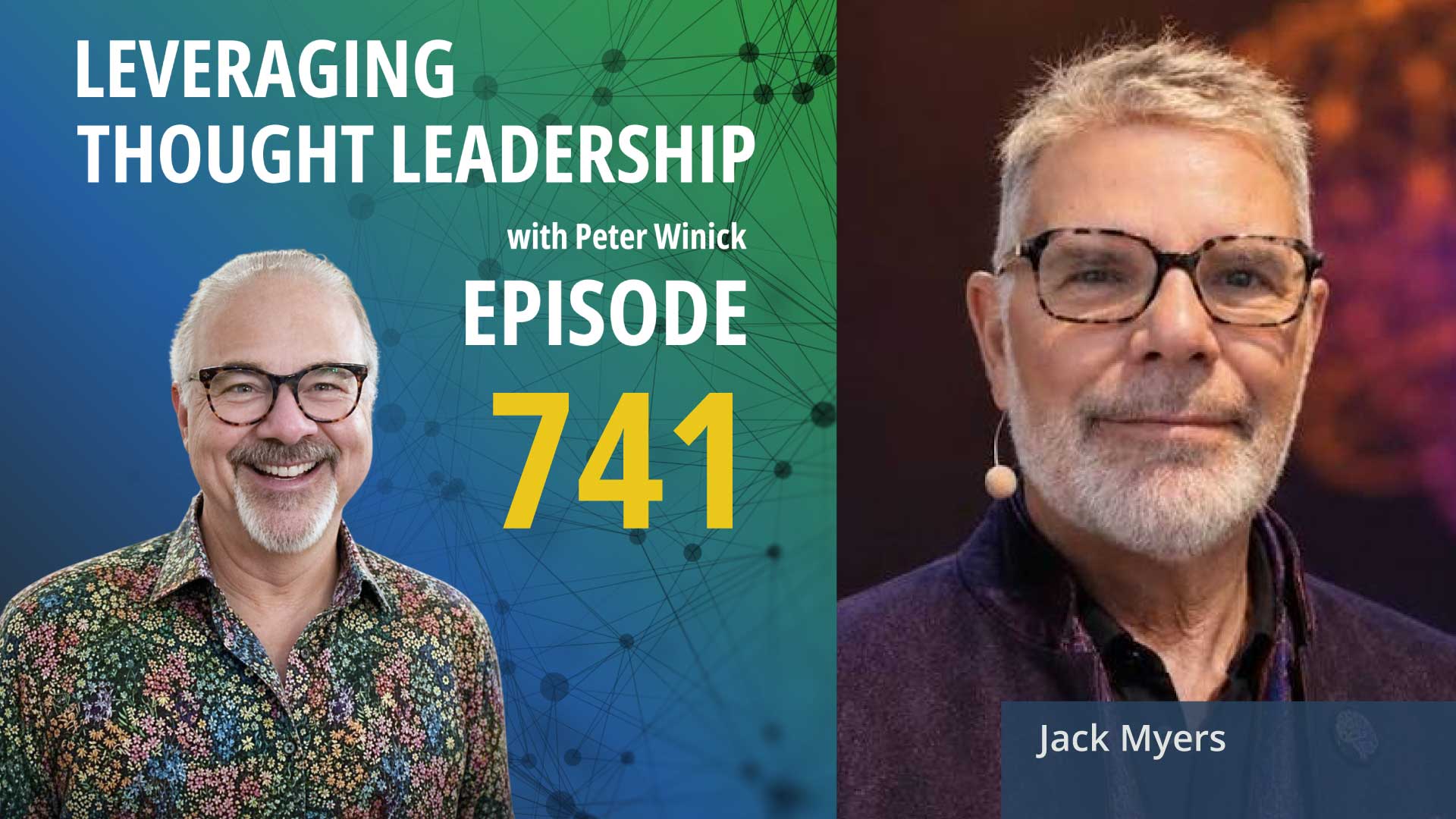



Build trust and authority through human relationships, with Your Third Brain author Jack Myers
When AI makes content and expertise abundant, what still earns attention and trust? This episode explores why discernment, judgment, and deep human relationships now matter more than expertise, and how thought leaders can stand out by leading with humanity in the age of co-intelligence.
What if the one thing you’ve spent your career building, your expertise, is about to become the least valuable thing you own?
In this episode of Leveraging Thought Leadership, Peter Winick sits down with Jack Myers, a media ecologist, futurist, and author of Your Third Brain: Powering a Future of Unimagined Possibilities. Jack launched The Myers Report as a fax newsletter in 1984, founded MediaVillage, and has spent decades watching each new medium reshape the people who use it. The two have known each other for more than ten years. Peter’s focus is how to scale, leverage, and monetize ideas; Jack’s is the humanity behind them.
Jack’s argument starts with a simple observation: distribution and content creation are now commodities. When anyone can publish anywhere and AI can replicate knowledge on demand, information stops being the product. Citing his NYU mentor Neil Postman, he calls information a form of garbage and predicts that expertise alone will carry almost no commercial value within a few years. What AI can’t replace, he says, is lived experience, ethical judgment, empathy, intuition, and trust.
Peter pushes back with the other side of that coin. Today’s AI is the worst it will ever be, but there’s a flip side: laziness and AI slop that quietly burn through the trust a brand has spent years building. His litmus test is simple. If a semi-intelligent reader can tell, you’ve failed. Jack’s answer centers on discernment and on the consistent, original, deeply human work that makes an audience show up in the first place.
The conversation also covers why Jack wrote another book in a market flooded with them, what he means by the “third brain,” techno-intelligence, and techno-intuition, and why he calls this moment a potential spiritual awakening without meaning anything religious. Jack also shares the advice he gave a young Newhouse graduate that very morning: build a career on relationships, not a resume.
For authors, speakers, consultants, and executives wondering where their ideas hold value as AI gets faster, this episode is worth the time.
Three Key Takeaways:
- Information and expertise are being commoditized. With distribution and content creation available to everyone, and AI able to replicate knowledge on demand, expertise alone no longer differentiates you. Jack expects its commercial value to shrink fast.
- Judgment, discernment, and trust are the new premium. AI can’t replicate lived experience, ethical judgment, empathy, or intuition. The thought leaders who break through will lead with who they are, not only what they know.
- Relationships beat reach. Originality, consistency, and genuine human connection build the trust that keeps an audience coming back. Follower counts and content volume can’t deliver that, and AI can’t do it consistently.
Jack Myers makes the case that expertise alone is no longer enough, and that the leaders who stand out will be the ones who know how to turn their ideas into visible, trusted impact. That is the problem Peter Winick set out to solve with co-authors Bill Sherman and Naren Aryal in The Thought Leadership Handbook: How the Experts Elevate Their Big Ideas, and How You Can Too. The book draws on more than 700 conversations from this podcast, distilling the patterns behind how ideas get built, scaled, and monetized into frameworks you can apply to your own work. Learn more at thoughtleadershiphandbook.com, then order your copy today from Amazon, Barnes & Noble, Bookshop, or Amplify Publishing.
Get Your Copy of The Thought Leadership Handbook at:
Amazon
Barnes & Noble
Bookshop.org
Amplify Publishing
Apple Books
Transcript
Peter Winick And welcome, welcome, welcome. This is Peter Winick. I’m the founder and CEO at Thought Leadership Leverage, and you’re joining us on the podcast, which is Leveraging Thought Leadership. Today, my guest is an old friend, Jack Myers. Jack is a media ecologist, which is not a title or explanation. You hear about somebody often. He’s a futurist, an author, an educator, and a trusted advisor helping leaders, parents, coaches, educators, and all those navigating. The Era of Accelerated Intelligence, and he is the author of Your Third Brain, Powering a Future of Unimaginable Possibilities, co-founder of Media Village, and an all-around interesting and fascinating guy. So welcome aboard, Jack.
Jack Myers Thank you thank you I really appreciate the opportunity I have followed you as you know for many many years so it’s an honor to be with you today.
Peter Winick Yeah, and you and I have known each other and worked together in probably 10 plus years, I guess.
Jack Myers At least ten yeah and you know you’re the interesting thing about where you and I are on the same page in terms of really. Understanding using and advancing thought leadership. And the difference is that you’ve been really focused on the qualities that go into thought leadership and I’m as a tool as a resource and I am more focused on humanity behind. The thought leadership, so it’s an interesting conversation we can have.
Peter Winick Yes, not that I don’t care about the humanity piece of it, but my clients are engaging with me to figure out how do you scale it, how do your leverage it, how do better monetize it, get more impact. So talk about, you’ve had a lot of different threads of thought leadership, if you will, over the years. Talk to me about sort of how they each came to be, and then I always think there’s an interesting, as we look backwards, they seem more connected than they might have been when we were doing them looking forward. So give me a journey down.
Jack Myers That’s very true. You know, you could say there have been pivots. I say there’s been a straight line. I launched the Meyers Report, which is now at Substack as a standalone email, actually fax newsletter in 1985.
Peter Winick For wait time out time out for any for anyone under like 40 or whatever Google fact it was it was cutting edge at one point we all had those machines and burned out decibels listening to the high squeaks of the pitches of getting this.
Jack Myers A facsimile machine, you had to have it installed and it was a big piece of equipment and you were able to get content in real time, which was a breakthrough for content.
Peter Winick And just on that, my definition of the world’s greatest salesperson is the guy or gal that sold the first one, because who would you fax to? I’ve always thought about that, but anyway.
Jack Myers Exactly, and why would you want to even be able to do that? What’s interesting today with AI in this conversation is that the ability to distribute content has become a commodity. It was very difficult. It was challenging to get content into the hands of whether it was your clients, your friends, your family. And today, of course, it’s ubiquitous, and everyone has access to the distribution tools. And to the content creation which is the big game changer right now that we’re dealing with and that’s what I deal with in your third brain it’s that ability to have an intelligent partner an intelligent collaborator and intelligent co creator. And the question peter that I ask your audience your listeners is how do you recognize this massive change in. Really in publishing and thought leadership models, from a human point of view, how do you not just replace your tools that you’ve been using in the past, but how do you really elevate and bring the human aspects of thought leadership to the forefront?
Peter Winick Yeah, so tell me about what that looks like for you, right? So, you know, fax machines, newsletters, media village, whatever, they’re modalities, if you will, right. So when you talk about the humanity, what’s the essence of what you’re trying to get out in the world today?
Jack Myers If you think about delivering content 40 years ago, 10 years ago even five years ago it was about delivering information for the most part. Today information, my mentor and professor at NYU, Neil Postman in Media Ecology said information has become a form of garbage, barely useful for performing the most fundamental tasks. So I think the challenge is not expertise. Or information alone, and it’s not even expertise. I think expertise alone will really have almost no commercial value in the next few years. It’s the judgment. Well, wait, stay there. I mean, you said.
Peter Winick Fairly quickly that’s a radical thought because most of us have spent most of our. Yeah education life professional life whatever developing some sort of expertise specialize get expertise don’t be a specialist whatever and there is an oh yeah by the way note to self that means nothing anymore like hello.
Jack Myers Well a I can replicate expertise it can replicate knowledge it’s actually smarter than an increasingly smarter than even the smartest intellectuals so expertise where the more it’s replicated it can’t replace a i cant replace lived experience ethical judgment empathy intuition trust so. As you look at thought leadership and as you look at the humanistic qualities of, of communications and the entire premise of my book, your third brain is how do you bring those human qualities to the forefront? How do you be both practical and valuable in thought leadership, as well as being personal and emotional and bringing your humanity to the forefront, I think that’s… When you have over 400,000 sub stacks, a hundred thousand of which are earning money, how do you break through? And I think you do that by communicating who you are as a person, as a human being, connecting with other human beings and the expertise that you’re delivering, I believe becomes secondary.
Peter Winick So why write another book now you know what it takes. It’s a lot of work. I don’t need to explain that to you Why did you choose to torture yourself at this stage in your career?
Jack Myers That That is the question and why write why write another book most people in business who are writing business books are not necessarily doing it right the book they’re doing it to get speaking gigs out of speaking gigs to get consulting gigs yeah and the reality is as you know better than anyone even those. Obvious end games have become commoditized more and more with more and more experts. So-called experts out of work, they’re giving away, they’re speaking in order to get consulting and they’re given away, there’s consulting in order get long-term advisory roles. So the whole process of writing a book, I understand Amazon publishes five to 10,000 new books every single day, so yeah, I think that is the question. The only reason For me to write your third brain is because I really believe that in the marketplace of thought leadership today of business that the humanistic qualities we have two brains now. We have our SIR Brain that we were born with the biological brain and then we have our emotional brain our social brain that we really learned and develop. And now we have a third brain which is co intelligence that i expand i call it techno intelligence not a i and i call a techno intuition. These are the expanded human qualities that i write about your third brain and whether it’s writing speaking and advising. I think this is where the opportunity is in the future for me and for your audience.
Peter Winick So I would say you’re a guy that’s always been ahead of the curve, right? You’ve always been, I mean, part of, part of your bio is futurist and there’s a downside and an upside to that. So you see things really, really clearly that don’t quite exist yet for the rest of us, right. And there’s, there’s a challenge to that in that. A people might not be where you’re at yet B before you or they’ll engage with you, there’s an education curve where you’ve got to sort of get them to understand what you’re even talking about versus being somebody else talking about X, whatever X might be. So you’re creating not only a new X, but then underneath the X, a Y. So it’s multi-variable, which is a harder equation to do. Is that, is it, you can’t help yourself or why, how did that come to? If you ever wondered how strong ideas become visible, trusted, and scalable, that’s the work behind the Thought Leadership Handbook. Bill Sherman, Nara and Ariel and I wrote it for experts who are ready to move from insight to real impact. Learn more at thoughtleadershiphandbook.com and order it today at Amazon, BNN, Bookshop, or Amplify.
Jack Myers Well, first of all, I think that AI is going to create the greatest leadership opportunity since the beginning of the industrial age. I think we are ending the industrial age, the information age, and we’re entering the age of intelligence. And I don’t think the biggest question facing leaders is whether AI will change their business. It already has. I think the real question… Is whether they’re developing human capabilities that AI will never replicate.
Peter Winick And that’s why… Oh, so let’s stay there, right? So if expertise in and of itself is out the window, things that, and I’m pushed back, that won’t go out the windows or AI won’t eat your lunch is gonna be critical thinking, is gonna intuition, is gonna being seeing patterns that don’t exist, right. So AI is really good, you know, there’s a long list of things that AI is good at and getting better and better every day. Like if we think about it, whatever the tool or the platform of AI that you’re using today Is that the worst state that it will ever be? Right. So I always think about when the, when the dial up ages of AI. And if somebody said to me, all right, Peter, you know what, for a week, the only way you can use the internet is the way you did in the nineties dialing up. My head would explode. I couldn’t even fathom going back to that, but at that moment in time, that was the greatest, fastest, quickest thing ever. How do you get people to separate sort of the, the cool enamored, Oh my God, this is amazing with, you know, these truths will never change.
Jack Myers What discernment comes to mind in terms of where what that where the value is because i is not replacing human intelligence it’s replacing the commercial value of information and expertise so judgment discernment. Really can’t be automated thought leadership has traditionally focused on knowledge and the next generation of thought leaders. We’ll also have to address meaning, purpose, ethics, humility, hope, trust, and those aren’t software features. They’re, they’re spiritual in a lot of ways. There’s spiritual capacities. So what I argue for in your third brain is that the greatest competitive advantage, uh, won’t come from building smarter machines, but from becoming wiser, more fully human.
Peter Winick So let me let me flip that. So let me flip that because there’s so many things that I could do today that just weren’t possible at the speed, at the cost, at the scale six months ago, a year ago. Like this is lightning fast. Like I’ve been around long enough to see lots of technologies adopt and all that other things, nothing at the screen of this. Right. But I think, you know, you’re optimistically talking about the intelligent piece. I think there’s a flip side to this, which is laziness and stupidity. Right. So there’s a lot of marketers that many marketers have always been lazy, but now because they’re using AI slop, I look at that and go, Oh my God, like the level of laziness or, you know, people’s enemy, you know, well, I use AI and it could create all this content, great. All this. And it’s like, okay, well the litmus test should really be, if you put it in front of a semi-intelligent person, can they tell? And if they tell, if they can tell you failed. And the damage to your brand isn’t just, oh, you put out a piece of content that was less than mediocre. It’s I’ve now lost the trust in you and I lost the faith in you. I know when Jack put something in the Meyers report or the Substack or whatever, that you toiled over these thoughts and these ideas. I don’t agree with everything you say and I don’t think every one of your pieces is the best piece you ever wrote, but I know you’re putting in the rep and you’re not funding it.
Jack Myers The idea is original, it is focused, and it’s consistent on advancing humanity. When AI can instantly create content, which you’re sharing the laziness, what really comes to the forefront arises are genuine human relationships. Whether they’re human relationships in person, whether they’re what you and I are doing here playing on. You know, ten plus years of knowing each other, respecting each other. But relationships can also be across technology through technology. And it’s, I think it’s the last truly scarce competitive advantage.
Peter Winick But part of that relationship, when anyone thinks about why do I read who I read, whether that’s in a newspaper, online or whatever, there’s a level of admiration, there is a level of trust, there a level respect, there are a level curiosity, right? Why am I going to spend my time, whether it’s watching a video or reading an article or whatever with this person. There’s also, they built a consistency of what I expect, so there’s level of expectation that I have from you. That you’ve never violated, right? Like it’s just OK, it’ll be cool. It’ll be thoughtful. It’ll it’ll get me to think differently, which is a big deal. And it’s not that I wouldn’t be silly enough to say I can never do that. Yeah, no, it could at on occasion at times, right, but not consistently. So and I don’t that’s not what I’m trusting AI for.
Jack Myers Right. So, um, yeah, we use the word earlier spirituality and at you know, I believe that AI has the potential to create the greatest spiritual awakening again since the Industrial Revolution because How do you define it?
Peter Winick Because spiritual awakening could sound like I don’t know that’s
Jack Myers I’m not saying religious I’m saying the component parts that you voice the trust the respect what makes us uniquely human the empathy the belief in each other the trust in each of the coming together as a civilization with common purpose and meaning these are the deepest human relationships and I think. The next generation of thought leaders who you talk to won’t win because they have the biggest audience because they’re the measurement of likes and hearts are the largest though right because they had the deep human relationships and that’s how I use the word spiritual.
Peter Winick All right, so if we were to think about, you just got reincarnated as you, but you’re now 30 years old. What would you tell young Jack, who is making his way in the world, trying to strive, trying to be successful, passionate, what would you, what would tell young you.
Jack Myers Just earlier today, I spoke to a young man who’s in his early thirties, early in his career, new house graduate as I am from Syracuse University, who I’ve been speaking with mentoring and I said exactly the same thing I’m saying now I’m saying, I told him he’s working in the technology business, I said right out the next couple of years, build your relationships, right? Leaders His leadership won’t come from is not his expertise it won’t cut it’ll come somewhat from his resume and what he’s learned but ultimately his career will be defined. My relationships and helping people helping others discover who they can become in their own careers and that’s where leadership and spirituality and your third brain intersect.
Peter Winick So that sounds, at once, quaint. Nostalgic yet poignant and incredibly relevant like we’ve come all the way back around. So I would say that You know you might attribute some of your success to folks that you met or fellow new house alums or folks, you know X number of years ago at the beginning of your career who? At one point might have been clients or one point Might have been your boss or at one point may have been someone that worked for you, right? And that’s true regardless, right so it’s kind of interesting and again This still isn’t something that’s typically taught. It’s either someone’s got charisma or some intuition or some superpower to do that. So I love that you came all the way around there. So now if I could just hear the keyboards pecking of a bunch of 30 year olds going into chat saying, how do I build a relationship, right? That’s what you know. How do I just build an authentic relationship quickly or whatever? Give me the five hacks to building a relationship. You know we get so right.
Jack Myers We get so wrapped up in technology, Peter. What I love about this conversation and what you do and the book that you’ve written, uh, is, is you focus, not just not on the technology, you focus on the human leadership and, and I think we are going into the greatest leadership crisis of our lifetime, of our life time in which there’s longer than those 30 year olds, but the greatest opportunity of that they will face. Is to really understand that technology is not their answer. It’s an answer, but their answer is how they develop, elevate and use their most human qualities of empathy, listening, creating a sense of belonging around them and in the organization and the lives that they lead. And that that’s why I really believe in a positive. You know, perhaps you call me a futurist or a visionary, and I’ve always been positive. Sometimes it’s not been the best commercial direction to take because negativity is where success has been generated by a lot of thought leaders. And I think their time is over and should be over.
Peter Winick Love it. Well, this has been great. I appreciate you sharing the time with you as always and it’s mutual Thank you, Jack. Good stuff. Thank you
Peter Winick To learn more about Thought Leadership Leverage, please visit our website at ThoughtLeadershipLeverage.com. To reach me directly, feel free to email me at peter at Thought Leadership leverage.com and please subscribe to Leveraging Thought Leadership on iTunes or your favorite podcast app to get your weekly episode automatically.
