
Building Trust Between Humans and AI in R&D | Jayshree Seth | 740
The Leveraging Thought Leadership podcast is created by Peter Winick and Bill Sherman and produced by Thought Leadership Leverage.
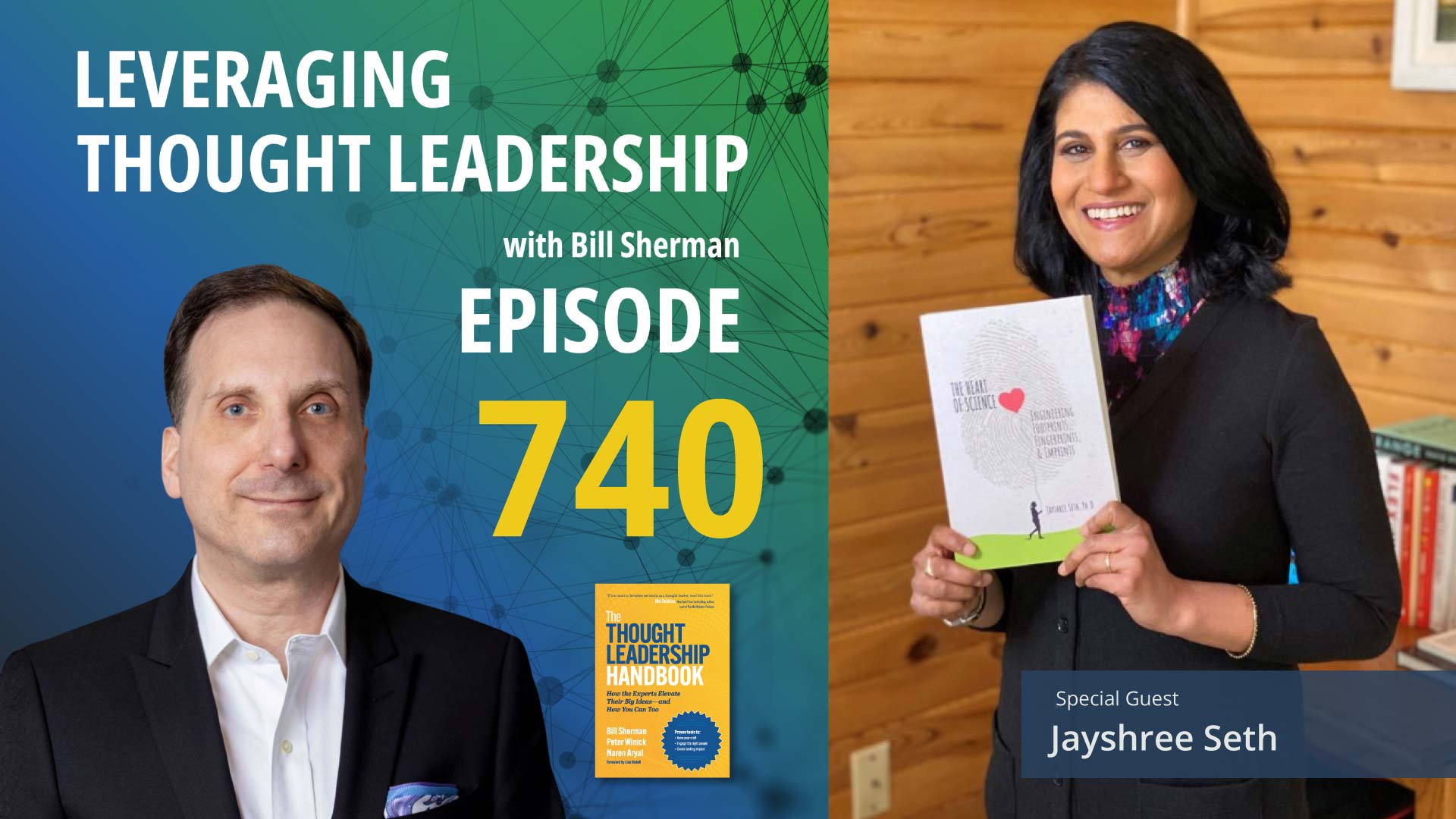



3M’s Jayshree Seth on voice, visibility, and building thought leadership as a scientist
A 3M corporate scientist returns for a third conversation on turning technical expertise into public influence. She unpacks the personal-branding framework and STEM advocacy lessons behind her Thinkers50 recognition, her collaboration with Amy Edmondson on trust and AI, and the hands-on blueprint in her new book.
What does it take for a corporate scientist with zero direct reports to land on a list dominated by business school professors and bestselling authors? That’s the question Jayshree Seth had to answer for herself when she was named to the Thinkers50 Radar in 2025 — and her answer became a framework.
In her third appearance on the show, Jayshree Seth, 3M’s Chief Science Advocate and now-published trilogy author, returns to catch listeners up on a remarkable stretch: a Thinkers50 keynote, a panel alongside Amy Edmondson, an HBR collaboration on trust and AI, and the release of her third book, The Heart of Science: Engineering Blueprint.
The conversation moves through several of Jayshree’s signature acronym-driven frameworks. There’s METRICS-OPTICS-RUBRICS-ENERGETICS, born from reflecting on how she — an engineer with no traditional management credentials — ended up on a list built for management thinkers. There’s the “three Cs” that block innovation: copy-pasting, catchphrases, and cherry-picking, delivered as her Thinkers50 keynote. And there’s VIABLE, her personal-branding framework built around voice and visibility, image and impact, backstory and behaviors, and experience and exposure.
Beyond the frameworks, this is a conversation about the mechanics of building a reputation from inside a technical role. Jayshree traces the specific chain of relationships — a mention in David Epstein’s book Range, an introduction to Rita McGrath, an eventual collaboration with Amy Edmondson on psychological safety and “intelligent failure” applied to human-AI trust — that turned an internal 3M scientist into an external voice cited in Harvard Business Review and Fast Company.
Bill and Jayshree also dig into what it means to write a book for three different audiences at once — emerging thought leaders, established experts, and Hall of Fame-level veterans — and why friction in that process is often a sign you’re doing it right. The episode closes with a reflection on responsibility: once you have an audience, thought leadership isn’t a hobby, it’s a discipline that has to coexist with a full-time job.
If you’ve ever wondered whether your expertise “counts” as thought leadership because it didn’t come with a traditional credential, this one’s for you.
Three Key Takeaways:
- Being different can be your competitive advantage, not a liability. Jayshree’s METRICS-OPTICS-RUBRICS-ENERGETICS framework argues that outsiders to a field — like an engineer among management thinkers — don’t need to conform to existing rubrics. Changing the measurement, the framing, and the energy you bring can alter who gets to lead a conversation.
- Reaching out to “inaccessible” experts is a discipline, not a gamble. Jayshree’s collaborations with Amy Edmondson, Rita McGrath, and others didn’t start with credentials — they started with cold outreach after reading an article or hearing a podcast. The lesson: most thought leaders are more accessible than they appear, and it’s
okay if they say no. - A personal brand for thought leadership rests on delivery, not image. Her VIABLE framework (voice/visibility, image/impact, backstory/behaviors, experience/exposure) puts the emphasis on tangible results and consistent values over aesthetics — visibility only amplifies a brand that already has substance behind it.
This episode isn’t just an interview — it’s a live example of the ideas in Bill’s brand-new book, The Thought Leadership Handbook, co-written with Peter Winick and Naren Aryal.
Jayshree’s journey — from in-house corporate scientist to Thinkers50 Radar honoree — is practically a case study for the book’s core idea: that thought leadership follows identifiable patterns, not luck. In fact, the book itself draws on more than 700 conversations from this very podcast and organizes those stories into five thought leadership “avatars” — Jayshree’s path as an In-House Expert turned public voice fits right into that framework. If her VIABLE branding model resonated with you, the Handbook goes deeper into exactly how experts like her make that leap from personal effort to public influence.
Pick up The Thought Leadership Handbook: How the Experts Elevate Their Big Ideas — And How You Can Too, by Bill Sherman, Peter Winick, and Naren Aryal, wherever books are sold — including Amazon, Barnes & Noble, and Amplify Publishing Group’s website.
Get Your Copy:
Amazon
Barnes & Noble
Bookshop.org
Amplify Publishing
Apple Books
Transcript
Bill Sherman There are many people who practice thought leadership inside their organization. Sometimes these in-house experts have thought leadership as part of their formal role. And sometimes it’s a role they take on in addition to other duties. Today, I welcome back Jayshree Seth. At 3M, she’s both a corporate scientist and the chief science advocate. She’s also the author of the Heart of Science trilogy of books. Her journey also appears as the anchor story for the in-house expert chapter in our book, The Thought Leadership Handbook. Today, I talk with Jay Sri about how her thought leadership journey has continued. The third book being named to the Thinker’s 50 Radar list, being on a panel there with Amy Edmondson and how that panel led to collaboration and co-creation. We talk together about what fuels her thought leadership work and the difference between a personal brand and a brand for your ideas. I’m Bill Sherman and you’re listening to Leveraging Thought Leadership. Ready? Let’s begin. Welcome to the show, Jayshree.
Jayshree Seth Thank you. Good to see you again.
Bill Sherman Yeah, yeah. Three times now you’ve been on the show twice once in 2021 and 2024 and you’ve continued your work. Catch us up on what’s happened in science advocacy and the thought leadership front. I think you’ve written a new book since that one. Yes, yes, yes.
Jayshree Seth You’ve been a great partner in my thought leadership journey and excited to be on for the third time and excited about your new book. Thanks for sending it.
Bill Sherman You’re welcome. You’re welcome. And thank you for allowing us to have you in it.
Jayshree Seth Yeah, yeah, I loved it. It was great to see. We’ve talked about this for a while, you know, books and everything else. You know, I was inspired to write my first book during the height of the pandemic and everything that went on in the world at that time, you know, the disease, the deaths, the disasters, the divides, you know, Memorial Day weekend in Minnesota where I’m based. And I just wanted to be productive with purpose. And so I collected many of the essays, as you know, and the book was published by Society of Women Engineers, all proceeds going towards a scholarship for underrepresented women in STEM. And I got the chance to meet the first scholar. It was so surreal. I thought, I can’t stop here. Second book comes out, and we talked about the second book. And with two books, we had five scholars, very exciting. But then I started getting more and more requests for worksheets. And workshops based on my frameworks and mental models. And I was like, we need to do this. So the first book, Engineering Footprints, Fingerprints and Imprints, that laid the foundation, exploring all these themes of the things that I had thought about, personal development, authentic leadership, making a meaningful impact. And then Engineering Fine Print, the second book that took us deeper, and that was about the fine print. You know, I love acronyms. So fine print was feelings, identities, needs, and experiences. And these were like catalysts for purposeful action and self-realization. And I thought that was important because we were emerging from the pandemic, life-changing experience. So in this third book, I take the insights and the strategies, including those in the first two books, and then I put them in practice. So it’s a hands-on guide. It has suggested reflections, actions, and basically it’s designed to help the reader sort of construct a personalized plan and vision for success, which they get to define. And so step-by-step, this journey of self-discovery and growth. And really by the final page, my hope is that the mental models and the frameworks that I have provide like a tangible blueprint. For a joyful and impactful and purposeful journey. That’s kind of my whole. Love that. So I’ve got like tips and tricks for getting the job done, practical strategies for simple things. Then I’ve gotten trends and tactics of how we make sure we have a robust pipeline of talent, especially for the STEM ecosystem. Then we have tasks and templates on how you develop leadership attributes. And then The fourth section is more about tools and techniques for self-growth. And then in every framework, of course, there’s this acronym-based construct, and these actually serve as the anchor for that draft blueprint for that particular exercise. And so, you know, it’s not providing answers, but it’s about asking the necessary questions. And no matter where you are in the journey, I feel like it meets you where you. And then this draft blueprint that you created focuses your thinking through where you’ve been, where you are, where you’d like to be. So I really think from a thought leadership standpoint, the first two books were easier, let’s just say. In this one, I had to stretch my own thinking because not only are you conceptualizing frameworks, but you have to operationalize them, if you will. And that’s different. Yes. And that’s very different as you as you now know, you know Each of the books in the trilogy has been a unique experience and your book has just come out So, you, know how interesting the process can be. I mean, how was your experience?
Bill Sherman Well, and in some ways, you touch on something which I strove for as well with the book, which was how do you make a book that’s relevant and useful to people at multiple stages of the journey? There are people who are stumbling into thought leadership, gave their first keynote, wrote their first article, whatever, right? And they’re like, where do I go? How do I improve? These emerging thought leaders didn’t have it on their plan necessarily. And it’s not like they studied it in school. Similarly, there’s established thought leaders, the folks who are out there advocating all day, every day on ideas, traveling the world, speaking, writing, and really advancing the conversation. How do I give them tools that they’ll find useful? And then… Also, I knew that I had an audience where many of the thought leaders who either we’ve worked with or in our community, they’re the hall of famers. They’re the experts who have done this for decades. Can I add something to the conversation for them? And so trying to write on three levels simultaneously when you said this was the hardest book for you in the trilogy, I felt the tension of How do I write for three very different stages of the journey?
Jayshree Seth Yep. Well said. It was constantly on my mind, too. Somebody who’s just entering their career journey, somebody who’s starting out in their educational journey, somebody who is mid-career, somebody who was late-stage. You’ve got to have something for everybody, and you still have to keep true to the message. And that friction and tension, I think, is a good thing when you wrestle with it and when you come out and you go, You know what? I tried and I think I’ve done it, you know, that kind of a feeling.
Bill Sherman Exactly. And you put it out into the world, you’ve done that with your books, mine, we’re recording this two weeks before publication date. And at this point, quite literally, it’s in the world. The advanced copies are out there, people have pre-ordered, they’ll look at it and they’ll say, oh, this is useful for me, or this is not useful for at this time, right? You can only do so much. In a book. Right. But… You try to put it forward. So let’s jump to the question of thinkers 50 and the thinkers 50 radar, because you were named to the radar list in 2025. I would love to hear a little bit about that. How did that feel when you heard you were nominated for that as well as then the And I think you even spoke at Thinkers50, right?
Jayshree Seth Yes, it was so amazing. And I guess the first question I had, how did I end up here? You know, never in a million years, I would have thought that an engineer, a STEM professional would be on this acclaimed list of management thinkers. It was like a true pinch me moment. And I want to put a pin in this. Oh, pinch me. I don’t even have a single direct report. So I’m not a people manager. Right. So it tells your audience something, you know, don’t sell yourself short. That list is dominated by, you know, business school academics, renowned consultants, you know, authors of best-selling management books, publications and highly acclaimed journals and positions at top tier business schools. Or they’re an author, you know, groundbreaking business, best seller, high profile consultancy service, name it.
Bill Sherman Advance the conversation in business. Yeah, right.
Jayshree Seth I don’t got that none of that, none of that, and not only that I even lack the traditional credentials that are prerequisite for some sort of a management related recognition. So that’s why I think for your listeners, this is an important lesson. My selection challenged not just assumptions, but also the very notion of who is a thought leader and what makes someone’s ideas influential. So I thought a lot about this. And of course I did a framework emerges from this. Of course it does, Bill goes.
Bill Sherman Where each word has a mnemonic. I know!
Jayshree Seth Yes, yes, you figured out my trick, but that’s how I think now Yeah, but if I think about my journey, right not the science type to chief science advocate summer intern to corporate scientists working on durable diamond like coatings in academia to disposable diapers and industry Product development engineer to management thought leader, you know all along this what I’ve learned is if you have the right energetic You can change the rubrics You can alter the metrics and you can transform the optics of who enters, who persists, and who excels in any field. It could be STEM, it could be thought leadership, it doesn’t matter. So that’s what it brought to me, the tactics that sometime more is better. What is more? Metrics, optics, rubrics, energetic. Metrics is about breaking the measurement. Optics is about turning different into distinctive. Rubrics is about rewriting the rules and energetics is about accessing that authentic drive. So being different isn’t necessarily a weakness that can be the superpower. And what makes it come to life is how you show up. What is your commitment? What is you authentic presence? That becomes the X factor. And in anything, of course, there’s a strong role of luck and destiny and timing. But sometimes it all comes together just like it did for me. But I think the important realization from a thought leadership perspective is that for ideas that make a real difference in the world, you don’t have to transform yourself into someone else to make that difference. The very qualities that make you different can often become your greatest strength. So really that call to action in my mind is to get outside of the comfort zone. And I kept saying to myself, more power to you, more power do you, as I took that stage to deliver, my gosh, a keynote at the Thinker’s 50, you know.
Bill Sherman So I think about our conversations and you’ve told the story when you were at the airport and you got the call for the position of chief science advocate. I can also hear a voice inside my head go, but I’m not the management thinker type. That’s a different world that I live in, but I think one of the things that thought leadership has shown us over the years is that ideas don’t have to come from the same places, from traditional places. And when you put two incredibly, or more, two or more incredibly smart people together from different backgrounds, often the conversations that occur because they have one perspective, you have another, it compounds, it’s additive. It’s more than two plus two, right? And so I want to turn to you, not only deliver the keynote, but you were also on a panel with Amy Edmondson there at Thinkers50, right. And so, I want talk about that, the connection and some of the work that came.
Jayshree Seth From now. Yeah. Yeah. I mean, I, so first the keynote, I basically thought about my thought leadership journey. And I talked about that, that I had this role, I had the platform that 3M gave me. And the more I thought about it, you realize that it isn’t just about that thing. It’s just and broader, and in 2020, I had more time to think and… Tune into the outside world that I found this entire community. I found you and others, you know, thought leaders, coaches, consultants. But there, it was a chasm between the thinkers and the doers. I realized that the voice of the person in the trenches, somebody like me is also getting lost. So I talked about the challenges at this keynote. I saw that in translation of research into real world impact. And we can’t let the thinker to the doer narrative be hijacked by the talkers. So I focused on that and I talked about three things that I see, you know, and they literally start with C. So it’s not an acronym, sorry to disappoint you, Bill, but it’s all three. It’s copy pasting, catch phrase ideas, and cherry picking. Copy pasting is the problem of applying ideas or management practices from one context directly into another without at all thinking about adapting them. You know, what works and what doesn’t.
Bill Sherman Does this fit our culture? Does this get our process? Just ignore that. Hey, this is the idea of the month. Let’s apply it.
Jayshree Seth Yeah, and so my point was that context matters deeply, especially for the topic of innovation. Catchphraseitis is when, you know, you have this very rich nuanced concepts that the research is a research, and then it gets reduced to slogans, buzzwords, check the box, talking points. And in that process, the real meaning is lost. So my message was that, you knows, leaders, you need to go beyond the rhetoric and really build. And do the real work to build the real organizational capability. And cherry picking is, as the name suggests, selecting only the research or the evidence that supports a decision that you’ve already made. Ignore the full picture. So now you have turned research, which is a tool for discovery, into a mere tool for justification. And the reason I framed the talk around these three Cs is that these are recurring patterns that can block innovation. You know, this whole concept of regeneration or collaboration. So at its heart, that keynote was about greater respect for context, content, and purpose so that research can actually lead to impact more than just being, you know, performative. And, uh, and I delivered it and Bill, it was amazing because people were cheering and clapping and it was surreal. It was quite amazing. And of course, right after that, I have to sit on a panel with Professor Amy Edmondson. So you asked about that. And working with her has really been a highlight too. I actually collaborated with her on a fast company article. I met her at Drucker Forum. We were on the same panel at T50, Thinkers 50. And… Another important thing for your audience, like how, how am I working with Amy Edmondson, you know, leading thinker and always highly rated thinker, um, written the book literally on psychological, psychological safety, you know? And how, are we connected? But it doesn’t start there. It starts way back when somebody noticed in 3M communication that When some author calls and wants to know if there’s a generalist who can speak to certain things, they call me. Why do they call because they must have seen my work somewhere internally where I’ve talked. Now this external person calls me, interviews me. I tell them about how I think and what I wanna do. They put it in their book. That’s David Epstein from the book, Ranged. So if you open page 206, that’s my story. I am one of the stories in this book. Well, that gets me connected to this larger group. He introduces me to some people. And suddenly I’m listening to Rita McGrath’s podcasts every Friday during the pandemic. And then I eventually just reach out because I’ve talked about this on your episode. I think my daughter says, you should be on that. And I’m like, what do you mean? I’m nobody. And then, I’m, hmm, can I be on the podcast? Then I was on her podcast. And then when I had this idea, She’s like, you know, I’m not the perfect person for this. And I’m like, is professor Amy Edmondson, would you be kind enough to introduce? And so she says, yes. So they are wonderful, kind people who see that idea holds merit and we collaborated. So that work came out and Fast Company was amazing. And so now when I, so all I tell people is do good work. Number one, do good, talk about your work and why it’s good. Because you need to know what you’re doing is good. So you have to be able to defend it to yourself why it’s good. And then once you know that, people will come out of the woodwork to help you. And so that’s something that I think is important.
Bill Sherman Thought leadership doesn’t happen by accident. It takes clarity, consistency, and a path for your ideas to move through the world and create impact. I, Bill Sherman, and my co-authors, Peter Winnick and Naren Ariol, wrote the Thought Leadership Handbook to help you understand that path and choose the right business model and the right frameworks and tools for your thought leadership work. Learn more about this book at thoughtleadershiphandbook.com and order today an Amazon, B&N, Bookshop or Amplify.
Jayshree Seth So when I started working on AI in R&D, I had this thought about trust. And… This trust ambiguity that AI can create. You don’t know if you can trust AI, you don’t if you trust your team members, you don’t know if can trust your own judgment sometimes. And so I reached out to Professor Edmondson to Amy and I said, here’s what I’m seeing and here are three of your frameworks that perfectly work for this. Psychological safety, how teams speak up, teaming, how fluid collaboration works, and intelligent failure, how to learn from the right mistakes. And so that became the perfect backdrop for what I was seeing. So we worked on a Harvard Business Review article together and it explores leadership practices that can help teams navigate this uncertainty and build genuine human AI collaboration so we can overcome what we ended up calling trust ambiguity. So I’m super excited about that and I look forward to continuing this connection. But the journey and the first step started a long time ago. And you just run into people and you meet people and it leads to something else. You know, I met your coauthors, Peter Winnick and Naren Ariel at the Thinkers 50. So actually I’m curious, how did your connection with Naren come about?
Bill Sherman So I’ve known Naren for close to eight, 10 years. Obviously being in thought leadership and publishing are adjacent. A few years ago, we did a research study sponsored by a number of companies, Gotham Ghostwriters, Amplify Publishing, Smith PR, Thought Leadership Leverage. And we asked a question and the question was, What’s the return on investment for nonfiction business books, right? And where does that return come from for the authors as well as what was their experience, regardless of whether they publish traditional hybrid self publishing. And we did the largest study of the time with 350 respondents. Little bit harder because you have to ask people to opt in. It’s not as scientific because we have range restriction on that of the people who volunteered to respond. But we were able to quantify a lot of questions with data that hadn’t existed before, right? So Naren at that time, about four years ago, had sponsored the research and It was two years ago, Peter and I said, you know, we’ve got 650 podcast episodes. There’s probably a book here. Well. Let’s go have a conversation with our friend, Aaron. And he said, I love the idea. You should definitely do a book. What if I join you and contribute a couple chapters around publishing in the current age, from my perspective as CEO of a publishing house? And we were like, that sounds fantastic, right? So we are in a privileged position where we have not only. Another co-author, but also someone who can add to the conversation on publishing, as well as from a book perspective for the businesses, our interests were perfectly aligned and we could create a book that served our audiences.
Jayshree Seth Wonderful. Yeah. So now I can honestly say I have met all three because I saw Peter and Naren at the Thinkers 50 and then you and I had met when I was visiting Las Vegas.
Bill Sherman Yeah, and you’ve I want to go back a step on something you talked about reaching out and You’ve done that consistently. So I think about you read an article about Goal orientation in Sciences and you wound up reaching out to professor Amanda Diekman you reached out to read a McGrath you reached out to people to not only ask questions, but also respond. And I think one of the things, and absolutely foundational for thought leadership, your work has to be solid. That is the table stake. However, there is a community of people who are asking questions around, how does business work? How is it changing? How do we need to evolve the work? And that’s a conversation that you can participate in. By reading, or listening to a keynote speech, or reaching out and saying, hey, I got an idea, you wanna talk about it? These people, often the ones we put on pedestals, are very accessible, and they love talking about their ideas, especially if it’s a fresh perspective with a smart person.
Jayshree Seth Yep, yep. And that’s exactly right. What you said is key. I don’t think people understand that it takes a level of personal risk to do that. Yes, it does. You have to be willing to do that. And I have this, this intrinsic motivation about certain things. And you just go, is this piece of work that I have done good? Is this vantage point unique? And quickly you start realizing it is, it is offering, like you said, something fresh to that perspective. And some people may definitely seem out of reach, but it doesn’t hurt to reach out. And it’s okay if they say no or don’t respond. You know, so that’s the other thing. There’s. It’s consistent effort that makes a difference. You don’t have 10 podcasts, you don’t have 200, you have over 600. Yeah. That makes a different.
Bill Sherman It totally does. I mean, we are now at 720 episodes to the point where I can look on the calendar. I can tell you we’re in episode 750 will be and I can make a decent guess on when episode 1000 will be. And when Peter and I started the podcast, we’re like, okay, we’ll commit to 20 because we know doing one podcast is just a silly, you know, sort of experiment. Right. Yeah. And we realized there were so many stories. And one of the things I think that puts, you talk about the heart of science in your series, right? I think the heart of thought leadership is this willingness to speak and share an idea with others, often strangers, because it matters. And you think you can add value to their life, their world, their conversation. And there’s something that nudges you to speak. And one of the things in the book. That came through clear, through all of the podcast interviews is this sense of I had to figure it out on my own. I was working on this, but I didn’t know a lot of people who did this. Maybe I found a mentor in thought leadership. Maybe someone gave me a little bit of advice, but I felt like I was cutting a new trail for myself, right, and this transformation. A lot of work about thought leadership has been from the outside or just around the frameworks, models, and tools. What we wanted to do was really tell the stories that we’d heard in the podcast about uncertainty, doubt, hesitation. Is this idea good enough? How are people gonna respond? It should I speak up, right? Those were all things that we’d heard from guest after guest, including you, Jayshree, going back to when we recorded our first podcast and you were asked to speak outside of the lab, right. And with that, I want to turn and ask you a question. You’ve been inducted into the National Academy of Engineering. And that’s quite an honor. You’re doing work with the International Space Station for the Education Subcommittee. You’re on the American Association for the Advancement of Science. But there’s a number of places where you’re either an innovation fellow, you’re on an advisory group like the Aspen Institute. You’re really talking about science, the betterment of science, and also the visibility of science. What it means to the next generation of scientists. What is it that fuels you in this work? Because clearly this is a passion. You mentioned joy early at the beginning of this podcast. What brings you joy? What excites you and thrills you?
Jayshree Seth Yeah, this is, uh, you know, incredible as I’m listening to the list of. Honors and distinctions that you are mentioning again, all of that seems like, you no pinch me moment, but again, it’s going back to where you put your energetics and to me, I think it’s important that the phase that I’m in, it’s all about giving it forward, you not paying forward. And I keep thinking about how critical it is to have a robust pipeline of talent to deliver the innovation that the world needs. And thinking about our careers in different ways may attract a lot more people to different avenues of making that difference. And so if STEM is viewed a certain way, and if I’m able to bring through my thought leadership, different way to view certain things and bring more people in. I think it is important. So I think what I experienced at 3M was a culture of empowerment, an emphasis on collaboration, a communal context of improving lives. And then I get this platform and then I have all this experience, you know, now 33 years of working in product development, working on AI R&D, all these different experiences that I had, I want to talk about it. That look you can start here as somebody who didn’t even think they were the science type but you can be a great scientist and if you have other ideas and you have this urge to create and if You want to influence you can still do that. And so I really think thought leadership Has opened these doors Because the more you bring your ideas forth the more they resonate with others The more your name spreads, and then if somebody is looking for somebody for certain things, they go, you know, why not her or why not him? Because they have seen how you think, how you communicate, what your experiences they’ve heard about it. In fact, if I may, sorry, there’s a framework that I can talk about here. And it relates to brand. I mean, the younger folks talk a lot about, you know, personal branding, stuff like that. So I was forced to think about that because that’s not something that I often think about. But in, in marketing, your brand is like, you know, voice of the brand, the image, you know, the esthetics, whatever the backstory, and then the overall brand experience. When you’re doing thought leadership, when you want to lead with thoughts, it’s not just your voice, it’s also your visibility. And that becomes important. And that visibility serves to sort of amplify your brand. But at the core, it is still about what you can really deliver. But it helps because now you can have larger relevance. Image, it’s okay, but it’s your real impact. The tangible proof of what you have done and what results you have delivered. Backstory is fine, but you really need to have the. Behaviors that are a cornerstone of public, you know, sort of communication and branding. You know, the integrity of your story only comes alive when you demonstrate what your values are consistent. And you uphold whatever is the cultural element of your organization. And then there’s experience, but really it becomes about your exposure. It becomes more about what all have you interacted with? What have you done? Just what you were. Intending to do or a little more than that. And somehow people like if people have different kinds of exposure because it not only builds your expertise, it gets you more soft skills, communication, collaboration, critical thinking, et cetera. So my framework essentially, which you knew was coming is what’s your vibe. Voice and visibility, image and impact, backstory and behaviors, experience and exposure. So for me, truly, it has been an authentic intersection between what you can get good at. I wasn’t born to do this. What you can learn to enjoy doing. I didn’t know about this. Where you find you can provide unique value. And that is really what can power our vibe to make that branding come alive. And that’s when you see that people are like, how about her on this podcast? Or how about here in this interview? Or how bout this? And if you genuinely think you have something to bring to this, then you will say yes and make time for it. And that how you end up suddenly bringing your ideas to all these forums. And so it’s not easy and it is not a breeze to manage because it also brings with it the responsibility. And you have to balance that you are also working a full day job, delivering the impact where it is absolutely essential. And so that is where authenticity really becomes important. You do things that you really believe in and you prioritize them. So that’s how I think it’s been. I’m very thankful for this journey because that’s not what I set out to do. I didn’t even set out to be a STEM sort of person that, you know. People can check our previous episodes or my TEDx talk on this whole topic. But yeah, it’s been just amazing. It really has.
Bill Sherman As you talk about that, I think that passion, you can’t fake it and fake your way through thought leadership and traveling and speaking and advocating and writing, because your audience is never gonna be more excited about your ideas than you are, period, full stop, right? And additionally, The only ones you’re going to be excited to really put the effort into are the ones that you deeply care about. And so one of the things that I talk about is that if you’ve found that little T truth, whether it’s about a part of how business works or professional development or career or life, we don’t have the big answers in thought leadership. Why are we here? What’s the meaning of life? And is there a God? That’s out of our lane. That’s philosophers and theologians, right? But if you have an insight, the public square is noisy and it’s often filled with people who want to be heard but don’t have much to say. So true experts, people who have that insight, I argue you’ve got a duty to speak. You’ve got to responsibility to add that value into the conversation. And here’s the challenge, you’ve got to earn your audience. People can tune out if they want, or they can lean in. And so doing that work, like you said, is real work of how do I manage my day job, remain excellent at that, and then also build an audience for an idea that I deeply care about, right? That’s a level up of challenge. When you’re pushing yourself to a new level. Yeah. Yeah, well said. So, Jaishree, I want to thank you for joining us today. I also want to think you for the other two times you’ve been on this podcast, as well as sharing the journey and your friendship, and most importantly, entrusting us to share your story in the Thought Leadership Handbook.
Jayshree Seth I love it, I love, it I call it the hashtag real stem. It’s all about skills, talent, expertise, and mindset. And that’s what thought leadership has allowed me to do. Develop your skills, nurture your talent, build your expertise, cultivate your mindset. So.
Bill Sherman Wait, before you go, take a minute to think about your own thought leadership. Are you building thought leadership for reach, revenue, legacy, impact? Whatever you answer, thought leadership skills are the way that you reach those goals. And the Thought Leadership Handbook can help you find your path. Visit thoughtleadershiphandbook.com for a free chapter, the thought leadership profile quiz, worksheets. And even more resources to help you move your ideas through the world. Again, go to thoughtleadershiphandbook.com and also order your copy of the book today at Amazon, BNN, Bookshop, and Amplify Publishing. Thanks for listening.
