
Why Your Book’s ROI Isn’t Book Sales | Zach Kristensen | 739
The Leveraging Thought Leadership podcast is created by Peter Winick and Bill Sherman and produced by Thought Leadership Leverage.
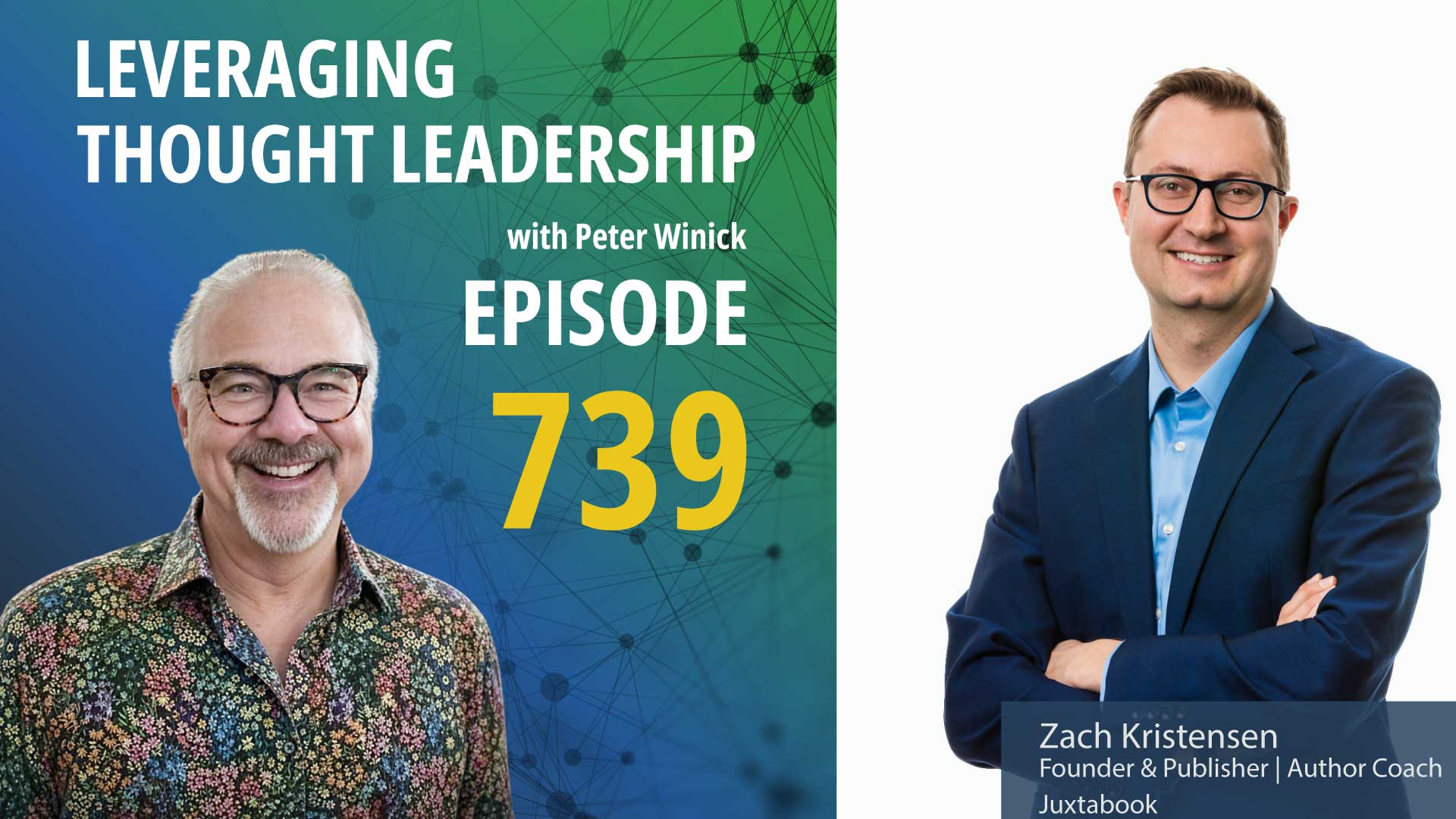



Publishing strategist Zach Kristensen on turning nonfiction books into client pipelines
A publishing strategist unpacks why a book isn’t measured in copies sold, but in the trust — and clients — it generates. The conversation covers audience psychographics, marketing timelines, and treating your book as a long-term business asset rather than a 90-day sprint.
Here’s an uncomfortable truth for anyone thinking about writing a book: the profit from the book itself is usually a rounding error. The real return shows up somewhere else entirely — and this episode, featuring publishing strategist Zach Kristensen, is about figuring out where.
Zach has spent 15 years inside the thought leadership publishing world, first at FranklinCovey helping build out titles like The 4 Disciplines of Execution, and now running his own publishing and author-coaching practice, Juxtabook. His new book, Trust Me, I’m an Author, distills what he’s learned working with over a hundred nonfiction authors, and the central idea is disarmingly simple: a book is a shortcut to trust.
Not universal trust — domain-specific trust. When someone reads your book, or even just knows you wrote one, they’ve already decided you know what you’re talking about in your area of expertise. That self-selection changes everything about how a sales conversation starts. Instead of spending four calls explaining who you are, you’re starting on third base.
But getting there is the hard part, and Zach doesn’t sugarcoat it. He lays out why “who is this book for” is a psychographic question, not a demographic one — and why skipping that step means spinning your wheels indefinitely. He also breaks down a practical marketing timeline: 80% writing / 20% promotion while you’re drafting, flipping to 20/80 as launch approaches, with a six-month runway to build your platform before the book ever hits shelves.
There’s also a candid discussion about “fit” — why author-coach relationships fail when there’s no shared willingness to collaborate, and why Zach will tell a prospective client, plainly, when he’s not the right fit. And there’s a genuinely useful reframe on ROI: instead of asking how many books you need to sell, Zach suggests asking how many new clients would make the whole thing worth it. The math gets a lot less intimidating fast.
If you’ve been circling the idea of writing a book — or you’ve written one and aren’t sure what to do next — this conversation with Zach Kristensen gives you a framework for both.
Three Key Takeaways:
- A book is a shortcut to trust, not a universal one. People don’t need to trust you generally — they need to trust your expertise in the specific domain the book covers. That narrow, earned trust is what gets a prospect to self-select into a conversation already believing in your point of view.
- Psychographics beat demographics for identifying your audience. Age, income, and geography are the “lazy” way to define a reader. The harder, more valuable work is understanding mindset — growth-oriented, risk-tolerant, ready to change — because that’s what actually predicts who will act on your book.
- A book’s ROI isn’t units sold — it’s the business it generates. Instead of chasing bestseller lists, calculate how many new clients or opportunities would make the book a success, then work backward. The profit margin on the book itself is usually negligible; the downstream business impact is the real return.
If Zach’s idea that “a book is a shortcut to trust” resonated with you, you’ll want to check out The Thought Leadership Handbook: How the Experts Elevate Their Big Ideas—And How You Can Too, by Bill Sherman, Peter Winick, and Naren Aryal. Drawing on more than 700 conversations from this very podcast, the book takes the patterns Zach describes — building trust through expertise, finding your audience, and turning ideas into influence — and expands them into a full framework, including five distinct thought leadership avatars to help you see where you fit.
It’s the natural next step after hearing Zach’s take on what it actually takes to build authority through a book. Pick up The Thought Leadership Handbook wherever books are sold, including Porchlight Books and Amplify Publishing.
Get Your Copy of The Thought Leadership Handbook at:
Amazon
Barnes & Noble
Bookshop.org
Amplify Publishing
Apple Books
Transcript
Peter Winick And welcome, welcome, welcome. This is Peter Winick. I’m the founder and CEO at Thought Leadership Leverage, and you’re joining us on the podcast today, which is Leveraging Thought Leadership. Today, my guest is Zach Kristensen, and this one’s going to be fun. Zach has an interesting career in that he’s been in publishing since 2012. He was at a little company you may have heard of called Franklin Covery, where he was a senior project manager in the thought leadership division. And he’s currently doing some really, really cool stuff in the world of books in terms of platform called justabooks.com. And he has published a book called, Trust Me, I’m an Author. And we’re gonna talk about that and his journey and all the cool stuff he’s doing and all that. So welcome aboard, Zach, how are you?
Zach Kristensen I’m excited to be on and chat with you about books or whatever we end up talking about, right?
Peter Winick Yeah, yeah. So you’ve been in this sort of thought leadership universe for a while, right? So 15 years or so. Yeah. First, I want to start with sort of what you’ve seen and from the standpoint of, well, what’s you know, on the one hand, everything’s changed. On the other hand, nothing’s changed, so what’s changed and what hasn’t what what is true regardless of what’s going on in the universe today.
Zach Kristensen Yeah, I think generally that the method of how content is delivered has rapidly changed in some ways over the past 15 years. When I started at Franklin Covey, it was still looking at going through books. And for them, that was kind of their entry point into the company. And then it was leading to all of their business solutions.
Peter Winick So wait, stay there a minute because I want to unpack that. So the point, the purpose, one of the purposes for books at Covey from a business standpoint is the entry point. It’s the first exposure that someone has at a nominal price to the ideas, the concepts, the models and the framework. But that’s not necessarily where they made the money, they made money on that. But now the next step is, okay, welcome aboard, let me show you what else we can do. I think that’s an important…
Zach Kristensen Point yeah absolutely and so yeah that was like one of the examples I would say is the four disciplines of execution book that they had published it’s been around for over ten years that was driven by their internal solution they wrote a book about it and then that even exploded that even further from what they did it sort of
Peter Winick They had an internal thing, and then they said, well, this is working on us. We’re figuring out how to execute. Let’s take that and codify it into a book.
Zach Kristensen They established a proof of concept of what works, the system, the process, then did the book and brought in all these case studies that could show this work, this is how it worked. And then they had the three main authors, one of which was Chris McChesney. He’s kind of the lead author who went out and he just speaks. He ended up, and that’s all he does now, is speak on the four disciplines of execution. And that just brings in more business for the company.
Peter Winick Cool so what? What’s different and what’s the same that so good ideas matter that’s universal right now I think the big variable today would be where does it need to sit right? Does it have to be a book doesn’t need to be in short form video? What do you you know? I mean, I love books obviously as do you but it’s not the only thing like where else can you put those ideas to? Get the exposure thing
Zach Kristensen Yeah, yeah. So it’s really thinking about I think at the center of all this is you’re thinking about your thought leadership and your IP. So the delivery methods have just become more vast. So whether it’s a book, whether it is going through the short form video, sub stack articles, and then of course, you probably want to get paid for this eventually. So then it leads to the speaking. And then right now there’s like, with AI, we all know about this, all the talk talking about it. How what role does that play? Is it support of something that you offer with your offerings? Or is it then something or is it something that you end up bringing into and licensing to somebody else?
Peter Winick On the AI piece, I think that at its simplest level, it’s just another tool. Now, it might be game changing. It might change the whole world. All that is true. But I think where it needs to start from a thought leader’s perspective is, okay, given my strategy, given my goals, given, my objectives, where can this help me get there, right? As opposed to Oh look, a shiny new thing, let me jump on the shiny new thing and have a total disregard for strategy, my target market, monetizing the content.
Zach Kristensen Yeah, absolutely. Yeah, no, that’s number one. You got to know who you’re targeting and who you are going after. So no matter the delivery method, whether it’s the book and how do all those tools work together to support maybe how someone kind of at a buffet wants to sample or and then dive deep. Maybe some people are like, oh, I love the book. I want the book that’s where I want to engage with the content. Others might be the course or the coaching or consulting side where they want that support. So having that suite of offerings can especially help, but it does start with. The idea, the key concept that’s just delivered in all those different formats and tools.
Peter Winick Got it. So now you’re at a stage in your life and your career where you’re going from sort of Not not just being the guy behind the guys and gals helping them but being more front of the house, right? You’re right. You’ve written a book you’re getting out there. So talk about that because it’s at that to me is always fascinating I can remember several conversations. I’ve had with Stephen and Mark Covey who’s done the same, right he came from the operation side ran ran his dad’s business, etc, and then into the role of a thought leader in his own right in a very, very good way. But that’s an unusual I can’t think of too many people that have done that. So now you said, you know what? I’m putting my stuff out there. I’m going to write a book. And I love the concept of trust me. I’m an author. One of the things that I was reading through it again the last couple of days is that straight out to me is a book is a shortcut to trust.
Zach Kristensen Yeah And that kind of came out of writing it. Yeah, so my book I was trying to think there’s so many books out there on how to be an author what an author needs and so I really wanted To go a level deeper and think well, what is it that generally and I speak to non-fiction authors primary. Yes What is it? That all of them need? What is that you want as you’re going through this and it was led back to trust and I do believe that was influenced by working with Stephen M. R. Covey on his book, Trust and Inspire, and just knowing him, and he’s a great. A mentor and individual that I’ve had the pleasure of working with. But it really, I was like, oh, well, what people really want is for someone to trust them. Like when you’re up there speaking and talking to someone, they’re not necessarily asking, do I like this person? They’re like, can I trust this person and for
Peter Winick Well, and then the trust is I think difference between maybe Stephen MR stuff is I’m I only need to trust you through the lens of your domain expertise. Yeah, absolutely. So if you’re coming out there, you know, in your case, trust me, I’m an author. I want to learn from you like why I should think about being an author, what I know, what I don’t know. I might not trust you for record restaurant recommendation. I might not trust you for fashion advice like whatever it doesn’t It’s not universal, but really what you’re saying is in this world where I plant my flag, I am I have expertise and you should trust me in this space. You’re not going to say that out loud. And here’s why I’ve literally written the book. I’ve worked with a zillion people like check, check, check, check, check.
Zach Kristensen Right is that Does that make sense? That does make sense. And so I would relate that to when you have a book, even if no one’s read it yet, by just saying, oh yeah, I’m a published author, I have a books, you have already created some level of trust in that domain that you speak of in that expertise. Because we assume that if someone takes the time to write a book to go through the process that they have some knowledge and expertise that’s valuable through that. And that’s where kind of the book is a shortcut to trust. Now, to increase that trust… Hopefully you get the person buys the book, they read it, and then they’re like, oh yeah, this person definitely knows what they’re talking about. I need their help. I want their help, and that’s where it leads to the increased business.
Peter Winick Yep, so You and I have similar mindsets on lots of things because we’ve had several conversations sort of like like this cool mind meld so you know, I’m my books coming out a couple days and I am I think realistic in that realizing ninety nine point nine nine percent of the universe Doesn’t care about my book and that’s okay, right? So it’s it’s a bit niche I would imagine you have the same perspective as well. You’re looking I would guess aspiring authors, an author looking to write their second book, etc. You’re not looking to have this as a general leadership or management book, is that right?
Zach Kristensen Yeah, that’s true. And so for me, it is establishing the proof like, hey, I can do this too. I’ve worked with authors over 10 years, and that was at the point where I said, you know, I need to do this myself. So I found an idea I was passionate about. And yeah, I would love for people to read it. I would look for it to do those things, but it’s not the primary reason. And since the book has launched, it has opened those doors for me to close some new clients and have them impacted by the book and that’s ultimately what I want it to do. So that people, when they work with me, can understand, like, yeah, I can trust Zach to lead me in the best way that’s gonna be matched to my goals and where I want to go.
Peter Winick So one of the things I think happens with books like that is there’s a self-selection piece. So when someone reaches out to you that’s read the book or skimmed the book, or is aware of it, one, they know where you stand, right? They know how you think, not 100%, but they’re like, oh, I get what this guy’s about. I get where he’s coming from, etc. Some relationship that’s, yeah. Yeah, and they feel like they have a rapport with you, whatever. So when you start talking to them about how you can support them, how you can help them, whatever, you’re kind of starting on third base versus, you know, an interaction might need four or five calls for you to explain to them how the publishing industry works and how this happens and the cost and blah, blah, but like they’ve read the books. They come to you self-selecting. Most people don’t choose to reach out to a thought leader if they violently disagree with everything they stand for, right? Like it doesn’t make any sense. No, no, it’s like, OK, if you think, if you think I’m an idiot, if You think? Everything I say is wrong, great. You just saved me a bunch of time. I’m not for you, yeah. Yeah, no, and I think people don’t appreciate that because everybody’s got a certain style or nuance or whatever, and not everyone is for everyone.
Zach Kristensen That’s a good thing. When I meet with anybody, I say, hey, I’m really big on fit. Fit that you want to work with me and fit that I want to work with you. And some people I’ve told, hey I love your idea. I like you, but I’m not the best fit for your book. Just because it’s not my area of expertise. For example, I had a woman who came to me who had written, she’s a psychologist, to done therapy for a long time and. Wrote this book and it was more like I would say like a cross between a fiction and a business parable. Okay. And the way that she wrote it, it just wasn’t a fit for me. So I referred her to someone else, her books coming out this fall, and she is thrilled with how it turned out. And I just had that feeling at the time was like, I’m not going to be able to help her where she wants to go. So let’s stay on the fit thing because
Peter Winick I think fit is interesting from the standpoint. I look at fit across really two dimensions, you know, competence, you know. Is this a client that I can help, that I could support, whatever, because there’s lots of things we don’t do, right? And if it’s not, I’m happy to say then, hey, I’m just not your guy. If I have someone to connect them, well, I’d be happy to do that. So that’s the competence piece. And I think it’s great to be honest about that, because I think about that as leasing a problem. If you take on someone that’s outside of your zone of competence, guess what? 30 days, 60 days, you’re going to be frustrated, they’re going to be disappointed, who needs that? Life’s too short. But the second level of fit is really, I don’t know, style, personality, whatever, right? So I’ve had clients come to me and we get to talk and they’re like, well, I think, you know, everything that we’re advising and suggesting from our experience, they are disagreeing with. And it’s like, listen, you can disagree with anything you want. But, like, Why did you hire us to win a debate? Because this isn’t fun for me, it’s a waste of your money and my time, right? So, do you think about it similarly or is it really more on the top? That’s a good question.
Zach Kristensen Very similar. One, yeah, is can what we provide really help them? And then me and my co-founder, we have a bit of an unwritten rule where we said we don’t work with author divas. And it’s those who just come in and think, honestly, they’re God’s gift to the world. I’ve done this. I’ve been successful in this one area. So that means it’s going to work for everyone. And it just not collaborative because a book, I say, is a team sport. And you’ve got to have collaboration with me, the author, and the other team you bring in. And so if there’s someone that’s not willing to have that mindset, it’s just not going to work for us. For others, I have friends and colleagues that work with those people all day and they’re a great fit for them, but it’s not, it’s for me. It’s not how I want to spend my time.
Peter Winick Yeah, I do what I call the Thursday at three o’clock test, which is, OK, if we were to work together and it’s on my calendar next Thursday at 3 o’ clock that I have a call with this person, am I going to cringe or look forward to that because I love to be energized. Yeah. Are you energized or are you just like, oh, boy.
Zach Kristensen Yeah.
Peter Winick Great, I’m gonna reschedule this for a root canal that I don’t need, because that would be perfect. Ha ha!
Zach Kristensen Yeah, that’s telling you something if you want a root canal versus working with the client exactly
Peter Winick So if someone’s out there, and I know that they are, that’s thinking about, well, maybe I should write a book, what’s this about, you know, all that. If you ever wondered how strong ideas become visible, trusted, and scalable, that’s the work behind the Thought Leadership Handbook. Bill Sherman, Nara Narell, and I wrote it for experts who are ready to move from insight to real impact. Learn more at ThoughtLeadershipHandbook.com and order it today at Amazon, B&N, Bookshop, or Amplify. Talk a little bit about the unknown, unknown, because one of the things that I’ve experienced now that I’m on the other side of it is, okay, now I get why it takes longer than you think. You can estimate as best you can. And I think I told you, it’s the only two things I failed miserably at in my life in terms of scoping and all that is a major house renovation. Well, that was a joke, right? And how long will it take to write this book? And totally misjudged both. So how do you, what would you be talking to authors about now, like set some expectations or think about this or whatever.
Zach Kristensen Yeah. So I would say depending on where they want to go, there’s a variety of topics. So let’s start with the book. The book, you need to decide, are you going to write it or someone else? Yeah. And figure that out. Because if you enjoy writing, great, but it’s going to take longer or do you need help with a strong editor, a strong ghost writer? So that’s the conversation I want to have for authors to think about. Next is honestly talking about what are your expectations for the sales is one those that I have, and I say. You can have the best book, but if you don’t have a way to facilitate the sales, the platform, if you’re speaking, or if you have a social following or an email list, you need to understand your sales are going to come in different ways. It’s not going to launch and also be a best seller. If you don’t have a platform that you’re going to, and I say best seller, not Amazon best seller but like a book that’s going to grow over time and become one that people are going want to recommend to everyone else. Yeah, I think I always talk about audience. I hound every person I meet with about audience, you gotta know who you’re speaking to, you gotta who the ideal person is. I care that you want it to be for everyone and it could be potentially, but you gotta have it for someone when you’re writing, when you are focusing on it or else you’re gonna struggle, you’re going to be frustrated, you’re not going to able to progress if you don’t know who you’re writing to and why you’re riding it for that person.
Peter Winick And that seems obvious, but it’s really difficult. It is. And I find that there’s two ways I think about that as well. Some things, there’s more than two ways I think of about something, but there’s a demographic, age, income level, geography, whatever, and that’s sort of lazy marketing, I think more psychographically.
Zach Kristensen Absolutely. And that’s where I’d love to go too.
Peter Winick Yeah, which is harder because you can’t just go to LinkedIn and say, give me a list of everyone that’s got a growth mindset, you know, thinking about being an author, give me the list of someone with a that is open minded or has a risk caught like like, whatever. But if you’re not willing to put in the reps to figure that stuff out, you know, someone that makes this amount of money that lives in the Midwest with a bachelor’s degree or something, you know, that’s how you sell laundry detergent. Right, Frank? Yeah.
Zach Kristensen Exactly. Well, and by going with the psychographics, you’re digging deeper. And it’s not just going to be for your book, it’s going to be if you’re messaging, it can be for your website copy, it is going to be how you talk to your clients. And, and it’s by separating out what problems they’re experiencing and challenges that they know about versus what you know about and how to help them because they may not know the solution, which is good for you because that’s why you’re there to help them. But you have to speak to them where they’re at and what the challenges are. And until you get into psychographics. Like you said, that’s really tough to discover. And you gotta spend your whales forever and not be able to gain traction in your business until you figure that out.
Peter Winick Now comes the fun part, right? So as difficult as it is to write the book, define your market, get it right, all those other things, that sort of hold my beer in easy compared to the next phase, which is actually getting the book out into the marketplace. So it’s difficult as, and I’m not discounting as difficult as that is, but the other side of this is really, really, A, it’s probably not what most people signed up for, it’s not what they enjoy, It’s not what they’re passionate about whatever But talk about sort of the importance of marketing, the things that you can do and not from a hack standpoint, because I don’t believe in the here’s the chase the algorithm thing, but like, you know, you’re an evangelist for your book, period, right? So talk about cool, creative, interesting things you can to from a marketing perspective. Yeah.
Zach Kristensen Yeah. So when someone asks me, Zach, when should I start marketing the book? I say right away. I say, right now. But people immediately think, Oh, I got to be like promoting and talking about it all the time. And so if they’re writing their book, I say let’s use the 80 20 rule 80% should be focused on writing. Yeah, and 20% should be on promoting your book. Now promotion can be as simple as today, I’m working on my book, and I struggled with this, right? Yeah, had to So you’re starting to see that you’re working on a book. As you get closer to launch, that flips to being 20% getting the book done and 80% to marketing. And to give a realistic timeframe, I would say get six months beforehand, your book launches, get your marketing plan set during those first three months of the six. Start building out everything you need, like your assets, making sure your website’s ready, who are you targeting, your audiences. And then three months before, that’s heavy execution. That’s reaching out, that doing the marketing, the promotion to each of the audiences that you’ve segmented out with them. And I think many authors get to a point where like, oh, my book’s done. I want to get it out there and then now it’s over and then you’re also in like two months you’re scrambling like my book comes out in a month, what marketing do I do? And that’s where most fall flat.
Peter Winick The other thing I think is that it’s a team sport from the standpoint of a lot of people think, well, I’ll hire the PR firm and rainbows and unicorn and magic and I’ll be on the today show and I get the jacket with the felt patches and a pipe and that’s what an author does, right? Yeah. I found, and I’d love to get your take on it, you know, it’s really, if you let people know early on, here’s what I’m doing, here is what I am struggling with and you start to tell the story, then as you get closer, you reach into your tribe in your community and say, hey. Help me out here things coming out soon any ideas any thoughts like I’ve been asking tons and tons of people you’ve done this you know what did you learn what if you were in my shoes what we did do differently and they’re making introductions to podcasts and you know all those different things people want to help you because even though I don’t view books as competitor right like that’s a stupid way to look at the world so everybody else that’s out there particularly in your space in your genre right is a colleague not necessarily a competitor focus. It’s not like Coke or Pepsi. I’m going to have one or the other for lunch. Like, guess what? I buy lots of books. How do you think about sort of this collaboration and asking and sharing and all that? Could be a little awkward for some.
Zach Kristensen Yeah, and I I think it’s thinking about kind of the awkward pieces. Many authors say, I don’t wanna be a me monster. And I said, okay, well, have your idea be the me monster? Yeah. That’s really where the value’s coming in is talk about your idea, talk about what’s gonna change people. And then I love how you’re talking about reaching out, reach out, segment your list or your contacts and say, which are the ones that could help me give me ideas? What are the one that I know would buy the book and which ones can I just say, hey, here’s my book, here is who it’s for. Do you, did you benefit from this or do you know anyone who could? And then I think the one thing is you got to give it time. When I looked at my book in just over in June, I’m still getting people that I reached out to saying, Hey, sorry, I missed this. How can I support you? And that was probably like almost 45 days after I messaged them.
Peter Winick Yeah, stay there because that’s a critical point. I think the industry has done a huge disservice to authors where because of their cycles there’s this is a spring release and this is a fall release and blah blah blah you know that the other things like oh I got 90 days to get all the juice out of this lemon or I’m screwed and I’m like no you know no pun intended the book has a shelf life and for most of us unless you’re writing about an election cycle or something topical or whatever. That shelf life is five plus years. So yeah, you want to sort of give birth to it and launch it, but it’s never over, right? You should consistently, you know, maybe you’re gonna front load doing a bunch of podcasts the first 90 days or something, but you should constantly be thinking of yourself as the shepherd of the book or the evangelist of the book and all those things. Because to me, when I get a good book in my hand, I’m the only dork that opens up and looks to the pub date and who the publisher is, cause that’s kind of what I do. But most people, it’s like, Yeah and you probably do as well so there’s you know the dorks anonymous will start a club whatever but most people like hey this is cool this landed on my desk or in my Kindle I’m going to read this this this speaks to me today based on where I am right like your book somebody might not care about it today that would care deeply about it in 18 months.
Zach Kristensen Yeah, and my goal is to get it out to as many people as I can or at least tell people even if they’re not my target audience So hopefully if someone says hey, I’m thinking of writing a book. They’re like, hey, I know who you need to talk to yeah and they have me be the first one that comes to mind as much as possible and So that that generates that long-term and it can take a walk and take a few months Yeah people that have that one contact point with you and then six months down the road. They like alright I’m ready to reach out now.
Peter Winick Yeah and I think the last point I want to make which is to me an obvious one but it’s not always so obvious is the ROI on a book unlike any other product business or service that I know is not number of units sold times some profit per unit it’s the aggregate that you know that it adds to your business right and usually that like book profit per se if there is even is any is sort of the rounding error so I would be telling people think about well based on what you do and who you are and whatever. Many net new clients as an example would I need over 12 months for this to be an amazing success? Oh, I need three. Well, three is not a big number, right? Okay. Well how many, you know, does that mean I need to sell 300 books, 3,000, 30,000? I don’t know. We’ll figure it out.
Zach Kristensen Well and who you’re targeting because you could send out a hundred books to people who don’t care. And so that’s why you need to know like who is it that you’re sending them out to or connecting with on it. Yep.
Peter Winick Yep. Well, this has been great. I appreciate your time and love the way you think is you’re kind of the brother from another mother, right? In terms of. Yeah. So thank you, Jack. I wish you the best with trust me, I’m an author. So yeah, I would I would also say because it’s better when it comes from someone else. You should trust that he knows what he’s doing. He knows what he’s talking about. And he’s a good guy and a smart guy. Well, thanks, Peter.
Peter Winick To learn more about Thought Leadership Leverage, please visit our website at ThoughtLeadershipLeverage.com. To reach me directly, feel free to email me at peter at Thought Leadership leverage.com and please subscribe to Leveraging Thought Leadership on iTunes or your favorite podcast app to get your weekly episode automatically.
