Four practical frameworks to sharpen your message, market, and metrics This Best of 2025 compilation…
Why Pressure—not Power—Breaks Leaders | Sabina Nawaz
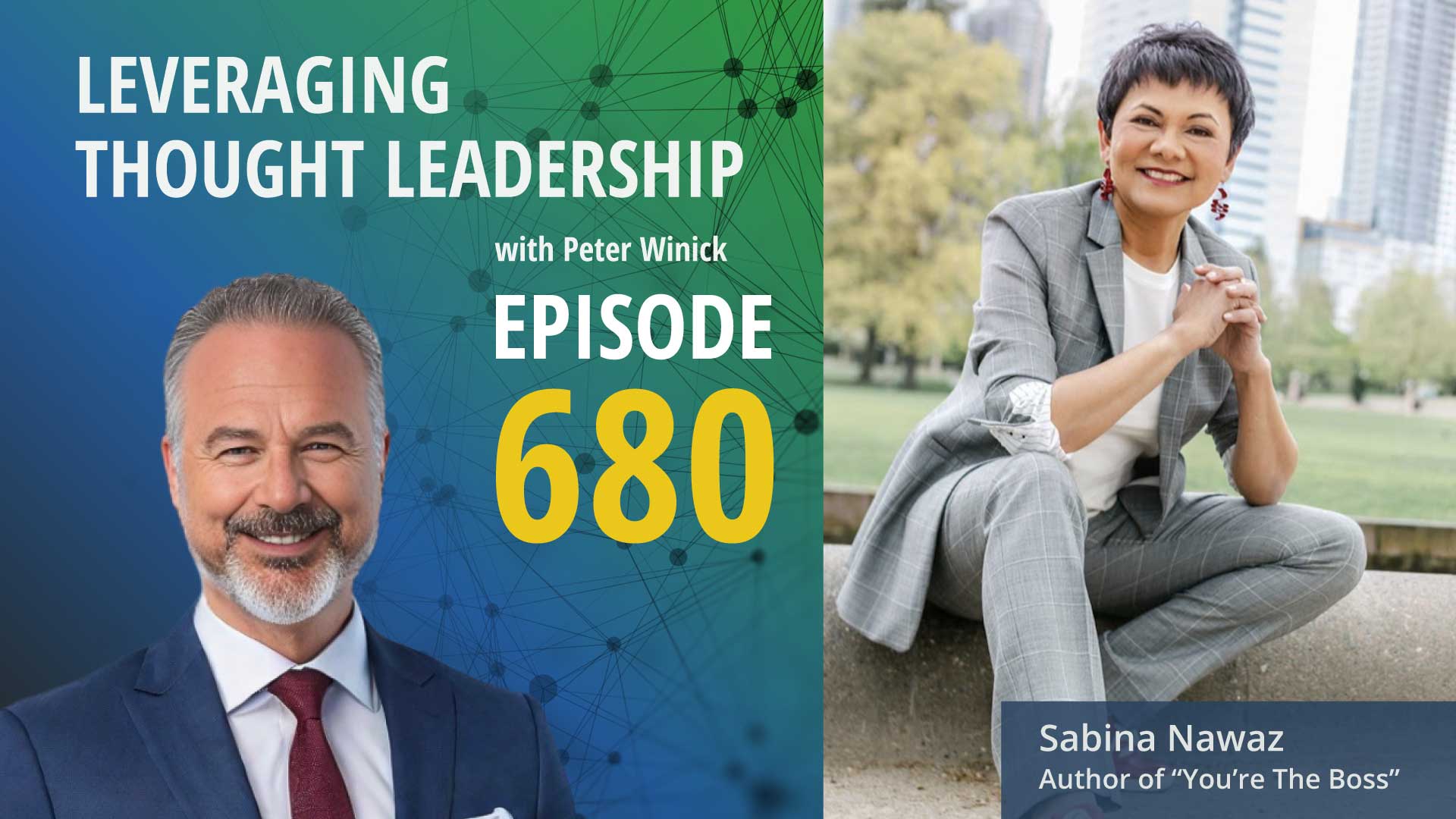



The Hidden Cost of Corporate Pressure—and How Leaders Can Rise Above It
This episode explores how pressure—not power—shapes leadership behavior and can erode a manager’s humanity if left unchecked. It examines the true ROI of senior-level coaching, including how value, scope, and pricing align to drive meaningful organizational impact. The conversation also digs into what it really takes to publish and promote a thought leadership book ethically, effectively, and without shortcuts.
What happens when pressure—not power—shapes the way leaders show up?
That’s the question at the heart of this conversation with executive advisor, keynote speaker, and bestselling author Sabina Nawaz.
Sabina’s thought leadership centers on a bold idea: pressure can squeeze the humanity out of even the best leaders. And in today’s high-velocity business environment, every manager—from first-line supervisors to CEOs—is at risk. Her work helps leaders reclaim that humanity, especially when the stakes are highest.
In this episode, Sabina shares the research behind her book “You’re the Boss: Become the Manager You Want to Be (and Others Need)”, built on 12,000 pages of interviews with employees about their managers. Her frameworks reveal the real drivers of effective leadership. Not charisma. Not authority. But the ability to stay grounded, present, and self-aware when demands are relentless.
Sabina also unpacks how senior-level coaching delivers exponential ROI. She explains why small behavioral shifts at the C-suite ripple through organizations, and why understanding value—not hours—is the key to pricing high-impact advisory work. Her insights on scope, pricing, and client alignment are a masterclass for anyone growing a thought leadership business.
We also explore the business of books. Sabina offers a candid look at what it truly takes to publish successfully with a traditional publisher—and why marketing, positioning, and community matter more than manuscripts. Her perspective on ethical promotion, generosity within the thought leadership ecosystem, and crafting high-quality, specific asks is practical and refreshing.
Finally, Sabina introduces one of her signature practices: “the blank space”—two intentional hours each week to step back from pressure, reset, and let insight emerge. It’s a powerful mindset shift that every leader needs.
This episode is packed with actionable wisdom for executives, coaches, and thought leaders ready to lead with clarity, courage, and humanity.
Three Key Takeaways
- Pressure changes leaders more than power does, and without intentional practices—like creating “blank space”—managers risk losing their humanity and effectiveness.
- High-impact coaching is valued by the long-term ripple effects it creates, making thoughtful pricing, scope alignment, and articulating ROI essential for senior-level advisory work.
- Writing a book is only the first step—successful thought leadership publishing requires strategic positioning, ethical promotion, and the courage to make focused, specific asks of your network.
If you found this episode insightful, you won’t want to miss our conversation with Lance Tanaka. Both episodes unpack what really happens when senior leaders step into high-pressure roles, rethink how they lead, and learn to create impact through clarity, presence, and intentional development. Lance takes those themes even further—diving into how executives transition into high-value coaching, define their worth, and build influence that truly sticks.
If Sabina’s insights on pressure, leadership behavior, and the real value of coaching resonated with you, Lance’s episode will deepen your understanding and give you even more actionable ideas to elevate your own leadership practice.
Listen next: The Lance Tanaka Episode — and continue your growth journey.
Transcript
Peter Winick And welcome, welcome, welcome. This is Peter Winick. I’m the founder and CEO at Thought Leadership Leverage. And you’re joining us on the podcast, which is Leveraging Thought Leadership. And this is one of our special LinkedIn Live editions. So I want to welcome my guest today, Sabina Nawaz. She is the author of You’re the Boss. She is an author. She’s a speaker. She’s an advisor. And she’s had an amazing corporate career prior to that on the HR side of the house. So welcome aboard today, Sabina. How are you?
Sabina Nawaz Thank you, Peter. Doing great.
Peter Winick So tell me a little bit on how we got here or how you got here, because usually not that there’s a usual, but someone having the sort of level and the stellar career that you did on the HR side doesn’t just wake up one day and say, you know, I’m gonna go do my own thing. Right. So how did how did that come to pass?
Sabina Nawaz It starts well before the HR side of my career, Peter, because I started my first job as an engineer with degrees in computer science and electronics and computer systems engineering. And it was a wake up kind of moment for both big transitions in my career. The first one, I was on sabbatical. The Microsoft offers when you meet certain conditions. Sleeping a lot because I was burned out, tired, sitting on the couch eating bonbons. And I had this moment, this one moment of crystal clarity, sitting on this white leather couch in my living room. And that moment was realizing that it was no longer a matter of if, but when that I would become a corporate vice president, which was sort of the be all end-all of my career dreams.
Peter Winick That’s the rash frame, right?
Sabina Nawaz Absolutely. I was I was really gunning for it and hoping to get there someday. And now I think, oh, it’s right in front of my nose. Well, right in front of my nose somewhere in the next one to five years. Sure. Boom, suddenly it’s like the most anticlimactic moment of my life.
Peter Winick Yeah.
Sabina Nawaz Because I’m like, well, if I know the formula, if I know how to get there, why am I gonna spend the next five years of my life trying to get there? I realized that I just needed to prove that to myself that I could make it, not anybody else. And then I go shoot. What do I do with my life? Because a lot of my life I had spent chasing this sort of title and becoming as opposed to being. And as soon as I sat down to be, to do nothing, to have some quiet space, I’m thinking, okay. So what do I do well? I get feedback that I’m a good manager. Let’s work on the people side. And that’s how I transitioned and ran Microsoft’s executive development and management development and worked with Bill and Steve for six years, nearly doing succession planning and running the executive retreats and so on. I thought I was the luckiest person alive, couldn’t believe I got paid to do that work. And as Peter, so why did I then suddenly decide to leave this wonderful job? I was seven months pregnant with my second boy. My first boy was two years old. My husband stayed home, so I had the immense privilege of having a stay at home spouse. But the question was, what would I regret ten, fifteen years down the road more? That I didn’t have even more time working with Bill and Steve, or that I didn’t spend enough time with my kids. And so I decided to take the leap. I had never been outside the corporate world. It was scary. But you know what? The moment I did leave. I have never looked back.
Peter Winick So stay there a minute because that’s an incredibly Even though you have the realization and and the the sort of epiphany, it’s still a courageous thing to leave the comfort of a job at that level and the financial security and and and all the thing that you stock and all the things that that come with that. Then you go to the other side. And I think what happens a lot when high level corporate folks go out on their own, there’s a lot of things they don’t know they don’t know. Right. So they know how to do the stuff, right? So the development, the coaching, the things that you do. That wasn’t, I would imagine, the challenge. But how do you find clients? How do you set price? How do you manage accounts receivable? What were the challenges you you had from the business side of the house when you first started out?
Sabina Nawaz Well, great question. For the most part, it was great. The biggest challenge, business development, finding clients, was not a challenge for me. I had a great network at Microsoft and outside. And then whenever somebody would leave Microsoft, I would reach out to the executive and say, Hey, remember me, I’m still open for business. And then they would hire in their new companies because my goal was to expand beyond the world that I knew. So finding clients was not an issue and very, very fortunate. The biggest hurdle I faced was understanding pricing and how to value my time, my worth to figure out what is the value, what is the net value to the client and how do I how do I how do I price accordingly? I discovered fairly early on that I was asking for too little money.
Peter Winick I also don’t know not unusual, right? So if you stay there a minute, when you look at the let’s take coaching as an example, there are coaches and there are coaches, right? There are coaches that could charge, you know, hundreds of thousands of dollars a year to work with clients. And then there are coaches that can, you know, charge very, very, very small percentages of that. And the justification, right, of the value that you create, usually it’s more of a function of the impact that the client could have, right? And and their span of control. And and you know, you have a small improvement on a on an EVP has more value than an improvement on a newly minted frontline manager, is an example.
Sabina Nawaz For sure. For sure. Exactly right. Exactly right, Peter. And so just learning what is that impact? What is the value of this? The fact that we have six months of coaching and then this person is able to tap into that for the next six years, not just in that job, but in the next two jobs that they’ve gotten promoted to, is a is a different equation. So that was that was the challenge to understand that
Peter Winick And when you have the courage again to say, you know what, I’m gonna charge what I’m worth. Because a lot of folks when they come out, whether they’re on the keynote side or coaching side or the advisory side, I hear things like, I had no problem getting business. And then I say, well, that’s actually kind of a problem, right? Because it’s one thing to get the demand, but then to engage in conversations. And if you’re not having any pushback or challenges or questions around price 95% of the time, you’re probably not charging enough. Right. And it’s okay pushback and all that. So once you started to realize your value and charge accordingly, did you get more pushback? Was it harder? Was it easier? How did that play?
Sabina Nawaz There were times I got pushed back and that’s fine. And and that fell into a couple of different categories. One, it was so far off that they were not looking for somebody like me. And I was very happy to connect them with other folks in my network who would meet them where they are and able to deliver great value for what they were looking for at a price point that they could. And I was very happy and completely fine walking away from that work. The other category was where we sat down and had a conversation. In your classic scope and cost. Made some decisions. Okay, you have this much money, I’m asking for this much money, but we can negotiate around the scope. What you get for less money. And so thinking about ways.
Peter Winick Minute because although that seems totally rational and logical and almost intuitive and simple, too many people respond when they get pushback on price. They say my price is here and the client says it’s there. Well, we’ll meet them in the middle. But I love the idea, and this is what I advocate as well to say to the client, Well, what are you willing to give up? Right. So I can’t give you this, but for that budget, I can accommodate that. And let me explain what the trade offs are, not just financially, but relative to the expectations on the outcomes. Absolutely. And then and then if they’re okay with that, that’s great. But it the first reaction shouldn’t just be, oh, gee, they’ll drop my price. Interesting. What are the things that you looked for in a client relationship to be able to justify the value that you’re creating? ‘Cause they might not even know like if they haven’t hired a coach before at a senior level, they need to justify to internal folks, you know, on the finance side, whatever, while they’re making, why they’re making such a significant investment. How do you help them tell that story of the impact, the ROI and those things?
Sabina Nawaz I rarely run into that problem. Now say I work with people at the C suite level or at the CEO level and they’re used to investing heavily in professional development. They know that there are very few people who can work at that level and therefore what the value of that is. So I don’t usually run into a lot of justifications.
Peter Winick Excellent. So I wanna segue into the book. So your book came out a couple months ago. You’re the boss. Tell me the story of why you chose to write that, what you thought the experience would be like and what it has been. Yeah. Good, bad or ugly.
Sabina Nawaz Well, the why starts with a very for a very personal reason. And then it’s backed up by 12,000 pages of data where I interviewed a thousand people on what they experienced working for their managers and created the themes that form the skeleton of the book, the backbone of the book. But the personal story is that I was a lousy manager at Microsoft. That wasn’t always the case. At first, I managed teams that built software. People told me I was the best manager that ever had. I coached them. I cared about them. Those were great. But then everything changed. I was running Microsoft’s management development. When I the first day back from parental leave, as I’m getting ready, my assistant calls me frantic. Where are you? Steve expects you in 30 minutes. That would be Steve Baumer, the CEO of Microsoft. She’s reading the memo I’m supposed to discuss with him as I’m hitting warp speed on the freeway. Pace and tone for work. So I’m rushing to meet deadlines. I don’t have time to explain things in detail, let alone repeat them. I’m micromanaging. I’m turning all hands on the keyboard looking side. People are and the worst part is I’m thinking, I’m killing this. I’m being so efficient. Now of course with no sleep, no peace and no patience with an infant at home, I am not doing any of that. Sure. My colleague stops by and tells me Zach is crying in his office because of something you said. And that’s when my gut falls to my floor and I I just my whole body washes over with shame and I think, How did I morph? From being caring and compassionate? This, somebody people apparently fear and really don’t like. And of course, after apologizing to Zach and watching his eyes brim with tears, I think this is what I want. I want to treat people with humanity. And that’s why, Peter, I’ve written the book because I have walked in those shoes. There are no good or bad managers. They’re all within us. It’s not power that corrupts us, it’s pressure. And that pressure didn’t just squeeze out my time, it squeezed out my humanity, and it squeezes out the humanity of every manager who’s under pressure and who here today is not under tremendous amounts of pressure. So I have that compassion and empathy, and I want to show them a different way to harness that pressure when they’re in positions of power.
Peter Winick Right, because the pressure is not going to go away. Right. You couldn’t have told your assistant, say, Call Steve and tell him I’ll be an hour late to go grab a cup of coffee and wait in the office. That’s probably or can we do this tomorrow? I’m a little frenetic today, right? It’s right. That’s just not the way it’s done, right? At a certain level.
Peter Winick If you’re enjoying this episode of Leveraging Thought Leadership, please make sure to subscribe. If you’d like to help spread the word about our podcast, please leave a five-star review at ratethispodcast.com/LTL and share it with your friends. We’re available on Apple Podcasts and on all major listening apps, as well as at Thought Leadership Leverage.com/podcast.
Peter Winick So then you choose to write the book. What was the process by which you chose to publish with a traditional publisher versus some of the other options and alternatives that are available today?
Sabina Nawaz Initially, I thought the book would be a calling card that I could just say I have a book and then it gives me, opens up more lines of business or maybe a greater set of fees. Very soon into the process, when I’m sitting on this pile of 12,000 pages of data, I realize this is way more than a calling card. I am going to be pouring my life’s work into this book. And I want to give this as big a platform as possible. That’s where I decided to go with an agent, with a traditional publisher, the whole sort of traditional route for the book to bring it to life.
Peter Winick Describe what you thought the experience would be like and what it was actually like and where there’s some differences…And what were some of the surprises or the differences?
Sabina Nawaz I’m sure you’ve heard this all, Peter, as you work with so many different thought leaders. Of course, I had heard that writing a book is a difficult process. No new news there. What I hadn’t realized was that writing and submitting the manuscript of the book is way easier than what comes afterward, which is positioning the book, marketing the book, bringing the message to wider and wider audiences, getting on podcasts, gathering Amazon reviews, and so on. And doing those in ethical ways that I feel are right for me, that work for who I am and my set of values. It’s so tempting to do things, to make shortcuts, to do things that Don’t sit right with me, but to do it in the right place.
Peter Winick Yeah, so stay there a second. I think I think that you’re right, and I agree with you a thousand percent. Right. So I think most people think that the process of writing the book, getting your ideas together, the research, et cetera, is the hard part. And it’s not easy by any stretch. I don’t want to make it seem like you, you know, it’s particularly a good book, particularly with the caliber of research that you’ve done. You know, this wasn’t just a storytelling book or something like that. But then the real work begins, right? Because getting a book out there and it’s and it’s not a matter of how many units am I going to sell, but it’s really about the impact. It’s really about elevating the brand. It’s really about all those things. There’s a lot of work, right? You know, a lot of podcasts on a lot of things. And I love what you said about not taking the shortcuts. And I think a lot of people don’t realize until these things are offered to you that you get solicited by everybody from all over the world to say, I can bl dot dot dot, make you an Amazon bestseller, sell thousands of books, sell, you know. And then you say, Great, that’s really intriguing. Of course I’d want to do that. How does that work? And what does that cost? And you look at some of these things, and I you know, I think you probably get the reaction, ooh, that that’s not who I am, right? Like that’s I don’t want to do it that way. Like I I want to do it properly and organically and not buy my way onto a list or something.
Sabina Nawaz Exactly, exactly. It’s so it’s and that leads to my second surprise. And that surprise is the generosity of people. Yes. It’s the absolute No ties, no expectations and return generosity. Now I am somebody who’s a huge believer in reciprocity. I like to shove in the playing field, so to speak. I actually am not hundred percent comfortable asking for help. But one of the biggest transformations I’ve made for myself personally, this book, this process has changed me in becoming more comfortable and trusting that if I ask for help, it will arrive. And even if it doesn’t arrive, that’s okay.
Peter Winick Right. And that’s a place where a lot of people feel uncomfortable, awkward, et cetera. So there’s a couple of mindsets that people ship to say, it’s not about me. I really believe in this book, and I need to do what I need to do to get the book out there because it’ll help people. So it’s not about, you know, you being the beneficiary per se. When you say people were really helpful, I want to drill down on that a little bit. So one reaction I have to that is I think a lot of people are surprised how supportive and helpful sort of the community of thought leaders are through others and such advice, endorsements of the book, you know, recommendations, introductions to podcasts. It’s a very it’s a lonely business on some level, but it’s a really supportive one. And then the other reaction I had to that, and I’d like for you to comment on both, is it’s one thing to put out to your network, hey, I’m writing a book. People say, Great, good luck, thumbs up, like whatever. But to be specific about what you’re asking of whom by when increases the probability of that happening. So saying to a friend, I know that you know so and so or whatever. So answer sort of play with both of those from me, the thought leader community and being specific in the asks that you make of certain people in service of promoting the book.
Sabina Nawaz Yes, so the thought leader community was fortunate enough to receive endorsements for the book from many, many thought leaders Adam Grant, Kim Scott, Marshall Old Smith, to name just a few, Amy Edmondson. Molly West Duffy, Liz Fossling, I mean, I can go on and on. And some of these people I knew, and some of these people were complete strangers. Okay. An aspiring author right now said, hi, what are the tips and tricks to getting Adam Grant to write a testimonial for your book? And I said, I don’t know. I simply emailed him out of the blue, and he responded right away with an FAQ. Here’s the process. And if you don’t hear from me by your deadline, I’m not gonna write one. And I heard from him a few days before the deadline with a testimonial. So phenomenal. This asking not just of people you know, but complete strangers, Kim Scott, she and I met through a decline. Yeah. And she set aside a dedicated session with me to brainstorm a two by two matrix for the book. Because her radical candor matrix is so beautiful. And she sent me a bunch of sketches with ideas. And oh, what about this? Oh, you know, I started noodling about this even more. So clearly the ideas were capturing people, but more than that, they were willing to generously give of their time. So that’s on the thought leader side. And as you see, a lot of introductions, our conversation today is happening because of an introduction. And a lot of those introductions, my colleague and fellow author Jonathan Stutz, for example, said when he is the person who connected us, and when he found out I was writing a book, he contacted me. He sent me an entire spreadsheet of here’s all the things you need to do at T minus one month, T minus one week. Here’s the list of podcasts I’ve been on. Tell me which ones want me to connect you to, and so on. So incredible generation. I love it. Now it’s the question of how do you ask, how do you make asks? The quality of help you receive is directly proportional to the quality of your ask. Right. So being really, really clear about what do you want and scoping it in not give me the world, but give me this. For example, I was at dinner at a friend’s place who had told me that he had read the book and found it incredibly helpful for his job. And I said, Hey Todd, if you can, would you be willing to put up an Amazon review? It doesn’t have to be three paragraphs long or an exhaustive book report. It could simply be two sentences about the single thing that most stood out. So scope it right for them. Tell them the impact of that. Having an Amazon review not just means a lot to me, it helps with the book being viewed and recommended by Amazon to broader sets of people. And I think this message needs to go.
Peter Winick Well, so some of it is just that is having also as an author having an understanding of why you’re asking for what. Right. So the Amazon reviews are important. Like you said, people might not know your name as an author because you hadn’t published before. So they’re looking for a comfort. They’re looking for them to manage the risk, not of spending twenty, thirty bucks on a book, but like, am I gonna waste six hours Of my life, right? So having people like Adam Grant say great things is helpful. But then going to the Amazon page and if nobody reviewed it, that’s a sort of a signal or re or a red flag or or whatever. So I like so I and I I love the because I agree as well with the the the high level of specificity when you reach out to someone and just don’t just say I’m writing a book, but say, Hey, I know that you’ve written books and what I’m looking for is to learn more about how to get on the right podcast or how to get testimonials or whatever it is. And I need to know that by, you know, some date in time, 30, 45 days out, whatever whatever that is, would you be willing to do that? And if you can make it specific and relevant to that person, right? And you know, reaching out to someone to say, Hey, could you buy a thousand books? That’s a little annoying. That’s a little obnoxious, right?
Sabina Nawaz Exactly. Also, I think there’s another key component to the ask, which is always giving them an out. So I’m not going to judge you for saying no. So at the towards the end of my message, I always have something along the lines of, and if this is for any reason not the right time or the right action for you, no problem at all. Thank you for being the kind of person I felt comfortable making the ask in the first place. Yeah. Always give them an out because that keeps the relationship intact down the road.
Peter Winick Yeah, and you don’t want someone to feel as if either they’re obligated or if they say no, you’re gonna hold it against them. So I like that to say no no worries if you can’t, would appreciate if you can and you know, I understand either way. So cool. So as we start to wrap up, any ideas, any thoughts that you would share with someone who is where you were, let’s say, a year or two ago when you were starting to think about publishing in the book and what to do?
Sabina Nawaz Well, I will tie that with one of the concepts of the book, that it’s not power but pressure that corrupts. Writing a book will come packed with a ton of pressure. And when you feel that pinch of pressure, it’s gonna want you to react. It’s gonna want you to first of all treat those around you not in ideal ways, potentially, but it’s also gonna want you to hunker down and think, oh, I’ve got to do more and more and more, and I’ve got to grind things out day to day. I’ve got my day job, I’ve got this writing job. I have no space and everything is squeezed out. So when you’re under that pressure, because you will feel that when you’re writing and developing the
Peter Winick And there are deadlines and
Sabina Nawaz There are deadlines.
Peter Winick: Other people you’re accountable to…
Sabina Nawaz Yes! Deadlines and red lines, right? The author, the Oedipus, the sending you all these red lines. And so under pressure, do nothing. Do nothing. This is a practice I call a blank space that I advocate with my clients. Two hours a week of stepping back and unplugging because suddenly you realize a lot of those little things don’t matter. And you get those bolts of insight, which are incredibly helpful in formulating your thoughts and your writing.
Peter Winick That’s fantastic. Fantastic. Well, I appreciate your time. I appreciate the candor and the transparency. And wish you the best in your continued success with the book and everything else that you’re doing, Sabina. Thank you so much.
Sabina Nawaz Thank you so much, Peter.
Peter Winick To learn more about Thought Leadership Leverage, please visit our website at thoughtleadershipleverage.com. To reach me directly, feel free to email me at peter at thoughtleadershipleverage.com, and please subscribe to Leveraging Thought Leadership on iTunes or your favorite podcast app to get your weekly episode automatically.

Related Posts