From In-House Analyst to Independent Thought Leader | Charlene Li | 723
The Leveraging Thought Leadership podcast is created by Peter Winick and Bill Sherman and produced by Thought Leadership Leverage.
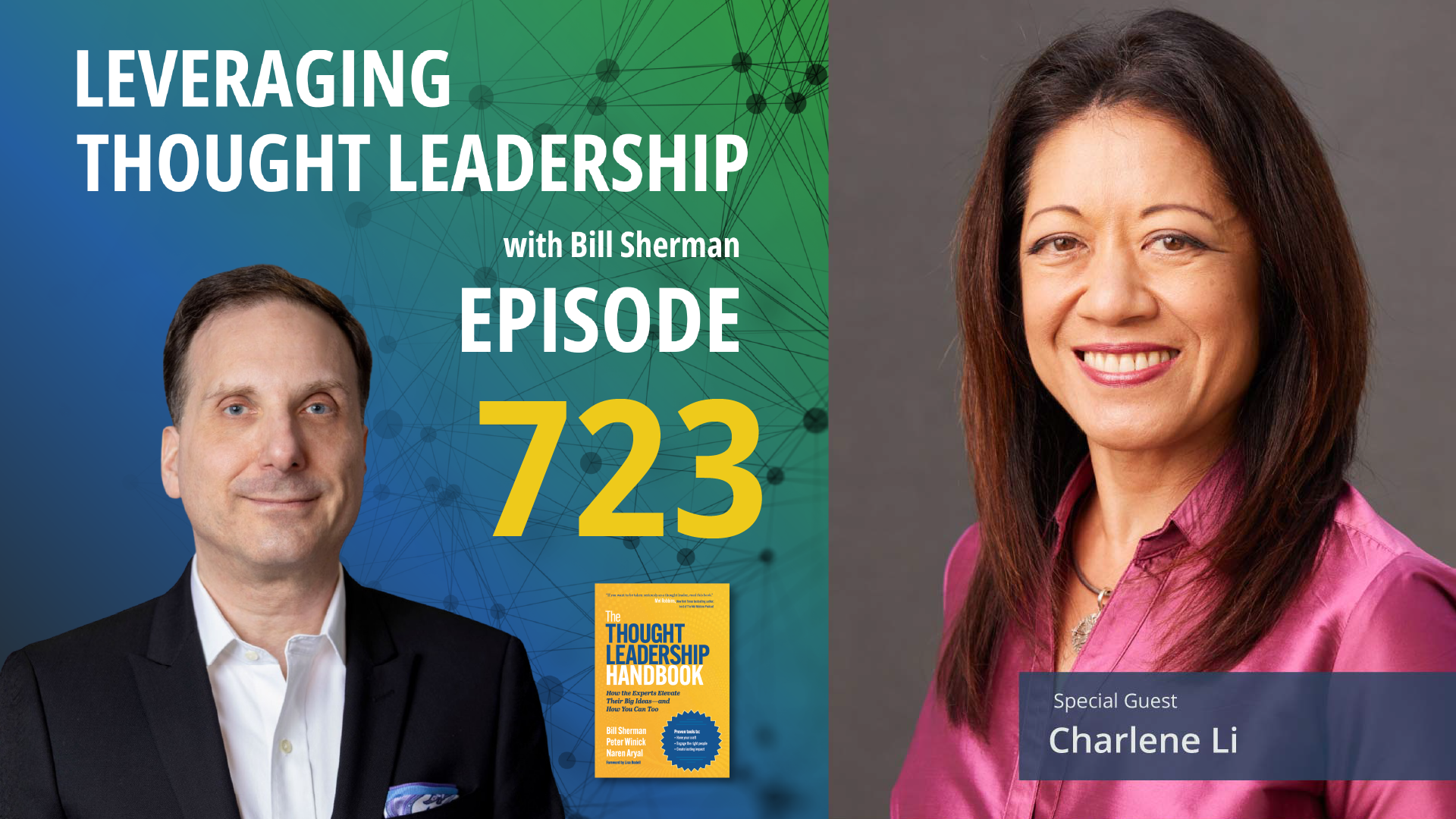



NYT bestselling author Charlene Li on turning AI disruption into strategy and action
This conversation follows one analyst’s journey from writing inside a corporate structure to building an independent voice, exploring co-authorship, the economics of giving ideas away for free, and why decades-old frameworks still hold up.
This episode is a companion to the upcoming Thought Leadership Handbook — part of a series where Bill speaks with exemplars featured in the book about how they actually practice thought leadership.
There are plenty of books explaining what AI is. This one is about the person who decided to write a book that tells you what to do about it instead — and who’s spent 25 years turning disruption into frameworks other people can actually use.
Charlene Li joins Bill Sherman to talk about her new book, Winning with AI, co-written with Katia Walsh, and why this one felt different from her five previous titles. It’s less an explainer, she says, and more a “doing book” — built for a moment when the case studies go stale before the ink dries.
That tension opens into a bigger conversation about how ideas get made and shared. Charlene walks through the origin of Groundswell, the book that made her a New York Times bestseller, written entirely remotely with co-author Josh Bernoff while she was still an in-house analyst at Forrester. She’s candid about what co-authorship actually requires — not just complementary skills, but real trust built over years, disagreements included.
The conversation also digs into a business model question that shaped her career: when she left Forrester to found Altimeter, she gave research away for free, betting that value would come back around. It did — inbound demand from companies who’d read the free work and wanted the deeper conversation. Bill connects this to economist Elinor Ostrom’s works on knowledge commons.
Underneath it all is a simple throughline: frameworks outlast the moment they were built for. The “ladder of engagement” from Groundswell is still taught 18 years later — not because the case studies held up, but because the thinking did. If you’re building a book, a body of research, or a career on ideas that might get overtaken by the next news cycle, this one’s worth your time.
Three Key Takeaways:
- Co-authorship runs on trust, not just talent. Charlene describes working with multiple co-authors over her career and is clear that the deciding factor was never just complementary skill sets — it was years of built trust, the ability to disagree productively, and knowing when to step away from a deadline argument and come back with a clear head.
- Give the idea away first — the business follows. At Altimeter, Charlene made research free when competitors charged for it, building an audience of 100,000+ readers almost overnight. The resulting inbound demand became the foundation of the business, illustrating a “blue ocean” alternative to the traditional pay-for-access analyst model.
- Durable frameworks outlive their case studies. Charlene expects Winning with AI to need a new edition once roughly 20% of its examples go stale — but she draws a distinction between outdated examples and outdated thinking, pointing to Groundswell’s “ladder of engagement,” still taught 18 years after publication.
If you enjoyed hearing Charlene Li unpack the thinking behind Winning with AI, go back to her first appearance on the show — episode 113, recorded back when she was preparing to launch The Disruption Mindset. Both conversations trace the same throughline: how Charlene builds frameworks that outlast the moment they were written for, whether she’s leaving Forrester to found Altimeter or navigating a fast-moving AI landscape years later. Hearing the two together shows how consistent her approach to thought leadership has been across three very different books and two decades of change. Listen to “Leveraging Thought Leadership with Peter Winick — Episode 113” with Charlene Li.
Transcript
Bill Sherman What is thought leadership and how does it work? Why does it matter? I stumbled into this field in the early 2000s, and I’ve been exploring these questions for the last 20 years. This podcast episode is a companion to our new book, The Thought Leadership Handbook. And in this series of episodes, we want to do something a little bit different. We speak with many of the exemplars. Appear in the book, and we have conversations about thought leadership. In today’s episode, I speak with Charlene Li, who published her new book, Winning with AI, in spring of 2026. In this conversation, we talk about practicing thought leadership as an in-house expert at Forrester, where she wrote her first book, Groundswell, with Josh Burnoff. We discuss concepts such as co-authorship, and we explore why she continues to practice thought leadership and the impact she hopes to make. I’m Bill Sherman. You’re listening to Leveraging Thought Leadership. Let’s begin. Welcome to the show, Charlene. Thank you so much for having me. So, I want to ask you a question around you write a book that’s titled Winning with A.F. And you’re in a space where there are a lot of books coming out with AI. But you’ve been looking at technology questions very differently your entire journey. What is it that makes winning with AI stand out?
Charlene Li Well, this book is different because it has a lot of frameworks in it, but it’s also a book about how do you execute on it. And the difficulty is that this is a book being written when everything is changing all the time. And so we wanted to write a book. Our purpose was to write a book how do create value? How do you get started? And my co-author, Katja Welsh, has been a chief AI officer for 15 years. And so it was a great combination of my thinking and writing. Around disruptive technologies and leadership and her practical approaches to things. And so that combination is, it’s a very, very different book than my other ones that were looking at new trends also on these disruptive technologies, but there wasn’t so much pressure to say, okay, so what do you do with it? This time it’s very different. Things are happening so quickly, we felt we needed to give an explanation to people to say this is a doing book. This isn’t just an explaining book.
Bill Sherman So the book came out in March, if I remember right, which means your training was done somewhere in the fall, October.
Charlene Li November 10th, 2025. I don’t know if it taped very well.
Bill Sherman How do you deal with the topic that where the case studies and examples that were true in fall, well summer and fall of 2025 as you’re finalizing the book, we’re now summer of 26. How are you keeping it fresh?
Charlene Li Well, we knew the book would get outdated, and not so much because the frameworks would be outdated, but there would be new case studies. And people were always asking, like, I need more case studies and need more examples. And so our plan was always to update the book, again, with whatever has changed in the technology front and also with brand new, fresh case studies, so our goal is that when 20% of the book needed to change, that’s when we would publish a new edition. So we’re getting close to that already. But the frameworks and the thinking behind them still remain. I recently Had talked to a professor who said I’m still teaching some of the frameworks from your first book grounds. Well, the ladder of engagement was something He goes it’s still really relevant and you know that book was published 18 years ago But the framework and they think again 20 years ago the idea that you could have a two-way conversation with somebody was revolutionary Now it’s so really important to understand how that happens and that framework still has lasted the test of time.
Bill Sherman So let’s stay on Groundswell for a moment, you and Josh Farnoff, who both of us know very well and who has been passionate about books probably more than most anyone else I know in the business book space, right? How did you and josh come together to write Groundswell? You were at Forrester at the time. Did they lean in? Were they encouraging it?
Charlene Li How did the book come to be? Oh, we had worked together for eight years already. And so, I knew Josh, I knew that he always wanted to write a book. And I literally had a book in my belly. I’ve been writing all these reports about social media. I was blogging and I had been blogging for three years by the time I started the book. And I just went, you know, it’s, there’s a book that needs to be written here. This is bigger. This is a much bigger phenomenon, and a social change, and aid. Is a leadership change that was happening. And so we need a book to explain this to people. And so Josh, as it’s a Josh you want to write, he goes, yeah, this is great. He’d been looking for a topic. He wanted to write a book, he was looking for the topic. And then we went to Forrester together and Forrester fortunately said, yes, yes write the book. And they had done other books and so they could see that this could be a really interesting thing for us to work on.
Bill Sherman So the two of you co-authoring and at this point, you’re both in Boston.
Charlene Li He’s in Boston, I’m in San Francisco. We started the book working completely. Okay, yeah. Yeah, so we wrote the entire book completely remote from each other.
Bill Sherman We didn’t see each other once, so we all were crazy about that. Where you’d worked together for eight years, but you also had this sense of distance, right? And you’ve had a number of co-authors through your career.
Charlene Li What makes the co-authoring work? A Tremendous amount of trust. I mean I’ve worked with Josh for eight years I worked with Brian Solis for I think two three years before we wrote our book and my latest co-authored country Well, should I say this is the biggest joyous smile on my face. I have known each other for 25 years We had babies at the same time. We’ve gone through life together. I may were deep dear friends and It was such a privilege to work on the book with her And the trust that’s there, that she can tell me what she’s thinking and I can take it and she knows that and that I can listen with an open heart and that she could accept my experiences too, it’s just, there’s nothing better. So when you can have that exchange, and I’m not saying it’s easy because we disagree on quite a few things and our writing styles, even though we’re trained in the forest, our writing style is different. And so that it’s like, how do you modulate all these things together into a cohesive work? Uh, and I mean, there were times when like, okay, we need to take a break here. It’s just like, go away and then come back, take a deep breath, take a break, especially when you’re on deadline, you know, it’s hard. It’s really hard.
Bill Sherman So if we go through the number of books that you have, as well as different co-authors, different writing styles, like you said, Josh was at Forrester as well, trained in the Forrestar writing style, but you’ve had to adapt not only with different coauthors but you have written inside of Forreste and been an advocate for ideas while still wearing the Forrster hat, You written books while leading Altimeter and being the founder and CEO there, and now you’ve written books in other entities’ relationships and now, you’re continuing to advocate, right? So, what makes it work when you’re working within the context of an organization? What made it work at Forrester? What made it work at Altimeter?
Charlene Li Right again, I think at Forrester it was that they could see that the market was there, but they also trusted us as to senior principal analysts that we knew what we were doing and they, they wanted to support our passion project here. There’s a little book that we wanted to write about social media and they said, well, if you can get a publisher to do this, then great. And our book went to auction and Harvard Business Publishing signed on. And it was a big deal for this book to come out. A really big deal. And it did extremely well at Altimeter.
Bill Sherman Created a Groundswell.
Charlene Li It did, it really did. I mean, it’s, it, I think well into the 150, 180,000 printed copies.
Bill Sherman Were there any moments where marketing or legal said, oh, we’re looking at the manuscript, are you sure you want to say that? Or when you’re out talking, say this instead of that?
Charlene Li Was there tension? No, no. And it’s because they knew that we knew what to talk about. And I had been writing about social media at Forrester. I think the only time it came to be an issue is George Colony said to me once, you know, our company’s based on roles. I mean, market roles and we write to roles. There isn’t a role for social media. And I kind of tongue in cheek said, not yet, George, but there will be. So it’s just new. And You know, his, his objection was that we didn’t fit into any particular deployment yet at the time, but clearly.
Bill Sherman Whose fire for this idea, right?
Charlene Li Exactly. Because we have to have a fire. And I appreciated that his perspective as the CEO of a company that had to make revenues didn’t have this. Uh, and, and so when I left for so shortly after that, because I didn’t fit into these boxes anymore, I didn’t want to be in the constraints of writing to a particular buyer in a department, because, I believe that disruption goes across an entire organization and so I wanted that freedom. So at Altimeter, again, I was a CEO, so I could write any book that I wanted, but it was again, in support of the business. And in particular, I recruited analysts who it was very clear that you are promoting your brand and you’re promoting that company brand and the two are going to live in harmony.
Bill Sherman Was an expectation of the people coming in that they were going to do both. They couldn’t just be a good analyst and sort of hide behind the paywall, right? You were very conscious about how did Altimeter put its ideas out into the world. It was a choice.
Charlene Li Yeah. We, we intentionally gave our research away for free and people thought we were crazy, but it’s very difficult for the traditional players to come after free because they couldn’t do it. Uh, and so we built an audience almost overnight. We had a hundred thousand people reading our reports versus maybe five or 7,000 who would read a Forrester report. I mean, it was just magnitudes of difference. And as a result, we built our entire business on inbound. People call and pick up the phone and say, you just wrote about a major problem we had. You need to get in here. And so we changed and disrupted the way thought leadership worked. And the way that we looked at books is like, if you’ve got a book in you, write it. We just ask that it be in harmony with the work that you’re trying to do as a firm, because our people and our work had to live together and be under one brand.
Bill Sherman Happens when your idea is bigger than your current reach? That’s the question behind the Thought Leadership Handbook. Peter Winnick, Naren Ariel, and myself wrote it to help experts, authors, speakers, and executives understand their thought leadership path and build the systems that help ideas scale. Learn more at thoughtleadershiphandbook.com and pre-order the book at Amazon, Barnes& Noble, Bookshop, or Amplify. And many of the big consultancies for many years had a reputation of we have the smartest people hire us and we’ll show you what’s behind the curtain. What encouraged you to take that sort of step and go, nah, that’s not the way I’m building.
Charlene Li Yeah Well, I said I could fight in this red ocean where there’s just tons of blood and hire a sales force and go after this and get as much vendor money as I could. And I don’t want to sell my soul that way. And, um, and I just, I’m going to go to blue ocean over here where it’s a completely different business model plan, uh, sell only to people who actually needed the help and they would call us because they could see. And we took a design thinking approach, but we spent a third of our research cycle just on defining what the right question was. And so a superficial question up here, everyone else is answering, we’re gonna go a couple layers deeper. Right. What’s the underlying question? And that was the thing that distinguished our research, was that we were hitting these topics and we could go, again, where the traditional analyst firms couldn’t, because they were segmented by existing roles. We were talking about new disruptions that had no roles and it was just disrupting across the entire enterprise. So we were playing a completely different game.
Bill Sherman So if we look at the underpinnings, and I did a fair amount of looking at this in preparation for our book, The Thought Leadership Handbook, because thought leadership exists in a weird space where you can do a TED Talk, which is now then on YouTube and is virtually free as long as you have an internet connection. A book at $30, representing years of your best thinking, again, nominal cost. But if you look at a keynote rate or a day rate for consulting, those are much different numbers. And so the question I asked was, okay, what’s the relationship in the economics? Closest answer I found was Eleanor Ostrom looked at the commons and the tragedy of the commas and specifically she wrote about knowledge as a commons where you can put ideas into the commons and then people can take them out. And so it becomes a both and. You can enrich the world with knowledge and you can also make a good living. And, you know, with her having earned the Nobel in economics seems a good model to me.
Charlene Li Again, I think about thought leadership as this act of creating change in the world. And if you want your leadership, your thought leadership to actually grab people and really inspire them to create that change, then it really has to resonate with them. And I feel like the ideas need to be out there and free. And if it comes back to you, if it then it comes to you if you’re helping people make that change. Inevitably somebody will like I need help making that change I need inspiration to make that change come and give us more of this goodness that’s in this book.
Bill Sherman I was just working my situation, not because my situation is different than everybody else’s, but I want you as a guide. I want your there or explain this to my people or help us craft the strategy that we can execute. You want the deeper, richer conversations. The book is the overture to those conversations. The article is the interview. They’re all opportunities. And I know you’ve done thought leadership in a number of different modalities from everywhere, from the dinners to the talks, to the books. Here’s my question, Charlene, what keeps you going and why do you practice thought leadership and what sparks you?
Charlene Li Yeah, in the end, I do this because of this incredible feeling of aha that people get. I love the aha feeling that somebody goes from a point of confusion and in action to a place of understanding. And then because they understand they can take a decision and make it take action. And that is the most beautiful moment for me that if I could help somebody get to that point of action, because my belief is that. We need disruptors in this world to make the change happen that we want to see. We’re not gonna get there by incrementally changing things. And so my point in doing this leadership is the thought leadership is to inspire people to create change. And if I can explain all this changing complex world of ours and simplify in a way, so that they can take action, then that is very satisfying. My favorite thing to do after a speech is to ask people, you know, they come up to you and say like, oh, that was great. I loved it and everything. Thank you so much, but… And what was your takeaway? It’s such a gift for me to hear like, oh, I got this out of it. And it just lights me up. And it also helps them figure out, well, what am I taking away from this? What am I gonna do with that? So that feeds me, that keeps me going. And again, there’s also the selfish thing. I love ideas and books and thought leadership is a great way for me work through something. So I’ll take a research, I’ll even do like a live stream or write an article. And pick a topic that I don’t know the answer to, just so I can think about it, spend some dedicated time, do research, do some interviews, so that I can like, oh, so that’s how that works.
Bill Sherman The great thing on thought leadership and that diving into ideas is you can find the smartest people on a topic and say, let’s talk. And so whether it’s on AI or I think you’re working on another topic ahead.
Charlene Li Working on yes, I’m working on wisdom like talk about like gnarly topics. What is wisdom and how do we get wiser?
Bill Sherman Oh, but that interview list for the book, if you want to discover, you can be talking to neuroscientists, you can talk to philosophers, various cultures, various religious traditions. The one with your oyster.
Charlene Li And this is the thing, it’s amazing when you call up somebody, I’m working on a book, I’d like to talk to you about your expertise, and amazingly, people say yes. Yeah, we say yes, and so that’s, and I’ve always, people will ask me like, how do I write something original? You know, I don’t have anything original to say it’s all been said, and like, agree. We are standing on the shoulders of giants here. And we’re taking our experiences, our questions, our perspectives. And forming something new out of it. It’s all derivative works, but it becomes something completely different the more you shape it. And this is what I love about that, that whole writing process, that thinking process, is you’re shaping it. You’re putting your own imprint on top of these ideas that have been said a thousand times before, millions of times before. And it comes out different.
Bill Sherman It’s continuing the conversation, advancing the conversation or in some cases, bringing the conversation to people who haven’t had the time to explore or think about it. And if the option or the other alternative is silence and no one’s speaking about the topic, we are all poor for it. Charlene Lee, I wanna thank you for joining us today. It’s been a delightful conversation. Thank you so much for having me.
Bill Sherman Okay, you’ve made it to the end of the episode, and that means you’re probably someone deeply interested in thought leadership. Want to learn even more? Here are three recommendations. First, check out the back catalog of our podcast episodes. There are a lot of great conversations with people at the top of their game in thought leadership, as well as just starting out. Second, subscribe to our newsletter that talks about the business of thought leadership, and finally, feel free to reach out to me. My day job is helping people with big insights take them to scale through the practice of thought leadership. Maybe you’re looking for strategy or maybe you wanna polish up your ideas or even create new products and offerings. I’d love to chat with you. Thanks for listening.
