
Does Your Thought Leadership Have a Core Idea?
The Four Elements of Thought Leadership by Bill Sherman | Art by Renee Hawthorne
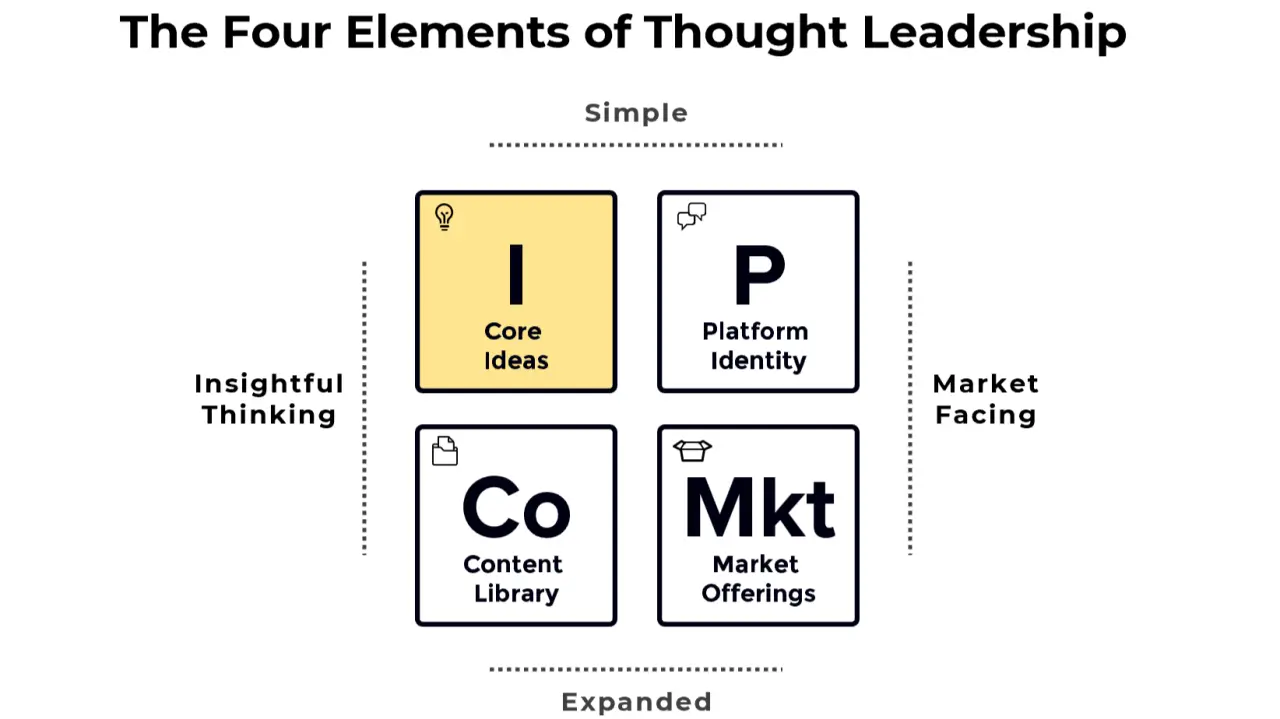
We all have ideas: “let’s go to lunch” is an idea. “Our company has a 10% growth target” is an idea. “I want to study negotiations” is an idea. These everyday ideas keep the world moving. Thought leadership takes a different approach. Instead of many ideas, a thought leader needs a few core ideas that they use to communicate their insights to the world. Core ideas are part of the Four Elements of Thought Leadership framework. Over the past twenty years, I learned to recognize them by working with hundreds of thought leaders and exploring their intellectual libraries.

Core Ideas part of The Four Elements of Thought Leadership by Bill Sherman
What is My Core Idea?
I’ve also learned that many thought leaders struggle to identify their own core ideas. They explain in paragraphs when their core audience needs something simple to latch on to. What is a core idea for thought leadership?
Unlike the everyday ideas above, core ideas have recurring characteristics that make them essential for thought leadership.
- Provocative: designed to break through the noise and earn your target audience’s attention.
- Generous: adds to the conversation and shows a new perspective or proposes a fresh way forward.
- Distinctive: sounds like you (not others) and definitely not like AI.
- Short: fewer than 20 words, making it easy to remember under cognitive load and easy for others to share with friends and colleagues.
How many core ideas do I need for thought leadership?
The minimum number, quite literally is one core idea. If you want to build a thought leadership practice, you probably will need 3-5 core ideas. The good news is that you don’t have to develop all of them at once. You can add them over time and continue to polish them.
What does a core idea look like?
A core idea is the engine that fuels a book’s topic, a keynote presentation, or a workshop program. Here are few examples of core ideas taken from my own work.
- Expertise in a field ≠ expertise in thought leadership skills. However, you can learn.
- You have a duty to speak your imperfect truths. However, you have no right to an audience.
- Why you practice thought leadership is far more revealing than how you practice it (speaking, writing, coaching, consulting, etc.)
You’ll note that each of those core ideas invites a conversation. I’m not trying to prove my claim in twenty words. Instead, I’m signaling to my audience and inviting them to take a look. I’m also giving everyone else (the 99% of the world that doesn’t practice thought leadership permission to scroll past).
How Do You Know Your Core Idea is Reaching Your Audience?
When someone in your target audience reads one of your core ideas, you want them to say, “Wait, what?? I’ve not heard that before. I’m not sure I agree with you. Tell me more.”
Your core idea is an invitation to a conversation. Your core idea does not need to contain all of your nuance and proof.
Why Start with Core Ideas? Aren’t People Going to Want More?
Many thought leadership practitioners try to deliver a full-meal deal. They bundle up their core ideas, supporting proof, and action steps into one massive message. They overwhelm potential new audiences.
You will need support for your core idea: stories, data, examples, case studies, and quotes. Those are essential elements of your thought leadership that live in your content library.
Are My Core Ideas Good Enough?
In twenty years, I’ve heard highly accomplished individuals (Ivy-League b-school professors, F500 CEOs, and world-class experts) ask variants of this question. I’m fairly sure that the smarter you are (and the more you have seen the world), you’re more likely to question what you’re adding to the conversation. If you feel that hesitation about your core ideas, you’re in very good company.
You don’t need your core ideas to be perfectly polished to start practicing thought leadership. Put your ideas out into the world. Listen to how others respond. Do they say “Wait. Tell me more!” Do they ask questions or give a polite nod.
Resist the lure of waiting for a perfect core idea. You find and refine your core ideas by engaging with your target audience. Speak what you know now. The right words will come over time.
How Do I Find My Core Idea(s)?
You look within your work. You survey the existing conversation to see where your beliefs differ from the current focus. You evaluate whether the idea is one you can share hundreds of times and not get worn out.
How Do I Sharpen My Core Idea(s)?
Engage with your audience. Put your ideas into the public square (or at least the part of it where your target audience gathers). Watch carefully for responses–verbal, written, and pay close attention to non-verbal signals. Revise and iterate. Test different language. You can have the right core idea and still need to polish how you explain it.
Where Can I Learn More About Core Ideas?
You’ll find more information about core ideas in our new book, The Thought Leadership Handbook. We also include some of the tools we use every day when we work with thought leaders to help them find and sharpen their core ideas.
