
How to Create a Content Library for Your Thought Leadership
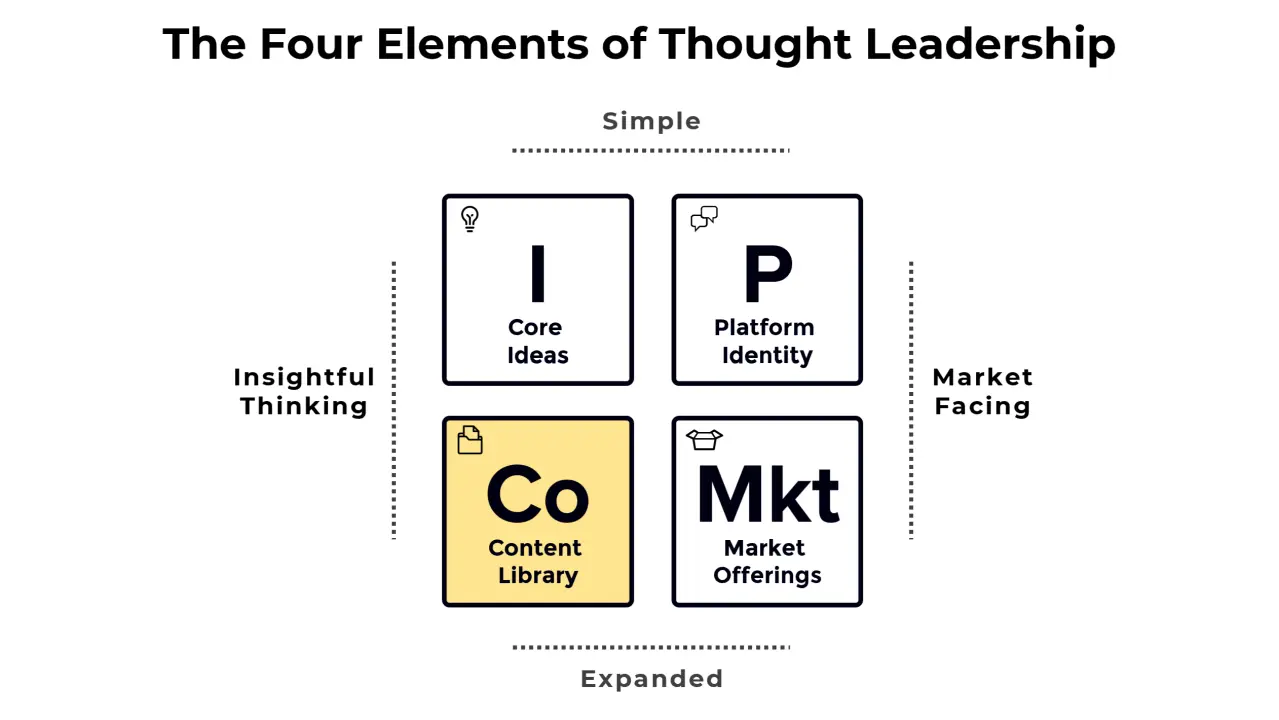
Content Library: The Four Elements of Thought Leadership by Bill Sherman | Art by Renee Hawthorne
“Do you have a content library for your thought leadership? If so, what does it look like.” We’ve asked many hundreds of practicing thought leaders this question.
Some thought leaders send us a beautiful CV. It lists every presentation, article, chapter, and book. They beam with pride at their accomplishments. And they should. However, a CV is not a thought leadership content library.
How to Create Your Content Library by Bill Sherman | Art by Renee Hawthorne
What is a Content Library for Thought Leadership?
A content library is the organized home for your repeatable thought leadership content:
- Stories
- Examples
- Data (your original datasets and 3rd party research)
- Phrases
- Case studies
- Quotes
- Frameworks, models, and processes
All of these assets can be used and reused. One day in a keynote talk. The next day in short-form video. And two months later in a written article. Content in your thought leadership content library should be reusable.
Note, that list doesn’t include finished articles, videos, books, or consulting decks. Don’t confuse the container with the reusable content.
How Does a Content Library Help Me?
It allows you to find the right reusable content for the right audience quickly.
Do I Need a Content Library?
You essentially have three options to keep your content organized:
- Manage everything in your head–easy at the start but gets harder as you accumulate more content.
- Have a folder of work product–decks, articles, outlines, etc. Either search through it or send AI to find things.
- Build a content library–organize content by its relevance to your core ideas.
How Does a Content Library Support Core Ideas?
If you have a few core ideas for your thought leadership, you want your audience to say “that’s interesting, tell me more.”
Your content library becomes the place where you can quickly draw from when someone wants to learn more. It allows you to be much more persuasive when you engage with an audience. You select the right material for the audience. Everything is at your fingertips.
Where Should I Start with My Content Library?
We typically start by asking thought leaders to gather forty pieces of reusable content. Some people tell us they’d never have that much. Others think one-hundred pieces is a ridiculously small fraction of their reusable content.
We’ve found that forty pieces is enough to learn the process, see the value, and also realize how much reusable content is living solely inside your head or in a forgotten file on your hard drive.
How Do I Build a Content Library?
Make a list of reusable content (see the list above). Then, for each piece of content, identify which core ideas it supports.
- Do you have content that supports each core idea?
- Does one core idea have more or less supporting content?
- Do you favor one type of content (see list above) or neglect a certain type? For example, lots of stories but no research data.
How Long Will It Take Me to Create a Content Library?
You can create the first draft of your content library in just a few hours. Then it becomes a living document that you will continue to update over time.
Can I Practice Thought Leadership without a Content Library?
Sure. But it’s going to be a lot harder. If you have a strong content library, you’ll spend less time searching for the right reusable content.
You’ll also be able to ask colleagues (or even AI) to help you craft new assets. If all of the reusable content is undocumented inside your head, it’s much harder to hand off projects to other people.
Where Can I Learn More about Building a Content Library?
You’ll find more information (including stories and case studies) in Chapter 4 of The Thought Leadership Handbook by Bill Sherman, Peter Winick, and Naren Aryal. The book also contains tools to help you stand up your own content library.
This is the second of four articles about the Four Elements of Thought Leadership.
Read the first article about core ideas.
